REVIEW 3 major objections 4 minor 55 references
Axion Searches at the CERN SPS: From Their Dawn to Current Prospects
T0 review · 3 major / 4 minor · reviewed 2026-08-06 · deepseek-v4-flash
Pith's one-line read This review argues that the CERN SPS has become a versatile platform for axion-like particle searches, from Guido Barbiellini's 1982 beam-dump proposal to today's NA64, NA62, FASER and SHiP experiments.
desk verdict A useful mini-review of SPS axion searches, but its tribute framing leans on an unproven claim that Barbiellini directly influenced CHARM. read the letter →
The pith
A machine-rendered reading of the paper's core claim, the machinery that carries it, and where it could break.
The reading
What carries the argument
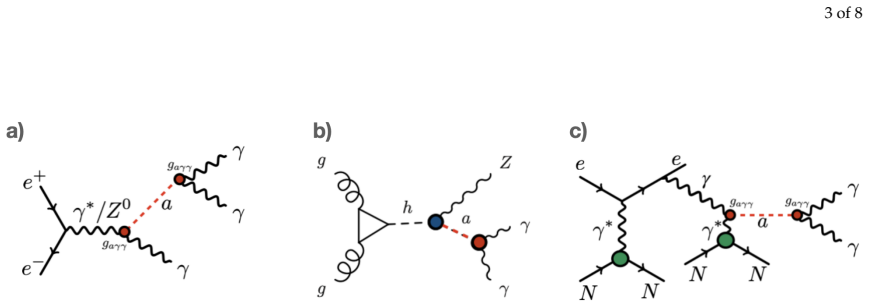
The load-bearing experimental mechanism is the high-intensity beam dump coupled to an instrumented decay volume. In NA64, 100 GeV electrons strike an active electromagnetic calorimeter target, producing ALPs through Primakoff conversion of bremsstrahlung photons in the nuclear field; the experiment then looks for either missing energy, if the ALP escapes the detector, or a displaced vertex from decay $a \to \gamma\gamma$ inside the hadronic calorimeter. In NA62, the mechanism is rare kaon decays such as $K^+ \to \pi^+ a$ with the ALP decaying to leptons, hadrons, or photons. The two signature classes together cover both long-lived and short-lived ALPs.
What would settle it
A search of the CHARM collaboration's 1986 paper and its internal records: if the publication contains no citation to Barbiellini's 1982 workshop report and no correspondence or minutes show awareness of his proposal, then the direct-influence claim is unsupported even though the experimental results would remain valid.
Extended reading notes
Core claim
On the paper's own terms, the central claim is that the SPS has evolved from the site of a single proposed axion beam-dump search into a multi-experiment platform for axion-like particles. Barbiellini's 1982 workshop proposal is presented as the seed of this program, implemented in the CHARM experiment's 1986 limits on long-lived neutral particles decaying into photon or lepton pairs. The modern thread runs through NA64's world-leading limits on the ALP-photon coupling below 100 MeV, NA62's searches for gluon- and fermion-coupled ALPs in rare kaon decays, and the complementary future reach of FASER and SHiP. The paper concludes that the combined SPS effort now explores the ALP parameter space in the MeV-GeV region more thoroughly than any single experiment could.
Load-bearing premise
The historical thread depends on the claim that Barbiellini's 1982 workshop proposal directly influenced the CHARM collaboration's 1986 analysis, a link asserted without citing evidence that CHARM knew of his proposal.
Editorial extensions
If this is right
- NA64's planned dataset of $10^{13}$ electrons on target is roughly a factor of 40 larger than the 2020 ALP analysis and should push sensitivity toward higher ALP masses and lower couplings.
- In the high-coupling region where ALPs decay inside the ECAL and mimic ordinary electromagnetic showers, simply accumulating more statistics gives only marginal improvement, motivating the proposed detector modifications such as a shorter dump and more segmented calorimeters.
- NA62 is already operating in beam-dump mode and expects new ALP results from the full 2021-2026 dataset.
- FASER's first ALP results complement NA64 in the regime of smaller couplings and higher masses, while SHiP, under construction, aims to fill sensitivity gaps at heavier masses and smaller couplings.
- The combined NA64, NA62, FASER and SHiP program is argued to give coherent coverage of the ALP parameter space in the MeV-GeV region at CERN.
Reading between the lines
- If the claimed Barbiellini-to-CHARM influence were confirmed by archival evidence, the intellectual genealogy of beam-dump ALP searches would gain a decade of history; if not, the experimental limits themselves still stand independently of that lineage.
- The same missing-energy and displaced-vertex toolkit that NA64 uses for ALPs could be applied to other feebly interacting beyond-Standard-Model particles, a direction the paper's closing quote about seeking small unorthodox effects implicitly encourages.
- The proposed detector upgrades for the high-coupling QCD axion band could be tested first in simulation and then in a dedicated short-dump run, yielding a concrete near-term check of whether the planned sensitivity gains are realized.
Editorial analysis
A structured set of objections, weighed in public.
Referee Report
Summary. This mini-review traces axion and axion-like-particle (ALP) searches at the CERN SPS, from Guido Barbiellini's 1982 workshop proposal through early beam-dump experiments (E137, E141, E774, CHARM, NuCal, NOMAD) to the current NA62 and NA64 programs and the future FASER and SHiP efforts. It is explicitly framed as a tribute to Barbiellini's scientific legacy. The paper contains no new experimental results or derivations; it summarizes published limits, describes the experimental strategies, and outlines planned upgrades and projections.
Significance. The review is useful as a compact documentary entry point to the SPS-based axion search program, collecting primary references and clearly explaining the two main NA64 search signatures (missing energy and displaced vertices). Its value is primarily historical and pedagogical rather than quantitative, as it does not reanalyze data or derive new limits. The review's emphasis on the continuity from Barbiellini's proposal to current experiments is engaging and gives context to ongoing searches, provided the historical causal links are accurate.
major comments (3)
- [Section 2.2] The sentence 'This proposal directly influenced the CHARM collaboration's later analysis' is asserted without citing any evidence that CHARM knowingly built on Barbiellini's 1982 workshop contribution. The cited CHARM paper [14] is referenced only for the resulting limits, not for the influence, and no archival record or secondary historical source is given. Because the paper's throughline and conclusion ('building on Guido's original insight') rest on this causal claim, it is load-bearing. The claim should either be supported by a direct citation or archival evidence, or softened to state that Barbiellini's proposal was an early and conceptually similar suggestion that preceded the CHARM analysis.
- [Section 2.2] The text states 'In their 1986 publication [14]', but reference [14] is dated 1985 (Phys. Lett. B 157, 458, 1985). This internal inconsistency in the year of the CHARM publication should be corrected, as it appears in the central historical narrative.
- [Section 2.3] The text attributes constraints on eV-scale ALPs to 'NOMAD' and cites reference [21], but that reference is a single-author paper by S.N. Gninenko in Nucl. Phys. B Proc. Suppl. 2000, not a NOMAD collaboration publication. This is a factual attribution error. Either cite the actual NOMAD collaboration paper if one exists, or rephrase to attribute the result to Gninenko's analysis.
minor comments (4)
- [Section 2.2] The sentence 'axions (a) could be produced through proton-nucleus interactions [15]' cites Donnelly et al. (1978), which is a general theoretical paper on axions, not a specific treatment of proton-nucleus production. A more targeted reference for proton-beam-dump production would be appropriate, or the text should be adjusted to match the scope of the cited work.
- [Section 3] The phrase 'setting world-leading limits on the ALP-photon coupling in the mass range below 100 MeV' for the 2020 NA64 result is a strong claim. The limits were competitive and important, but 'world-leading' should be qualified with the specific mass range and compared against contemporaneous constraints (e.g., E137 and NuCal), or softened to 'leading' within the stated mass range.
- [Figure 3] The label 'KSVZ DSVZ' in the legend of Figure 3 is likely a typo for 'KSVZ DFSZ'; the text correctly refers to DFSZ [32] and KSVZ [33] models. The figure should be checked for label accuracy.
- [Section 5] The concluding sentence 'Try to be a little bit heretic (but not too much!)' is a nice tribute, but it is not introduced as a direct quote with quotation marks; adding quotation marks or an explicit 'as Guido put it' would improve clarity.
Circularity Check
No circularity: this is a narrative review that summarises independent external experimental results; no derivation reduces to its own inputs.
full rationale
This paper is a perspective/review article, not a derivation. It makes no theoretical predictions, fits no parameters, and contains no equations whose outputs are equivalent to inputs by construction. The ALP search strategies, limits, and projections it describes (SLAC E137, CHARM, NA64, NA62, FASER, SHiP) are all attributed to external publications with independent results. The one arguable weakness is the unsupported historical assertion in Section 2.2 that Barbiellini's 1982 workshop proposal 'directly influenced the CHARM collaboration's later analysis'; no CHARM paper, acknowledgement, or archival source is cited for that causal link. This is an evidentiary or historical-support concern, not circular reasoning: the review's summary of the experimental results and the current SPS programme does not depend on proving that causal link, and nothing in the paper is derived from or reduced to the influence claim. The article is self-contained against external benchmarks, so the appropriate circularity score is 0.
Assumptions & free parameters
Cite this review
Pith. "Pith review of Axion Searches at the CERN SPS: From Their Dawn to Current Prospects." pith.science (2026). https://pith.science/paper/OTZ5CFFP
@misc{pith2026250718254,
  author       = {Pith},
  title        = {Pith review of: Axion Searches at the CERN SPS: From Their Dawn to Current Prospects},
  year         = {2026},
  howpublished = {\url{https://pith.science/paper/OTZ5CFFP}},
  note         = {Machine review of arXiv:2507.18254}
}
read the original abstract
This mini-review traces the evolution of axion searches at the CERN Super Proton Synchrotron (SPS), beginning with the early proposal by Guido Barbiellini in 1982 and culminating in the recent advances of the NA62 and NA64 experiments. We discuss the experimental strategies employed in early beam dump searches, the current status of axion and axion-like particle (ALPs) searches at the CERN SPS and future directions. This review serves as a tribute to Guido Barbiellini's scientific legacy and his visionary contributions to this field.
Figures


Reference graph
Works this paper leans on
-
[14]
The North Experimental Area at the Cern Super Proton Synchrotron 2021
Banerjee, D.; Bernhard, J.; Brugger, M.; Charitonidis, N.; Doble, N.; Gatignon, L.; Gerbershagen, A. The North Experimental Area at the Cern Super Proton Synchrotron 2021. Dedicated to Giorgio Brianti on the 50th anniversary of his founding the SPS Experimental Areas Group of CERN-Lab II and hence initiating the present Enterprise., https://doi.org/10.171...
-
[21]
Light in the beam dump - ALP production from decay photons in proton beam-dumps
Döbrich, B.; Jaeckel, J.; Spadaro, T. Light in the beam dump - ALP production from decay photons in proton beam-dumps. JHEP 2019, 05, 213, [arXiv:hep-ph/1904.02091]. [Erratum: JHEP 10, 046 (2020)], https://doi.org/10.1007/JHEP05(2019)213
arXiv 2020
-
[1]
Introduction The search for axions and axion-like particles (ALPs) is a very active field trying to address long- standing puzzles in particle physics [1–3]. Originally proposed as a consequence of the Peccei–Quinn mechanism [4] to solve the strong CP problem [5,6], axions are also viable candidates for light, weakly interacting bosons that could account ...
-
[2]
Axion Searches at the CERN SPS: From Their Dawn to Current Prospects
Early Beam Dump Searches for Axion-Like Particles The experimental pursuit of axions and ALPs dates back to the early 1980s, when several beam dump experiments laid the groundwork for future searches. These efforts were instrumental in developing the conceptual and methodological tools that underpin modern investigations. 2.1. SLAC E137: An Electron Beam ...
work page Pith review arXiv 1980
-
[3]
Modern Axion Searches at the CERN SPS: NA62 and NA64 NA64 represents a new generation fixed-target experiment optimised for the search for Dark Sectors [22,23]. It utilises ∼100 GeV electron [ 24], positron [ 25,26], hadron [ 27] and muon [ 28,29] beams from the CERN SPS, which are directed onto an active target consisting of an electromagnetic calorimete...
work page 2020
-
[4]
Future Prospects at CERN NA64 has already recorded an order of magnitude more data compared to the published results, and plans to collect up to 1013 electrons on target after LS3. This represents an increase by a factor ∼40 in statistics compared to the dataset used in the 2020 ALP analysis, which will boost the experiment’s sensitivity towards the unexp...
work page 2020
-
[5]
Try to be a little bit heretical (but not too much!)
Conclusion The search for axions and axion-like particles has evolved into one of the most compelling frontiers in the quest to uncover physics beyond the Standard Model. At CERN, the SPS is continuing to serve as a versatile platform for such searches. More than four decades ago, Guido Barbiellini proposed using the SPS beam dump configuration to investi...
-
[6]
Sikivie, P . Axion Cosmology. Lect. Notes Phys. 2008, 741, 19–50, [astro-ph/0610440]. https://doi.org/10.100 7/978-3-540-73518-2_2
arXiv 2008
Show all 55 references
-
[7]
The Low-Energy Frontier of Particle Physics
Jaeckel, J.; Ringwald, A. The Low-Energy Frontier of Particle Physics. Ann. Rev. Nucl. Part. Sci. 2010, 60, 405–437, [arXiv:hep-ph/1002.0329]. https://doi.org/10.1146/annurev.nucl.012809.104433
2010 arXiv
-
[8]
New experimental approaches in the search for axion-like particles
Irastorza, I.G.; Redondo, J. New experimental approaches in the search for axion-like particles. Progress in Particle and Nuclear Physics 2018, 102, 89–159. https://doi.org/https://doi.org/10.1016/j.ppnp.2018.05.003
2018 doi
-
[9]
CP Conservation in the Presence of Instantons
Peccei, R.D.; Quinn, H.R. CP Conservation in the Presence of Instantons. Phys. Rev. Lett. 1977, 38, 1440–1443. https://doi.org/10.1103/PhysRevLett.38.1440
1977 doi
-
[10]
Problem of Strong P and T Invariance in the Presence of Instantons
Wilczek, F. Problem of Strong P and T Invariance in the Presence of Instantons. Phys. Rev. Lett. 1978, 40, 279–282. https://doi.org/10.1103/PhysRevLett.40.279
1978 doi
-
[11]
A New Light Boson? Phys
Weinberg, S. A New Light Boson? Phys. Rev. Lett. 1978, 40, 223–226. https://doi.org/10.1103/PhysRevLett. 40.223
1978 doi
-
[12]
Axion Dark Matter
Adams, C.B.; et al. Axion Dark Matter. In Proceedings of the Snowmass 2021, 3 2022, [arXiv:hep- ex/2203.14923]
2021 arXiv
-
[13]
Summary Report of the Physics Beyond Colliders Study at CERN 2025
Alemany Fernández, R.; et al. Summary Report of the Physics Beyond Colliders Study at CERN 2025. [arXiv:hep-ex/2505.00947]
2025 arXiv
-
[15]
Closing the gap between beam dump and colliders: ALP searches with NA64
Crivelli, P . Closing the gap between beam dump and colliders: ALP searches with NA64. https://ep-news. web.cern.ch/content/closing-gap-between-beam-dump-and-colliders-alps-searches-na64, 2020
2020
-
[16]
Searching for Light Dark Matter and Dark Sectors with the NA64 experiment at the CERN SPS 2025
Andreev, Y.M.; et al. Searching for Light Dark Matter and Dark Sectors with the NA64 experiment at the CERN SPS 2025. [arXiv:hep-ex/2505.14291]
2025 arXiv
-
[17]
Search for Neutral Metastable Penetrating Particles Produced in the SLAC Beam Dump
Bjorken, J.D.; Ecklund, S.; Nelson, W.R.; Abashian, A.; Church, C.; Lu, B.; Mo, L.W.; Nunamaker, T.A.; Rassmann, P . Search for Neutral Metastable Penetrating Particles Produced in the SLAC Beam Dump. Phys. Rev. D 1988, 38, 3375. https://doi.org/10.1103/PhysRevD.38.3375
1988 doi
-
[18]
Search for Massive Neutrinos, Axions and SUSY Particles at CERN SPS Energies
Barbiellini, G. Search for Massive Neutrinos, Axions and SUSY Particles at CERN SPS Energies. In Proceedings of the Workshop on SPS Fixed Target Physics for the Years 1984–1989, 1982. https://cds.cern. ch/record/147478
1984
-
[19]
Search for Axion Like Particle Production in 400-GeV Proton - Copper Interactions
Bergsma, F.; et al. Search for Axion Like Particle Production in 400-GeV Proton - Copper Interactions. Phys. Lett. B 1985, 157, 458–462. https://doi.org/10.1016/0370-2693(85)90400-9
1985 doi
-
[20]
Do Axions Exist? Phys
Donnelly, T.W.; Freedman, S.J.; Lytel, R.S.; Peccei, R.D.; Schwartz, M. Do Axions Exist? Phys. Rev. D 1978, 18, 1607. https://doi.org/10.1103/PhysRevD.18.1607
1978 doi
-
[22]
A Search for Short Lived Axions in an Electron Beam Dump Experiment
Riordan, E.M.; et al. A Search for Short Lived Axions in an Electron Beam Dump Experiment. Phys. Rev. Lett. 1987, 59, 755. https://doi.org/10.1103/PhysRevLett.59.755
1987 doi
-
[23]
A Search for Shortlived Particles Produced in an Electron Beam Dump
Bross, A.; Crisler, M.; Pordes, S.H.; Volk, J.; Errede, S.; Wrbanek, J. A Search for Shortlived Particles Produced in an Electron Beam Dump. Phys. Rev. Lett. 1991, 67, 2942–2945. https://doi.org/10.1103/PhysRevLett.67.2 942
1991 doi
-
[24]
Mass and Lifetime Limits on New Longlived Particles in 300-GeV/ cπ− Interactions
Badier, J.; et al. Mass and Lifetime Limits on New Longlived Particles in 300-GeV/ cπ− Interactions. Z. Phys. C 1986, 31, 21. https://doi.org/10.1007/BF01559588
1986 doi
-
[25]
Limits on neutral light scalar and pseudoscalar particles in a proton beam dump experiment
Blumlein, J.; et al. Limits on neutral light scalar and pseudoscalar particles in a proton beam dump experiment. Z. Phys. C 1991, 51, 341–350. https://doi.org/10.1007/BF01548556
1991 doi
-
[26]
Search for eV (pseudo)scalar penetrating particles in the SPS neutrino beam
Gninenko, S.N. Search for eV (pseudo)scalar penetrating particles in the SPS neutrino beam. Nucl. Phys. B Proc. Suppl. 2000, 87, 105–107. https://doi.org/10.1016/S0920-5632(00)00646-0
2000 doi
-
[27]
Search for MeV dark photons in a light-shining-through-walls experiment at CERN
Gninenko, S.N. Search for MeV dark photons in a light-shining-through-walls experiment at CERN. Phys. Rev. D 2014, 89, 075008, [arXiv:hep-ph/1308.6521]. https://doi.org/10.1103/PhysRevD.89.075008
2014 arXiv
-
[28]
Missing energy signature from invisible decays of dark photons at the CERN SPS
Gninenko, S.N.; Krasnikov, N.V .; Kirsanov, M.M.; Kirpichnikov, D.V . Missing energy signature from invisible decays of dark photons at the CERN SPS. Phys. Rev. D 2016, 94, 095025, [arXiv:hep-ph/1604.08432]. https://doi.org/10.1103/PhysRevD.94.095025. 7 of 8
2016 arXiv
-
[29]
Search for Light Dark Matter with NA64 at CERN
Andreev, Y.M.; et al. Search for Light Dark Matter with NA64 at CERN. Phys. Rev. Lett. 2023, 131, 161801, [arXiv:hep-ex/2307.02404]. https://doi.org/10.1103/PhysRevLett.131.161801
2023 arXiv
-
[30]
Probing light dark matter with positron beams at NA64.Phys
Andreev, Y.M.; et al. Probing light dark matter with positron beams at NA64.Phys. Rev. D 2024, 109, L031103, [arXiv:hep-ex/2308.15612]. https://doi.org/10.1103/PhysRevD.109.L031103
2024 arXiv
-
[31]
Proof of principle for a light dark matter search with low-energy positron beams at NA64 2025
Andreev, Y.M.; et al. Proof of principle for a light dark matter search with low-energy positron beams at NA64 2025. [arXiv:hep-ex/2502.04053]
2025 arXiv
-
[32]
Dark-Sector Search via Pion-Produced η and η’ Mesons Decaying Invisibly in the NA64h Detector
Andreev, Y.M.; et al. Dark-Sector Search via Pion-Produced η and η’ Mesons Decaying Invisibly in the NA64h Detector. Phys. Rev. Lett. 2024, 133, 121803, [arXiv:hep-ex/2406.01990]. https://doi.org/10.1103/ PhysRevLett.133.121803
2024 arXiv
-
[33]
First Results in the Search for Dark Sectors at NA64 with the CERN SPS High Energy Muon Beam
Andreev, Y.M.; et al. First Results in the Search for Dark Sectors at NA64 with the CERN SPS High Energy Muon Beam. Phys. Rev. Lett. 2024, 132, 211803, [arXiv:hep-ex/2401.01708]. https://doi.org/10.1103/ PhysRevLett.132.211803
2024 arXiv
-
[34]
Shedding light on dark sectors with high-energy muons at the NA64 experiment at the CERN SPS
Andreev, Y.M.; et al. Shedding light on dark sectors with high-energy muons at the NA64 experiment at the CERN SPS. Phys. Rev. D 2024, 110, 112015, [arXiv:hep-ex/2409.10128]. https://doi.org/10.1103/PhysRevD. 110.112015
2024 arXiv
-
[35]
Photoproduction of axionlike particles in the NA64 experiment
Dusaev, R.R.; Kirpichnikov, D.V .; Kirsanov, M.M. Photoproduction of axionlike particles in the NA64 experiment. Phys. Rev. D 2020, 102, 055018, [arXiv:hep-ph/2004.04469]. https://doi.org/10.1103/PhysRevD. 102.055018
2020 arXiv
-
[36]
Search for Axionlike and Scalar Particles with the NA64 Experiment
Banerjee, D.; et al. Search for Axionlike and Scalar Particles with the NA64 Experiment. Phys. Rev. Lett. 2020, 125, 081801, [arXiv:hep-ex/2005.02710]. https://doi.org/10.1103/PhysRevLett.125.081801
2020 arXiv
-
[37]
A Simple Solution to the Strong CP Problem with a Harmless Axion
Dine, M.; Fischler, W.; Srednicki, M. A Simple Solution to the Strong CP Problem with a Harmless Axion. Phys. Lett. B 1981, 104, 199–202. https://doi.org/10.1016/0370-2693(81)90590-6
1981 doi
-
[38]
Weak Interaction Singlet and Strong CP Invariance
Kim, J.E. Weak Interaction Singlet and Strong CP Invariance. Phys. Rev. Lett. 1979, 43, 103. https: //doi.org/10.1103/PhysRevLett.43.103
1979 doi
-
[39]
Review of Particle Physics
Tanabashi, M.; et al. Review of Particle Physics. Phys. Rev. D 2018, 98, 030001. https://doi.org/10.1103/ PhysRevD.98.030001
2018
-
[40]
Constraints on very light axions from cavity experiments
Kim, J.E. Constraints on very light axions from cavity experiments. Phys. Rev. D 1998, 58, 055006, [hep-ph/9802220]. https://doi.org/10.1103/PhysRevD.58.055006
1998 arXiv
-
[41]
Proposal to measure the rare decay K+ → π+νν at the CERN SPS 2005
Anelli, G.; et al. Proposal to measure the rare decay K+ → π+νν at the CERN SPS 2005
2005
-
[42]
The Beam and detector of the NA62 experiment at CERN
Cortina Gil, E.; et al. The Beam and detector of the NA62 experiment at CERN. JINST 2017, 12, P05025, [arXiv:physics.ins-det/1703.08501]. https://doi.org/10.1088/1748-0221/12/05/P05025
2017 arXiv
-
[43]
Physics Beyond Colliders at CERN: Beyond the Standard Model Working Group Report
Beacham, J.; et al. Physics Beyond Colliders at CERN: Beyond the Standard Model Working Group Report. J. Phys. G 2020, 47, 010501, [arXiv:hep-ex/1901.09966]. https://doi.org/10.1088/1361-6471/ab4cd2
2020 arXiv
-
[44]
Search for hadronic decays of feebly-interacting particles at NA62
Cortina Gil, E.; et al. Search for hadronic decays of feebly-interacting particles at NA62. Eur. Phys. J. C 2025, 85, 571, [arXiv:hep-ex/2502.04241]. https://doi.org/10.1140/epjc/s10052-025-14133-w
2025 arXiv
-
[45]
Search forπ0 decays to invisible particles
Cortina Gil, E.; et al. Search forπ0 decays to invisible particles. JHEP 2021, 02, 201, [arXiv:hep-ex/2010.07644]. https://doi.org/10.1007/JHEP02(2021)201
2021 arXiv
-
[46]
Search for a feebly interacting particle X in the decay K+ → π+X
Cortina Gil, E.; et al. Search for a feebly interacting particle X in the decay K+ → π+X. JHEP 2021, 03, 058, [arXiv:hep-ex/2011.11329]. https://doi.org/10.1007/JHEP03(2021)058
2021 arXiv
-
[47]
Measurement of the K+ → π+γγ decay
Cortina Gil, E.; et al. Measurement of the K+ → π+γγ decay. Phys. Lett. B 2024, 850, 138513, [arXiv:hep- ex/2311.01837]. https://doi.org/10.1016/j.physletb.2024.138513
2024 arXiv
-
[48]
Improved limits on a hypothetical X(16.7) boson and a dark photon decaying into e+e− pairs
Banerjee, D.; et al. Improved limits on a hypothetical X(16.7) boson and a dark photon decaying into e+e− pairs. Phys. Rev. D 2020, 101, 071101, [arXiv:hep-ex/1912.11389]. https://doi.org/10.1103/PhysRevD.101.07 1101
2020 arXiv
-
[49]
Hunting down the X17 boson at the CERN SPS
Depero, E.; et al. Hunting down the X17 boson at the CERN SPS. Eur. Phys. J. C 2020, 80, 1159, [arXiv:hep- ex/2009.02756]. https://doi.org/10.1140/epjc/s10052-020-08725-x
2020 arXiv
-
[50]
Probing axion and muon-philic new physics with muon beam dump2025
Li, H.; Liu, Z.; Song, N. Probing axion and muon-philic new physics with muon beam dump2025. [arXiv:hep- ph/2501.06294]
-
[51]
Leptophilic ALPs in Laboratory Experiments 2025
Eberhart, A.; Fedele, M.; Kahlhoefer, F.; Ravensburg, E.; Ziegler, R. Leptophilic ALPs in Laboratory Experiments 2025. [arXiv:hep-ph/2504.05873]
2025
-
[52]
Projection of finalized NA62 beam-dump analyses to the full 2021-2026 statistics 2025
Jerhot, J. Projection of finalized NA62 beam-dump analyses to the full 2021-2026 statistics 2025
2021
-
[53]
Shining light on the dark sector: search for axion-like particles and other new physics in photonic final states with FASER
Mammen Abraham, R.; et al. Shining light on the dark sector: search for axion-like particles and other new physics in photonic final states with FASER. JHEP 2025, 01, 199, [arXiv:hep-ex/2410.10363]. https: //doi.org/10.1007/JHEP01(2025)199. 8 of 8
2025 arXiv
-
[54]
ForwArd Search ExpeRiment at the LHC
Feng, J.L.; Galon, I.; Kling, F.; Trojanowski, S. ForwArd Search ExpeRiment at the LHC. Phys. Rev. D 2018, 97, 035001, [arXiv:hep-ph/1708.09389]. https://doi.org/10.1103/PhysRevD.97.035001
2018 arXiv
-
[55]
The SHiP experiment at the proposed CERN SPS Beam Dump Facility
Ahdida, C.; et al. The SHiP experiment at the proposed CERN SPS Beam Dump Facility. Eur. Phys. J. C 2022, 82, 486, [arXiv:physics.ins-det/2112.01487]. https://doi.org/10.1140/epjc/s10052-022-10346-5
2022 arXiv
Reviewed August 6, 2026 · model on record in the stance chip above.
Discussion (0). Sign in to comment.