REVIEW 5 major objections 6 minor 24 references
Residual Koopman Model Predictive Control for Enhanced Vehicle Dynamics with Small On-Track Data Input
T0 review · 5 major / 6 minor · reviewed 2026-08-06 · deepseek-v4-flash
Pith's one-line read Learned residual correction lets a vehicle controller match data-driven MPC with 20% of the training data.
desk verdict Sensible residual Koopman MPC combination with a real hardware demo, but the headline data-efficiency claim is confounded by a KMPC baseline trained on a different data distribution. read the letter →
The pith
A machine-rendered reading of the paper's core claim, the machinery that carries it, and where it could break.
The reading
What carries the argument
The load-bearing object is the residual Koopman model with neural-network lifting: a two-layer fully connected network maps the vehicle state into a high-dimensional observation space, and a linear state-space model $z_{t+1}=A z_t + B \Delta u_t$, with $C$ mapping back to physical state, is fit by least squares to the residual control $\Delta U = U_r - U_p$. This model is then solved by a second linear MPC whose decision variables are the corrections. The mechanism works because the lifted linear model only needs to represent the mismatch left over by the kinematic baseline, which is why the authors argue the required data volume drops to about one fifth.
What would settle it
Collect two laps of LMPC data on a track, train the residual model, then run RKMPC on a second track with markedly faster corner entry speeds. If lateral error grows beyond the LMPC baseline or the vehicle runs off the track, the residual failed to generalize to unseen states, which would refute the data-efficiency claim.
Extended reading notes
Core claim
On its own terms, the paper's central discovery is that the residual between a linear MPC's prediction and the control input that actually works on the vehicle evolves approximately linearly in a lifted state space, so it can be learned with a small dataset and used as a second MPC's objective. The paper frames the residual as $\Delta U = U_r - U_p$, where $U_p$ is the control predicted by the kinematic-model MPC and $U_r$ is the control needed to match the observed state evolution. A neural network lifts $(x, y, \theta)$ to a high-dimensional state $z$, and least-squares fitting yields $z_{t+1} = A z_t + B \Delta u_t$, whose correction is then added to the baseline. The claim is supported by simulation and by a physical-vehicle experiment, where pure Koopman MPC could not finish a lap while RKMPC finished with lower lateral and heading errors than the baseline.
Load-bearing premise
The learned correction must predict accurately on states and inputs the vehicle encounters during closed-loop driving, even though it was trained on just two laps of data collected under the baseline controller; if the residual model leaves the training distribution, the additive command becomes unreliable, as happened to the pure Koopman controller in the physical experiment.
Editorial extensions
If this is right
- Controllers built this way could be deployed where collecting large datasets is expensive or dangerous, such as racing or inspection vehicles, since two laps of on-track data appear sufficient.
- The two-linear-MPC structure keeps computation in the 1–20 ms range, so it can run on onboard hardware where an NMPC requiring roughly 66 ms peak time cannot.
- Because the baseline linear MPC remains active even if the residual misbehaves, the architecture has a built-in fallback that a purely data-driven Koopman controller lacks.
- The residual formulation generalizes the Koopman idea to any controller with a mechanistic prior, meaning the data-efficiency gain may extend beyond trajectory tracking.
Reading between the lines
- The same residual-Koopman split could be applied to other model-based predictors, such as inertial navigation or motion planning, wherever a physical prior leaves a systematic, state-dependent error.
- A natural next experiment would measure how the residual model's one-step prediction error on a held-out lap grows with data volume, to see whether the 20% figure reflects a true scaling law or just the particular track geometry.
- The paper's comparison to NMPC is simulation-only; a head-to-head physical test at similar computation budgets would clarify whether the residual correction closes the accuracy gap with nonlinear MPC.
Editorial analysis
A structured set of objections, weighed in public.
Referee Report
Summary. The paper proposes Residual Koopman Model Predictive Control (RKMPC), a dual-MPC architecture in which a kinematic-model-based linear MPC (LMPC) provides a baseline control input and a neural-network-based Koopman residual MPC computes a compensating input, with the final command being the sum of the two. The residual model is trained on a small amount of on-track data collected under LMPC closed-loop control, using a local-coordinate transformation to expand the training set. The authors claim that RKMPC requires only about 20% of the training data needed by conventional Koopman MPC (KMPC) while delivering improved tracking performance relative to LMPC. Validation is reported on a Carsim-MATLAB simulation platform and on a 1:10-scale F1TENTH hardware platform, with lateral error reductions of 11.7%-22.1%, heading error reductions of 8.9%-15.8%, and steering-stability improvements of up to 27.6% claimed relative to LMPC.
Significance. If the central claims were firmly established, RKMPC would be a practically valuable contribution: it combines the reliability and interpretability of a mechanistic kinematic baseline with the expressive power of a learned Koopman residual, potentially enabling data-efficient control on real vehicles where collecting large, diverse datasets is expensive. The paper has concrete strengths: the method is clearly described, the authors provide a physical hardware experiment, and the implementation is promised as open source. However, the headline data-efficiency claim (20% of KMPC's data) is currently not well supported because the comparison confounds data quantity with data distribution and dataset construction. The performance numbers are also internally inconsistent, and the experimental tables lack statistical reporting. These issues are central to the paper's contributions, so the manuscript requires substantive revision before the claims can be accepted.
major comments (5)
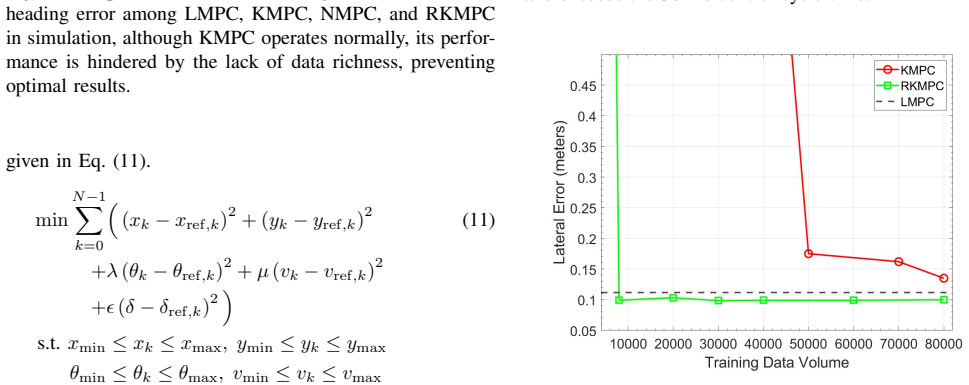
- [Section V and Section VI] The central claim that RKMPC requires only 20% of the training data needed by KMPC is not established because the comparison is confounded. In simulation, KMPC is trained on 50,000 randomly generated trajectory points, while RKMPC is trained on 8,933 task-specific points collected on the target track with LMPC (Section V). In the real experiment, RKMPC uses 1,527 raw points expanded to 22,950 training pairs, and KMPC is stated to be trained on 10 laps of track data (Section VI). No experiment varies the amount or distribution of KMPC's training data while holding other factors fixed. To support the 20% claim, the authors should train KMPC on on-track data of varying sizes (and ideally also vary RKMPC's data size) and report the resulting performance curves, rather than comparing a task-matched small dataset with a large off-distribution dataset.
- [Abstract, Table II, Table III] The performance numbers in the abstract are inconsistent with the tables. The abstract claims lateral error reduction of 11.7%-22.1%, heading error reduction of 8.9%-15.8%, and steering stability improvement of up to 27.6%. Table II reports simulation values of 11.21%, 8.63%, and 27.58%, which round to 11.2%, 8.6%, and 27.6%, not to 11.7% and 8.9%. Table III reports real-world values of 22.08%, 15.82%, and 0.80%. The real-world steering improvement is only 0.80%, so the abstract's "up to 27.6%" is misleading without explicitly indicating that this is the simulation result. The numbers should be corrected and the metric definitions clarified.
- [Tables II and III] The experimental tables report single performance values with no variance, no number of runs, and no statistical significance. This is particularly problematic for the hardware experiments, where the observed improvements could be the result of a single favorable trial. The authors should run multiple laps or trials per controller and report mean ± standard deviation (and ideally confidence intervals or a significance test) to demonstrate that the claimed improvements are reproducible.
- [Section IV-A and Section VI] The data-preprocessing description is ambiguous about what counts as a training data point. Section IV-A defines M = N × Np for the local-coordinate transformation, but Section V reports 8,933 data points for RKMPC without stating the raw count or the conversion ratio, while Section VI states that 1,527 raw points are expanded to 22,950 pairs. The claimed 20% ratio and Figure 8 cannot be verified without a consistent definition of "data point" (raw samples versus transformed training pairs). Please specify raw counts, the point-block size Np, and the conversion ratio for both the simulation and real experiments.
- [Section IV-A, Eq. (10) and Section VI] The residual model is trained on data generated under LMPC closed-loop control (the residual is ΔU = Ur - Up, where Up is the LMPC prediction), but the deployed RKMPC uses the LMPC baseline plus the learned residual, which shifts the closed-loop state distribution. The paper does not analyze whether the residual model remains valid under this distribution shift. The authors themselves attribute KMPC's failure in the real experiment to the state leaving the training data range (Section VI); the same risk applies to the residual model. At minimum, the paper should provide evidence (e.g., prediction-error plots on the RKMPC closed-loop trajectory) that the residual model's predictions remain accurate when used in the combined controller.
minor comments (6)
- [Section III-B, Eq. (4)] The notation for the Koopman operator is nonstandard: the left side should act on the observable (e.g., [Kg](xt) = g(f(xt,ut))), rather than writing Kg(xt) = g ∘ f(xt,ut). Please clarify the definition.
- [Section V] There is a typo: "longger" should be "longer" in the sentence about NMPC's computation time.
- [Section IV-B, Eq. (12)] The constraint label says "Recidual Koopman Model" instead of "Residual Koopman Model." Please fix the typo.
- [Abstract] The GitHub link contains a space: "https://github.com/ZJU-DDRX/Residual Koopman" is not a valid URL. The repository name should be encoded or renamed so that the link is directly accessible.
- [Sections IV-VI] The values of several key hyperparameters are not reported: the MPC cost weights λ, μ, and ε, the Huber loss threshold δ_huber, the prediction horizon N, the point-block size Np, the conversion ratio used in simulation, the neural network hidden widths, and the lifted state dimension n. Please provide these values to enable reproducibility.
- [Table III] The KMPC row in the real experiment reports only computation time and the footnote that it could not complete a full lap. Please clarify how many laps of data were used to train KMPC in the real experiment, and whether the intended comparison is with the 50,000-point simulation training set, since this affects the interpretation of the data-efficiency claim.
Circularity Check
No significant circularity: RKMPC's derivation is a standard residual-learning loop with independent experimental validation; the 20%-data headline is confounded but not circular.
full rationale
The central chain is: LMPC generates a baseline U0; a residual signal ΔU = Ur − Up is formed from LMPC data (Section IV-A, Fig. 4); a neural-network Koopman model (Eqs. (7), (9), (10)) is fit to state-evolution data; and the final command is U_final = U_LMPC + ΔU. Nothing in this chain is an identity between input and output: the residual model is trained on state transitions, not on the final tracking-error numbers, and the reported 11.21%–22.08% lateral-error reductions are measured on closed-loop simulation and on an F1TENTH vehicle, not recovered from the fitting objective. The paper's self-citations ([8], [9], [18]) are background references for MPC and kinematic modeling; none is load-bearing for the claimed result. The main caveat is that the '20% of training data' claim is confounded: KMPC was trained on 50,000 randomly generated off-track points, while RKMPC used 8,933 LMPC on-track points in simulation and 22,950 expanded sets in the real experiment, and KMPC failed to complete a lap there. That is a comparison-validity problem, not a circular reduction. No equation is equivalent to another by construction, and no fitted parameter is renamed as a prediction.
Assumptions & free parameters
free parameters (6)
- MPC cost weights lambda, mu, epsilon =
not reported
- Huber loss threshold delta_huber =
not reported
- Prediction horizon N and point-block size Np =
not reported
- Data conversion ratio =
30% in real experiment
- Lifted-state dimension and network hidden widths =
not reported
- Koopman matrices A, B, C =
learned by least squares
assumptions (4)
- domain assumption Kinematic bicycle model (Eq. 1) adequately describes vehicle motion at the speeds tested.
- ad hoc to paper The residual dynamics between the kinematic model and true vehicle are linearly representable in the lifted neural-network coordinate system (Eq. 10).
- domain assumption Two laps of LMPC-generated on-track data are representative of the state distribution encountered during closed-loop RKMPC operation.
- standard math The least-squares pseudo-inverse in Eq. (7) is well-conditioned for the augmented data matrix.
Cite this review
Pith. "Pith review of Residual Koopman Model Predictive Control for Enhanced Vehicle Dynamics with Small On-Track Data Input." pith.science (2026). https://pith.science/paper/UD6QVJQZ
@misc{pith2026250718396,
  author       = {Pith},
  title        = {Pith review of: Residual Koopman Model Predictive Control for Enhanced Vehicle Dynamics with Small On-Track Data Input},
  year         = {2026},
  howpublished = {\url{https://pith.science/paper/UD6QVJQZ}},
  note         = {Machine review of arXiv:2507.18396}
}
read the original abstract
In vehicle trajectory tracking tasks, the simplest approach is the Pure Pursuit (PP) Control. However, this single-point preview tracking strategy fails to consider vehicle model constraints, compromising driving safety. Model Predictive Control (MPC) as a widely adopted control method, optimizes control actions by incorporating mechanistic models and physical constraints. While its control performance critically depends on the accuracy of vehicle modeling. Traditional vehicle modeling approaches face inherent trade-offs between capturing nonlinear dynamics and maintaining computational efficiency, often resulting in reduced control performance. To address these challenges, this paper proposes Residual Koopman Model Predictive Control (RKMPC) framework. This method uses two linear MPC architecture to calculate control inputs: a Linear Model Predictive Control (LMPC) computes the baseline control input based on the vehicle kinematic model, and a neural network-based RKMPC calculates the compensation input. The final control command is obtained by adding these two components. This design preserves the reliability and interpretability of traditional mechanistic model while achieving performance optimization through residual modeling. This method has been validated on the Carsim-Matlab joint simulation platform and a physical 1:10 scale F1TENTH racing car. Experimental results show that RKMPC requires only 20% of the training data needed by traditional Koopman Model Predictive Control (KMPC) while delivering superior tracking performance. Compared to traditional LMPC, RKMPC reduces lateral error by 11.7%-22.1%, decreases heading error by 8.9%-15.8%, and improves front-wheel steering stability by up to 27.6%. The implementation code is available at: https://github.com/ZJU-DDRX/Residual Koopman.
Figures


Figures from the paper (7 more)




Reference graph
Works this paper leans on
-
[1]
H. Guo, C. Shen, H. Zhang, H. Chen, and R. Jia, “Simultaneous trajectory planning and tracking using an mpc method for cyber- physical systems: A case study of obstacle avoidance for an intelligent vehicle,” IEEE Transactions on Industrial Informatics , vol. 14, no. 9, pp. 4273–4283, 2018
work page 2018
-
[2]
Kinematic and dynamic vehicle models for autonomous driving control design,
J. Kong, M. Pfeiffer, G. Schildbach, and F. Borrelli, “Kinematic and dynamic vehicle models for autonomous driving control design,” in 2015 IEEE intelligent vehicles symposium (IV) . IEEE, 2015, pp. 1094–1099
work page 2015
-
[3]
Linear predictors for nonlinear dynamical systems: Koopman operator meets model predictive control,
M. Korda and I. Mezi ´c, “Linear predictors for nonlinear dynamical systems: Koopman operator meets model predictive control,” Auto- matica, vol. 93, pp. 149–160, 2018
work page 2018
-
[4]
Model predictive control of a vehicle using koopman operator,
V . Cibulka, T. Hani ˇs, M. Korda, and M. Hrom ˇc´ık, “Model predictive control of a vehicle using koopman operator,” IF AC-PapersOnLine, vol. 53, no. 2, pp. 4228–4233, 2020
work page 2020
-
[5]
On robust computation of koopman operator and prediction in random dynamical systems,
S. Sinha, B. Huang, and U. Vaidya, “On robust computation of koopman operator and prediction in random dynamical systems,” Journal of Nonlinear Science , vol. 30, no. 5, pp. 2057–2090, 2020
work page 2020
-
[6]
G. M. Hoffmann, C. J. Tomlin, M. Montemerlo, and S. Thrun, “Autonomous automobile trajectory tracking for off-road driving: Con- troller design, experimental validation and racing,” in 2007 American control conference. IEEE, 2007, pp. 2296–2301
work page 2007
-
[7]
The improved pure pursuit algorithm for autonomous driving advanced system,
W.-J. Wang, T.-M. Hsu, and T.-S. Wu, “The improved pure pursuit algorithm for autonomous driving advanced system,” in 2017 IEEE 10th international workshop on computational intelligence and appli- cations (IWCIA) . IEEE, 2017, pp. 33–38
work page 2017
-
[8]
Z. Li, B. Zhou, C. Hu, L. Xie, and H. Su, “A data-driven aggressive autonomous racing framework utilizing local trajectory planning with velocity prediction,” arXiv preprint arXiv:2410.11570 , 2024
work page Pith review arXiv 2024
Show all 24 references
-
[9]
Combined fast control of drifting state and trajectory tracking for autonomous vehicles based on mpc controller,
C. Hu, X. Zhou, R. Duo, H. Xiong, Y . Qi, Z. Zhang, and L. Xie, “Combined fast control of drifting state and trajectory tracking for autonomous vehicles based on mpc controller,” in 2022 International Conference on Robotics and Automation (ICRA) . IEEE, 2022, pp. 1373–1379
2022
-
[10]
Model predictive control for autonomous vehicle following,
A. Bienemann and H.-J. Wuensche, “Model predictive control for autonomous vehicle following,” in 2023 IEEE Intelligent V ehicles Symposium (IV) . IEEE, 2023, pp. 1–6
2023
-
[11]
A tube-based robust nonlinear predictive control approach to semiautonomous ground vehicles,
Y . Gao, A. Gray, H. E. Tseng, and F. Borrelli, “A tube-based robust nonlinear predictive control approach to semiautonomous ground vehicles,” V ehicle System Dynamics, vol. 52, no. 6, pp. 802–823, 2014
2014
-
[12]
Residual policy learning facilitates efficient model-free autonomous racing,
R. Zhang, J. Hou, G. Chen, Z. Li, J. Chen, and A. Knoll, “Residual policy learning facilitates efficient model-free autonomous racing,” IEEE Robotics and Automation Letters , vol. 7, no. 4, pp. 11 625– 11 632, 2022
2022
-
[13]
Residual policy learning for vehicle control of autonomous racing cars,
R. Trumpp, D. Hoornaert, and M. Caccamo, “Residual policy learning for vehicle control of autonomous racing cars,” in 2023 IEEE Intelli- gent V ehicles Symposium (IV) . IEEE, 2023, pp. 1–6
2023
-
[14]
Physical enhanced residual learning (perl) framework for vehicle trajectory prediction,
K. Long, Z. Sheng, H. Shi, X. Li, S. Chen, and S. Ahn, “Physical enhanced residual learning (perl) framework for vehicle trajectory prediction,” Communications in Transportation Research , vol. 5, p. 100166, 2025
2025
-
[15]
Koop- man invariant subspaces and finite linear representations of nonlinear dynamical systems for control,
S. L. Brunton, B. W. Brunton, J. L. Proctor, and J. N. Kutz, “Koop- man invariant subspaces and finite linear representations of nonlinear dynamical systems for control,” PloS one, vol. 11, no. 2, p. e0150171, 2016
2016
-
[16]
Deep neural networks with koopman operators for modeling and control of autonomous vehicles,
Y . Xiao, X. Zhang, X. Xu, X. Liu, and J. Liu, “Deep neural networks with koopman operators for modeling and control of autonomous vehicles,” IEEE transactions on intelligent vehicles , vol. 8, no. 1, pp. 135–146, 2022
2022
-
[17]
Comparative study of autonomous path- following vehicle control via model predictive control and linear quadratic control,
F. Yakub and Y . Mori, “Comparative study of autonomous path- following vehicle control via model predictive control and linear quadratic control,” Proceedings of the Institution of Mechanical En- gineers, Part D: Journal of automobile engineering , vol. 229, no. 12, pp. 1695–...
2015
-
[18]
Learning to race in extreme turning scene with active exploration and gaus- sian process regression-based mpc,
G. Wu, C. Hu, W. Weng, Z. Li, Y . Fu, L. Xie, and H. Su, “Learning to race in extreme turning scene with active exploration and gaus- sian process regression-based mpc,” arXiv preprint arXiv:2410.05740 , 2024
2024 arXiv
-
[19]
Introduction to the koopman operator in dynamical systems and control theory,
A. Mauroy, Y . Susuki, and I. Mezi ´c, “Introduction to the koopman operator in dynamical systems and control theory,” The koopman operator in systems and control: concepts, methodologies, and ap- plications, pp. 3–33, 2020
2020
-
[20]
Deep koopman data-driven control framework for autonomous racing,
R. Wang, Y . Han, and U. Vaidya, “Deep koopman data-driven control framework for autonomous racing,” in Proc. Int. Conf. Robot. Au- tom.(ICRA) Workshop Opportunities Challenges Auton. Racing , 2021, pp. 1–6
2021
-
[21]
racetrack-database,
T. I. of Automotive Technology, “racetrack-database,” https://github. com/TUMFTM/racetrack-database, 2021
2021
-
[22]
F1tenth: An open-source evaluation environment for continuous control and reinforcement learning,
M. O’Kelly, H. Zheng, D. Karthik, and R. Mangharam, “F1tenth: An open-source evaluation environment for continuous control and reinforcement learning,” Proceedings of Machine Learning Research , vol. 123, 2020
2020
-
[23]
Real-time loop closure in 2d lidar slam,
W. Hess, D. Kohler, H. Rapp, and D. Andor, “Real-time loop closure in 2d lidar slam,” in 2016 IEEE international conference on robotics and automation (ICRA) . IEEE, 2016, pp. 1271–1278
2016
-
[24]
Cddt: Fast approximate 2d ray casting for accelerated localization,
C. H. Walsh and S. Karaman, “Cddt: Fast approximate 2d ray casting for accelerated localization,” in 2018 IEEE International Conference on Robotics and Automation (ICRA) . IEEE, 2018, pp. 3677–3684
2018
Reviewed August 6, 2026 · model on record in the stance chip above.
Discussion (0). Continue with ORCID to comment.