REVIEW 4 major objections 5 minor 60 references
Radiative corrections to the $\rm S, T, U$ parameters and their impact on the $W$ boson mass in the 331 model
T0 review · 4 major / 5 minor · reviewed 2026-08-15 · deepseek-v4-flash
Pith's one-line read The 331 model's S, T, U constraints confine the new-physics scale v3 to 1.5–2.3 TeV and can explain the CDF W-mass shift in that window.
desk verdict Useful SARAH/SPheno scan of S,T,U in the beta=-sqrt(3) 331 model, but the CDF-compatible window implies MZ' ~2.2-2.8 TeV and MV++ ~0.6-0.75 TeV, below published bounds, and the paper's mitigation is qualitative. read the letter →
The pith
A machine-rendered reading of the paper's core claim, the machinery that carries it, and where it could break.
The reading
What carries the argument
The central object is the set of Peskin-Takeuchi oblique parameters S, T, and U, computed from one-loop gauge-boson vacuum-polarization diagrams with the 331 model's additional Higgs bosons running in the loops. The argument is carried by the closed formula $\Delta M_W^2 = \frac{c_w^2 m_Z^2}{c_w^2 - s_w^2}\left(-\frac{S}{2} + c_w^2 T - \frac{c_w^2 - s_w^2}{4 s_w^2} U\right)$, which converts the experimentally allowed region of S, T, U into an allowed shift in the W mass. The paper scans the model inputs—v3, f, the quartic Higgs couplings, and tan $\beta$—and retains only points that keep the light Higgs at 123–127 GeV and satisfy the 3-$\sigma$ S, T, U constraints, mapping which parameter regions survive.
What would settle it
A model-specific recast of published collider searches that excludes a Z' below about 7 TeV or a doubly charged vector boson below about 750 GeV would rule out the central STU window; alternatively, a future high-precision W-mass measurement that settles on the Standard Model value would undercut the claim that the CDF shift is explained in the 1800–2300 GeV window.
Extended reading notes
Core claim
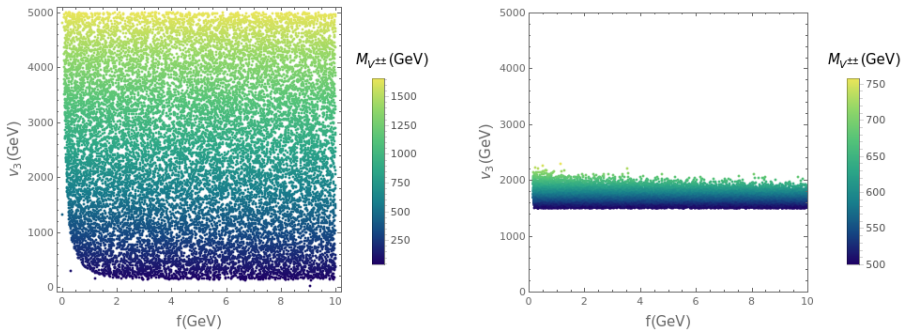
The paper's central claim is that, in the 331 model with beta = -sqrt(3), the Peskin-Takeuchi parameters are dominated by the extended Higgs sector, and their measured values restrict the third triplet vacuum expectation value to 1500 GeV < v3 < 2300 GeV. This translates into upper bounds MZ' < 7000 GeV, MY± < 700 GeV, and MV±± < 700 GeV on the new gauge bosons. Within the narrower slice 1800 GeV < v3 < 2300 GeV, with f < 9 GeV, the one-loop corrections shift the W-boson mass upward enough to match the CDF value 80.4335 ± 0.0094 GeV within 3 sigma. The authors present this as an indirect but sharp constraint on the model's parameter space, not as a proof that the model is the correct explanation of the anomaly.
Load-bearing premise
The load-bearing premise is that the published collider lower bounds on the new neutral and doubly charged gauge bosons can be relaxed by model-dependent uncertainties enough to coexist with the STU-preferred masses, since the quoted doubly charged boson bound sits at face value above the preferred upper limit.
Editorial extensions
If this is right
- The STU-preferred v3 window forces the new gauge bosons into a finite, searchable mass range: Z' below about 7 TeV, Y± below about 700 GeV, and V±± below about 700 GeV.
- Most of the additional Higgs bosons of the model must sit at or below the TeV scale; the region with the heaviest extra scalars is excluded by precision data.
- Explaining the CDF W-mass shift requires the narrower sub-window 1800 GeV < v3 < 2300 GeV together with f < 9 GeV, giving a joint, falsifiable prediction for v3 and f.
- Because the exotic quarks and leptons are set at 800 GeV and do not enter S, T, U at one loop, the precision constraints target the scalar and gauge sectors rather than the new fermions.
- The authors expect the qualitative bounds to transfer to other 331 variants with a similar Higgs sector, making the result a template for a family of models.
Reading between the lines
- A beta = -sqrt(3) recast of existing dilepton and multilepton collider searches is the decisive next test; until it is done, the 1.5–2.3 TeV window remains a precision-data prediction rather than a confirmed region.
- If future W-mass measurements settle near the Standard Model value, the CDF-specific part of the claim becomes moot, but the v3 and f bounds from S, T, U would remain and could still be tested through direct searches for the new gauge bosons and heavy Higgs states.
- The small-f preference suggests a mild fine-tuning in the Higgs potential; independent probes such as precision measurements of the 125 GeV Higgs couplings could test the same region without invoking oblique parameters.
- A natural extension would be to relax the fixed 800 GeV exotic-fermion masses and check whether fermion-loop contributions, currently neglected, shift the allowed v3 window.
Signed reviews
Editorial analysis
A structured set of objections, weighed in public.
Referee Report
Summary. The manuscript computes the Peskin-Takeuchi oblique parameters S, T, and U in the SU(3)_C x SU(3)_L x U(1)_X 331 model with beta = -sqrt(3), using SARAH-generated SPheno code and parameter scans. The authors report that the S, T, U constraints restrict the VEV v3 to the range 1500-2300 GeV, impose upper bounds on the new gauge boson masses (M_Z' < 7000 GeV, M_Y± < 700 GeV, M_V±± < 700 GeV), and favor small values of the trilinear coupling f, with f < 9 GeV. They further claim that the same parameter region (1800 < v3 < 2300 GeV, f < 9 GeV) can produce a shift in the W boson mass consistent with the CDF measurement. The central claim is that the model can simultaneously satisfy electroweak precision constraints and explain the CDF W mass anomaly.
Significance. If the result holds, the paper identifies a concrete region of the 331 parameter space that is consistent with EWPO and can explain the CDF anomaly; the use of SARAH/SPheno and the 125 GeV Higgs mass filter are strengths. However, the claimed parameter region is in tension with published collider bounds that the paper itself quotes, and the mitigation of that tension is not demonstrated with a recast or branching-ratio calculation. The significance therefore depends on an unverified assumption, and the W-mass explanation is conditional on the collider bounds being substantially weaker for this specific model variant.
major comments (4)
- [Sec. 4.4 (Gauge Boson Masses) and Sec. 5 (Conclusions)] The STU-preferred window 1800 < v3 < 2300 GeV, combined with Eq. (15) and Eq. (13) for beta = -sqrt(3), implies M_Z' around 2.2-2.8 TeV and M_V±± around 0.6-0.75 TeV, which are below the published limits quoted in the same section (M_Z' ≳ 4 TeV and M_V±± ≳ 1.3 TeV). The paper's mitigation via 'plausible O(1) variations' in couplings and reduced leptonic branching ratios is not supported by any explicit calculation; no recast for beta = -sqrt(3), no branching-ratio computation, and no production cross-section estimate is provided. Because the W-mass explanation is tied to this specific v3 window, the central claim of the paper is conditional on an unverified assumption. The text acknowledges this in Sec. 4.4, but the abstract and conclusions state the explanation as a demonstrated result without the same caveat.
- [Sec. 4.2 (Input parameters) and Sec. 4.5 (Delta M_W^2)] The conclusion that S, T, U restrict f to values f < 9 GeV is an artifact of the scan range. The input scan is defined as 0 <= f <= 10 GeV, so the finding that 'no points ... are observed for f > 9 GeV' merely means that the top 10% of the chosen interval is excluded; it does not constitute a derived bound on the model parameter f. Since the natural scale of f is expected to be of order v3 (the authors themselves note f is 'typically assumed to be of the same order as v3'), the scan should extend to f values of order TeV to demonstrate a genuine constraint. As written, the bound is a consequence of the chosen input range, not of the physics.
- [Sec. 4.3 (Higgs Boson Masses) and Sec. 4.4 (Gauge Boson Masses)] The 'constraints' on v3 (1500 < v3 < 2300 GeV) are inferred from the absence of scan points in the excluded regions, but the paper provides no information on the number of scan points, the sampling density, or the coverage of the f-v3 plane. Without this information, the apparent bounds could be sampling artifacts rather than robust exclusions. The authors should report scan statistics (e.g., total number of accepted and rejected points, density histograms) or perform a more systematic fit to establish that the excluded regions are truly disfavored and not merely under-sampled.
- [Eq. (15) and Sec. 4.4] There is a numerical inconsistency between the analytic formula Eq. (15) and the stated mass ranges. Using Eq. (15) with beta = -sqrt(3), s_w^2 ≈ 0.223, and g ≈ 0.65, the relation gives M_Z' ≈ 1.0 * v3, so for the scan maximum v3 = 5000 GeV one obtains M_Z' ≈ 5 TeV, not the 'potential range up to 13 TeV' quoted in Sec. 4.4. The paper should clarify whether the 13 TeV value comes from the SPheno mass spectrum, which may include effects beyond the approximate formula, and reconcile the analytic approximation with the numerical output. Currently the reader cannot reproduce the stated mass ranges from the provided formulas.
minor comments (5)
- [Eq. (28)] The right-hand side of Eq. (28) is written as (80.4332 - 80.3572) GeV^2, which is dimensionally inconsistent; it should be (80.4332^2 - 80.3572^2) GeV^2. The numerical values also do not match the quoted M_W^CDF = 80.4335 GeV and M_W^SM = 80.353 GeV in the text. Please correct the equation.
- [Sec. 4.4] The sentence 'the beta = ±1/sqrt(3) bound is expected to be somewhat stronger' is not quantified. Consider citing a specific recast analysis or providing a rough numerical estimate of how much stronger the bound is expected to be for that beta.
- [Abstract and Sec. 5] The abstract states that S, T, U constrain 'most of the scalar masses to lie in the TeV range or below,' but the paper does not quantify 'most' or provide a clear definition of the scalar mass set. Please rephrase to be more precise.
- [Computational Setup] The paper does not provide the SARAH model file or the input parameter card needed to reproduce the SPheno calculation. Making the code available (e.g., in a repository) or describing the model file in an appendix would improve reproducibility.
- [Sec. 4.3] The plots in Figs. 2-12 show the distribution of points but no theory uncertainty from missing higher-order corrections. A brief comment on the expected size of such uncertainties in the S, T, U computation would be helpful for assessing the robustness of the claimed 3-sigma ranges.
Circularity Check
No circularity: STU constraints and W-mass shift are independent uses of external inputs; scan-based bounds are derived, not fitted outputs.
full rationale
The derivation chain is self-contained and non-circular. The paper scans the 331 model parameters (Sec. 4.2), computes the S, T, U parameters from the resulting mass spectrum with SARAH/SPheno, and filters the scan against the external PDG values quoted in Eqs. (24)-(26). It then computes the implied W-boson mass shift from those same computed S, T, U values using the standard oblique relation Eq. (29) and compares the result with the CDF target defined in Sec. 3.2. The CDF W mass is not used as an input in the S, T, U fit, and no parameter is fitted to the W-shift and then renamed a prediction. The gauge-boson mass bounds in Sec. 4.4 are derived, not imposed, from the S, T, U-selected v3 range through Eqs. (13)-(15). The cited previous work, including Refs. [43] and [51], is external prior work and is used only for the model setup and the Landau-pole scan cutoff, not as a load-bearing self-citation or uniqueness argument. The acknowledged collider tension in Sec. 4.4 is a viability limitation for the model window, not a circularity in the derivation. No step reduces to its own input by construction, so the appropriate finding is no significant circularity.
Assumptions & free parameters
free parameters (5)
- v3 (VEV of chi triplet) =
1500-2300 GeV allowed by STU
- f (trilinear in scalar potential) =
< 9 GeV
- lambda_i, lambda_ij, lambda'_ij =
scanned 0-0.5
- tan beta =
scanned 0-60
- new fermion masses =
set to 800 GeV
assumptions (5)
- domain assumption The beta=-sqrt(3) 331 gauge structure and particle content.
- domain assumption The scalar potential form in Eq. (3).
- domain assumption Decoupling limit v3 >> v1,2 for the mass formulas.
- domain assumption Negligible STU contribution from new fermions, Y±, V±±, Z′ except Z-Z' mixing.
- ad hoc to paper The collider bounds can be relaxed with O(1) coupling variations.
Cite this review
Pith. "Pith review of Radiative corrections to the $\rm S, T, U$ parameters and their impact on the $W$ boson mass in the 331 model." pith.science (2026). https://pith.science/paper/RATP7CM4
@misc{pith2026250718527,
  author       = {Pith},
  title        = {Pith review of: Radiative corrections to the $\rm S, T, U$ parameters and their impact on the $W$ boson mass in the 331 model},
  year         = {2026},
  howpublished = {\url{https://pith.science/paper/RATP7CM4}},
  note         = {Machine review of arXiv:2507.18527}
}
abstract
We investigate radiative corrections to electroweak precision observables, specifically the Peskin--Takeuchi parameters $\mathrm{S}$, $\mathrm{T}$, and $\mathrm{U}$, in the $SU(3)_C \times SU(3)_L \times U(1)_X$ (331) model with $\beta = -\sqrt{3}$. Using the SARAH and SPheno packages, we compute the mass spectrum and low-energy observables. We show that these parameters place strong constraints on the model, requiring most of the scalar masses to lie in the TeV range or below, and imposing indirect bounds on the newly predicted gauge bosons. Furthermore, we demonstrate that the model can accommodate the $W$ boson mass anomaly reported by the CDF collaboration, should future measurements confirm its persistence.
Figures


Figures from the paper (9 more)




Reference graph
Works this paper leans on
- [1]
-
[2]
Navas et al
S. Navas et al. [Particle Data Group], Phys. Rev. D 110 (2024) no.3, 030001
2024
- [3]
- [4]
-
[5]
F. Pisano and V. Pleitez, Phys. Rev. D 46 (1992), 410-417 [arXiv:hep-ph/9206242 [hep- ph]]
arXiv 1992
-
[6]
P. H. Frampton, Phys. Rev. Lett. 69 (1992), 2889-2891
work page 1992
-
[7]
R. Foot, O. F. Hernandez, F. Pisano and V. Pleitez, Phys. Rev. D 47 (1993), 4158-4161 [arXiv:hep-ph/9207264 [hep-ph]]
arXiv 1993
- [8]
Show all 60 references
-
[9]
R. Foot, H. N. Long and T. A. Tran, Phys. Rev. D 50 (1994) no.1, R34-R38 [arXiv:hep- ph/9402243 [hep-ph]]
1994
-
[10]
C. A. de Sousa Pires and O. P. Ravinez, Phys. Rev. D 58 (1998), 035008 doi:10.1103/PhysRevD.58.035008 [arXiv:hep-ph/9803409 [hep-ph]]
1998 arXiv
-
[11]
P. V. Dong and H. N. Long, Int. J. Mod. Phys. A 21 (2006), 6677-6692 [arXiv:hep- ph/0507155 [hep-ph]]
2006
-
[12]
H. N. Long and V. T. Van, J. Phys. G 25 (1999), 2319-2324 [arXiv:hep-ph/9909302 [hep-ph]]
1999 arXiv
-
[13]
P. B. Pal, Phys. Rev. D 52 (1995), 1659-1662 [arXiv:hep-ph/9411406 [hep-ph]]
1995 arXiv
-
[14]
A. G. Dias and V. Pleitez, Phys. Rev. D 69 (2004), 077702 doi:10.1103/PhysRevD.69.077702 [arXiv:hep-ph/0308037 [hep-ph]]
2004 arXiv
-
[15]
J. K. Mizukoshi, C. A. de S.Pires, F. S. Queiroz and P. S. Rodrigues da Silva, Phys. Rev. D 83 (2011), 065024 doi:10.1103/PhysRevD.83.065024 [arXiv:1010.4097 [hep-ph]]
2011 arXiv
-
[16]
H. N. Long and N. Q. Lan, EPL 64 (2003), 571 [arXiv:hep-ph/0309038 [hep-ph]]
2003 arXiv
-
[17]
M. J. Neves, Mod. Phys. Lett. A 36 (2021) no.09, 2150057 [arXiv:2103.01999 [hep-ph]]
2021 arXiv
-
[18]
A. J. Buras, F. De Fazio and J. Girrbach-Noe, JHEP 08 (2014), 039 [arXiv:1405.3850 [hep-ph]]
2014 arXiv
-
[19]
Oliveira and C
V. Oliveira and C. A. d. S. Pires, J. Phys. G 50 (2023) no.11, 115002 doi:10.1088/1361- 6471/acf1b7 [arXiv:2208.00420 [hep-ph]]. 17
2023 arXiv
-
[20]
Escalona, J
P. Escalona, J. P. Pinheiro, A. Doff and C. A. de S. Pires, JHEP 07 (2025), 105 doi:10.1007/JHEP07(2025)105 [arXiv:2503.14653 [hep-ph]]
2025 arXiv
-
[21]
M. B. Tully and G. C. Joshi, Phys. Rev. D 64 (2001), 011301 [arXiv:hep-ph/0011172 [hep-ph]]
2001 arXiv
-
[22]
A. Doff, J. P. Pinheiro and C. A. de S. Pires, Phys. Lett. B 863 (2025), 139375 doi:10.1016/j.physletb.2025.139375 [arXiv:2412.15055 [hep-ph]]
2025
-
[23]
V. H. Binh, C. Bonilla, A. E. C´ arcamo Hern´ andez, D. T. Huong, V. K. N., H. N. Long, P. N. Thu and I. Schmidt, Phys. Rev. D 110 (2024) no.7, 075022 doi:10.1103/PhysRevD.110.075022 [arXiv:2404.13373 [hep-ph]]
2024 arXiv
-
[24]
D. T. Huong, P. V. Dong, C. S. Kim and N. T. Thuy, Phys. Rev. D 91 (2015), 055023 [arXiv:1501.00543 [hep-ph]]
2015 arXiv
-
[25]
Van Dong, D
P. Van Dong, D. T. Huong, D. A. Camargo, F. S. Queiroz and J. W. F. Valle, Phys. Rev. D 99 (2019) no.5, 055040 [arXiv:1805.08251 [hep-ph]]
2019 arXiv
-
[26]
P. V. Dong, D. Q. Phong, D. V. Soa and N. C. Thao, Eur. Phys. J. C 78 (2018) no.8, 653 [arXiv:1706.06152 [hep-ph]]
2018 arXiv
-
[27]
J. G. Ferreira, Jr, P. R. D. Pinheiro, C. A. d. S. Pires and P. S. R. da Silva, Phys. Rev. D 84 (2011), 095019 [arXiv:1109.0031 [hep-ph]]
2011 arXiv
-
[28]
P. V. Dong, H. N. Long, D. T. Nhung and D. V. Soa, Phys. Rev. D 73 (2006), 035004 [arXiv:hep-ph/0601046 [hep-ph]]
2006 arXiv
-
[29]
P. V. Dong, N. T. K. Ngan and D. V. Soa, Phys. Rev. D 90 (2014) no.7, 075019 [arXiv:1407.3839 [hep-ph]]
2014 arXiv
-
[30]
R. M. Fonseca and M. Hirsch, JHEP 08 (2016), 003 [arXiv:1606.01109 [hep-ph]]
2016 arXiv
-
[31]
Pleitez and M
V. Pleitez and M. D. Tonasse, Phys. Rev. D 48 (1993), 2353-2355 [arXiv:hep- ph/9301232 [hep-ph]]
1993
-
[32]
P. V. Dong, L. T. Hue, H. N. Long and D. V. Soa, Phys. Rev. D 81 (2010), 053004 [arXiv:1001.4625 [hep-ph]]
2010 arXiv
-
[33]
A. G. Dias, R. Martinez and V. Pleitez, Eur. Phys. J. C 39 (2005), 101-107 doi:10.1140/epjc/s2004-02083-0 [arXiv:hep-ph/0407141 [hep-ph]]
2005 arXiv
-
[34]
A. G. Dias, Phys. Rev. D 71 (2005), 015009 doi:10.1103/PhysRevD.71.015009 [arXiv:hep-ph/0412163 [hep-ph]]
2005 arXiv
-
[35]
Doff and C
A. Doff and C. A. de S. Pires, Nucl. Phys. B 992 (2023), 116254 doi:10.1016/j.nuclphysb.2023.116254 [arXiv:2302.08578 [hep-ph]]
2023
-
[36]
M. E. Peskin and T. Takeuchi, Phys. Rev. Lett. 65 (1990), 964-967
1990
-
[37]
M. E. Peskin and T. Takeuchi, Phys. Rev. D 46 (1992), 381-409 18
1992
-
[38]
Maksymyk, C
I. Maksymyk, C. P. Burgess and D. London, Phys. Rev. D50 (1994), 529-535 [arXiv:hep- ph/9306267 [hep-ph]]
1994
-
[39]
Sasaki, Phys
K. Sasaki, Phys. Lett. B 308 (1993), 297-303
1993
-
[40]
P. H. Frampton and M. Harada, Phys. Rev. D58 (1998), 095013 [arXiv:hep-ph/9711448 [hep-ph]]
1998 arXiv
-
[41]
H. N. Long and T. Inami, Phys. Rev. D 61 (2000), 075002 [arXiv:hep-ph/9902475 [hep-ph]]
2000 arXiv
-
[42]
M. C. Rodriguez, [arXiv:2205.09109 [hep-ph]]
-
[43]
Van Loi and P
D. Van Loi and P. Van Dong, Eur. Phys. J. C 83 (2023) no.1, 56 [arXiv:2206.10100 [hep-ph]]
2023 arXiv
-
[44]
Staub, Comput
F. Staub, Comput. Phys. Commun. 181 (2010), 1077-1086 [arXiv:0909.2863 [hep-ph]]
2010 arXiv
-
[45]
Staub, Comput
F. Staub, Comput. Phys. Commun. 182 (2011), 808-833 [arXiv:1002.0840 [hep-ph]]
2011 arXiv
-
[46]
Staub, Comput
F. Staub, Comput. Phys. Commun. 184 (2013), 1792-1809 [arXiv:1207.0906 [hep-ph]]
2013 arXiv
-
[47]
Staub, Comput
F. Staub, Comput. Phys. Commun. 185, 1773 (2014) [arXiv:1309.7223 [hep-ph]]
2014 arXiv
-
[48]
Staub, Adv
F. Staub, Adv. High Energy Phys. 2015 (2015), 840780 [arXiv:1503.04200 [hep-ph]]
2015 arXiv
-
[49]
Porod, Comput
W. Porod, Comput. Phys. Commun. 153 (2003), 275-315 [arXiv:hep-ph/0301101 [hep- ph]]
2003 arXiv
-
[50]
Staub, T
F. Staub, T. Ohl, W. Porod and C. Speckner, Comput. Phys. Commun. 183 (2012), 2165-2206 [arXiv:1109.5147 [hep-ph]]
2012 arXiv
-
[51]
Q. H. Cao, Y. Liu, K. P. Xie, B. Yan and D. M. Zhang, Phys. Rev. D 93 (2016) no.7, 075030 [arXiv:1512.08441 [hep-ph]]
2016 arXiv
-
[52]
Aad et al
G. Aad et al. [ATLAS], Phys. Lett. B 716 (2012), 1-29 [arXiv:1207.7214 [hep-ex]]
2012 arXiv
-
[53]
Chatrchyan et al
S. Chatrchyan et al. [CMS], Phys. Lett. B 716 (2012), 30-61 [arXiv:1207.7235 [hep-ex]]
2012 arXiv
-
[54]
D. C. Kennedy, B. W. Lynn, C. J. C. Im and R. G. Stuart, Nucl. Phys. B 321 (1989), 83-107
1989
-
[55]
D. C. Kennedy and B. W. Lynn, Nucl. Phys. B 322 (1989), 1-54
1989
-
[56]
de Blas, M
J. de Blas, M. Pierini, L. Reina and L. Silvestrini, Phys. Rev. Lett. 129 (2022) no.27, 271801 [arXiv:2204.04204 [hep-ph]]
2022 arXiv
-
[57]
Amoroso et al
S. Amoroso et al. [LHC-TeV MW Working Group], Eur. Phys. J. C 84 (2024) no.5, 451 [arXiv:2308.09417 [hep-ex]]
2024
-
[58]
Y. A. Coutinho, V. Salustino Guimar˜ aes and A. A. Nepomuceno, Phys. Rev. D 87 (2013) no.11, 115014 doi:10.1103/PhysRevD.87.115014 [arXiv:1304.7907 [hep-ph]]. 19
2013 arXiv
-
[59]
Alves, L
A. Alves, L. Duarte, S. Kovalenko, Y. M. Oviedo-Torres, F. S. Queiroz and Y. S. Vil- lamizar, Phys. Rev. D 106 (2022) no.5, 055027 doi:10.1103/PhysRevD.106.055027 [arXiv:2203.02520 [hep-ph]]
2022 arXiv
-
[60]
Calabrese, A
R. Calabrese, A. O. M. Iorio, S. Morisi, G. Ricciardi and N. Vignaroli, Phys. Rev. D 109 (2024) no.5, 055030 [arXiv:2312.02287 [hep-ph]]. 20
2024 arXiv
Reviewed August 15, 2026 · model on record in the stance chip above.
Discussion (0). Continue with ORCID to comment.