Strong enhancements to superconducting properties of 1D systems from metallic reservoirs
Pith reviewed 2026-05-19 02:19 UTC · model grok-4.3
The pith
A metallic reservoir in a 1D bilayer geometry boosts effective pairing strength and long-range pair-pair coupling, allowing the system to approach superconducting long-range order.
A machine-rendered reading of the paper's core claim, the machinery that carries it, and where it could break.
Core claim
In a 1D bilayer geometry the metallic reservoir layer enhances both the effective pairing strength and the long-range pair-pair coupling that it mediates; these two processes together raise the superconducting susceptibility and the thermal correlation length far above the values found in the isolated pairing layer, bringing the system close to superconducting long-range order.
What carries the argument
Reservoir-mediated boosting, in which the metallic layer simultaneously strengthens local pairing and transmits long-range pair-pair interactions throughout the bilayer.
Load-bearing premise
The metallic reservoir parameters can be tuned independently without introducing disorder or destroying the one-dimensional character of the pairing layer.
What would settle it
Numerical simulations or experiments in which the superconducting susceptibility and correlation length remain short and finite even after the metallic-layer parameters are optimized and the system size is increased.
Figures




read the original abstract
Using a 1D bilayer system comprised of pairing and metallic layers, the present work proves the striking power of reservoir-mediated boosting of superconductivity. Employing many-body numerics on large systems at zero and finite temperature, we unravel the complex processes by which the tuning of the metal parameters can impact the effective pairing strength as well as the long-range pair-pair-coupling mediated by the metal. It is these two processes that in turn can strongly enhance superconducting susceptibility and thermal superconducting correlation length over those of the isolated system. We show that in this way, even a 1D system can come very close to achieving superconducting long-range order.
Editorial analysis
A structured set of objections, weighed in public.
Referee Report
Summary. The manuscript examines a 1D bilayer geometry consisting of a pairing layer coupled to a metallic reservoir layer. Using many-body numerical simulations on large systems at both zero and finite temperature, the authors demonstrate that tuning the metallic reservoir parameters enhances the effective pairing strength and generates long-range pair-pair couplings mediated by the metal. These effects in turn produce substantial increases in superconducting susceptibility and thermal correlation length relative to the isolated pairing system, with the central claim being that such reservoir-mediated boosting can bring a 1D system close to achieving superconducting long-range order.
Significance. If the numerical findings are robust, the work provides quantitative evidence for a reservoir-mediated mechanism that can substantially strengthen superconducting correlations in low-dimensional systems. The large-system numerics at finite temperature offer concrete support for how mediated interactions boost both local pairing and nonlocal pair correlations, which is a strength of the study.
major comments (2)
- [§4 (Numerical Methods)] §4 (Numerical Methods): The central claim rests on many-body numerics for large systems, yet the manuscript provides no explicit convergence data, bond-dimension checks, or error estimates on the reported susceptibility and correlation-length enhancements; without these, the quantitative improvements cannot be verified at the level needed to support the approach to long-range order.
- [Model Hamiltonian and Setup] Model Hamiltonian and Setup: The assumption that metallic-reservoir parameters can be tuned independently while preserving the 1D character of the pairing layer and avoiding disorder at the interface is stated but not tested through additional simulations of interface roughness or disorder; this is load-bearing for the claim that the enhancements survive in realistic realizations.
minor comments (2)
- [Figures] Figure captions should specify the exact system sizes, temperatures, and parameter values used in each panel to allow direct comparison with the text.
- [Abstract] The abstract would be clearer if it explicitly separated the zero-temperature ground-state results from the finite-temperature correlation-length data.
Simulated Author's Rebuttal
We thank the referee for the careful reading of our manuscript and the positive assessment of its significance. We address each major comment below and outline the revisions we will make to strengthen the presentation of our numerical results and model assumptions.
read point-by-point responses
-
Referee: [§4 (Numerical Methods)] §4 (Numerical Methods): The central claim rests on many-body numerics for large systems, yet the manuscript provides no explicit convergence data, bond-dimension checks, or error estimates on the reported susceptibility and correlation-length enhancements; without these, the quantitative improvements cannot be verified at the level needed to support the approach to long-range order.
Authors: We agree that explicit documentation of convergence is essential for supporting the quantitative claims. Although internal checks with system size, bond dimension, and truncation error were performed during the DMRG simulations, these were not reported in the original manuscript. In the revised version we will add a dedicated subsection (or supplementary section) that includes: (i) the bond dimensions employed for the largest systems, (ii) convergence plots of the superconducting susceptibility and correlation length versus bond dimension, and (iii) estimated error bars derived from the discarded weight. This will allow independent verification of the reported enhancements. revision: yes
-
Referee: [Model Hamiltonian and Setup] Model Hamiltonian and Setup: The assumption that metallic-reservoir parameters can be tuned independently while preserving the 1D character of the pairing layer and avoiding disorder at the interface is stated but not tested through additional simulations of interface roughness or disorder; this is load-bearing for the claim that the enhancements survive in realistic realizations.
Authors: The present study is deliberately formulated in the clean, translationally invariant limit to isolate the reservoir-mediated pairing and pair-pair coupling mechanisms. We acknowledge that interface disorder is relevant for experimental realizations. In the revised manuscript we will expand the discussion to include a qualitative analysis of weak disorder effects, drawing on established results for 1D superconductors, and we will explicitly state that our quantitative claims apply to the ideal interface. A full numerical treatment of roughness or strong disorder lies outside the scope of this work but is identified as a natural direction for follow-up studies. revision: partial
Circularity Check
No significant circularity; derivation is self-contained via numerics
full rationale
The paper uses many-body numerics on large 1D bilayer systems at zero and finite temperature to demonstrate reservoir-mediated boosting of effective pairing strength and long-range pair-pair coupling. These enhancements are shown to increase superconducting susceptibility and thermal correlation length relative to the isolated system. No equations or claims reduce by construction to fitted parameters renamed as predictions, self-definitional loops, or load-bearing self-citations whose validity depends on the present work. The numerical setup on large systems provides independent, externally verifiable content against known mediated-interaction mechanisms, rendering the central result self-contained rather than tautological.
Axiom & Free-Parameter Ledger
axioms (1)
- domain assumption The bilayer geometry preserves the essential 1D character while allowing reservoir effects.
Lean theorems connected to this paper
-
IndisputableMonolith/Cost/FunctionalEquationwashburn_uniqueness_aczel unclear?
unclearRelation between the paper passage and the cited Recognition theorem.
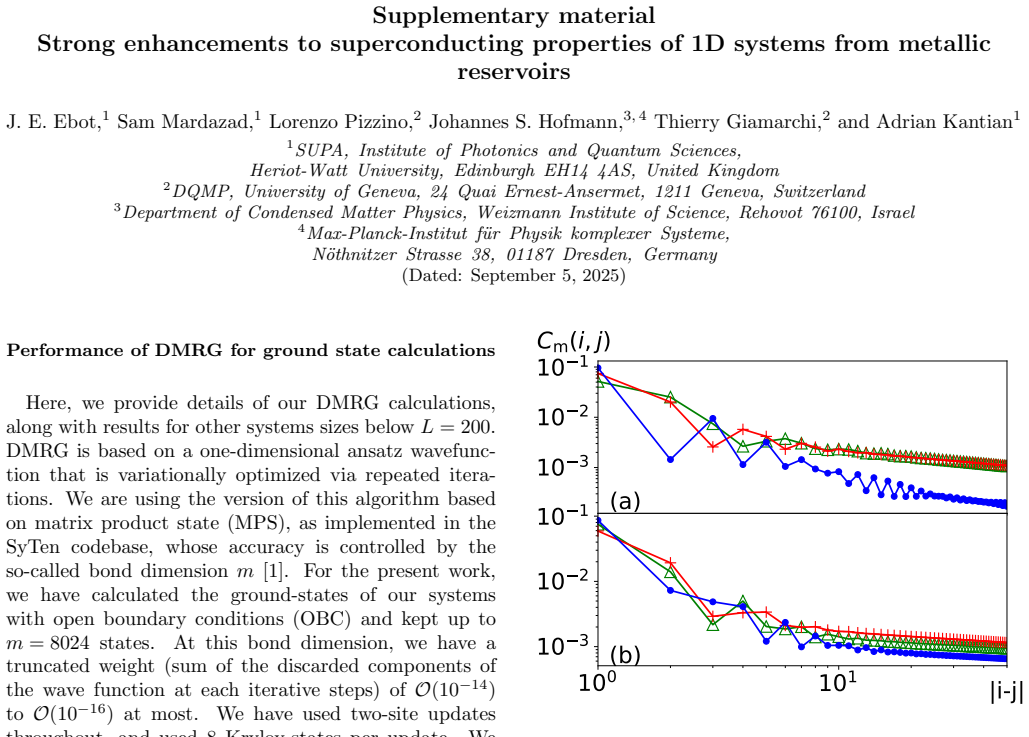
Hamiltonian (1) with t_λ, μ_λ, U, t_⊥; fits C_p(i,j) ~ [π A_C / (ξ sinh(π r/ξ))]^{K^{-1}} and S ~ A exp(-r/ξ)
What do these tags mean?
- matches
- The paper's claim is directly supported by a theorem in the formal canon.
- supports
- The theorem supports part of the paper's argument, but the paper may add assumptions or extra steps.
- extends
- The paper goes beyond the formal theorem; the theorem is a base layer rather than the whole result.
- uses
- The paper appears to rely on the theorem as machinery.
- contradicts
- The paper's claim conflicts with a theorem or certificate in the canon.
- unclear
- Pith found a possible connection, but the passage is too broad, indirect, or ambiguous to say the theorem truly supports the claim.
Reference graph
Works this paper leans on
-
[1]
V. J. Emery and S. A. Kivelson, Importance of phase fluc- tuations in superconductors with small superfluid den- sity, Nature 374, 434 (1995), publisher: Nature Publish- ing Group
work page 1995
-
[2]
S. Kivelson, Making high Tc higher: a theoretical pro- posal, Physica B: Condensed Matter 318, 61 (2002)
work page 2002
-
[3]
E. Berg, D. Orgad, and S. A. Kivelson, Route to high- temperature superconductivity in composite systems, Phys. Rev. B 78, 094509 (2008)
work page 2008
-
[4]
G. Wachtel, A. Bar-Yaacov, and D. Orgad, Superfluid stiffness renormalization and critical temperature en- hancement in a composite superconductor, Phys. Rev. B 86, 134531 (2012)
work page 2012
- [5]
-
[6]
P. M. Dee, S. Johnston, and T. A. Maier, Enhancing T c in a composite superconductor/metal bilayer system: A dynamical cluster approximation study, Physical Review B 105, 214502 (2022)
work page 2022
-
[7]
Optimizing the critical temperature and superfluid density of a metal-superconductor bilayer
Y. Zhang, P. M. Dee, B. Cohen-Stead, T. A. Maier, S. Johnston, and R. Scalettar, Optimizing the Criti- cal Temperature and Superfluid Density of a Metal- Superconductor Bilayer (2025), arXiv:2501.15428 [cond- mat]
-
[8]
O. Yuli, I. Asulin, O. Millo, D. Orgad, L. Iomin, and G. Koren, Enhancement of the superconducting transi- tion temperature of la 2− xsrxcuo4 bilayers: Role of pairing and phase stiffness, Physical Review Letters 101, 057005 (2008)
work page 2008
-
[9]
D. Huang and J. E. Hoffman, Monolayer FeSe on SrTiO 3, Annual Review of Condensed Matter Physics 8, 311 (2017)
work page 2017
-
[10]
A. M. Lobos, A. Iucci, M. M¨ uller, and T. Giamarchi, Dissipation-driven phase transitions in superconducting wires, Phys. Rev. B 80, 214515 (2009)
work page 2009
-
[11]
see also supplementary materials section
-
[13]
F. F. Assaad, M. Bercx, F. Goth, A. G¨ otz, J. S. Hofmann, E. Huffman, Z. Liu, F. P. Toldin, J. S. E. Portela, and 6 J. Schwab, Codebase release 2.0 for ALF (Algorithms for Lattice Fermions), SciPost Phys. Codebases , 1 (2022)
work page 2022
-
[14]
Giamarchi, Quantum Physics in One Dimension (Ox- ford University Press, 2003)
T. Giamarchi, Quantum Physics in One Dimension (Ox- ford University Press, 2003)
work page 2003
-
[15]
E. Gull, A. J. Millis, A. I. Lichtenstein, A. N. Rubtsov, M. Troyer, and P. Werner, Continuous-time Monte Carlo methods for quantum impurity models, Reviews of Mod- ern Physics 83, 349 (2011)
work page 2011
-
[16]
G. Bollmark, T. K¨ ohler, L. Pizzino, Y. Yang, J. S. Hof- mann, H. Shi, S. Zhang, T. Giamarchi, and A. Kan- tian, Solving 2D and 3D Lattice Models of Corre- lated Fermions—Combining Matrix Product States with Mean-Field Theory, Phys. Rev. X 13, 011039 (2023). Supplementary material Strong enhancements to superconducting properties of 1D systems from metal...
work page 2023
-
[17]
Schollw¨ ock, The density-matrix renormalization group in the age of matrix product states, Ann
U. Schollw¨ ock, The density-matrix renormalization group in the age of matrix product states, Ann. Phys. 326, 96 (2011)
work page 2011
-
[18]
F. F. Assaad, M. Bercx, F. Goth, A. G¨ otz, J. S. Hofmann, E. Huffman, Z. Liu, F. P. Toldin, J. S. E. Portela, and J. Schwab, Codebase release 2.0 for ALF (Algorithms for Lattice Fermions), SciPost Phys. Codebases , 1 (2022)
work page 2022
discussion (0)
Sign in with ORCID, Apple, or X to comment. Anyone can read and Pith papers without signing in.