Non-perturbative switching rates in bistable open quantum systems: from driven Kerr oscillators to dissipative cat qubits
Pith reviewed 2026-05-19 02:29 UTC · model grok-4.3
The pith
Path integral techniques predict non-perturbative switching rates in bistable open quantum systems with hidden time-reversal symmetry.
A machine-rendered reading of the paper's core claim, the machinery that carries it, and where it could break.
Core claim
We use path integral techniques to predict the switching rate in a single-mode bistable open quantum system. While analytical expressions are well-known for systems subject to Gaussian noise obeying classical detailed balance, we generalize this approach to quantum systems satisfying hidden time-reversal symmetry. In particular, we deliver precise estimates of bit-flip error rates in cat-qubit architectures, circumventing the need for costly numerical simulations.
What carries the argument
Path integral formulation generalized via hidden time-reversal symmetry for calculating switching rates in bistable open quantum systems.
If this is right
- Precise bit-flip error rates can be estimated analytically for cat qubits.
- Costly numerical simulations are no longer necessary for these estimates.
- The method applies to driven Kerr oscillators and dissipative cat qubits.
- New avenues open for studying switching in multistable single- and many-body open quantum systems.
Where Pith is reading between the lines
- Designers of quantum error-corrected hardware could use this to quickly assess error rates for different parameters.
- The technique might extend to other open quantum systems beyond single-mode bistable ones.
- Connections could be made to classical stochastic processes for hybrid quantum-classical models.
Load-bearing premise
The open quantum systems satisfy the hidden time-reversal symmetry.
What would settle it
Direct numerical simulation of the switching rate for a specific set of parameters in a driven Kerr oscillator and comparison to the analytical prediction from the path integral method.
Figures
read the original abstract
In this work, we use path integral techniques to predict the switching rate in a single-mode bistable open quantum system. While analytical expressions are well-known to be accessible for systems subject to Gaussian noise obeying classical detailed balance, we generalize this approach to a class of quantum systems, those which satisfy the recently-introduced hidden time-reversal symmetry [1]. In particular, in the context of quantum computing, we deliver precise estimates of bit-flip error rates in cat-qubit architectures, circumventing the need for costly numerical simulations. Our results open new avenues for exploring switching phenomena in multistable single- and many-body open quantum systems.
Editorial analysis
A structured set of objections, weighed in public.
Referee Report
Summary. The paper uses path-integral techniques to derive non-perturbative switching rates for bistable open quantum systems obeying a hidden time-reversal symmetry (Ref. [1]). It generalizes classical results for systems with Gaussian noise and detailed balance, then applies the formalism to driven Kerr oscillators and dissipative cat qubits to obtain analytical estimates of bit-flip error rates that avoid direct numerical simulation of the master equation.
Significance. If the symmetry condition holds exactly for the two-photon-driven, Kerr-nonlinear, two-photon-loss dynamics, the approach would supply a practical analytical route to bit-flip rates in cat-qubit architectures and more generally to switching phenomena in multistable open quantum systems, reducing dependence on expensive numerics.
major comments (2)
- [Theory section (application to cat-qubit master equation)] The central claim rests on the assertion that the Lindblad master equation for the driven dissipative Kerr oscillator (two-photon drive, Kerr term, and two-photon loss) satisfies the hidden time-reversal symmetry of Ref. [1]. No explicit verification is provided—e.g., no demonstration that the effective action or noise kernel obeys the required conjugation property under the symmetry transformation. This verification is load-bearing for the exactness of the resulting rate formula and for the claim that numerical simulations can be bypassed.
- [Results section on dissipative cat qubits] The manuscript states that the path-integral reduction yields precise bit-flip rates, yet supplies neither error estimates nor direct comparisons against exact diagonalization or quantum-trajectory numerics for any parameter regime of the cat-qubit model. Without such benchmarks, the quantitative accuracy of the non-perturbative expressions cannot be assessed.
minor comments (1)
- [Abstract] The abstract refers to 'systems subject to Gaussian noise obeying classical detailed balance' without briefly indicating how the hidden symmetry extends this property to the quantum Lindblad setting.
Simulated Author's Rebuttal
We thank the referee for their careful reading of our manuscript and for the constructive comments, which help clarify the presentation of our results. We address each major point below and indicate the revisions we will make to strengthen the manuscript.
read point-by-point responses
-
Referee: [Theory section (application to cat-qubit master equation)] The central claim rests on the assertion that the Lindblad master equation for the driven dissipative Kerr oscillator (two-photon drive, Kerr term, and two-photon loss) satisfies the hidden time-reversal symmetry of Ref. [1]. No explicit verification is provided—e.g., no demonstration that the effective action or noise kernel obeys the required conjugation property under the symmetry transformation. This verification is load-bearing for the exactness of the resulting rate formula and for the claim that numerical simulations can be bypassed.
Authors: We agree that an explicit verification of the hidden time-reversal symmetry for the specific cat-qubit master equation would make the application of the general formalism more transparent and self-contained. In the revised manuscript we add a short subsection (new Sec. III.C) that performs this check directly: we construct the effective action from the two-photon drive, Kerr nonlinearity, and two-photon loss terms, compute the associated noise kernel, and verify that it satisfies the conjugation property required by the symmetry condition of Ref. [1]. This confirms that the non-perturbative rate formula applies exactly, without additional approximations beyond those already stated in the general theory. revision: yes
-
Referee: [Results section on dissipative cat qubits] The manuscript states that the path-integral reduction yields precise bit-flip rates, yet supplies neither error estimates nor direct comparisons against exact diagonalization or quantum-trajectory numerics for any parameter regime of the cat-qubit model. Without such benchmarks, the quantitative accuracy of the non-perturbative expressions cannot be assessed.
Authors: We acknowledge that direct numerical benchmarks are essential for assessing the practical accuracy of the analytic expressions. In the revised manuscript we include a new subsection (Sec. V.C) together with an additional figure that compares the path-integral bit-flip rates against (i) exact diagonalization of the Lindblad master equation for cat sizes up to 8 photons and (ii) quantum-trajectory Monte Carlo simulations for larger photon numbers. The comparisons are performed across a range of two-photon drive and loss strengths relevant to current cat-qubit experiments. We also add a brief discussion of the error budget, including the contribution from the saddle-point approximation and from truncation of the coherent-state path integral. These benchmarks show agreement to within a few percent in the regime where the hidden time-reversal symmetry is well satisfied. revision: yes
Circularity Check
No significant circularity: derivation applies external symmetry to obtain rates
full rationale
The paper's central derivation generalizes classical path-integral instanton methods to open quantum systems obeying the hidden time-reversal symmetry introduced in reference [1], then applies the resulting non-perturbative rate formula to the driven dissipative Kerr oscillator (cat-qubit) master equation. No step equates the output switching rate to a fitted parameter or input by construction, nor renames a known result, nor reduces the final expression to a self-citation chain whose validity is presupposed inside the present work. The symmetry is treated as an external assumption whose applicability to the specific Lindblad operators is asserted rather than re-derived here; this is a modeling choice, not a definitional loop. The manuscript therefore remains self-contained against external benchmarks once the symmetry is granted.
Axiom & Free-Parameter Ledger
axioms (1)
- domain assumption The bistable open quantum systems satisfy the hidden time-reversal symmetry of reference [1].
Lean theorems connected to this paper
-
IndisputableMonolith/Foundation/ArrowOfTime.leanarrow_from_z unclear?
unclearRelation between the paper passage and the cited Recognition theorem.
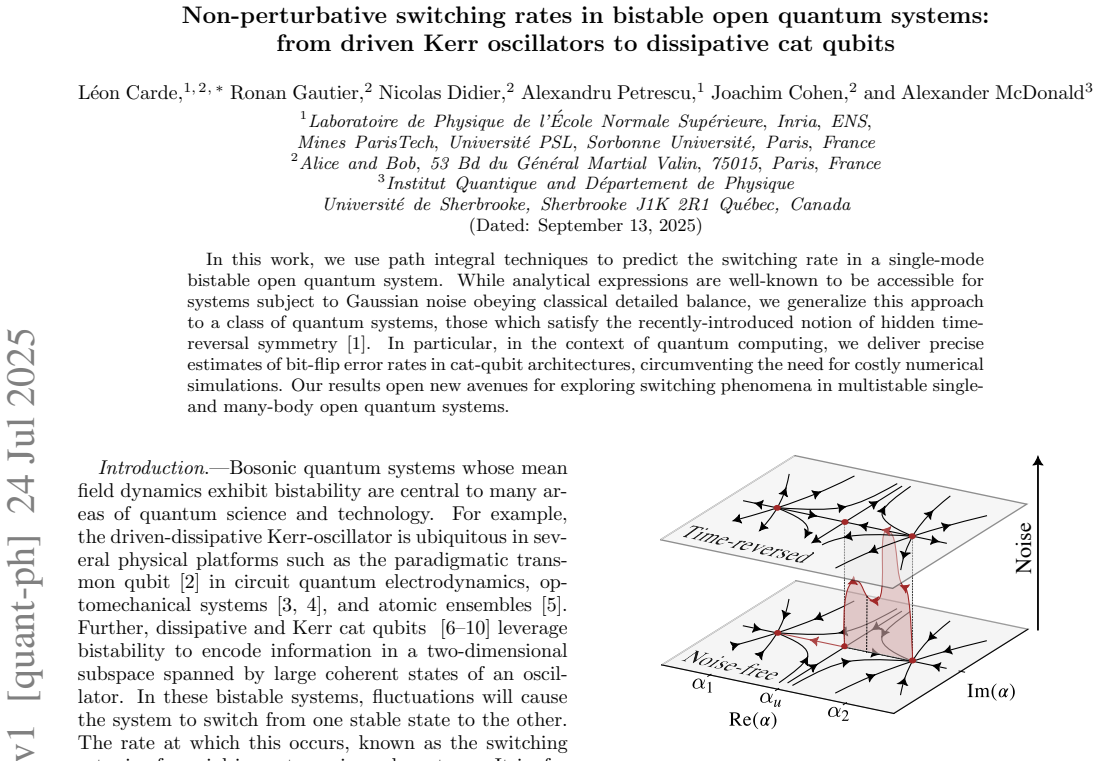
we generalize this approach to a class of quantum systems, those which satisfy the recently-introduced hidden time-reversal symmetry [1]... the switching rates... are controlled by the time-reversed noise-free paths
-
IndisputableMonolith/Cost/FunctionalEquation.leanwashburn_uniqueness_aczel unclear?
unclearRelation between the paper passage and the cited Recognition theorem.
Φ(z) is determined by the steady-state potential function of the complex-P representation, whose corresponding Fokker-Planck equation is known to obey detailed balance
What do these tags mean?
- matches
- The paper's claim is directly supported by a theorem in the formal canon.
- supports
- The theorem supports part of the paper's argument, but the paper may add assumptions or extra steps.
- extends
- The paper goes beyond the formal theorem; the theorem is a base layer rather than the whole result.
- uses
- The paper appears to rely on the theorem as machinery.
- contradicts
- The paper's claim conflicts with a theorem or certificate in the canon.
- unclear
- Pith found a possible connection, but the passage is too broad, indirect, or ambiguous to say the theorem truly supports the claim.
Reference graph
Works this paper leans on
- [1]
-
[2]
J. Koch, T. M. Yu, J. Gambetta, A. A. Houck, D. I. Schuster, J. Majer, A. Blais, M. H. Devoret, S. M. Girvin, and R. J. Schoelkopf, Phys. Rev. A76, 042319 (2007)
work page 2007
-
[3]
S. Bose, K. Jacobs, and P. L. Knight, Phys. Rev. A56, 4175 (1997)
work page 1997
- [4]
- [5]
-
[6]
M. Mirrahimi, Z. Leghtas, V. V. Albert, S. Touzard, R. J. Schoelkopf, L. Jiang, and M. H. Devoret, New J. Phys. 16, 045014 (2014)
work page 2014
-
[7]
Z. Leghtas, S. Touzard, I. M. Pop, A. Kou, B. Vlastakis, A. Petrenko, K. M. Sliwa, A. Narla, S. Shankar, M. J. Ha- tridge, M. Reagor, L. Frunzio, R. J. Schoelkopf, M. Mir- rahimi, and M. H. Devoret, Science347, 853 (2015)
work page 2015
-
[8]
R. Lescanne, M. Villiers, T. Peronnin, A. Sarlette, M. Delbecq, B. Huard, T. Kontos, M. Mirrahimi, and Z. Leghtas, Nat. Phys.16, 509 (2020)
work page 2020
-
[9]
S. Puri, S. Boutin, and A. Blais, npj Quantum Inf3, 18 (2017)
work page 2017
- [10]
-
[11]
I. Siddiqi, R. Vijay, F. Pierre, C. M. Wilson, M. Metcalfe, C. Rigetti, L. Frunzio, and M. H. Devoret, Phys. Rev. Lett.93, 207002 (2004)
work page 2004
-
[12]
P. R. Muppalla, O. Gargiulo, S. I. Mirzaei, B. P. Venkatesh, M. L. Juan, L. Gr¨ unhaupt, I. M. Pop, and G. Kirchmair, Phys. Rev. B97, 024518 (2018)
work page 2018
-
[13]
C. K. Andersen, A. Kamal, N. A. Masluk, I. M. Pop, A. Blais, and M. H. Devoret, Phys. Rev. Appl.13, 044017 (2020)
work page 2020
-
[14]
M. Dykman,Fluctuating nonlinear oscillators: from nanomechanics to quantum superconducting circuits(Ox- ford University Press, 2012)
work page 2012
-
[15]
U. R´ eglade, A. Bocquet, R. Gautier, J. Cohen, A. Marquet, E. Albertinale, N. Pankratova, M. Hall´ en, F. Rautschke, L. A. Sellem, P. Rouchon, A. Sarlette, M. Mirrahimi, P. Campagne-Ibarcq, R. Lescanne, S. Je- zouin, and Z. Leghtas, Nature629, 778 (2024)
work page 2024
-
[16]
A. Marquet, A. Essig, J. Cohen, N. Cottet, A. Murani, E. Albertinale, S. Dupouy, A. Bienfait, T. Peronnin, S. Jezouin, R. Lescanne, and B. Huard, Phys. Rev. X 14, 021019 (2024)
work page 2024
- [17]
-
[18]
H. Putterman, K. Noh, C. T. Hann, G. S. MacCabe, S. Aghaeimeibodi, R. N. Patel, M. Lee, W. M. Jones, H. Moradinejad, R. Rodriguez,et al., Nature638, 927 (2025)
work page 2025
-
[19]
J. Guillaud and M. Mirrahimi, Physical Review X9, 10.1103/physrevx.9.041053 (2019)
-
[20]
S. Puri, L. St-Jean, J. A. Gross, A. Grimm, N. E. Frattini, P. S. Iyer, A. Krishna, S. Touzard, L. Jiang, A. Blais, S. T. Flammia, and S. M. Girvin, Science Advances6, eaay5901 (2020), https://www.science.org/doi/pdf/10.1126/sciadv.aay5901
-
[21]
A. S. Darmawan, B. J. Brown, A. L. Grimsmo, D. K. Tuckett, and S. Puri, PRX Quantum2, 030345 (2021)
work page 2021
-
[22]
C. Chamberland, K. Noh, P. Arrangoiz-Arriola, E. T. Campbell, C. T. Hann, J. Iverson, H. Putterman, T. C. Bohdanowicz, S. T. Flammia, A. Keller, G. Refael, J. Preskill, L. Jiang, A. H. Safavi-Naeini, O. Painter, and F. G. Brand˜ ao, PRX Quantum3, 010329 (2022)
work page 2022
-
[23]
D. Ruiz, J. Guillaud, A. Leverrier, M. Mirrahimi, and C. Vuillot, Nat. Commun.16, 1040 (2025)
work page 2025
- [24]
- [25]
-
[26]
C.-W. Lee, P. Brookes, K.-S. Park, M. H. Szyma´ nska, and E. Ginossar, Phys. Rev. A112, 012216 (2025)
work page 2025
- [27]
-
[28]
D. K. J. Boneß, W. Belzig, and M. I. Dykman, Phys. Rev. Res.7, 023188 (2025)
work page 2025
-
[29]
Q. Su, R. G. Corti˜ nas, J. Venkatraman, and S. Puri, arXiv 10.48550/arXiv.2501.00209 (2024), 2501.00209
-
[30]
K. S. Dubovitskii, Phys. Rev. A111, 012617 (2025)
work page 2025
-
[31]
F.-M. L. R´ egent and P. Rouchon, in2023 62nd IEEE Conference on Decision and Control (CDC)(2023) pp. 7208–7213
work page 2023
- [32]
-
[33]
M. I. Dykman and V. N. Smelyanskii, Soviet Physics - JETP67(1988)
work page 1988
-
[34]
M. I. Dykman, Phys. Rev. E75, 011101 (2007)
work page 2007
-
[35]
Z. R. Lin, Y. Nakamura, and M. I. Dykman, Phys. Rev. E92, 022105 (2015)
work page 2015
-
[36]
Kamenev,Field Theory of Non-Equilibrium Systems (Cambridge University Press, 2011)
A. Kamenev,Field Theory of Non-Equilibrium Systems (Cambridge University Press, 2011)
work page 2011
-
[37]
Gardiner,Stochastic Methods(Springer, Berlin, Ger- many, 2009)
C. Gardiner,Stochastic Methods(Springer, Berlin, Ger- many, 2009)
work page 2009
-
[38]
R. S. Maier and D. L. Stein, Phys. Rev. E48, 931 (1993)
work page 1993
-
[39]
N. Bartolo, F. Minganti, W. Casteels, and C. Ciuti, Phys. Rev. A94, 033841 (2016)
work page 2016
- [40]
- [41]
-
[42]
M. Yao, A. Lingenfelter, R. Belyansky, D. Roberts, and A. A. Clerk, Phys. Rev. Lett.134, 130404 (2025)
work page 2025
- [43]
-
[44]
J. Venkatraman, R. G. Corti˜ nas, N. E. Frattini, X. Xiao, and M. H. Devoret, Proc. Natl. Acad. Sci. U.S.A.121, e2311241121 (2024)
work page 2024
-
[45]
C. H. Meaney, H. Nha, T. Duty, and G. J. Milburn, EPJ Quantum Technol.1, 1 (2014)
work page 2014
-
[46]
Supplementary Material
-
[47]
D. K. J. Boneß, W. Belzig, and M. I. Dykman, Phys. Rev. Res.6, 033240 (2024)
work page 2024
- [48]
-
[49]
L. M. Sieberer, M. Buchhold, and S. Diehl, Rep. Prog. Phys.79, 096001 (2016)
work page 2016
-
[50]
A. Altland and B. D. Simons,Condensed Matter Field Theory, 2nd ed. (Cambridge University Press, 2010)
work page 2010
-
[51]
J.-Y. Ke, Y. Wang, and P. He, J. Cosmol. Astropart. Phys.2025(04), 064
work page 2025
- [52]
-
[53]
A. Lingenfelter, M. Yao, A. Pocklington, Y.-X. Wang, A. Irfan, W. Pfaff, and A. A. Clerk, Phys. Rev. X14, 021028 (2024)
work page 2024
- [54]
-
[55]
M. I. Freidlin and A. D. Wentzell,Random Perturbations of Dynamical Systems(Springer, Berlin, Germany, 2012)
work page 2012
-
[56]
D. F. Walls and G. J. Milburn,Quantum Optics (Springer Nature Switzerland, Cham, Switzerland, 2025)
work page 2025
-
[57]
b c q −bc q # =−D −1A, iSi→j = Z −¯bc q∂tbcl +b c q∂t¯bcl dt, = Z (D−1A)· ∂t
P. D. Drummond and C. W. Gardiner, J. Phys. A: Math. Gen.13, 2353 (1980). SUPPLEMENTARY MATERIAL Non-perturbative switching rates in bistable open quantum systems: from driven Kerr oscillators to dissipative cat qubits L´ eon Carde,1, 2,∗ Ronan Gautier,2 Nicolas Didier,2 Alexandru Petrescu,1 Joachim Cohen,2 and Alexander McDonald3 1Laboratoire de Physique...
work page 1980
discussion (0)
Sign in with ORCID, Apple, or X to comment. Anyone can read and Pith papers without signing in.