REVIEW 4 major objections 5 minor 1 cited by
Simulation-Driven Reinforcement Learning in Queuing Network Routing Optimization
T0 review · 4 major / 5 minor · reviewed 2026-08-06 · deepseek-v4-flash
Pith's one-line read This paper argues that a simulation-trained Dyna-DDPG agent with separate next-state and reward predictors learns queueing-network routing policies that remain effective under single-server disruptions and scale to 100-node networks.
desk verdict A solid engineering artifact with an unsupported core claim: the split-predictor improvement is never ablated, and the scaling evidence measures runs, not training time. read the letter →
The pith
A machine-rendered reading of the paper's core claim, the machinery that carries it, and where it could break.
The reading
What carries the argument
The load-bearing object is the enhanced Dyna-DDPG agent, whose actor and critic networks are augmented by two separate predictive models: a next-state predictor and a reward predictor. In Dyna-style planning, the agent uses these predictors to hallucinate additional experiences from state-action pairs stored in the replay buffer, increasing sample efficiency without extra real interactions. A masking layer converts the continuous action vector into routing probabilities per queue, using the network's edge list, so each node's outgoing queues receive a share of jobs. The reward is computed as $\text{reward} = -D/R$, the negative average end-to-end delay divided by the throughput ratio, which pushes the agent to reduce delays while maximising completed jobs. Blockage exploration trains the agent on states where one server's service rate is set to infinity, teaching it to reroute around failures.
What would settle it
A deployment or high-fidelity simulation test in which two servers fail at once, or service times become stochastic, would settle the robustness claim: if the learned policy's throughput degrades sharply or it fails to reroute, the central claim that it maintains robust performance under disruptions is contradicted.
Extended reading notes
Core claim
The central discovery, on the paper's own terms, is that an enhanced Dyna-DDPG agent with separate next-state and reward predictor networks learns effective continuous-action routing policies for Jackson-style queueing networks. The paper shows the agent assigns higher routing probability to faster service paths, drops routing probability to a blocked server from about 0.78 to about 0.05 after training with single-server blockages, and maintains an increasing throughput trend when inter-arrival noise is introduced at evaluation. It also reports that, measured by the maximum standard deviation of final transition probabilities across trained agents, one training run is sufficient for a 10-node network and two runs suffice for 50- and 100-node networks. The authors frame this as evidence that the framework scales to larger network sizes without proportional increases in training effort.
Load-bearing premise
The load-bearing premise is that the queueing simulation—infinite buffers, FIFO service, deterministic service rates, rational job-following, and only single-server blockages—faithfully represents the real manufacturing or communication system where the learned policy will be deployed.
Editorial extensions
If this is right
- Routing decisions can be learned directly as continuous probabilities per queue, avoiding the coarse discretisation of tabular or discrete-action approaches.
- A policy trained with single-server blockage exploration transfers to evaluation-time blockages: in the reported 11-node network the routing probability to a blocked queue drops sharply, so servers can be taken offline without manual reconfiguration.
- The improved stability from separate predictor networks means fewer training runs are needed: one run for 10 nodes and two for 50- and 100-node networks, under the paper's variance-based robustness criterion.
- Moderate noise in inter-arrival times at evaluation reduces throughput only slightly, with the increasing-throughput trend preserved, indicating the learned policy is not brittle to out-of-distribution arrival patterns.
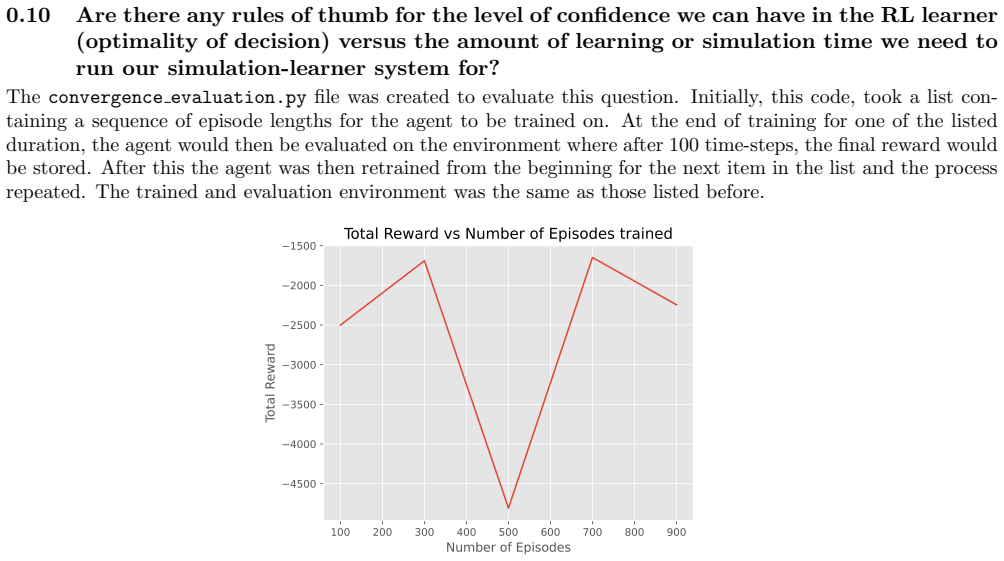
- Training duration can be chosen by observing reward convergence: the paper recommends roughly 300 episodes for smaller systems and more episodes as network complexity grows.
Reading between the lines
- Editorial inference: if the robustness result transfers beyond the simulator, the same recipe—separate predictors plus blockage exploration—could be applied to other queueing-network domains such as logistics or data routing, where live training is also risky.
- Editorial inference: a natural testable extension the paper leaves implicit is multi-server blockages; since only single-server outages were trained, the framework's behaviour under simultaneous failures is unknown and is the most direct stress test of the robustness claim.
- Editorial inference: the separate next-state and reward predictors could plausibly improve other Dyna-style continuous-control algorithms in high-dimensional environments, because the original single shared model is reported to be unstable in this setting.
- Editorial inference: the scaling result to 100 nodes was limited by compute, so the claim of modest scaling effort should be re-tested on larger and looped topologies before being used as a general rule.
Editorial analysis
A structured set of objections, weighed in public.
Referee Report
Summary. The paper describes a simulation-driven reinforcement learning framework for routing optimization in queueing networks, targeting manufacturing and communication applications. The authors implement a DDPG agent augmented with Dyna-style planning, in which the original combined next-state/reward predictor is split into two separate neural networks. They build a configurable queueing-network environment, introduce blockage exploration to train on single-server failures, and provide an evaluation suite that includes startup-behavior, convergence, noise, robustness, and scaling analyses. The stated central claims are that the split-predictor architecture significantly improves stability and sample efficiency, that the learned policies remain robust under disruptions, and that training scales effectively to networks up to 100 nodes. The paper also emphasizes the software-engineering and reproducibility aspects of the released package.
Significance. If the central claims were fully supported, the framework would be a practical contribution: it offers a configurable queueing-network simulator, a continuous-action RL agent with Dyna-style planning, and an evaluation toolkit, all packaged with unit/integration tests and version-controlled dependencies. The reproducibility-oriented features (Poetry, pytest, configuration files) are commendable and are a genuine strength. However, the paper's headline algorithmic contribution, the split next-state and reward predictors, is not validated against any baseline, and the robustness and scaling evidence is either partly built into training or measures a different quantity than claimed. For these reasons the current significance is limited; the framework may be useful as engineering infrastructure, but the scientific claims require substantially stronger empirical support.
major comments (4)
- [0.4.1 and 0.12] The central claim that splitting the original Dyna-DDPG predictor into separate next-state and reward networks 'significantly improves stability and sample efficiency' is not supported by any baseline comparison or ablation. Section 0.4.1 asserts that the original algorithm led to unstable training and poor convergence, but no results for the original Dyna-DDPG, plain DDPG, or a single-predictor control are shown. The learning curves and loss plots in Section 0.12 show only the proposed architecture. To substantiate the main contribution, the authors should add controlled experiments with identical hyperparameters, network seeds, and environments, reporting reward trajectories, convergence episodes, wall-clock time, and sample counts for both the split and original predictors.
- [0.13 and 0.2.3] The scaling claim is not supported by the evidence presented. Section 0.2.3 states that 'we demonstrate in section 0.6.2 that the algorithm's training time scales well with larger queueing networks,' but Section 0.13, the performance-scaling section, reports the number of training instances needed to meet a decision-variance threshold (one instance for 10 nodes, two for 50 and 100 nodes). This does not measure training-time growth or sample complexity, and it is not the quantity promised. The authors should either measure and report actual training time or sample counts as a function of network size, or explicitly reframe the scaling claim in terms of the number of runs required for decision robustness.
- [0.4.4] The description of how a server is made non-functional is technically inconsistent: the paper states that a server is 'rendered non-functional by setting its service rate to infinity.' In queueing semantics, an infinite service rate makes a server maximally fast, not blocked or non-functional. This is load-bearing because the robustness experiments in Sections 0.9 and 0.13 depend on the blockage mechanism. Please clarify the actual implementation: if the code blocks the server through a different mechanism (e.g., zero service rate or removal from the network), the text and figures should describe that mechanism accurately.
- [0.9 and 0.4.4] The robustness claim is partially circular. The agent is deliberately trained on single-server blockage scenarios (Section 0.4.4), and the evaluation in Section 0.9 measures performance under exactly this same class of single-server blockages. The drop in routing probability after blocking therefore largely demonstrates that training achieved its intended effect, not that the policy generalizes to new disruption types. The paper acknowledges that only single-server blockages were considered, but the abstract and conclusions nevertheless claim robust performance under disruptions. To support this claim, the authors should evaluate on held-out disruptions, such as multiple simultaneous blocked servers, blockages at untrained nodes, or blockages of different durations, and report whether the policy degrades gracefully in those settings.
minor comments (5)
- [0.2.3 and 0.6.2] There is a section-reference error: Section 0.2.3 refers to Section 0.6.2 for the training-time scaling demonstration, but Section 0.6.2 is 'Code Formatting'; the relevant material is in Section 0.13.
- [References] The citation for Dyna-DDPG appears mismatched: the reference list entry is Zhang, Boehmer and Whiteson (2020) 'Deep residual reinforcement learning,' which is not an obvious source for the Dyna-DDPG algorithm. Please verify and correct this citation.
- [0.8] The sample-size equation n = (z * sigma / E)^2 uses sigma without a definition in the equation; the text later refers to 'the maximum standard deviation' but the symbol should be defined explicitly in the equation or immediately before it.
- [0.3.2] The sentence 'queues with greater probability process jobs faster than others' is imprecise: routing probability is not a service rate, and the agent's action vector is not itself a property of the queue. Please rephrase to avoid confusing routing probability with processing speed.
- [0.9 and Figures 5-7] Figures 5, 6, and 7 should state explicitly which node's routing probability is shown and how the blockage is implemented; the captions currently only say 'Before blocking' and 'After blocking,' which is insufficient for reproducibility.
Circularity Check
Low circularity: the disruption-robustness demonstration is partly in training distribution, while the central split-predictor claim is unsupported by a baseline but not circular.
-
fitted input called prediction
[Section 0.9, blockage coverage evaluation (Figures 5-7)]
"After the agent being trained on various blockage scenarios, this probability significantly drops to only around 0.05. As a result, training under outage cases can enable the agent to deal with blockages effectively."
The disruption-robustness result is evaluated on the same single-blockage scenarios that were deliberately included in training. Section 0.4.4 renders a single server non-functional during training, and Section 0.9 uses weight parameters to give blockage cases equal coverage. The observed post-blocking drop in routing probability is therefore a check that the policy matched its training distribution, not an independent prediction about novel disruptions. The paper's own conclusion ('training under outage cases can enable the agent to deal with blockages effectively') makes the output a direct consequence of the training input.
full rationale
No fitted parameter is relabeled as a prediction, no load-bearing self-citation or imported uniqueness theorem appears, and no known result is renamed. The only partially circular element is the disruption-robustness claim: because the agent was explicitly trained on single-server blockage scenarios (Section 0.4.4), the observed routing-probability drop after blocking (Section 0.9) is an in-training-distribution check rather than an out-of-sample prediction; the paper is transparent about this dependence. The central claim that splitting Dyna-DDPG's combined predictor into separate next-state and reward networks improves stability and sample efficiency is not circular, although it is an evidence gap because no baseline against the original single-network Dyna-DDPG or plain DDPG is reported. Similarly, Section 0.13's scaling evidence counts required training instances rather than training time despite Section 0.2.3 promising a training-time demonstration; that too is a missing-support gap, not a circularity. Overall circularity is therefore low.
Assumptions & free parameters
free parameters (6)
- learning_rate =
not reported
- batch_size =
not reported
- planning_steps =
not reported
- tau =
not reported
- epsilon =
not reported
- w1 and w2 =
0.5 each
assumptions (6)
- domain assumption Jackson network and M/M/1 queueing abstractions with Poisson arrivals and exponential service times describe the target manufacturing flows.
- domain assumption Dyna-style planning improves DDPG sample efficiency.
- domain assumption The queueing-tool simulation is faithful enough that policies transfer to real systems.
- domain assumption Infinite buffer, FIFO discipline, rational job-following, and arrival rate below service rate.
- domain assumption Service rates are deterministic.
- ad hoc to paper Training on single-server blockages is sufficient to confer robustness.
Cite this review
Pith. "Pith review of Simulation-Driven Reinforcement Learning in Queuing Network Routing Optimization." pith.science (2026). https://pith.science/paper/IZABN7VH
@misc{pith2026250718795,
  author       = {Pith},
  title        = {Pith review of: Simulation-Driven Reinforcement Learning in Queuing Network Routing Optimization},
  year         = {2026},
  howpublished = {\url{https://pith.science/paper/IZABN7VH}},
  note         = {Machine review of arXiv:2507.18795}
}
read the original abstract
This study focuses on the development of a simulation-driven reinforcement learning (RL) framework for optimizing routing decisions in complex queueing network systems, with a particular emphasis on manufacturing and communication applications. Recognizing the limitations of traditional queueing methods, which often struggle with dynamic, uncertain environments, we propose a robust RL approach leveraging Deep Deterministic Policy Gradient (DDPG) combined with Dyna-style planning (Dyna-DDPG). The framework includes a flexible and configurable simulation environment capable of modeling diverse queueing scenarios, disruptions, and unpredictable conditions. Our enhanced Dyna-DDPG implementation incorporates separate predictive models for next-state transitions and rewards, significantly improving stability and sample efficiency. Comprehensive experiments and rigorous evaluations demonstrate the framework's capability to rapidly learn effective routing policies that maintain robust performance under disruptions and scale effectively to larger network sizes. Additionally, we highlight strong software engineering practices employed to ensure reproducibility and maintainability of the framework, enabling practical deployment in real-world scenarios.
Figures


Figures from the paper (8 more)





Forward citations
Cited by 1 Pith paper
-
Efficient Computation of Blackwell Optimal Policies using Rational Functions
Using symbolic comparisons of rational value functions near gamma=1, the authors obtain the first strongly polynomial algorithms for Blackwell-optimal policies in deterministic MDPs and a subexponential expected algor...
Reference graph
Works this paper leans on
-
[1]
Buzacott, J. & Yao, D. (1986), ‘On queueing network models of flexible manufacturing systems’, Queueing Systems 1, 5–27. URL: https://link.springer.com/article/10.1007/BF01149326 Chen, C. & Tiong, R. (2018), ‘Using queuing theory and simulated annealing to design the facility layout in an agv-based modular manufacturing system’, International Journal of P...
-
[2024]
Mnih, V., Kavukcuoglu, K., Silver, D., Rusu, A. A., Veness, J., Bellemare, M. G., Graves, A., Riedmiller, M. A., Fidjeland, A. K., Ostrovski, G., Petersen, S., Beattie, C., Sadik, A., Antonoglou, I., King, H., Kumaran, D., Wierstra, D., Legg, S. & Hassabis, D. (2015), ‘Human-level control through deep reinforcement learning’, Nature 518, 529–533. URL: htt...
arXiv 2015
Reviewed August 6, 2026 · model on record in the stance chip above.
Discussion (0). Continue with ORCID to comment.