Exploring Entanglement and Parameter Sensitivity in QAOA through Quantum Fisher Information
Pith reviewed 2026-05-19 02:10 UTC · model grok-4.3
The pith
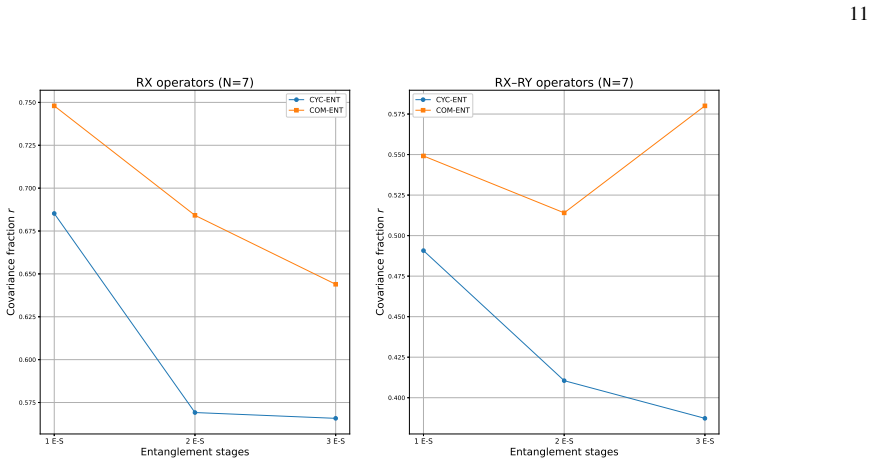
Quantum Fisher Information supplies mutation rates that lift QAOA performance above random baselines on small Max-Cut graphs.
A machine-rendered reading of the paper's core claim, the machinery that carries it, and where it could break.
Core claim
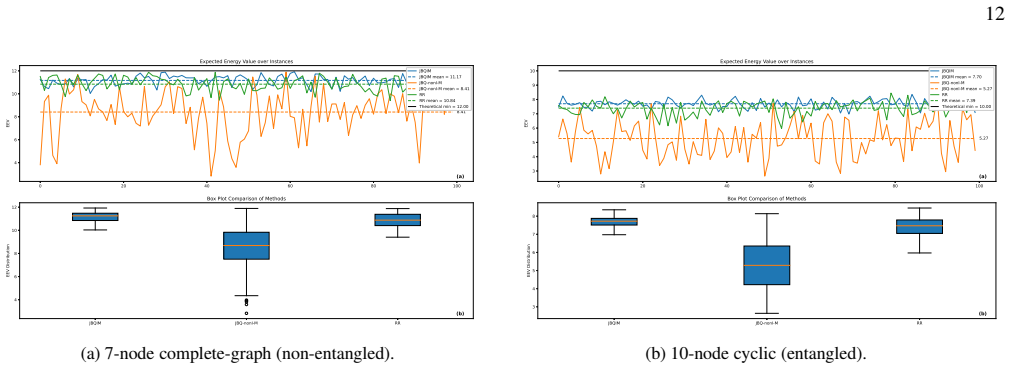
Complete graphs yield larger QFI eigenvalues than cyclic graphs; entanglement redistributes weight from diagonal to off-diagonal matrix entries; and a mutation heuristic that sets probabilities and step sizes from the normalized diagonal QFI produces higher mean energies and lower variance than equal-probability or random-restart baselines on seven- and ten-qubit Max-Cut problems.
What carries the argument
The QFI-Informed Mutation (QIm) heuristic, which converts the normalized diagonal elements of the Quantum Fisher Information matrix into per-parameter mutation probabilities and step sizes.
If this is right
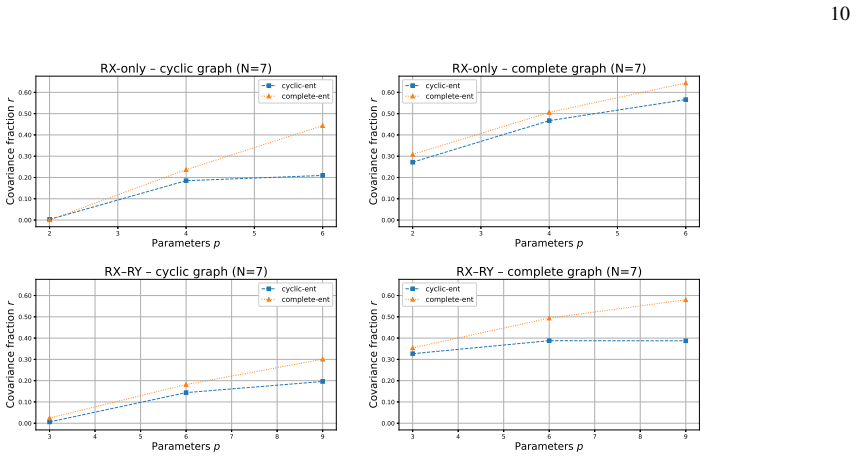
- Entangling stages increase the fraction of QFI that resides in off-diagonal covariances, raising cross-parameter correlations.
- None of the tested circuit families reaches the Heisenberg limit of 4N squared, yet several exceed the linear bound of 4N.
- The mutation rule functions as a problem-aware preconditioner that lowers outcome variance without requiring additional circuit executions beyond the QFI calculation.
- QFI analysis can be repeated for other variational quantum algorithms to obtain similar parameter-sensitivity diagnostics.
Where Pith is reading between the lines
- The same diagonal-QFI rule might be used to choose initial parameter values rather than only mutation steps during search.
- Comparing QFI spectra across graph families could indicate which problem structures benefit most from early entanglement stages.
- Extending the heuristic from discrete mutations to continuous gradient steps would test whether the sensitivity information remains useful in gradient-based VQA training.
Load-bearing premise
The normalized diagonal QFI values obtained on the studied small instances and circuit families supply mutation probabilities and step sizes that improve optimization performance.
What would settle it
Running the same QIm heuristic on QAOA instances larger than ten qubits or on different combinatorial problems and checking whether it still outperforms the equal-probability and random-restart baselines.
Figures





read the original abstract
Quantum Fisher Information (QFI) can be used to quantify how sensitive a quantum state reacts to changes in its variational parameters, making it a natural diagnostic for algorithms such as the Quantum Approximate Optimization Algorithm (QAOA). We perform a systematic QFI analysis of QAOA for Max-Cut on cyclic and complete graphs with $N = 4 - 10$ qubits. Two mixer families are studied, RX-only and hybrid RX-RY, with depths $p = 2, 4, 6$ and $p = 3, 6, 9$, respectively, and with up to three entanglement stages implemented through cyclic- or complete-entangling patterns. Complete graphs consistently yield larger QFI eigenvalues than cyclic graphs; none of the settings reaches the Heisenberg limit ($4N^2$), but several exceed the linear bound ($4N$). Introducing entanglement primarily redistributes QFI from diagonal to off-diagonal entries: non-entangled circuits maximize per-parameter (diagonal) sensitivity, whereas entangling layers increase the covariance fraction and thus cross-parameter correlations, with diminishing returns beyond the first stage. Leveraging these observations, we propose, as a proof of concept, a QFI-Informed Mutation (QIm) heuristic that sets mutation probabilities and step sizes from the normalized diagonal QFI. On 7- and 10-qubit instances, QIm attains higher mean energies and lower variance than equal-probability and random-restart baselines over 100 runs, underscoring QFI as a lightweight, problem-aware preconditioner for QAOA and other variational quantum algorithms.
Editorial analysis
A structured set of objections, weighed in public.
Referee Report
Summary. The manuscript conducts a systematic numerical study of the Quantum Fisher Information (QFI) matrix for QAOA applied to Max-Cut on cyclic and complete graphs with N=4–10 qubits. It compares RX-only and hybrid RX-RY mixer families at depths p=2,4,6 and p=3,6,9 respectively, with up to three entanglement stages using cyclic or complete entangling patterns. Findings include consistently larger QFI eigenvalues on complete graphs, several settings exceeding the linear bound 4N but none reaching the Heisenberg limit 4N², and entanglement primarily shifting QFI weight from diagonal to off-diagonal entries with diminishing returns after the first stage. From these diagnostics the authors introduce a proof-of-concept QFI-Informed Mutation (QIm) heuristic that derives mutation probabilities and step sizes from the normalized diagonal QFI; on 7- and 10-qubit instances this heuristic reports higher mean energies and lower variance than equal-probability and random-restart baselines across 100 runs.
Significance. If the reported performance gains prove robust, the work would usefully position QFI as a lightweight, problem-aware diagnostic and preconditioner for variational quantum algorithms. The systematic exploration of entanglement effects on QFI redistribution for small but representative Max-Cut instances supplies concrete, falsifiable observations that can guide circuit design. The heuristic itself is presented as a proof-of-concept rather than a fully optimized method, so its broader impact hinges on statistical validation and scaling behavior.
major comments (2)
- [QIm heuristic performance evaluation] In the section presenting the QIm heuristic results, the abstract and associated text state that QIm attains higher mean energies and lower variance than the two baselines over 100 runs on 7- and 10-qubit instances, yet no standard errors, confidence intervals, or hypothesis-test statistics (e.g., paired t-test or Wilcoxon rank-sum p-values) are reported. Because the underlying optimization is stochastic, these omissions leave open the possibility that the observed differences lie within run-to-run variation; this is load-bearing for the central claim that the normalized diagonal QFI supplies an effective preconditioner.
- [QFI eigenvalue analysis] The claim that “none of the settings reaches the Heisenberg limit (4N²)” and that “several exceed the linear bound (4N)” is presented without an explicit table or figure listing the largest eigenvalues for each (N, p, mixer, entanglement) combination. Adding such a summary table would allow direct verification that the reported exceedances are not artifacts of numerical precision or particular graph realizations.
minor comments (2)
- [Abstract / Methods] The abstract refers to “up to three entanglement stages implemented through cyclic- or complete-entangling patterns” but does not specify the exact two-qubit gate sequence or the placement of these stages within the QAOA circuit; a short methods paragraph or supplementary circuit diagram would improve reproducibility.
- [Heuristic definition] Notation for the normalized diagonal QFI used to set mutation probabilities should be introduced once with an explicit formula (e.g., p_i = F_ii / sum_j F_jj) rather than described only qualitatively, to avoid ambiguity when readers attempt to re-implement the heuristic.
Simulated Author's Rebuttal
We thank the referee for their thorough review and valuable suggestions. We address each of the major comments below and indicate the revisions we will make to the manuscript.
read point-by-point responses
-
Referee: [QIm heuristic performance evaluation] In the section presenting the QIm heuristic results, the abstract and associated text state that QIm attains higher mean energies and lower variance than the two baselines over 100 runs on 7- and 10-qubit instances, yet no standard errors, confidence intervals, or hypothesis-test statistics (e.g., paired t-test or Wilcoxon rank-sum p-values) are reported. Because the underlying optimization is stochastic, these omissions leave open the possibility that the observed differences lie within run-to-run variation; this is load-bearing for the central claim that the normalized diagonal QFI supplies an effective preconditioner.
Authors: We agree with the referee that statistical measures are necessary to substantiate the performance claims of the QIm heuristic given the stochastic nature of the optimization. In the revised version, we will report standard errors for the reported means and variances. Additionally, we will include p-values from paired t-tests or non-parametric alternatives to evaluate whether the improvements are statistically significant. These additions will be incorporated into the results section and referenced in the abstract. We have performed the necessary post-processing on our existing run data to generate these statistics. revision: yes
-
Referee: [QFI eigenvalue analysis] The claim that “none of the settings reaches the Heisenberg limit (4N²)” and that “several exceed the linear bound (4N)” is presented without an explicit table or figure listing the largest eigenvalues for each (N, p, mixer, entanglement) combination. Adding such a summary table would allow direct verification that the reported exceedances are not artifacts of numerical precision or particular graph realizations.
Authors: We appreciate this suggestion for improving the transparency of our QFI eigenvalue analysis. We will add a summary table to the manuscript that explicitly lists the largest QFI eigenvalue for every combination of system size N, circuit depth p, mixer family, and entanglement pattern. The table will also flag which values exceed the linear bound of 4N. This will enable readers to verify our statements directly from the numerical results without ambiguity. revision: yes
Circularity Check
No circularity: QFI diagnostic informs heuristic construction but performance claims rest on independent empirical runs
full rationale
The paper first computes the quantum Fisher information matrix directly from the QAOA circuit unitaries for the chosen depths, mixers, and graph topologies. It then observes patterns (e.g., redistribution of QFI from diagonal to off-diagonal entries upon adding entanglement) and uses the normalized diagonal QFI values to define the mutation probabilities and step sizes of the QIm heuristic. The central performance claim—that QIm yields higher mean energies and lower variance than baselines—is established by running the heuristic and the control methods on 7- and 10-qubit instances over 100 independent trials and comparing the resulting energy distributions. This empirical comparison does not reduce to any equation or fitted parameter inside the QFI analysis; the heuristic is an externally constructed procedure whose effectiveness is tested against separate stochastic baselines. No self-citations, uniqueness theorems, or ansatzes are invoked in a load-bearing manner, and the derivation chain remains self-contained against the reported numerical benchmarks.
Axiom & Free-Parameter Ledger
free parameters (3)
- Circuit depth p
- Number of entanglement stages
- Graph family
axioms (2)
- domain assumption QFI quantifies parameter sensitivity of variational quantum states
- standard math Max-Cut on graphs is a standard QAOA benchmark problem
Lean theorems connected to this paper
-
IndisputableMonolith/Foundation/RealityFromDistinction.leanreality_from_one_distinction unclear?
unclearRelation between the paper passage and the cited Recognition theorem.
systematic QFI analysis of QAOA for Max-Cut on cyclic and complete graphs
What do these tags mean?
- matches
- The paper's claim is directly supported by a theorem in the formal canon.
- supports
- The theorem supports part of the paper's argument, but the paper may add assumptions or extra steps.
- extends
- The paper goes beyond the formal theorem; the theorem is a base layer rather than the whole result.
- uses
- The paper appears to rely on the theorem as machinery.
- contradicts
- The paper's claim conflicts with a theorem or certificate in the canon.
- unclear
- Pith found a possible connection, but the passage is too broad, indirect, or ambiguous to say the theorem truly supports the claim.
Reference graph
Works this paper leans on
-
[1]
Random-parameter sampling: For each setting, 100 random parameter draws in [0, 2π ) are used to probe the nonuniform sensitivity landscape; QFI matrices are averaged to suppre ss sampling noise
-
[2]
Entanglement-pattern comparison: We contrast two CNOT-based patterns in the mixer, cyclic (nearest-neighbor ring) and complete (all-to-all), to isolate the effect of entanglement connec tivity on QFI
-
[3]
This study is carried out on the 7-node complete graph
Entanglement-stage count: Holding the overall depth fixed (e.g., 3L), we vary the number of entanglement stages (1, 2, or 3) to assess how repeated entangling layers redistribu te QFI between diagonal and off-diagonal components. This study is carried out on the 7-node complete graph. IV . RESULTS AND DISCUSSION We report Quantum Fisher Information (QFI) f...
-
[4]
55 → 0. 51 → 0. 58, cyclic: 0. 49 → 0. 42 → 0. 39). Thus, while the first entangling layer delivers the larges t QFI gain and cross-talk increase, additional stages offer diminish ing and sometimes non-monotonic returns. The key findings of the QFI results of the different QAOA and entanglement models are su mmarized in Table I. 10 2 3 4 5 6 Parameters p 0....
-
[5]
A Quantum Approximate Optimization Algorithm
E. Farhi, J. Goldstone, and S. Gutmann, “A quantum approx imate optimization algorithm,” arXiv preprint arXiv:1411.4028, 2014
work page internal anchor Pith review Pith/arXiv arXiv 2014
-
[6]
M. P . e. a. Harrigan, “Quantum approximate optimization of non-planar graph problems on a planar superconducting pr ocessor,” Nature Physics, vol. 17, pp. 332–336, 2021
work page 2021
-
[7]
L. Zhou, S. T. Wang, S. Choi, H. Pichler, and M. D. Lukin, “Q uantum approximate optimization algorithm: Performance, mechanism, and implementation on near-term devices,” Physical Review X, vol. 10, no. 2, p. 021067, 2020
work page 2020
-
[8]
Quantum approximate optimization algorithm for max-cut: A fermion ic view,
Z. Wang, S. Hadfield, Z. Jiang, and E. G. Rieffel, “Quantum approximate optimization algorithm for max-cut: A fermion ic view,” Physical Review A, vol. 97, no. 2, p. 022304, 2018
work page 2018
-
[9]
A tutorial on quantum approximate opt imization algorithm (qaoa): Fundamentals and application s,
J. Choi and J. Kim, “A tutorial on quantum approximate opt imization algorithm (qaoa): Fundamentals and application s,” in 2019 international conference on information and communicatio n technology convergence (ICTC). IEEE, 2019, pp. 138–142
work page 2019
-
[10]
Barren plateaus in quantum neural network training landscapes,
J. R. McClean, S. Boixo, V . N. Smelyanskiy, R. Babbush, and H. Neven, “Barren plateaus in quantum neural network training landscapes,” Nature Communications, vol. 9, no. 1, p. 4812, 2018
work page 2018
-
[11]
Noise-induced barren plateaus in varia tional quantum algorithms,
S. Wang, E. Fontana, M. Cerezo, K. Sharma, A. Sone, L. Cinc io, and P . J. Coles, “Noise-induced barren plateaus in varia tional quantum algorithms,” Nature Communications, vol. 12, no. 1, p. 6961, 2021
work page 2021
-
[12]
Comparison of QAOA with Quantum and Simulated Annealing
M. Streif and M. Leib, “Comparison of qaoa with quantum an d simulated annealing,” arXiv preprint arXiv:1901.01903, 2019
work page internal anchor Pith review Pith/arXiv arXiv 1901
-
[13]
Qaoa-in-qaoa: solvin g large-scale maxcut problems on small quantum machines,
Z. Zhou, Y . Du, X. Tian, and D. Tao, “Qaoa-in-qaoa: solvin g large-scale maxcut problems on small quantum machines,” Physical Review Applied, vol. 19, no. 2, p. 024027, 2023
work page 2023
-
[14]
Benchmarkin g the performance of portfolio optimization with qaoa,
S. Brandhofer, D. Braun, V . Dehn, G. Hellstern, M. H¨ uls, Y . Ji, I. Polian, A. S. Bhatia, and T. Wellens, “Benchmarkin g the performance of portfolio optimization with qaoa,” Quantum Information Processing, vol. 22, no. 1, p. 25, 2022
work page 2022
-
[15]
L. Zhou, S. T. Wang, S. Choi, H. Pichler, and M. D. Lukin, “ Quantum approximate optimization algorithm: Performance , mechanism, and implementation on near-term devices,” Physical Review X, vol. 10, no. 2, p. 021067, 2020
work page 2020
-
[16]
Quantum computing in the nisq era and beyo nd,
J. Preskill, “Quantum computing in the nisq era and beyo nd,” Quantum, vol. 2, p. 79, 2018
work page 2018
-
[17]
Qaoa for max-cut re quires hundreds of qubits for quantum speed-up,
G. G. Guerreschi and A. Y . Matsuura, “Qaoa for max-cut re quires hundreds of qubits for quantum speed-up,” Scientific reports, vol. 9, no. 1, p. 6903, 2019
work page 2019
-
[18]
Policy gradient methods for reinforcement learning: A su rvey,
J. Yao et al. , “Policy gradient methods for reinforcement learning: A su rvey,” F oundations and Trends in Machine Learning , vol. 14, no. 6, pp. 403–500, 2021
work page 2021
-
[19]
Statistical distance and the geometry of quantum states,
S. L. Braunstein and C. M. Caves, “Statistical distance and the geometry of quantum states,” Physical Review Letters, vol. 72, no. 22, pp. 3439–3443, 1994
work page 1994
-
[20]
C. W. Helstrom, Quantum Detection and Estimation Theory . New Y ork: Academic Press, 1976
work page 1976
-
[21]
Quantum estimation for quantum technolog y,
M. G. Paris, “Quantum estimation for quantum technolog y,” International Journal of Quantum Information , vol. 7, no. supp01, pp. 125–137, 2009
work page 2009
-
[22]
Quantum metrology from a qua ntum information science perspective,
G. T´ oth and I. Apellaniz, “Quantum metrology from a qua ntum information science perspective,” Journal of Physics A: Mathematical and Theoretical, vol. 47, no. 42, p. 424006, 2014
work page 2014
-
[23]
Quantum metrology: Fundamental aspects and recent pr ogress,
R. Demkowicz-Dobrza´ nski, M. Jarzyna, and J. Kołody´ nski, “Quantum metrology: Fundamental aspects and recent pr ogress,” Progress in Optics, vol. 60, pp. 345–435, 2015
work page 2015
-
[24]
V ariational quantum algorithm for estimating the quantum fisher info rmation,
J. Beckey, M. Cerezo, A. Sone, and P . J. Coles, “V ariational quantum algorithm for estimating the quantum fisher info rmation,” Physical Review Research, 2020
work page 2020
-
[25]
K. C. Tan and T. V olkoff, “V ariational quantum algorithms to estimate rank, quantum entropies, fidelity, and fisher i nformation via purity minimization,” Physical Review Research, 2021
work page 2021
-
[26]
Predicting quantum le arnability from landscape fluctuation,
H.-K. Zhang, C. Zhu, and X. Wang, “Predicting quantum le arnability from landscape fluctuation,” arXiv preprint arXiv:2406.11805 , 2024
-
[27]
J. Stokes, J. Izaac, N. Killoran, and G. Carleo, “Quantu m natural gradient,” Quantum, vol. 4, p. 269, 2020
work page 2020
-
[28]
Noise-resilient variational hybrid quantum-c lassical optimization,
L. Gentini, A. Cuccoli, S. Pirandola, P . V errucchi, and L. Banchi, “Noise-resilient variational hybrid quantum-c lassical optimization,” Physical Review A, 2019
work page 2019
-
[29]
Quantu m metrology assisted by machine learning,
J. Huang, M. Zhuang, J. Zhou, Y . Shen, and C. Lee, “Quantu m metrology assisted by machine learning,” Advanced Quantum Technologies, p. 2300329, 2024
work page 2024
-
[30]
Quantum natural gradient generalized to noisy and nonunitary circuits,
B. Koczor and S. C. Benjamin, “Quantum natural gradient generalized to noisy and nonunitary circuits,” Physical Review A , vol. 106, no. 6, p. 062416, 2022
work page 2022
-
[31]
Fisher information in noisy intermediate -scale quantum applications,
J. J. Meyer, “Fisher information in noisy intermediate -scale quantum applications,” Quantum, vol. 5, p. 539, 2021. 14
work page 2021
-
[32]
Cost function dependent barren plateaus in shallow quantum neural networks,
M. Cerezo, A. Sone, T. V olkoff, L. Cincio, and P . J. Coles, “Cost function dependent barren plateaus in shallow quantum neural networks,” Nature Communications, vol. 12, no. 1, p. 1791, 2021
work page 2021
-
[33]
Theory of quantum-assisted genetic algorithms,
M. Larocca, M. Cerezo, K. Sharma, A. Sornborger, and P . J . Coles, “Theory of quantum-assisted genetic algorithms,” Quantum, vol. 6, p. 824, 2022
work page 2022
-
[34]
Heisenberg limit beyond quantum fisher information,
W. G´ orecki, “Heisenberg limit beyond quantum fisher information,” arXiv preprint arXiv:2304.14370, 2023
-
[35]
Entanglement detection via quantum fisher information in a coupled atom-field system,
S. S. Mirkhalaf et al., “Entanglement detection via quantum fisher information in a coupled atom-field system,” Firenze Thesis Repository, 2016
work page 2016
-
[36]
Molecu lar entanglement witness by absorption spectroscopy in cav ity qed,
W. Wu, F. Fassioli, D. A. Huse, and G. D. Scholes, “Molecu lar entanglement witness by absorption spectroscopy in cav ity qed,” The Journal of Physical Chemistry Letters , vol. 16, pp. 7369–7375, 2024
work page 2024
-
[37]
Y . Li and Z. Ren, “Quantum metrology with an n-qubit w sup erposition state under noninteracting and interacting ope rations,” Physical Review A, vol. 107, no. 1, p. 012403, 2023
work page 2023
-
[38]
Estimation of the quantum fisher informat ion on a quantum processor,
V . Vitale, A. Rath, P . Jurcevic, A. Elben, C. Branciard, and B. V ermersch, “Estimation of the quantum fisher informat ion on a quantum processor,” PRX Quantum, vol. 5, no. 3, p. 030338, 2024
work page 2024
-
[39]
At the limits of criticality-based quantum metro logy: Apparent super-heisenberg scaling revisited,
M. M. Rams, P . Sierant, O. Dutta, P . Horodecki, and J. Zak rzewski, “At the limits of criticality-based quantum metro logy: Apparent super-heisenberg scaling revisited,” Physical Review X, vol. 8, no. 2, p. 021022, 2018
work page 2018
-
[40]
Z. Hou, Y . Jin, H. Chen, J.-F. Tang, C.-J. Huang, H. Y uan, G.-Y . Xiang, C.-F. Li, and G.-C. Guo, ““super-heisenberg” a nd heisenberg scalings achieved simultaneously in the estimation of a rot ating field,” Physical Review Letters, vol. 126, no. 7, p. 070503, 2021
work page 2021
-
[41]
Interaction-based quantum metrology showing scaling beyond the heisenberg limit,
M. Napolitano, M. Koschorreck, B. Dubost, N. Behbood, R . Sewell, and M. W. Mitchell, “Interaction-based quantum metrology showing scaling beyond the heisenberg limit,” Nature, vol. 471, no. 7339, pp. 486–489, 2011
work page 2011
-
[42]
G. Guerreschi et al., “Qaoa for max-cut: A primer,” Quantum Science and Technology, vol. 4, no. 2, p. 024002, 2019
work page 2019
-
[43]
C. W. Commander, “Maximum cut problem, max-cut.” Encyclopedia of Optimization , vol. 2, 2009
work page 2009
-
[44]
Solving large scale max cut problems via tabu search,
G. A. Kochenberger, J.-K. Hao, Z. L¨ u, H. Wang, and F. Glo ver, “Solving large scale max cut problems via tabu search,” Journal of Heuristics, vol. 19, pp. 565–571, 2013
work page 2013
-
[45]
Hybridizing the cro ss-entropy method: An application to the max-cut problem,
M. Laguna, A. Duarte, and R. Marti, “Hybridizing the cro ss-entropy method: An application to the max-cut problem,” Computers & Operations Research, vol. 36, no. 2, pp. 487–498, 2009. VI. DATA A V AILABILITY The code and QFI results for the problems studied are publicly available at https://github.com/BrianSarmina/Papers/tree/m The QFI matrices used in th...
work page 2009
discussion (0)
Sign in with ORCID, Apple, or X to comment. Anyone can read and Pith papers without signing in.