REVIEW 3 major objections 4 minor 34 references
Optimising Perfect Quantum State Transfer for Timing Insensitivity
T0 review · 3 major / 4 minor · reviewed 2026-08-15 · deepseek-v4-flash
Pith's one-line read Perfect quantum state transfer can be made timing-insensitive at any chain length, and the improvement is proven optimal.
desk verdict T-Rex construction is a genuine advance in timing-insensitive spin-chain state transfer; the optimality claim holds up in outline, and the paper needs only typo/ordering fixes before it is referee-ready. read the letter →
The pith
A machine-rendered reading of the paper's core claim, the machinery that carries it, and where it could break.
The reading
What carries the argument
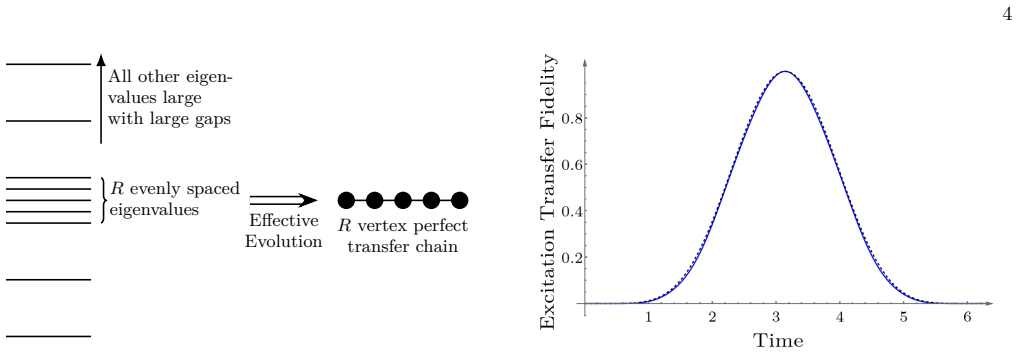
The T-Rex construction: the spectrum of the engineered Hamiltonian has a central cluster of $R$ evenly spaced eigenvalues (gap 1, centred at 0) and all other eigenvalues at $O(\gamma)$ with gaps $O(\gamma)$; the symmetric tridiagonal couplings are recovered by the classical inverse-eigenvalue construction. The endpoint weights $a_n = |\langle 1|\lambda_n\rangle|^2$ obey $a_n \propto 1/|q'(\lambda_n)|$, so the $O(\gamma)$ eigenvectors carry total weight $O(\gamma^{1-R})$ on the endpoint. In the large-$\gamma$ limit the end-to-end evolution is therefore governed by an $R$-site Krawtchouk chain (couplings $\sqrt{n(R-n)}$), the extremal couplings stay $O(1)$ while the central couplings grow as $O(\gamma)$, and after rescaling to maximum coupling 1 the quantity $J_1 t_0$ tends to $\pi\sqrt{R-1}/2$—exactly the threshold in Theorem 1 for $R=4,5$.
What would settle it
Take a constructed T-Rex chain of fixed length $N=8$ with $R=4$ and compute the exact fidelity $F_e(t)$ from the tridiagonal Hamiltonian. Then measure the sup-norm deviation $\sup_t |F_e(t)-\sin^6(\pi t/(2t_0))|$ as $\gamma$ increases (e.g. $\gamma=13,149,1001$) and, separately, the deviation of $J_1 t_0$ from $\pi\sqrt{3}/2$. If either deviation fails to decrease to zero as $\gamma\to\infty$, the asymptotic optimality claim is refuted; if the ratio $(J_1^2 - \pi\sqrt3/(2t_0))$ instead saturates at a positive constant, the bound is not tight for finite chains.
Extended reading notes
Core claim
The paper's central claim is that the previous belief that the Krawtchouk perfect-transfer chains are essentially optimal for timing insensitivity is wrong. For any length $N\ge 4$, there exists a symmetric nearest-neighbour spin chain with perfect state transfer in time $t_0$ whose excitation transfer fidelity approaches $F_e = \sin^{2(R-1)}(\pi t/(2t_0))$ in the large-$\gamma$ limit, with $R=4$ for even $N$ and $R=5$ for odd $N$. The first coupling and transfer time satisfy $J_1 t_0 \to \pi\sqrt{3}/2$ (even) and $J_1 t_0 \to \pi$ (odd). Theorem 1 proves $J_1^2 \ge \pi\alpha/(2t_0)$ with $\alpha=\sqrt{3}$ or $2$; the constructed chains saturate these inequalities, so they achieve the best possible trade-off between transfer time and arrival width, and the arrival profile no longer narrows with the chain length.
Load-bearing premise
Everything rests on the claim that in the large-$\gamma$ limit the very high-energy modes of the chain contribute negligibly to the endpoint state for all relevant times; this is justified only by order-of-magnitude estimates of spectral weights, not by a uniform error bound.
Editorial extensions
If this is right
- For any perfect-transfer chain of length $N\ge 4$, the arrival peak can be made as broad as that of a 4- or 5-site chain, with fidelity profile $\sin^6$ or $\sin^8$ instead of the Krawtchouk $\sin^{2(N-1)}$.
- The product $J_1 t_0$ saturates the new lower bounds $\pi\sqrt{3}/2$ (even $N$) and $\pi$ (odd $N$), so no perfect transfer chain can asymptotically be both faster and less timing-sensitive.
- The same T-Rex spectrum, with only its central couplings adjusted, produces fractional revival—a superposition of the two endpoint states—with the same broad arrival characteristic.
- Numerical perturbation tests show that errors in the central couplings degrade the engineered chains much less than they degrade Krawtchouk chains, despite the longer transfer time.
- Encoding the state over $M>1$ endpoints and choosing the optimal singular vector broadens the arrival peak, and the optimal encoding for timing insensitivity is the smallest singular vector of $\Pi_A S H_0^2 \Pi_A$.
Reading between the lines
- If the convergence to the effective $R$-site chain is uniform in time, then the usable timing window near $t_0$ is set by $R$, not $N$; a 100-site chain and a 6-site chain would tolerate the same absolute timing jitter—something the Krawtchouk family cannot do.
- The bound is stated for $J_1^2$, but the $\sin^{2(R-1)}$ profile implies the construction also makes the full expected fidelity $\tilde{F}_e$ approach its optimum for any peaked receiving distribution $p(t)$; proving tightness for arbitrary $p(t)$ would strengthen the optimality statement.
- Finite-$\gamma$ performance leaves a gap to the bound, so the same spectral design can be turned into a finite-dimensional optimisation over $\gamma$ and the central eigenvalue gaps to minimise the exact expected fidelity for a specified receiver, rather than only the asymptotic limit.
Signed reviews
Editorial analysis
A structured set of objections, weighed in public.
Referee Report
Summary. The paper studies how insensitive perfect state transfer (PST) in a one-dimensional spin chain can be to errors in the arrival time. The authors introduce the first coupling strength J1 as the leading figure of merit, state a new lower bound (Theorem 1) on J1 t0 for PST chains of length N≥4, and construct a family of chains, dubbed T-Rex, whose spectrum consists of R low-lying Krawtchouk eigenvalues and N−R large peripheral eigenvalues. They argue that in the large-γ limit the endpoint evolution of such a chain matches that of a length-R Krawtchouk chain, giving arrival profiles proportional to sin^{2(R−1)}(πt/(2t0)), and that choosing R=4 (even N) or R=5 (odd N) saturates Theorem 1, making the construction asymptotically optimal. The same idea is applied to encoded transfer and to fractional revival, and numerical experiments and a supporting notebook are provided.
Significance. If the results hold, the paper resolves a natural optimization problem in quantum state transfer: it shows that the original Krawtchouk chains are not timing-optimal for fixed length, and it provides an explicit, scalable construction with arrival peaks whose width is essentially independent of the chain length. The asymptotic saturation of a nontrivial bound on J1 t0 is a clean and potentially useful statement, and the paper gives numerical evidence plus reproducible code, which strengthens confidence in the construction. The fractional-revival and robustness sections broaden the applicability. The main caveat is that the proof machinery behind the lower bound currently contains a fixable but load-bearing sign/ordering problem, and the claimed convergence of the arrival profile is argued by order-of-magnitude estimates rather than by a uniform error bound.
major comments (3)
- [Section II, Lemma 1] The proof of Lemma 1 is only valid if λ1 denotes the largest-magnitude eigenvalue, but the manuscript never specifies this ordering. The displayed formula an = a_{n+1}(λ1^2−λ_n^2)/Γ requires λ1^2−λ_n^2>0 for all remaining eigenvalues, i.e. Γ=λ1^2−J1^2>0. If the eigenvalues are ordered in the usual increasing order, λ1 is the smallest-magnitude eigenvalue and Γ<0, so the inequality ilde J1^2 < J1^2 is reversed. Concretely, for the N=4 Krawtchouk spectrum {±1/2,±3/2}, removing the smallest pair ±1/2 leaves ±3/2 and gives ilde J1^2=9/4>3/4=J1^2, contradicting the claimed reduction. Removing the largest pair gives ilde J1^2=1/4<3/4, as intended. Since Theorem 1 uses Lemma 1 to conclude J1^{(1)}≤J1^{(k)} for all k, this sign/ordering issue is load-bearing; the lemma must be restated with the ordering convention made explicit and the proof adjusted accordingly.
- [Section II, Theorem 1] The theorem as printed, J1^2 ≥ πα/(2t0), is inconsistent with the proof and with the paper's own examples. The derivation for N=4 gives J1 ≥ π√3/(2t0), and for N=5 gives J1 ≥ π/t0; i.e. the bound is on J1 t0, not on J1^2 t0. For the N=4 Krawtchouk chain with t0=π one has J1=√3/2, so J1^2=3/4, whereas the printed inequality would require J1^2≥√3/2≈0.866, which fails. The statement should be corrected to J1 ≥ πα/(2t0), with α=√3 for even N and α=2 for odd N, and all subsequent references to the bound should use the corrected form.
- [Section III] The step from spectral-weight estimates to the claimed arrival profile is not a proof as written. The sentence 'At large gamma, the effect of those large eigenvalues is negligible' is justified only by the order-of-magnitude estimate an=O(γ^{1−R}); what is needed for the central claim Fe≈sin^{2(R−1)}(πt/(2t0)) is a uniform-in-t statement that the total contribution of the N−R large eigenvalues tends to zero and that the weights of the R central eigenvectors converge to the corresponding length-R Krawtchouk weights. A bound of the form O(Nγ^{1−R}) on the total residual weight would suffice for the first part, and the second part should follow from continuity of the inverse eigenvalue problem, but neither is written down. Since the abstract says the construction is 'proved' asymptotically optimal, this missing control on the large-γ limit should be supplied.
minor comments (4)
- [Section IV] The first sentence contains a duplicated phrase: 'has been to has been to create a transfer system' should read 'has been to create a transfer system'.
- [Section II, proof of Theorem 1] The notation J1^{(m)} appears in the even-N part of the proof without being defined; it appears to be a typo for J1^{(k)} or for the minimal value over length-4 chains.
- [Figure 3 caption] The legend labels should be clarified: 'Mandelstam-Tamm' and 'Improved bound for odd N≥5' are plotted, but the even-N bound and the T-Rex R=4, R=7, R=9 families are not all identified unambiguously in the caption.
- [Section III] In the paragraph beginning 'To evaluate the central couplings', the expression Tr(H0^k S)=∑(−1)^{n+1}λ_n^k is stated without explanation of the ordering of the eigenvalues used in the alternating sign; a brief clarification would help the reader reproduce the calculation.
Circularity Check
No circularity: the T-Rex chains are engineered from a prescribed spectrum and compared against an independently derived lower bound.
full rationale
The derivation chain is self-contained. The lower bound in Theorem 1 is proved from the PST spectral conditions (odd-integer gaps, symmetry) via the eigenvalue-removal argument in Lemma 1; it is not assumed and is not derived from the T-Rex construction. The T-Rex chain is then built by prescribing eigenvalues and solving the inverse eigenvalue problem, and its claimed sin^{2(R-1)} arrival profile follows from the dominance of the R central spectral weights in the large-gamma limit, with the endpoint weights for the O(gamma) eigenvalues estimated from the characteristic-polynomial formula, Eq. (1). No fitted parameter is later renamed as a prediction: J1 t0 tends to pi sqrt(R-1)/2 after rescaling and is compared with the independent bound of Theorem 1. Known results used—PST characterization [4], the inverse eigenvalue problem [13,14,20], Mandelstam-Tamm [18], the Anandan-Aharonov bound [19], and the Krawtchouk chain fidelity [2,3]—are standard, externally checkable, and are not invoked to forbid alternatives. The manuscript itself flags limitations (the finite-gamma central coupling question, lack of analytic backing for R=2,3, and the open high-fidelity fast-transfer regime), further indicating that the optimality claim is not definitionally forced. The skeptic's Lemma 1 sign/ordering point is a correctness gap, not circularity: even if the bound is unproven as printed, it is attempted from spectral data rather than assumed. Therefore no circular step can be exhibited, and the appropriate score is 0.
Assumptions & free parameters
free parameters (3)
- gamma =
odd integer, examples 13, 21, 51, 149
- R =
4 for even N, 5 for odd N in the optimal construction
- theta =
pi/8 in the example
assumptions (6)
- domain assumption A field-free tridiagonal chain achieves perfect state transfer iff it is mirror-symmetric and its spectrum has odd integer gaps in units of pi/t0.
- domain assumption Given a symmetric spectrum with odd integer gaps, the inverse eigenvalue (Lanczos) construction yields a valid nearest-neighbor Hamiltonian with the required couplings.
- domain assumption For a strongly peaked receiver timing distribution p(t), timing insensitivity is quantified by the leading-order coefficient J1^2 = <1|H0^2|1>.
- domain assumption In the large-gamma limit, the contribution of the O(gamma) eigenvalues to the endpoint evolution is negligible, so the arrival statistics coincide with an R-site Krawtchouk chain.
- domain assumption The maximum coupling strength of the T-Rex chain is the central coupling for large gamma, so rescaling to Jmax=1 multiplies the transfer time by pi Jmax.
- standard math The Anandan-Aharonov bound Fe <= sin^2(J1 t) bounds the excitation fidelity at intermediate times.
Cite this review
Pith. "Pith review of Optimising Perfect Quantum State Transfer for Timing Insensitivity." pith.science (2026). https://pith.science/paper/2HMJZKPS
@misc{pith2026250718872,
  author       = {Pith},
  title        = {Pith review of: Optimising Perfect Quantum State Transfer for Timing Insensitivity},
  year         = {2026},
  howpublished = {\url{https://pith.science/paper/2HMJZKPS}},
  note         = {Machine review of arXiv:2507.18872}
}
read the original abstract
When studying the perfect transfer of a quantum state from one site to another, it is typically assumed that one can receive the arriving state at a specific instant in time, with perfect accuracy. Here, we study how sensitive perfect state transfer is to that timing. We design engineered spin chains which reduce their sensitivity, proving that this construction is asymptotically optimal. The same construction is applied to the task of creating superpositions, also known as fractional revival.
Figures


Figures from the paper (2 more)


Reference graph
Works this paper leans on
-
[1]
Bose, Quantum Communication through an Unmodu- lated Spin Chain, Phys
S. Bose, Quantum Communication through an Unmodu- lated Spin Chain, Phys. Rev. Lett. 91, 207901 (2003)
work page 2003
-
[2]
Christandl, N
M. Christandl, N. Datta, A. Ekert, and A. J. Landahl, Perfect State Transfer in Quantum Spin Networks, Phys. Rev. Lett. 92, 187902 (2004)
2004
-
[3]
Christandl, N
M. Christandl, N. Datta, T. C. Dorlas, A. Ekert, A. Kay, and A. J. Landahl, Perfect transfer of arbitrary states in quantum spin networks, Phys. Rev. A 71, 032312 (2005)
2005
-
[4]
Kay, A Review of Perfect State Transfer and its Appli- cation as a Constructive Tool, Int
A. Kay, A Review of Perfect State Transfer and its Appli- cation as a Constructive Tool, Int. J. Quantum Inform. 8, 641 (2010)
2010
-
[5]
Kay, Perfect state transfer: Beyond nearest-neighbor couplings, Phys
A. Kay, Perfect state transfer: Beyond nearest-neighbor couplings, Phys. Rev. A 73, 032306 (2006)
work page 2006
-
[6]
S. Kirkland, Sensitivity analysis of perfect state transfer in quantum spin networks, Linear Algebra Appl. 472, 1 (2015)
work page 2015
-
[7]
G. Lippner and Y. Shi, Quantifying State Transfer Strength on Graphs with Involution, Quantum Inf. Pro- cess. 23, 166 (2024)
work page 2024
-
[8]
G. Lippner and Y. Shi, Strong quantum state transfer on graphs via loop edges, Linear Algebra Appl. 704, 77 (2025)
work page 2025
Show all 34 references
-
[9]
B. Chen, Z. Song, and C. P. Sun, Fractional revivals of quantum state in tight-binding chain, Phys. Rev. A 75, 012113 (2007), arXiv:quant-ph/0603033
2007 arXiv
-
[10]
L. Dai, Y. P. Feng, and L. C. Kwek, Engineering quantum cloning through maximal entanglement between bound- ary qubits in an open spin chain, J. Phys. A: Math. Theor. 43, 035302 (2010)
2010
-
[11]
Banchi, E
L. Banchi, E. Compagno, and S. Bose, Perfect wave- packet splitting and reconstruction in a one-dimensional lattice, Phys. Rev. A 91, 052323 (2015)
2015
-
[12]
A. Kay, C. Tamon, and S. Kim, Time-Insensitive Perfect State Transfer Supporting Notebook, https://doi.org/10.17637/rh.29336069 (2025)
2025 doi
-
[13]
Karbach and J
P. Karbach and J. Stolze, Spin chains as perfect quantum state mirrors, Phys. Rev. A 72, 030301(R) (2005)
2005
-
[14]
G. M. L. Gladwell, The Inverse Mode Problem for Lumped-Mass Systems, Q J Mechanics Appl Math 39, 297 (1986)
1986
-
[15]
Yung, Quantum speed limit for perfect state trans- fer in one dimension, Phys
M.-H. Yung, Quantum speed limit for perfect state trans- fer in one dimension, Phys. Rev. A 74, 030303(R) (2006)
2006
-
[16]
We can see this realised in Fig
gives the same result for odd N, so thatR = 5 is asymptotically optimal. We can see this realised in Fig. 3, where the R = 5 case tends towards the limiting behaviour. A. Smaller R Clearly, it is preferable to reach as small a value ofR as possible. We have easily argued the b...
-
[17]
Albanese, M
C. Albanese, M. Christandl, N. Datta, and A. Ekert, Mirror Inversion of Quantum States in Linear Registers, Phys. Rev. Lett. 93, 230502 (2004)
2004
-
[18]
states that for an initial state |ψ⟩ to evolve into an orthogonal one, it must take a time at least π 2 √ ⟨ψ|H 2 0|ψ⟩−⟨ ψ|H0|ψ⟩2 which, in the present case, is just π 2J1 . The Krawtchouk perfect transfer chain, taking Jmax = 1, has J1 = O ( 1/ √ N ) , which already gives us a...
-
[19]
A. Kay, W. Xie, and C. Tamon, A Note on the Speed of Perfect State Transfer (2022), arXiv:1609.01854
2022 arXiv
-
[20]
Mandelstam and Ig
L. Mandelstam and Ig. Tamm, The Uncertainty Rela- tion Between Energy and Time in Non-relativistic Quan- tum Mechanics, in Selected Papers , edited by I. E. 9 Tamm, B. M. Bolotovskii, V. Y. Frenkel, and R. Peierls (Springer, Berlin, Heidelberg, 1991) pp. 115–123
1991
-
[21]
Anandan and Y
J. Anandan and Y. Aharonov, Geometry of quantum evo- lution, Phys. Rev. Lett. 65, 1697 (1990)
1990
-
[22]
G. M. L. Gladwell, ed., Inverse Problems in Vibration , Solid Mechanics and Its Applications, Vol. 119 (Kluwer, Dordrecht, 2005)
2005
-
[23]
Bailey, S
R. Bailey, S. Costa, M. Derevyagin, C. Findley, and K. Zuang, Hamiltonians that realize perfect quantum state transfer and early state exclusion, Quantum Inf. Process. 24, 51 (2025)
2025
-
[24]
H. L. Haselgrove, Optimal state encoding for quantum walks and quantum communication over spin systems, Phys. Rev. A 72, 062326 (2005)
2005
-
[25]
Keele and A
C. Keele and A. Kay, Combating the effects of disorder in quantum state transfer, Phys. Rev. A 105, 032612 (2022)
2022
-
[26]
Keele and A
C. Keele and A. Kay, Noise-reducing encoding strategies for spin chains, Phys. Rev. A 105, 032613 (2022)
2022
-
[27]
Kay, Encoded State Transfer: Beyond the Uniform Chain (2022), arXiv:2207.12189 [quant-ph]
A. Kay, Encoded State Transfer: Beyond the Uniform Chain (2022), arXiv:2207.12189 [quant-ph]
2022 arXiv
-
[28]
Kay, Incorporating Encoding into Quantum System Design (2022), arXiv:2207.01954 [quant-ph]
A. Kay, Incorporating Encoding into Quantum System Design (2022), arXiv:2207.01954 [quant-ph]
2022 arXiv
-
[29]
Kay, Interfacing with Hamiltonian dynamics, Phys
A. Kay, Interfacing with Hamiltonian dynamics, Phys. Rev. A 79, 042330 (2009)
2009
-
[30]
T. J. Osborne and N. Linden, Propagation of quantum information through a spin system, Phys. Rev. A 69, 052315 (2004)
2004
-
[31]
The{an} for the eigenvectors that we remove are small, making a negligible contribution to the weighted aver- age ∑ anλ2 n, so removing them completely will be less effective than removing weight from some other terms
-
[32]
Vinet and A
L. Vinet and A. Zhedanov, Quantum state transfer with sufficient fidelity (2024), arXiv:2412.02321 [quant-ph]
2024 arXiv
-
[33]
V. X. Genest, L. Vinet, and A. Zhedanov, Quantum spin chains with fractional revival, Annals of Physics371, 348 (2016)
2016
-
[34]
T. J. G. Apollaro, L. Banchi, A. Cuccoli, R. Vaia, and P. Verrucchi, Phys. Rev. A 85, 052319 (2012)
2012
Reviewed August 15, 2026 · model on record in the stance chip above.
Discussion (0). Continue with ORCID to comment.