REVIEW 5 major objections 5 minor 43 references
A New One-Shot Federated Learning Framework for Medical Imaging Classification with Feature-Guided Rectified Flow and Knowledge Distillation
T0 review · 5 major / 5 minor · reviewed 2026-08-15 · deepseek-v4-flash
Pith's one-line read The paper claims that one-shot federated learning can beat multi-round federated learning on medical image classification when clients share a feature-level rectified flow model and the server trains the global model with dual-layer…
desk verdict Solid engineering result with a plausible accuracy story; the privacy claim is the part that needs real work before I'd trust it. read the letter →
The pith
A machine-rendered reading of the paper's core claim, the machinery that carries it, and where it could break.
The reading
What carries the argument
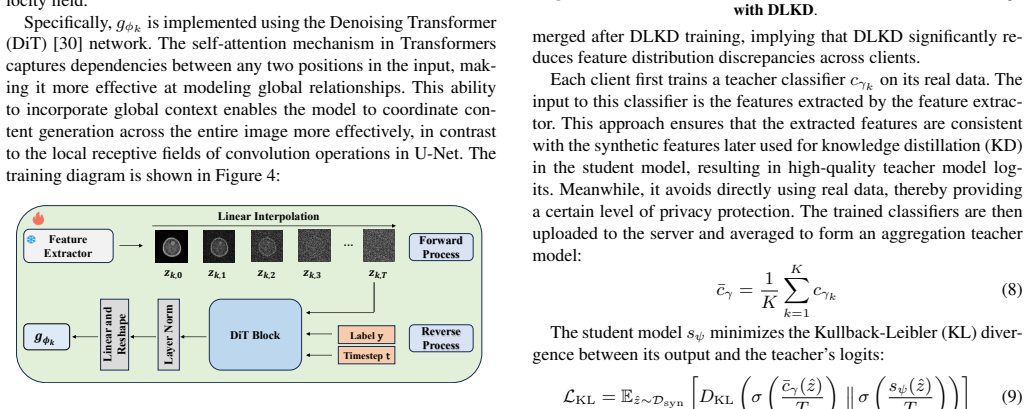
Feature-Guided Rectified Flow (FG-RF) plus Dual-Layer Knowledge Distillation (DLKD). In FG-RF, each client trains a lossy feature extractor (a convolutional layer followed by tanh) and a classifier; the rectified flow model learns the velocity field $g_\phi(z_t, t)$ that transports Gaussian noise $z_T$ to target features $z_0$ along a linear interpolation path, and the server samples synthetic features $\hat{z}$ by solving the ODE. In DLKD, the server averages uploaded classifiers into a teacher $\bar{c}_\gamma$ and trains a student $s_\psi$ on synthetic features with $(1-\alpha)$ cross-entropy, $\alpha$ KL divergence against teacher logits, and $\beta$ $\ell_2$ alignment of the student's third-layer features to the teacher's; this two-depth alignment is the mechanism claimed to reduce both the synthetic-real distribution gap and the logits-only distillation error.
What would settle it
Train a powerful, unconstrained reconstruction decoder against the synthetic features produced by FG-RF and measure the minimum $\ell_2$ distance between reconstructed and original training images; if any original image is recovered at or below the paper's own 0.1 memorization threshold, the claimed strict privacy advantage of feature-level generation over pixel-level generation fails.
Extended reading notes
Core claim
The central claim is that single-round aggregation can converge under non-IID medical data if the synthetic data are generated in a lossy feature space rather than pixel space, and if the student model imitates teachers at two depths. The paper shows this concretely: on three datasets, the framework exceeds the accuracy of multi-round federated learning baselines and of a comparable one-shot medical baseline, while training and inference are far faster than a pixel-level DDPM. Theoretically, the authors argue from the data-processing inequality that a Markov chain $x \to z \to \hat{z}$ obeys $I(x; \hat{z}) \leq I(x; z) < I(x; \hat{x})$, so feature-level generation leaks less about the original image than pixel-level generation, and from an $H$-divergence bound that aligning intermediate features reduces both the distribution gap and the distillation error. Experimentally, feature-level synthetic images have larger $\ell_2$ distance from original images under a memorization threshold, which the paper interprets as evidence of reduced privacy leakage.
Load-bearing premise
The privacy guarantee rests on the claim that the conv+tanh feature extractor is truly lossy — that it destroys enough image information so no decoder can reconstruct the original image; the paper asserts this lossiness but does not measure or bound it for the actual extractor.
Editorial extensions
If this is right
- A single communication round is enough to match or exceed 100-round federated learning on the three datasets tested, so communication costs drop by roughly two orders of magnitude.
- Feature-level rectified flow is much faster than pixel-level DDPM: training time roughly halves and per-image inference drops from tens of seconds to under a second on the reported datasets.
- Feature-level synthetic images stay farther from original images under the $\ell_2$ memorization metric used, giving the method a measurable privacy margin over pixel-level generation.
- The intermediate-feature alignment in DLKD is load-bearing: removing it lowers accuracy, for example from 86.32% to 84.74% on chest X-ray.
- The method reproduces across MRI, chest X-ray, and dermoscopy, indicating the framework is not restricted to a single imaging modality.
Reading between the lines
- A natural next step would be to measure mutual information or reconstruction error for the actual conv+tanh extractor on each dataset; a numeric bound would convert the qualitative privacy argument into a testable guarantee.
- Since DLKD only requires a chosen intermediate layer in student and teacher, the same scheme could in principle aggregate clients with different backbone architectures once a layer correspondence is fixed; the paper does not test this.
- The reported speedups suggest that the efficiency advantage of feature-level rectified flow will grow with image resolution, making the approach a plausible fit for higher-resolution or volumetric medical scans.
Signed reviews
Editorial analysis
A structured set of objections, weighed in public.
Referee Report
Summary. This paper proposes a one-shot federated learning framework for medical image classification. Each client trains a feature extractor and classifier on its local non-IID data, then trains a rectified flow model on the extracted features, and uploads only the classifier and flow model to the server. The server samples synthetic features from the flow models, aggregates the client classifiers into a teacher ensemble, and trains a global student via Dual-Layer Knowledge Distillation that matches both output logits and intermediate-layer features. Experiments on three medical imaging datasets report accuracies of 60.15%, 86.32%, and 70.01%, which the authors interpret as improvements over multi-round FL, over other one-shot methods, and over a DDPM variant, along with lower training and inference times. The paper also presents an information-theoretic privacy analysis and a generalization bound for the distillation step.
Significance. If the empirical results are reproducible, the framework is a useful contribution: it targets a practical problem, one-shot federated learning under non-IID medical data, with a concrete mechanism combining feature-level rectified flow synthesis and two-level knowledge distillation. The reported accuracy gains over FedISCA and over multi-round FL are large, the efficiency comparison with DDPM is favorable, and the authors release code. However, the privacy guarantee, which is a headline contribution, is not established by the current argument, and the empirical claim is undermined by missing variance/seed reporting and by inconsistencies between the abstract and Table 1. The accuracy result is separable from the privacy claim and could stand after revision, but the paper needs substantial reworking before the central claims are supported.
major comments (5)
- [Section 3.4, Eqs. (12)-(16)] The data-processing inequality step I(x;zhat) <= I(x;z) is not valid for the proposed pipeline because the rectified flow model is trained and sampled conditionally on the class label y (Figure 4 and Algorithm 1 line 15), and y is not a deterministic function of z; zhat can therefore carry information about x through y that is not mediated by z, so the Markov chain x -> z -> zhat is not guaranteed. In addition, the assumption H(x|z)>0 in Eq. (15) is asserted rather than established: the feature extractor is a stride-1 convolution followed by tanh, and tanh is bijective while a stride-1 convolution can be near-invertible. Please either measure or bound the mutual information for the actual extractor, or replace the formal privacy claim with an empirical reconstruction study under a well-defined threat model.
- [Section 3.4, Eq. (14), and Section 4.5, Table 5] Equation (14) assumes that pixel-level generation achieves H(x|xhat) ≈ 0, but no memorization test is provided to support this, and generative models trained on finite data do not in general memorize every training example. The empirical check in Table 5 also does not establish a privacy advantage: the authors train a feature decoder themselves, which is a cooperative actor rather than a worst-case adversary, and the threshold delta=0.1 from reference [5] is applied without explaining why it remains meaningful for decoded feature-space outputs. Larger average L2 distances under this protocol do not show that feature-level generation leaks less information than pixel-level generation. Please state a concrete adversary model and report reconstruction success or information leakage under that model.
- [Abstract and Section 4.2, Table 1] The central empirical claim is not consistently reported. The abstract states an improvement of up to 21.73% and an average improvement over FedISCA of 21.75%, but the numbers in Table 1 imply improvements over FedAvg of 23.20, 31.44, and 14.93 percentage points (up to 31.44) and improvements over FedISCA of 23.38, 32.78, and 48.51 percentage points (average 34.89). Table 1 also reports no standard deviations, no number of seeds, and no statistical significance. Please correct the abstract, report mean and standard deviation over multiple seeds, and describe the evaluation protocol precisely.
- [Section 3.4, Eqs. (17)-(21)] The generalization analysis is a standard domain-adaptation bound, and the claim that DLKD reduces both terms is not derived. The feature-alignment loss beta L_feat is minimized on synthetic features, but no argument shows that it reduces the H-divergence d_H(D_real, D_syn) or the distillation consistency term |eps_gen(s_psi) - eps_real(cbar_gamma)|. The symbol lambda is also reused for the loss weight in Eq. (1) and for the minimum combined error in Eq. (20), which is confusing. Please either provide a proof of the claimed reduction or state the bound as motivation and remove the claim of proof.
- [Section 4.1 and Algorithm 1] The experimental setup is underspecified to the point of preventing replication. The paper does not state the train/test split, the evaluation protocol, the client/server hyperparameters (learning rates, numbers of epochs, alpha, beta, temperature T, and selected intermediate layer l), or the exact non-IID sharding procedure for the Brain Tumor and HAM10000 datasets. It is also unclear how a client uses the returned student model s_psi on raw images, since s_psi is trained on feature vectors while the feature extractor is not uploaded to the server. The lack of this information, together with the absence of error bars, makes it difficult to rule out data leakage or test-set contamination.
minor comments (5)
- [Section 3 heading and Section 3.3] The acronym is spelled inconsistently: Section 3 introduces 'Dual-Layer Knowledge Distillation (DLDK)', while the title, abstract, and Algorithm 1 use DLKD; please standardize.
- [Eq. (1) and Algorithm 1] Equation (1) writes the cross-entropy loss as L_CE(s_psi(x), y) even though D_syn is composed of synthetic features zhat; the student model input should be written consistently as z or zhat.
- [Algorithm 1, line 7] The notation z_i,T and z_i,0 is introduced without defining the noise endpoint, and T is also used for the total number of epochs; please rename one of these quantities to avoid ambiguity.
- [Table 4] The ablation row labeled 'w/o DLKD and feature extractor' is not clearly defined; please state which components are removed in each row, especially whether this row corresponds to pixel-level generation.
- [Section 4.5, Table 5] The phrases 'Train with pictures' and 'Train with features' are unclear; the caption should describe the two conditions, the decoder training procedure, and why delta=0.1 applies to decoded features.
Circularity Check
Accuracy claims are empirically self-contained, but the §3.4 privacy guarantee is self-definitional: it assumes the feature extractor is lossy (H(x|z)>0) and then 'proves' feature-level generation leaks less, so the theoretical privacy advantage reduces to its construction assumption.
-
self definitional
[Section 3.4, Eqs. (12)-(16); supporting design claim in Section 3.2 ('Feature Extractor Design')]
"Given that the original data x is transformed into a feature z through an irreversible and lossy feature extractor fθ ... the transformation x→z inevitably leads to information loss due to the lossy nature of the feature extractor fθ, i.e., H(x|z) > 0. ... This indicates that the mutual information between x and the generated feature ˆz is strictly less than that between x and ˆx in pixel-level generation, suggesting a lower risk of privacy leakage in feature-level generation."
The inequality I(x;ˆz) < I(x;ˆx) is derived from H(x|z)>0, which is asserted as an inevitable property of the feature extractor rather than measured. That same lossiness is the paper's stated design rationale for the feature extractor, which is chosen because it 'irreversibly perturbs the original image, thereby preventing excessive information leakage.' Thus the theorem's conclusion is entailed by its own construction assumption: if the extractor were not lossy, Eq. (15) would fail. The privacy guarantee is a restatement of the design premise, not an independent derivation. The empirical Table 5 test is a separate, weaker check using a cooperative decoder, but the theoretical proof itself is circular.
full rationale
The main accuracy derivation is not circular. The framework trains local feature extractors and rectified flow models, synthesizes a server-side feature dataset, and applies dual-layer knowledge distillation; the reported gains over FedAvg, FedISCA, and a DDPM baseline are empirical comparisons with ablations, and no fitted parameter is renamed as a prediction. The self-citations (e.g., refs. 24-26, 35, 39, 43) are used as background, dataset sources, or prior OSFL/medical diffusion work and are not load-bearing for the central empirical claim. The one genuine circular step is the privacy analysis in Section 3.4: Eq. (15) concludes I(x;z)<H(x) solely from the assertion that the feature extractor is 'lossy' and 'irreversible,' which is exactly the design property used to motivate the extractor. The theorem therefore proves the privacy advantage by assuming it. Separately, the DPI chain x→z→ˆz is not established because the rectified flow model is label-conditioned during training (Figure 4 and Algorithm 1), so ˆz may carry information about x beyond z; this is a correctness gap rather than a circularity. Since the accuracy contribution remains independent and empirically supported, the overall circularity is partial and localized to the theoretical privacy claim.
Assumptions & free parameters
free parameters (5)
- loss weight alpha =
not reported
- loss weight beta =
not reported
- distillation temperature T =
not reported
- selected intermediate layer l =
third layer of ResNet-18
- privacy threshold delta =
0.1
assumptions (4)
- standard math Shannon mutual information and the data processing inequality hold for the defined Markov chain x -> z -> z_hat.
- domain assumption The feature extractor is lossy, so H(x|z) > 0.
- standard math Ben-David domain adaptation bound applies to the synthetic and real distributions.
- domain assumption For pixel-level generation, the conditional entropy H(x|x_hat) is approximately zero.
Cite this review
Pith. "Pith review of A New One-Shot Federated Learning Framework for Medical Imaging Classification with Feature-Guided Rectified Flow and Knowledge Distillation." pith.science (2026). https://pith.science/paper/BRCKTL6T
@misc{pith2026250719045,
  author       = {Pith},
  title        = {Pith review of: A New One-Shot Federated Learning Framework for Medical Imaging Classification with Feature-Guided Rectified Flow and Knowledge Distillation},
  year         = {2026},
  howpublished = {\url{https://pith.science/paper/BRCKTL6T}},
  note         = {Machine review of arXiv:2507.19045}
}
read the original abstract
In multi-center scenarios, One-Shot Federated Learning (OSFL) has attracted increasing attention due to its low communication overhead, requiring only a single round of transmission. However, existing generative model-based OSFL methods suffer from low training efficiency and potential privacy leakage in the healthcare domain. Additionally, achieving convergence within a single round of model aggregation is challenging under non-Independent and Identically Distributed (non-IID) data. To address these challenges, in this paper a modified OSFL framework is proposed, in which a new Feature-Guided Rectified Flow Model (FG-RF) and Dual-Layer Knowledge Distillation (DLKD) aggregation method are developed. FG-RF on the client side accelerates generative modeling in medical imaging scenarios while preserving privacy by synthesizing feature-level images rather than pixel-level images. To handle non-IID distributions, DLKD enables the global student model to simultaneously mimic the output logits and align the intermediate-layer features of client-side teacher models during aggregation. Experimental results on three non-IID medical imaging datasets show that our new framework and method outperform multi-round federated learning approaches, achieving up to 21.73% improvement, and exceeds the baseline FedISCA by an average of 21.75%. Furthermore, our experiments demonstrate that feature-level synthetic images significantly reduce privacy leakage risks compared to pixel-level synthetic images. The code is available at https://github.com/LMIAPC/one-shot-fl-medical.
Figures


Figures from the paper (2 more)

Reference graph
Works this paper leans on
-
[5]
N. Carlini, J. Hayes, M. Nasr, M. Jagielski, V . Sehwag, F. Tramer, B. Balle, D. Ippolito, and E. Wallace. Extracting training data from diffusion models. In 32nd USENIX Security Symposium (USENIX Se- curity 23), pages 5253–5270, 2023
work page 2023
-
[1]
Brain Tumor Classification (MRI) — kaggle.com. https://www.kaggle. com/datasets/sartajbhuvaji/brain-tumor-classification-mri. [Accessed 30-04-2025]
work page 2025
-
[2]
M. Beitollahi, A. Bie, S. Hemati, L. M. Brunswic, X. Li, X. Chen, and G. Zhang. Parametric feature transfer: One-shot federated learning with foundation models. arXiv preprint arXiv:2402.01862, 2024
arXiv 2024
-
[3]
S. Ben-David, J. Blitzer, K. Crammer, A. Kulesza, F. Pereira, and J. W. Vaughan. A theory of learning from different domains. Machine learn- ing, 79:151–175, 2010
work page 2010
- [4]
-
[6]
H. Chen, H. Li, Y . Zhang, J. Bi, G. Zhang, Y . Zhang, P. Torr, J. Gu, D. Krompass, and V . Tresp. Fedbip: Heterogeneous one-shot feder- ated learning with personalized latent diffusion models. arXiv preprint arXiv:2410.04810, 2024
-
[7]
R. Dai, Y . Zhang, A. Li, T. Liu, X. Yang, and B. Han. Enhancing one- shot federated learning through data and ensemble co-boosting. arXiv preprint arXiv:2402.15070, 2024
arXiv 2024
-
[8]
Y . Deng, Y . Zhou, G. Liu, J. H. Wang, and Y . Shui. Enhancing fed- erated learning by one-shot transferring of intermediate features from clients. In 2023 IEEE 10th International Conference on Data Science and Advanced Analytics (DSAA), pages 1–11. IEEE, 2023
work page 2023
Show all 43 references
-
[9]
N. Guha, A. Talwalkar, and V . Smith. One-shot federated learning. arXiv preprint arXiv:1902.11175, 2019
1902 arXiv
-
[10]
K. He, X. Zhang, S. Ren, and J. Sun. Deep residual learning for image recognition. In Proceedings of the IEEE conference on computer vision and pattern recognition, pages 770–778, 2016
2016
-
[11]
C. E. Heinbaugh, E. Luz-Ricca, and H. Shao. Data-free one-shot feder- ated learning under very high statistical heterogeneity. In The Eleventh International Conference on Learning Representations, 2023
2023
-
[12]
Hinton, O
G. Hinton, O. Vinyals, and J. Dean. Distilling the knowledge in a neural network. arXiv preprint arXiv:1503.02531, 2015
2015 arXiv
-
[13]
J. Ho, A. Jain, and P. Abbeel. Denoising diffusion probabilistic mod- els. Advances in neural information processing systems, 33:6840–6851, 2020
2020
-
[14]
M. Kang, P. Chikontwe, S. Kim, K. H. Jin, E. Adeli, K. M. Pohl, and S. H. Park. One-shot federated learning on medical data using knowl- edge distillation with image synthesis and client model adaptation. In International Conference on Medical Image Computing and Computer- Ass...
2023
-
[15]
S. P. Karimireddy, S. Kale, M. Mohri, S. Reddi, S. Stich, and A. T. Suresh. Scaffold: Stochastic controlled averaging for federated learn- ing. In International conference on machine learning , pages 5132–
-
[16]
Kasturi and C
A. Kasturi and C. Hota. Osgan: One-shot distributed learning using generative adversarial networks. The Journal of Supercomputing , 79 (12):13620–13640, 2023
2023
-
[17]
Kasturi, A
A. Kasturi, A. R. Ellore, and C. Hota. Fusion learning: A one shot fed- erated learning. In Computational Science–ICCS 2020: 20th Interna- tional Conference, Amsterdam, The Netherlands, June 3–5, 2020, Pro- ceedings, Part III 20, pages 424–436. Springer, 2020
2020
-
[18]
Kolchinsky, B
A. Kolchinsky, B. D. Tracey, and D. H. Wolpert. Nonlinear information bottleneck. Entropy, 21(12):1181, 2019
2019
-
[19]
Q. Li, B. He, and D. Song. Practical one-shot federated learning for cross-silo setting. arXiv preprint arXiv:2010.01017, 2020
2010 arXiv
-
[20]
Q. Li, B. He, and D. Song. Model-contrastive federated learning. In Proceedings of the IEEE/CVF conference on computer vision and pat- tern recognition, pages 10713–10722, 2021
2021
-
[21]
T. Li, A. K. Sahu, M. Zaheer, M. Sanjabi, A. Talwalkar, and V . Smith. Federated optimization in heterogeneous networks. Proceedings of Ma- chine learning and systems, 2:429–450, 2020
2020
-
[22]
S. Liu, R. Zhang, M. Fang, H. Li, T. Xun, Z. Wang, W. Shang, J. Tian, and D. Dong. Pcrfed: personalized federated learning with contrastive representation for non-independently and identically distributed medi- cal image segmentation. Visual Computing for Industry, Biomedicine...
2025
-
[23]
X. Liu, C. Gong, and Q. Liu. Flow straight and fast: Learning to generate and transfer data with rectified flow. arXiv preprint arXiv:2209.03003, 2022
2022 arXiv
-
[24]
Y . Liu, G. Luo, and Y . Zhu. Fedfms: Exploring federated founda- tion models for medical image segmentation. In International Con- ference on Medical Image Computing and Computer-Assisted Interven- tion, pages 283–293. Springer, 2024
2024
-
[25]
G. Luo, T. Liu, J. Lu, X. Chen, L. Yu, J. Wu, D. Z. Chen, and W. Cai. In- fluence of data distribution on federated learning performance in tumor segmentation. Radiology: Artificial Intelligence, 5(3):e220082, 2023
2023
-
[26]
G. Luo, H. Zhang, X. Wang, M. Chen, and Y . Zhu. Mpcpa: Multi-center privacy computing with predictions aggregation based on denoising dif- fusion probabilistic model. arXiv preprint arXiv:2403.07838, 2024
2024 arXiv
-
[27]
Luo and S
J. Luo and S. Wu. Fedsld: Federated learning with shared label distribu- tion for medical image classification. In 2022 IEEE 19th International Symposium on Biomedical Imaging (ISBI), pages 1–5. IEEE, 2022
2022
-
[28]
A new one-shot federated learning framework for medical imaging classification with feature-guided rectified flow and knowl- edge distillation
Y . Ma, H. Zhang, Q. Yang, G. Luo, and Y . Zhu. Supplementary ma- terial for "A new one-shot federated learning framework for medical imaging classification with feature-guided rectified flow and knowl- edge distillation". Zenodo, 2025. Available at https://doi.org/10.5281/ ze...
2025
-
[29]
McMahan, E
B. McMahan, E. Moore, D. Ramage, S. Hampson, and B. A. y Arcas. Communication-efficient learning of deep networks from decentralized data. In Artificial intelligence and statistics, pages 1273–1282. PMLR, 2017
2017
-
[30]
Peebles and S
W. Peebles and S. Xie. Scalable diffusion models with transformers. In Proceedings of the IEEE/CVF international conference on computer vision, pages 4195–4205, 2023
2023
-
[31]
Rombach, A
R. Rombach, A. Blattmann, D. Lorenz, P. Esser, and B. Ommer. High- resolution image synthesis with latent diffusion models. InProceedings of the IEEE/CVF conference on computer vision and pattern recogni- tion, pages 10684–10695, 2022
2022
-
[32]
C. E. Shannon. A mathematical theory of communication. The Bell system technical journal, 27(3):379–423, 1948
1948
-
[33]
Tschandl, C
P. Tschandl, C. Rosendahl, and H. Kittler. The ham10000 dataset, a large collection of multi-source dermatoscopic images of common pig- mented skin lesions. Scientific data, 5(1):1–9, 2018
2018
-
[34]
J. Wang, Q. Liu, H. Liang, G. Joshi, and H. V . Poor. Tackling the objective inconsistency problem in heterogeneous federated optimiza- tion. Advances in neural information processing systems , 33:7611– 7623, 2020
2020
-
[35]
J. Xie, Z. Zhang, Z. Weng, Y . Zhu, and G. Luo. Meddiff-ft: Data- efficient diffusion model fine-tuning with structural guidance for con- trollable medical image synthesis. arXiv preprint arXiv:2507.00377 , 2025
2025 arXiv
-
[36]
M. Yang, S. Su, B. Li, and X. Xue. One-shot federated learning with classifier-guided diffusion models. arXiv preprint arXiv:2311.08870 , 2023
2023 arXiv
-
[37]
M. Yang, S. Su, B. Li, and X. Xue. Exploring one-shot semi-supervised federated learning with pre-trained diffusion models. In Proceedings of the AAAI Conference on Artificial Intelligence , volume 38, pages 16325–16333, 2024
2024
-
[38]
M. Yang, S. Su, B. Li, and X. Xue. Feddeo: Description-enhanced one- shot federated learning with diffusion models. In Proceedings of the 32nd ACM International Conference on Multimedia, pages 6666–6675, 2024
2024
-
[39]
Zhang, M
H. Zhang, M. Chen, Y . Liu, G. Luo, and Y . Zhu. Non-iid medical im- age segmentation based on cascaded diffusion model for diverse multi- center scenarios. IEEE Journal of Biomedical and Health Informatics , 2025
2025
-
[40]
Zhang, C
J. Zhang, C. Chen, B. Li, L. Lyu, S. Wu, S. Ding, C. Shen, and C. Wu. Dense: Data-free one-shot federated learning. Advances in Neural In- formation Processing Systems, 35:21414–21428, 2022
2022
-
[41]
Zhang, X
J. Zhang, X. Qi, and B. Zhao. Federated generative learning with foun- dation models. arXiv preprint arXiv:2306.16064, 2023
2023 arXiv
-
[42]
Y . Zhou, G. Pu, X. Ma, X. Li, and D. Wu. Distilled one-shot federated learning. arXiv preprint arXiv:2009.07999, 2020
2009 arXiv
-
[43]
Z. Zhou, G. Luo, M. Chen, Z. Weng, and Y . Zhu. Federated learning for medical image classification: A comprehensive benchmark. arXiv preprint arXiv:2504.05238, 2025
2025 arXiv
Reviewed August 15, 2026 · model on record in the stance chip above.
Discussion (0). Continue with ORCID to comment.