REVIEW 5 major objections 5 minor 50 references
GCL-GCN: Graphormer and Contrastive Learning Enhanced Attributed Graph Clustering Network
T0 review · 5 major / 5 minor · reviewed 2026-08-15 · deepseek-v4-flash
Pith's one-line read GCL-GCN claims that a four-module fusion — autoencoder, GCN, Graphormer, and contrastive learning — beats 14 attributed graph clustering methods on six datasets, with the biggest reported gain over MBN on Cora.
desk verdict A plausible modular graph-clustering architecture whose universal performance claim is contradicted by its own tables; worth reviewing but needs major revision. read the letter →
The pith
A machine-rendered reading of the paper's core claim, the machinery that carries it, and where it could break.
The reading
What carries the argument
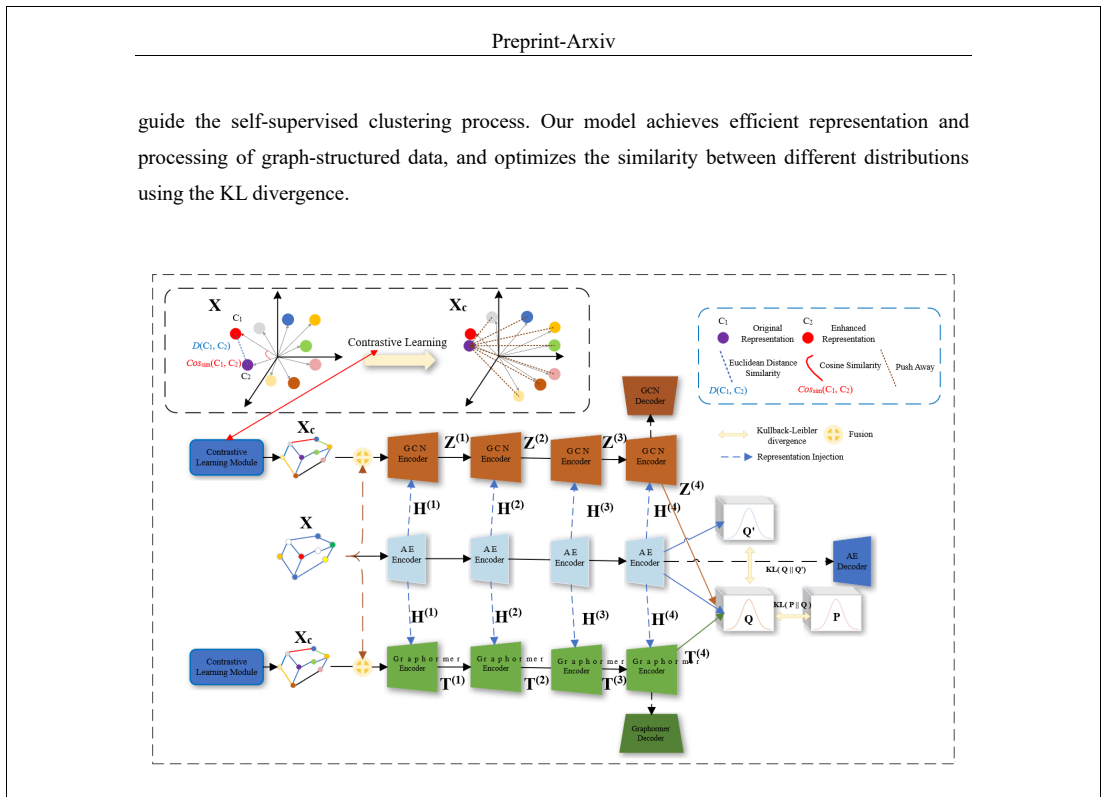
The machinery that carries the argument is the Graphormer encoder layer. It is a transformer-convolution layer that injects two extra signals into multi-head attention: a composite centrality vector $C(v)=[C_D(v), C_B(v), C_C(v)]$ built from degree, betweenness, and closeness centrality, and a Euclidean spatial relation $d(i,j)$ added to each scaled dot-product attention score before softmax. This is what lets the attention mechanism respect local graph geometry while still seeing global dependencies. The second carrying mechanism is the contrastive pretraining module: it masks random features to build an augmented view and trains a two-layer GCN with a hybrid similarity score $(\mathrm{CosSim}\times \mathrm{EucSim})^\beta$ under a temperature-scaled cross-entropy loss. The third is the dual self-supervised module, where the fused embedding $Z_L=\tilde A(\lambda Z_{GCN}^{(L)}+\theta Z_{AE}^{(L)}+\gamma Z_T^{(L)})$ produces soft assignments and a sharpened target, and the total loss $L = L_{rec} + \alpha L_{clu} + \beta L_{con}$ coordinates reconstruction, clustering, and consistency.
What would settle it
Two checks would settle the central claim: rerun the Cora configuration from the supplied code with the stated seed and try to reproduce the reported means and standard deviations; and verify that the SCGC row in Table 4 actually comes from a self-supervised contrastive graph clustering method, since the bibliography entry [45] points to a paper on self-compacting geopolymer concrete.
Extended reading notes
Core claim
The paper's central claim is that fusing the embeddings of three encoders—a linear autoencoder on node attributes, a GCN on the attribute-plus-structure graph, and a Graphormer module with centrality and spatial encodings—along with a contrastive pretraining stage on the original feature matrix yields better clustering than any single inductive bias used alone. The fused representation is $Z_L=\tilde A(\lambda Z_{GCN}^{(L)}+\theta Z_{AE}^{(L)}+\gamma Z_T^{(L)})$, and it feeds a dual self-supervised loop in which Student-t soft assignments $Q$ are sharpened into a target distribution $P$ and the model minimizes $KL(P\parallel Q)$ plus a consistency term $KL(Q\parallel Q')$, together with reconstruction losses for the attribute and adjacency matrices. Across six datasets and four metrics (ACC, NMI, ARI, F1) the paper reports best or second-best results on most settings, and on Cora it reports ACC 73.24, NMI 55.16, ARI 52.19, which are improvements over MBN of 4.94%, 13.01%, and 10.97% respectively. The paper also concedes that TDCN remains better on Reuters metrics and on HHAR NMI.
Load-bearing premise
The load-bearing premise is that the comparison is fair: all 14 baseline numbers come from matched experimental conditions, and the dataset-specific hyperparameters in Table 2 were not chosen using the clustering labels that define the test.
Editorial extensions
If this is right
- If the reported margins hold, modular fusion of a local GCN, a global Graphormer, and contrastive pretraining is a workable alternative to choosing a single architecture for attributed graph clustering.
- The ablation study implies each module is load-bearing: removing GCN, Graphormer, or contrastive learning lowers mean accuracy, NMI, ARI, or F1 on most datasets, and on Cora ACC falls from 73.52 to 47.93 when any one of them is removed.
- The encoding comparison implies the specific encodings matter: combining degree, betweenness, and closeness centrality with Euclidean spatial distance beats shortest-path distance and single-centrality variants on most metrics.
- The layer-number experiment implies three encoder/decoder layers is the preferred depth, with four layers causing large drops such as DBLP ACC falling from 79.81 to 44.49.
- The contrastive-module comparison implies a shallow two-layer GCN with simple random-feature dropout outperforms more complex augmentations and deeper encoders for this clustering objective.
Reading between the lines
- A test the paper does not run is a single fixed choice of the fusion weights $\lambda,\theta,\gamma$ across all six datasets; since Table 2 tunes them per dataset, such a test would separate the architecture's contribution from per-dataset tuning.
- The contrastive pretraining stage could be checked directly by measuring cluster separation on the contrastively transformed features $X_c$ versus the raw $X$ before downstream training; the paper claims stronger discriminability but does not report such a diagnostic.
- The same modular recipe might transfer to other unsupervised graph tasks such as node classification or link prediction, but the paper only evaluates clustering, so that transfer is an extension, not a claim.
Signed reviews
Editorial analysis
A structured set of objections, weighed in public.
Referee Report
Summary. The paper proposes GCL-GCN, a deep attributed graph clustering model that combines an autoencoder, a GCN, a Graphormer-style module with centrality and spatial encodings, and a contrastive learning pretraining stage. The claimed novelty is the joint use of these modules to capture both local and global structure, with a multi-task loss for reconstruction, clustering, and consistency. Experiments are reported on six datasets (ACM, DBLP, CiteSeer, Cora, HHAR, Reuters) against 14 comparison methods, and the abstract and conclusion assert that GCL-GCN outperforms all 14 methods in clustering quality and robustness.
Significance. If the reported results were reproducible and the comparisons fair, the paper would offer a useful modular recipe for attributed graph clustering, with the Graphormer-style centrality/spatial encoding and the contrastive pretraining as the most distinctive ingredients. The paper also ships a public code link and presents ablation, hyperparameter sensitivity, layer-number, and encoding-method experiments, which are appropriate checks for a systems-style clustering paper. However, the central universal claim of outperforming all 14 baselines is contradicted by the paper's own tables, and the experimental protocol has unresolved reproducibility questions; the contribution is thus not validated as written.
major comments (5)
- [Abstract, Section 4.5, Tables 3 and 4] The central claim that GCL-GCN 'outperforms 14 advanced methods' is contradicted by the paper's own reported numbers. On HHAR, TDCN beats OURS on all four metrics (ACC 88.32 vs 83.07, NMI 82.24 vs 81.05, ARI 77.22 vs 73.45, F1 88.12 vs 83.81) and DFCN also beats OURS on all four HHAR metrics. On Reuters, TDCN's NMI (59.28) exceeds OURS (56.76) and IDEC's F1 (76.21) exceeds OURS (73.58). On Cora, CONVERT beats OURS on ACC (73.99 vs 73.24) and F1 (72.84 vs 64.79), while SCGC beats OURS on NMI (55.78 vs 55.16). Section 4.5 itself concedes that GCL-GCN's NMI on HHAR and various metrics on Reuters fall short of TDCN. The universal claim should be revised to a 'competitive on most datasets' statement, or the tables and comparisons must be corrected.
- [Section 4.4, Tables 3 and 4] The reproducibility premise is internally inconsistent: Section 4.4 states 'we set a random seed' to ensure reproducibility, but Tables 3 and 4 report mean ± standard deviation, which requires multiple runs. The manuscript does not state the number of independent runs, the range of seeds, or whether the baselines were rerun under identical conditions or copied from prior papers. Without this information, the reported means and variances cannot be independently verified, and the comparisons may not be apples-to-apples.
- [Table 2, Section 4.6] The model uses many dataset-specific hyperparameters (α, β, λ, θ, γ, learning rate, epochs, nz), and Section 4.6 reports the 'highest F1 scores' obtained after searching over λ and θ. The paper does not describe a validation procedure or state whether test labels were used for model selection. If the final reported numbers are the best over a hyperparameter grid, the improvements over baselines may be inflated by selection bias. Please specify the validation protocol, or report results for a fixed configuration independent of the test labels.
- [Section 3.4, Eq. (9) and Eq. (16)] The betweenness centrality definition in Eq. (9) uses σ_st(v) for both the total number of shortest paths and the number of those paths passing through v; the standard notation is σ_st for the former. As written, the formula is circular. Additionally, Eq. (16) adds the raw Euclidean distance d(i,j) to the attention logits, which would increase attention between distant nodes, the opposite of what a spatial proximity bias should do. Please clarify the intended bias (e.g., −d(i,j) or a learned transformation) and correct the notation.
- [References [3] and [45]] Two references are clearly mismatched. Reference [3] is cited in Section 2.4 as the source of the Graphormer model, but it points to Wang et al.'s 'Dual contrastive attributed graph clustering network' rather than Ying et al.'s Graphormer paper. Reference [45] is cited for the SCGC clustering method, but the bibliographic entry is a paper on self-compacting geopolymer concrete. These citation errors affect the credibility of the related-work survey and must be fixed.
minor comments (5)
- [Table 3 and Table 4 captions] Both table captions say 'seven datasets,' but the paper uses six datasets; please correct the captions.
- [Section 3.8, Eq. (37)] The text says 'In Eq. (36), referring to the MBN model setup,' but the adjacency reconstruction weighting appears in Eq. (37); the equation number should be updated.
- [Section 4.4] The deployment environment is described as 'PyTorch 3.9.0,' which appears to conflate Python and PyTorch versions; please specify both correctly.
- [Eq. (41)] The notation '𝐇𝐺𝑖̂ = 𝐇𝐴𝐸̂' in Eq. (41) is visually confusing; please align the hat placement and define all symbols consistently.
- [Abstract] The source code link is mentioned, but the manuscript does not describe the repository contents, license, or instructions for reproducing the reported results; please add a reproducibility statement.
Circularity Check
No circularity found: the central claim is an empirical benchmark comparison, not a derivation chain that reduces to its own inputs.
full rationale
GCL-GCN is an empirical clustering paper. Its central assertion, stated in the abstract and Section 4.5, is that the proposed architecture outperforms 14 baselines on six benchmark datasets. That assertion is evaluated against external baselines and external datasets, and it is not derived from the method's own definitions. The model's objective in Eq. (42) combines reconstruction losses, a KL-divergence clustering loss, and a consistency loss, and Eq. (44) assigns cluster labels by argmax over the soft assignment Q; none of these equations encodes the reported ACC, NMI, ARI, or F1 numbers by construction. No fitted parameter is renamed as a prediction: the dataset-specific hyperparameters lambda, theta, gamma, alpha, beta, learning rate, and epoch count are tuned and reported, but the paper does not claim to predict those values or to derive the benchmark numbers from them. There are no load-bearing self-citations: the cited MBN, TDCN, and Graphormer works are external baselines or standard components, and no uniqueness theorem from the present authors is invoked to force the architecture. The paper's tables do contain internal inconsistencies, such as TDCN and DFCN exceeding OURS on all four HHAR metrics and some Reuters and Cora metrics despite the abstract's universal superiority claim, but that is an empirical-support and correctness problem, not a circularity problem. The reported standard deviations alongside a fixed random seed are also a reproducibility concern, not a circularity concern. Overall, the central claim is self-contained empirical evaluation, so the circularity score is 0.
Assumptions & free parameters
free parameters (6)
- lambda, theta, gamma fusion weights =
per dataset, Table 2
- alpha, beta loss weights =
per dataset, Table 2
- contrastive beta in Eq. (27) =
not stated
- dropout rate p and temperature tau =
not stated
- epsilon mixing weight =
0.5
- learning rate, epochs, nz =
per dataset, Table 2
assumptions (3)
- domain assumption Benchmark datasets and baseline numbers are used as fair external comparisons.
- domain assumption The self-supervised target distribution in Eq. (31) improves clustering when minimized via KL divergence.
- domain assumption Centrality and Euclidean spatial encodings in the Graphormer module improve node representations for clustering.
Cite this review
Pith. "Pith review of GCL-GCN: Graphormer and Contrastive Learning Enhanced Attributed Graph Clustering Network." pith.science (2026). https://pith.science/paper/QE7B2S7A
@misc{pith2026250719095,
  author       = {Pith},
  title        = {Pith review of: GCL-GCN: Graphormer and Contrastive Learning Enhanced Attributed Graph Clustering Network},
  year         = {2026},
  howpublished = {\url{https://pith.science/paper/QE7B2S7A}},
  note         = {Machine review of arXiv:2507.19095}
}
read the original abstract
Attributed graph clustering holds significant importance in modern data analysis. However, due to the complexity of graph data and the heterogeneity of node attributes, leveraging graph information for clustering remains challenging. To address this, we propose a novel deep graph clustering model, GCL-GCN, specifically designed to address the limitations of existing models in capturing local dependencies and complex structures when dealing with sparse and heterogeneous graph data. GCL-GCN introduces an innovative Graphormer module that combines centrality encoding and spatial relationships, effectively capturing both global and local information between nodes, thereby enhancing the quality of node representations. Additionally, we propose a novel contrastive learning module that significantly enhances the discriminative power of feature representations. In the pre-training phase, this module increases feature distinction through contrastive learning on the original feature matrix, ensuring more identifiable initial representations for subsequent graph convolution and clustering tasks. Extensive experimental results on six datasets demonstrate that GCL-GCN outperforms 14 advanced methods in terms of clustering quality and robustness. Specifically, on the Cora dataset, it improves ACC, NMI, and ARI by 4.94%, 13.01%, and 10.97%, respectively, compared to the primary comparison method MBN.
Figures


Figures from the paper (6 more)


Reference graph
Works this paper leans on
-
[3]
Dual contrastive attributed graph clustering network
Wang T, Yang G, Wu J, He Q, Zhang Z. Dual contrastive attributed graph clustering network. arXiv Preprint arXiv:220607897 2022
work page 2022
-
[45]
Structural Deep Clustering Network
Bo D, Wang X, Shi C, Zhu M, Lu E, Cui P. Structural Deep Clustering Network. Proceedings of The Web Conference 2020, Taipei Taiwan: ACM; 2020, p. 1400 –10. https://doi.org/10.1145/3366423.3380214
arXiv 2020
-
[1]
Mutual Boost Network for attributed graph clustering
Yan X, Y u X, Hu S, Ye Y . Mutual Boost Network for attributed graph clustering. Expert Systems with Applications 2023;229:120479
work page 2023
-
[2]
Transformer-based dynamic fusion clustering network
Zhang C, Zhao Y , Wang J. Transformer-based dynamic fusion clustering network. Knowledge- Based Systems 2022;258:109984
work page 2022
-
[4]
Contrastive Learning with Hard Negative Samples 2021
Robinson J, Chuang C-Y , Sra S, Jegelka S. Contrastive Learning with Hard Negative Samples 2021
work page 2021
-
[5]
Variational Graph Auto-Encoders 2016
Kipf TN, Welling M. Variational Graph Auto-Encoders 2016
work page 2016
-
[6]
Graph clustering with graph neural networks
Tsitsulin A, Palowitch J, Perozzi B, Müller E. Graph clustering with graph neural networks. Journal of Machine Learning Research 2023;24:1–21
work page 2023
-
[7]
Vaswani A, Shazeer N, Parmar N, Uszkoreit J, Jones L, Gomez AN, et al. Attention is all you need. Advances in Neural Information Processing Systems 2017;30
work page 2017
Show all 50 references
-
[8]
Graph Transformer Networks: Learning meta-path graphs to improve GNNs
Yun S, Jeong M, Yoo S, Lee S, Yi SS, Kim R, et al. Graph Transformer Networks: Learning meta-path graphs to improve GNNs. NEURAL NETWORKS 2022;153:104–19
2022
-
[9]
Contrastive clustering
Li Y , Hu P, Liu Z, Peng D, Zhou JT, Peng X. Contrastive clustering. Proceedings of the AAAI conference on artificial intelligence, vol. 35, 2021, p. 8547–55
2021
-
[10]
Deep graph clustering via dual correlation reduction
Liu Y , Tu W, Zhou S, Liu X, Song L, Yang X, et al. Deep graph clustering via dual correlation reduction. Proceedings of the AAAI conference on artificial intelligence, vol. 36, 2022, p. 7603–11
2022
-
[11]
Some methods for classification and analysis of multivariate observations
MacQueen J. Some methods for classification and analysis of multivariate observations. Proceedings of the fifth Berkeley symposium on mathematical statistics and probability, vol. 1, Oakland, CA, USA; 1967, p. 281–97
1967
-
[12]
Unsupervised deep embedding for clustering analysis
Xie J, Girshick R, Farhadi A. Unsupervised deep embedding for clustering analysis. International conference on machine learning, PMLR; 2016, p. 478–87
2016
-
[13]
Deep discriminative clustering network
Shaol X, Ge K, Su H, Luo L, Peng B, Li D. Deep discriminative clustering network. 2018 International Joint Conference on Neural Networks (IJCNN), IEEE; 2018, p. 1–7
2018
-
[14]
Variational Deep Embedding: An Unsupervised and Generative Approach to Clustering 2017
Jiang Z, Zheng Y , Tan H, Tang B, Zhou H. Variational Deep Embedding: An Unsupervised and Generative Approach to Clustering 2017
2017
-
[15]
Embedding graph auto -encoder for graph clustering
Zhang H, Li P, Zhang R, Li X. Embedding graph auto -encoder for graph clustering. IEEE Transactions on Neural Networks and Learning Systems 2022;34:9352–62
2022
-
[16]
CaEGCN: Cross -attention fusion based enhanced graph convolutional network for clustering
Huo G, Zhang Y , Gao J, Wang B, Hu Y , Yin B. CaEGCN: Cross -attention fusion based enhanced graph convolutional network for clustering. IEEE Transactions on Knowledge and Data Engineering 2021;35:3471–83
2021
-
[17]
Deep fusion clustering network
Tu W, Zhou S, Liu X, Guo X, Cai Z, Zhu E, et al. Deep fusion clustering network. Proceedings of the AAAI Conference on Artificial Intelligence, vol. 35, 2021, p. 9978–87
2021
-
[18]
Graph contrastive learning with augmentations
You Y , Chen T, Sui Y , Chen T, Wang Z, Shen Y . Graph contrastive learning with augmentations. Binxiong Li et al., GCL-GCN: Graphormer and Contrastive Learning Enhanced Attributed Graph Clustering Network 41 Advances in Neural Information Processing Systems 2020;33:5812–23
2020
-
[19]
Deep Graph Contrastive Representation Learning 2020
Zhu Y , Xu Y , Yu F, Liu Q, Wu S, Wang L. Deep Graph Contrastive Representation Learning 2020
2020
-
[20]
Structure -Enhanced Heterogeneous Graph Contrastive Learning
Zhu Y , Xu Y , Cui H, Yang C, Liu Q, Wu S. Structure -Enhanced Heterogeneous Graph Contrastive Learning. Proceedings of the 2022 SIAM International Conference on Data Mining (SDM), Society for Industrial and Applied Mathematics; 2022, p. 82–90
2022
-
[21]
Hyperspectral image classification with contrastive graph convolutional network
Yu W, Wan S, Li G, Yang J, Gong C. Hyperspectral image classification with contrastive graph convolutional network. IEEE Transactions on Geoscience and Remote Sensing 2023;61:1–15
2023
-
[22]
Attention-driven Graph Clustering Network
Peng Z, Liu H, Jia Y , Hou J. Attention-driven Graph Clustering Network. Proceedings of the 29th ACM International Conference on Multimedia, Virtual Event China: ACM; 2021, p. 935–
2021
-
[23]
Do transformers really perform badly for graph representation? Advances in Neural Information Processing Systems 2021;34:28877–88
Ying C, Cai T, Luo S, Zheng S, Ke G, He D, et al. Do transformers really perform badly for graph representation? Advances in Neural Information Processing Systems 2021;34:28877–88
2021
-
[24]
Accurate Learning of Graph Representations with Graph Multiset Pooling 2021
Baek J, Kang M, Hwang SJ. Accurate Learning of Graph Representations with Graph Multiset Pooling 2021
2021
-
[25]
ClusterFormer: Neural clustering attention for efficient and effective transformer
Wang N, Gan G, Zhang P, Zhang S, Wei J, Liu Q, et al. ClusterFormer: Neural clustering attention for efficient and effective transformer. Proceedings of the 60th Annual Meeting of the Association for Computational Linguistics (V olume 1: Long Papers), 2022, p. 2390–402
2022
-
[26]
Semi -Supervised Heterogeneous Graph Learning with Multi-Level Data Augmentation
Chen Y , Qiang S, Ha M, Liu X, Li S, Tong J, et al. Semi -Supervised Heterogeneous Graph Learning with Multi-Level Data Augmentation. ACM Trans Knowl Discov Data 2024;18:1–27. https://doi.org/10.1145/3608953
2024 doi
-
[27]
Masked Label Prediction: Unified Message Passing Model for Semi-Supervised Classification 2021
Shi Y , Huang Z, Feng S, Zhong H, Wang W, Sun Y . Masked Label Prediction: Unified Message Passing Model for Semi-Supervised Classification 2021
2021
-
[28]
A graph skeleton transformer network for action recognition
Jiang Y , Sun Z, Yu S, Wang S, Song Y . A graph skeleton transformer network for action recognition. Symmetry 2022;14:1547
2022
-
[29]
A Systematic Review of Deep Graph Neural Networks: Challenges, Classification, Architectures, Applications & Potential Utility in Bioinformatics 2023
Malla AM, Banka AA. A Systematic Review of Deep Graph Neural Networks: Challenges, Classification, Architectures, Applications & Potential Utility in Bioinformatics 2023
2023
-
[30]
Rotating black holes at large D in Einstein-Gauss-Bonnet theory
Suzuki R, Tomizawa S. Rotating black holes at large D in Einstein-Gauss-Bonnet theory. Phys Rev D 2022;106:024018. https://doi.org/10.1103/PhysRevD.106.024018
2022 doi
-
[31]
Adversarial attack and defense on graph data: A survey
Sun L, Dou Y , Yang C, Zhang K, Wang J, Philip SY , et al. Adversarial attack and defense on graph data: A survey. IEEE Transactions on Knowledge and Data Engineering 2022;35:7693– 711
2022
-
[32]
Visualizing data using t -SNE
Van der Maaten L, Hinton G. Visualizing data using t -SNE. Journal of Machine Learning Research 2008;9. [33]Ünlü R, Xanthopoulos P. Estimating the number of clusters in a dataset via consensus clustering. Expert Systems with Applications 2019;125:33–9
2008
-
[34]
Heterogeneous Graph Attention Network
Wang X, Ji H, Shi C, Wang B, Ye Y , Cui P, et al. Heterogeneous Graph Attention Network. The World Wide Web Conference, San Francisco CA USA: ACM; 2019, p. 2022 –32. Preprint-Arxiv 42 https://doi.org/10.1145/3308558.3313562
2019
-
[35]
DBLP: some lessons learned
Ley M. DBLP: some lessons learned. Proc VLDB Endow 2009;2:1493 –500. https://doi.org/10.14778/1687553.1687577
2009
-
[36]
CiteSeer: an automatic citation indexing system
Giles CL, Bollacker KD, Lawrence S. CiteSeer: an automatic citation indexing system. Proceedings of the third ACM conference on Digital libraries - DL ’98, Pittsburgh, Pennsylvania, United States: ACM Press; 1998, p. 89 –98. https://doi.org/10.1145/276675.276685
1998
-
[37]
Simplifying graph convolutional networks
Wu F, Souza A, Zhang T, Fifty C, Yu T, Weinberger K. Simplifying graph convolutional networks. International conference on machine learning, PMLR; 2019, p. 6861–71
2019
-
[38]
Smart Devices are Different: Assessing and MitigatingMobile Sensing Heterogeneities for Activity Recognition
Stisen A, Blunck H, Bhattacharya S, Prentow TS, Kjærgaard MB, Dey A, et al. Smart Devices are Different: Assessing and MitigatingMobile Sensing Heterogeneities for Activity Recognition. Proceedings of the 13th ACM Conference on Embedded Networked Sensor Systems, Seoul South Ko...
2015
-
[39]
Rcv1: A new benchmark collection for text categorization research
Lewis DD, Yang Y , Russell -Rose T, Li F. Rcv1: A new benchmark collection for text categorization research. Journal of Machine Learning Research 2004;5:361–97
2004
-
[40]
Information Theoretic Measures for Clusterings Comparison: Variants
Vinh NX, Epps J, Bailey J. Information Theoretic Measures for Clusterings Comparison: Variants. Properties, Normalization and Correction for Chance 2009;18
2009
-
[41]
MUC -5 evaluation metrics
Chinchor N, Sundheim BM. MUC -5 evaluation metrics. Fifth Message Understanding Conference (MUC-5): Proceedings of a Conference Held in Baltimore, Maryland, August 25- 27, 1993, 1993
1993
-
[42]
Attributed Graph Clustering: A Deep Attentional Embedding Approach 2019
Wang C, Pan S, Hu R, Long G, Jiang J, Zhang C. Attributed Graph Clustering: A Deep Attentional Embedding Approach 2019
2019
-
[43]
https://doi.org/10.1145/3474085.3475276
-
[44]
Learning representations by back-propagating errors
Rumelhart DE, Hinton GE, Williams RJ. Learning representations by back-propagating errors. Nature 1986;323:533–6
1986
-
[46]
Properties of Chemically Synthesized Nano - geopolymer Cement based Self -Compacting Geopolymer Concrete (SCGC)
Sikandar MA, Jo BW, Baloch Z, Khan MA. Properties of Chemically Synthesized Nano - geopolymer Cement based Self -Compacting Geopolymer Concrete (SCGC). J Wuhan Univ Technol-Mat Sci Edit 2019;34:98–106. https://doi.org/10.1007/s11595-019-2021-2
2019 doi
-
[47]
CONVERT: Contrastive Graph Clustering with Reliable Augmentation
Yang X, Tan C, Liu Y , Liang K, Wang S, Zhou S, et al. CONVERT: Contrastive Graph Clustering with Reliable Augmentation. Proceedings of the 31st ACM International Conference on Multimedia, Ottawa ON Canada: ACM; 2023, p. 319 –27. https://doi.org/10.1145/3581783.3611809
2023
-
[48]
Improved deep embedded clustering with local structure preservation
Guo X, Gao L, Liu X, Yin J. Improved deep embedded clustering with local structure preservation. Ijcai, vol. 17, 2017, p. 1753–9
2017
-
[49]
Attributed Graph Clustering via Adaptive Graph Convolution Binxiong Li et al., GCL-GCN: Graphormer and Contrastive Learning Enhanced Attributed Graph Clustering Network 43 2019
Zhang X, Liu H, Li Q, Wu X-M. Attributed Graph Clustering via Adaptive Graph Convolution Binxiong Li et al., GCL-GCN: Graphormer and Contrastive Learning Enhanced Attributed Graph Clustering Network 43 2019
2019
-
[50]
Learning graph embedding with adversarial training methods
Pan S, Hu R, Fung S, Long G, Jiang J, Zhang C. Learning graph embedding with adversarial training methods. IEEE Transactions on Cybernetics 2019;50:2475–87
2019
-
[51]
Towards robust cluster- based hyperparameter optimization
Izaú L, Fortes M, Ribeiro V , Marques C, Oliveira C, Bezerra E, et al. Towards robust cluster- based hyperparameter optimization. Anais do XXXVII Simpósio Brasileiro de Bancos de Dados, SBC; 2022, p. 439–44
2022
Reviewed August 15, 2026 · model on record in the stance chip above.
Discussion (0). Continue with ORCID to comment.