REVIEW 3 major objections 5 minor 38 references
Achievable Rates for a Distributed Antenna System with No Channel State Information at the Central Processor
T0 review · 3 major / 5 minor · reviewed 2026-08-15 · deepseek-v4-flash
Pith's one-line read The paper derives nearly tight achievable rates for a two-relay diamond network where the central processor has no channel state information, under Gaussian inputs.
desk verdict Solid upper bounds and a useful framework, but the TCI and FC achievability proofs have a gap that undermines the tightness claim in the low-fronthaul regime. read the letter →
The pith
A machine-rendered reading of the paper's core claim, the machinery that carries it, and where it could break.
The reading
What carries the argument
The load-bearing device is the information-theoretic formulation of oblivious relay processing from [21] and [9], where each relay is represented by an auxiliary random variable $Z_k$ conditionally independent of everything else given its own observation $(Y_k,S_k)$, the communication rate is $I(X;Z_1,Z_2)$, and the fronthaul constraints appear as bottleneck inequalities. On top of this, the paper builds a computable upper bound by relaxing two restrictions at once: the central processor is given the full channel state ('informed receiver') and the relays are allowed to cooperate, which turns the network into a single two-antenna oblivious relay whose closed-form rate (10)/(63) follows from the eigenvalue distribution of the channel Gram matrix. The achievable schemes are then concrete choices of the auxiliaries: channel inversion with quantized noise levels, truncated inversion with a selection sequence, MMSE estimation followed by Gaussian compression, and—for two users—joint Gaussian compression of $(H_k,Y_k)$ with a distortion trade-off parameter $D$.
What would settle it
For the single-user model, compute the TCI achievable rate at SNR = 30 dB and fronthaul C = 2 bits per dimension and compare it with the cooperative upper bound $R^{\mathrm{ub}}$ of (10): the paper's figures show near-coincidence at C = 5, so a large gap at C = 2 would delimit the 'broad range' claim. For the two-user model, the decisive test is whether any local joint-compression scheme at C = 5 bits and SNR = 30 dB can approach $R^{\mathrm{ub}}$; the paper's Fig. 10 shows a visible gap there, so that regime is the paper's own boundary case.
Extended reading notes
Core claim
On its own terms, the paper establishes that for the single-user two-relay Gaussian diamond with i.i.d. Rayleigh fading and channel state known only at the relays, the cooperative informed-receiver upper bound $R^{\mathrm{ub}}$ in (10) is closely approached by three achievable schemes—quantized channel inversion ($R^{\mathrm{qci}}$), truncated channel inversion ($R^{\mathrm{tci}}$), and MMSE-based compression ($R^{\mathrm{mmse}}$)—with the TCI scheme best at low fronthaul capacity and QCI best when capacity is ample. For the two-user case, the paper proves that the single-user local-processing ideas cannot be carried over, and instead shows that a fronthaul-compression scheme in which each relay lossily quantizes both its channel state and its received signal, then transmits them together, approaches the cooperative upper bound $R^{\mathrm{ub}}$ in (63) whenever the fronthaul is not the bottleneck. The paper explicitly does not claim an exact capacity characterization, calling it 'surprisingly difficult.'
Load-bearing premise
The load-bearing premise is that users are restricted to Gaussian random codebooks: if non-Gaussian input distributions were allowed, the true ergodic capacity could exceed every rate reported in the paper, so the near-tight bounds are bounds on the Gaussian-input rate, not on unrestricted capacity.
Editorial extensions
If this is right
- If the bounds are as tight as the simulations indicate, a system designer can predict the ergodic rate of a disaggregated RAN uplink without tracking channel state at the central processor, using only local relay processing and the statistics of the fading.
- In the single-user case, the truncated-channel-inversion scheme is essentially optimal when the fronthaul is small: both it and the upper bound converge to $C_1+C_2$ as SNR grows (Lemma 1).
- When the fronthaul is large, the quantized-channel-inversion scheme closes the gap to the upper bound, meaning the bottleneck moves from the relay processing to the fading channel itself, at rate $\mathbb{E}[\log(1+\lambda/\sigma^2)]$ in the limit.
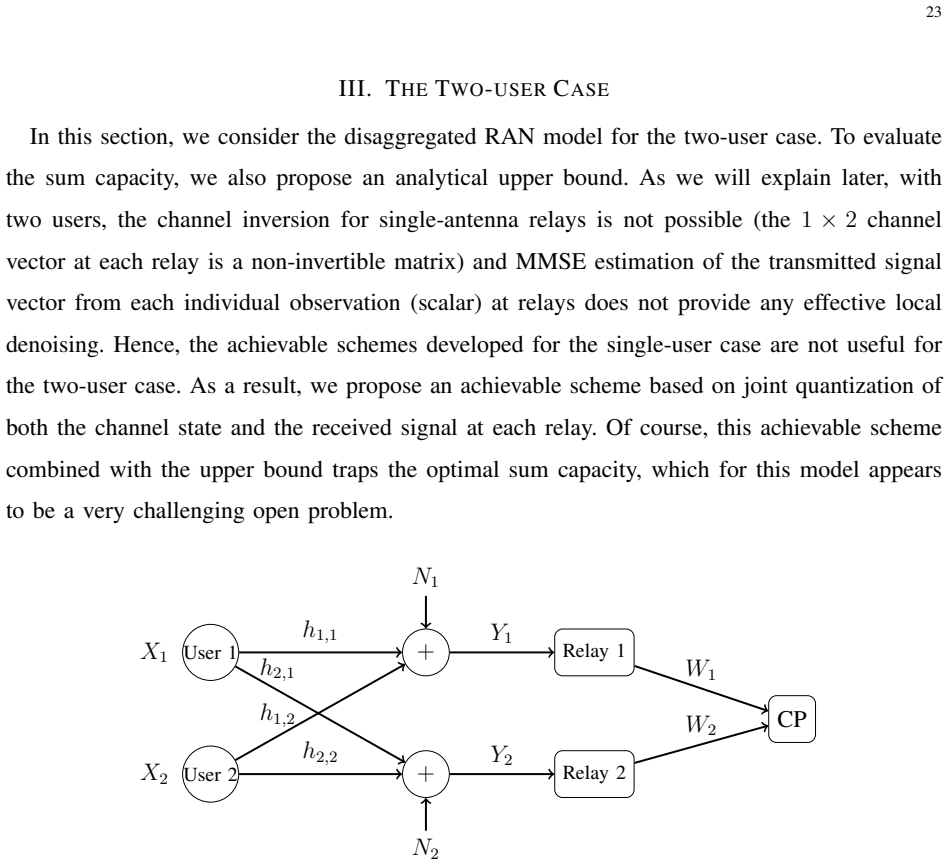
- For two users, the joint compression of channel state and signal is the first scheme that approaches the upper bound at all, and its distortion parameter $D$ trades channel-state accuracy against signal fidelity; no local filtering alone can work because a $1\times 2$ channel vector is not invertible.
- The drift-plus-penalty stochastic optimization provides an $O(1/V)$-accurate way to approximate the harder informed-receiver upper bound, so the tightest bound in the paper can actually be computed (Theorem 1).
Reading between the lines
- The same bounding strategy—relax to an informed cooperative receiver, then build local compression schemes—should extend to more than two relays; the single-antenna-per-relay channel inversion obstruction in the multi-user case suggests that for general $K$, joint $(H,Y)$ compression at each relay is the natural candidate.
- The Gaussian-input restriction is the real ceiling on the reported numbers; a non-Gaussian ensemble designed to exploit the fading structure could in principle push the achievable rate above the Gaussian-input upper bound, so the 'near-tight' claim is conditioned on the input ensemble.
- Because the channel states are i.i.d. per symbol, the setting is the $T=1$ extreme of a block-fading model; the paper's own discussion of block length $T$ suggests the gap between achievable rate and upper bound is likely to shrink further as $T$ grows, since the cost of conveying channel state to the CP falls.
- The natural next test is to close the two-user low-fronthaul gap visible in the paper's Figure 10; if a better scheme succeeds there, the 'fronthaul is not the bottleneck' caveat can be dropped.
Signed reviews
Editorial analysis
A structured set of objections, weighed in public.
Referee Report
Summary. The paper considers a two-relay Gaussian 'diamond' network (single-user and two-user versions) with Rayleigh fading, where each relay knows its own channel state but the central processor (CP) has no channel state information, and the relays are oblivious to the users' codebooks. For the single-user case, the authors derive an analytical cooperative informed-receiver upper bound R^ub, a lower bound to the informed-receiver bound, a DPP-based approximation, and three achievable schemes: quantized channel inversion (QCI), truncated channel inversion (TCI), and an MMSE-based scheme. For the two-user case, they propose a cooperative upper bound and an achievable scheme based on joint fronthaul compression of the received signal and the channel state (FC). The paper's central claim is that the achievable rates perform close to the respective upper bounds over a broad range of parameters, supported by numerical results.
Significance. If the derivations are correct, the paper would provide computationally tractable bounds and practical low-complexity relay strategies for a relevant C-RAN model with partial CSI at the CP. The QCI and MMSE schemes appear to be rigorously derived, as is the analytical upper-bound framework based on [27], and the DPP approximation follows standard stochastic optimization theory. The paper is also honest about the difficulty of exact ergodic capacity and about the Gaussian-input restriction. However, the TCI and FC schemes contain load-bearing gaps in their achievability arguments; without those, the numerical demonstration that the schemes are close to the upper bounds is not fully established. The paper's value is therefore conditional on fixing these proofs.
major comments (3)
- [Section II-C2, Eqs. (32)-(34)] The TCI achievable rate is derived by substituting the average post-selection SNR eρ_k into the fixed-state Gaussian rate expression, but the CP never learns the instantaneous fading coefficient S_k. After selection, the normalized observation is eX_k = X + (S_k^*/|S_k|^2) N_k, and the noise variance |S_k|^{-2}σ^2 remains random and unknown to the CP. The resulting channel is a Gaussian mixture, not the AWGN channel used in [21, Thm. 5], and its capacity is not generally equal to the expression with eρ_k. The appeal to [33] does not close this gap: [33] concerns rate-distortion with mismatched Gaussian codebooks, not joint decoding of an information message at a CP that lacks the fading realizations. No single-letter achievability proof is provided for Eq. (33). Consequently, the TCI rates plotted in Figs. 5 and 6 are not established valid lower bounds, and the claim that TCI approaches R^ub in the limited-fronthaul regime is unsupported.
- [Section III-B, Eqs. (74)-(75)] The FC scheme defines an auxiliary variable Z^{(2)}_{k,g} = Z^{(1)H}_k X + bN_{k,g} + bQ_k in Eq. (74) that depends explicitly on the users' signal X. Since the relays are oblivious to the users' codebooks, they cannot generate a quantization codebook according to this distribution. Moreover, the actual observation is Y_k = Z^{(1)H}_k X + E^H_k X + N_k, where E_k is a non-Gaussian, signal-dependent term. Replacing E^H_k X + N_k with an independent Gaussian noise of the same second moment changes the channel model; no argument is given that the communication rate for the actual channel is at least R_fc. Thus the FC rates in Figs. 8-10 are not established achievable rates. A valid derivation would need to specify a test channel P_{Z^{(2)}_k | Y_k, Z^{(1)}_k} and then evaluate the mutual information terms in Eq. (73) for the true non-Gaussian source.
- [Section II-C2 and Section III-B] Both the TCI and FC schemes invoke [33] to justify the use of Gaussian codebooks for non-Gaussian sources. That reference addresses the rate-distortion performance of mismatched Gaussian codebooks for source coding, not the end-to-end reliability of a relay channel where the CP lacks the state information needed to form the correct likelihoods. The paper should either provide a proper joint-typicality achievability proof for the proposed test channels or clearly state that the rates are heuristic and not established lower bounds.
minor comments (5)
- [Eqs. (32a) and (34a)] The terms eP1(1−bP2)eR1,0 and (1−eP1)bP2eR0,1 in Eq. (32a), and the analogous terms in Eq. (34a), use the QCI probability bP2 where the TCI probability eP2 is clearly intended; this typo should be corrected.
- [Section II-C2, Eq. (32b)] The rate allocation eck = (Ck − eHk)/ePk can become negative when Ck < eHk, making the scheme infeasible. The optimization should explicitly restrict to thresholds Sth for which eck ≥ 0 for all k.
- [Section II-B2 and Appendix B] The constant B is defined in Theorem 1 as (1/K) ∑_k max{C_k^2, (Cmax−C_k)^2}, while the derivation in Eq. (85) uses B = (1/2) ∑_k max{...}; for K=2 these coincide, but the general statement should be made consistent by defining B as the bound on the second moment term in Eq. (83).
- [Section I-B and Eq. (1)] The paper should make more prominent that all rates are for Gaussian channel inputs only; the upper bounds and achievable schemes do not bound the unrestricted capacity over arbitrary input distributions. The current wording is clear in Section I-B but could be repeated in the numerical section to avoid overstatement in the conclusion.
- [Section IV-B2, Fig. 8] The achievable rate for D = 0.001 at low C is reported as zero because the channel-state encoding consumes all available capacity; this behavior is correct but deserves a brief explanation in the text, as it is visible only in the plots and not discussed.
Circularity Check
No significant circularity: the random-state bounds are obtained by averaging published fixed-state results, and the achievable schemes are independently derived lower bounds.
full rationale
The derivation chain is not circular. The random-state upper bounds are built on external fixed-state characterizations: Rub in Eqs. (10)-(11) is the closed form from [27, Thm. 1] for the cooperative informed receiver with CP knowing the state; Rub0 in Eq. (7) is the ergodic average of the fixed-state formula [21, Thm. 5] via parallel channel decomposition; the two-user Rub in Eqs. (63)-(64) follows from [27] and the Wishart eigenvalue density in Eq. (61). These citations are load-bearing, but they are published, parameter-free fixed-state results whose assumptions do not include the target random-state no-CSI rate, so they count as independent support rather than circular self-citation. The achievable schemes are separately constructed lower bounds: QCI sends the quantized channel level indices to the CP, so the parallel evaluation in Eqs. (25)-(27) is legitimate; MMSE verifies the bottleneck constraints and lower-bounds I(X; Z1, Z2) through entropy inequalities; the FC scheme computes a genuine mutual-information expression and only then adopts the single-relay assumption explicitly acknowledged as conservative. No parameter is fitted to make an achievable rate equal an upper bound, and no predicted quantity is defined in terms of the quantity it is supposed to predict. The paper also explicitly states its own limits, e.g., 'an exact characterization of the ergodic capacity for this model is surprisingly difficult' and 'admittedly, a very conservative assumption', which are honest scope statements. The TCI step that replaces the true post-selection noise variance with its average eσ^2_k in Eqs. (30)-(33) is a possible correctness or approximation gap, but it is not circularity: the paper does not define eρ_k as the rate being predicted, nor does it fit the rate to the upper bound. The Gaussian-input restriction is a modeling assumption, not a circular reduction. Therefore the appropriate finding is no significant circularity.
Assumptions & free parameters
free parameters (4)
- QCI quantization bits B =
B = 1, 2, 3, 4 (grid J = 2^B)
- TCI threshold Sth =
Swept from 0 to 2 in steps of 0.1
- FC distortion D =
Simulated values include D = 0.001, 0.01, 0.1, 0.2
- DPP parameters V and Cmax =
V = 100; Cmax searched from C to C+20 in steps of 4
assumptions (5)
- domain assumption Sanderovich et al. [21, Theorem 1]: capacity of the oblivious primitive relay network with fixed channel state known to all nodes is given by the expression in Eq. (2), equivalent to Eq. (5) under Gaussian inputs.
- domain assumption Aguerri et al. [9, Theorems 1 and 4]: sum capacity of the L-user K-relay oblivious network for discrete memoryless and Gaussian channels.
- domain assumption Xu et al. [27, Theorem 1]: closed-form information bottleneck rate for a vector Gaussian relay with channel state known to the relay and receiver.
- standard math Gaussian rate-distortion theory [32, Theorem 10.3.3] and mismatch achievability [33].
- standard math Wishart eigenvalue distributions, including the Marchenko-Pastur and Laguerre forms in Eq. (61).
Cite this review
Pith. "Pith review of Achievable Rates for a Distributed Antenna System with No Channel State Information at the Central Processor." pith.science (2026). https://pith.science/paper/XQEXXC3B
@misc{pith2026250719177,
  author       = {Pith},
  title        = {Pith review of: Achievable Rates for a Distributed Antenna System with No Channel State Information at the Central Processor},
  year         = {2026},
  howpublished = {\url{https://pith.science/paper/XQEXXC3B}},
  note         = {Machine review of arXiv:2507.19177}
}
read the original abstract
A recent trend in wireless communications considers the migration of traditional monolithic base stations to the so-called disaggregated architecture, where radio units (RUs) implement only the low-level physical layer functionalities such as demodulation, and A/D conversion, while the high-level physical layer, such as channel decoding, is implemented as software-defined functions running on general-purpose hardware in some remote central processing unit (CP). The corresponding information theoretic model for the uplink (from the wireless users to the CP) is a multiaccess-relay channel with primitive oblivious relays. The relays (RUs) are oblivious, as they are agnostic of the users codebooks, and primitive, since the fronthaul links (from RUs to CP) are error-free with limited capacity. This class of networks has been intensely studied in the information theoretic literature, where several approximated or exact (under certain conditions) capacity results have been derived. In particular, in the Gaussian case, the model has been analyzed for fixed and known channel state. This paper is motivated by the fact that, in practice, the channel state is a random process, and it is estimated at the base station side through uplink pilot symbols sent by the users. The pilot dimension may take up a large portion of the channel coherence block, i.e., the number of symbols over which the channel state remains approximately constant. Hence, sending both pilot and data symbols from the relays to the CP may require a significant overhead, especially when the fronthaul capacity is small. As a prototypical problem, we consider the ergodic achievable rate for a diamond network formed by a single user and two relays where the channel state is known at the relays, but not known at the CP.
Figures


Figures from the paper (7 more)


Reference graph
Works this paper leans on
-
[33]
On the role of mismatch in rate distortion theory,
A. Lapidoth, “On the role of mismatch in rate distortion theory,” IEEE Trans. Inf. Theory, vol. 43, no. 1, pp. 38–47, 1997
work page 1997
-
[27]
Information bottleneck for an oblivious relay with channel state information: the vector case,
H. Xu, T. Yang, G. Caire, and S. S. Shitz, “Information bottleneck for an oblivious relay with channel state information: the vector case,” Information, vol. 12, no. 4, Apr. 2021
work page 2021
-
[1]
B. 3GPP, “Technical specification group radio access network; NR; physical layer procedures for data (release 15),” 3rd Generation Partnership Project (3GPP), Technical Specification (TS) 38.214 , 2018
work page 2018
-
[2]
Ahmadi, 5G NR: Architecture, Technology, Implementation, and Operation of 3GPP New Radio Standards
S. Ahmadi, 5G NR: Architecture, Technology, Implementation, and Operation of 3GPP New Radio Standards . Elsevier Science, 2019
work page 2019
-
[3]
Y . Xu, E. G. Larsson, E. A. Jorswieck, X. Li, S. Jin, and T.-H. Chang, “Distributed signal processing for extremely large-scale antenna array systems: State-of-the-art and future directions,” IEEE J. Sel. Top. Signal Process. , 2025
work page 2025
-
[4]
Cloud radio access network (C-RAN): a primer,
J. Wu, Z. Zhang, Y . Hong, and Y . Wen, “Cloud radio access network (C-RAN): a primer,” IEEE Netw., vol. 29, no. 1, pp. 35–41, Jan. 2015
work page 2015
-
[5]
Cloud RAN for mobile networks—a technology overview,
A. Checko, H. L. Christiansen, Y . Yan, L. Scolari, G. Kardaras, M. S. Berger, and L. Dittmann, “Cloud RAN for mobile networks—a technology overview,” IEEE Commun. Surveys Tuts. , vol. 17, no. 1, pp. 405–426, 1st Quart. 2015
work page 2015
-
[6]
S.-H. Park, O. Simeone, O. Sahin, and S. Shamai Shitz, “Fronthaul compression for cloud radio access networks: Signal processing advances inspired by network information theory,” IEEE Signal Process. Mag., vol. 31, no. 6, pp. 69–79, 2014
work page 2014
Show all 38 references
-
[7]
Oblivious fronthaul-constrained relay for a Gaussian channel,
A. Homri, M. Peleg, and S. S. Shitz, “Oblivious fronthaul-constrained relay for a Gaussian channel,” IEEE Trans. commun., vol. 66, no. 11, pp. 5112–5123, Nov. 2018
2018
-
[8]
Gaussian diamond primitive relay with oblivious processing,
A. Katz, M. Peleg, and S. Shamai, “Gaussian diamond primitive relay with oblivious processing,” in Proc. IEEE Int. Conf. Micro., Ant., Commun., Elec. Syst. (COMCAS) , Nov. 2019, pp. 1–6
2019
-
[9]
On the capacity of cloud radio access networks with oblivious relaying,
I. E. Aguerri, A. Zaidi, G. Caire, and S. S. Shitz, “On the capacity of cloud radio access networks with oblivious relaying,” IEEE Trans. Inf. Theory , vol. 65, no. 7, pp. 4575–4596, July 2019
2019
-
[10]
Capacity of a class of deterministic relay channels,
Y .-H. Kim, “Capacity of a class of deterministic relay channels,” IEEE Trans. Inf. Theory , vol. 54, no. 3, pp. 1328–1329, 2008
2008
-
[11]
The filtered Gaussian primitive diamond channel,
A. Katz, M. Peleg, and S. Shamai, “The filtered Gaussian primitive diamond channel,” arXiv preprint arXiv:2101.09564 , 2021
2021 arXiv
-
[12]
Distributed information bottleneck for a primitive Gaussian diamond channel with Rayleigh fading,
H. Xu, K.-K. Wong, G. Caire, and S. S. Shitz, “Distributed information bottleneck for a primitive Gaussian diamond channel with Rayleigh fading,” in Proc. IEEE Int. Symp. Inf. Theory (ISIT) , Espoo, Finland, Jun. 2022, pp. 2845–2850
2022
-
[13]
Cloud radio access networks: Uplink channel estimation and downlink precoding,
O. Simeone, J. Kang, J. Kang, and S. Shamai, “Cloud radio access networks: Uplink channel estimation and downlink precoding,” Signal Processing for 5G: Algorithms and Implementations , pp. 429–455, 2016
2016
-
[14]
Communication on the grassmann manifold: A geometric approach to the noncoherent multiple-antenna channel,
L. Zheng and D. N. C. Tse, “Communication on the grassmann manifold: A geometric approach to the noncoherent multiple-antenna channel,” IEEE Trans. Inf. Theory , vol. 48, no. 2, pp. 359–383, 2002
2002
-
[15]
The information bottleneck method,
N. Tishby, F. C. Pereira, and W. Bialek, “The information bottleneck method,” arXiv preprint physics/0004057 , 2000
2000 arXiv
-
[16]
Overview and investigation of algorithms for the information bottleneck method,
S. Hassanpour, D. W ¨ubben, and A. Dekorsy, “Overview and investigation of algorithms for the information bottleneck method,” in Proc. 11th Int. ITG Conf. Syst., Commun. Coding (SCC) . VDE, Feb. 2017, pp. 1–6
2017
-
[17]
Opening the black box of deep neural networks via information,
R. Shwartz-Ziv and N. Tishby, “Opening the black box of deep neural networks via information,” arXiv preprint arXiv:1703.00810, 2017
2017 arXiv
-
[18]
On the information bottleneck problems: models, connections, applications and information theoretic views,
A. Zaidi, I. Estella-Aguerri, and S. S. Shitz, “On the information bottleneck problems: models, connections, applications and information theoretic views,” Entropy, vol. 22, no. 2, p. 151, Jan. 2020
2020
-
[19]
The information bottleneck problem and its applications in machine learning,
Z. Goldfeld and Y . Polyanskiy, “The information bottleneck problem and its applications in machine learning,” IEEE J. Sel. Areas Inf. Theory , vol. 1, no. 1, pp. 19–38, May 2020
2020
-
[20]
Information bottleneck for Gaussian variables,
G. Chechik, A. Globerson, N. Tishby, and Y . Weiss, “Information bottleneck for Gaussian variables,” Advances in Neural Information Processing Systems , vol. 16, 2003. 40
2003
-
[21]
Communication via decentralized processing,
A. Sanderovich, S. Shamai, Y . Steinberg, and G. Kramer, “Communication via decentralized processing,” IEEE Trans. Inf. Theory, vol. 54, no. 7, pp. 3008–3023, Jul. 2008
2008
-
[22]
Distributed information bottleneck method for discrete and Gaussian sources,
I. Estella Aguerri and A. Zaidi, “Distributed information bottleneck method for discrete and Gaussian sources,” in Proc. Int. Zurich Sem. Inf. Commun. (IZS 2018) . ETH Zurich, Feb. 2018, pp. 35–39
2018
-
[23]
Distributed variational representation learning,
I. E. Aguerri and A. Zaidi, “Distributed variational representation learning,” IEEE Trans. Pattern Anal. Mach. Intell. , vol. 43, no. 1, pp. 120–138, July 2019
2019
-
[24]
Multiterminal source coding under logarithmic loss,
T. A. Courtade and T. Weissman, “Multiterminal source coding under logarithmic loss,” IEEE Trans. Inf. Theory , vol. 60, no. 1, pp. 740–761, Jan. 2014
2014
-
[25]
Distributed MIMO receiver—achievable rates and upper bounds,
A. Sanderovich, S. Shamai, and Y . Steinberg, “Distributed MIMO receiver—achievable rates and upper bounds,” IEEE Trans. Inf. Theory, vol. 55, no. 10, pp. 4419–4438, Oct. 2009
2009
-
[26]
Information bottleneck for an oblivious relay with channel state information: the scalar case,
G. Caire, S. Shamai, A. Tulino, S. Verdu, and C. Yapar, “Information bottleneck for an oblivious relay with channel state information: the scalar case,” in Proc. IEEE Int. Conf. Science of Electrical Engineering in Israel (ICSEE) , Eilat, Israel, Dec. 2018, pp. 1–5
2018
-
[28]
Distributed information bottleneck for a primitive Gaussian diamond MIMO channel,
Y . Song, H. Xu, K.-K. Wong, G. Caire, and S. Shamai Shitz, “Distributed information bottleneck for a primitive Gaussian diamond MIMO channel,” in Proc. IEEE Int. Symp. Inf. Theory (ISIT) , Tapei, Taiwan, June 2023, pp. 1484–1489
2023
-
[29]
Interference networks with point-to-point codes,
F. Baccelli, A. El Gamal, and N. David, “Interference networks with point-to-point codes,” IEEE Trans. Inf. Theory, vol. 57, no. 5, pp. 2582–2596, 2011
2011
-
[30]
Resource allocation and cross-layer control in wireless networks,
L. Georgiadis, M. J. Neely, L. Tassiulas et al. , “Resource allocation and cross-layer control in wireless networks,” Foundations and Trends® in Networking , vol. 1, no. 1, pp. 1–144, 2006
2006
-
[31]
Stochastic network optimization with application to communication and queueing systems,
M. J. Neely, “Stochastic network optimization with application to communication and queueing systems,” Synth. Lectures Commun. Netw., vol. 3, no. 1, pp. 1–211, 2010
2010
-
[32]
T. M. Cover and J. A. Thomas, Elements of Information Theory . John Wiley & Sons, 1999
1999
-
[34]
El Gamal and Y .-H
A. El Gamal and Y .-H. Kim, Network Information Theory . Cambridge University Press, 2011
2011
-
[35]
A. M. Tulino, S. Verd ´u et al., Random matrix theory and wireless communications . Now Publishers, 2004
2004
-
[36]
Bounds on the capacity of the multiple access diamond channel with cooperating base-stations,
M. Dikshtein, S. S. Bidokhti, and S. S. Shitz, “Bounds on the capacity of the multiple access diamond channel with cooperating base-stations,” in Proc. IEEE Int. Symp. Inf. Theory (ISIT) . IEEE, 2022, pp. 3031–3036
2022
-
[37]
The broadcast approach in communication networks,
A. Tajer, A. Steiner, and S. Shamai, “The broadcast approach in communication networks,” Entropy, vol. 23, no. 1, p. 120, 2021
2021
-
[38]
A simple convergence time analysis of drift-plus-penalty for stochastic optimization and convex programs,
M. J. Neely, “A simple convergence time analysis of drift-plus-penalty for stochastic optimization and convex programs,” arXiv preprint arXiv:1412.0791 , Dec. 2014
2014 arXiv
Reviewed August 15, 2026 · model on record in the stance chip above.
Discussion (0). Continue with ORCID to comment.