REVIEW 4 major objections 4 minor 31 references
Transfinite Fixed Points in Alpay Algebra as Ordinal Game Equilibria in Dependent Type Theory
T0 review · 4 major / 4 minor · reviewed 2026-08-15 · deepseek-v4-flash
Pith's one-line read Transfinite iteration provably stops at a unique fixed point.
desk verdict The central claim is unsupported: Theorem 4.1 is false as stated, and the paper's promised machine-checked proof is only a hand-wavy sketch. read the letter →
The pith
A machine-rendered reading of the paper's core claim, the machinery that carries it, and where it could break.
The reading
What carries the argument
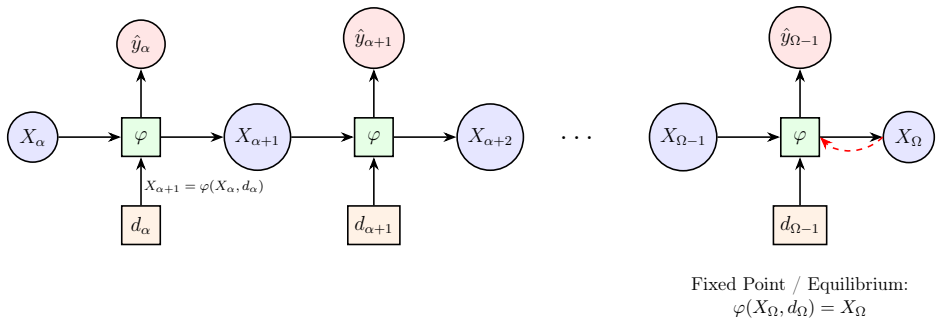
The load-bearing object is YF, the transfinite fixed-point operator of Alpay Algebra: an abstract operator defined by ordinal-indexed iteration, where $\varphi^0(x) = x$, $\varphi^{\alpha+1}(x) = \varphi(\varphi^\alpha(x))$, and at limit ordinals $\lambda$ the state $\varphi^\lambda(x)$ is the limit of the preceding stages. The argument runs on well-founded induction over ordinals together with a 'progressive' condition on $\varphi$—no infinite strictly descending sequence under some measure—which is what forces the iteration to become stationary at some ordinal $\Omega$. That stationary stage is the fixed point; the limit case of the induction is where existence is established, and uniqueness follows from the same progressive property.
What would settle it
Try to formalize Theorem 4.1 in a proof assistant without adding axioms: if the construction of the limit-stage state $\varphi^\lambda(x)$ cannot be checked because it already assumes eventual constancy, the machine-checkability claim fails. Alternatively, exhibit a well-founded, progressive $\varphi$ with two distinct fixed points, or a progressive $\varphi$ whose ordinal approximants never stabilize, to refute uniqueness or existence.
Extended reading notes
Core claim
The discovery, on the paper's own terms, is that the correspondence 'fixed point $\simeq$ game equilibrium' holds at every ordinal stage: each approximant of the iteration is a partial equilibrium, and the transordinal fixed point is the full equilibrium at which the process stops. The formalized version represents the iteration as an ordinal-indexed family of approximants inside dependent type theory and uses well-founded induction to construct the limit $x_\infty$, prove $\varphi(x_\infty) = x_\infty$, and prove that any other fixed point coincides with it. Theorem 4.1 packages this as the Formal Transfinite Fixed Point theorem, and the paper asserts that the proof is machine-checkable, with the limit stage of the induction as the decisive step.
Load-bearing premise
The result rests on the assumption that every progressive transformation—one with no infinite strictly descending sequence under some measure—must become stationary at some ordinal, and that this stabilization can be constructed inside dependent type theory; the paper states this as part of Theorem 4.1 but does not define the measure or supply the limit-case proof.
Editorial extensions
If this is right
- If Theorem 4.1 is correct, every self-referential update process that satisfies the progressive and well-founded conditions has one and only one stable outcome.
- Because the construction is embedded in dependent type theory, the existence and uniqueness claims are checkable by machine, with no appeal to unrestricted set-theoretic fixed-point axioms.
- The equality 'fixed point = equilibrium' means the semantic dialogue cannot have multiple stable interpretations or divergent stabilization points.
- The same well-founded iteration scheme can be reused to certify convergence of other iterative algorithms, provided an appropriate decreasing measure is supplied.
Reading between the lines
- I infer that the theorem cannot be instantiated on any concrete system until an explicit decreasing measure is produced; the paper motivates the 'progressive' condition but never defines a measure for a particular state space.
- I read the game-equilibrium connection as a conceptual identification rather than a formal game with players and payoffs: the paper defines equilibrium as the fixed-point equation $\varphi(x) = x$ and leaves a full strategic formalization to future work.
- A testable next step is to instantiate the ordinal-indexed family on a concrete type, such as finite lattices or streams, and run the proof in a proof assistant; success would demonstrate that the limit case is constructively realizable rather than an axiom in disguise.
Signed reviews
Editorial analysis
A structured set of objections, weighed in public.
Referee Report
Summary. The paper claims to unify Alpay Algebra's transfinite fixed-point operator with game-theoretic equilibria and to embed this framework in dependent type theory, yielding a machine-checked proof that the iterative semantic dialogue stabilizes to a unique fixed point. Sections 2 and 3 survey classical fixed-point theorems and prior Alpay Algebra results, and Section 4 sketches a formalization strategy with ordinals, well-founded recursion, and a stated Theorem 4.1 asserting existence and uniqueness of a fixed point under a 'progressive' condition. No proof-assistant code or machine-checked artifact is provided; the formal development is presented only as a proof outline.
Significance. If the claimed formalization existed and Theorem 4.1 were true, the result would be significant: it would provide a machine-checked bridge between transfinite fixed-point theory, game equilibrium, and dependent type theory, and would support the Alpay Algebra program's semantic-convergence claims. The paper also usefully surveys the analogy between fixed-point theorems and game equilibria. However, the central theorem is not proved and its stated hypotheses are insufficient; the machine-checked claim is unsubstantiated by any artifact. The paper's positive contributions are therefore limited to the expository survey, not the advertised formal results.
major comments (4)
- [Section 4, Theorem 4.1] The existence proof is circular. In the 'Limit case' paragraph, the text states that State_at(o) is defined as the limit of previous states and then imposes an axiom or rule that State_at(o) is a fixed point if o is a limiting stabilization stage; it immediately concedes 'that is exactly what we are ultimately trying to prove, so we can’t assume it upfront without circularity.' No semantic discrepancy measure d and no bounding ordinal Ω are defined in the manuscript, so the claimed stabilization cannot be derived from the stated hypotheses.
- [Section 4, Theorem 4.1] The uniqueness argument contains an invalid inference. The text says 'if A and B are both fixed points, then A = φ(A) = φ(B) = B, which implies A = B'; but φ(A)=A and φ(B)=B do not imply φ(A)=φ(B). Equality of the outputs under φ requires a separate argument that is not given, and the contraction-like condition needed for such an argument is not stated in Theorem 4.1.
- [Section 4, Theorem 4.1] Theorem 4.1 is false as stated under its own hypotheses. Let State = Bool, let phi = id, and take any constant measure; then phi is progressive because the iteration sequence is constant and contains no strictly descending chain under the measure, but there are two distinct fixed points (true and false), contradicting the claimed uniqueness. The theorem therefore requires additional hypotheses (e.g., a genuine contraction or an order-theoretic uniqueness condition), which are never formulated.
- [Abstract and Section 5] The abstract claims 'This procedure yields a machine checked proof that the iterative dialogue necessarily stabilizes and that its limit is unique,' and Section 5 repeats that the proof is formal and verifiable, but no proof-assistant code, no formal definitions, and no machine-checked theorem statements are included in the manuscript. The formalization exists only as a sketch, so the central machine-checked claim is not supported by the submitted text.
minor comments (4)
- [Section 3] The operator YF is introduced informally as 'the abstract fixed-point operator of the system' but is never given a precise definition or typing; this makes the formalization in Section 4 hard to follow.
- [Section 4] Notation for the state family is inconsistent: the text uses 'State_at(o)', 'Stateat(o)', and 'State_at(α)' interchangeably, which should be unified.
- [Figure 1] The caption states that X_Ω is reached at a limit ordinal, but the text defines Ω as the stage where stabilization occurs, which need not be a limit ordinal; this should be clarified.
- [References] The paper relies heavily on self-citations, especially [3] and [18], for the existence and uniqueness of fixed points that Theorem 4.1 is supposed to establish independently; the dependence should be made explicit in the theorem statement.
Circularity Check
Theorem 4.1 is asserted, not derived: the limit case imposes the fixed point by axiom, the 'progressive' hypothesis is the stabilization conclusion, equilibrium is defined as the fixed-point equation, and uniqueness is imported from the authors' own [18].
-
self definitional
[Section 4, 'Limit case' bullet (ordinal-indexed iteration)]
"In type-theoretic terms, since we cannot take a literal limit, we impose an axiom or rule that State_at(o) is a fixed point of φ if o is a limit at which things stabilize. ... but that is exactly what we're ultimately trying to prove, so we can't assume it upfront without circularity."
The existence claim phi(x_infty) = x_infty is placed directly into the construction: at limit ordinals, State_at(o) is declared to be a fixed point by axiom or rule. The text itself flags this as circular and then suggests carrying a coinductive stream instead, but nowhere is a proof given that the stream yields a fixed point without the same assumption. Thus Theorem 4.1's existence conclusion is not derived from the iteration; it is assumed at the limit stage.
-
self definitional
[Section 4, Theorem 4.1]
"Suppose State is a type and phi: State -> State is a function such that (i) there is a well-founded ordinal index set Ord parameterizing the iteration of phi, and (ii) phi is progressive (no infinite strictly descending sequence under some measure). Then there exists an element x_infty: State such that phi(x_infty) = x_infty . Moreover, for any y: State with phi(y) = y , we have y = x_infty."
The hypothesis (ii) is not a separately verified input with a defined measure; it is a restatement of the stabilization property that the theorem claims to prove. No ordinal index set, measure, State, or phi is instantiated anywhere in the paper, so the theorem is a conditional whose key assumption is the conclusion. In addition, uniqueness is asserted as part of the theorem with no proof beyond the imported self-citation below.
2 more flagged steps
-
self definitional
[Section 4, 'Nash Equilibrium and Game Formalization']
"one could encode a predicate Equilibrium(x) meaning phi(x) = x – indeed that is exactly the fixed-point equation. ... So we will be content to say: by construction, the fixed point X∞ satisfies the equilibrium condition."
The advertised correspondence 'fixed point ≃ game equilibrium' is obtained by defining equilibrium to be the fixed-point equation. There is no game with players, strategies, or best responses proving that the fixed point is an equilibrium; the alleged game-theoretic content reduces by definition to the fixed-point equation being solved.
-
self citation load bearing
[Section 4, 'Formal Proof of Fixed-Point Existence and Uniqueness']
"We will likely make use of the fact proven in Alpay Algebra V: if two fixed points existed, it violates the Banach-like condition, specifically they mention in their proof: 'if A and B are both fixed points, then A =φ(A) =φ(B) =B, which implies A =B' [18]."
The uniqueness half of Theorem 4.1 is not proved here; it is imported from [18], a paper by the same authors (Kılıç & Alpay). The quoted equality chain is also not a derivation, since φ(A)=A and φ(B)=B do not imply φ(A)=φ(B). The central uniqueness claim therefore rests on a self-citation whose content is the target claim, not on an independent formal proof.
full rationale
The claimed machine-checked derivation of Theorem 4.1 is not self-contained. The only formal statement in the paper (Theorem 4.1) is conditional on a 'progressive' condition that is exactly the stabilization target, and no State, phi, ordinal index set, or measure is ever instantiated. Existence is further built into the construction at limit ordinals: the paper explicitly imposes 'an axiom or rule that State_at(o) is a fixed point of φ if o is a limit at which things stabilize' and then admits this is 'exactly what we're ultimately trying to prove, so we can't assume it upfront without circularity.' The advertised game-theoretic result collapses to a definition: 'Equilibrium(x) meaning phi(x) = x' is declared to be the fixed-point equation, and the fixed point is then called the equilibrium 'by construction.' Uniqueness is not proved in the manuscript; it is imported from a self-authored predecessor [18], whose quoted argument is an invalid equality chain. The introduction and conclusion also repeatedly rely on [3], [6], [18], and [19] for the existence and uniqueness facts rather than on an independent, machine-checked development; no proof script or concrete formalization is included. This is not a normal 0-2 case of harmless self-citation, because every load-bearing step—existence, uniqueness, and the equilibrium interpretation—reduces to an assumed stabilization condition, a definition, or a self-citation. Score 8 reflects that the central result is forced by these inputs by construction.
Assumptions & free parameters
free parameters (2)
- Bounding ordinal Ω =
unspecified
- Semantic discrepancy measure d =
unspecified
assumptions (5)
- domain assumption Ordinal-indexed iteration with limits at limit ordinals is available in type theory.
- ad hoc to paper phi is progressive: there is no infinite strictly descending sequence under some measure d.
- ad hoc to paper Prior Alpay Algebra results establish existence and uniqueness of the relevant fixed points.
- ad hoc to paper Game equilibrium is defined as satisfying the fixed-point equation phi(x)=x.
- domain assumption A well-founded type Ord of ordinals, large enough for the iteration, exists in the type theory.
invented entities (2)
-
Transfinite fixed-point operator YF / φ∞
-
Semantic distance / discrepancy measure d
Cite this review
Pith. "Pith review of Transfinite Fixed Points in Alpay Algebra as Ordinal Game Equilibria in Dependent Type Theory." pith.science (2026). https://pith.science/paper/MLVGCAGN
@misc{pith2026250719245,
  author       = {Pith},
  title        = {Pith review of: Transfinite Fixed Points in Alpay Algebra as Ordinal Game Equilibria in Dependent Type Theory},
  year         = {2026},
  howpublished = {\url{https://pith.science/paper/MLVGCAGN}},
  note         = {Machine review of arXiv:2507.19245}
}
read the original abstract
This paper contributes to the Alpay Algebra by demonstrating that the stable outcome of a self referential process, obtained by iterating a transformation through all ordinal stages, is identical to the unique equilibrium of an unbounded revision dialogue between a system and its environment. The analysis initially elucidates how classical fixed point theorems guarantee such convergence in finite settings and subsequently extends the argument to the transfinite domain, relying upon well founded induction and principles of order theoretic continuity. Furthermore, the resulting transordinal fixed point operator is embedded into dependent type theory, a formalization which permits every step of the transfinite iteration and its limit to be verified within a modern proof assistant. This procedure yields a machine checked proof that the iterative dialogue necessarily stabilizes and that its limit is unique. The result provides a foundation for Alpay's philosophical claim of semantic convergence within the framework of constructive logic. By unifying concepts from fixed point theory, game semantics, ordinal analysis, and type theory, this research establishes a broadly accessible yet formally rigorous foundation for reasoning about infinite self referential systems and offers practical tools for certifying their convergence within computational environments.
Figures
Reference graph
Works this paper leans on
-
[1]
Alpay, F. (2025a). Alpay Algebra: A Universal Structural Foundation.arXiv Preprint arXiv:2505.15344
arXiv 2025
-
[2]
Alpay, F. (2025b). Emergent AI Identity via Transfinite Fixed-Point Convergence in Alpay Algebra.PhilArchive Preprint(July 2025)
work page 2025
-
[3]
Alpay, F. (2025c). Alpay Algebra II: Identity as Fixed-Point Emergence in Categorical Data. arXiv Preprint arXiv:2505.17480
arXiv 2025
-
[4]
Alpay, F. (2025d). Alpay Algebra III: Observer-Coupled Collapse and the Temporal Drift of Identity.arXiv Preprint arXiv:2505.19790
arXiv 2025
- [5]
-
[6]
Alpay, F., & Alakkad, H. (2025f). Transordinal Fixed-Point Operators and Self- Referential Games: A Categorical Framework for Reflective Semantic Convergence. arXiv Preprint arXiv:2507.16620
work page Pith review arXiv 2025
-
[7]
Alpay, F., & Kılıç, B. (2025g). Alpay Algebra VI: The Universal Semantic Virus and Transfinite Embedding Alignment.Authorea/PhilArchive(July 2025)
work page 2025
-
[8]
Banach, S. (1922). Sur les opérations dans les ensembles abstraits et leur application aux équations intégrales.Fundamenta Mathematicae, 3, 133–181
work page 1922
Show all 31 references
-
[9]
(2004).Interactive Theorem Proving and Program Develop- ment
Bertot, Y., & Castéran, P. (2004).Interactive Theorem Proving and Program Develop- ment. Coq’Art: The Calculus of Inductive Constructions. Springer-Verlag
2004
-
[10]
(1968).Elements of Mathematics: Theory of Sets
Bourbaki, N. (1968).Elements of Mathematics: Theory of Sets. Paris: Hermann (English translation, Addison-Wesley)
1968
-
[11]
Bradfield, J., & Stirling, C. (2007). The modal mu-calculus. InHandbook of Modal Logic (pp. 721–756). Elsevier
2007
-
[12]
Brouwer, L. E. J. (1911). über Abbildung von Mannigfaltigkeiten.Mathematische An- nalen, 71(1), 97–115
1911
-
[13]
Capretta, V. (2005). General Recursion via Coinductive Types.Logical Methods in Computer Science, 1(2), 1–18. DOI: 10.2168/LMCS-1(2:1)2005
2005 doi
-
[14]
Conway, J. H. (1976).On Numbers and Games. Academic Press
1976
-
[15]
(1991).Game Theory
Fudenberg, D., & Tirole, J. (1991).Game Theory. MIT Press
1991
-
[16]
(1993).The Revision Theory of Truth
Gupta, A., & Belnap, N. (1993).The Revision Theory of Truth. MIT Press. 20
1993
-
[17]
Kakutani, S. (1941). A generalization of Brouwer’s fixed point theorem.Duke Mathe- matical Journal, 8, 457–459
1941
-
[18]
Kılıç, B., & Alpay, F. (2025). Alpay Algebra V: Multi-Layered Semantic Games and Transfinite Fixed-Point Simulation.arXiv Preprint arXiv:2507.07868
2025 arXiv
-
[19]
Kılıç, B., & Alpay, F. (2025b). Alpay Algebra IV: Symbiotic Semantics and the Fixed- Point Convergence of Observer Embeddings.arXiv Preprint arXiv:2507.03774
2025 arXiv
-
[20]
Knaster, B. (1928). Un thór` me sur les fonctions d’ensembles.Annales de la Société Polonaise de Mathématique, 6, 133–134
1928
-
[21]
Kripke, S. (1975). Outline of a theory of truth.Journal of Philosophy, 72(19), 690–716
1975
-
[22]
Lambek, J. (1968). A fixpoint theorem for complete categories.Mathematische Zeitschrift, 103, 151–161. DOI: 10.1007/BF01110627
1968 doi
-
[23]
Lawvere, F. W. (1969). Adjointness in foundations.Dialectica, 23(3-4), 281–296
1969
-
[24]
Le Roux, S., & Pauly, A. (2020). A semi-potential for finite and infinite games in extensive form.Dynamic Games and Applications, 10(1), 120–144. DOI: 10.1007/s13235- 019-00301-7
2020 doi
-
[25]
(1986).Mathematics: Form and Function
Mac Lane, S. (1986).Mathematics: Form and Function. Springer-Verlag
1986
-
[26]
(1984).Intuitionistic Type Theory
Martin-Löf, P. (1984).Intuitionistic Type Theory. Naples: Bibliopolis
1984
-
[27]
Monderer, D., & Shapley, L. S. (1996). Potential games.Games and Economic Behavior, 14(1), 124–143
1996
-
[28]
Nash, J. (1951). Non-cooperative games.Annals of Mathematics, 54(2), 286–295
1951
-
[29]
(1990).Programming in Martin-L¨f’s Type Theory
Nordström, B., Petersson, K., & Smith, J. (1990).Programming in Martin-L¨f’s Type Theory. Oxford University Press
1990
-
[30]
Setzer, A. (1998). Well-ordering proofs for Martin-L¨f’s type theory with W-type and one universe. Annals of Pure and Applied Logic, 92(1), 113–159
1998
-
[31]
Tarski, A. (1955). A lattice-theoretical fixpoint theorem and its applications.Pacific Journal of Mathematics, 5(2), 285–309. 21
1955
Reviewed August 15, 2026 · model on record in the stance chip above.
Discussion (0). Continue with ORCID to comment.