Probing Quantum States Over Spacetime Through Interferometry
Pith reviewed 2026-05-19 02:21 UTC · model grok-4.3
The pith
Quantum states over arbitrary regions in spacetime gain operational meaning through causally agnostic interferometric measurements.
A machine-rendered reading of the paper's core claim, the machinery that carries it, and where it could break.
Core claim
We give an operational meaning to multipartite quantum states over arbitrary regions in spacetime through a causally agnostic measurement, a measurement scheme that can be consistently implemented independently of the causal relation between the regions. We prove that such measurements can always be implemented with interferometry, also known as the scattering circuit technique, wherein the conventional density operator, the recently developed quantum state over time (QSOT), and the process matrix formalisms smoothly merge. This framework allows for a systematic study of mixed states in the temporal setting, which turn out to be crucial for modeling quantum non-Markovianity.
What carries the argument
Causally agnostic measurement realized through interferometry (scattering circuit technique), which unifies density operators, QSOT, and process matrices for spacetime states.
If this is right
- Two different ensembles of quantum dynamics can share the same QSOT and therefore remain indistinguishable by interferometry.
- Mixed states in the temporal setting become accessible for systematic modeling of quantum non-Markovianity.
- A new type of spatiotemporal correlation appears between quantum dynamics that originates from synchronized propagation under time-reversal symmetry.
- Systems exhibiting this correlation can serve as reference frames to distinguish dynamics that are otherwise indistinguishable under time-reversal symmetry.
Where Pith is reading between the lines
- The unification may simplify calculations of temporal correlations in open quantum systems by allowing any of the three formalisms to be swapped as convenient.
- The reference-frame application could be tested by preparing synchronized dynamics in a lab and checking whether an auxiliary system improves discrimination of time-reversed processes.
- Limits on distinguishability via interferometry imply that additional resources beyond standard scattering circuits may be needed to resolve certain non-Markovian features.
Load-bearing premise
A causally agnostic measurement scheme exists and can be consistently implemented independently of the causal relation between the regions.
What would settle it
Perform the proposed interferometric measurement on a pair of regions with fixed causal order and check whether the extracted QSOT matches the predictions from the process matrix formalism for the same dynamics.
Figures
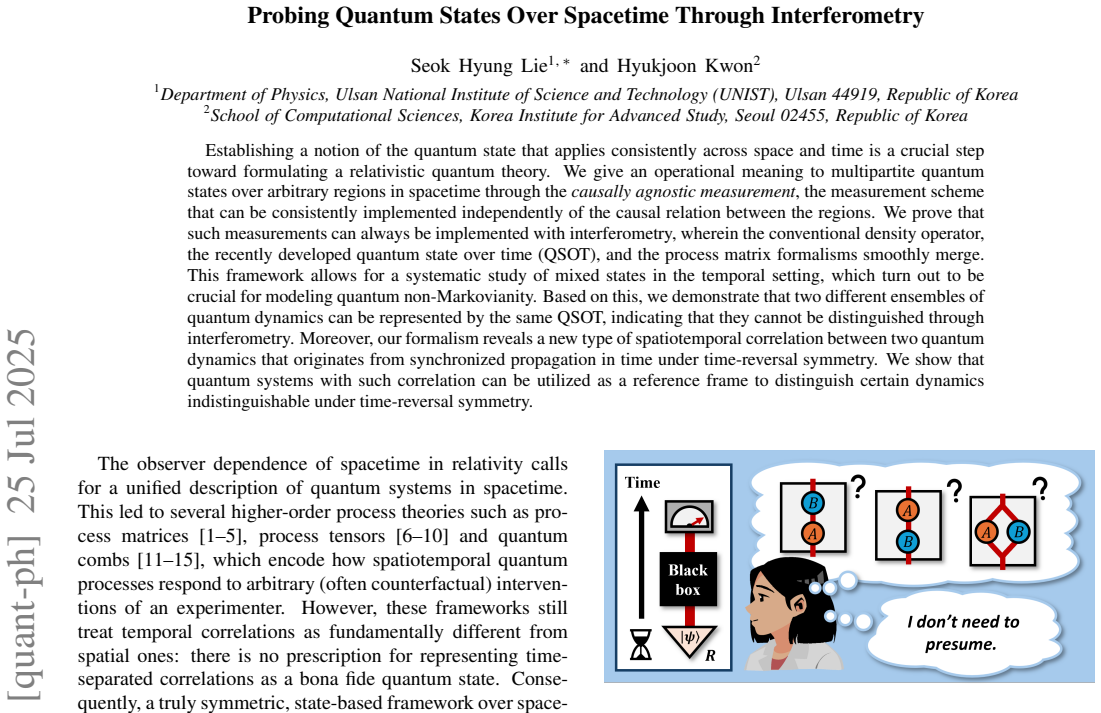


read the original abstract
Establishing a notion of the quantum state that applies consistently across space and time could be a crucial step toward formulating a relativistic quantum theory. We give an operational meaning to multipartite quantum states over arbitrary regions in spacetime through a causally agnostic measurement, a measurement scheme that can be consistently implemented independently of the causal relation between the regions. We prove that such measurements can always be implemented with interferometry, also known as the scattering circuit technique, wherein the conventional density operator, the recently developed quantum state over time (QSOT), and the process matrix formalisms smoothly merge. This framework allows for a systematic study of mixed states in the temporal setting, which turn out to be crucial for modeling quantum non-Markovianity. Based on this, we demonstrate that two different ensembles of quantum dynamics can be represented by the same QSOT, indicating that they cannot be distinguished through interferometry. Moreover, our formalism reveals a new type of spatiotemporal correlation between two quantum dynamics that originates from synchronized propagation in time under time-reversal symmetry. We show that quantum systems with such correlation can be utilized as a reference frame to distinguish certain dynamics indistinguishable under time-reversal symmetry.
Editorial analysis
A structured set of objections, weighed in public.
Referee Report
Summary. The manuscript develops an operational definition of multipartite quantum states over arbitrary spacetime regions via causally agnostic measurements. It proves that any such measurement can be realized using interferometry (scattering circuits), under which the standard density operator, quantum state over time (QSOT), and process matrix formalisms merge. The framework is applied to mixed temporal states for non-Markovianity, shows indistinguishability of certain dynamics ensembles via interferometry, and identifies a new spatiotemporal correlation arising from synchronized propagation under time-reversal symmetry that can serve as a reference frame.
Significance. If the core construction is valid, the result offers a concrete operational route to spacetime quantum states without presupposed causal order, potentially aiding relativistic quantum information and the study of temporal correlations. The unification of formalisms and the explicit demonstration of indistinguishable ensembles plus the new correlation are strengths that could enable falsifiable predictions in interferometric setups.
major comments (2)
- [Abstract and interferometry construction] Abstract and the interferometry implementation section: the central claim that causally agnostic measurements 'can always be implemented with interferometry' and that the three formalisms 'smoothly merge' requires an explicit derivation showing that the ancillary probe, controlled operations, and interference paths are defined without any background causal structure; the current presentation leaves open whether the scattering circuit construction implicitly encodes a definite order between regions.
- [Mixed states and non-Markovianity discussion] The section on mixed states and non-Markovianity: the assertion that mixed states are 'crucial for modeling quantum non-Markovianity' needs a concrete example or theorem linking the QSOT representation to a specific non-Markovian witness that cannot be captured by standard process matrices alone.
minor comments (2)
- [Introduction] Notation for the causally agnostic measurement should be introduced with a clear operational definition before the proof, to distinguish it from standard projective measurements.
- [Figures] Figure captions for any interferometry circuits should explicitly label the ancillary probe and the absence of assumed causal arrows.
Simulated Author's Rebuttal
We thank the referee for their careful reading and constructive comments. We address the major comments point by point below, clarifying our construction and indicating planned revisions to improve explicitness and provide additional examples.
read point-by-point responses
-
Referee: [Abstract and interferometry construction] Abstract and the interferometry implementation section: the central claim that causally agnostic measurements 'can always be implemented with interferometry' and that the three formalisms 'smoothly merge' requires an explicit derivation showing that the ancillary probe, controlled operations, and interference paths are defined without any background causal structure; the current presentation leaves open whether the scattering circuit construction implicitly encodes a definite order between regions.
Authors: The interferometry construction in the manuscript is formulated operationally: the ancillary probe couples to the systems via controlled operations whose definitions depend only on the local regions and the interference measurement, without reference to any causal ordering between those regions. The scattering circuit is therefore defined in a causally agnostic manner, allowing the density operator, QSOT, and process matrix to merge as stated. To remove any possible ambiguity in the presentation, we will add an explicit step-by-step derivation in a new subsection of the revised manuscript that specifies the probe state, controlled unitaries, and interference paths solely in terms of the spacetime regions themselves, confirming that no background causal structure is presupposed. revision: yes
-
Referee: [Mixed states and non-Markovianity discussion] The section on mixed states and non-Markovianity: the assertion that mixed states are 'crucial for modeling quantum non-Markovianity' needs a concrete example or theorem linking the QSOT representation to a specific non-Markovian witness that cannot be captured by standard process matrices alone.
Authors: We agree that an explicit illustration would strengthen the section. The manuscript already shows that mixed QSOTs arise naturally when temporal correlations are present and that they unify with process matrices. In the revision we will insert a concrete example of a two-time non-Markovian channel together with a short theorem demonstrating that the associated mixed QSOT yields a non-Markovianity witness (information back-flow) that is invisible to the standard process-matrix description alone. revision: yes
Circularity Check
No significant circularity; derivation rests on operational definition and explicit construction
full rationale
The paper defines a causally agnostic measurement operationally and proves its realization via interferometry (scattering circuit). The abstract and described framework show the merging of density operators, QSOT, and process matrices as a consequence of this construction rather than a presupposed input. No self-definitional loops, fitted parameters renamed as predictions, or load-bearing self-citations appear in the provided text. The central claim is a proof of implementability, which is independent of the target formalisms once the circuit is specified. This is the most common honest finding for papers whose core step is an explicit equivalence construction.
Axiom & Free-Parameter Ledger
axioms (1)
- domain assumption Causally agnostic measurements can be defined independently of the causal relation between regions
Forward citations
Cited by 1 Pith paper
-
Temporal State Tomography via Quantum Snapshotting the Temporal Quasiprobabilities
Temporal state tomography reconstructs multi-time quantum processes from temporal quasiprobability distributions via a Bloch-type representation and derives the associated sample complexity.
Reference graph
Works this paper leans on
-
[1]
O. Oreshkov, F. Costa, and ˇC. Brukner, Quantum correlations with no causal order, Nature Communications3, 1092 (2012)
work page 2012
-
[2]
M. Ara ´ujo, F. Costa, and ˇC. Brukner, Computational advantage from quantum-controlled ordering of gates, Physical Review Letters113, 250402 (2014)
work page 2014
-
[3]
L. M. Procopio, A. Moqanaki, M. Ara ´ujo, F. Costa, I. Alonso Calafell, E. G. Dowd, D. R. Hamel, L. A. Rozema, ˇC. Brukner, and P. Walther, Experimental superposition of or- ders of quantum gates, Nature Communications6, 7913 (2015)
work page 2015
-
[4]
M. Ara ´ujo, C. Branciard, F. Costa, A. Feix, C. Giarmatzi, and ˇC. Brukner, Witnessing causal nonseparability, New Journal of Physics17, 102001 (2015)
work page 2015
-
[5]
O. Oreshkov and C. Giarmatzi, Causal and causally separable processes, New Journal of Physics18, 093020 (2016)
work page 2016
-
[6]
F. A. Pollock, C. Rodr ´ıguez-Rosario, T. Frauenheim, M. Pater- nostro, and K. Modi, Non-markovian quantum processes: Com- plete framework and efficient characterization, Physical Review A97, 012127 (2018)
work page 2018
-
[7]
F. A. Pollock, C. Rodr ´ıguez-Rosario, T. Frauenheim, M. Pater- nostro, and K. Modi, Operational markov condition for quan- tum processes, Physical Review Letters120, 040405 (2018)
work page 2018
-
[8]
M. R. Jørgensen and F. A. Pollock, Exploiting the causal ten- sor network structure of quantum processes to efficiently simu- late non-markovian path integrals, Physical Review Letters123, 240602 (2019)
work page 2019
-
[9]
G. A. L. White, C. D. Hill, F. A. Pollock, L. C. L. Hollenberg, and K. Modi, Demonstration of non-markovian process charac- terisation and control on a quantum processor, Nature Commu- nications11, 6301 (2020)
work page 2020
-
[10]
S. Milz, M. S. Kim, F. A. Pollock, and K. Modi, Completely positive divisibility does not mean markovianity, Physical Re- view Letters123, 040401 (2019)
work page 2019
-
[11]
G. Chiribella, G. M. D’Ariano, P. Perinotti, and B. Valiron, Quantum computations without definite causal structure, Phys- ical Review A88, 022318 (2013)
work page 2013
-
[12]
G. Chiribella, G. M. D’Ariano, and P. Perinotti, Theoreti- cal framework for quantum networks, Physical Review A80, 022339 (2009)
work page 2009
-
[13]
G. Chiribella, G. M. D’Ariano, and P. Perinotti, Probabilis- tic theories with purification, Physical Review A81, 062348 (2010)
work page 2010
-
[14]
G. Chiribella, G. M. D’Ariano, and P. Perinotti, Quantum cir- cuit architecture, Physical Review Letters101, 060401 (2008)
work page 2008
-
[15]
G. Chiribella, G. M. D’Ariano, and P. Perinotti, Transforming quantum operations: Quantum supermaps, EPL (Europhysics Letters)83, 30004 (2008). 6
work page 2008
-
[16]
L. Accardi, A. Souissi, and E. G. Soueidy, Quantum markov chains: A unification approach, Infinite Dimensional Analysis, Quantum Probability and Related Topics23, 2050016 (2020)
work page 2020
-
[17]
M. S. Leifer and R. W. Spekkens, Towards a formulation of quantum theory as a causally neutral theory of bayesian infer- ence, Physical Review A88, 052130 (2013)
work page 2013
-
[18]
J. Fullwood and A. J. Parzygnat, On quantum states over time, Proceedings of the Royal Society A478, 20220104 (2022)
work page 2022
-
[19]
Fullwood, Quantum dynamics as a pseudo-density matrix, arXiv:2304.03954 [quant-ph] (2023)
J. Fullwood, Quantum dynamics as a pseudo-density matrix, arXiv:2304.03954 [quant-ph] (2023)
-
[20]
A. J. Parzygnat and J. Fullwood, From time-reversal symmetry to quantum bayes’ rules, PRX Quantum4, 020334 (2023)
work page 2023
-
[21]
Y . Aharonov, S. Popescu, and J. Tollaksen, Each instant of time a new universe, inQuantum Theory: A Two-Time Success Story: Yakir Aharonov Festschrift(Springer, 2014) pp. 21–36
work page 2014
-
[22]
Y . Aharonov, S. Popescu, and J. Tollaksen, A time-symmetric formulation of quantum mechanics, Physics Today63, 10.1063/1.3518209 (2010)
-
[23]
Multiple-time states and multiple-time measurements in quantum mechanics
Y . Aharonov, S. Popescu, J. Tollaksen, and L. Vaid- man, Multiple-time states and multiple-time measurements in quantum mechanics, Phys. Rev. A79, 052110 (2009), arXiv:0712.0320 [quant-ph]
work page internal anchor Pith review Pith/arXiv arXiv 2009
-
[24]
D. Horsman, C. Heunen, M. F. Pusey, J. Barrett, and R. W. Spekkens, Can a quantum state over time resemble a quantum state at a single time?, Proceedings of the Royal Society A473, 20170395 (2017)
work page 2017
-
[25]
S. Milz and K. Modi, Quantum stochastic processes and quan- tum non-markovian phenomena, PRX Quantum2, 030201 (2021)
work page 2021
-
[26]
S. H. Lie and N. H. Y . Ng, Quantum state over time is unique, Physical Review Research6, 033144 (2024)
work page 2024
- [27]
- [28]
-
[29]
J. F. Fitzsimons, J. A. Jones, and V . Vedral, Quantum cor- relations which imply causation, Scientific Reports5, 18281 (2015)
work page 2015
-
[30]
C. Marletto, V . Vedral, S. Virz `ı, A. Avella, F. Piacentini, M. Gramegna, I. P. Degiovanni, and M. Genovese, Tempo- ral teleportation with pseudo-density operators: How dynam- ics emerges from temporal entanglement, Science Advances7, eabe4742 (2021)
work page 2021
-
[31]
J. G. Kirkwood, Quantum statistics of almost classical assem- blies, Physical Review44, 31 (1933)
work page 1933
-
[32]
M. Lostaglio, A. Belenchia, A. Levy, S. Hern ´andez-G´omez, N. Fabbri, and S. Gherardini, Kirkwood-Dirac quasiprobability approach to the statistics of incompatible observables, Quantum 7, 1128 (2023)
work page 2023
-
[33]
A. A. Abbott, R. Silva, J. Wechs, N. Brunner, and C. Bran- ciard, Anomalous weak values without post-selection, Quantum 3, 194 (2019)
work page 2019
-
[34]
H. Margenau and R. N. Hill, Correlation between measure- ments in quantum theory, Progress of Theoretical Physics26, 722 (1961)
work page 1961
-
[35]
Y . Aharonov, D. Z. Albert, and L. Vaidman, How the result of a measurement of a component of the spin of a spin-1/2 particle can turn out to be 100, Physical Review Letters60, 1351 (1988)
work page 1988
-
[36]
J. S. Lundeen and C. Bamber, Procedure for direct measurement of general quantum states using weak measurement, Physical Review Letters108, 070402 (2012)
work page 2012
-
[37]
D. R. M. Arvidsson-Shukur, N. Yunger Halpern, H. V . Lep- age, A. A. Lasek, C. H. W. Barnes, and S. Lloyd, Quantum advantage in post-selected metrology, Nature Communications 11, 3775 (2020)
work page 2020
-
[38]
F. Buscemi and V . Scarani, Fluctuation theorems from bayesian retrodiction, Physical Review E103, 052111 (2021)
work page 2021
-
[39]
A. Milekhin, Z. Adamska, and J. Preskill, Observable and computable entanglement in time, arXiv:2502.12240 [quant- ph] (2025)
-
[40]
M. Hoogsteder-Riera, J. Calsamiglia, and A. Winter, Ap- proach to optimal quantum transport via states over time, arXiv:2504.04856 [quant-ph] (2025)
-
[41]
G. Mitchison, R. Jozsa, and S. Popescu, Sequential weak mea- surement, Phys. Rev. A76, 062105 (2007)
work page 2007
-
[42]
N. Yunger Halpern, B. Swingle, and J. Dressel, Quasiprobabil- ity behind the out-of-time-ordered correlator, Phys. Rev. A97, 042105 (2018)
work page 2018
-
[43]
L. Mazzola, G. De Chiara, and M. Paternostro, Measuring the characteristic function of the work distribution, Phys. Rev. Lett. 110, 230602 (2013)
work page 2013
-
[44]
J. S. Pedernales, R. Di Candia, I. L. Egusquiza, J. Casanova, and E. Solano, Efficient quantum algorithm for computingn-time correlation functions, Phys. Rev. Lett.113, 020505 (2014)
work page 2014
-
[45]
Yunger Halpern, Jarzynski-like equality for the out-of-time- ordered correlator, Phys
N. Yunger Halpern, Jarzynski-like equality for the out-of-time- ordered correlator, Phys. Rev. A95, 012120 (2017)
work page 2017
-
[46]
P. Wang, H. Kwon, C. Luan, W. Chen, M. Qiao, Z. Zhou, K. Wang, M. S. Kim, and K. Kim, Snapshotting quantum dy- namics at multiple time points, Nature Communications15, 8900 (2024)
work page 2024
-
[47]
M. M. Wilde,Quantum Information Theory(Cambridge Uni- versity Press, 2013)
work page 2013
-
[48]
R. J. Glauber and G. Matthiae, High-energy scattering of pro- tons by nuclei, Nuclear Physics B21, 135 (1970)
work page 1970
-
[49]
D. H. Boal, J. C. Kaplan, and S. Pratt, Glauber multiple scatter- ing model of nuclear reactions, Reviews of Modern Physics62, 553 (1990)
work page 1990
-
[50]
V . Franco and R. J. Glauber, High-energy deuteron cross sec- tions, Physical Review142, 1195 (1966)
work page 1966
-
[51]
Franco, Glauber theory for high-energy scattering, Physical Review C6, 1704 (1972)
V . Franco, Glauber theory for high-energy scattering, Physical Review C6, 1704 (1972)
work page 1972
-
[52]
C. A. Bertulani and G. Baur, Electromagnetic processes in rel- ativistic heavy ion collisions, Physics Reports163, 299 (1988)
work page 1988
-
[53]
R. D. Sorkin, Quantum mechanics as quantum measure theory, Modern Physics Letters A9, 3119 (1994)
work page 1994
-
[54]
X. Liu, Y . Qiu, O. Dahlsten, and V . Vedral, Quantum causal inference with extremely light touch, npj Quantum Information 11, 54 (2025)
work page 2025
-
[55]
A. J. Parzygnat and J. Fullwood, Time-symmetric correlations for open quantum systems, arXiv preprint arXiv:2407.11123 10.48550/arXiv.2407.11123 (2024), arXiv:2407.11123 [quant- ph]
-
[56]
M. Song and A. J. Parzygnat, Bipartite quantum states ad- mitting a causal explanation, arXiv preprint arXiv:2507.14278 (2025), arXiv:2507.14278 [quant-ph]
-
[57]
J. Fullwood and A. J. Parzygnat, Operator representa- tion of spatiotemporal quantum correlations, arXiv preprint arXiv:2405.17555 10.48550/arXiv.2405.17555 (2024), revised v2, April 2025, arXiv:2405.17555 [quant-ph]
-
[58]
The Partition Ensemble Fallacy Fallacy
K. Nemoto and S. L. Braunstein, The partition ensemble fallacy fallacy, arXiv:quant-ph/0207135 (2002)
work page internal anchor Pith review Pith/arXiv arXiv 2002
-
[59]
M. Song, V . Narasimhachar, B. Regula, T. J. Elliott, and M. Gu, Causal classification of spatiotemporal quantum correlations, Phys. Rev. Lett.133, 110202 (2024)
work page 2024
-
[60]
A. J. Parzygnat and F. Buscemi, Axioms for retrodiction: achieving time-reversal symmetry with a prior, Quantum7, 7 1013 (2023)
work page 2023
-
[61]
S. Bravyi and M. Vyalyi, Commutative version of the k-local hamiltonian problem and common eigenspace problem, Quantum Information & Computation5, 187 (2005), quant- ph/0308021
-
[62]
J. H. M. Wedderburn, On hypercomplex numbers, Proceedings of the London Mathematical Society 2,6, 77 (1908)
work page 1908
-
[63]
R. V . Kadison and J. R. Ringrose,Fundamentals of the Theory of Operator Algebras. Volume I: Elementary Theory, Graduate Studies in Mathematics, V ol. 15 (American Mathematical Soci- ety, Providence, RI, 1997)
work page 1997
-
[64]
N. Jacobson,Basic Algebra II, 2nd ed. (W. H. Freeman, New York, 1989). END MATTER Examples of indistinguishable dynamics The following example demonstrates that two different en- sembles of quantum dynamics can lead to the same quantum state over spacetime, which implies excessive information in the conventional channel formalism regarding distinguishabil...
work page 1989
-
[65]
(No-orchestration) The class of causally agnostic measurement schemes is characterized only by the set of admissible HamiltoniansI. It means that the type and the duration of interaction between the probe and the system of interest can be chosen independently and spontaneously at each region in spacetime
-
[66]
(Commutativity) For any two systemsXandY, as long asH XR andH Y R are admissible, i.e. inI, the interaction unitary channelsU tX AH (σ) = exp(−iH XR tX )σexp(iH XR tX )andU tY Y H (σ) = exp(−iH Y RtY )σexp(iH Y RtY )commute for any positive interaction timet X andt Y . In other words, (U tX XR ⊗id Y )(idX ⊗ U tY Y R) = (U tX XR ⊗id Y )(idX ⊗ U tY Y R). Ho...
discussion (0)
Sign in with ORCID, Apple, or X to comment. Anyone can read and Pith papers without signing in.