REVIEW 3 major objections 8 minor 16 references
Hybrid tensor network and neural network quantum states for quantum chemistry
T0 review · 3 major / 8 minor · reviewed 2026-08-15 · deepseek-v4-flash
Pith's one-line read A bounded-degree graph recurrent neural network, initialized from a matrix product state and boosted by RBM-inspired correlators, reaches chemical accuracy in strongly correlated molecules at bond dimensions far smaller than plain MPS.
desk verdict Solid methods paper: BDG-RNN plus RBM correlators hits chemical accuracy on three benchmarks, but the missing statistical error bars on final energies need attention before I'd trust the exact margin. read the letter →
The pith
A machine-rendered reading of the paper's core claim, the machinery that carries it, and where it could break.
The reading
What carries the argument
The load-bearing object is the bounded-degree graph recurrent neural network (BDG-RNN) memory cell, whose recurrence follows the graph topology rather than a sequential sweep, with the tensor term Tucker-compressed to avoid $O(\chi^d)$ scaling. The graph topology is fixed by a Fiedler ordering of the exchange integrals $K_{ij}=[ij|ji]$ followed by greedy edge addition to a bounded out-degree $k$; this is what adapts the network to the molecule's entanglement structure. The RBM-inspired correlators $f_n$ (cos and Ising variants) multiply a normalized base NQS $\Phi(n)$, and the reweighting formula $E_\theta = \langle \tilde{E}_{\mathrm{loc}}(n)\rangle_{n\sim|\Phi(n)|^2}$ with $\tilde{E}_{\mathrm{loc}}(n) = \sum_m \tilde{f}_n^* H_{nm} \tilde{f}_m \Phi(m)/\Phi(n)$ preserves autoregressive sampling. The semistochastic local energy completes the machinery by splitting the sum over $m$ into deterministic large-$|H_{nm}|$ and sampled small-$|H_{nm}|$ parts, making the estimator unbiased while reducing cost.
What would settle it
Compute the BDG(1)-RNN energy for a molecule whose dominant correlations are known to span orbitals far apart in the Fiedler order (for example, a stretched bond with long-range exchange) and compare with a converged DMRG/MPS reference at large bond dimension; if the error stays above the 1.6 mHa target and does not drop as the graph degree k increases toward full connectivity, the graph-construction assumption is falsified.
Extended reading notes
Core claim
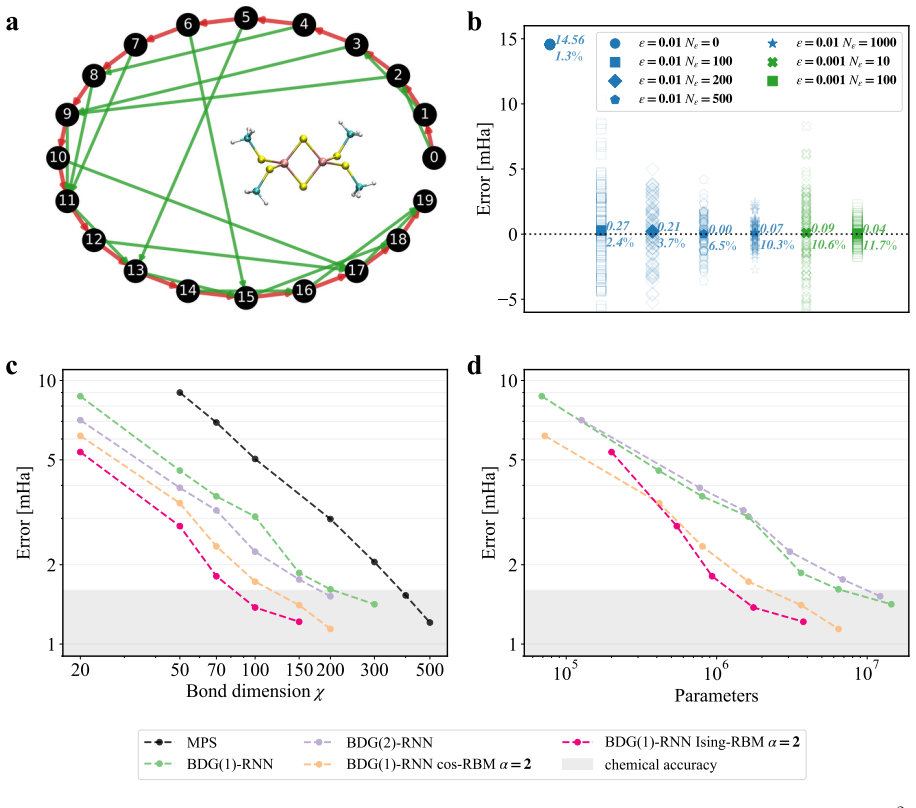
The central claim is that the expressivity bottleneck of tensor-network states can be lifted by letting a recurrent network act along the edges of a graph chosen from the molecule's own exchange integrals, rather than along a fixed one-dimensional sweep. Concretely, the BDG-RNN memory update at orbital i is $\mathbf{h}_i^{n_i} = \sum_{\alpha \in \mathcal{N}(i)} \mathbf{M}_{i\alpha}^{n_i} \mathbf{h}_\alpha^{n_\alpha} + \mathbf{T}_{i\alpha\beta\cdots\gamma}^{n_i} \mathbf{h}_\alpha \mathbf{h}_\beta \cdots \mathbf{h}_\gamma + \mathbf{v}_i^{n_i}$, which reduces to MPS-RNN when the graph is a chain, and the graph itself is generated from the Fiedler ordering of $K_{ij}=[ij|ji]$ plus a greedy edge-addition step. On top of this, multiplying by $f_n = \prod_k \cos(b_k + \sum_i W_{ki} n_i)$ (cos-RBM) or its quadratic generalization (Ising-RBM) yields $|\Psi\rangle = \sum_n f_n \Phi(n)|n\rangle$, and the paper shows via a reweighting identity that both the energy and its gradient keep the same autoregressive sampling structure. The semistochastic estimator splits the local-energy sum into a deterministic part over $|H_{nm}| \geq \epsilon$ and a stochastic part sampled from $|H_{nm}|$ for the remaining terms, giving an unbiased energy. The numerical evidence is that BDG-RNN with cos/Ising-RBM correlators reaches chemical accuracy at bond dimensions substantially smaller than plain MPS.
Load-bearing premise
The load-bearing premise is that the bounded-degree graph built from the Fiedler ordering of the orbital exchange integrals plus greedy edge addition captures the dominant entanglement structure of the molecule; if that graph misses important orbital correlations, the BDG-RNN cannot represent them, and the reported accuracy would not transfer to other molecular systems.
Editorial extensions
If this is right
- On the 1D hydrogen chain H50, BDG(1)-RNN at chi=30 reaches 0.6 mHa error while MPS needs chi>50 for the same accuracy, and adding cos-RBM drops the error to 0.2 mHa.
- On the iron-sulfur cluster CAS(30e,20o) model, BDG(1)-RNN reaches chemical accuracy at chi=200 where plain MPS needs chi=400, and the Ising-RBM correlator reaches it at chi=100.
- On the 3D H18 cluster, BDG(3)-RNN approaches 1.1 mHa error at chi=250; adding cos/Ising-RBM correlators reaches the same accuracy at chi=150, and BDG(2)-TensorRNN does so at chi=100.
- The semistochastic local-energy estimator yields up to a 2000-fold speedup (for H50, about 0.05% of the original cost) and reduces the local-energy scaling from O(K^5) to roughly O(K^2).
- The methods are released in the open-source PyNQS package, so the ansatze and estimators can be applied and extended by other groups.
Reading between the lines
- If the graph-construction recipe transfers, then a molecule's dominant entanglement pattern could be summarized by its exchange-integral connectivity; a natural test beyond the paper is to learn the graph from data rather than greedily adding edges, and compare BDG(k)-RNN energies.
- The correlator-reweighting trick is modular: because the base Phi(n) stays normalized and sampling is untouched, deeper or nonlocal correlators could be layered on top without changing the sampler, extending beyond the cos/Ising-RBM forms tested here.
- The semistochastic estimator's hyperparameters epsilon and N_epsilon are system-dependent; an adaptive schedule that lowers epsilon as optimization progresses might preserve the speedups on larger molecules without the bias seen at N_epsilon=0.
- The near-tie between BDG(2)-RNN and BDG(3)-RNN on H18 suggests that graph topology, not just degree, is the bottleneck; combining the BDG construction with entanglement-minimized orbital orderings (as done for Fe2S2) could be the more important ingredient on 3D systems.
Signed reviews
Editorial analysis
A structured set of objections, weighed in public.
Referee Report
Summary. This manuscript proposes three methodological developments for neural-network quantum states (NQS) in molecular electronic structure: (1) a bounded-degree graph recurrent neural network (BDG-RNN) ansatz that generalizes MPS-RNN by using a graph constructed from Fiedler ordering of orbital exchange integrals plus greedy edge addition; (2) RBM-inspired cos and Ising correlators applied on top of a normalized NQS through a reweighting scheme; and (3) a semistochastic local-energy estimator that treats large Hamiltonian matrix elements deterministically and samples the small ones. The methods are benchmarked on H50 in STO-6G, the [Fe2S2(SCH3)4]2- cluster in a CAS(30e,20o) active space, and a 3D 3x3x2 H18 cluster in STO-3G, with the authors reporting energy errors below 1.6 mHa at smaller bond dimensions than plain MPS. The code is released as the open-source PyNQS package.
Significance. If the results hold, the paper is a useful contribution to NQS for quantum chemistry: it provides a practical route to inject tensor-network initialization and graph structure into RNN-based NQS, and the semistochastic local-energy scheme offers substantial computational savings. The reweighting derivation in Eqs. (17)-(19) is clean, internally consistent, and correctly reduces to the standard VMC estimator when f_n = 1. The benchmarks are against external published references, and the energies are variational upper bounds, so the central claim is not circular. The open-source implementation is an additional strength that supports reproducibility. The main reservation is that final optimized energies are presented without statistical error bars, which prevents a full assessment of the chemical-accuracy claim; this is a fixable issue rather than a fundamental flaw.
major comments (3)
- [§2.4, Eq. (22); §4, Figs. 2d, 3c-d, 4c-f] The paper reports final VMC energies without statistical error bars or standard errors. The energies are stochastic estimates obtained with a semistochastic estimator whose variance depends on the hyperparameters ε and N_ε, yet the reported comparisons (e.g., 0.6 mHa for BDG(1)-RNN at χ=30 in H50, 1.1 mHa for Ising-RBM in Fe2S2, and 1.1 mHa for BDG(3)-RNN at χ=250 in H18) are not accompanied by a measure of sampling uncertainty. Because the central claim is chemical accuracy at the 1.6 mHa scale, the absence of error bars makes it impossible to verify that the differences from the reference energies are statistically meaningful. Please add error bars or standard errors for the final energies and describe how they were estimated.
- [§2.2, Algorithms S1/S2] The BDG graph determines which orbital correlations the ansatz can represent, and its construction is a heuristic based on Fiedler ordering of exchange integrals followed by greedy edge addition. The paper validates this construction only on the three benchmark systems and provides no sensitivity analysis, such as comparison with alternative orbital orderings, random edge selection, or different out-degrees k. Without such evidence or an explicit scope limitation, the claimed systematic improvement over MPS at fixed bond dimension cannot be cleanly separated from the particular graph choice. Please add a sensitivity study or clearly state the heuristic nature and scope of the graph-construction step.
- [§4.2, Fig. 3 caption and text] The text and figure caption refer to the Fe2S2 result as the 'exact energy', but the reference is taken from Ref. 57, which is a spin-projected MPS calculation rather than an exact result. If that reference has an uncertainty comparable to the reported margins of 1.1-1.7 mHa, the chemical-accuracy statement for this system needs qualification. Please state the precision or convergence of the reference energy, or replace it with a fully converged exact result.
minor comments (8)
- [§2.2] There is a typo: 'maximum out-dedgressk' should read 'maximum out-degree'.
- [§2.1, Eq. (3)] The notation '(n_i)∈{0,1}^{2K}' is ambiguous; it should state that each n_i takes values in {0,1} for i=1,...,2K.
- [§2.2, Eq. (13)] The phrase 'rank-(d+1) core tensor' should be 'order-(d+1) core tensor', and the complexity expression O(χ'^d) appears to undercount by one mode unless d is defined differently.
- [Fig. 3 caption] The caption says 'CAS(30e,2o)' but the text uses CAS(30e,20o); please correct the typo.
- [§2.4, Fig. 2a] The text says 'decreasing variance as N_ε increases', but the figure shows errors relative to the exact local energy; please report the variance or standard error explicitly to support this statement.
- [§4.1, Fig. 2b] The bar chart in Fig. 2b is not fully described in the caption; please specify what the bars represent, e.g., computation time in seconds.
- [§2.3] Minor wording issues: 'we introduce an correlator' should be 'we introduce a correlator', and 'THe' in the first paragraph of §2.1 should be 'The'.
- [§2.2 and SI] The main text refers to Algorithms S1-S3 and the gradient derivation only in the Supporting Information; for a self-contained reading, include at least a brief description of the greedy edge-selection criterion in the main text.
Circularity Check
No significant circularity: variational energies are benchmarked against external references and no fitted constant is relabeled as a prediction.
full rationale
The central derivation chain is self-contained. The BDG-RNN ansatz is a parameterized variational wavefunction whose graph is heuristically constructed from exchange integrals via Fiedler ordering and greedy edge addition, but the reported energies are variational upper bounds obtained by optimizing that wavefunction on the Hamiltonian, not algebraic functions of the graph or of the reference energies. The RBM-inspired correlator reweighting in Eqs. (17)-(19) is an exact importance-sampling identity, and the semistochastic local energy estimator in Eqs. (20)-(22) is an unbiased decomposition of the exact local energy; neither equation reduces the predicted energy to a fitted constant. Benchmarks are against pre-existing reference values: exact results for the hydrogen chain, the CAS(30e,20o) iron-sulfur active-space energy from Ref. 57, and a high-bond-dimension MPS reference for H18; the latter is an in-house benchmark rather than an independent exact value, but it is a validation caveat, not a circularity. Hyperparameters such as epsilon, N_epsilon, alpha, and graph degree are tuned per system on the same data, which is mild selection bias but does not make the chemical-accuracy claim equivalent to its inputs. The self-citations to the authors' earlier codes and papers (Refs. 51, 52, 57, 59) provide implementation tools or pre-existing reference data; none is invoked as an unverified uniqueness theorem or as the justification for the central numerical claim. The derivation therefore contains no step in which a prediction is defined in terms of the quantity it is supposed to predict, and no fitted parameter is renamed as a prediction.
Assumptions & free parameters
free parameters (5)
- epsilon (semistochastic threshold) =
0.01
- N_epsilon (stochastic samples for small matrix elements) =
100 (H50, H18); 1000 (Fe2S2)
- alpha (hidden density of RBM correlators) =
2
- graph out-degree k =
1 (H50), 2 (Fe2S2), 3 (H18)
- bond dimension chi =
Various (e.g., 30 for H50, 100-200 for Fe2S2, 250 for H18)
assumptions (5)
- standard math Slater-Condon rules for Hamiltonian matrix elements
- domain assumption Autoregressive factorization of the wavefunction enables unbiased sampling
- domain assumption VMC optimization converges to the ground state of the ansatz
- domain assumption Reference energies are accurate enough to define chemical accuracy
- ad hoc to paper Fiedler ordering plus greedy edge addition gives a useful BDG
Cite this review
Pith. "Pith review of Hybrid tensor network and neural network quantum states for quantum chemistry." pith.science (2026). https://pith.science/paper/S6AT5FHX
@misc{pith2026250719276,
  author       = {Pith},
  title        = {Pith review of: Hybrid tensor network and neural network quantum states for quantum chemistry},
  year         = {2026},
  howpublished = {\url{https://pith.science/paper/S6AT5FHX}},
  note         = {Machine review of arXiv:2507.19276}
}
abstract
Neural network quantum states (NQS) have emerged as a powerful and flexible framework for addressing quantum many-body problems. While successful for model Hamiltonians, their application to molecular systems remains challenging for several reasons. In this work, we introduce three innovations to overcome some of the key limitations. (1) We propose two novel ans\"atzet hat hybridize tensor network and neural network states for addressing initialization challenges and enhancing the expressivity of tensor networks. First, we develop a bounded-degree graph recurrent neural network (BDG-RNN) ansatz that leverages graph-based updates, enabling applications to molecular electronic structure problems. Second, we introduce restricted Boltzmann machine (RBM) inspired correlators to further enhance expressivity and improve accuracy, without dramatically modifying the underlying variational Monte Carlo (VMC) optimization framework. (2) We introduce a semi-stochastic algorithm for local energy evaluation, which significantly reduces computational cost while maintaining high accuracy. Combining these advances, we demonstrate that our approaches can achieve chemical accuracy in challenging systems, including the one-dimensional hydrogen chain H50, the iron-sulfur cluster [Fe2S2(SCH3)4]^{2-}, and a three-dimensional $3 \times 3 \times 2$ hydrogen cluster H18. These methods are implemented in an open-source package - PyNQS (https://github.com/Quantum-Chemistry-Group-BNU/PyNQS) to advance NQS methodologies for quantum chemistry.
Figures


Figures from the paper (1 more)

Reference graph
Works this paper leans on
-
[1]
(1) Grimme, S. Improved second-order Møller–Plesset perturbation theory by separate scal- ing of parallel-and antiparallel-spin pair correlation energies.J. Chem. Phys.2003, 118, 9095–9102. (2) Werner, H.-J.; Knowles, P. J. An efficient internally contracted multiconfiguration– reference configuration interaction method. J. Chem. Phys.1988, 89, 5803–5814....
work page 2003
-
[7]
Neuralized Fermionic Tensor Networks for Quantum Many-Body Systems
(22) Knitter, O.; Zhao, D.; Stokes, J.; Ganahl, M.; Leichenauer, S.; Veerapaneni, S. Retentive neural quantum states: efficient ans¨ atze for ab initio quantum chemistry.Mach. Learn.: Sci. Technol.2025, 6, 025022. (23) Liu, A.-J.; Clark, B. K. Neural network backflow for ab-initio quantum chemistry.Phys. Rev. B2024, 110, 115137. (24) Kan, B.; Tian, Y.; Wu...
work page Pith review arXiv 2025
-
[16]
Entanglement-minimized orbitals enable faster quantum simulation of molecules
27 (59) Li, Z. Entanglement-minimized orbitals enable faster quantum simulation of molecules. arXiv preprint arXiv:2506.133862025, (60) Chen, A.; Heyl, M. Efficient optimization of deep neural quantum states toward machine precision. Nat. Phys.2024, 20, 1381–1382. 28 TOC Graphic hj2 hj1 Mij2Mij1 vNvi vj1 vj2 v1 hNhh1 vN vv2v1 |Ψ ⟩ = ∑ n f nΦ(n)|n⟩ BDG–RNN...
arXiv 2024
-
[32]
(51) Li, Z. Expressibility of comb tensor network states (CTNS) for the P-cluster and the FeMo-cofactor of nitrogenase. Electron. Struct.2021, 3, 014001. (52) Xiang, C.; Jia, W.; Fang, W.-H.; Li, Z. Distributed Multi-GPU Ab Initio Density Matrix Renormalization Group Algorithm with Applications to the P-Cluster of Nitrogenase. J. Chem. Theory Comput.2024,...
work page 2021
-
[125]
(56) Sharma, S.; Chan, G. K. Communication: A flexible multi-reference perturbation the- ory by minimizing the Hylleraas functional with matrix product states. J. Chem. Phys. 2014,
work page 2014
-
[141]
(57) Li, Z.; Chan, G. K.-L. Spin-projected matrix product states: Versatile tool for strongly correlated systems. J. Chem. Theory Comput.2017, 13, 2681–2695. (58)http://github.com/zhendongli2008/Active-space-model-for-Iron-Sulfur-Clusters,
work page 2017
-
[142]
(45) Tucker, L. R. Some mathematical notes on three-mode factor analysis. Psychometrika 1966, 31, 279–311. (46) Deng, D.-L.; Li, X.; Das Sarma, S. Quantum entanglement in neural network states. Phys. Rev. X2017, 7, 021021. (47) Yang, P.-J.; Sugiyama, M.; Tsuda, K.; Yanai, T. Artificial Neural Networks Applied as Molecular Wave Function Solvers. J. Chem. T...
work page 1966
-
[149]
Improved speed and scaling in orbital space variational Monte Carlo
(32) Sabzevari, I.; Sharma, S. Improved speed and scaling in orbital space variational Monte Carlo. J. Chem. Theory Comput.2018, 14, 6276–6286. (33) Levin, D. A.; Peres, Y. Markov chains and mixing times; American Mathematical Soc., 2017; Vol
work page 2018
Show all 16 references
-
[153]
The density-matrix renormalization group in the age of matrix product states
(54) Schollw¨ ock, U. The density-matrix renormalization group in the age of matrix product states. Ann. Phys.2011, 326, 96–192. (55) Hachmann, J.; Cardoen, W.; Chan, G. K. Multireference correlation in long molecules with the quadratic scaling density matrix renormalization g...
2011
-
[160]
(28) Liu, A.-J.; Clark, B. K. Efficient optimization of neural network backflow for ab-initio quantum chemistry. arXiv preprint arXiv:2502.188432025, (29) Zhao, T.; Stokes, J.; Veerapaneni, S. Scalable neural quantum states architecture for quantum chemistry. Mach. Learn.: Sci...
2023 arXiv
-
[1791]
Green function Monte Carlo with stochastic reconfiguration
22 (9) Sorella, S. Green function Monte Carlo with stochastic reconfiguration. Phys. Rev. Lett. 1998, 80,
1998
-
[2008]
A stochastic approximation method
(35) Robbins, H.; Monro, S. A stochastic approximation method. Ann. Math. Statist.1951, 400–407. (36) Kingma, D. P.; Ba, J. Adam: A method for stochastic optimization. International Conference on Learning Representations
1951
-
[2017]
(50) Paszke, A.; Gross, S.; Massa, F.; Lerer, A.; Bradbury, J.; Chanan, G.; Killeen, T.; Lin, Z.; Gimelshein, N.; Antiga, L., et al
26 (49)https://github.com/Quantum-Chemistry-Group-BNU/PyNQS. (50) Paszke, A.; Gross, S.; Massa, F.; Lerer, A.; Bradbury, J.; Chanan, G.; Killeen, T.; Lin, Z.; Gimelshein, N.; Antiga, L., et al. Pytorch: An imperative style, high- performance deep learning library. Adv. Neural ...
2019
-
[2019]
S.; Yamaji, Y.; Imada, M
25 (38) Nomura, Y.; Darmawan, A. S.; Yamaji, Y.; Imada, M. Restricted Boltzmann ma- chine learning for solving strongly correlated quantum systems. Phys. Rev. B2017, 96, 205152. (39) Choo, K.; Mezzacapo, A.; Carleo, G. Fermionic neural-network states for ab-initio electronic s...
2020
-
[3081]
(6) Toulouse, J.; Assaraf, R.; Umrigar, C. J. Adv. Quantum Chem.; Elsevier, 2016; Vol. 73; pp 285–314. (7) Austin, B. M.; Zubarev, D. Y.; Lester Jr, W. A. Quantum Monte Carlo and related approaches. Chem. Rev.2012, 112, 263–288. (8) Kalos, M. H. Monte Carlo calculations of the...
2016
-
[4558]
Ab initio computations of molecular systems by the auxiliary-field quantum Monte Carlo method
(10) Motta, M.; Zhang, S. Ab initio computations of molecular systems by the auxiliary-field quantum Monte Carlo method. WIREs Comput. Mol. Sci.2018, 8, e1364. (11) Lee, J.; Pham, H. Q.; Reichman, D. R. Twenty years of auxiliary-field quantum Monte Carlo in quantum chemistry: ...
2018
Reviewed August 15, 2026 · model on record in the stance chip above.
Discussion (0). Continue with ORCID to comment.