REVIEW 3 major objections 5 minor 2 cited by
HairCUP: Hair Compositional Universal Prior for 3D Gaussian Avatars
T0 review · 3 major / 5 minor · reviewed 2026-08-06 · deepseek-v4-flash
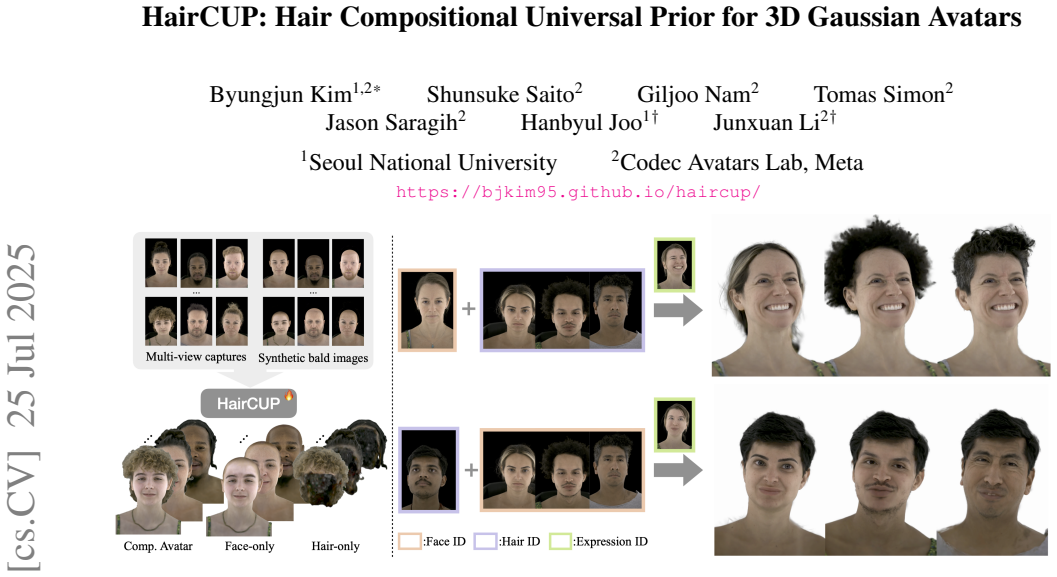
Pith's one-line read HairCUP claims that separating face and hair into independent latent spaces, supervised by synthetic hairless images, yields a universal 3D avatar prior for seamless hairstyle transfer and few-shot personalization.
desk verdict A credible compositional Gaussian avatar prior with a genuinely new synthetic-bald-data trick, but the load-bearing assumption is unvalidated and the evaluation is narrower than the claims; worth a serious referee, not a desk reject. read the letter →
The pith
A machine-rendered reading of the paper's core claim, the machinery that carries it, and where it could break.
The reading
What carries the argument
The load-bearing object is a paired synthetic-bald dataset plus a compositional Gaussian decoder architecture: separate identity-conditioned hypernetworks for face and hair produce bias maps from mean albedo and geometry UV maps; separate decoders emit relightable 3D Gaussians for each component; a bald-geometry predictor supplies the scalp mesh that anchors hair Gaussians; and a boundary-free segmentation loss, relaxed near the face-hair boundary, assigns each Gaussian to one component. The paired bald images are what make the separation learnable, because they force the face Gaussians to reconstruct a hairless version of the subject instead of hiding hair appearance inside the face code.
What would settle it
Collect real hairless multi-view captures for a few subjects, run the same face-only and compositional rendering losses against those real images, and measure scalp-region L1 and LPIPS for the synthetic-bald-trained model versus a version fine-tuned on the real bald captures; if the synthetic model is worse, the diffusion-inpainted targets carry bias.
Extended reading notes
Core claim
The paper's central claim is that explicit compositionality—independent latent codes, hypernetworks, and Gaussian decoders for face and hair, with hair Gaussians anchored to a predicted bald scalp—yields a universal prior whose face and hair spaces are disentangled enough for identity-preserving transfer, whereas holistic priors trained on the same data remain entangled. The key supervision is the synthetic bald image: the face-only rendering is trained against a hairless composite of the subject, so facial Gaussians cannot encode hair-dependent appearance, while the hair model is trained on the original images and anchored to the bald mesh so it adapts to any target head shape. The paper further claims that this prior supports few-shot fine-tuning on unseen subjects from monocular captures, producing high-fidelity compositional avatars with independent face and hair control.
Load-bearing premise
The load-bearing premise is that the diffusion-generated bald images are faithful enough to serve as ground truth for how each subject looks without hair; if the hallucinated scalp color, geometry, or occlusion handling is biased, the face and hair latent spaces will remain entangled and transfer poorly across identities.
Editorial extensions
If this is right
- Hairstyle transfer becomes a feed-forward operation: combining one identity's face hypernetwork with another's hair hypernetwork transfers the hairstyle without additional scaling or alignment, because hair Gaussians are defined relative to the predicted bald scalp.
- A short monocular head-rotation video is enough to fine-tune the prior into a personalized relightable avatar, and the face and hair of that avatar can later be recombined with any other identity.
- The face-only rendering path reconstructs plausible appearance under hair occlusion, effectively dehairing an avatar and hallucinating the scalp region.
- Avatar interpolation improves: with face and hair manifolds separated, interpolating between subjects no longer morphs ears into hair as the holistic baseline does.
- Relighting remains consistent across a transferred hairstyle because both components share the same relightable Gaussian appearance model, and the paper demonstrates relightable hairstyle transfer.
Reading between the lines
- The same recipe—mask out an occluding attribute, inpaint its absence with a diffusion prior, and train a separate decoder on the paired data—should extend to glasses, beards, hats, and other headwear, as long as the attribute can be segmented and the inpainted target stays multi-view consistent.
- A direct test the paper does not run: if the face and hair codes are truly disentangled, a classifier trained on face latent codes to predict the source identity's hairstyle should perform at chance; showing otherwise would reveal residual entanglement.
- Because the scalp texture is optimized from a single neutral frame and a diffusion prior, factors like skin color under different expressions or lighting are extrapolated; even a handful of real hairless multi-view captures of new subjects would calibrate how much bias the synthetic targets introduce.
Editorial analysis
A structured set of objections, weighed in public.
Referee Report
Summary. The paper introduces HairCUP, a universal relightable 3D Gaussian avatar prior with explicit compositionality of face and hair. Face and hair are modeled by separate identity-conditioned hypernetworks and Gaussian decoders, and both components are anchored on a predicted bald head mesh. The key training signal is a synthetic hairless image (Eq. 22) formed by compositing the original photo with a rendered bald mesh whose texture is optimized from a single neutral, fully-lit frame using a reconstruction loss and Score Distillation Sampling with a diffusion prior (Eq. 20). Training combines compositional and face-only reconstruction losses with a Gaussian segmentation loss. The paper claims seamless face/hair transfer between avatars and few-shot monocular personalization, and evaluates on 8 unseen identities against DELTA, with additional qualitative interpolation and ablation results.
Significance. If the synthetic hairless supervision is trustworthy, the explicit compositional prior is a timely and practically useful extension of URAvatar, enabling controllable hairstyle transfer and few-shot personalization with relightable 3D Gaussians. Strengths of the paper include a detailed method section, a large studio capture setup (252 pretraining / 8 held-out subjects), and genuine held-out fine-tuning evaluation. The main weakness is that the validity of the synthetic bald targets is not established, and the quantitative evaluation is too narrow to fully support the central claims; with those points addressed, the contribution would be solid.
major comments (3)
- [Section 3.3, Eq. (22); Section 3.4; Limitations] The face-only reconstruction loss Lface_rec is supervised by synthetic bald images Ibald, whose occluded scalp region is hallucinated by a diffusion prior through an SDS loss and optimized from a single neutral, fully-lit frame. The central disentanglement claim therefore depends on this hallucinated scalp being an accurate per-subject ground truth. The paper provides no comparison against real hairless or tight-cap captures and no quantitative identity-retention metric for hair-swapped avatars. Since the Limitations paragraph itself concedes color discrepancy and poor relighting of the occluded scalp, these are exactly the failure modes that would entangle face identity with the diffusion prior. Please validate the synthetic bald data on subjects with real haircut or cap captures, and quantify how bald-texture error propagates to face transfer and personalization quality.
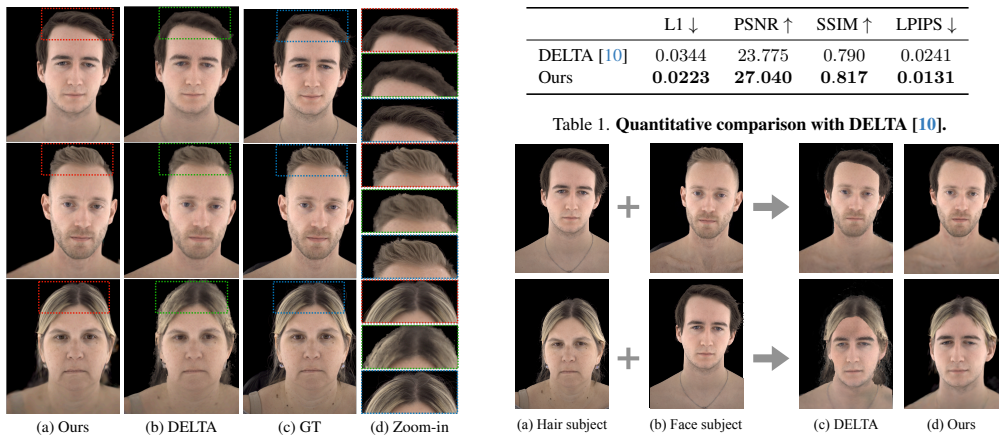
- [Section 4.1, Table 1; Section 4.2] The quantitative evaluation for few-shot personalization compares only DELTA on 8 unseen subjects and reports average metrics without per-subject variance, error bars, or statistical significance. Since URAvatar and LUCAS are universal prior baselines using the same relightable Gaussian codec setup, a comparison with them under the same fine-tuning protocol is needed to substantiate the universal-prior claim. In addition, the headline application of hairstyle transfer is evaluated only qualitatively (Figs. 5, 11, 12); please report transfer metrics such as face identity preservation, hair fidelity (e.g., LPIPS or FID on swapped compositions), and boundary artifact measures.
- [Section 4.2, Figs. 7-8] The ablations for hair offset modeling and boundary-free segmentation loss are qualitative only, despite these components being central to the method. Without quantitative ablation on the same 8-subject held-out protocol, it is hard to attribute the reported improvements to the compositional prior, the segmentation loss, or the synthetic data pipeline. Please provide quantitative results for each ablated design choice, including the use of synthetic bald targets versus no such supervision.
minor comments (5)
- [Eq. (15)] In Eq. (15), n_f^k is written as t_b^k + delta t_f^k, which appears to be a typo; it should presumably read n_b^k + delta n_f^k, using the normal from the bald geometry map rather than the texel position.
- [Section 3.3, Eq. (21)] The term Icond is called a 'bald image prompt' but is described as generated by a pretrained text-to-image inpainting model; please define precisely how Icond is constructed and whether it is an image, a text prompt, or both.
- [Section 3.5] The sentence 'we only update the last layer of the hypernetworks' is underspecified: it should state which hypernetworks (face, hair, eyes) are updated, and what 'last layer' means for a UNet-based hypernetwork.
- [Supplementary B.2, Fig. 10] The main text says the bald texture is optimized from a single neutral expression frame, but the supplementary material describes an additional capture with hair tied back to reduce occlusion; please state this auxiliary capture in the main method for reproducibility.
- [Table 1] The numerical formatting in Table 1 contains stray spaces (e.g., '23 .775', '0 .790') and would benefit from standard formatting; more importantly, per-subject results should be reported given the small held-out set.
Circularity Check
No significant circularity: the face-hair disentanglement is trained on synthetic bald targets and evaluated on held-out identities, so the central claim is empirically contingent rather than true by construction.
full rationale
The paper's central claim is that a compositional universal prior can disentangle face and hair and enable identity-preserving transfer. The disentanglement is trained via an explicit face-only reconstruction loss against synthetic bald images defined by Eq. (22), Ibald = Mtilde_hair * Iorig + (1 - Mtilde_hair) * R(Mbald), plus a segmentation loss and separate face/hair decoders and hypernetworks. These are architectural inductive biases and supervised training targets, not a derivation in which the conclusion is assumed by the inputs. The face and hair latent spaces are not defined in terms of the transfer/identity-preservation claim; rather, the transfer behavior is an empirical consequence evaluated qualitatively and against the external baseline DELTA [10] on unseen identities. Self-citations to URAvatar [26] and Codec Avatar Studio [33] provide the base architecture, the relightable Gaussian representation, and the capture data; they are prior work and real data, not uniqueness theorems or ansatz smuggled in via citation, and no load-bearing argument reduces to a self-citation. The Limitations paragraph concedes color discrepancies and poor relighting of the occluded scalp; these are data-fidelity risks that could bias the learned disentanglement, but they are not circular reductions. No fitted parameter is renamed as a prediction, and no equation is equivalent to its own input by construction. The main assessment risk is external validity of the synthetic hairless supervision, not logical circularity.
Assumptions & free parameters
free parameters (6)
- SDS loss weight lambda_sds_bald =
1e-6
- Reconstruction loss weight lambda_rec_bald =
1
- Bald texture optimization schedule =
2500 iterations (1500 rec, 1000 SDS)
- Boundary-free segmentation loss schedule =
unspecified iteration count
- Learning rates =
5e-4 pretrain, 1e-5 fine-tune
- Pretraining/fine-tuning subject split =
252 pretrain, 8 fine-tune
assumptions (5)
- domain assumption Diffusion-inpainted synthetic bald images are a faithful proxy for real hairless captures
- domain assumption Predefined UV face/hair masks correctly separate face from hair across all subjects
- domain assumption A single neutral-frame bald mesh with shared topology is a consistent anchor for hair across identities and expressions
- domain assumption The diffusion prior and ControlNet trained on dome-captured human images are representative enough to inpaint occluded scalps
- standard math Standard Gaussian splatting and the relightable Gaussian appearance model are valid rendering assumptions
Cite this review
Pith. "Pith review of HairCUP: Hair Compositional Universal Prior for 3D Gaussian Avatars." pith.science (2026). https://pith.science/paper/WGQNERNS
@misc{pith2026250719481,
  author       = {Pith},
  title        = {Pith review of: HairCUP: Hair Compositional Universal Prior for 3D Gaussian Avatars},
  year         = {2026},
  howpublished = {\url{https://pith.science/paper/WGQNERNS}},
  note         = {Machine review of arXiv:2507.19481}
}
read the original abstract
We present a universal prior model for 3D head avatars with explicit hair compositionality. Existing approaches to build generalizable priors for 3D head avatars often adopt a holistic modeling approach, treating the face and hair as an inseparable entity. This overlooks the inherent compositionality of the human head, making it difficult for the model to naturally disentangle face and hair representations, especially when the dataset is limited. Furthermore, such holistic models struggle to support applications like 3D face and hairstyle swapping in a flexible and controllable manner. To address these challenges, we introduce a prior model that explicitly accounts for the compositionality of face and hair, learning their latent spaces separately. A key enabler of this approach is our synthetic hairless data creation pipeline, which removes hair from studio-captured datasets using estimated hairless geometry and texture derived from a diffusion prior. By leveraging a paired dataset of hair and hairless captures, we train disentangled prior models for face and hair, incorporating compositionality as an inductive bias to facilitate effective separation. Our model's inherent compositionality enables seamless transfer of face and hair components between avatars while preserving identity. Additionally, we demonstrate that our model can be fine-tuned in a few-shot manner using monocular captures to create high-fidelity, hair-compositional 3D head avatars for unseen subjects. These capabilities highlight the practical applicability of our approach in real-world scenarios, paving the way for flexible and expressive 3D avatar generation.
Figures


Figures from the paper (9 more)


Forward citations
Cited by 2 Pith papers
-
Durian: Dual Reference Image-Guided Portrait Animation with Attribute Transfer
Durian introduces a dual-reference diffusion model trained via self-reconstruction on video frames to enable cross-identity attribute transfer in portrait animations, supporting multi-attribute composition and interpolation.
-
PhysHead: Simulation-Ready Gaussian Head Avatars
PhysHead builds simulation-ready head avatars by layering 3D Gaussians on a head mesh and physics-simulatable hair strands, enabling wind-blown and expression-driven hair motion from video data.
Reference graph
Works this paper leans on
-
[1]
Learning personal- ized high quality volumetric head avatars from monocular rgb videos
Ziqian Bai, Feitong Tan, Zeng Huang, Kripasindhu Sarkar, Danhang Tang, Di Qiu, Abhimitra Meka, Ruofei Du, Ming- song Dou, Sergio Orts-Escolano, et al. Learning personal- ized high quality volumetric head avatars from monocular rgb videos. In Proc. CVPR, 2023. 2
2023
-
[2]
Effi- cient 3d implicit head avatar with mesh-anchored hash table blendshapes
Ziqian Bai, Feitong Tan, Sean Fanello, Rohit Pandey, Ming- song Dou, Shichen Liu, Ping Tan, and Yinda Zhang. Effi- cient 3d implicit head avatar with mesh-anchored hash table blendshapes. In Proc. CVPR, 2024. 2
2024
-
[3]
A morphable model for the synthesis of 3d faces
V olker Blanz and Thomas Vetter. A morphable model for the synthesis of 3d faces. In Proc. ACM SIGGRAPH, 1999. 2
work page 1999
-
[4]
Preface: A data-driven volumetric prior for few-shot ultra high-resolution face synthesis
Marcel C B ¨uhler, Kripasindhu Sarkar, Tanmay Shah, Gengyan Li, Daoye Wang, Leonhard Helminger, Ser- gio Orts-Escolano, Dmitry Lagun, Otmar Hilliges, Thabo Beeler, et al. Preface: A data-driven volumetric prior for few-shot ultra high-resolution face synthesis. InProc. ICCV,
-
[5]
Facewarehouse: A 3d facial expression database for visual computing
Chen Cao, Yanlin Weng, Shun Zhou, Yiying Tong, and Kun Zhou. Facewarehouse: A 3d facial expression database for visual computing. IEEE Trans. Vis. Comput. Graph., 20(3): 413–425, 2013. 2
work page 2013
-
[6]
Authentic volumetric avatars from a phone scan
Chen Cao, Tomas Simon, Jin Kyu Kim, Gabe Schwartz, Michael Zollhoefer, Shun-Suke Saito, Stephen Lombardi, Shih-En Wei, Danielle Belko, Shoou-I Yu, Yaser Sheikh, and Jason Saragih. Authentic volumetric avatars from a phone scan. ACM Trans. Graph., 41(4), 2022. 2, 3, 12, 14
work page 2022
-
[7]
Pega- sus: Personalized generative 3d avatars with composable at- tributes
Hyunsoo Cha, Byungjun Kim, and Hanbyul Joo. Pega- sus: Personalized generative 3d avatars with composable at- tributes. In Proc. CVPR, 2024. 2, 5
work page 2024
-
[8]
Perse: Person- alized 3d generative avatars from a single portrait
Hyunsoo Cha, Inhee Lee, and Hanbyul Joo. Perse: Person- alized 3d generative avatars from a single portrait. arXiv preprint arXiv:2412.21206, 2024. 2
arXiv 2024
Show all 82 references
-
[9]
Black, and Timo Bolkart
Yao Feng, Jinlong Yang, Marc Pollefeys, Michael J. Black, and Timo Bolkart. Capturing and animation of body and clothing from monocular video. In Proc. ACM SIGGRAPH Asia, 2022. 2
2022
-
[10]
Learning disentangled avatars with hybrid 3d representations
Yao Feng, Weiyang Liu, Timo Bolkart, Jinlong Yang, Marc Pollefeys, and Michael J Black. Learning disentangled avatars with hybrid 3d representations. arXiv preprint arXiv:2309.06441, 2023. 2, 3, 5, 7
2023 arXiv
-
[11]
Dynamic neural radiance fields for monocular 4d facial avatar reconstruction
Guy Gafni, Justus Thies, Michael Zollh ¨ofer, and Matthias Nießner. Dynamic neural radiance fields for monocular 4d facial avatar reconstruction. In Proc. CVPR, 2021. 2
2021
-
[12]
Reconstructing personalized se- mantic facial nerf models from monocular video
Xuan Gao, Chenglai Zhong, Jun Xiang, Yang Hong, Yudong Guo, and Juyong Zhang. Reconstructing personalized se- mantic facial nerf models from monocular video. ACM Trans. Graph., 41(6):1–12, 2022. 2
2022
-
[13]
Npga: Neural parametric gaussian avatars
Simon Giebenhain, Tobias Kirschstein, Martin R ¨unz, Lour- des Agapito, and Matthias Nießner. Npga: Neural parametric gaussian avatars. In Proc. ACM SIGGRAPH Asia, 2024. 2
2024
-
[14]
Neu- ral head avatars from monocular rgb videos
Philip-William Grassal, Malte Prinzler, Titus Leistner, Carsten Rother, Matthias Nießner, and Justus Thies. Neu- ral head avatars from monocular rgb videos. In Proc. CVPR,
-
[15]
Vid2avatar-pro: Authentic avatar from videos in the wild via universal prior
Chen Guo, Junxuan Li, Yash Kant, Yaser Sheikh, Shunsuke Saito, and Chen Cao. Vid2avatar-pro: Authentic avatar from videos in the wild via universal prior. In Proc. CVPR, 2025. 2
2025
-
[16]
Denoising diffu- sion probabilistic models
Jonathan Ho, Ajay Jain, and Pieter Abbeel. Denoising diffu- sion probabilistic models. NeurIPS, 2020. 3, 5
2020
-
[17]
Single- view hair modeling using a hairstyle database
Liwen Hu, Chongyang Ma, Linjie Luo, and Hao Li. Single- view hair modeling using a hairstyle database. ACM Trans. Graph., 34(4):1–9, 2015. 6
2015
-
[18]
3d gaussian splatting for real-time radiance field rendering
Bernhard Kerbl, Georgios Kopanas, Thomas Leimk ¨uhler, and George Drettakis. 3d gaussian splatting for real-time radiance field rendering. ACM Trans. Graph., 42(4):139–1,
-
[19]
Realistic one-shot mesh-based head avatars
Taras Khakhulin, Vanessa Sklyarova, Victor Lempitsky, and Egor Zakharov. Realistic one-shot mesh-based head avatars. In Proc. ECCV, 2022. 2
2022
-
[20]
Ncho: Un- supervised learning for neural 3d composition of humans and objects
Taeksoo Kim, Shunsuke Saito, and Hanbyul Joo. Ncho: Un- supervised learning for neural 3d composition of humans and objects. In Proc. ICCV, 2023. 2
2023
-
[21]
Gala: Generating animatable layered assets from a sin- gle scan
Taeksoo Kim, Byungjun Kim, Shunsuke Saito, and Hanbyul Joo. Gala: Generating animatable layered assets from a sin- gle scan. In Proc. CVPR, 2024. 2, 5, 6
2024
-
[22]
Adam: A method for stochastic opti- mization
Diederik P Kingma. Adam: A method for stochastic opti- mization. arXiv preprint arXiv:1412.6980, 2014. 7
2014 arXiv
-
[23]
Kingma and Max Welling
Diederik P. Kingma and Max Welling. Auto-encoding vari- ational bayes. In Proc. ICLR, 2014. 3, 6, 12
2014
-
[24]
Guess the unseen: Dynamic 3d scene reconstruction from partial 2d glimpses
Inhee Lee, Byungjun Kim, and Hanbyul Joo. Guess the unseen: Dynamic 3d scene reconstruction from partial 2d glimpses. In Proc. CVPR, 2024. 5
2024
-
[25]
Megane: Morphable eyeglass and avatar network
Junxuan Li, Shunsuke Saito, Tomas Simon, Stephen Lom- bardi, Hongdong Li, and Jason Saragih. Megane: Morphable eyeglass and avatar network. In Proc. CVPR, 2023. 2
2023
-
[26]
Uravatar: Universal relightable gaussian codec avatars
Junxuan Li, Chen Cao, Gabriel Schwartz, Rawal Khirodkar, Christian Richardt, Tomas Simon, Yaser Sheikh, and Shun- suke Saito. Uravatar: Universal relightable gaussian codec avatars. In Proc. ACM SIGGRAPH Asia, 2024. 2, 3, 4, 5, 6, 8, 12, 14
2024
-
[27]
Black, Hao Li, and Javier Romero
Tianye Li, Timo Bolkart, Michael J. Black, Hao Li, and Javier Romero. Learning a model of facial shape and ex- pression from 4d scans. ACM Trans. Graph., 36(6), 2017. 2, 3
2017
-
[28]
Layga: Layered gaussian avatars for animatable clothing transfer
Siyou Lin, Zhe Li, Zhaoqi Su, Zerong Zheng, Hongwen Zhang, and Yebin Liu. Layga: Layered gaussian avatars for animatable clothing transfer. In Proc. ACM SIGGRAPH,
-
[29]
Lucas: Layered universal codec avatars
Di Liu, Teng Deng, Giljoo Nam, Yu Rong, Stanislav Pid- horskyi, Junxuan Li, Jason Saragih, Dimitris N Metaxas, and Chen Cao. Lucas: Layered universal codec avatars. In Proc. CVPR, 2025. 2 9
2025
-
[30]
Mix- ture of volumetric primitives for efficient neural rendering
Stephen Lombardi, Tomas Simon, Gabriel Schwartz, Michael Zollhoefer, Yaser Sheikh, and Jason Saragih. Mix- ture of volumetric primitives for efficient neural rendering. ACM Trans. Graph., 40(4):1–13, 2021. 2
2021
-
[31]
Gaussianhair: Hair modeling and rendering with light-aware gaussians
Haimin Luo, Min Ouyang, Zijun Zhao, Suyi Jiang, Longwen Zhang, Qixuan Zhang, Wei Yang, Lan Xu, and Jingyi Yu. Gaussianhair: Hair modeling and rendering with light-aware gaussians. arXiv preprint arXiv:2402.10483, 2024. 3
2024 arXiv
-
[32]
Pixel codec avatars
Shugao Ma, Tomas Simon, Jason Saragih, Dawei Wang, Yuecheng Li, Fernando De La Torre, and Yaser Sheikh. Pixel codec avatars. In Proc. CVPR, 2021. 2
2021
-
[33]
Jewett, Simon Ven- shtain, Christopher Heilman, Yueh-Tung Chen, Sidi Fu, Mo- hamed Ezzeldin A
Julieta Martinez, Emily Kim, Javier Romero, Timur Bagaut- dinov, Shunsuke Saito, Shoou-I Yu, Stuart Anderson, Michael Zollh ¨ofer, Te-Li Wang, Shaojie Bai, Chenghui Li, Shih-En Wei, Rohan Joshi, Wyatt Borsos, Tomas Simon, Jason Saragih, Paul Theodosis, Alexander Greene, Anjani...
2024
-
[34]
Occupancy net- works: Learning 3d reconstruction in function space
Lars Mescheder, Michael Oechsle, Michael Niemeyer, Se- bastian Nowozin, and Andreas Geiger. Occupancy net- works: Learning 3d reconstruction in function space. In Proc. CVPR, 2019. 2
2019
-
[35]
Srinivasan, Matthew Tancik, Jonathan T
Ben Mildenhall, Pratul P. Srinivasan, Matthew Tancik, Jonathan T. Barron, Ravi Ramamoorthi, and Ren Ng. Nerf: Representing scenes as neural radiance fields for view syn- thesis. In Proc. ECCV, 2020. 2
2020
-
[36]
Instant neural graphics primitives with a mul- tiresolution hash encoding
Thomas M ¨uller, Alex Evans, Christoph Schied, and Alexan- der Keller. Instant neural graphics primitives with a mul- tiresolution hash encoding. ACM Trans. Graph., 41(4):1–15,
-
[37]
Strand-accurate multi-view hair capture
Giljoo Nam, Chenglei Wu, Min H Kim, and Yaser Sheikh. Strand-accurate multi-view hair capture. In Proc. CVPR ,
-
[38]
Rsgan: face swapping and editing using face and hair repre- sentation in latent spaces
Ryota Natsume, Tatsuya Yatagawa, and Shigeo Morishima. Rsgan: face swapping and editing using face and hair repre- sentation in latent spaces. In Proc. ACM SIGGRAPH, 2018. 2
2018
-
[39]
Capture of hair geometry from multiple images.ACM Trans
Sylvain Paris, Hector M Briceno, and Franc ¸ois X Sillion. Capture of hair geometry from multiple images.ACM Trans. Graph., 23(3):712–719, 2004. 3
2004
-
[40]
Deepsdf: Learning con- tinuous signed distance functions for shape representation
Jeong Joon Park, Peter Florence, Julian Straub, Richard Newcombe, and Steven Lovegrove. Deepsdf: Learning con- tinuous signed distance functions for shape representation. In Proc. CVPR, 2019. 14
2019
-
[41]
Georgios Pavlakos, Vasileios Choutas, Nima Ghorbani, Timo Bolkart, Ahmed A. A. Osman, Dimitrios Tzionas, and Michael J. Black. Expressive body capture: 3D hands, face, and body from a single image. In Proc. CVPR, 2019. 2
2019
-
[42]
Rasterized edge gradients: Handling discontinuities differentiably
Stanislav Pidhorskyi, Tomas Simon, Gabriel Schwartz, He Wen, Yaser Sheikh, and Jason Saragih. Rasterized edge gradients: Handling discontinuities differentiably. In Proc. ECCV, 2024. 5
2024
-
[43]
Barron, and Ben Milden- hall
Ben Poole, Ajay Jain, Jonathan T. Barron, and Ben Milden- hall. Dreamfusion: Text-to-3d using 2d diffusion. In Proc. ICLR, 2023. 5, 12
2023
-
[44]
Gaus- sianavatars: Photorealistic head avatars with rigged 3d gaus- sians
Shenhan Qian, Tobias Kirschstein, Liam Schoneveld, Davide Davoli, Simon Giebenhain, and Matthias Nießner. Gaus- sianavatars: Photorealistic head avatars with rigged 3d gaus- sians. In Proc. CVPR, 2024. 2, 3, 8
2024
-
[45]
High-resolution image syn- thesis with latent diffusion models
Robin Rombach, Andreas Blattmann, Dominik Lorenz, Patrick Esser, and Bj¨orn Ommer. High-resolution image syn- thesis with latent diffusion models. In Proc. CVPR, 2022. 5, 13
2022
-
[46]
Ronneberger, P.Fischer, and T
O. Ronneberger, P.Fischer, and T. Brox. U-net: Convolu- tional networks for biomedical image segmentation. InProc. MICCAI, 2015. 6
2015
-
[47]
Neural strands: Learning hair geometry and appearance from multi-view im- ages
Radu Alexandru Rosu, Shunsuke Saito, Ziyan Wang, Chen- glei Wu, Sven Behnke, and Giljoo Nam. Neural strands: Learning hair geometry and appearance from multi-view im- ages. In Proc. ECCV, 2022. 3
2022
-
[48]
Radu Alexandru Rosu, Keyu Wu, Yao Feng, Youyi Zheng, and Michael J. Black. DiffLocks: Generating 3d hair from a single image using diffusion models. In Proc. CVPR, 2025. 3
2025
-
[49]
3d hair synthesis using volumetric variational autoencoders
Shunsuke Saito, Liwen Hu, Chongyang Ma, Hikaru Ibayashi, Linjie Luo, and Hao Li. 3d hair synthesis using volumetric variational autoencoders. ACM Trans. Graph. , 37(6):1–12, 2018. 3
2018
-
[50]
Relightable gaussian codec avatars
Shunsuke Saito, Gabriel Schwartz, Tomas Simon, Junxuan Li, and Giljoo Nam. Relightable gaussian codec avatars. In Proc. CVPR, 2024. 2, 3, 4, 6, 8, 12, 14
2024
-
[51]
Namboodiri, and Ben- jamin E Lundell
Jack Saunders, Charlie Hewitt, Yanan Jian, Marek Kowal- ski, Tadas Baltruˇsaitis, Yiye Chen, Darren Cosker, Virginia Estellers, Nicholas Gyde, Vinay P. Namboodiri, and Ben- jamin E Lundell. GASP: Gaussian avatars with synthetic priors, 2024. 2
2024
-
[52]
Semanticstylegan: Learning compositional generative priors for controllable image synthesis and editing
Yichun Shi, Xiao Yang, Yangyue Wan, and Xiaohui Shen. Semanticstylegan: Learning compositional generative priors for controllable image synthesis and editing. In Proc. CVPR,
-
[53]
Deep- voxels: Learning persistent 3d feature embeddings
Vincent Sitzmann, Justus Thies, Felix Heide, Matthias Nießner, Gordon Wetzstein, and Michael Zollhofer. Deep- voxels: Learning persistent 3d feature embeddings. In Proc. CVPR, 2019. 2
2019
-
[54]
Martel, Alexander W
Vincent Sitzmann, Julien N.P. Martel, Alexander W. Bergman, David B. Lindell, and Gordon Wetzstein. Implicit neural representations with periodic activation functions. In NeurIPS, 2020. 5 10
2020
-
[55]
Neural haircut: Prior-guided strand-based hair reconstruction
Vanessa Sklyarova, Jenya Chelishev, Andreea Dogaru, Igor Medvedev, Victor Lempitsky, and Egor Zakharov. Neural haircut: Prior-guided strand-based hair reconstruction. In Proc. CVPR, 2023. 3
2023
-
[56]
Black, and Justus Thies
Vanessa Sklyarova, Egor Zakharov, Otmar Hilliges, Michael J. Black, and Justus Thies. Text-conditioned gen- erative model of 3d strand-based human hairstyles. In Proc. CVPR, 2024. 3
2024
-
[57]
De- ferred neural rendering: Image synthesis using neural tex- tures
Justus Thies, Michael Zollh ¨ofer, and Matthias Nießner. De- ferred neural rendering: Image synthesis using neural tex- tures. ACM Trans. Graph., 38(4):1–12, 2019. 2
2019
-
[58]
Nonlinear 3d face morphable model
Luan Tran and Xiaoming Liu. Nonlinear 3d face morphable model. In Proc. CVPR, 2018. 2
2018
-
[59]
Mega: Hybrid mesh-gaussian head avatar for high-fidelity rendering and head editing
Cong Wang, Di Kang, Heyi Sun, Shenhan Qian, Zixuan Wang, Linchao Bao, and Song-Hai Zhang. Mega: Hybrid mesh-gaussian head avatar for high-fidelity rendering and head editing. In Proc. CVPR, 2025. 2, 3, 6
2025
-
[60]
All-frequency rendering of dynamic, spatially- varying reflectance
Jiaping Wang, Peiran Ren, Minmin Gong, John Snyder, and Baining Guo. All-frequency rendering of dynamic, spatially- varying reflectance. In Proc. ACM SIGGRAPH Asia. 2009. 3
2009
-
[61]
Neuwigs: A neural dynamic model for volumetric hair capture and animation
Ziyan Wang, Giljoo Nam, Tuur Stuyck, Stephen Lombardi, Chen Cao, Jason Saragih, Michael Zollh ¨ofer, Jessica Hod- gins, and Christoph Lassner. Neuwigs: A neural dynamic model for volumetric hair capture and animation. In Proc. CVPR, 2023. 3
2023
-
[62]
Nerfiller: Completing scenes via generative 3d inpainting
Ethan Weber, Aleksander Holynski, Varun Jampani, Saurabh Saxena, Noah Snavely, Abhishek Kar, and Angjoo Kanazawa. Nerfiller: Completing scenes via generative 3d inpainting. In Proc. CVPR, 2024. 5
2024
-
[63]
Reconfusion: 3d reconstruction with diffusion priors
Rundi Wu, Ben Mildenhall, Philipp Henzler, Keunhong Park, Ruiqi Gao, Daniel Watson, Pratul P Srinivasan, Dor Verbin, Jonathan T Barron, Ben Poole, et al. Reconfusion: 3d reconstruction with diffusion priors. In Proc. CVPR ,
-
[64]
Hairmap- per: Removing hair from portraits using gans
Yiqian Wu, Yong-Liang Yang, and Xiaogang Jin. Hairmap- per: Removing hair from portraits using gans. In Proc. CVPR, 2022. 5
2022
-
[65]
Modeling clothing as a separate layer for an animatable hu- man avatar
Donglai Xiang, Fabian Prada, Timur Bagautdinov, Weipeng Xu, Yuan Dong, He Wen, Jessica Hodgins, and Chenglei Wu. Modeling clothing as a separate layer for an animatable hu- man avatar. ACM Trans. Graph., 40(6):1–15, 2021. 2
2021
-
[66]
Flashavatar: High-fidelity head avatar with efficient gaussian embedding
Jun Xiang, Xuan Gao, Yudong Guo, and Juyong Zhang. Flashavatar: High-fidelity head avatar with efficient gaussian embedding. In Proc. CVPR, 2024. 2, 3
2024
-
[67]
Gaussian head avatar: Ultra high-fidelity head avatar via dynamic gaussians
Yuelang Xu, Benwang Chen, Zhe Li, Hongwen Zhang, Lizhen Wang, Zerong Zheng, and Yebin Liu. Gaussian head avatar: Ultra high-fidelity head avatar via dynamic gaussians. In Proc. CVPR, 2024. 2, 3
2024
-
[68]
Facescape: A large- scale high quality 3d face dataset and detailed riggable 3d face prediction
Haotian Yang, Hao Zhu, Yanru Wang, Mingkai Huang, Qiu Shen, Ruigang Yang, and Xun Cao. Facescape: A large- scale high quality 3d face dataset and detailed riggable 3d face prediction. In Proc. CVPR, 2020. 2
2020
-
[69]
Towards practical capture of high-fidelity relightable avatars
Haotian Yang, Mingwu Zheng, Wanquan Feng, Haibin Huang, Yu-Kun Lai, Pengfei Wan, Zhongyuan Wang, and Chongyang Ma. Towards practical capture of high-fidelity relightable avatars. In Proc. ACM SIGGRAPH Asia, 2023. 2
2023
-
[70]
Vrmm: A volumetric re- lightable morphable head model
Haotian Yang, Mingwu Zheng, Chongyang Ma, Yu-Kun Lai, Pengfei Wan, and Haibin Huang. Vrmm: A volumetric re- lightable morphable head model. In Proc. ACM SIGGRAPH,
-
[71]
One2avatar: Generative implicit head avatar for few-shot user adaptation, 2024
Zhixuan Yu, Ziqian Bai, Abhimitra Meka, Feitong Tan, Qiangeng Xu, Rohit Pandey, Sean Fanello, Hyun Soo Park, and Yinda Zhang. One2avatar: Generative implicit head avatar for few-shot user adaptation, 2024. 2
2024
-
[72]
Human hair recon- struction with strand-aligned 3d gaussians
Egor Zakharov, Vanessa Sklyarova, Michael Black, Giljoo Nam, Justus Thies, and Otmar Hilliges. Human hair recon- struction with strand-aligned 3d gaussians. In Proc. ECCV,
-
[73]
Hao Zhang, Yao Feng, Peter Kulits, Yandong Wen, Justus Thies, and Michael J. Black. TECA: Text-Guided Genera- tion and Editing of Compositional 3D Avatars . InProc. Intl. Conf. on 3D Vision (3DV), 2024. 2, 3
2024
-
[74]
Adding conditional control to text-to-image diffusion models
Lvmin Zhang, Anyi Rao, and Maneesh Agrawala. Adding conditional control to text-to-image diffusion models. In Proc. ICCV, 2023. 5, 12
2023
-
[75]
Stable-hair: Real-world hair transfer via diffusion model
Yuxuan Zhang, Qing Zhang, Yiren Song, and Jiaming Liu. Stable-hair: Real-world hair transfer via diffusion model. arXiv preprint arXiv:2407.14078, 2024. 5
2024 arXiv
-
[76]
Headgap: Few-shot 3d head avatar via generalizable gaussian priors
Xiaozheng Zheng, Chao Wen, Zhaohu Li, Weiyi Zhang, Zhuo Su, Xu Chang, Yang Zhao, Zheng Lv, Xiaoyuan Zhang, Yongjie Zhang, et al. Headgap: Few-shot 3d head avatar via generalizable gaussian priors. arXiv preprint arXiv:2408.06019, 2024. 2, 14
2024 arXiv
-
[77]
Im avatar: Implicit morphable head avatars from videos
Yufeng Zheng, Victoria Fern ´andez Abrevaya, Marcel C B¨uhler, Xu Chen, Michael J Black, and Otmar Hilliges. Im avatar: Implicit morphable head avatars from videos. InPro- ceedings of the IEEE/CVF Conference on Computer Vision and Pattern Recognition, pages 13545–13555, 2022. 2
2022
-
[78]
Pointavatar: Deformable point-based head avatars from videos
Yufeng Zheng, Wang Yifan, Gordon Wetzstein, Michael J Black, and Otmar Hilliges. Pointavatar: Deformable point-based head avatars from videos. In Proceedings of the IEEE/CVF conference on computer vision and pattern recognition, pages 21057–21067, 2023. 2
2023
-
[79]
Mofanerf: Morphable facial neural radiance field
Yiyu Zhuang, Hao Zhu, Xusen Sun, and Xun Cao. Mofanerf: Morphable facial neural radiance field. InProc. ECCV, 2022. 2
2022
-
[80]
Instant volumetric head avatars
Wojciech Zielonka, Timo Bolkart, and Justus Thies. Instant volumetric head avatars. In Proc. CVPR, 2023. 2
2023
-
[81]
Garbin, Alexandros Lattas, George Kopanas, Paulo Gotardo, Thabo Beeler, Justus Thies, and Timo Bolkart
Wojciech Zielonka, Stephan J. Garbin, Alexandros Lattas, George Kopanas, Paulo Gotardo, Thabo Beeler, Justus Thies, and Timo Bolkart. Synthetic prior for few-shot drivable head avatar inversion. arXiv:2501.06903, 2025. 2
2025 arXiv
-
[82]
Orig. Light- ing
Matthias Zwicker, Hanspeter Pfister, Jeroen Van Baar, and Markus Gross. Ewa splatting. IEEE Trans. Vis. Comput. Graph., 8(3):223–238, 2002. 12 11 HairCUP: Hair Compositional Universal Prior for 3D Gaussian Avatars Supplementary Material A. Preliminaries: URAvatar [26] Our meth...
2002
Reviewed August 6, 2026 · model on record in the stance chip above.
Discussion (0). Sign in to comment.