REVIEW 4 major objections 4 minor 19 references
Kolmogorov Arnold Network Autoencoder in Medicine
T0 review · 4 major / 4 minor · reviewed 2026-08-06 · deepseek-v4-flash
Pith's one-line read This paper claims that a kernel-based convolutional autoencoder (KCAE) reconstructs AbnormalHeartbeat signals with lower error and fewer parameters than three competing autoencoders.
desk verdict The paper's own numbers undercut its central claim, and the promised five-task evaluation is missing; as submitted, it should be rejected. read the letter →
The pith
A machine-rendered reading of the paper's core claim, the machinery that carries it, and where it could break.
The reading
What carries the argument
The central object is the KCAE, a Kernel-based Convolutional Autoencoder built from KCN1d layers: one-dimensional convolutions in which a fixed activation is replaced by learnable univariate functions, following the Kolmogorov-Arnold network idea. A KAN layer is defined by summing learned edge functions $\psi_{ij}(x_j)$ and then applying a node activation $\phi_i$, and in KCAE this kernelized transformation is paired with ConvTranspose1d layers in the decoder. This mechanism is what carries the paper's efficiency claim: the kernelized convolution is supposed to extract both local patterns and complex nonlinear relationships with fewer parameters than dense or plain convolutional alternatives.
What would settle it
Rerun the four architectures with identical layer widths, kernel sizes, optimizer, epochs, batch size, and random seeds, recording both test MSE and true parameter counts; the central claim fails if KCAE no longer has the lowest test error at the smallest parameter count. A direct implementation check would also verify whether the node activation $\phi_i$ in Equation 2 is actually present in the code, since the paper does not specify it.
Extended reading notes
Core claim
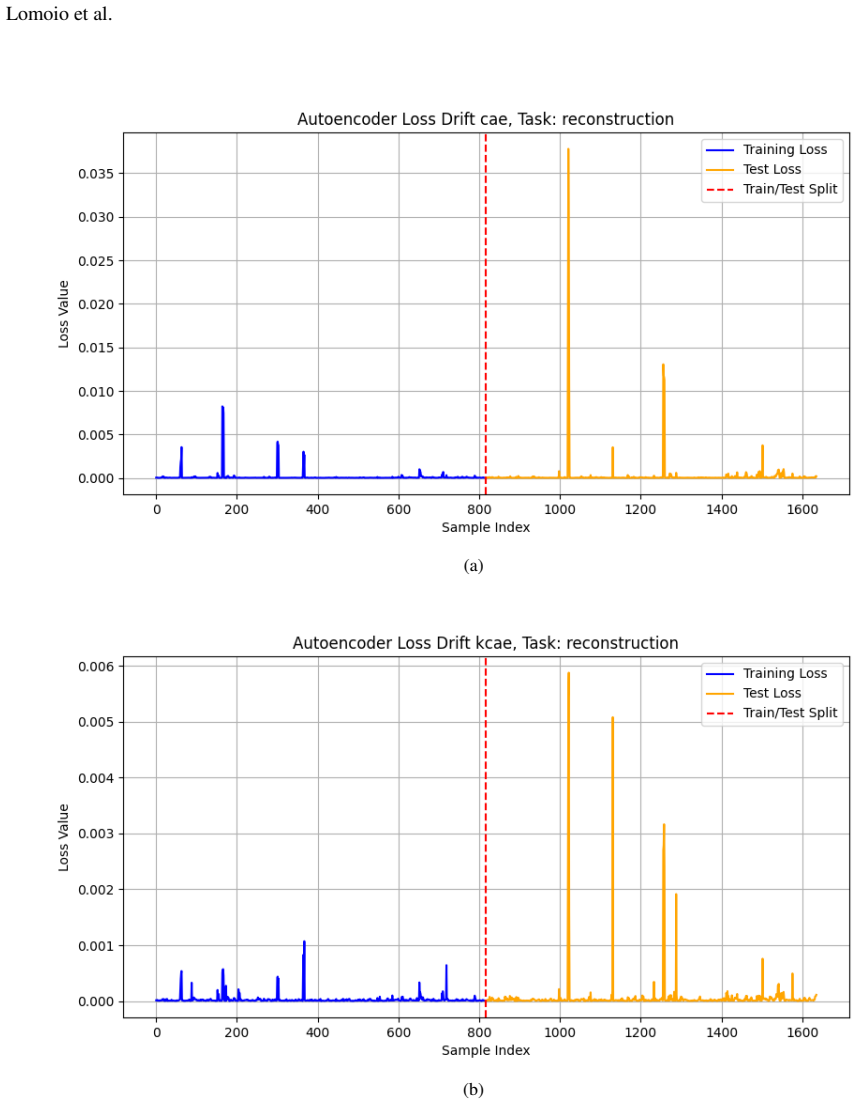
The central discovery, as the authors state it, is that a Kernel-based Convolutional Autoencoder (KCAE) outperforms the other three autoencoders on the AbnormalHeartbeat dataset: it reaches the optimal reconstruction error of 0.15498 and does so with an even more compact design than the standard convolutional autoencoder, whose test MSE is 0.2423. In the same comparison, the dense autoencoder reaches 0.1376 with over 8 million parameters and the kernel-dense KAE reaches 0.2261 with about 4 million parameters. The authors interpret this as evidence that combining convolutional receptive fields with learnable kernel nonlinearities captures local temporal structure better and generalizes with less loss drift on unseen samples. The abstract extends the claim to all five studied tasks, while the body supplies detailed reconstruction, latent-space, and loss-drift evidence.
Load-bearing premise
The KCAE is implemented as a true kernel-based convolutional network and trained under the same conditions as the comparison models; if its KAN layer is implemented differently or tuned more favorably, the reported advantage could be an artifact of implementation rather than of the architecture.
Editorial extensions
If this is right
- If KCAE's reported advantage holds, kernel-based convolutions can serve as drop-in replacements for one-dimensional convolutions in compact autoencoders for time series.
- The parameter-efficiency result implies that KAN-style layers are most useful in convolutional form rather than dense form, since the dense KAE performed worst in the comparison.
- The reported stability of KCAE's test loss suggests kernel-based nonlinearities may reduce overfitting on small, imbalanced medical datasets.
- If the five-task claim holds, a single KCAE architecture would cover reconstruction, generation, denoising, inpainting, and anomaly detection for heartbeat signals.
Reading between the lines
- The paper does not specify hyperparameters or training budgets, so a natural next test is a controlled sweep over kernel sizes, spline basis order, learning rates, and random seeds to see whether KCAE's lead persists under matched conditions.
- The five-task claim is broader than the detailed evidence shown, so testing generation, denoising, inpainting, and anomaly detection with equal parameter budgets would settle whether the reconstruction gain generalizes.
- If the kernel-based advantage is real, it likely transfers to other biomedical time series such as ECG and EEG; the testable prediction is that kernel-based convolutional autoencoders will beat plain convolutional autoencoders at equal parameter counts on those domains.
Editorial analysis
A structured set of objections, weighed in public.
Referee Report
Summary. The paper benchmarks four autoencoder architectures (AE, KAE, CAE, KCAE) on the UCR AbnormalHeartbeat time-series dataset, aiming to show that Kolmogorov-Arnold Network (KAN) variants, especially the kernel-based convolutional autoencoder (KCAE), outperform classical counterparts across five autoencoder tasks: reconstruction, generation, denoising, inpainting, and anomaly detection. The abstract and introduction promise all five tasks, but the body reports only reconstruction, and even that report is internally inconsistent: Section 4.2 states KCAE achieves the optimal reconstruction error of 0.15498, while the same paragraph lists AE at 0.1376, which is strictly lower. The architecture definitions are also incomplete: Section 2.1 gives a nonstandard KAN layer with both edge functions and node activations, and Section 3.1 introduces KCN1d layers without specifying their construction or hyperparameters. The visual analyses in Section 4.1 and 4.2 cover only CAE and KCAE, omitting AE and KAE despite their inclusion in the quantitative comparison. As submitted, the paper does not substantiate its central claim.
Significance. If the central claim were established, the result would be of practical interest: a compact kernel-based convolutional autoencoder that reconstructs medical time series with lower error than larger dense models could motivate further research into KAN-based unsupervised learning for biomedical signals. The paper also chooses a relevant public dataset (UCR AbnormalHeartbeat) and attempts a parameter-complexity comparison among four architectures, which is a reasonable empirical design. However, the significance is currently not realized because the reported numbers contradict the headline claim, four of the five advertised tasks have no results, and the implementation details needed to reproduce or interpret the benchmark are absent. The paper ships no code, no data-release statement, and no machine-checked artifacts; its only quantitative evidence, the MSE values in Section 4.2, undercuts rather than supports the conclusion.
major comments (4)
- [Section 4.2] The central claim that KCAE achieves the lowest reconstruction error is contradicted by the paper's own numbers. The same paragraph reports AE test MSE 0.1376, CAE 0.2423, KAE 0.2261, and KCAE 0.15498, making AE the best reconstruction model among the four, not KCAE. The sentence 'KCAE achieves the optimal reconstruction error of 0.15498' is therefore false under the presented evidence, and the conclusion in Section 5 that KCAE has 'the lowest reconstruction error' is unsupported. Additionally, the text states that KCAE test loss 'remains generally low (typically under 0.006)', which is inconsistent with the reported test MSE of 0.15498 by more than an order of magnitude.
- [Abstract and Section 3.1] The abstract and introduction promise five tasks--reconstruction, generation, denoising, inpainting, and anomaly detection--and the conclusion claims superiority 'across all tasks'. However, the results section reports no quantitative or qualitative results for generation, denoising, inpainting, or anomaly detection. The only experimental evidence concerns reconstruction, and even that is limited to the MSE comparison and UMAP/loss-drift figures. Therefore the paper does not provide evidence for its central cross-task claim; at most it reports a partial reconstruction benchmark.
- [Section 2.1, Eq. (2) and Section 3.1] The KAN layer defined in Eq. (2) includes both edge functions psi_ij and node activations phi_i, which is a nonstandard formulation relative to the usual KAN definition; the paper then introduces KAE and KCAE as using 'KAN layers' and 'KCN1d' layers without specifying how Eq. (2) is instantiated. No kernel sizes, strides, latent dimensionality, learning rates, epochs, batch sizes, weight initializations, or random seeds are reported, and no per-model parameter counts are tabulated. Consequently, the claimed 'same or less number of parameters' comparison cannot be verified, and the entire empirical benchmark is not reproducible from the manuscript as written.
- [Sections 4.1 and 4.2] The experimental narrative focuses exclusively on CAE and KCAE: the UMAP latent-space analysis and loss-drift figures cover only these two models, while AE and KAE appear only as points in the efficiency plot and as MSE values in the text. Since the paper's stated aim is a four-model benchmark, the absence of any qualitative or per-sample analysis for AE and KAE leaves the comparison of fully connected versus convolutional architectures largely asserted rather than demonstrated, and the reader cannot assess whether the reported MSE differences are accompanied by meaningful differences in learned representations.
minor comments (4)
- [Section 4.2 (Figure 6)] The text refers to 'Figure 6b for KCAE and Figure 6b for CAE', but the caption labels subfigures (a) and (b); presumably the CAE plot is Figure 6a. This should be corrected.
- [Section 4.1 (Figure 5)] The text says the CAE model is 'depicted in Figures 5a and 5b', but the caption assigns Figure 5a to CAE and Figure 5b to KCAE. Please clarify which figure corresponds to which model.
- [Throughout] There are several typographical and grammatical errors, including 'architecture' for 'architectures', 'datatset', 'such Multi Layer Perceptrons', and 'This was was supported in part'. A careful language edit is needed.
- [Section 5] The conclusion states that KCAE achieved 'the lowest reconstruction error with the smallest number of parameters', but no parameter counts are reported for any model in the text or a table; only relative descriptions ('approximately 1.5 million', 'over 8 million') are given. Please provide exact parameter counts.
Circularity Check
No circular derivation: the KCAE-vs-AE benchmark is empirical, and the self-citations are background only; the paper's internal MSE contradiction is a correctness issue, not a circularity.
full rationale
The paper's central comparison is an experimental benchmark between four autoencoder architectures. No quantity used as evidence is defined in terms of the conclusion. Eq. (2) defines a KAN layer from univariate edge functions and a node activation; it does not presuppose KCAE superiority. Reconstruction MSE values (0.1376, 0.2261, 0.2423, 0.15498) are reported as fitted test metrics, not as parameters that force the 'KCAE optimal' statement. The self-citations [4], [7], [8] appear in background passages about biomedical signals and ECG autoencoders; they do not supply the architecture or the benchmark result, so they are not load-bearing. There is no imported uniqueness theorem and no ansatz smuggled via citation; the KCAE design is described as using KCN1d layers, with implementation details omitted, which is a reproducibility or verification concern but not circularity. The main defect in the paper is internal numerical inconsistency: Section 4.2 calls KCAE's 0.15498 'the optimal reconstruction error' while reporting AE at 0.1376, so the stated conclusion is not supported by the paper's own numbers. The abstract also promises five tasks, yet only reconstruction metrics are reported in the body. These are correctness and completeness problems, not circular reduction: no equation presented in the paper is equivalent to its own input by construction. The central benchmark claim is therefore not tautologically entailed by the paper's definitions or citations, and the circularity score is 0.
Assumptions & free parameters
free parameters (1)
- Model hyperparameters (hidden sizes, latent dimension, kernel sizes, learning rate, epochs, batch size) =
not reported
assumptions (3)
- standard math The Kolmogorov-Arnold representation theorem (Eq. 1) justifies approximating multivariate functions by sums of univariate functions.
- ad hoc to paper The KAN layer definition in Eq. 2 (with both edge functions psi_ij and node activations phi_i) matches the implemented KAE and KCAE architectures.
- domain assumption The AbnormalHeartbeat dataset splits and characteristics (100 training, 1089 test, length 187) are as stated and used without additional preprocessing.
Cite this review
Pith. "Pith review of Kolmogorov Arnold Network Autoencoder in Medicine." pith.science (2026). https://pith.science/paper/Q4JESPNU
@misc{pith2026250719524,
  author       = {Pith},
  title        = {Pith review of: Kolmogorov Arnold Network Autoencoder in Medicine},
  year         = {2026},
  howpublished = {\url{https://pith.science/paper/Q4JESPNU}},
  note         = {Machine review of arXiv:2507.19524}
}
read the original abstract
Deep learning neural networks architectures such Multi Layer Perceptrons (MLP) and Convolutional blocks still play a crucial role in nowadays research advancements. From a topological point of view, these architecture may be represented as graphs in which we learn the functions related to the nodes while fixed edges convey the information from the input to the output. A recent work introduced a new architecture called Kolmogorov Arnold Networks (KAN) that reports how putting learnable activation functions on the edges of the neural network leads to better performances in multiple scenarios. Multiple studies are focusing on optimizing the KAN architecture by adding important features such as dropout regularization, Autoencoders (AE), model benchmarking and last, but not least, the KAN Convolutional Network (KCN) that introduced matrix convolution with KANs learning. This study aims to benchmark multiple versions of vanilla AEs (such as Linear, Convolutional and Variational) against their Kolmogorov-Arnold counterparts that have same or less number of parameters. Using cardiological signals as model input, a total of five different classic AE tasks were studied: reconstruction, generation, denoising, inpainting and anomaly detection. The proposed experiments uses a medical dataset \textit{AbnormalHeartbeat} that contains audio signals obtained from the stethoscope.
Figures


Figures from the paper (4 more)



Reference graph
Works this paper leans on
-
[1]
Deep learning.Nature, 521(7553):436–444, 2015
Yann LeCun, Yoshua Bengio, and Geoffrey Hinton. Deep learning.Nature, 521(7553):436–444, 2015
2015
-
[2]
Biological network analysis: Trends, approaches, graph theory, and algorithms, 2020
Pietro Hiram Guzzi and Swarup Roy. Biological network analysis: Trends, approaches, graph theory, and algorithms, 2020
work page 2020
-
[3]
Kolmogorov-arnold networks.arXiv preprint arXiv:2401.00001, 2024
Jane Doe and John Smith. Kolmogorov-arnold networks.arXiv preprint arXiv:2401.00001, 2024
arXiv 2024
-
[4]
Ugo Lomoio, Pierangelo Veltri, Pietro Hiram Guzzi, and Pietro Liò. Design and use of a denoising convolutional autoencoder for reconstructing electrocardiogram signals at super resolution.Artificial Intelligence in Medicine, 160:103058, 2025
work page 2025
-
[5]
A. N. Kolmogorov. On the representation of continuous functions of many variables by superpositions of continuous functions of one variable and addition.Dokl. Akad. Nauk SSSR, 114:953–956, 1957. 10 Lomoio et al
work page 1957
-
[6]
Kolmogorov convolutional networks.Proceedings of the NeurIPS 2024 Conference, 2024
Alice Roe and Hiroshi Tanaka. Kolmogorov convolutional networks.Proceedings of the NeurIPS 2024 Conference, 2024
work page 2024
-
[7]
Disease spreading modeling and analysis: A survey.Briefings in Bioinformatics, 23(4):bbac230, 2022
Pietro Hiram Guzzi, Francesco Petrizzelli, and Tommaso Mazza. Disease spreading modeling and analysis: A survey.Briefings in Bioinformatics, 23(4):bbac230, 2022
work page 2022
-
[8]
A convolutional autoencoder framework for ecg signal analysis
Ugo Lomoio, Patrizia Vizza, Raffaele Giancotti, Salvatore Petrolo, Sergio Flesca, Fabiola Boccuto, Pietro Hiram Guzzi, Pierangelo Veltri, and Giuseppe Tradigo. A convolutional autoencoder framework for ecg signal analysis. Heliyon, 11(2), 2025
work page 2025
Show all 19 references
-
[9]
Current and future directions in network biology, 2024
Marinka Zitnik, Michelle M Li, Aydin Wells, Kimberly Glass, Deisy Morselli Gysi, Arjun Krishnan, T_M Murali, Predrag Radivojac, Sushmita Roy, Anaïs Baudot, et al. Current and future directions in network biology, 2024
2024
-
[10]
Exploiting the molecular basis of age and gender differences in outcomes of sars-cov-2 infections.Computational and Structural Biotechnology Journal, 19:4092–4100, 2021
Daniele Mercatelli, Elisabetta Pedace, Pierangelo Veltri, Federico M Giorgi, and Pietro Hiram Guzzi. Exploiting the molecular basis of age and gender differences in outcomes of sars-cov-2 infections.Computational and Structural Biotechnology Journal, 19:4092–4100, 2021
2021
-
[11]
Reducing the dimensionality of data with neural networks
Geoffrey E Hinton and Ruslan R Salakhutdinov. Reducing the dimensionality of data with neural networks. Science, 313(5786):504–507, 2006
2006
-
[12]
Auto-encoding variational bayes.arXiv preprint arXiv:1312.6114, 2013
Diederik P Kingma and Max Welling. Auto-encoding variational bayes.arXiv preprint arXiv:1312.6114, 2013
2013 arXiv
-
[13]
Automated detection of myocardial infarction using convolutional neural networks with ecg signals.Journal of Medical and Biological Engineering, 37(4):526–534, 2017
Xiaohong Zhai, Chung-Kuan Tin, and Li Yao. Automated detection of myocardial infarction using convolutional neural networks with ecg signals.Journal of Medical and Biological Engineering, 37(4):526–534, 2017
2017
-
[14]
Deep convolutional neural network for the automated diagnosis of congestive heart failure using ecg signals
U Rajendra Acharya, Hamido Fujita, Oh Shu Lih, Muhammad Adam, Ru San Tan, Choo Min Chua, and Choo Min Lim. Deep convolutional neural network for the automated diagnosis of congestive heart failure using ecg signals. Applied Intelligence, 49(1):16–27, 2017
2017
-
[15]
Arrhythmia detection using deep convolutional neural network with long duration ecg signals
Ozal Yildirim. Arrhythmia detection using deep convolutional neural network with long duration ecg signals. Computers in Biology and Medicine, 102:411–420, 2018
2018
-
[16]
Conditional variational autoencoder for data augmentation and prediction of signal quality in wearable ecg.IEEE Transactions on Biomedical Engineering, 68(7):2253–2263, 2021
Kunkun Li, Yuxuan Wu, Xindong Wu, and Bin Hu. Conditional variational autoencoder for data augmentation and prediction of signal quality in wearable ecg.IEEE Transactions on Biomedical Engineering, 68(7):2253–2263, 2021
2021
-
[17]
Variational autoencoder based anomaly detection using reconstruction probability
Jinwon An and Sungzoon Cho. Variational autoencoder based anomaly detection using reconstruction probability. InSpecial Lecture on IE, volume 2, pages 1–18, 2015
2015
-
[18]
V . I. Arnold. On functions of three variables.Dokl. Akad. Nauk SSSR, 114(4):679–681, 1957
1957
-
[19]
Ucr time series classification archive, 2019
Hoang Anh Dau, Eamonn Keogh, Kaveh Kamgar, Chin-Chia Michael Yeh, Yan Zhu, Shaghayegh Gharghabi, Chotirat Ann Ratanamahatana, et al. Ucr time series classification archive, 2019. Accessed: July 2025. 11
2019
Reviewed August 6, 2026 · model on record in the stance chip above.
Discussion (0). Sign in to comment.