REVIEW 2 major objections 5 minor 2 cited by
A Catalog of Galactic Supernova Remnants and Supernova Remnant Candidates from the EMU/POSSUM Radio Sky Surveys. I
T0 review · 2 major / 5 minor · reviewed 2026-08-06 · deepseek-v4-flash
Pith's one-line read This paper argues that ASKAP's EMU/POSSUM surveys confirm 14 supernova remnants — six never before proposed — and adds 37 new candidates across a quarter of the southern Galactic plane.
desk verdict A genuinely useful SNR catalog whose headline count of six new SNRs is one too many under its own rules. read the letter →
The pith
A machine-rendered reading of the paper's core claim, the machinery that carries it, and where it could break.
The reading
What carries the argument
The central tool is the radio–mid-infrared discriminant paired with Faraday-corrected polarization imaging. Because H II regions glow brightly at 12 and 22 µm in WISE while supernova remnants are usually invisible there, a shell-like radio structure lacking a mid-infrared counterpart is selected as a candidate, and evidence of genuine nonthermal emission is then sought in the polarized-intensity maps, produced by de-rotating Stokes Q and U across the 1 MHz channels for each rotation measure and taking the peak of the Faraday depth function. Real synchrotron polarization shows up as a 'speckled' pattern whose rotation measure changes on small scales — a signature the paper argues cannot be fabricated instrumentally — and the requirement of peak percentage polarization above 1% separates it from the roughly 0.2% instrumental leakage floor. Where a source is bright enough, spectral indices from flux densities at 943 MHz (ASKAP), 1360 MHz (MeerKAT), 843 MHz (SUMSS) and 198 MHz (GLEAM) provide a second confirmation route, though the paper shows that two-frequency indices built only from ASKAP and MeerKAT come out systematically too steep and are treated as unreliable.
What would settle it
Take full-Stokes follow-up of the eleven remnants confirmed by polarization at a frequency near 5 GHz, where Faraday rotation is much weaker than at 943 MHz. Genuine nonthermal shells should retain their mottled, small-scale polarization structure (the rotation-measure pattern only rescales with $\lambda^2$), whereas instrumental leakage would be smooth, locked to the total-power morphology, and would not track the frequency change; any source that loses its speckled signature fails the paper's own confirmation criterion, and the same data would supply the extra flux densities needed to check the faintest confirmed remnants for the expected $\alpha \approx -0.5$ spectra.
Extended reading notes
Core claim
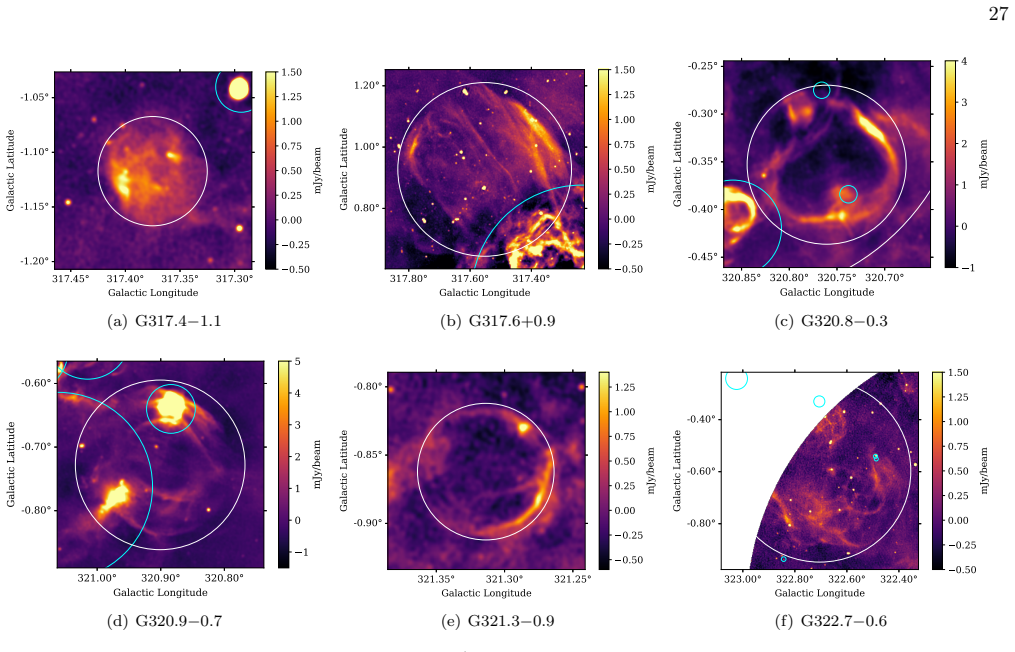
The paper claims that combining ASKAP's 943 MHz total-power images with polarization maps built by de-rotating the Stokes Q and U cubes and taking the peak of the Faraday depth function can find and confirm the low-surface-brightness remnants that earlier radio surveys missed. Candidates are first picked out as shell-like radio structures without 12 or 22 µm mid-infrared counterparts, which separates them from H II regions; confirmation then requires either linear polarization with a mottled, small-scale structure and peak percentage polarization above 1%, or a steep negative spectral index near $\alpha \approx -0.5$ determined from at least three frequencies. On that basis the authors confirm eight of the 46 previously known radio candidates, present six new remnants and 37 new candidates, and conclude that 14 sources, six of them previously unknown, should now be counted as supernova remnants; they also enlarge four known remnants whose true shells exceed their catalogue sizes, link four X-ray and three optical candidates to radio counterparts, and extrapolate over 400 candidates for the completed survey.
Load-bearing premise
The load-bearing premise is that a mottled, small-scale patch of polarized radio emission peaking above 1% of total power is intrinsic synchrotron radiation from the source rather than telescope leakage or foreground Faraday effects; if that identification fails for any individual source, the corresponding 'new supernova remnant' confirmation loses its quantitative support.
Editorial extensions
If this is right
- If the 14 confirmations hold, the count of securely known remnants in the surveyed strip rises from 44 to 58, and the combined remnant-plus-candidate surface density reaches about 2.0 per kpc², close to the 2.2 per kpc² needed, at the paper's geometry, to reach the 1000-Galactic-remnant lower estimate.
- Extrapolating the discovery rate over the full EMU/POSSUM Galactic plane footprint, about five times this area, predicts over 400 SNR candidates, roughly 200 of them new, which the paper says would nearly close the census gap if confirmed.
- Polarization, not spectral shape, will be the workhorse for confirming faint candidates: two-frequency spectral indices computed from ASKAP and MeerKAT fluxes come out systematically too steep, so the paper only trusts indices built from three or more frequencies.
- Multi-wavelength follow-up now has concrete targets: four X-ray-detected candidates and three optical candidates gain possible radio counterparts, including a radio tail that links the X-ray pulsar wind nebula G284.0−1.8 to its likely host remnant.
- Four long-known remnants are bigger than catalogued — G278.9+1.3 spans over 3°, G286.1−1.1 gains a western shell, G291.0+0.1 merges two catalogue entries, and G308.5−1.4 gains a filament — so population statistics built on the old sizes undercount the largest remnants.
Reading between the lines
- If the speckled-polarization test is as reliable as the paper claims, the same test at higher observing frequencies, where Faraday rotation is far weaker, should promote many of the 57 weak candidates to confirmed remnants — a prediction that follows from the paper's logic but is not stated in it.
- The systematically too-steep two-frequency spectral indices hint that published spectral-index confirmations of other faint remnants, and some catalogue values, may carry the same missing-flux bias; re-deriving those indices with a third frequency would be a cheap audit of the existing SNR catalogue, which the paper does not propose.
- Because the new candidates share the negative-latitude skew of H II regions and track the warp of the outer disk, several 'high-latitude' sources may actually lie inside the warped plane; HI absorption or parallax distances for sources like G289.6+5.8 and G321.3−3.9 would test this directly and would change how the population is compared with Galactic models.
- The paper's expectation that some sources are 'radio observable but not radio confirmable' implies the census gap may never close with radio alone; the natural check is whether the unconfirmable weak candidates collectively show a nonthermal component in X-ray or γ-ray surveys, which would decide whether faint shells are being missed or misclassified.
Editorial analysis
A structured set of objections, weighed in public.
Referee Report
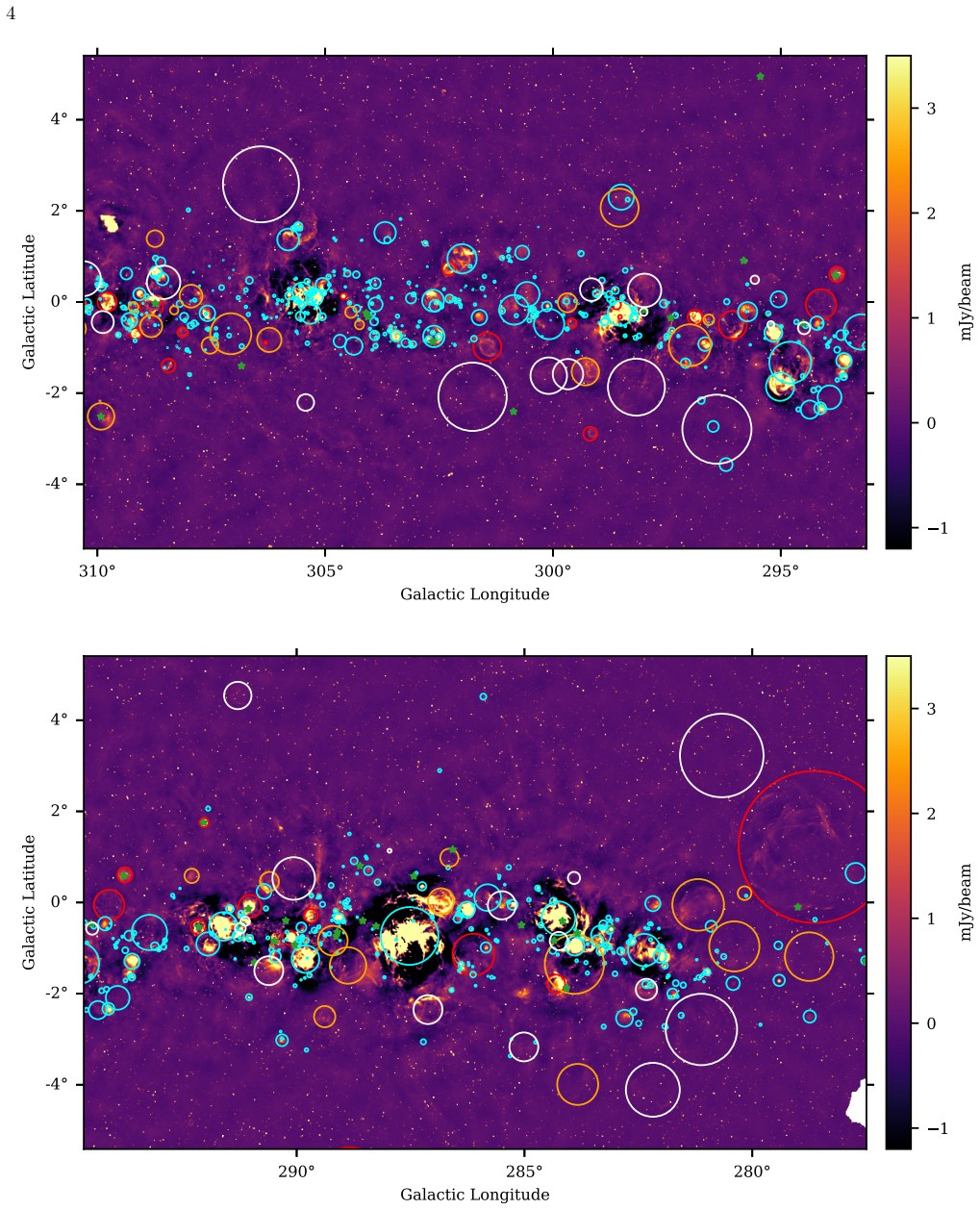
Summary. The paper presents a catalogue of Galactic supernova remnants (SNRs) and SNR candidates from the EMU and POSSUM ASKAP surveys, covering a contiguous region of 277.5° ≤ l ≤ 311.7°, |b| ≤ 5.4°, plus an additional field near l ≈ 315.5°–323.0°. It catalogues 44 known SNRs and 46 previously identified radio SNR candidates, confirms eight of those candidates as SNRs, identifies possible radio counterparts for four X-ray and three optical candidates, and claims six newly discovered SNRs and 37 new SNR candidates (43 new sources total). The classification uses ASKAP 943 MHz total-power and polarization images, WISE mid-infrared data, and ancillary radio surveys (SMGPS, SUMSS, GLEAM), with spectral indices and polarization as confirmation tools. The paper also contains completeness statistics (e.g., 0.85 SNRs/kpc² after adding newly confirmed SNRs) and argues that EMU/POSSUM will likely uncover many more remnants, especially at high latitudes.
Significance. If the confirmations hold, this is a valuable contribution: it demonstrates ASKAP's ability to find low-surface-brightness and high-latitude SNRs, validates polarization as a practical confirmation route, and provides a uniformly processed catalogue based on public survey data. The paper is careful in several respects: it explicitly warns that two-frequency ASKAP+MeerKAT spectral indices are systematically too steep (§4.1.1), it states the limitation of MIR-based rejection in dense H II regions (§3.1), and it provides images, flux measurements, and polarization maps for the key sources. The main claims are falsifiable and tied to specific tables and figures. However, the internal inconsistency in the classification of one of the six 'new SNRs' directly affects the headline counts and the population statistics built on them.
major comments (2)
- [§4.1.1, Table 7, §4.3.1] The classification of G283.1−0.6 as a 'New SNR' violates the paper's own confirmation criterion. Section 4.1.1 states that two-frequency ASKAP+MeerKAT spectral indices are systematically too steep and that confirmation on the basis of a steep negative spectral index requires flux densities at at least three distinct frequencies. Table 7 lists G283.1−0.6 as a new SNR with Pol = N and a spectral index of −0.55 ± 0.13 derived from only 943 MHz (EMU) and 1360 MHz (SMGPS) data. Section 4.3.1 adds that 'the host SNR is uncertain', that the tabulated flux is 'for the PWN only', and that the two-frequency index is expected to be steeper than the true value. This source therefore meets neither the morphological nor the spectral-index leg of the 'New SNR' definition in §3.3. Please reclassify G283.1−0.6 as a strong candidate and consistently revise all dependent counts: the abstract's 'six new SNRs' and '14 ... confirmed SNRs', the §4.3 statement of '14 newly confirmed SNRs', the §5.2 density estimate (0.85 SNRs/kpc² becomes ~0.84), and the extrapolations in §6.
- [§3.1.3] The confirmation of 11 of the 14 sources relies on the polarization criterion of Section 3.1.3: speckled polarized structure with peak percentage polarization >1% is taken as intrinsic nonthermal emission because, the text states, 'This effect cannot be produced instrumentally.' This is a strong, load-bearing claim. The paper does not provide a quantitative validation, for example a demonstration that this criterion does not flag known H II regions or imaging artifacts in the same fields, or a comparison of the RM structure with the known instrumental polarization pattern. Given that some sources show polarized emission with a morphology that differs from the Stokes I shell (e.g., G285.0−3.2), please provide such a check, or explicitly qualify the polarization-based confirmations as resting on a working assumption about instrumental leakage and foreground Faraday effects.
minor comments (5)
- [§4.2.1] The sentence 'they split a couple of our candidates into two separate sources' is ambiguous; please clarify whether the SMGPS list splits sources that the authors treat as single.
- [§4.3.1] The section heading 'New SNRs' is confusing because the section also includes previously identified candidates (Table 4); consider renaming it 'Newly Confirmed SNRs'.
- [§2.1] The description of the Faraday de-rotation method for the PI maps refers only to Ball et al. (2023); a brief statement of the RM range and step size would aid reproducibility.
- [§5.2] The statement that the survey 'covers approximately 12% of the Galactic plane by surface area, or 55 kpc²' would benefit from a one-sentence explanation of the projection, since the longitude range alone is only 9.5% of a full circle.
- [Reference list] The reference 'Filipovic, M. D.' lacks the accent used elsewhere for the same author; please ensure the spelling is consistent.
Circularity Check
No circular derivation: the catalogue uses independent observables and external catalogues, with self-citations only for method continuity; the G283.1−0.6 issue is a consistency error, not circularity.
full rationale
This paper is an observational catalogue, not a parametric derivation, so most circularity patterns do not apply. The classification pipeline uses independent inputs: ASKAP 943 MHz Stokes I, POSSUM Q/U cubes, WISE 12/22 micron images, and external catalogues (Green 2024b; Anderson et al. 2014; ATNF; SMGPS; SUMSS; GLEAM). No parameter is fitted to the catalogue classifications; the flux-integration method from Ball et al. (2023) is a data-reduction tool, and the paper validates it against the independent Green catalogue in Table 2 before applying it to candidates. Section 4.1.1 is a genuine calibration check against known SNRs and H II regions, and it explicitly establishes: 'we only argue for the confirmation of a source as an SNR based on a steep negative spectral index if we can calculate flux densities for at least three distinct frequencies.' The only apparent violation is Section 4.3.1 and Table 7, where G283.1−0.6 is listed as a 'New SNR' with a two-frequency index (−0.55 ± 0.13 from 943 MHz and 1360 MHz), Pol = N, and the text admits 'the host SNR is uncertain' and that the tabulated flux is 'for the PWN only.' That is an internal inconsistency that could inflate the headline count and the density statistic in Section 5.2, but it is a correctness or classification error, not circularity: the criterion is not defined in terms of the target classification, and the index is not a fitted input that reproduces the output by construction. Self-citations (Ball et al. 2023; Filipovic et al. 2023, 2024, 2025; Lazarevic et al. 2024; Smeaton et al. 2024; in-preparation items) are used for method continuity, prior discovery credit, or follow-up work; none serves as the sole load-bearing evidence for a new SNR confirmation. Where a self-cited prior work identified a source, the present paper adds its own polarization or imaging observations. There is no self-definitional reduction, no fitted input renamed as a prediction, and no imported uniqueness theorem; the honest finding is no significant circularity, with a flagged internal-consistency caveat that belongs in the correctness review rather than the circularity score. Score 1 is given only for the minor, non-load-bearing self-citations, not for any circular reduction.
Assumptions & free parameters
free parameters (2)
- Minimum peak polarization threshold =
>1%
- Young pulsar age cutoff =
500 kyr
assumptions (4)
- domain assumption Shell-like radio morphology with no MIR counterpart identifies an SNR candidate.
- domain assumption Speckled linear polarization with peak percentage above 1% is intrinsic nonthermal emission, not instrumental leakage.
- domain assumption Spectral index around -0.5 separates SNRs from H II regions with flat or positive indices.
- domain assumption Pulsars with characteristic age below 500 kyr can still be associated with a detectable host SNR.
Cite this review
Pith. "Pith review of A Catalog of Galactic Supernova Remnants and Supernova Remnant Candidates from the EMU/POSSUM Radio Sky Surveys. I." pith.science (2026). https://pith.science/paper/RQUIP7LW
@misc{pith2026250719625,
  author       = {Pith},
  title        = {Pith review of: A Catalog of Galactic Supernova Remnants and Supernova Remnant Candidates from the EMU/POSSUM Radio Sky Surveys. I},
  year         = {2026},
  howpublished = {\url{https://pith.science/paper/RQUIP7LW}},
  note         = {Machine review of arXiv:2507.19625}
}
abstract
We use data from the EMU (Evolutionary Map of the Universe) and POSSUM (Polarization Sky Survey of the Universe's Magnetism) radio southern sky surveys, conducted with the Australian Square Kilometre Array Pathfinder (ASKAP), to compile a catalogue of Galactic supernova remnants (SNRs) and candidate SNRs within the region of $277.5^\circ \leq \ell \leq 311.7^\circ$ Galactic longitude, $|b| \leq 5.4^\circ$ Galactic latitude, as well as an additional field along the Galactic plane, approximately $315.5^\circ \leq \ell \leq 323.0^\circ$ Galactic longitude, $-4.5^\circ \leq b \leq 1.5^\circ$ Galactic latitude. In the areas studied, there are 44 known SNRs and 46 SNR candidates that have been previously identified in the radio. We confirm eight of these candidates as SNRs based on evidence of linear polarization or through the calculation of nonthermal spectral indices. Additionally, we identify possible radio counterparts for seven SNR candidates that were previously only identified in X-rays (four) or optical (three). We also present six new SNRs and 37 new SNR candidates. The results of this study demonstrate the utility of ASKAP for discovering new and potential SNRs and refining the classification of previously identified candidates. In particular, we find that the EMU and POSSUM surveys are particularly well suited for observing high-latitude SNRs and confirming SNR candidates with polarization. The region studied in this work represents approximately one-quarter of the Galactic plane, by longitude, that will eventually be surveyed by EMU/POSSUM and we expect that the ongoing surveys will continue to uncover new SNRs and SNR candidates.
Figures


Figures from the paper (22 more)




Forward citations
Cited by 2 Pith papers
-
The Treble Clef radio phoenix and its old nonthermal filaments
VLSS J0318.9+5755 (the Treble Clef) is a radio phoenix with ultra-steep spectrum in a massive merging cluster at z≈0.117 in the Zone of Avoidance, shaped by ICM gas motions that may also power a candidate radio halo.
-
The topology of the magnetic field in Abell 2255 out to its virial radius. Results from the LOFAR Galaxy Cluster Ultra-Deep Field
The magnetic field in Abell 2255 shows ordered, region-dependent orientations inferred from synchrotron intensity gradients, with radial fields in bridges and tangential fields in relics.
Reference graph
Works this paper leans on
-
[1]
, " * write output.state after.block = add.period write newline
ENTRY address archivePrefix author booktitle chapter doi edition editor eprint howpublished institution journal key month number organization pages publisher school series title misctitle type volume year version url label extra.label sort.label short.list INTEGERS output.state before.all mid.sentence after.sentence after.block FUNCTION init.state.consts ...
-
[2]
write newline
" write newline "" before.all 'output.state := FUNCTION format.url url empty "" new.block "" url * "" * if FUNCTION format.eprint eprint empty "" archivePrefix empty "" archivePrefix "arXiv" = new.block " " eprint * " " * new.block " " eprint * " " * if if if FUNCTION format.doi doi empty "" " " doi * " " * if FUNCTION format.pid doi empty eprint empty ur...
-
[3]
thebibliography [1] 20pt to REFERENCES 6pt =0pt -12pt 10pt plus 3pt =0pt =0pt =1pt plus 1pt =0pt =0pt -12pt =13pt plus 1pt =20pt =13pt plus 1pt \@M =10000 =-1.0em =0pt =0pt 0pt =0pt =1.0em @enumiv\@empty 10000 10000 `\.\@m \@noitemerr \@latex@warning Empty `thebibliography' environment \@ifnextchar \@reference \@latexerr Missing key on reference command E...
arXiv 2021
-
[4]
A., Ackermann , M., Ajello , M., et al
Abdo , A. A., Ackermann , M., Ajello , M., et al. 2009, Science, 325, 840, 10.1126/science.1175558
-
[5]
2022, , 260, 53, 10.3847/1538-4365/ac6751
Abdollahi , S., Acero , F., Baldini , L., et al. 2022, , 260, 53, 10.3847/1538-4365/ac6751
-
[6]
Anderson , L. D., Bania , T. M., Balser , D. S., et al. 2014, , 212, 1, 10.1088/0067-0049/212/1/1
-
[7]
D., Camilo , F., Faerber , T., et al
Anderson , L. D., Camilo , F., Faerber , T., et al. 2024, arXiv e-prints, arXiv:2409.16607, 10.48550/arXiv.2409.16607
-
[8]
D., Kothes , R., Rosolowsky , E., et al
Ball , B. D., Kothes , R., Rosolowsky , E., et al. 2023, , 524, 1396, 10.1093/mnras/stad1953
Show all 110 references
-
[9]
2020, , 365, 178, 10.1007/s10509-020-03891-6
Bamba , A., Watanabe , E., Mori , K., et al. 2020, , 365, 178, 10.1007/s10509-020-03891-6
2020 doi
-
[10]
Becker et al. in prep
-
[11]
2023, , 520, 1832, 10.1093/mnras/stad094
Binney , J., & Vasiliev , E. 2023, , 520, 1832, 10.1093/mnras/stad094
2023 doi
-
[12]
2016, , 54, 529, 10.1146/annurev-astro-081915-023441
Bland-Hawthorn , J., & Gerhard , O. 2016, , 54, 529, 10.1146/annurev-astro-081915-023441
2016 doi
-
[13]
Bock , D. C. J., Large , M. I., & Sadler , E. M. 1999, , 117, 1578, 10.1086/300786
1999 doi
-
[14]
M., Filipovi \'c , M
Bozzetto , L. M., Filipovi \'c , M. D., Sano , H., et al. 2023, MNRAS, 518, 2574, 10.1093/mnras/stac2922
2023 doi
-
[15]
L., Gelfand , J
Brogan , C. L., Gelfand , J. D., Gaensler , B. M., Kassim , N. E., & Lazio , T. J. W. 2006, , 639, L25, 10.1086/501500
2006 doi
-
[16]
Burger-Scheidlin et al. in prep
-
[17]
Burn , B. J. 1966, , 133, 67, 10.1093/mnras/133.1.67
1966 doi
-
[18]
M., Gotthelf , E
Camilo , F., Gaensler , B. M., Gotthelf , E. V., Halpern , J. P., & Manchester , R. N. 2004 a , , 616, 1118, 10.1086/424924
2004 doi
-
[19]
F., Manchester , R
Camilo , F., Bell , J. F., Manchester , R. N., et al. 2001, , 557, L51, 10.1086/323171
2001 doi
-
[20]
N., Lyne , A
Camilo , F., Manchester , R. N., Lyne , A. G., et al. 2004 b , , 611, L25, 10.1086/423620
2004 doi
-
[21]
G., Kargaltsev , O., & Shibanov , Y
Chang , C., Pavlov , G. G., Kargaltsev , O., & Shibanov , Y. A. 2012, , 744, 81, 10.1088/0004-637X/744/2/81
2012 doi
-
[22]
L., Matsuura , M., et al
Chawner , H., Gomez , H. L., Matsuura , M., et al. 2020, , 493, 2706, 10.1093/mnras/staa221
2020 doi
-
[23]
2020, , 637, A96, 10.1051/0004-6361/201937289
Chrob \'a kov \'a , Z ., Nagy , R., & L \'o pez-Corredoira , M. 2020, , 637, A96, 10.1051/0004-6361/201937289
2020 doi
-
[24]
J., Pletsch , H
Clark , C. J., Pletsch , H. J., Wu , J., et al. 2016, , 832, L15, 10.3847/2041-8205/832/1/L15
2016 doi
-
[25]
J., Wu , J., Pletsch , H
Clark , C. J., Wu , J., Pletsch , H. J., et al. 2017, , 834, 106, 10.3847/1538-4357/834/2/106
2017 doi
-
[26]
A., Rahoui , F., & Tomsick , J
Coleiro , A., Chaty , S., Zurita Heras , J. A., Rahoui , F., & Tomsick , J. A. 2013, , 560, A108, 10.1051/0004-6361/201322382
2013 doi
-
[27]
D., Filipovi \'c , M
Cotton , W. D., Filipovi \'c , M. D., Camilo , F., et al. 2024, MNRAS, 529, 2443, 10.1093/mnras/stae277
2024 doi
-
[28]
Y., Collier , J
De Horta , A. Y., Collier , J. D., Filipovi \'c , M. D., et al. 2013, , 428, 1980, 10.1093/mnras/sts168
2013 doi
-
[29]
1989, , 341, L13, 10.1086/185446
Djorgovski , S., & Sosin , C. 1989, , 341, L13, 10.1086/185446
1989 doi
-
[30]
2018, , 866, 61, 10.3847/1538-4357/aadc0c
Dokara , R., Roy , N., Beuther , H., et al. 2018, , 866, 61, 10.3847/1538-4357/aadc0c
2018 doi
-
[31]
M., et al
Dokara , R., Brunthaler , A., Menten , K. M., et al. 2021, , 651, A86, 10.1051/0004-6361/202039873
2021 doi
-
[32]
2017, in Handbook of Supernovae, ed
Dubner , G. 2017, in Handbook of Supernovae, ed. A. W. Alsabti & P. Murdin , 2041, 10.1007/978-3-319-21846-5_91
2017 doi
-
[33]
R., Stewart , R
Duncan , A. R., Stewart , R. T., Haynes , R. F., & Jones , K. L. 1995, , 277, 36, 10.1093/mnras/277.1.36
1995 doi
- [34]
-
[35]
2012, Advances in Space Research, 49, 1313, 10.1016/j.asr.2012.02.004
Ferrand , G., & Safi-Harb , S. 2012, Advances in Space Research, 49, 1313, 10.1016/j.asr.2012.02.004
2012 doi
-
[36]
A., Drechsler , M., Strottner , X., et al
Fesen , R. A., Drechsler , M., Strottner , X., et al. 2024, , 272, 36, 10.3847/1538-4365/ad410a
2024 doi
-
[37]
M., Burkert , A., Ntormousi , E., et al
Fierlinger , K. M., Burkert , A., Ntormousi , E., et al. 2016, , 456, 710, 10.1093/mnras/stv2699
2016 doi
-
[38]
D., & Tothill, N
Filipovi \'c , M. D., & Tothill, N. F. H. 2021 a , Principles of Multimessenger Astronomy, 2514-3433 (IOP Publishing), 10.1088/2514-3433/ac087e
2021 doi
-
[39]
D., & Tothill, N
Filipovi \'c , M. D., & Tothill, N. F. H., eds. 2021 b , Multimessenger Astronomy in Practice, 2514-3433 (IOP Publishing), 10.1088/2514-3433/ac2256
2021 doi
-
[40]
D., Dai , S., Arbutina , B., et al
Filipovi \'c , M. D., Dai , S., Arbutina , B., et al. 2023, , 166, 149, 10.3847/1538-3881/acf19c
2023 doi
-
[41]
D., Lazarevi \'c , S., Araya , M., et al
Filipovi \'c , M. D., Lazarevi \'c , S., Araya , M., et al. 2024, , 41, e112, 10.1017/pasa.2024.93
2024 doi
- [42]
-
[43]
A., Goss , W
Frail , D. A., Goss , W. M., & Whiteoak , J. B. Z. 1994, , 437, 781, 10.1086/175038
1994 doi
-
[44]
M., Landecker , T
Gaensler , B. M., Landecker , T. L., Taylor , A. R., & POSSUM Collaboration . 2010, in American Astronomical Society Meeting Abstracts, Vol. 215, American Astronomical Society Meeting Abstracts \#215, 470.13
2010
-
[45]
M., Stappers , B
Gaensler , B. M., Stappers , B. W., Frail , D. A., et al. 2000, , 318, 58, 10.1046/j.1365-8711.2000.03626.x
2000
- [46]
-
[47]
D., Camilo , F., et al
Goedhart , S., Cotton , W. D., Camilo , F., et al. 2024, , 531, 649, 10.1093/mnras/stae1166
2024 doi
-
[48]
J., Reeves , S
Green , A. J., Reeves , S. N., & Murphy , T. 2014, , 31, e042, 10.1017/pasa.2014.37
2014 doi
-
[49]
Green , D. A. 2015, , 454, 1517, 10.1093/mnras/stv1885
2015 doi
- [50]
-
[51]
2024 b , ‘A Catalogue of Galactic Supernova Remnants (2024 October version)’
---. 2024 b , ‘A Catalogue of Galactic Supernova Remnants (2024 October version)’. https://www.mrao.cam.ac.uk/surveys/snrs/
2024
-
[52]
2019, ASKAPsoft: ASKAP science data processor software , Astrophysics Source Code Library, record ascl:1912.003
Guzman , J., Whiting , M., Voronkov , M., et al. 2019, ASKAPsoft: ASKAP science data processor software , Astrophysics Source Code Library, record ascl:1912.003
2019
-
[53]
H. E. S. S. Collaboration , Abramowski , A., Acero , F., et al. 2011, , 533, A103, 10.1051/0004-6361/201117445
2011 doi
-
[54]
2012, , 548, A46, 10.1051/0004-6361/201219814
---. 2012, , 548, A46, 10.1051/0004-6361/201219814
2012 doi
-
[55]
L., Manchester , R
Han , J. L., Manchester , R. N., Lyne , A. G., Qiao , G. J., & van Straten , W. 2006, , 642, 868, 10.1086/501444
2006 doi
-
[56]
2019, , 875, 107, 10.3847/1538-4357/ab10da
Hare , J., Volkov , I., Kargaltsev , O., Younes , G., & Rangelov , B. 2019, , 875, 107, 10.3847/1538-4357/ab10da
2019 doi
-
[57]
J., Becker , R
Helfand , D. J., Becker , R. H., White , R. L., Fallon , A., & Tuttle , S. 2006, , 131, 2525, 10.1086/503253
2006 doi
-
[58]
2025, , 42, e071, 10.1017/pasa.2025.10042
Hopkins , A., Kapinska , A., Marvil , J., et al. 2025, , 42, e071, 10.1017/pasa.2025.10042
2025
-
[59]
W., Bunton , J
Hotan , A. W., Bunton , J. D., Chippendale , A. P., et al. 2021, , 38, e009, 10.1017/pasa.2021.1
2021 doi
- [60]
-
[61]
D., Gaensler , B
Hurley-Walker , N., Filipovi \'c , M. D., Gaensler , B. M., et al. 2019 a , , 36, e045, 10.1017/pasa.2019.34
2019 doi
-
[62]
J., Franzen , T
Hurley-Walker , N., Hancock , P. J., Franzen , T. M. O., et al. 2019 b , , 36, e047, 10.1017/pasa.2019.37
2019 doi
-
[63]
M., Leahy , D
Hurley-Walker , N., Gaensler , B. M., Leahy , D. A., et al. 2019 c , , 36, e048, 10.1017/pasa.2019.33
2019 doi
-
[64]
G., Manchester , R
Johnston , S., Lyne , A. G., Manchester , R. N., et al. 1992, , 255, 401, 10.1093/mnras/255.3.401
1992 doi
- [65]
-
[67]
M., Ables , J
Komesaroff , M. M., Ables , J. G., Cooke , D. J., Hamilton , P. A., & McCulloch , P. M. 1973, , 15, 169
1973
-
[68]
S., Staveley-Smith , L., Westmeier , T., et al
Koribalski , B. S., Staveley-Smith , L., Westmeier , T., et al. 2020, , 365, 118, 10.1007/s10509-020-03831-4
2020 doi
-
[69]
2017, in Astrophysics and Space Science Library, Vol
Kothes , R. 2017, in Astrophysics and Space Science Library, Vol. 446, Modelling Pulsar Wind Nebulae, ed. D. F. Torres , 1, 10.1007/978-3-319-63031-1_1
2017 doi
-
[70]
J., & Uyan ker , B
Kothes , R., Fedotov , K., Foster , T. J., & Uyan ker , B. 2006, , 457, 1081, 10.1051/0004-6361:20065062
2006 doi
-
[71]
F., Manchester , R
Kramer , M., Bell , J. F., Manchester , R. N., et al. 2003, , 342, 1299, 10.1046/j.1365-8711.2003.06637.x
2003
-
[72]
D., Koribalski , B
Lazarevi \'c , S., Filipovi \'c , M. D., Koribalski , B. S., et al. 2024, Research Notes of the American Astronomical Society, 8, 107, 10.3847/2515-5172/ad40a9
2024 doi
-
[73]
A., Ranasinghe , S., & Gelowitz , M
Leahy , D. A., Ranasinghe , S., & Gelowitz , M. 2020, , 248, 16, 10.3847/1538-4365/ab8bd9
2020 doi
-
[74]
2011, , 412, 1473, 10.1111/j.1365-2966.2011.18162.x
Li , W., Chornock , R., Leaman , J., et al. 2011, , 412, 1473, 10.1111/j.1365-2966.2011.18162.x
2011
-
[75]
Longair , M. S. 2011, High Energy Astrophysics
2011
-
[76]
2024, , 692, A193, 10.1051/0004-6361/202450404
Loru , S., Ingallinera , A., Umana , G., et al. 2024, , 692, A193, 10.1051/0004-6361/202450404
2024 doi
-
[77]
N., Hobbs , G
Manchester , R. N., Hobbs , G. B., Teoh , A., & Hobbs , M. 2005, , 129, 1993, 10.1086/428488
2005 doi
-
[78]
N., Lyne , A
Manchester , R. N., Lyne , A. G., Taylor , J. H., et al. 1978, , 185, 409, 10.1093/mnras/185.2.409
1978 doi
-
[79]
N., Lyne , A
Manchester , R. N., Lyne , A. G., Camilo , F., et al. 2001, , 328, 17, 10.1046/j.1365-8711.2001.04751.x
2001
- [80]
-
[81]
2025, , 42, e021, 10.1017/pasa.2025.1
Mantovanini , S., Hurley-Walker , N., & Anderson , G. 2025, , 42, e021, 10.1017/pasa.2025.1
2025 doi
-
[82]
Y., Gaensler , B
Ng , C. Y., Gaensler , B. M., Chatterjee , S., & Johnston , S. 2010, , 712, 596, 10.1088/0004-637X/712/1/596
2010 doi
-
[83]
P., Hopkins , A
Norris , R. P., Hopkins , A. M., Afonso , J., et al. 2011, , 28, 215, 10.1071/AS11021
2011 doi
-
[84]
P., Marvil , J., Collier , J
Norris , R. P., Marvil , J., Collier , J. D., et al. 2021, , 38, e046, 10.1017/pasa.2021.42
2021 doi
-
[85]
A., Phillipps , S., Pierce , M
Parker , Q. A., Phillipps , S., Pierce , M. J., et al. 2005, , 362, 689, 10.1111/j.1365-2966.2005.09350.x
2005
-
[86]
G., & Carey , S
Pinheiro Gon c alves , D., Noriega-Crespo , A., Paladini , R., Martin , P. G., & Carey , S. J. 2011, , 142, 47, 10.1088/0004-6256/142/2/47
2011 doi
-
[87]
D., Chawner , H., Barlow , M
Priestley , F. D., Chawner , H., Barlow , M. J., et al. 2022, , 516, 2314, 10.1093/mnras/stac2408
2022 doi
-
[88]
2012, , 544, A7, 10.1051/0004-6361/201219086
Prinz , T., & Becker , W. 2012, , 544, A7, 10.1051/0004-6361/201219086
2012 doi
-
[89]
2022, , 940, 63, 10.3847/1538-4357/ac940a
Ranasinghe , S., & Leahy , D. 2022, , 940, 63, 10.3847/1538-4357/ac940a
2022 doi
- [90]
-
[91]
2021, Universe, 7, 338, 10.3390/universe7090338
Ranasinghe , S., Leahy , D., & Stil , J. 2021, Universe, 7, 338, 10.3390/universe7090338
2021 doi
-
[92]
T., Rho , J., Tappe , A., et al
Reach , W. T., Rho , J., Tappe , A., et al. 2006, , 131, 1479, 10.1086/499306
2006 doi
-
[93]
T., Miller , J
Reynolds , M. T., Miller , J. M., Maitra , D., et al. 2012, The Astronomer's Telegram, 3963, 1
2012
-
[94]
S., Milne , D
Roger , R. S., Milne , D. K., Caswell , J. L., & Little , A. G. 1986, , 219, 815, 10.1093/mnras/219.4.815
1986 doi
-
[95]
B., & Lightman , A
Rybicki , G. B., & Lightman , A. P. 1986, Radiative Processes in Astrophysics
1986
-
[96]
M., Fesen , R
Saken , J. M., Fesen , R. A., & Shull , J. M. 1992, , 81, 715, 10.1086/191703
1992 doi
-
[97]
K., Badenes , C., Chomiuk , L., Caprioli , D., & Huizenga , D
Sarbadhicary , S. K., Badenes , C., Chomiuk , L., Caprioli , D., & Huizenga , D. 2017, , 464, 2326, 10.1093/mnras/stw2566
2017 doi
-
[98]
M., Dormody , M., Ziegler , M., et al
Saz Parkinson , P. M., Dormody , M., Ziegler , M., et al. 2010, , 725, 571, 10.1088/0004-637X/725/1/571
2010 doi
-
[99]
J., Filipovi \'c , M
Smeaton , Z. J., Filipovi \'c , M. D., Koribalski , B. S., et al. 2024, Research Notes of the American Astronomical Society, 8, 158, 10.3847/2515-5172/ad5309
2024 doi
-
[100]
A., & Filipovi \'c , M
Stupar , M., Parker , Q. A., & Filipovi \'c , M. D. 2008, , 390, 1037, 10.1111/j.1365-2966.2008.13761.x
2008
-
[101]
2010, , 401, 1760, 10.1111/j.1365-2966.2009.15814.x
---. 2010, , 401, 1760, 10.1111/j.1365-2966.2009.15814.x
2010
-
[102]
2011, , 332, 241, 10.1007/s10509-010-0544-2
---. 2011, , 332, 241, 10.1007/s10509-010-0544-2
2011 doi
-
[103]
Sushch , I., Oya , I., Schwanke , U., Johnston , S., & Dalton , M. L. 2017, , 605, A115, 10.1051/0004-6361/201527871
2017 doi
-
[104]
A., Loeffler , W., & Schroeder , A
Tammann , G. A., Loeffler , W., & Schroeder , A. 1994, , 92, 487, 10.1086/192002
1994 doi
-
[105]
van de Steene , G. C. M., & Pottasch , S. R. 1993, , 274, 895
1993
-
[106]
van der Hucht , K. A. 2001, , 45, 135, 10.1016/S1387-6473(00)00112-3
2001 doi
-
[107]
1962, , 124, 179, 10.1093/mnras/124.2.179
van der Laan , H. 1962, , 124, 179, 10.1093/mnras/124.2.179
1962 doi
-
[108]
Whiteoak , J. B. Z., & Green , A. J. 1996, , 118, 329
1996
-
[109]
E., & Large , M
Wielebinski , R., Vaughan , A. E., & Large , M. I. 1969, , 221, 47, 10.1038/221047a0
1969 doi
-
[110]
Woermann , B., & Jonas , J. L. 1988, , 234, 971, 10.1093/mnras/234.4.971
1988 doi
-
[111]
L., Eisenhardt , P
Wright , E. L., Eisenhardt , P. R. M., Mainzer , A. K., et al. 2010, , 140, 1868, 10.1088/0004-6256/140/6/1868
2010 doi
Reviewed August 6, 2026 · model on record in the stance chip above.
Discussion (0). Sign in to comment.