REVIEW 2 major objections 6 minor 1 cited by
GSCache: Real-Time Radiance Caching for Volume Path Tracing using 3D Gaussian Splatting
T0 review · 2 major / 6 minor · reviewed 2026-08-06 · deepseek-v4-flash
Pith's one-line read A multi-level 3D Gaussian radiance cache lets volume path tracers render less noisy images at no extra cost.
desk verdict A novel path-space Gaussian radiance cache with promising empirical results, but the training target's unbiasedness is unproven and likely biased, which casts doubt on the headline claim. read the letter →
The pith
A machine-rendered reading of the paper's core claim, the machinery that carries it, and where it could break.
The reading
What carries the argument
The central object is a multi-level point cloud of 3D Gaussians, one level per path length, rasterized with the differentiable 3D Gaussian splatting rasterizer to produce cache images used by the path tracer. The cache carries the argument by being trainable in real time on noisy path buffers: the HDR loss of [26] is used as the Noise2Noise objective, and an AdamW optimizer with adaptive learning rates and a size-capped, density-matched initial point cloud keeps the optimization stable under high-variance radiance targets. A throughput-based path termination heuristic, with a user coefficient $C$ and a $\beta_n$ cascade correction, decides when to cut paths short and read the cache.
What would settle it
In a simple scene with one volume and one light, render with early termination enabled and disabled at high sample counts, and compare the cached radiance at a single path-length level to a converged unbiased reference for that level; if the two diverge systematically, the early-termination training targets are biased.
Extended reading notes
Core claim
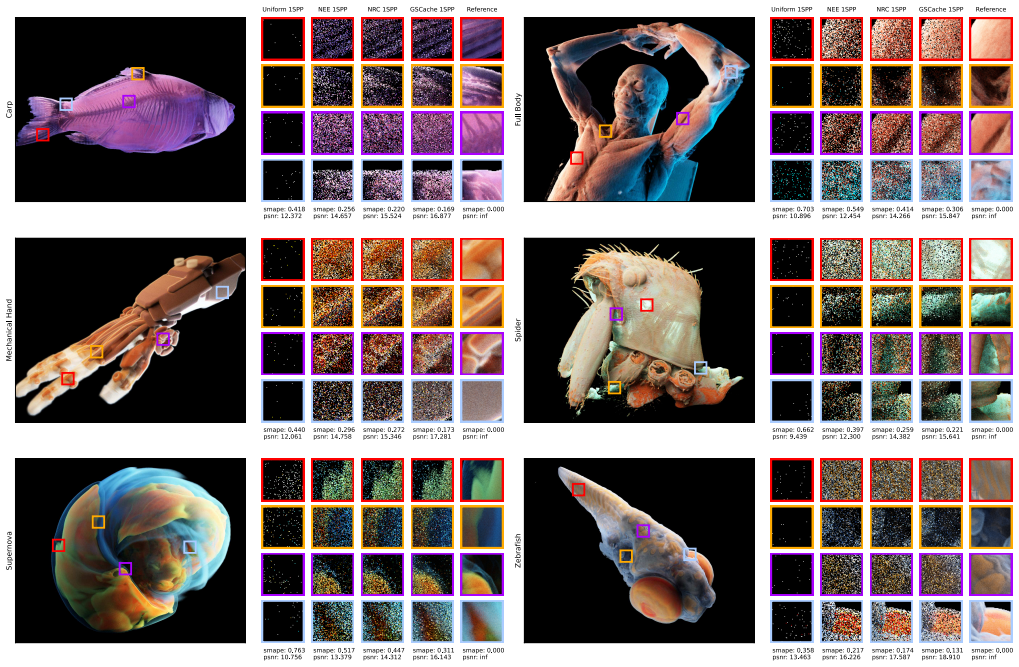
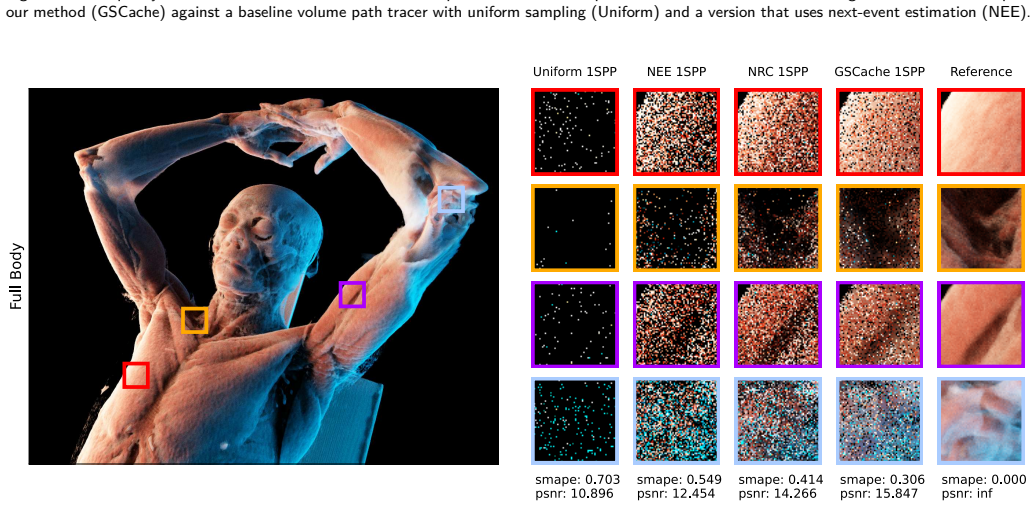
The core discovery is that the radiance integral along a volumetric ray can be reorganized by path length, with each path-length subspace represented by its own level of a Gaussian-splatting cache, and that this cache can be optimized in real time directly on noisy, single-sample path buffers. The paper argues that the expected value of the samples accumulating in each level buffer behaves like the expected value of regular path tracing, so applying the Noise2Noise training rule to these noisy targets drives the Gaussians toward the true path-space radiance of that level. Because each level stores pre-attenuated radiance at a specific path length, a path can be terminated early into the cache whenever its current throughput is low, and a product-of-cache-miss-probabilities factor ($\beta$) corrects the cached read for the chance that the path would have stopped earlier. The result is a cache that trades variance for bias but, at the reported settings, yields measurably higher PSNR at 1 SPP than both uniform-sampling and NEE baselines and than a neural radiance caching baseline, with the cache's runtime overhead constant in the sample count.
Load-bearing premise
The load-bearing premise is that path samples stored in each level buffer, including those from paths cut short by the cache's own termination rule, are unbiased estimators of that level's path-space radiance after throughput adjustment, so that Noise2Noise training converges to the correct cached radiance.
Editorial extensions
If this is right
- At low sample counts the cache raises image quality without a frame-time penalty, and the benefit grows as sample counts rise because the cache's overhead stays constant while each sample is generated faster through early termination.
- The cache adapts to user-driven scene changes such as transfer functions and lighting within roughly 16 frames, making it suitable for interactive exploration rather than offline rendering.
- The cache relies only on attenuated radiance and path length from the host renderer, so it can be added to existing volume path tracers without requiring intersection metadata or sampling details.
- Because the cache learning is self-contained, it can be trained purely on noisy Monte Carlo output, with no clean reference images needed.
Reading between the lines
- The same path-space cache structure could in principle wrap surface path tracers as easily as volume ones, since pre-attenuated radiance at a given bounce depth is a scene-agnostic quantity; the paper only demonstrates it on volumes.
- The bias-variance trade-off controlled by $C$ suggests an automatic controller could tune $C$ per pixel or per frame to a target noise level, something the paper leaves to the user.
- The claim that early-terminated samples are unbiased targets for the cache is the one step most worth an independent derivation or Monte Carlo check, since the paper's own $\beta$ correction handles cache reads but not the training target distribution.
Editorial analysis
A structured set of objections, weighed in public.
Referee Report
Summary. The manuscript introduces GSCache, a multi-level radiance cache for real-time volume path tracing. Each cache level is a set of 3D Gaussians that represents the radiance contribution of paths of a given length; the cache is rasterized into images, used to terminate and shade paths early, and optimized online with noisy path samples. The path-tracer uses a throughput-dependent termination heuristic, and cached radiance is attenuated with a cascade correction factor. The evaluation compares against a uniform-sampling path tracer, a next-event-estimation path tracer, and a re-implemented NRC baseline on six volume datasets, reporting PSNR and frame timings, with additional ablations of cache size and hyperparameters.
Significance. The paper's main novelty is the use of 3D Gaussian splatting as a trainable path-space radiance cache for volume rendering. If the training-target issue below is resolved, the practical contribution is significant: online Noise2Noise-style training of a cache from noisy radiance buffers is well motivated, the method is relatively non-invasive, and the reported PSNR gains at 1 SPP are large and consistent across the six datasets. The cache-size and hyperparameter ablations are useful, and the initialization timing table provides useful reproducibility detail. The main correctness risk is the claimed unbiasedness of the training buffers, which is the load-bearing justification for the Noise2Noise training; this is not a circularity issue but an unproven statistical claim.
major comments (2)
- [§3.5 and Algorithm 1] Early-terminated training samples are not shown to be unbiased estimators of path-space radiance. In Algorithm 1, when q < p the function returns True before the correction Trout <- Trout / Tr, so a sample stored at its terminating level is weighted by Trout while the probability of being stored is p = 1 - clamp(C * luminance(Trout), 0, 1), which depends on the same Trout. The expected value of a stored level-n sample is therefore E[Trout L_n | terminated] = E[Trout L_n p] / E[p], not E[Trout L_n]. Section 3.5 asserts that the behavior is "analogous to regular path tracing" without deriving this expectation. Equation (3)'s beta correction applies to cache reads, not to the training-target distribution, so it does not fix the target. Because Noise2Noise converges to the conditional mean of the noisy target, the cache would learn a termination-weighted average of radiance rather than the path-space radiance of Eq. (1). Please derive the exact target of the per-level buffers under Algorithm 1 and correct the stored weight (e.g., divide by p) or provide the independence assumptions under which the current weighting is unbiased.
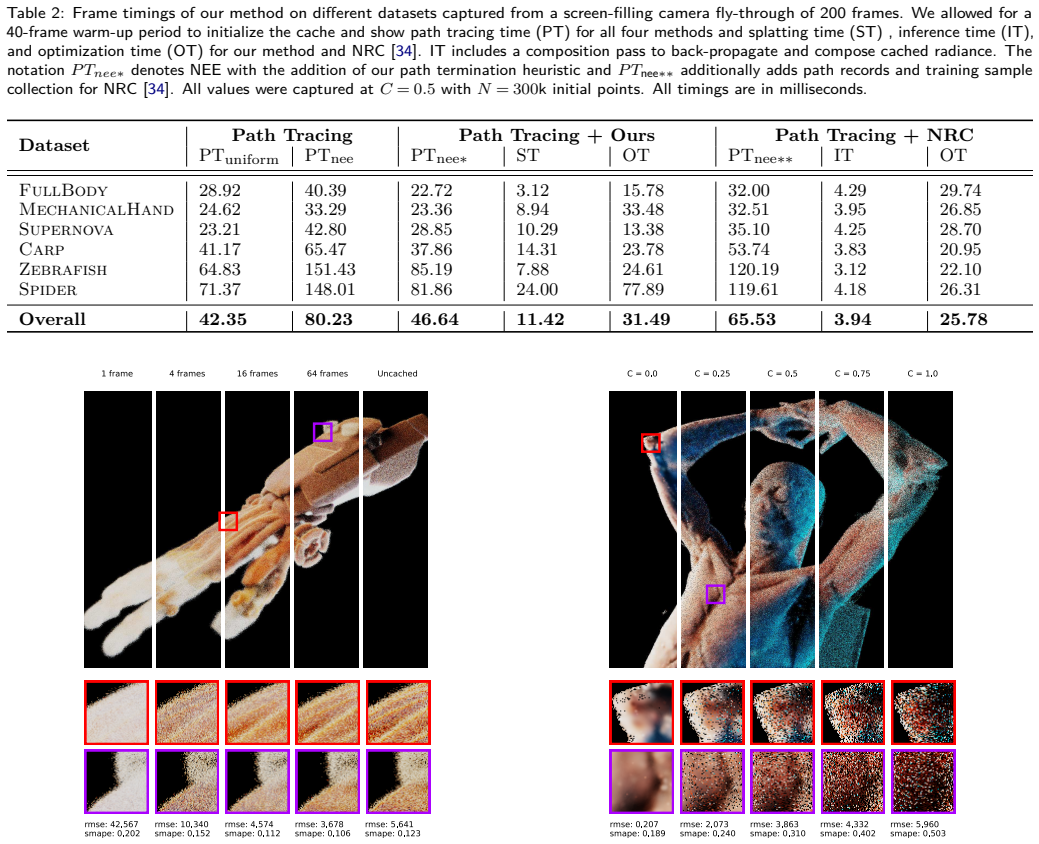
- [§4.1, Table 2, Figure 6] Quantitative claims rest on single-run measurements without error bars or repeated seeds. Cache training is stochastic (random initialization of the Gaussian point cloud, AdamW updates, learning-rate resets on viewport change), and the reported PSNR differences and timings are presented as point values. The reader cannot distinguish systematic gains from run-to-run variation, especially for the comparison with the NRC baseline. Please report multiple runs or per-frame variance across the fly-through, specify how many frames contribute to each PSNR number, and state the warm-up schedule for all methods. The NRC baseline should also be explicitly labeled as a modified reimplementation: it uses the authors' path termination heuristic, disables self-training, and replaces the spatio-directional input with hash-grid encoding.
minor comments (6)
- [§3.2, Eq. (2)] The wedge symbol in the scale formula is undefined; if it denotes a component-wise minimum or clamp, please state this explicitly.
- [Abstract and §4.4] The phrase "without increasing rendering costs" is stronger than Table 2 supports; for example, MechanicalHand shows roughly 65.8 ms total with the cache versus 33.3 ms for NEE, and Spider shows 183.8 ms versus 148.0 ms. Suggest qualifying the claim to "comparable or lower in several tested scenes."
- [§4.1] The NRC description says "The model configuration is the same as NRC [34]" and then introduces hash-grid encoding; please state explicitly which parts are from the original method and which are modifications for this comparison.
- [Figure 7] The text says "less than 16 samples" while the caption discusses 16 SPP; clarify whether the horizontal axis is frames or accumulated samples per pixel.
- [Table 2] Reporting PT, ST, and OT separately is useful, but the headline comparison would be clearer if each method also had a single combined frame time; the current format makes it easy to misread the totals.
- [References] Reference [51] lists "Woodock"; the correct spelling is "Woodcock."
Circularity Check
No circular derivation: the cache training and evaluation rest on external Noise2Noise theory and external baselines; the §3.5 buffer-expectation concern is an unproven correctness assumption, not a definitional reduction.
full rationale
The derivation chain is not circular. The cache's training targets are path-buffer samples collected from the renderer ('To train the cache, we collect unbiased samples from the renderer, attenuate them, and assign them to their appropriate cache level', Section 3.5), and the Noise2Noise principle used to justify learning from noisy targets is an external result [26], not a conclusion derived inside this paper. No equation defines the cache's prediction as its own input: Eq. (3) is an importance-sampling attenuation for cache reads, and Algorithm 1 is a termination heuristic, neither of which reduces the claimed quality gain to a fitted parameter. The self-citations ([1], [2], [9], [52], [53], [55]) appear as related work and are not load-bearing for the central claim; the evaluation compares against external baselines (uniform PT, NEE, and an NRC implementation) and a 512-SPP reference, so the PSNR improvements are empirical rather than constructed. The paper also explicitly acknowledges that the method is biased and has no guaranteed error bounds (Section 5, 'Bias'), which is a correctness limitation, not evidence of circularity. The main scientific risk—that Section 3.5's assertion 'the expected value of samples in the buffers behaves analogously to regular path tracing' is not derived, so early-terminated buffer entries may have a conditional-expectation bias—is a soundness/bias concern rather than a definitional or self-citation circularity: the training target is not defined in terms of the cache output. I therefore find no significant circularity.
Assumptions & free parameters
free parameters (5)
- Cache termination coefficient C =
0.5
- Initial cache size N =
300,000
- Number of cache levels K+1 =
3
- Learning rates =
position 1.16e-3, color 1.25e-2, rotation 1e-3, opacity 1.5e-1, scale 0
- Allowed throughput threshold 0.9 =
0.9
assumptions (5)
- domain assumption Radiative transfer equation model for volume rendering (Equation 1).
- standard math Path-space decomposition of the radiance integral (Veach, Chapter 8).
- domain assumption Noise2Noise: minimizing mean squared error against noisy targets with expected value equal to clean targets recovers the clean solution.
- ad hoc to paper Early-terminated, attenuated path samples have the correct expected value for their path-length buffer.
- domain assumption Path-space radiance at each length can be represented by view-independent isotropic 3D Gaussians with RGB color.
Cite this review
Pith. "Pith review of GSCache: Real-Time Radiance Caching for Volume Path Tracing using 3D Gaussian Splatting." pith.science (2026). https://pith.science/paper/CILLKZJQ
@misc{pith2026250719718,
  author       = {Pith},
  title        = {Pith review of: GSCache: Real-Time Radiance Caching for Volume Path Tracing using 3D Gaussian Splatting},
  year         = {2026},
  howpublished = {\url{https://pith.science/paper/CILLKZJQ}},
  note         = {Machine review of arXiv:2507.19718}
}
read the original abstract
Real-time path tracing is rapidly becoming the standard for rendering in entertainment and professional applications. In scientific visualization, volume rendering plays a crucial role in helping researchers analyze and interpret complex 3D data. Recently, photorealistic rendering techniques have gained popularity in scientific visualization, yet they face significant challenges. One of the most prominent issues is slow rendering performance and high pixel variance caused by Monte Carlo integration. In this work, we introduce a novel radiance caching approach for path-traced volume rendering. Our method leverages advances in volumetric scene representation and adapts 3D Gaussian splatting to function as a multi-level, path-space radiance cache. This cache is designed to be trainable on the fly, dynamically adapting to changes in scene parameters such as lighting configurations and transfer functions. By incorporating our cache, we achieve less noisy, higher-quality images without increasing rendering costs. To evaluate our approach, we compare it against a baseline path tracer that supports uniform sampling and next-event estimation and the state-of-the-art for neural radiance caching. Through both quantitative and qualitative analyses, we demonstrate that our path-space radiance cache is a robust solution that is easy to integrate and significantly enhances the rendering quality of volumetric visualization applications while maintaining comparable computational efficiency.
Figures


Figures from the paper (13 more)





Forward citations
Cited by 1 Pith paper
-
A Query-Efficient Stochastic Volume Rendering Framework for Time-Varying Implicit Neural Volumes
Delta-tracking plus a four-stage RT/tensor-core pipeline renders unmodified time-varying INRs interactively (~30–40 FPS at 1024²) with ~1–2 ms timestep updates.
Reference graph
Works this paper leans on
- [1]
- [2]
-
[3]
P. Bekaert, P. Slussalek, R. Cools, V. Havran, and H.-P. Seidel. A custom designed density estimator for light transport.Technical Report, Max Planck Institut für Informatik , (4), 2003. 2, 3
work page 2003
-
[4]
B. Bitterli, C. Wyman, M. Pharr, P. Shirley, A. Lefohn, and W. Jarosz. Spatiotemporal reservoir resampling for real-time ray tracing with dynamic direct lighting.ACM Transactions on Graphics, 39(4):148:1–148:17, article no. 148, 2020. doi: 10. 1145/3386569.3392481 1, 9
arXiv 2020
-
[5]
J. Condor, S. Speierer, L. Bode, A. Bozic, S. Green, P. Didyk, and A. Jarabo. Don’t splat your gaussians: Volumetric ray- traced primitives for modeling and rendering scattering and emissive media. ACM Transactions on Graphics , 44(1):10:1– 10:17, article no. 10, 2025. doi: 10.1145/3711853 9
doi:10.1145/3711853 2025
-
[6]
E. Dappa, K. Higashigaito, J. Fornaro, S. Leschka, S. Wilder- muth, and H. Alkadhi. Cinematic rendering–an alternative to volume rendering for 3d computed tomography imaging.Insights Into Imaging, 7(6):849–856, 2016. doi: 10.1007/s13244-016-0518 -1 2
-
[7]
D. Engel and T. Ropinski. Deep volumetric ambient occlusion. IEEE Transactions on Visualization and Computer Graphics , 27(2):1268–1278, 2021. doi: 10.1109/TVCG.2020.3030344 3
arXiv 2021
-
[8]
Facebook Inc. PyTorch. https://pytorch.org/, 2024. [Online; accessed 01-November-2024]. 6
work page 2024
Show all 61 references
-
[9]
Gadirov, Q
H. Gadirov, Q. Wu, D. Bauer, K.-L. Ma, J. B. Roerdink, and S. Frey. Hyperflint: Hypernetwork-based flow estimation and temporal interpolation for scientific ensemble visualization.Com- puter Graphics Forum , 44(3):e70134, 2025. doi: 10.1111/cgf. 70134 3
2025 doi
-
[10]
Hadadan, S
S. Hadadan, S. Chen, and M. Zwicker. Neural radiosity.ACM Transactions on Graphics, 40(6):236:1–236:11, article no. 236,
-
[11]
Han and C
J. Han and C. Wang. Coordnet: Data generation and visualiza- tion generation for time-varying volumes via a coordinate-based neural network. IEEE Transactions on Visualization and Com- puter Graphics, 29(12):4951–4963, 2023. doi: 10.1109/TVCG. 2022.3197203 3
2023
-
[12]
Jakob, C
W. Jakob, C. Regg, and W. Jarosz. Progressive Expectation– Maximization for hierarchical volumetric photon mapping.Com- puter Graphics Forum (Proceedings of EGSR) , 30(4), 2011. doi: 10.1111/j.1467-8659.2011.01988.x 2
2011
-
[13]
Jarosz, C
W. Jarosz, C. Donner, M. Zwicker, and H. W. Jensen. Radi- ance caching for participating media. ACM Transactions on Graphics (Presented at SIGGRAPH) , 27(1):7:1–7:11, 2008. doi: 10/cwnw78 2, 3
2008
-
[14]
Jönsson, J
D. Jönsson, J. Kronander, T. Ropinski, and A. Ynnerman. His- torygrams: Enabling interactive global illumination in direct volume rendering using photon mapping.IEEE Transactions on Visualization and Computer Graphics , 18(12):2364–2371, 2012. doi: 10.1109/TVCG.2012.232 2
2012 doi
-
[15]
Jönsson, E
D. Jönsson, E. Sundén, A. Ynnerman, and T. Ropinski. A survey of volumetric illumination techniques for interactive volume rendering. Computer Graphics Forum, 33(1):27–51, 2014. doi: 10.1111/cgf.12252 2
2014 doi
-
[16]
Kandlbinder, A
L. Kandlbinder, A. Dittebrandt, A. Schipek, and C. Dachsbacher. Optimizing path termination for radiance caching through ex- plicit variance trading.Proceedings of the ACM on Computer Graphics and Interactive Techniques , 7(3):33:1–33:19, article no. 33, 2024. doi: 10.1145/367...
2024 doi
-
[17]
Keller, K
A. Keller, K. Dahm, and N. Binder. Path space filtering. In ACM SIGGRAPH 2014 Talks , SIGGRAPH ’14, article no. 68, pp. 68:1–68:1. ACM, New York, 2014. doi: 10.1145/2614106. 2614149 2
2014 doi
-
[18]
Kerbl, G
B. Kerbl, G. Kopanas, T. Leimkühler, and G. Drettakis. 3d gaussian splatting for real-time radiance field rendering.ACM Transactions on Graphics, 42(4):139:1–139:14, article no. 139,
-
[19]
Khlebnikov, P
R. Khlebnikov, P. Voglreiter, M. Steinberger, B. Kainz, and D. Schmalstieg. Parallel irradiance caching for interactive monte- carlo direct volume rendering. Computer Graphics Forum , 33(3):61–70, 2014. doi: 10.1111/cgf.12362 2
2014 doi
- [20]
-
[21]
Kniss, S
J. Kniss, S. Premoze, C. Hansen, and D. Ebert. Interactive translucent volume rendering and procedural modeling. InIEEE Visualization, pp. 109–116. IEEE, 2002. doi: 10.1109/VISUAL. 2002.1183764 2
2002 arXiv
-
[22]
Kniss, S
J. Kniss, S. Premoze, C. Hansen, P. Shirley, and A. McPherson. A model for volume lighting and modeling.IEEE Transactions on Visualization and Computer Graphics , 9(2):150–162, 2003. doi: 10.1109/TVCG.2003.1196003 2
2003 arXiv
-
[23]
Krivanek, P
J. Krivanek, P. Gautron, S. Pattanaik, and K. Bouatouch. Ra- diance caching for efficient global illumination computation. IEEE Transactions on Visualization and Computer Graphics , 11(5):550–561, 2005. doi: 10.1109/TVCG.2005.83 1, 2, 3
2005 doi
-
[24]
Kroes, F
T. Kroes, F. H. Post, and C. P. Botha. Exposure render: An interactive photo-realistic volume rendering framework.PLOS ONE, 7(7):1–10, 2012. doi: 10.1371/journal.pone.0038586 2
2012 doi
-
[25]
J. C. Lee, D. Rho, X. Sun, J. H. Ko, and E. Park. Compact 3d gaussian representation for radiance field. InProceedings of the IEEE/CVF Conference on Computer Vision and Pattern Recognition (CVPR), pp. 21719–21728, 2024. 9
2024
-
[26]
Lehtinen, J
J. Lehtinen, J. Munkberg, J. Hasselgren, S. Laine, T. Karras, M.Aittala, andT.Aila. Noise2Noise: Learningimagerestoration without clean data. In J. Dy and A. Krause, eds.,Proceedings of the 35th International Conference on Machine Learning , vol. 80 of Proceedings of Machine L...
2018
-
[27]
M. Levoy. Display of surfaces from volume data.IEEE Computer Graphics and Applications, 8(3):29–37, 1988. doi: 10.1109/38. 511 2
1988 doi
-
[28]
D. Lin*, M. Kettunen*, B. Bitterli, J. Pantaleoni, C. Yuksel, and C. Wyman. Generalized resampled importance sampling: Foundations of restir. ACM Transactions on Graphics (Pro- ceedings of SIGGRAPH 2022) , 41(4):75:1–75:23, article no. 75,
2022
-
[29]
D. Lin, C. Wyman, and C. Yuksel. Fast volume rendering with spatiotemporal reservoir resampling. ACM Transactions on Graphics (Proceedings of SIGGRAPH Asia 2021) , 40(6):278:1– 278:18, article no. 278, 2021. doi: 10.1145/3478513.3480499 1, 9
2021
-
[30]
Loshchilov and F
I. Loshchilov and F. Hutter. Decoupled weight decay regulariza- tion. In International Conference on Learning Representations ,
-
[31]
S. S. Mallick, R. Goel, B. Kerbl, M. Steinberger, F. V. Carrasco, and F. De La Torre. Taming 3dgs: High-quality radiance fields with limited resources. InSIGGRAPH Asia 2024 Conference Papers, SA ’24, article no. 2, pp. 2:1–2:11. ACM, New York,
2024
-
[32]
N. Max. Optical models for direct volume rendering. IEEE Transactions on Visualization and Computer Graphics , 1(2):99– 108, 1995. doi: 10.1109/2945.468400 2
1995
-
[33]
Moenne-Loccoz, A
N. Moenne-Loccoz, A. Mirzaei, O. Perel, R. de Lutio, J. Mar- tinez Esturo, G. State, S. Fidler, N. Sharp, and Z. Gojcic. 3d gaussian ray tracing: Fast tracing of particle scenes. ACM Transactions on Graphics, 43(6):232:1–232:19, article no. 232,
-
[34]
Müller, F
T. Müller, F. Rousselle, J. Novák, and A. Keller. Real-time neural radiance caching for path tracing.ACM Trans. Graph., 40(4), article no. 36, 2021. doi: 10.1145/3450626.3459812 1, 2, 3, 6, 7, 8, 9
2021
-
[35]
Niedermayr, J
S. Niedermayr, J. Stumpfegger, and R. Westermann. Com- pressed 3d gaussian splatting for accelerated novel view synthe- sis. In Proceedings of the IEEE/CVF Conference on Computer Vision and Pattern Recognition (CVPR) , pp. 10349–10358, 2024. 9
2024
-
[36]
doi: 10.1145/3680528.3687694 5, 8, 9
-
[37]
Supernova dataset
Oak Ridge National Lab. Supernova dataset. https://www.ornl.gov/. 7
-
[38]
Ouyang, S
Y. Ouyang, S. Liu, M. Kettunen, M. Pharr, and J. Pantaleoni. Restir gi: Path resampling for real-time path tracing.Computer Graphics Forum, 40(8):17–29, 2021. doi: 10.1111/cgf.14378 1
2021 doi
-
[39]
doi: 10.1145/3687934 9
-
[40]
Papantonakis, G
P. Papantonakis, G. Kopanas, B. Kerbl, A. Lanvin, and G. Dret- takis. Reducing the memory footprint of 3d gaussian splatting. Proceedings of the ACM on Computer Graphics and Interac- tive Techniques, 7(1):16:1–16:17, article no. 16, 2024. doi: 10. 1145/3651282 9
2024
-
[41]
M. Ruiz, I. Boada, I. Viola, S. Bruckner, M. Feixas, and M. Sbert. Obscurance-based volume rendering framework. In H.-C. Hege, D. Laidlaw, R. Pajarola, and O. Staadt, eds.,IEEE/ EG Sym- posium on Volume and Point-Based Graphics , pp. 113–120. The Eurographics Association, 2008...
2008 doi
-
[42]
OptiX.https://developer.nvidia.com/ rtx/ray-tracing/optix, 2024
NVIDIA Corporation. OptiX.https://developer.nvidia.com/ rtx/ray-tracing/optix, 2024. [Online; accessed 01-November- 2024]. 6
2024
-
[43]
Šoltészová, D
V. Šoltészová, D. Patel, S. Bruckner, and I. Viola. A multidi- rectional occlusion shading model for direct volume rendering. Computer Graphics Forum, 29(3):883–891, 2010. doi: 10.1111/j. 1467-8659.2009.01695.x 2
2010
-
[44]
Stadlbauer, W
P. Stadlbauer, W. Tatzgern, J. Mueller, M. Winter, R. Sto- janovic, A. Weinrauch, and M. Steinberger. Adaptive multi-view radiance caching for heterogeneous participating media.Com- puter Graphics Forum, p. e70051, 2025. doi: 10.1111/cgf.70051 2
2025 doi
-
[45]
B. Pan, J. Lu, H. Li, W. Chen, Y. Wang, M. Zhu, C. Yu, and W. Chen. Differentiable design galleries: A differentiable approach to explore the design space of transfer functions. IEEE Transactions on Visualization and Computer Graphics , 30(1):1369–1379, 2024. doi: 10.1109/TVCG...
2024
-
[46]
Šmajdek, v
U. Šmajdek, v. Lesar, M. Marolt, and C. Bohak. Combined volume and surface rendering with global illumination caching. The Visual Computer , 40(4):2491–2503, 2023. doi: 10.1007/ s00371-023-02932-9 2
2023
-
[47]
G. J. Ward, F. M. Rubinstein, and R. D. Clear. A ray tracing solution for diffuse interreflection.ACM SIGGRAPH Computer Graphics, 22(4):85–92, 1988. doi: 10.1145/378456.378490 1
1988
-
[49]
Weiss, M
S. Weiss, M. IşIk, J. Thies, and R. Westermann. Learning adaptive sampling and reconstruction for volume visualization. IEEE Transactions on Visualization and Computer Graphics , 28(7):2654–2667, 2022. doi: 10.1109/TVCG.2020.3039340 3
2022
-
[50]
Differentiabledirectvolumerender- ing
S.WeissandR.Westermann. Differentiabledirectvolumerender- ing. IEEE Transactions on Visualization and Computer Graph- ics, 28(1):562–572, 2022. doi: 10.1109/TVCG.2021.3114769 2
2022
-
[51]
E. Veach. Robust Monte Carlo methods for light transport simulation. Stanford University, 1998. 3
1998
-
[52]
Q. Wu, D. Bauer, Y. Chen, and K.-L. Ma. Hyperinr: A fast and predictive hypernetwork for implicit neural representations via knowledge distillation, 2023. 3
2023
-
[53]
Q. Wu, D. Bauer, M. J. Doyle, and K.-L. Ma. Interactive volume visualization via multi-resolution hash encoding based neural representation. IEEE Transactions on Visualization and Computer Graphics, 30(8):5404–5418, 2024. doi: 10.1109/TVCG .2023.3293121 3
2024
-
[54]
Weiss, P
S. Weiss, P. Hermüller, and R. Westermann. Fast neural rep- resentations for direct volume rendering.Computer Graphics Forum, 41(6):196–211, 2022. doi: 10.1111/cgf.14578 3
2022 doi
-
[55]
Zavorotny, Q
D. Zavorotny, Q. Wu, D. Bauer, and K.-L. Ma. From Cluster to Desktop: A Cache-Accelerated INR framework for Interactive Visualization of Tera-Scale Data. In G. Reina, S. Rizzi, and C. Gueunet, eds.,Eurographics Symposium on Parallel Graphics and Visualization. The Eurographics...
2025
-
[56]
Zhang, Z
Y. Zhang, Z. Dong, and K.-L. Ma. Real-time volume rendering in dynamic lighting environments using precomputed photon mapping. IEEE Transactions on Visualization and Computer Graphics, 19(8):1317–1330, 2013. doi: 10.1109/TVCG.2013.17 2 A Ablation Study We provide an ablation s...
2013 doi
-
[57]
E. R. Woodock, T. Murphy, P. J. Hemmings, and T. C. Long- worth. Techniques used in the GEM code for Monte Carlo neutronics calculation in reactors and other systems of complex geometry. In Proceedings of the conference on the application of computing methods to reactor proble...
1965
-
[60]
Q. Wu, J. M. Esturo, A. Mirzaei, N. Moënne-Loccoz, and Z. Go- jcic. 3dgut: Enabling distorted cameras and secondary rays in gaussian splatting. In Proceedings of the IEEE/CVF Confer- ence on Computer Vision and Pattern Recognition (CVPR) , pp. 26036–26046, 2025. 9
2025
-
[2021]
doi: 10.1145/3478513.3480569 1, 2, 3
-
[2022]
doi: 10.1145/3528223.3530158 1
(*Joint First Authors). doi: 10.1145/3528223.3530158 1
-
[2023]
doi: 10.1145/3592433 3, 5, 6, 11
-
[2024]
doi: 10.1109/TVCG.2023.3327107 2, 3
2023
Reviewed August 6, 2026 · model on record in the stance chip above.
Discussion (0). Sign in to comment.