REVIEW 4 major objections 6 minor 94 references
HydraMamba: Multi-Head State Space Model for Global Point Cloud Learning
T0 review · 4 major / 6 minor · reviewed 2026-08-06 · deepseek-v4-flash
Pith's one-line read The paper claims its state-space network HydraMamba outperforms all existing point cloud backbones on four benchmarks by adapting selective state space models (S6) to unordered point sets and local geometry.
desk verdict Plausible new SSM components, but the SOTA claim needs error bars and an apples-to-apples S3DIS comparison. read the letter →
The pith
A machine-rendered reading of the paper's core claim, the machinery that carries it, and where it could break.
The reading
What carries the argument
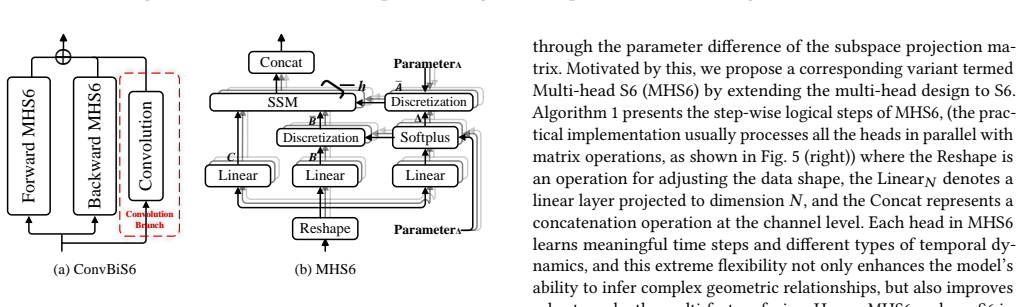
Three components carry the argument. Shuffle serialization: the point set is ordered by the Hilbert space-filling curve, and its six traversal variants (differing by axis priority: xyz, xzy, yxz, and so on) are randomly assigned to different network layers, so each layer's causal recurrence sees different structural dependencies without the redundancy of concatenating curves. ConvBiS6: a forward and a backward S6 run in parallel so every point has a global receptive field, while a 1D grid convolution along the Hilbert-ordered sequence captures local geometry; the two branches are summed, and the layer replaces the attention module inside a standard Transformer-style block. MHS6: the multi-head idea from self-attention is ported to S6 by reshaping the input into $h$ heads, giving each head its own linear projections and discretized parameters $\bar{\boldsymbol{A}}=\Delta\otimes\boldsymbol{A}$, $\bar{\boldsymbol{B}}=\Delta\otimes\boldsymbol{B}$, scanning heads in parallel, and concatenating outputs, so heads can specialize in different temporal dynamics. The base operator, S6, is the selective state space model from Mamba: its input-dependent parameters let it select task-relevant information at linear complexity, which is what makes whole-scene processing of over 100K points feasible.
What would settle it
Re-run S3DIS with HydraMamba constrained to the same block-based or window-based input partitioning that Point Transformer V3 and Pamba use, training with at least five seeds for both protocols; if the 73.6% mIoU no longer beats the baselines beyond seed-to-seed variance, the claimed supremacy is an artifact of whole-scene processing rather than of the proposed components.
Extended reading notes
Core claim
The paper's central claim is that earlier Mamba-based point cloud networks underperform not because S6 is the wrong operator but because they feed it poorly: they serialize unordered point sets incompletely and give S6 no explicit mechanism for local geometry. HydraMamba's shuffle serialization assigns the six axis-priority variants of the 3D Hilbert curve to random layers, so each layer's causal scan infers structure from a different perspective; in the paper's ablation this lifts ModelNet40 accuracy from 89.38% with no serialization to 93.96% with all six variants shuffled, while a fixed sequential assignment reaches only 93.23%. The ConvBiS6 layer runs a bidirectional S6 forward and backward over the sequence for global context in parallel with a 1D grid convolution that exploits the Hilbert order's locality preservation, and the MHS6 variant splits features into heads, each with its own input-dependent parameters, so different heads learn different temporal dynamics. The paper reports that the resulting network surpasses all prior backbones on object recognition, part segmentation, and scene-level semantic segmentation, including attention-based Point Transformer V3 and SSM-based Pamba and PointMamba, and reads this as the first case of an SSM network outperforming the Transformer paradigm in point cloud understanding. The efficiency claim is part of the same story: at 5.9G memory on S3DIS it is the lightest of the compared networks, which the paper takes as evidence that SSM backbones fit resource-constrained 3D applications.
Load-bearing premise
The load-bearing assumption is that the reported comparisons are fair: the S3DIS result feeds the entire scene to HydraMamba while the main baselines use blocks or windows, and no repeated-seed or error-bar statistics are reported, so the thin margins that establish state-of-the-art standing could be evaluation-protocol artifacts.
Editorial extensions
If this is right
- State space models can serve as full replacements for attention inside point cloud backbones, preserving global receptive fields without quadratic cost.
- Scene-level point clouds with more than 100K points can be processed as a single global input, which the paper argues is what lets long-range object dependencies actually influence prediction.
- The reported 5.9G memory footprint on S3DIS (below Point Transformer V3's 6.3G) puts SSM backbones in a favorable position for memory-constrained 3D perception, even though inference is not the fastest.
- Serialization quality is decisive for causal models on point sets: dropping the Hilbert ordering costs over 4 points of ModelNet40 accuracy, and cutting the number of variants from six to two costs up to 1.2 points.
- Extending the multi-head design to S6 itself (rather than using S6 as an off-the-shelf operator) yields a further gain of about 0.8 points, suggesting the scan computation itself is a lever, not just the input ordering.
Reading between the lines
- Because the ablation varies the number of curve variants and the shuffling together, the paper does not isolate whether randomness itself or simply seeing more orderings drives the serialization gain; a deterministic schedule that cycles through all six variants would separate the two.
- The S3DIS comparison is not protocol-matched: HydraMamba consumes the whole scene while leading baselines divide it into blocks or windows, and no error bars or repeated-seed runs are reported, so the 0.1-0.2 mIoU lead over Pamba and Point Transformer V3 may reflect input partitioning or training recipe rather than the architecture.
- The same pairing of space-filling-curve serialization with a 1D convolution branch could transfer to 2D image tasks, since the paper argues its locality mechanism exploits the curve's ordering rather than image grid structure, an extension the paper mentions but does not test.
Editorial analysis
A structured set of objections, weighed in public.
Referee Report
Summary. The paper proposes HydraMamba, a state-space-model (SSM) backbone for point cloud learning. It contributes three components: a shuffle serialization strategy that randomly assigns one of six Hilbert-curve variants to each block, a ConvBiS6 layer that combines bidirectional S6 with a 1D convolution branch for locality, and MHS6, a multi-head extension of the S6 selective state space model. The authors report state-of-the-art results on ModelNet40 (94.0% OA), ShapeNet part segmentation (86.8% instance mIoU), S3DIS semantic segmentation (73.6% mIoU), and ScanObjectNN (88.3% OA), and claim that SSM-based point cloud networks can outperform attention-based counterparts while using less memory.
Significance. If the empirical claims hold, the paper would provide evidence that selective state space models are competitive with or superior to attention on point cloud tasks, with lower memory footprint. The architecture combines sensible ideas: Hilbert-curve serialization for causality, a local convolution branch, and a multi-head variant of S6. The paper includes ablations for each component, compares with a broad set of baselines, and releases code. However, the central SOTA claim rests on small margins over the strongest baselines, and the S3DIS comparison is not apples-to-apples because HydraMamba uses whole-scene input while the cited baselines use block-based or window-based evaluation. These concerns are load-bearing for the paper's central message and require additional controlled experiments and variance reporting.
major comments (4)
- [§5.1, Table 3] The S3DIS comparison is confounded by an input-partitioning difference. The paper states that HydraMamba takes the entire point cloud (100K+ points) directly as input, whereas prior attention networks and SSM baselines such as Pamba and Point Transformer V3 divide the scene into blocks or windows. The reported margin over Pamba is 0.1 mIoU (73.6 vs 73.5) and over Point Transformer V3 is 0.2 mIoU (73.6 vs 73.4). These gaps are within the range of protocol-induced variation on S3DIS (e.g., block size, grid pooling configuration, test-time cropping), so the table does not establish that the architecture, rather than the evaluation setup, is responsible for the improvement. Please re-run at least the closest baselines under the same whole-scene protocol, or otherwise provide controlled experiments that isolate the effect of input partitioning.
- [Tables 1–3, 8] All reported accuracies are single-run numbers with no error bars, multiple seeds, or variance measures. The main SOTA claims rely on differences of 0.1–0.2 percentage points (e.g., S3DIS 73.6 vs 73.5, ScanObjectNN 88.3 vs 88.1, ShapeNet 86.8 vs 86.6). Without at least three seeds with mean and standard deviation, these margins cannot be distinguished from random seed or optimization noise. Please provide repeated-run statistics for the proposed method and, ideally, for the closest competing baselines under identical training conditions.
- [§5.3, Tables 5 and 6] The ablation for the shuffle serialization strategy is not cleanly interpretable. Group I vs Group II in Table 5 compares random ordering versus sequential ordering while keeping the same set of six Hilbert variants; the reported difference of 0.73% (93.96 vs 93.23) could be due to the specific random draw rather than to a systematic benefit of randomness, since only one trial is reported. In addition, Groups III–VIII vary both the number of variants and which variants are used, so the claimed 'positive correlation' between number of variants and accuracy is confounded with variant identity. Please report multiple random-assignment trials and, if possible, ablate the number of variants while holding the specific subset fixed or averaging over all subsets.
- [§5.3, Tables 6 and 7] There is an inconsistency between the ablation tables that affects the interpretation of MHS6 and ConvBiS6. Table 6 Group III (bidirectional S6 without convolution branch) reports OA 92.40, while Table 7 Group I (MHS6 disabled) reports OA 93.13; these appear to describe the same configuration (ConvBiS6 with standard S6 instead of MHS6). The discrepancy is not explained in the text. Please clarify the exact configurations and ensure the ablation baselines are consistent across tables.
minor comments (6)
- [Tables 1 and 5] Table 1 reports HydraMamba OA as 94.0%, while Table 5 Group I (the full model) reports 93.96%. Please state whether the difference is due to rounding or to different runs, and use consistent numbers.
- [Table 3] The entry 'Siwn3D' is a typo and should read 'Swin3D'.
- [Algorithm 1] The input line contains a duplicated word: 'and and the number of heads'. Please correct this.
- [References] Reference [30] contains an extra comma in the author list: 'Z. H. Lin, S. Y. Huang, , and Y. F. Wang'.
- [§4.2] The description 'enables each block to infer spatial relationships from multiple perspectives' is imprecise, since each block receives a single Hilbert variant; it is the network across blocks that sees multiple perspectives. Please rephrase to avoid confusion.
- [§6 and Abstract] The conclusion acknowledges that HydraMamba is slower than Point Transformer V3 in inference latency, but the abstract states that HydraMamba 'achieves state-of-the-art results on various tasks' without qualifying that the SOTA claim is for accuracy only. Please specify that the performance claim is about accuracy, not overall efficiency.
Circularity Check
No significant circularity: HydraMamba is an empirical architecture study whose components are evaluated on held-out benchmarks and ablations, with no derivation reducing to its inputs.
full rationale
Walking the claimed derivation chain, HydraMamba consists of three proposed components—shuffle serialization, ConvBiS6, and MHS6—each defined from standard point-cloud primitives (Hilbert curves, bidirectional S6, 1D convolution, and multi-head projections) rather than from the target accuracies. The state-space machinery in Section 3 is quoted from the external Mamba/S4 literature, and the component designs in Section 4 are justified by qualitative reasoning plus ablations in Tables 5–7; none of the ablations fits a parameter and then reports the same fitted quantity as a prediction. The SOTA claims in Section 5 compare against cited external baselines on ModelNet40, ShapeNet, S3DIS, and ScanObjectNN. The S3DIS comparison is not apples-to-apples because HydraMamba consumes the entire scene while prior baselines use blocks or windows, and no error bars are reported; that is a benchmark-comparability and reproducibility risk, not circularity, because the baseline numbers are independent empirical results rather than consequences of HydraMamba's definitions. The conclusion explicitly concedes that HydraMamba is slower than Point Transformer V3, another performance limitation rather than a circular step. No load-bearing self-citation or imported uniqueness theorem appears; the reference list contains no work by the present authors. The appendix's 'CloudMamba' label is a naming slip for HydraMamba and does not constitute a circular step. The derivation chain is therefore self-contained with respect to circularity.
Assumptions & free parameters
free parameters (2)
- Initial number of heads in MHS6 =
6
- Number of Hilbert curve variants =
6
assumptions (3)
- domain assumption The Hilbert curve preserves local spatial proximity well enough that a 1D convolution over the serialized sequence captures 3D local geometry.
- domain assumption Reported benchmark numbers of prior methods are accurate and were obtained under comparable training and evaluation settings.
- ad hoc to paper Randomly assigning different Hilbert curve variants to different layers provides a beneficial diversity of perspectives.
Cite this review
Pith. "Pith review of HydraMamba: Multi-Head State Space Model for Global Point Cloud Learning." pith.science (2026). https://pith.science/paper/ALKE7IUJ
@misc{pith2026250719778,
  author       = {Pith},
  title        = {Pith review of: HydraMamba: Multi-Head State Space Model for Global Point Cloud Learning},
  year         = {2026},
  howpublished = {\url{https://pith.science/paper/ALKE7IUJ}},
  note         = {Machine review of arXiv:2507.19778}
}
read the original abstract
The attention mechanism has become a dominant operator in point cloud learning, but its quadratic complexity leads to limited inter-point interactions, hindering long-range dependency modeling between objects. Due to excellent long-range modeling capability with linear complexity, the selective state space model (S6), as the core of Mamba, has been exploited in point cloud learning for long-range dependency interactions over the entire point cloud. Despite some significant progress, related works still suffer from imperfect point cloud serialization and lack of locality learning. To this end, we explore a state space model-based point cloud network termed HydraMamba to address the above challenges. Specifically, we design a shuffle serialization strategy, making unordered point sets better adapted to the causal nature of S6. Meanwhile, to overcome the deficiency of existing techniques in locality learning, we propose a ConvBiS6 layer, which is capable of capturing local geometries and global context dependencies synergistically. Besides, we propose MHS6 by extending the multi-head design to S6, further enhancing its modeling capability. HydraMamba achieves state-of-the-art results on various tasks at both object-level and scene-level. The code is available at https://github.com/Point-Cloud-Learning/HydraMamba.
Figures


Figures from the paper (3 more)


Reference graph
Works this paper leans on
-
[1]
Armeni, O
I. Armeni, O. Sener, A. R. Zamir, H. L. Jiang, I. K. Brilakis, M. Fischer, and S. Savarese. 2016. 3D Semantic Parsing of Large-Scale Indoor Spaces. In Proc. IEEE/CVF Conference on Computer Vision and Pattern Recognition (CVPR) . Las Vegas, NV, USA, 1534–1543
2016
-
[2]
S. R. Chen, Y. X. Luo, Y. Ma, Y. Qiao, and Y. L. Wang. 2025. H-MBA: Hierarchi- cal MamBa Adaptation for Multi-Modal Video Understanding in Autonomous Driving. arXiv:2501.04302
work page Pith review arXiv 2025
-
[3]
T. Dao, D. Y. Fu, S. Ermon, A. Rudra, and C. Ré. 2022. FlashAttention: Fast and Memory-Efficient Exact Attention with IO-Awareness. In Proc. Advances in Neural Information Processing Systems (NeurIPS) . New Orleans, LA, USA, 1–16
2022
-
[4]
X. Deng, W. Y. Zhang, Q. Ding, and X. M. Zhang. 2023. PointVector: A Vector Representation In Point Cloud Analysis. InProc. IEEE/CVF Conference on Computer Vision and Pattern Recognition (CVPR) . Vancouver, BC, Canada, 9455–9465
2023
-
[5]
R. P. Dong, Z. K. Qi, L. F. Zhang, J. B. Zhang, J. J. Sun, Z. Ge, L. Yi, and K. S. Ma. 2023. Autoencoders as Cross-Modal Teachers: Can Pretrained 2D Image Transformers Help 3D Representation Learning?. InProc. International Conference on Learning Representations (ICLR) . Kigali, Rwanda, 1–20
2023
-
[6]
Dosovitskiy, L
A. Dosovitskiy, L. Beyer, A. Kolesnikov, D. Weissenborn, X. H. Zhai, T. Unterthiner, M. Dehghani, M. Minderer, G. Heigold, S. Gelly, J. Uszkoreit, and N. Houlsby
-
[7]
L. H. Duan, S. S. Zhao, N. Xue, M. M. Gong, G. S. Xia, and D. C. Tao. 2023. ConDaFormer: Disassembled Transformer with Local Structure Enhancement for 3D Point Cloud Understanding. InProc. Advances in Neural Information Processing Systems (NeurIPS). New Orleans, LA, USA, 1–14
2023
-
[8]
L. Fan, Z. Q. Pang, T. Y. Zhang, Y. X. Wang, H. Zhao, F. Wang, N. Y. Wang, and Z. X. Zhang. 2022. Embracing single stride 3D object detector with sparse transformer. In Proc. IEEE/CVF Conference on Computer Vision and Pattern Recognition (CVPR) . New Orleans, LA, USA, 8448–8458
2022
Show all 94 references
-
[9]
Y. X. Fu, M. Lou, and Y. Z. Yu. 2025. SegMAN: Omni-scale Context Modeling with State Space Models and Local Attention for Semantic Segmentation. In Proc. IEEE/CVF Conference on Computer Vision and Pattern Recognition (CVPR) . Nashville, TN, USA, 19077–19087
2025
-
[10]
Gu and T
A. Gu and T. Dao. 2023. Mamba: Linear-time sequence modeling with selective state spaces. arXiv:2312.00752
2023 arXiv
-
[11]
A. Gu, T. Dao, S. Ermon, A. Rudra, and C. Ré. 2020. Hippo: Recurrent memory with optimal polynomial projections. In Proc. Advances in Neural Information Processing Systems (NeurIPS). Virtual Event, 1474–1487
2020
-
[12]
A. Gu, K. Goel, and C. Ré. 2022. Efficiently modeling long sequences with struc- tured state spaces. In Proc. International Conference on Learning Representations (ICLR). Virtual Event, 1–15
2022
-
[13]
A. Gu, I. Johnson, K. Goel, K. Saab, T. Dao, A. Rudra, and C. Ré. 2021. Combining recurrent, convolutional, and continuous-time models with linear state space layers. In Proc. Advances in Neural Information Processing Systems (NeurIPS) . Virtual Event, 572–585
2021
-
[14]
M. H. Guo, J. X. Cai, Z. N. Liu, T. J. Mu, R. R. Martin, and S. M. Hu. 2021. PCT: Point cloud transformer. Computational Visual Media 7, 2 (April 2021), 187–199
2021
-
[15]
Gupta, A
A. Gupta, A. Gu, and J. Berant. 2022. Diagonal State Spaces are as Effective as Structured State Spaces. In Proc. Advances in Neural Information Processing Systems (NeurIPS). New Orleans, LA, USA, 1–12
2022
-
[16]
X. Han, Y. Tang, Z. X. Wang, and X. Z. Li. 2024. Mamba3D: Enhancing Lo- cal Features for 3D Point Cloud Analysis via State Space Model. In Proc. ACM International Conference on Multimedia (ACM MM) . Melbourne, Australia, 1–10
2024
-
[17]
C. H. He, R. H. Li, S. Li, and L. Zhang. 2022. Voxel Set Transformer: A Set- to-Set Approach to 3D Object Detection from Point Clouds. In Proc. IEEE/CVF Conference on Computer Vision and Pattern Recognition (CVPR) . New Orleans, LA, USA, 8407–8417
2022
-
[18]
D. Hilbert. 1935. Über die stetige abbildung einer linie auf ein flächenstück. Dritter Band: Analysis· Grundlagen der Mathematik· Physik Verschiedenes: Nebst Einer Lebensgeschichte (1935)
1935
-
[19]
Howard, M.L
A.G. Howard, M.L. Zhu, B. Chen, D. Kalenichenko, W.J. Wang, T. Weyand, M. An- dreetto, and H. Adam. 2017. MobileNets: Efficient convolutional neural networks for mobile vision applications. arXiv:1704.04861
2017 arXiv
-
[20]
Q. Y. Hu, B. Yang, L. H. Xie, S. Rosa, Y. L. Guo, Z. H. Wang, N. Trigoni, and A. Markham. 2022. Learning Semantic Segmentation of Large-Scale Point Clouds With Random Sampling. IEEE Transactions on Pattern Analysis and Machine Intelligence 44, 11 (Nov. 2022), 8338–8354
2022
-
[21]
Huang, X
T. Huang, X. H. Pei, S. You, F. Wang, C. Qian, and C. Xu. 2024. LocalMamba: Visual State Space Model with Windowed Selective Scan. arXiv:2403.09338
2024 arXiv
-
[22]
Köprücü, D
N. Köprücü, D. Okpekpe, and A. Orvieto. 2024. NIMBA: Towards Robust and Principled Processing of Point Clouds With SSMs. arXiv:2411.00151
2024 arXiv
-
[23]
X. Lai, J. H. Liu, L. Jiang, L. W. Wang, and H. S. Zhao. 2022. Stratified Transformer for 3D Point Cloud Segmentation. In Proc. IEEE/CVF Conference on Computer Vision and Pattern Recognition (CVPR) . New Orleans, LA, USA, 8490–8499
2022
-
[24]
K. C. Li, X. H. Li, Y. Wang, Y. N. He, Y. L. Wang, L. M. Wang, and Y. Qiao
-
[25]
Y. W. Li, K. Zhang, J. Z. Cao, R. Timofte, M. Magno, L. Benini, and L. V. Gool
-
[26]
Z. Y. Li, Y. B. Ai, J. H. Lu, C. X. Wang, J. C., Deng, H. Z. Chang, Y. Z. Liang, W. F. Yang, S. F. Zhang, and T. Z. Zhang. 2025. Pamba: Enhancing Global Interaction in Point Clouds via State Space Model. In Proc. AAAI Conference on Artificial Intelligence (AAAI). Philadelphia,...
2025
-
[27]
D. K. Liang, T. R. Feng, X. Zhou, Y. M. Zhang, Z. K. Zou, and X. Bai. 2024. Parameter-Efficient Fine-Tuning in Spectral Domain for Point Cloud Learning. arXiv:2410.08114
2024 arXiv
- [28]
-
[29]
H. J. Lin, X. W. Zheng, L. J. Li, F. Chao, S. S. Wang, Y. Wang, Y. H. Tian, and R. R. Ji. 2023. Meta Architecture for Point Cloud Analysis. In Proc. IEEE/CVF Conference on Computer Vision and Pattern Recognition (CVPR) . Vancouver, BC, Canada, 17682–17691
2023
-
[30]
Z. H. Lin, S. Y. Huang, , and Y. F. Wang. 2022. Learning of 3D Graph Convolution Networks for Point Cloud Analysis. IEEE Transactions on Pattern Analysis and Machine Intelligence 44, 8 (Aug. 2022), 4212–4224
2022
-
[31]
D. K. Liang, X. Zhou, W. Xu, X. K. Zhu, Z. K. Zou, X. Q. Ye, X. Tan, and X. Bai
-
[32]
PointMamba: A Simple State Space Model for Point Cloud Analysis. In Proc. Advances in Neural Information Processing Systems (NeurIPS) . Vancouver, Canada, 1–12
-
[33]
Y Liu, M
L. Y Liu, M. Zhang, J. H. Yin, T. W. Liu, W. Ji, Y. R. Piao, and H. C. Lu. 2025. DefMamba: Deformable Visual State Space Model. In Proc. IEEE/CVF Conference on Computer Vision and Pattern Recognition (CVPR) . Nashville, TN, USA, 8838– 8847
2025
-
[34]
Y. Liu, Y. J. Tian, Y. Z. Zhao, H. T. Yu, L. X. Xie, Y. W. Wang, Q. X. Ye, and Y. F. Liu
-
[35]
H. T. Liu, M. Cai, and Y. J. Lee. 2022. Masked discrimination for self-supervised learning on point clouds. InProc. European Conference on Computer Vision (ECCV). Tel Aviv, Israel, 657–675
2022
-
[36]
J. M. Liu, R. J. Yu, Y. Wang, Y. Zheng, T. C. Deng, W. C. Ye, and H. S. Wang. 2024. Point Mamba: A Novel Point Cloud Backbone Based on State Space Model with Octree-Based Ordering Strategy. arXiv:2403.06467
2024 arXiv
-
[37]
J. Ma, F. F. Li, and B. Wang. 2024. U-Mamba: Enhancing Long-range Dependency for Biomedical Image Segmentation. arXiv:2401.04722
2024 arXiv
-
[38]
X. Ma, C. Qin, H. X. You, H. X. Ran, and Y. Fu. 2022. Rethinking Network Design and Local Geometry in Point Cloud: A Simple Residual MLP Framework. In Proc. International Conference on Learning Representations (ICLR) . Virtual Event, 1–14
2022
-
[39]
VMamba: Visual State Space Model. InProc. Advances in Neural Information Processing Systems (NeurIPS). Vancouver, BC, Canada, 1–14
-
[40]
Y. H. Liu, B. Tian, Y. S. Lv, L. X. Li, and F. Y. Wang. 2024. Point Cloud Classification Using Content-Based Transformer via Clustering in Feature Space. IEEE/CAA Journal of Automatica Sinica 11, 1 (Jan. 2024), 231–239
2024
-
[41]
Z. J. Liu, X. Y. Yang, H. T. Tang, S. Yang, and S. Han. 2023. FlatFormer: Flattened Window Attention for Efficient Point Cloud Transformer. In Proc. IEEE/CVF Conference on Computer Vision and Pattern Recognition (CVPR) . Vancouver, BC, Canada, 1200–1211
2023
-
[42]
D. Nie, R. Lan, L. Wang, and X. F. Ren. 2022. Pyramid Architecture for Multi- Scale Processing in Point Cloud Segmentation. In Proc. IEEE/CVF Conference on Computer Vision and Pattern Recognition (CVPR) . New Orleans, LA, USA, 17263–17273
2022
-
[43]
Nordin and A
A. Nordin and A. Telles. 2023. Comparing the Locality Preservation of Z-order Curves and Hilbert Curves. (2023)
2023
-
[44]
Martin and C
E. Martin and C. Cundy. 2018. Parallelizing linear recurrent neural nets over sequence length. In Proc. International Conference on Learning Representations . Vancouver, BC, Canada, 1–9
2018
-
[45]
Mazur and V
K. Mazur and V. Lempitsky. 2021. Cloud Transformers: A Universal Approach To Point Cloud Processing Tasks. In Proc. IEEE/CVF International Conference on Computer Vision (ICCV). Montreal, QC, Canada, 10695–10704
2021
-
[46]
Mehta, A
H. Mehta, A. Gupta, A. Cutkosky, and B. Neyshabur. 2022. Long range language modeling via gated state spaces. arXiv:2206.13947
2022 arXiv
-
[47]
C. R. Qi, H. Su, K. C. Mo, and L. J. Guibas. 2017. Pointnet: Deep learning on point sets for 3d classification and segmentation. In Proc. IEEE/CVF Conference on Computer Vision and Pattern Recognition . Honolulu, HI, USA, 77–85. MM ’25, October 27–31, 2025, Dublin, Ireland Kan...
2017
-
[48]
C. R. Qi, L. Yi, H. Su, and L. J. Guibas. 2017. Pointnet++: Deep hierarchical feature learning on point sets in a metric space. In Proc. Advances in Neural Information Processing Systems (NeurIPS). Long Beach, CA, USA, 5099–5108
2017
-
[49]
Y. T. Pang, W. X. Wang, F. E. H. Tay, W. Liu, Y. H. Tian, and L. Yuan. 2022. Masked Autoencoders for Point Cloud Self-supervised Learning. InProc. European Conference on Computer Vision (ECCV) . Tel Aviv, ISRAEL, 604–621
2022
-
[50]
C. Park, Y. Jeong, M. S. Cho, and J. Park. 2022. Fast point transformer. In Proc. IEEE/CVF Conference on Computer Vision and Pattern Recognition (CVPR) . New Orleans, LA, USA, 16928–16937
2022
-
[51]
X. H. Pei, T. Huang, and C. Xu. 2024. EfficientVMamba: Atrous Selective Scan for Light Weight Visual Mamba. arXiv:2403.09977
2024 arXiv
-
[52]
Robert, H
D. Robert, H. Raguet, and L. Landrieu. 2023. Efficient 3d semantic segmenta- tion with superpoint transformer. In Proc. IEEE/CVF International Conference on Computer Vision (ICCV). Paris, France, 17195–17204
2023
-
[53]
J. C. Ruan and S. C. Xiang. 2024. VM-UNet: Vision Mamba UNet for Medical Image Segmentation. arXiv:2402.02491
2024 arXiv
-
[54]
Z. K. Qi, R. P. Dong, G. F. Fan, Z. Ge, X. Y. Zhang, K. S. Ma, and L. Yi. 2023. Contrast with Reconstruct: Contrastive 3D Representation Learning Guided by Generative Pretraining. In Proc. International Conference on Machine Learning (ICML). Honolulu, HI, USA, 28223–28243
2023
-
[55]
G. C. Qian, Y. C. Li, H. W. Peng, J. J. Mai, H. A. A. K. Hammoud, M. Elhoseiny, and B. Ghanem. 2022. PointNeXt: Revisiting PointNet++ with Improved Training and Scaling Strategies. In Proc. Advances in Neural Information Processing Systems (NeurIPS). New Orleans, LA, USA, 1–13
2022
-
[56]
H. X. Ran, J. Liu, and C. J. Wang. 2022. Surface Representation for Point Clouds. In Proc. IEEE/CVF Conference on Computer Vision and Pattern Recognition (CVPR) . New Orleans, LA, USA, 18920–18930
2022
-
[57]
Vaswani, N
A. Vaswani, N. Shazeer, N. Parmar, J. Uszkoreit, L. Jones, A. N. Gomez, Ł. Kaiser, and I. Polosukhin. 2017. Attention is all you need. In Proc. Advances in Neural Information Processing Systems (NeurIPS) . Long Beach, CA, USA, 5998–6008
2017
-
[58]
C. Wang, O. Tsepa, J. Ma, and Bo Wang. 2024. Graph-Mamba: Towards Long- Range Graph Sequence Modeling with Selective State Spaces. arXiv:2402.00789
2024 arXiv
-
[59]
J. T. H. Smith, A. Warrington, and S. W. Linderman. 2023. Simplified state space layers for sequence modeling. In Proc. International Conference on Learning Representations (ICLR). Kigali, Rwanda, 1–13
2023
-
[60]
P. Sun, M. X. Tan, W. Y. Wang, C. X. Liu, F. Xia, Z. Q. Leng, and D. Anguelov
-
[61]
Y. Wang, Y. B. Sun, Z. W. Liu, S. E. Sarma, M. M. Bronstein, and J. M. Solomon
-
[62]
Thomas, C
H. Thomas, C. R. Qi, J. E. Deschaud, B. Marcotegui, F. Goulette, and L. J. Guibas
-
[63]
C. Z. Wu, J. W. Zheng, J. Pfrommer, and J. Beyerer. 2023. Attention-Based Point Cloud Edge Sampling. In Proc. IEEE/CVF Conference on Computer Vision and Pattern Recognition (CVPR). Vancouver, BC, Canada, 5333–5343
2023
-
[64]
X. Y. Wu, L. Jiang, P. S. Wang, Z. J. Liu, X. H. Liu, Y. Qiao, W. L. Ouyang, T. He, and H. S. Zhao. 2024. Point Transformer V3: Simpler, Faster, Stronger. In Proc. IEEE/CVF Conference on Computer Vision and Pattern Recognition (CVPR) . Seattle, WA, USA, 4840–4851
2024
-
[65]
X. Y. Wu, Y. X. Lao, L. Jiang, X. H. Liu, and H. S. Zhao. 2022. Point transformer V2: Grouped vector attention and partition-based pooling. In Proc. Advances in Neural Information Processing Systems (NeurIPS) . New Orleans, LA, USA, 1–13
2022
-
[66]
J. Wang, W. T. Zhu, P. C. Wang, X. Yu, L. D. Liu, M. Omar, and R. Hamid. 2023. Selective Structured State-Spaces for Long-Form Video Understanding. In Proc. IEEE/CVF Conference on Computer Vision and Pattern Recognition (CVPR) . Van- couver, BC, Canada, 6387–6397
2023
-
[67]
P. S. Wang. 2023. OctFormer: Octree-based Transformers for 3D Point Clouds. ACM Transactions on Graphics 42, 4 (July 2023), 155
2023
-
[68]
Y. C. Xiao, L. Song, S. L. Huang, J. S. Wang, S. Y. Song, Y. X. Ge, X. Li, and Y. Shan. 2024. MambaTree: Tree Topology is All You Need in State Space Model. In Proc. Advances in Neural Information Processing Systems (NeurIPS) . Vancouver, BC, Canada, 1–14
2024
-
[69]
ACM Transactions on Graphics 38, 5 (Oct
Dynamic graph cnn for learning on point clouds. ACM Transactions on Graphics 38, 5 (Oct. 2019), 146
2019
-
[70]
Z. C. Wang, Z. H. Chen, Y. M. Wu, Z. Zhao, L. P. Zhou, and D. Xu. 2024. PoinTramba: A Hybrid Transformer-Mamba Framework for Point Cloud Analysis. arXiv:2405.15463
2024 arXiv
-
[71]
Y. F. Xu, T. Q. Fan, M. Y. Xu, L. Zeng, and Y. Qiao. 2018. Spidercnn: Deep learning on point sets with parameterized convolutional filters. In Proc. European Conference on Computer Vision (ECCV) . Munich, Germany, 90–105
2018
-
[72]
X. Yan, C. D. Zheng, Z. Li, S. Wang, and S. G. Cui. 2020. Pointasnl: Robust point clouds processing using nonlocal neural networks with adaptive sampling. In Proc. IEEE/CVF Conference on Computer Vision and Pattern Recognition (CVPR) . Virtual Event / Seattle, WA, USA, 5588–5597
2020
-
[73]
C. Y. Yang, Z. H. Chen, M. Espinosa, L. Ericsson, Z. Y Wang, J. M. Liu, and E. J. Crowley. 2024. PlainMamba: Improving Non-Hierarchical Mamba in Visual Recognition. arXiv:2403.17695
2024 arXiv
-
[74]
Z. R. Wu, S. R. Song, A. Khosla, F. Yu, L. G. Zhang, X. O. Tang, and J. X. Xiao. 2015. 3d shapenets: A deep representation for volumetric shapes. In Proc. IEEE/CVF Conference on Computer Vision and Pattern Recognition (CVPR) . Boston, MA, USA, 1912–1920
2015
-
[75]
Xiang, X
P. Xiang, X. Wen, Y. S. Liu, H. Zhang, Y. Fang, and Z. Z. Han. 2023. Retro-FPN: Retrospective Feature Pyramid Network for Point Cloud Semantic Segmentation. In Proc. IEEE/CVF International Conference on Computer Vision (ICCV) . Paris, France, 17826–17838
2023
-
[76]
W. H. Yu, M. Luo, P. Zhou, C. Y. Si, Y. C. Zhou, X. C. Wang, J. S. Feng, and S. C. Yan. 2022. MetaFormer is Actually What You Need for Vision. In Proc. IEEE/CVF Conference on Computer Vision and Pattern Recognition (CVPR) . New Orleans, LA, USA, 10809–10819
2022
-
[77]
F. Xie, W. J. Zhang, Z. D. Wang, and C. Ma. 2024. QuadMamba: Learning Quadtree- based Selective Scan for Visual State Space Model. In Proc. Advances in Neural Information Processing Systems (NeurIPS) . Vancouver, BC, Canada, 1–14
2024
-
[78]
Z. H. Xing, T. Ye, Y. J. Yang, G. Liu, and L. Zhu. 2024. SegMamba: Long-range Se- quential Modeling Mamba For 3D Medical Image Segmentation. arXiv:2401.13560
2024 arXiv
-
[79]
Y. H. Zha, J. P. Wang, T. Dai, B. Chen, Z. Wang, and S. T. Xia. 2023. Instance-aware Dynamic Prompt Tuning for Pre-trained Point Cloud Models. In Proc. IEEE/CVF International Conference on Computer Vision (ICCV) . Paris, France, 1–10
2023
-
[80]
Zhang, H
C. Zhang, H. C. Wan, X. Y. Shen, and Z. Z. Wu. 2022. PatchFormer: An Ef- ficient Point Transformer with Patch Attention. In Proc. IEEE/CVF Conference on Computer Vision and Pattern Recognition (CVPR) . New Orleans, LA, USA, 11789–11798
2022
-
[81]
Zhang, X
T. Zhang, X. T. Li, H. B. Yuan, S. P. Ji, and S. C. Yan. 2024. Point Cloud Mamba: Point Cloud Learning via State Space Model. arXiv:2403.00762
2024 arXiv
-
[82]
Y. Q. Yang, Y. X. Guo, J. Y. Xiong, Y. Liu, H. Pan, P. S. Wang, X. Tong, and B. N. Guo. 2023. Swin3D: A Pretrained Transformer Backbone for 3D Indoor Scene Understanding. arXiv:2304.06906
2023 arXiv
-
[83]
L. Yi, V. G. Kim, D. Ceylan, I. C. Shen, M. Y. Yan, H. Su, C. Lu, Q. X. Huang, A. Sheffer, and L. Guibas. 2016. A scalable active framework for region annotation in 3d shape collections. ACM Transactions on Graphics 35, 6 (Dec. 2016), 210
2016
-
[84]
H. R. Zhou, Y. D. Feng, M. S. Fang, M. Q. Wei, J. Qin, and T. Lu. 2021. Adaptive Graph Convolution for Point Cloud Analysis. In Proc. IEEE/CVF International Conference on Computer Vision (ICCV) . Montreal, BC, Canada, 4945–4954
2021
-
[85]
X. M. Yu, L. L. Tang, Y. M. Rao, T. J. Huang, J. Zhou, and J. W. Lu. 2022. Point- BERT: Pre-training 3D Point Cloud Transformers with Masked Point Modeling. In Proc. IEEE/CVF Conference on Computer Vision and Pattern Recognition (CVPR) . New Orleans, LA, USA, 19291–19300
2022
-
[86]
Y. H. Zha, N. Q. Li, Y. Z. Wang, T. Dai, H. Guo, B. Chen, Z. Wang, Z. H. Ouyang, and S. T. Xia. 2024. LCM: Locally Constrained Compact Point Cloud Model for Masked Point Modeling. In Proc. Advances in Neural Information Processing Systems (NeurIPS). Vancouver, BC, Canada, 1–14
2024
-
[90]
H. S. Zhao, L. Jiang, C. W. Fu, and J. Y. Jia. 2019. Pointweb: Enhancing local neighborhood features for point cloud processing. In Proc. IEEE/CVF Conference on Computer Vision and Pattern Recognition (CVPR) . Long Beach, CA, USA, 5565– 5573
2019
-
[91]
H. S. Zhao, L. Jiang, J. Y. Jia, P. Torr, and V. Koltun. 2021. Point transformer. In Proc. IEEE/CVF International Conference on Computer Vision (ICCV) . Montreal, QC, Canada, 16239–16248
2021
-
[93]
X. Zhou, D. K. Liang, W. Xu, X. K. Zhu, Y. H. Xu, Z. K. Zou, and X. Bai. 2024. Dynamic Adapter Meets Prompt Tuning: Parameter-Efficient Transfer Learning for Point Cloud Analysis. In Proc. IEEE/CVF Conference on Computer Vision and Pattern Recognition (CVPR). Seattle, WA, USA,...
2024
-
[94]
L. H. Zhu, B. C. Liao, Q. Zhang, X. L. Wang, W. Y. Liu, and X. G. Wang. 2024. Vision Mamba: Efficient Visual Representation Learning with Bidirectional State Space Model. In Proc. International Conference on Machine Learning (ICML) . Vienna, Austria, 1–10. HydraMamba: Multi-He...
2024
-
[2019]
KPConv: Flexible and Deformable Convolution for Point Clouds. In Proc. IEEE/CVF International Conference on Computer Vision (ICCV). Seoul, South Korea, 6410–6419
-
[2021]
An image is worth 16x16 words: Transformers for image recognition at scale. In Proc. International Conference on Learning Representations (ICLR) . Virtual Event, Austria, 1–22
-
[2022]
SWFormer: Sparse Window Transformer for 3D Object Detection in Point Clouds. In Proc. European Conference on Computer Vision (ECCV) . Tel Aviv, Israel, 426–442
-
[2024]
arXiv:2403.06977
VideoMamba: State Space Model for Efficient Video Understanding. arXiv:2403.06977
Reviewed August 6, 2026 · model on record in the stance chip above.
Discussion (0). Sign in to comment.