REVIEW 4 major objections 5 minor 1 cited by
Towards Universal Modal Tracking with Online Dense Temporal Token Learning
T0 review · 4 major / 5 minor · reviewed 2026-08-15 · deepseek-v4-flash
Pith's one-line read One video-level tracker, trained once, sets state-of-the-art results across RGB, thermal, depth, and event tracking.
desk verdict A competent and useful ODTrack-to-multimodal extension whose one-shot training result is the real prize, but it overclaims novelty against Un-Track and never tests its temporal token at inference-time horizons. read the letter →
The pith
A machine-rendered reading of the paper's core claim, the machinery that carries it, and where it could break.
The reading
What carries the argument
The load-bearing object is the temporal token sequence $T_t$, a learned vector per frame that stores the target's appearance and trajectory information. The propagation rule $T_{t+1}=T_t+T_{empty}$ (Eq. 11) means the token is never re-initialized; it accumulates across frames and serves as a prompt in the next frame's attention, replacing online model update strategies. Two attention variants, concatenated and separated token attention, let the token interact with reference frames and the current search frame, and the gated modal-scalable perceiver with the conditional gate fuses RGB with thermal, depth, or event tokens. The token is what carries video-level information through the otherwise 2D transformer.
What would settle it
Run the tracker on a long sequence with full occlusion and periodically reset the temporal token to a fresh empty vector, then compare success rates: if resetting the token produces no loss, the propagation rule is not what carries the performance; alternatively, if the token's nearest-neighbor feature drifts away from the target's appearance over time, the accumulation assumption fails.
Extended reading notes
Core claim
UM-ODTrack reformulates visual tracking as an auto-regressive token sequence propagation task. Each frame contributes a temporal token that compresses the target's appearance, location, and motion trajectory; the token from frame $t$ is added to an empty token for frame $t+1$, so past information guides future inference without explicit online parameter updates. A universal modal encoder with a shared tokenizer processes RGB plus one auxiliary modality, and two gated perceivers, a conditional gate inserted between encoder layers and a gated modal-scalable perceiver after the encoder, adaptively weight the modalities and compress them into one shared feature space. One-shot joint training on LasHeR, DepthTrack, and VisEvent yields a single model that the paper reports as state-of-the-art on LasHeR, RGBT234, DepthTrack, VOT-RGBD2022, and VisEvent, while also improving the underlying RGB tracker on LaSOT, TrackingNet, GOT10K, TNL2K, OTB100, LaSOT_ext, and VOT2020.
Load-bearing premise
The load-bearing premise is that adding the previous frame's temporal token to the next frame's empty token, $T_{t+1}=T_t+T_{empty}$, preserves target appearance and trajectory well enough across many frames that the tracker never needs an explicit online update, and the paper tests this only through end-to-end benchmark ablations.
Editorial extensions
If this is right
- A single UM-ODTrack checkpoint can replace separate RGB-T, RGB-D, and RGB-E expert trackers; deploying on a new sensor type requires no retraining.
- Joint one-shot training improves each multi-modal task over the same model trained only on its own data, so data diversity across modalities, not task-specific architecture, is doing part of the work.
- Longer video-clip inputs help only up to a clip length of three; beyond that, performance plateaus or drops, indicating that the token's benefit is bounded by accumulated temporal noise.
- The token propagation mechanism transfers directly from RGB tracking to multi-modal tracking without changing the propagation rule, so a new auxiliary modality can likely be added by training a new tokenizer while reusing the gated perceivers.
Reading between the lines
- A natural stress test is to measure token drift directly: if $T_t$ is a trajectory memory, its content should track the target's embedding over time; the paper's ablations only measure end-to-end accuracy, so a token-replacement experiment could separate the memory effect from the extra compute of video-level sampling.
- The one-shot training result suggests that cross-modal datasets can be pooled even when their label distributions differ; a testable extension is to add a fourth modality dataset and see whether gains transfer to the RGB baseline without touching the architecture.
- Because the paper reports equal weighting across depth, infrared, and event as robust, a practical route is to treat modality weights as learnable per input frame rather than fixed per dataset, letting the gate decide reliability frame-by-frame during occlusion or sensor failure.
Signed reviews
Editorial analysis
A structured set of objections, weighed in public.
Referee Report
Summary. UM-ODTrack is a universal video-level tracker that extends the authors' prior ODTrack. It replaces image-pair sampling with video-clip sampling, propagates a learned temporal token across frames in an auto-regressive manner (Eq. 11), and introduces a conditional gate and a gated modal-scalable perceiver to fuse RGB with thermal, depth, or event data. A single model is trained jointly on LasHeR, DepthTrack, and VisEvent and then evaluated on five multi-modal benchmarks; a separate ODTrack model is evaluated on seven RGB benchmarks. The paper claims state-of-the-art results on both groups.
Significance. The practical significance is potentially high: if one checkpoint can serve RGB, RGB-T, RGB-D, and RGB-E tracking, it would remove the need for per-modality expert models and repeated training. The paper provides extensive comparisons and ablations (Tables I-XVI), and the controlled ablations for gated perceivers, gate layers, activation functions, and modality weights are informative. The central limitations are that the universal model is not actually evaluated on RGB benchmarks, and the long-horizon behavior of the temporal token is not validated.
major comments (4)
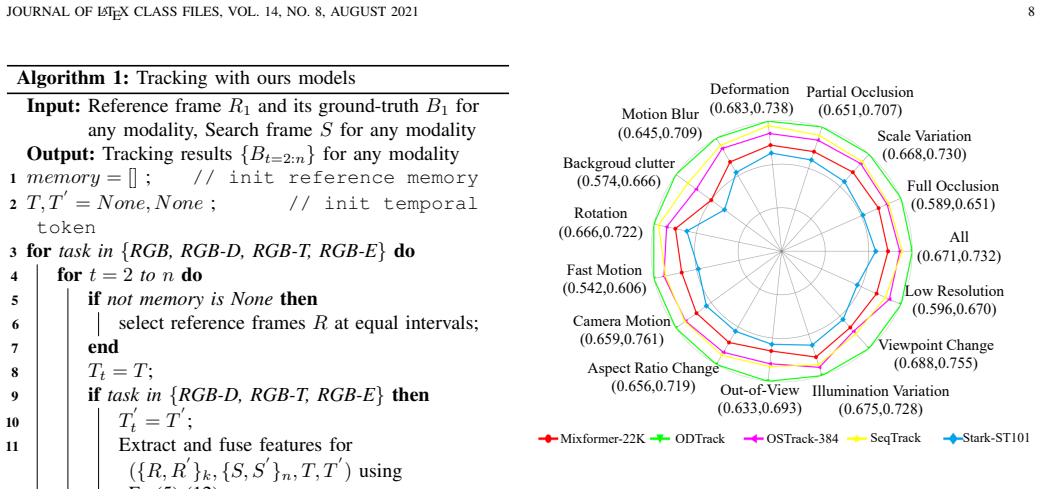
- [Section III.F, Eq. (11); Algorithm 1; Tables VIII and XVI] Equation (11) defines T_{t+1}=T_t+T_empty but never specifies what T_empty is; if T_empty is a zero token, then no information is added to the propagated token, while if it is a nonzero learned vector, the token grows approximately linearly with frame index. Tables VIII and XVI show that the model's own performance already declines when the training clip length exceeds 3, which the text attributes to 'accumulation of cross-modal temporal noise' (Section IV.C). Since Algorithm 1 propagates the token across the entire test sequence (often hundreds of frames) rather than the training clip length, the paper's central claim that online token propagation replaces explicit online updates requires direct evidence about token drift over inference-time horizons. I request (i) a precise definition and initialization of T_empty, (ii) a plot or statistic of token norm/change versus frame index on long sequences, and (iii) a long-sequence performance comparison between propagating the token and resetting it periodically.
- [Section IV.B; Tables I-III; Abstract and Conclusion] The abstract and conclusion state that UM-ODTrack achieves state-of-the-art results on seven visible and five multi-modal benchmarks, but all visible-benchmark tables (I, II, and III) report ODTrack, the RGB-only model, and no table reports RGB results for the jointly trained UM-ODTrack model. The paper therefore does not support the claim that the same trained parameters span RGB and multi-modal tracking. Either add RGB experiments with the universal model or revise the abstract and conclusion to state that UM-ODTrack is evaluated only on multi-modal benchmarks and that ODTrack serves as the RGB instantiation.
- [Algorithm 1 and Section III.D-G] Algorithm 1 is not executable as written: T and T' are initialized to None, and the first frame directly uses them in Eq. (11), which adds T_t to T_empty; 'if not memory is None' is always true for a list; and the update of T in the multi-modal branch is not clearly separated from the RGB branch. In addition, the paper does not specify the event representation (frames versus event stream), the kernel/stride of the shared modality tokenizer, or the architecture and initialization of T_empty and the gate networks. The 'code will be available' statement is not a substitute at review time; please provide the code/checkpoints or at least complete pseudocode and hyperparameter details so the central SOTA numbers can be independently reproduced.
- [Table XIV, rows 4 and 5] The comparison between single-task training (#4) and one-shot joint training (#5) in Table XIV confounds the training scheme with data quantity: the joint model is trained on three datasets, whereas each single-task expert is trained on one. The reported gains (e.g., 67.8 to 69.3 F-score on DepthTrack) may simply reflect three times more training data. Please add an equal-data control, e.g., a joint-trained model subsampled so each task sees the same number of samples as the single-task expert, or report per-task data volume and iterations.
minor comments (5)
- [Section III.B and Abstract] Section III.B contains the typo 'mdoal', and the Abstract contains 'an near-global'; a copyedit pass is needed.
- [Section III.E, Eq. (5)] Equation (5) uses the symbol bf for the gated output, which is easily confused with a bold vector notation; please choose a clearer symbol.
- [Table I] The GOT10K evaluation protocol for ODTrack is ambiguous because Section III.G describes training on LaSOT, GOT-10k, TrackingNet, and COCO, while Section IV.B says the GOT10K protocol is followed; please clarify which checkpoint was used for the GOT10K row.
- [Section IV.A] The term 'one-shot training' should be defined explicitly, since the multi-modal stage is preceded by a 300-epoch RGB training stage.
- [Fig. 5] Fig. 5 lists 'Backgroudclutter'; this should be 'Background clutter'.
Circularity Check
No significant circularity: SOTA claims are judged against external benchmarks; the temporal-token recurrence is an architectural definition tested by ablations, and the ODTrack self-citation is not load-bearing for the multi-modal contribution.
full rationale
The paper's derivation chain is an architecture-plus-benchmark argument rather than a closed-form derivation. The core recurrence, T_{t+1}=T_t+T_empty (Eq. 11), is a model definition, not a fitted constant renamed as a prediction. Its benefit is supported by ablation Tables VII, VIII, and XVI, which compare variants with and without token association, and by SOTA Tables I-VI against independently published trackers (e.g., ARTrack, ViPT, Un-Track) on external benchmarks. The multi-modal one-shot training claim is tested in Table XIV (#4 vs #5), a direct comparison against single-task training, and the gated-perceiver gains are tested in Tables X-XIII. The only in-family dependence is the prior ODTrack paper [87], which supplies the base temporal-token mechanism; this is a transparent, peer-reviewed self-citation and is not used to forbid alternatives or to justify the new multi-modal result. The Limitation section (p. 15) concedes the video-level modeling is 'a global approximation' and the long-horizon token behavior is an untested risk, but that is a robustness/correctness concern, not a circularity. No equation reduces to its own input and no reported metric is statistically forced by a fitted parameter.
Assumptions & free parameters
free parameters (14)
- loss_weight_l1 =
5
- loss_weight_giou =
2
- search_clip_length =
3
- reference_frame_count =
3
- sampling_range =
400 (implied)
- conditional_gate_layers =
0-11
- gmp_layers =
3
- gated_activation =
tanh
- modality_weight_ratio =
depth:thermal:event = 1:1:1
- backbone_lr =
1e-5
- rest_lr =
1e-4
- weight_decay =
1e-4
- rgb_training_epochs =
300
- multimodal_training_epochs =
15
assumptions (6)
- standard math Standard transformer attention and backpropagation work as claimed.
- domain assumption A finite set of sampled reference and search frames at intervals approximates the full video content.
- domain assumption A single additive token propagation T_{t+1}=T_t+T_empty preserves enough target trajectory information across frames.
- domain assumption A shared modality tokenizer and encoder can represent depth, thermal, and event data in a common visual space.
- domain assumption Joint training on LasHeR, DepthTrack, and VisEvent with equal weighting transfers positively to each downstream task.
- domain assumption Benchmark protocols are valid measures of tracking performance.
invented entities (3)
-
Temporal token (T_t)
-
Conditional gate module
-
Gated modal-scalable perceiver (GMP)
Cite this review
Pith. "Pith review of Towards Universal Modal Tracking with Online Dense Temporal Token Learning." pith.science (2026). https://pith.science/paper/YBK54A3S
@misc{pith2026250720177,
  author       = {Pith},
  title        = {Pith review of: Towards Universal Modal Tracking with Online Dense Temporal Token Learning},
  year         = {2026},
  howpublished = {\url{https://pith.science/paper/YBK54A3S}},
  note         = {Machine review of arXiv:2507.20177}
}
read the original abstract
We propose a universal video-level modality-awareness tracking model with online dense temporal token learning (called {\modaltracker}). It is designed to support various tracking tasks, including RGB, RGB+Thermal, RGB+Depth, and RGB+Event, utilizing the same model architecture and parameters. Specifically, our model is designed with three core goals: \textbf{Video-level Sampling}. We expand the model's inputs to a video sequence level, aiming to see a richer video context from an near-global perspective. \textbf{Video-level Association}. Furthermore, we introduce two simple yet effective online dense temporal token association mechanisms to propagate the appearance and motion trajectory information of target via a video stream manner. \textbf{Modality Scalable}. We propose two novel gated perceivers that adaptively learn cross-modal representations via a gated attention mechanism, and subsequently compress them into the same set of model parameters via a one-shot training manner for multi-task inference. This new solution brings the following benefits: (i) The purified token sequences can serve as temporal prompts for the inference in the next video frames, whereby previous information is leveraged to guide future inference. (ii) Unlike multi-modal trackers that require independent training, our one-shot training scheme not only alleviates the training burden, but also improves model representation. Extensive experiments on visible and multi-modal benchmarks show that our {\modaltracker} achieves a new \textit{SOTA} performance. The code will be available at https://github.com/GXNU-ZhongLab/ODTrack.
Figures


Figures from the paper (8 more)



Forward citations
Cited by 1 Pith paper
-
Enhancing Zero-Shot Brain Tumor Subtype Classification via Fine-Grained Patch-Text Alignment
FG-PAN improves zero-shot brain tumor subtype classification by aligning refined visual patch features with LLM-generated fine-grained text prototypes.
Reference graph
Works this paper leans on
-
[1]
Fully-convolutional siamese networks for object tracking,
L. Bertinetto, J. Valmadre, J. F. Henriques, A. Vedaldi, and P. H. Torr, “Fully-convolutional siamese networks for object tracking,” in European Conference on Computer Vision . Springer, 2016, pp. 850– 865
2016
-
[2]
High performance visual tracking with siamese region proposal network,
B. Li, J. Yan, W. Wu, Z. Zhu, and X. Hu, “High performance visual tracking with siamese region proposal network,” in IEEE Conference on Computer Vision and Pattern Recognition , 2018, pp. 8971–8980
2018
-
[3]
Distractor-aware siamese networks for visual object tracking,
Z. Zhu, Q. Wang, B. Li, W. Wu, J. Yan, and W. Hu, “Distractor-aware siamese networks for visual object tracking,” in European Conference on Computer Vision , 2018, pp. 101–117
2018
-
[4]
SiamRPN++: Evolution of siamese visual tracking with very deep networks,
B. Li, W. Wu, Q. Wang, F. Zhang, J. Xing, and J. Yan, “SiamRPN++: Evolution of siamese visual tracking with very deep networks,” inIEEE Conference on Computer Vision and Pattern Recognition , 2019, pp. 4282–4291
2019
-
[5]
Fast online object tracking and segmentation: A unifying approach,
Q. Wang, L. Zhang, L. Bertinetto, W. Hu, and P. H. Torr, “Fast online object tracking and segmentation: A unifying approach,” inIEEE Conference on Computer Vision and Pattern Recognition , 2019, pp. 1328–1338
2019
-
[6]
Deeper and wider siamese networks for real- time visual tracking,
Z. Zhang and H. Peng, “Deeper and wider siamese networks for real- time visual tracking,” in IEEE Conference on Computer Vision and Pattern Recognition, 2019, pp. 4591–4600
2019
-
[7]
Faster r-cnn: towards real-time object detection with region proposal networks,
S. Ren, K. He, R. Girshick, and J. Sun, “Faster r-cnn: towards real-time object detection with region proposal networks,” IEEE Transactions on Pattern Analysis and Machine Intelligence , vol. 39, no. 6, pp. 1137– 1149, 2017
2017
-
[8]
Object tracking benchmark,
Y . Wu, J. Lim, and M.-H. Yang, “Object tracking benchmark,” IEEE Transactions on Pattern Analysis and Machine Intelligence , vol. 37, no. 9, pp. 1834–1848, 2015
2015
Show all 115 references
-
[9]
TrackingNet: A large-scale dataset and benchmark for object tracking in the wild,
M. Muller, A. Bibi, S. Giancola, S. Alsubaihi, and B. Ghanem, “TrackingNet: A large-scale dataset and benchmark for object tracking in the wild,” in European Conference on Computer Vision , 2018, pp. 300–317
2018
-
[10]
LaSOT: A high-quality benchmark for large-scale single object tracking,
H. Fan, L. Lin, F. Yang, P. Chu, G. Deng, S. Yu, H. Bai, Y . Xu, C. Liao, and H. Ling, “LaSOT: A high-quality benchmark for large-scale single object tracking,” in IEEE Conference on Computer Vision and Pattern Recognition, 2019, pp. 5374–5383
2019
-
[11]
Got-10k: A large high-diversity benchmark for generic object tracking in the wild,
L. Huang, X. Zhao, and K. Huang, “Got-10k: A large high-diversity benchmark for generic object tracking in the wild,” IEEE transactions on pattern analysis and machine intelligence , vol. 43, no. 5, pp. 1562– 1577, 2019
2019
-
[12]
Microsoft COCO: Common objects in context,
T.-Y . Lin, M. Maire, S. Belongie, J. Hays, P. Perona, D. Ramanan, P. Doll´ar, and C. L. Zitnick, “Microsoft COCO: Common objects in context,” in European Conference on Computer Vision. Springer, 2014, pp. 740–755
2014
-
[13]
Generalized intersection over union: A metric and a loss for bounding box regression,
H. Rezatofighi, N. Tsoi, J. Gwak, A. Sadeghian, I. Reid, and S. Savarese, “Generalized intersection over union: A metric and a loss for bounding box regression,” in IEEE Conference on Computer Vision and Pattern Recognition, 2019, pp. 658–666
2019
-
[14]
Learning discrimi- native model prediction for tracking,
G. Bhat, M. Danelljan, L. V . Gool, and R. Timofte, “Learning discrimi- native model prediction for tracking,” in Proceedings of the IEEE/CVF international conference on computer vision , 2019, pp. 6182–6191
2019
-
[15]
ATOM: Accurate tracking by overlap maximization,
M. Danelljan, G. Bhat, F. S. Khan, and M. Felsberg, “ATOM: Accurate tracking by overlap maximization,” in IEEE Conference on Computer Vision and Pattern Recognition , 2019, pp. 4660–4669
2019
-
[16]
ECO: Efficient convolution operators for tracking,
M. Danelljan, G. Bhat, F. Shahbaz Khan, and M. Felsberg, “ECO: Efficient convolution operators for tracking,” in IEEE Conference on Computer Vision and Pattern Recognition , 2017, pp. 6638–6646
2017
-
[17]
Siamfc++: Towards robust and accurate visual tracking with target estimation guidelines,
Y . Xu, Z. Wang, Z. Li, Y . Yuan, and G. Yu, “Siamfc++: Towards robust and accurate visual tracking with target estimation guidelines,” in Proceedings of the AAAI conference on artificial intelligence, vol. 34, no. 07, 2020, pp. 12 549–12 556
2020
-
[18]
Ocean: Object-aware anchor-free tracking,
Z. Zhang, H. Peng, J. Fu, B. Li, and W. Hu, “Ocean: Object-aware anchor-free tracking,” in Computer Vision–ECCV 2020: 16th European Conference, Glasgow, UK, August 23–28, 2020, Proceedings, Part XXI
2020
-
[19]
Springer, 2020, pp. 771–787
2020
-
[20]
Toward accurate pixelwise object tracking via attention retrieval,
Z. Zhang, Y . Liu, B. Li, W. Hu, and H. Peng, “Toward accurate pixelwise object tracking via attention retrieval,” IEEE Transactions on Image Processing , vol. 30, pp. 8553–8566, 2021
2021
-
[21]
Video object segmentation using space-time memory networks,
S. W. Oh, J.-Y . Lee, N. Xu, and S. J. Kim, “Video object segmentation using space-time memory networks,” in Proceedings of the IEEE/CVF International Conference on Computer Vision , 2019, pp. 9226–9235
2019
-
[22]
D3s-a discriminative single shot segmentation tracker,
A. Lukezic, J. Matas, and M. Kristan, “D3s-a discriminative single shot segmentation tracker,” in Proceedings of the IEEE/CVF conference on computer vision and pattern recognition , 2020, pp. 7133–7142
2020
-
[23]
Siamban: Target-aware tracking with siamese box adaptive network,
Z. Chen, B. Zhong, G. Li, S. Zhang, R. Ji, Z. Tang, and X. Li, “Siamban: Target-aware tracking with siamese box adaptive network,” IEEE Transactions on Pattern Analysis and Machine Intelligence , vol. 45, no. 4, pp. 5158–5173, 2022
2022
-
[24]
Siamcar: Siamese fully convolutional classification and regression for visual tracking,
D. Guo, J. Wang, Y . Cui, Z. Wang, and S. Chen, “Siamcar: Siamese fully convolutional classification and regression for visual tracking,” in IEEE Conference on Computer Vision and Pattern Recognition , 2020, pp. 6269–6277
2020
-
[25]
Learning the model update for siamese trackers,
L. Zhang, A. Gonzalez-Garcia, J. v. d. Weijer, M. Danelljan, and F. S. Khan, “Learning the model update for siamese trackers,” in IEEE International Conference on Computer Vision , 2019, pp. 4010–4019
2019
-
[26]
Learning to filter: Siamese relation network for robust tracking,
S. Cheng, B. Zhong, G. Li, X. Liu, Z. Tang, X. Li, and J. Wang, “Learning to filter: Siamese relation network for robust tracking,” in IEEE Conference on Computer Vision and Pattern Recognition , 2021, pp. 4421–4431
2021
-
[27]
Learning to fuse asymmetric feature maps in siamese trackers,
W. Han, X. Dong, F. S. Khan, L. Shao, and J. Shen, “Learning to fuse asymmetric feature maps in siamese trackers,” in IEEE Conference on Computer Vision and Pattern Recognition , 2021, pp. 16 570–16 580
2021
-
[28]
Pg-net: Pixel to global matching network for visual tracking,
B. Liao, C. Wang, Y . Wang, Y . Wang, and J. Yin, “Pg-net: Pixel to global matching network for visual tracking,” in Computer Vision– ECCV 2020: 16th European Conference, Glasgow, UK, August 23–28, 2020, Proceedings, Part XXII 16 . Springer, 2020, pp. 429–444
2020
-
[29]
Stmtrack: Template-free visual tracking with space-time memory networks,
Z. Fu, Q. Liu, Z. Fu, and Y . Wang, “Stmtrack: Template-free visual tracking with space-time memory networks,” in Proceedings of the IEEE/CVF conference on computer vision and pattern recognition , 2021, pp. 13 774–13 783
2021
-
[30]
Graph attention tracking,
D. Guo, Y . Shao, Y . Cui, Z. Wang, L. Zhang, and C. Shen, “Graph attention tracking,” in Proceedings of the IEEE/CVF conference on computer vision and pattern recognition , 2021, pp. 9543–9552
2021
-
[31]
High- performance transformer tracking,
X. Chen, B. Yan, J. Zhu, H. Lu, X. Ruan, and D. Wang, “High- performance transformer tracking,” IEEE Transactions on Pattern Analysis and Machine Intelligence , 2022
2022
-
[32]
Learning spatio-temporal transformer for visual tracking,
B. Yan, H. Peng, J. Fu, D. Wang, and H. Lu, “Learning spatio-temporal transformer for visual tracking,” in Proceedings of the IEEE/CVF international conference on computer vision , 2021, pp. 10 448–10 457
2021
-
[33]
Transformer meets tracker: Exploiting temporal context for robust visual tracking,
N. Wang, W. Zhou, J. Wang, and H. Li, “Transformer meets tracker: Exploiting temporal context for robust visual tracking,” in Proceedings of the IEEE/CVF conference on computer vision and pattern recogni- tion, 2021, pp. 1571–1580
2021
-
[34]
Probabilistic regression for visual tracking,
M. Danelljan, L. V . Gool, and R. Timofte, “Probabilistic regression for visual tracking,” in Proceedings of the IEEE/CVF conference on computer vision and pattern recognition , 2020, pp. 7183–7192
2020
-
[35]
Decoupled weight decay regularization,
I. Loshchilov and F. Hutter, “Decoupled weight decay regularization,” in International Conference on Learning Representations , 2019
2019
-
[36]
Attention is all you need,
A. Vaswani, N. Shazeer, N. Parmar, J. Uszkoreit, L. Jones, A. N. Gomez, Ł. Kaiser, and I. Polosukhin, “Attention is all you need,” Advances in neural information processing systems , vol. 30, 2017
2017
-
[37]
An image is worth 16x16 words: Transformers for image recognition at scale,
A. Dosovitskiy, L. Beyer, A. Kolesnikov, D. Weissenborn, X. Zhai, T. Unterthiner, M. Dehghani, M. Minderer, G. Heigold, S. Gelly et al., “An image is worth 16x16 words: Transformers for image recognition at scale,” International Conference on Learning Representations, 2021
2021
-
[38]
Cvt: Introducing convolutions to vision transformers,
H. Wu, B. Xiao, N. Codella, M. Liu, X. Dai, L. Yuan, and L. Zhang, “Cvt: Introducing convolutions to vision transformers,” in Proceedings of the IEEE/CVF international conference on computer vision , 2021, pp. 22–31
2021
-
[39]
End-to-end object detection with transformers,
N. Carion, F. Massa, G. Synnaeve, N. Usunier, A. Kirillov, and S. Zagoruyko, “End-to-end object detection with transformers,” in JOURNAL OF LATEX CLASS FILES, VOL. 14, NO. 8, AUGUST 2021 17 European conference on computer vision . Springer, 2020, pp. 213– 229
2021
-
[40]
Siam r-cnn: Visual tracking by re-detection,
P. V oigtlaender, J. Luiten, P. H. Torr, and B. Leibe, “Siam r-cnn: Visual tracking by re-detection,” in Proceedings of the IEEE/CVF conference on computer vision and pattern recognition , 2020, pp. 6578–6588
2020
-
[41]
Deformable siamese attention networks for visual object tracking,
Y . Yu, Y . Xiong, W. Huang, and M. R. Scott, “Deformable siamese attention networks for visual object tracking,” in Proceedings of the IEEE/CVF conference on computer vision and pattern recognition , 2020, pp. 6728–6737
2020
-
[42]
Learning target candidate association to keep track of what not to track,
C. Mayer, M. Danelljan, D. P. Paudel, and L. Van Gool, “Learning target candidate association to keep track of what not to track,” in Proceedings of the IEEE/CVF International Conference on Computer Vision, 2021, pp. 13 444–13 454
2021
-
[43]
Mixformer: End-to-end track- ing with iterative mixed attention,
Y . Cui, C. Jiang, L. Wang, and G. Wu, “Mixformer: End-to-end track- ing with iterative mixed attention,” in Proceedings of the IEEE/CVF Conference on Computer Vision and Pattern Recognition , 2022, pp. 13 608–13 618
2022
-
[44]
Joint feature learning and relation modeling for tracking: A one-stream framework,
B. Ye, H. Chang, B. Ma, S. Shan, and X. Chen, “Joint feature learning and relation modeling for tracking: A one-stream framework,” in European Conference on Computer Vision . Springer, 2022, pp. 341–357
2022
-
[45]
Towards more flexible and accurate object tracking with natural lan- guage: Algorithms and benchmark,
X. Wang, X. Shu, Z. Zhang, B. Jiang, Y . Wang, Y . Tian, and F. Wu, “Towards more flexible and accurate object tracking with natural lan- guage: Algorithms and benchmark,” in Proceedings of the IEEE/CVF Conference on Computer Vision and Pattern Recognition , 2021, pp. 13 763–13 773
2021
-
[46]
Focal loss for dense object detection,
T.-Y . Lin, P. Goyal, R. Girshick, K. He, and P. Doll ´ar, “Focal loss for dense object detection,” in Proceedings of the IEEE international conference on computer vision , 2017, pp. 2980–2988
2017
-
[47]
Masked autoencoders are scalable vision learners,
K. He, X. Chen, S. Xie, Y . Li, P. Doll ´ar, and R. Girshick, “Masked autoencoders are scalable vision learners,” in Proceedings of the IEEE/CVF conference on computer vision and pattern recognition , 2022, pp. 16 000–16 009
2022
-
[48]
Lasot: A high-quality large-scale single object tracking benchmark,
H. Fan, H. Bai, L. Lin, F. Yang, P. Chu, G. Deng, S. Yu, Harshit, M. Huang, J. Liu et al., “Lasot: A high-quality large-scale single object tracking benchmark,” International Journal of Computer Vision , vol. 129, pp. 439–461, 2021
2021
-
[49]
Learning target-aware representation for visual tracking via informative interac- tions,
M. Guo, Z. Zhang, H. Fan, L. Jing, Y . Lyu, B. Li, and W. Hu, “Learning target-aware representation for visual tracking via informative interac- tions,” in IJCAI, 2022, pp. 927–934
2022
-
[50]
Correlation-aware deep tracking,
F. Xie, C. Wang, G. Wang, Y . Cao, W. Yang, and W. Zeng, “Correlation-aware deep tracking,” in Proceedings of the IEEE/CVF Conference on Computer Vision and Pattern Recognition , 2022, pp. 8751–8760
2022
-
[51]
Backbone is all your need: A simplified architecture for visual object tracking,
B. Chen, P. Li, L. Bai, L. Qiao, Q. Shen, B. Li, W. Gan, W. Wu, and W. Ouyang, “Backbone is all your need: A simplified architecture for visual object tracking,” in European Conference on Computer Vision . Springer, 2022, pp. 375–392
2022
-
[52]
Aiatrack: Attention in attention for transformer visual tracking,
S. Gao, C. Zhou, C. Ma, X. Wang, and J. Yuan, “Aiatrack: Attention in attention for transformer visual tracking,” in European Conference on Computer Vision . Springer, 2022, pp. 146–164
2022
-
[53]
Seqtrack: Sequence to sequence learning for visual object tracking,
X. Chen, H. Peng, D. Wang, H. Lu, and H. Hu, “Seqtrack: Sequence to sequence learning for visual object tracking,” in Proceedings of the IEEE/CVF Conference on Computer Vision and Pattern Recognition , 2023, pp. 14 572–14 581
2023
-
[54]
Autore- gressive visual tracking,
W. Xing, B. Yifan, Z. Yongchao, S. Dahu, and G. Yihong, “Autore- gressive visual tracking,” in Proceedings of the IEEE/CVF Conference on Computer Vision and Pattern Recognition (CVPR), 2023, pp. 9697– 9706
2023
-
[55]
Videotrack: Learning to track objects via video transformer,
F. Xie, L. Chu, J. Li, Y . Lu, and C. Ma, “Videotrack: Learning to track objects via video transformer,” in Proceedings of the IEEE/CVF Conference on Computer Vision and Pattern Recognition (CVPR) , 2023, pp. 22 826–22 835
2023
-
[56]
Tctrack: Temporal contexts for aerial tracking,
Z. Cao, Z. Huang, L. Pan, S. Zhang, Z. Liu, and C. Fu, “Tctrack: Temporal contexts for aerial tracking,” inProceedings of the IEEE/CVF Conference on Computer Vision and Pattern Recognition , 2022, pp. 14 798–14 808
2022
-
[57]
The eighth visual object tracking vot2020 challenge results,
M. Kristan, A. Leonardis, J. Matas, M. Felsberg, R. Pflugfelder, J.- K. K ¨am¨ar¨ainen, M. Danelljan, L. ˇC. Zajc, A. Luke ˇziˇc, O. Drbohlav et al., “The eighth visual object tracking vot2020 challenge results,” in Computer Vision–ECCV 2020 Workshops: Glasgow, UK, August 23– ...
2020
-
[58]
Alpha-refine: Boosting tracking performance by precise bounding box estimation,
B. Yan, X. Zhang, D. Wang, H. Lu, and X. Yang, “Alpha-refine: Boosting tracking performance by precise bounding box estimation,” in Proceedings of the IEEE/CVF Conference on Computer Vision and Pattern Recognition, 2021, pp. 5289–5298
2021
-
[59]
Generalized relation modeling for transformer tracking,
S. Gao, C. Zhou, and J. Zhang, “Generalized relation modeling for transformer tracking,” in Proceedings of the IEEE/CVF Conference on Computer Vision and Pattern Recognition , 2023, pp. 18 686–18 695
2023
-
[60]
Instance-level segmentation for autonomous driving with deep densely connected mrfs,
Z. Zhang, S. Fidler, and R. Urtasun, “Instance-level segmentation for autonomous driving with deep densely connected mrfs,” in Proceedings of the IEEE Conference on Computer Vision and Pattern Recognition , 2016, pp. 669–677
2016
-
[61]
Videochat: Chat-centric video understanding,
K. Li, Y . He, Y . Wang, Y . Li, W. Wang, P. Luo, Y . Wang, L. Wang, and Y . Qiao, “Videochat: Chat-centric video understanding,”arXiv preprint arXiv:2305.06355, 2023
2023 arXiv
-
[62]
Hand posture recognition using finger geometric feature,
L. Liu, J. Xing, H. Ai, and X. Ruan, “Hand posture recognition using finger geometric feature,” in Proceedings of the 21st International Conference on Pattern Recognition (ICPR2012) . IEEE, 2012, pp. 565–568
2012
-
[63]
Visual prompt multi- modal tracking,
J. Zhu, S. Lai, X. Chen, D. Wang, and H. Lu, “Visual prompt multi- modal tracking,” in Proceedings of the IEEE/CVF Conference on Computer Vision and Pattern Recognition , 2023, pp. 9516–9526
2023
-
[64]
Multi-modal fusion for end-to-end rgb-t tracking,
L. Zhang, M. Danelljan, A. Gonzalez-Garcia, J. Van De Weijer, and F. Shahbaz Khan, “Multi-modal fusion for end-to-end rgb-t tracking,” in Proceedings of the IEEE/CVF International Conference on Computer Vision Workshops, 2019, pp. 0–0
2019
-
[65]
Bridging search region interaction with template for rgb-t tracking,
T. Hui, Z. Xun, F. Peng, J. Huang, X. Wei, X. Wei, J. Dai, J. Han, and S. Liu, “Bridging search region interaction with template for rgb-t tracking,” in Proceedings of the IEEE/CVF Conference on Computer Vision and Pattern Recognition , 2023, pp. 13 630–13 639
2023
-
[66]
Resource-efficient rgbd aerial tracking,
J. Yang, S. Gao, Z. Li, F. Zheng, and A. Leonardis, “Resource-efficient rgbd aerial tracking,” in Proceedings of the IEEE/CVF Conference on Computer Vision and Pattern Recognition , 2023, pp. 13 374–13 383
2023
-
[67]
Revisiting color-event based tracking: A unified network, dataset, and metric,
C. Tang, X. Wang, J. Huang, B. Jiang, L. Zhu, J. Zhang, Y . Wang, and Y . Tian, “Revisiting color-event based tracking: A unified network, dataset, and metric,” arXiv preprint arXiv:2211.11010 , 2022
2022 arXiv
-
[68]
Rgb-t tracking via multi-modal mutual prompt learning,
Y . Luo, X. Guo, H. Feng, and L. Ao, “Rgb-t tracking via multi-modal mutual prompt learning,” arXiv preprint arXiv:2308.16386 , 2023
2023 arXiv
-
[69]
RGBD1K: A large-scale dataset and benchmark for RGB-D object tracking,
X. Zhu, T. Xu, Z. Tang, Z. Wu, H. Liu, X. Yang, X. Wu, and J. Kittler, “RGBD1K: A large-scale dataset and benchmark for RGB-D object tracking,” in AAAI. AAAI Press, 2023, pp. 3870–3878
2023
-
[70]
Learning dual-fused modality-aware representations for RGBD tracking,
S. Gao, J. Yang, Z. Li, F. Zheng, A. Leonardis, and J. Song, “Learning dual-fused modality-aware representations for RGBD tracking,” in ECCV Workshops (8) , ser. Lecture Notes in Computer Science, vol. 13808. Springer, 2022, pp. 478–494
2022
-
[71]
Object tracking by jointly exploiting frame and event domain,
J. Zhang, X. Yang, Y . Fu, X. Wei, B. Yin, and B. Dong, “Object tracking by jointly exploiting frame and event domain,” in ICCV. IEEE, 2021, pp. 13 023–13 032
2021
-
[72]
Lasher: A large-scale high-diversity benchmark for rgbt tracking,
C. Li, W. Xue, Y . Jia, Z. Qu, B. Luo, J. Tang, and D. Sun, “Lasher: A large-scale high-diversity benchmark for rgbt tracking,” IEEE Trans- actions on Image Processing , vol. 31, pp. 392–404, 2021
2021
-
[73]
Rgb-t object tracking: Benchmark and baseline,
C. Li, X. Liang, Y . Lu, N. Zhao, and J. Tang, “Rgb-t object tracking: Benchmark and baseline,” Pattern Recognition , vol. 96, p. 106977, 2019
2019
-
[74]
Visevent: Reliable object tracking via collaboration of frame and event flows,
X. Wang, J. Li, L. Zhu, Z. Zhang, Z. Chen, X. Li, Y . Wang, Y . Tian, and F. Wu, “Visevent: Reliable object tracking via collaboration of frame and event flows,” IEEE Transactions on Cybernetics , 2023
2023
-
[75]
Depthtrack: Unveiling the power of rgbd tracking,
S. Yan, J. Yang, J. K ¨apyl¨a, F. Zheng, A. Leonardis, and J.-K. K¨am¨ar¨ainen, “Depthtrack: Unveiling the power of rgbd tracking,” in Proceedings of the IEEE/CVF International Conference on Computer Vision, 2021, pp. 10 725–10 733
2021
-
[76]
Prompting for multi-modal tracking,
J. Yang, Z. Li, F. Zheng, A. Leonardis, and J. Song, “Prompting for multi-modal tracking,” in Proceedings of the 30th ACM International Conference on Multimedia , 2022, pp. 3492–3500
2022
-
[77]
Attribute-based progressive fusion network for rgbt tracking,
Y . Xiao, M. Yang, C. Li, L. Liu, and J. Tang, “Attribute-based progressive fusion network for rgbt tracking,” in Proceedings of the AAAI Conference on Artificial Intelligence , vol. 36, no. 3, 2022, pp. 2831–2838
2022
-
[78]
Duality-gated mutual condition network for rgbt tracking,
A. Lu, C. Qian, C. Li, J. Tang, and L. Wang, “Duality-gated mutual condition network for rgbt tracking,” IEEE Transactions on Neural Networks and Learning Systems , 2022
2022
-
[79]
Single-model and any-modality for video object tracking,
Z. Wu, J. Zheng, X. Ren, F.-A. Vasluianu, C. Ma, D. P. Paudel, L. Van Gool, and R. Timofte, “Single-model and any-modality for video object tracking,” arXiv preprint arXiv:2311.15851 , 2023
2023 arXiv
-
[80]
Context- aware three-dimensional mean-shift with occlusion handling for robust object tracking in rgb-d videos,
Y . Liu, X.-Y . Jing, J. Nie, H. Gao, J. Liu, and G.-P. Jiang, “Context- aware three-dimensional mean-shift with occlusion handling for robust object tracking in rgb-d videos,” IEEE Transactions on Multimedia , vol. 21, no. 3, pp. 664–677, 2018
2018
-
[81]
The seventh visual object tracking vot2019 challenge results,
M. Kristan, J. Matas, A. Leonardis, M. Felsberg, R. Pflugfelder, J.- K. Kamarainen, L. ˇCehovin Zajc, O. Drbohlav, A. Lukezic, A. Berg et al., “The seventh visual object tracking vot2019 challenge results,” JOURNAL OF LATEX CLASS FILES, VOL. 14, NO. 8, AUGUST 2021 18 in Procee...
2021
-
[82]
The ninth visual object tracking vot2021 challenge results,
M. Kristan, J. Matas, A. Leonardis, M. Felsberg, R. Pflugfelder, J.- K. K ¨am¨ar¨ainen, H. J. Chang, M. Danelljan, L. Cehovin, A. Luke ˇziˇc et al., “The ninth visual object tracking vot2021 challenge results,” in Proceedings of the IEEE/CVF international conference on compute...
2021
-
[83]
The tenth visual object tracking vot2022 challenge results,
M. Kristan, A. Leonardis, J. Matas, M. Felsberg, R. Pflugfelder, J.- K. K ¨am¨ar¨ainen, H. J. Chang, M. Danelljan, L. ˇC. Zajc, A. Luke ˇziˇc et al. , “The tenth visual object tracking vot2022 challenge results,” in European Conference on Computer Vision . Springer, 2022, pp. 431–460
2022
-
[84]
Visible-thermal uav tracking: A large-scale benchmark and new baseline,
P. Zhang, J. Zhao, D. Wang, H. Lu, and X. Ruan, “Visible-thermal uav tracking: A large-scale benchmark and new baseline,” in Proceed- ings of the IEEE/CVF Conference on Computer Vision and Pattern Recognition, 2022, pp. 8886–8895
2022
-
[85]
Bi-directional adapter for multi- modal tracking,
B. Cao, J. Guo, P. Zhu, and Q. Hu, “Bi-directional adapter for multi- modal tracking,” arXiv preprint arXiv:2312.10611 , 2023
2023 arXiv
-
[86]
Challenge-aware rgbt tracking,
C. Li, L. Liu, A. Lu, Q. Ji, and J. Tang, “Challenge-aware rgbt tracking,” in European Conference on Computer Vision . Springer, 2020, pp. 222–237
2020
-
[87]
Multi- adapter rgbt tracking,
C. Long Li, A. Lu, A. Hua Zheng, Z. Tu, and J. Tang, “Multi- adapter rgbt tracking,” in Proceedings of the IEEE/CVF International Conference on Computer Vision Workshops , 2019, pp. 0–0
2019
-
[88]
Odtrack: Online dense temporal token learning for visual tracking,
Y . Zheng, B. Zhong, Q. Liang, Z. Mo, S. Zhang, and X. Li, “Odtrack: Online dense temporal token learning for visual tracking,” in Proceed- ings of the AAAI conference on artificial intelligence , 2024
2024
-
[89]
Onellm: One framework to align all modalities with language,
J. Han, K. Gong, Y . Zhang, J. Wang, K. Zhang, D. Lin, Y . Qiao, P. Gao, and X. Yue, “Onellm: One framework to align all modalities with language,” arXiv preprint arXiv:2312.03700 , 2023
2023 arXiv
-
[90]
Tf-icon: Diffusion-based training-free cross-domain image composition,
S. Lu, Y . Liu, and A. W.-K. Kong, “Tf-icon: Diffusion-based training-free cross-domain image composition,” in Proceedings of the IEEE/CVF International Conference on Computer Vision , 2023, pp. 2294–2305
2023
-
[91]
Mace: Mass concept erasure in diffusion models,
S. Lu, Z. Wang, L. Li, Y . Liu, and A. W.-K. Kong, “Mace: Mass concept erasure in diffusion models,” in Proceedings of the IEEE/CVF Conference on Computer Vision and Pattern Recognition , 2024, pp. 6430–6440
2024
-
[92]
Robust watermark- ing using generative priors against image editing: From benchmarking to advances,
S. Lu, Z. Zhou, J. Lu, Y . Zhu, and A. W.-K. Kong, “Robust watermark- ing using generative priors against image editing: From benchmarking to advances,” arXiv preprint arXiv:2410.18775 , 2024
2024 arXiv
-
[93]
Eraseanything: Enabling concept erasure in rectified flow transformers,
D. Gao, S. Lu, S. Walters, W. Zhou, J. Chu, J. Zhang, B. Zhang, M. Jia, J. Zhao, Z. Fan et al. , “Eraseanything: Enabling concept erasure in rectified flow transformers,” arXiv preprint arXiv:2412.20413 , 2024
2024 arXiv
-
[94]
Set you straight: Auto- steering denoising trajectories to sidestep unwanted concepts,
L. Li, S. Lu, Y . Ren, and A. W.-K. Kong, “Set you straight: Auto- steering denoising trajectories to sidestep unwanted concepts,” arXiv preprint arXiv:2504.12782, 2025
2025 arXiv
-
[95]
Diffusion models in low-level vision: A survey,
C. He, Y . Shen, C. Fang, F. Xiao, L. Tang, Y . Zhang, W. Zuo, Z. Guo, and X. Li, “Diffusion models in low-level vision: A survey,” TPAMI, 2025
2025
-
[96]
Segment concealed object with incomplete supervision,
C. He, K. Li, Y . Zhang, Z. Yang, L. Tang, Y . Zhang, L. Kong, and S. Farsiu, “Segment concealed object with incomplete supervision,” TPAMI, 2025
2025
-
[97]
Hqg-net: Unpaired medical image enhancement with high- quality guidance,
C. He, K. Li, G. Xu, J. Yan, L. Tang, Y . Zhang, Y . Wang, and X. Li, “Hqg-net: Unpaired medical image enhancement with high- quality guidance,” TNNLS, 2023
2023
-
[98]
Unfoldir: Rethinking deep unfolding network in illumination degra- dation image restoration,
C. He, R. Zhang, F. Xiao, C. Fang, L. Tang, Y . Zhang, and S. Farsiu, “Unfoldir: Rethinking deep unfolding network in illumination degra- dation image restoration,” arXiv preprint arXiv:2505.06683 , 2025
2025 arXiv
-
[99]
Run: Reversible unfolding network for concealed object segmentation,
C. He, R. Zhang, F. Xiao, C. Fang, L. Tang, Y . Zhang, L. Kong, D.- P. Fan, K. Li, and S. Farsiu, “Run: Reversible unfolding network for concealed object segmentation,” ICML, 2025
2025
-
[100]
Reti-diff: Illumination degradation image restoration with retinex-based latent diffusion model,
C. He, C. Fang, Y . Zhang, K. Li, L. Tang, C. You, F. Xiao, Z. Guo, and X. Li, “Reti-diff: Illumination degradation image restoration with retinex-based latent diffusion model,” ICLR, 2025
2025
-
[101]
Weakly-supervised concealed object segmentation with sam- based pseudo labeling and multi-scale feature grouping,
C. He, K. Li, Y . Zhang, G. Xu, L. Tang, Y . Zhang, Z. Guo, and X. Li, “Weakly-supervised concealed object segmentation with sam- based pseudo labeling and multi-scale feature grouping,” NeurIPS, vol. 36, 2024
2024
-
[102]
A survey of camouflaged object detection and beyond,
F. Xiao, S. Hu, Y . Shen, C. Fang, J. Huang, C. He, L. Tang, Z. Yang, and X. Li, “A survey of camouflaged object detection and beyond,” CAAI AIR, 2024
2024
-
[103]
Strategic preys make acute predators: Enhancing camouflaged object detectors by generating camouflaged objects,
C. He, K. Li, Y . Zhang, Y . Zhang, Z. Guo, X. Li, M. Danelljan, and F. Yu, “Strategic preys make acute predators: Enhancing camouflaged object detectors by generating camouflaged objects,” ICLR, 2024
2024
-
[104]
Camouflaged object detection with feature decomposition and edge reconstruction,
C. He, K. Li, Y . Zhang, L. Tang, Y . Zhang, Z. Guo, and X. Li, “Camouflaged object detection with feature decomposition and edge reconstruction,” in CVPR, 2023, pp. 22 046–22 055
2023
-
[105]
Degradation- resistant unfolding network for heterogeneous image fusion,
C. He, K. Li, G. Xu, Y . Zhang, R. Hu, Z. Guo, and X. Li, “Degradation- resistant unfolding network for heterogeneous image fusion,” in ICCV, 2023, pp. 12 611–12 621
2023
-
[106]
Eliminate deviation with deviation for data augmentation and a general multi-modal data learning method,
Y . Gong, L. Huang, and L. Chen, “Eliminate deviation with deviation for data augmentation and a general multi-modal data learning method,” arXiv preprint arXiv:2101.08533 , 2021
2021 arXiv
-
[107]
Person re-identification method based on color attack and joint defence,
——, “Person re-identification method based on color attack and joint defence,” in Proceedings of the IEEE/CVF conference on computer vision and pattern recognition , 2022, pp. 4313–4322
2022
-
[108]
Cross- modality perturbation synergy attack for person re-identification,
Y . Gong, Z. Zhong, Y . Qu, Z. Luo, R. Ji, and M. Jiang, “Cross- modality perturbation synergy attack for person re-identification,” in The Thirty-eighth Annual Conference on Neural Information Processing Systems, 2024. [Online]. Available: https://openreview.net/ forum?id=LONd7ACEjy
2024
-
[109]
Directing mamba to complex textures: An efficient texture-aware state space model for image restoration,
L. Peng, X. Di, Z. Feng, W. Li, R. Pei, Y . Wang, X. Fu, Y . Cao, and Z.-J. Zha, “Directing mamba to complex textures: An efficient texture-aware state space model for image restoration,” arXiv preprint arXiv:2501.16583, 2025
2025 arXiv
-
[110]
Lightweight adaptive feature de-drifting for compressed image classification,
L. Peng, Y . Cao, Y . Sun, and Y . Wang, “Lightweight adaptive feature de-drifting for compressed image classification,” IEEE Transactions on Multimedia, vol. 26, pp. 6424–6436, 2024
2024
-
[111]
Boosting image de-raining via central-surrounding synergistic convolution,
L. Peng, Y . Wang, X. Di, X. Fu, Y . Cao, Z.-J. Zha et al. , “Boosting image de-raining via central-surrounding synergistic convolution,” in Proceedings of the AAAI Conference on Artificial Intelligence , vol. 39, no. 6, 2025, pp. 6470–6478
2025
-
[112]
Towards realistic data generation for real-world super- resolution,
L. Peng, W. Li, R. Pei, J. Ren, J. Xu, Y . Wang, Y . Cao, and Z.-J. Zha, “Towards realistic data generation for real-world super- resolution,” in The Thirteenth International Conference on Learning Representations, 2025. [Online]. Available: https://openreview.net/ forum?id=JkCJBoNUcU
2025
-
[113]
Toward unified token learning for vision-language tracking,
Y . Zheng, B. Zhong, Q. Liang, G. Li, R. Ji, and X. Li, “Toward unified token learning for vision-language tracking,” IEEE Transactions on Circuits and Systems for Video Technology , vol. 34, no. 4, pp. 2125– 2135, 2023
2023
-
[114]
Leveraging local and global cues for visual tracking via parallel interaction network,
Y . Zheng, B. Zhong, Q. Liang, Z. Tang, R. Ji, and X. Li, “Leveraging local and global cues for visual tracking via parallel interaction network,” IEEE Transactions on Circuits and Systems for Video Tech- nology, vol. 33, no. 4, pp. 1671–1683, 2022
2022
-
[115]
Decoupled spatio-temporal consistency learning for self-supervised tracking,
Y . Zheng, B. Zhong, Q. Liang, N. Li, and S. Song, “Decoupled spatio-temporal consistency learning for self-supervised tracking,” in Proceedings of the AAAI Conference on Artificial Intelligence , vol. 39, no. 10, 2025, pp. 10 635–10 643
2025
Reviewed August 15, 2026 · model on record in the stance chip above.
Discussion (0). Continue with ORCID to comment.