REVIEW 5 major objections 5 minor 1 cited by
T$^\text{3}$SVFND: Towards an Evolving Fake News Detector for Emergencies with Test-time Training on Short Video Platforms
T0 review · 5 major / 5 minor · reviewed 2026-08-06 · deepseek-v4-flash
Pith's one-line read The paper claims that test-time training with a masked-language modeling auxiliary task lets a fake news video detector adapt to emergency news using only unlabeled test videos, and reports state-of-the-art accuracy on the FakeSV…
desk verdict Plausible first use of test-time training for video fake-news detection with real gains, but the evaluation doesn't isolate whether the cross-modal MLM task is what drives them. read the letter →
The pith
A machine-rendered reading of the paper's core claim, the machinery that carries it, and where it could break.
The reading
What carries the argument
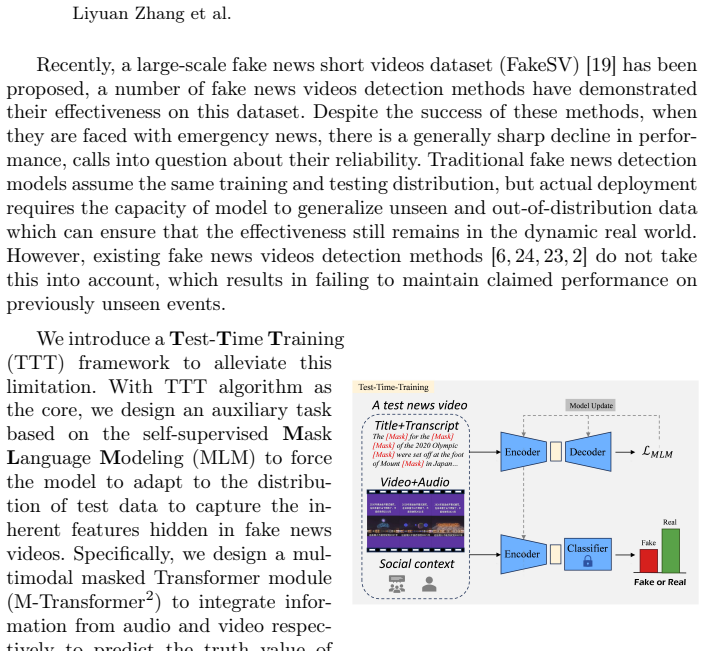
The load-bearing mechanism is the multimodal masked Transformer (M-Transformer2), paired with a test-time training loop. The model randomly masks a fraction of the words in the video transcript, then uses two parallel cross-attention transformers to reconstruct those masked tokens, one conditioned on keyframe visual features and one on audio features. The reconstruction loss acts as a self-supervised auxiliary task during both training and test-time fine-tuning; at test time only the encoder and decoder weights are updated, the classifier is frozen, and the updated encoder is used for prediction on a batch of unlabeled test videos.
What would settle it
Train the model exactly as described, but at test time replace the masked-token supervision with randomly shuffled word targets while keeping all other details fixed; if accuracy on the event split stays at the same improved level, the gains are not caused by semantic reconstruction. A sharper version is to measure the gradient alignment between the reconstruction loss and the classification loss on a held-out validation set of the target event; if the cosine similarity is zero or negative, the surrogate task is not aligned with the classifier's needs.
Extended reading notes
Core claim
The central claim is that a detector trained jointly on a supervised fake-news classification loss and a self-supervised masked-language reconstruction loss, then fine-tuned at test time on unlabeled target-event videos using only the reconstruction loss, generalizes better to unseen emergency events than detectors that ignore test data. The claim is substantiated by accuracy gains of 2.48% and 3.32% over the previous best method under event and temporal splits, respectively, with the gains coming from the test-time training step and the multimodal masking task in ablations.
Load-bearing premise
The framework assumes that minimizing the masked-word reconstruction loss on unlabeled test videos moves the shared encoder into a representation where the frozen classifier is more accurate on out-of-distribution emergency news, but the paper does not demonstrate a mechanism linking that surrogate loss to classification accuracy.
Editorial extensions
If this is right
- If correct, a deployed fake-news video detector can be adapted to a breaking event without any human annotation, using only a batch of unlabeled videos from that event.
- The method's gains on event-based splitting, where train and test events are disjoint, indicate that the approach addresses the distribution shift that causes performance drops in emergencies.
- The combination of audio and visual reconstruction signals matters: ablations removing either modality or the multimodal transformer reduce accuracy, so both modalities contribute to the adaptation effect.
- The best mask ratio of 0.15 and loss weight of 1 found in hyper-parameter tests provide a practical default configuration for future detectors built this way.
- An accuracy of 84.50% under temporal splitting suggests the method is compatible with the real-world deployment setting where detectors are trained on historical data and evaluated on later news.
Reading between the lines
- Inference: The paper does not show that the reconstructed words are semantically important; a testable extension would be to replace the masked-token prediction with a trivial copy objective and check whether the gains persist, which would separate distribution alignment from language understanding.
- Inference: The claim that unlabeled data provides the adaptation signal depends on the surrogate task correlating with the classification-relevant shift; the mechanism could be probed by measuring how the encoder's hidden representations shift toward the test distribution before and after test-time training.
- Inference: Emergency news is implicitly treated as a single distribution; a natural stress test is to split test events by topic or by temporal distance from the training events and see whether the gains concentrate on near-distribution events.
- Inference: The method updates on each test batch without persistent memory; a possible improvement, implicit in the framework, is to accumulate adapted statistics across batches or to stop updating once the reconstruction loss plateaus, trading adaptation for stability.
Editorial analysis
A structured set of objections, weighed in public.
Referee Report
Summary. The paper proposes T3SVFND, a multimodal fake-news-video detector that combines a supervised fake-news classification loss with a self-supervised masked-language-modeling (MLM) auxiliary task, and then applies test-time training (TTT) on unlabeled test videos. During the test-time phase, the M-Transformer2 encoder and decoders are updated by minimizing the MLM reconstruction loss, while the classifier is frozen. Experiments on the FakeSV dataset are reported under event-based and temporal split protocols, with claimed state-of-the-art accuracies of 80.93% and 84.50%, respectively, versus 78.45% and 81.18% for the best compared baseline SVFEND. The paper also includes ablations over TTT, MLM, the multimodal transformer, and audio/visual modalities, plus a hyperparameter study for the auxiliary loss weight alpha and masking ratio m.
Significance. If the reported results are reliable, the paper makes a useful contribution by adapting test-time training to multimodal short-video fake-news detection, using unlabeled test distribution to mitigate event-driven distribution shift. The idea of a cross-modal MLM auxiliary task that aligns audio, visual, and text features is plausible and relevant, and the paper provides a public code link and a detailed algorithm. However, the evaluation has several load-bearing weaknesses: the reported accuracy gains are not accompanied by error bars or significance tests, two hyperparameters are selected on a test fold, and the ablations do not cleanly isolate the MLM-specific contribution from the generic effect of transductive adaptation to the test batch. The central claim is therefore defensible but not yet convincingly established.
major comments (5)
- [Section 4.3, Table 1; Algorithm 1, lines 8-13] The main comparison is asymmetric in test-set access. T3SVFND uses unlabeled minibatches from D_test to update encoder weights before prediction, whereas none of the baselines in Table 1 receives any test-time adaptation. The resulting 2.48% and 3.32% accuracy margins could therefore reflect generic transductive adaptation rather than the specific cross-modal MLM alignment claimed. Please add control experiments that give baselines (or simple mechanisms such as test-time entropy minimization, batch-normalization statistics update, or a different self-supervised reconstruction task) the same unlabeled test-batch access, and report whether the MLM auxiliary task outperforms these generic adaptation controls.
- [Section 4.5, Fig. 3] The hyperparameters alpha and m are tuned with event fold 4 as the test set, as stated in the Fig. 3 caption, and the same choice is then used for the five-fold averaged results in Table 1. This leaks test information into model selection for all folds and can inflate the reported improvement. The authors should either perform model selection on a validation split held out from each training fold, or report per-fold sensitivity and show that the final accuracy is stable across the hyperparameter range. In addition, no standard deviations or significance tests are reported despite the Table 2 caption saying the standard deviations are 'ignored for simplicity'; these should be provided so the claimed margins can be assessed.
- [Section 4.4, Table 2, row 5] The ablation removing MLM is internally inconsistent. Row 5 of Table 2 has the TTT column checked but the MLM column unchecked, while the text in Section 4.4 says that removing MLM uses a traditional training framework in which auxiliary tasks are not effective, which implies TTT should be removed as well. If test-time training is still applied without MLM, the paper must specify what loss is minimized in the test-time phase; as written, this ablation is undefined and cannot isolate the contribution of the MLM auxiliary task.
- [Section 3.4, Eq. (5)] Equation (5) defines the supervised fake-news-detection loss as L_FND = -[(1-y) log y_hat + (1-y) log(1-y_hat)]. This is not a valid binary cross-entropy loss: when y=1 the loss is zero regardless of the prediction, and when y=0 it incorrectly penalizes the model for predicting the correct label. The intended expression is almost certainly -[y log y_hat + (1-y) log(1-y_hat)]. This typo appears in the central objective and must be corrected, and the released code should be checked to confirm which loss is actually optimized.
- [Algorithm 1, lines 2-14] The training procedure interleaves supervised training, test-time adaptation, and evaluation on minibatches from D_test inside the same loop, with an unspecified termination condition ('not converge'). It is unclear how many passes over D_test are used for adaptation, whether the evaluation minibatches overlap with the adaptation minibatches, and whether the reported accuracy corresponds to predictions after the final adaptation step or to an average over loop iterations. Please specify the full evaluation protocol, including the number of adaptation epochs, the minibatch schedule, and the exact point at which the reported test metrics are computed.
minor comments (5)
- [Eq. (1)] The cross-attention expression writes Q_M K_T^A / sqrt(d); this should presumably be Q_M K_A^T / sqrt(d) with the transpose applied to the key matrix. Please fix the notation.
- [Section 3.5, Eqs. (7)-(8)] Equation (7) defines optimized weights theta_e* and theta_d*, but Eq. (8) uses theta_e*' and theta_c*' without defining these primed quantities. The notation should be made consistent.
- [Section 2.3] There is a typo, 'Qian rt al.', which should read 'Qian et al.'.
- [Section 4.3] The discussion says performance in the event split is lower because of 'long-standing fake news events,' but no evidence is given to support this explanation; it should be reworded as a conjecture or supported with event-level analysis.
- [Table 1] The caption states that event-split results are the mean of five folds, but temporal-split results are reported without describing how the temporal split is constructed or whether it is a single split. Please clarify the temporal-split protocol.
Circularity Check
Core TTT+MLM derivation is not circular, but the reported SOTA margins are partially fitted: α and m are selected on a test fold and that same fold's accuracy is included in the five-fold mean.
-
fitted input called prediction
[Section 4.5 (Hyper-parameter Research) and Table 1]
"In the event set numbered 4 as the testing set, we first fix m to 0.15 to explore the impact of changes in α on performance. ... the best results were achieved when the mask ratio was 0.15."
The hyperparameters α and m are chosen by maximizing accuracy on event fold 4's test set (Section 4.5, Fig. 3). Table 1 then reports the five-fold mean accuracy (80.93% for event split) as the SOTA result, and that mean includes fold 4. On fold 4, the reported accuracy is by construction the maximum over the hyperparameter grid, so one fifth of the headline result is the tuning objective itself, not an independent prediction. The claimed 2.48% margin is therefore partly a fitted-input artifact, though the central TTT mechanism still has independent support from the ablations.
full rationale
The paper's main derivation is not circular: during test-time training, only the self-supervised MLM loss (Eq. 7) updates the encoder and decoder, the classifier is frozen, and the final accuracy is a genuine outcome on unlabeled test data. No equation reduces the reported accuracy to the input labels, and the MLM loss is computed from the test text itself rather than from fake/real labels. The ablations (Table 2) compare with and without TTT and with and without MLM, providing independent evidence that the proposed components contribute. Self-citations to refs [12,13,14,34] appear only as related work or method components, not as load-bearing justifications of the central claim. The one circularity-like step is the hyperparameter selection: α and m are tuned on event fold 4's test set, and the same fold is included in the five-fold average reported as SOTA. This inflates the exact margin but does not invalidate the qualitative conclusion that TTT with MLM helps. Overall, the circularity is partial and confined to the reported numerical claims, not the core mechanism.
Assumptions & free parameters
free parameters (2)
- auxiliary task loss weight alpha =
1.0
- masking ratio m =
0.15
assumptions (4)
- domain assumption Unlabeled test videos from the target event are available in a batch before classification, so the encoder can be fine-tuned on Dtest before prediction.
- domain assumption The MLM auxiliary loss, predicting masked words from audio and visual features, is a valid proxy for adaptation to distribution shift and does not damage the frozen classifier.
- domain assumption FakeSV is representative of real short-video fake news distributions and of emergency events.
- domain assumption Standard pre-trained encoders (BERT for text, VGG19 and C3D for vision, VGGish for audio) provide features adequate for the task.
Cite this review
Pith. "Pith review of T$^\text{3}$SVFND: Towards an Evolving Fake News Detector for Emergencies with Test-time Training on Short Video Platforms." pith.science (2026). https://pith.science/paper/OLZKJEVB
@misc{pith2026250720286,
  author       = {Pith},
  title        = {Pith review of: T$^\text3$SVFND: Towards an Evolving Fake News Detector for Emergencies with Test-time Training on Short Video Platforms},
  year         = {2026},
  howpublished = {\url{https://pith.science/paper/OLZKJEVB}},
  note         = {Machine review of arXiv:2507.20286}
}
abstract
The existing methods for fake news videos detection may not be generalized, because there is a distribution shift between short video news of different events, and the performance of such techniques greatly drops if news records are coming from emergencies. We propose a new fake news videos detection framework (T$^3$SVFND) using Test-Time Training (TTT) to alleviate this limitation, enhancing the robustness of fake news videos detection. Specifically, we design a self-supervised auxiliary task based on Mask Language Modeling (MLM) that masks a certain percentage of words in text and predicts these masked words by combining contextual information from different modalities (audio and video). In the test-time training phase, the model adapts to the distribution of test data through auxiliary tasks. Extensive experiments on the public benchmark demonstrate the effectiveness of the proposed model, especially for the detection of emergency news.
Figures


Forward citations
Cited by 1 Pith paper
-
Detecting AI-Generated Video: A Vision-Language Dual-View Survey
AIGC-V detection should be treated as factual fidelity verification and organized by a four-layer vision-language dual-view taxonomy spanning cues, motion, cross-modal consistency, and world-level reasoning.
Reference graph
Works this paper leans on
-
[1]
arXiv preprint arXiv:2406.07476 (2024)
Cheng, Z., Leng, S., Zhang, H., Xin, Y., Li, X., Chen, G., Zhu, Y., Zhang, W., Luo, Z., Zhao, D., et al.: Videollama 2: Advancing spatial-temporal modeling and audio understanding in video-llms. arXiv preprint arXiv:2406.07476 (2024)
arXiv 2024
-
[2]
IEEE Access 9, 164846–164853 (2021)
Choi, H., Ko, Y.: Using adversarial learning and biterm topic model for an effective fake news video detection system on heterogeneous topics and short texts. IEEE Access 9, 164846–164853 (2021)
work page 2021
-
[3]
IEEE/ACM Transactions on Audio, Speech, and Language Processing 29, 3504–3514 (2021)
Cui, Y., Che, W., Liu, T., Qin, B., Yang, Z.: Pre-training with whole word mask- ing for chinese bert. IEEE/ACM Transactions on Audio, Speech, and Language Processing 29, 3504–3514 (2021)
work page 2021
-
[4]
Advances in Neural Information Processing Systems35, 29374–29385 (2022)
Gandelsman, Y., Sun, Y., Chen, X., Efros, A.: Test-time training with masked au- toencoders. Advances in Neural Information Processing Systems35, 29374–29385 (2022)
work page 2022
-
[5]
In: 2017 ieee international conference on acoustics, speech and signal processing (icassp)
Hershey, S., Chaudhuri, S., Ellis, D.P., Gemmeke, J.F., Jansen, A., Moore, R.C., Plakal, M., Platt, D., Saurous, R.A., Seybold, B., et al.: Cnn architectures for large-scale audio classification. In: 2017 ieee international conference on acoustics, speech and signal processing (icassp). pp. 131–135. IEEE (2017)
work page 2017
-
[6]
In: 2019 International conference on multimodal interaction
Hou, R., Pérez-Rosas, V., Loeb, S., Mihalcea, R.: Towards automatic detection of misinformation in online medical videos. In: 2019 International conference on multimodal interaction. pp. 235–243 (2019)
work page 2019
-
[7]
Huang, Y., Du, C., Xue, Z., Chen, X., Zhao, H., Huang, L.: What makes multi- modal learning better than single (provably). Advances in Neural Information Pro- cessing Systems 34, 10944–10956 (2021) Liyuan Zhang et al. Zero-shot Prompting for GPT-4 T ext Prompt You are an experienced news video fact-checking expert and your position is neutral. You can han...
work page 2021
-
[8]
In: 2021 IEEE International Conference on Big Data (Big Data)
Li, Y., Lee, K., Kordzadeh, N., Faber, B., Fiddes, C., Chen, E., Shu, K.: Multi- source domain adaptation with weak supervision for early fake news detection. In: 2021 IEEE International Conference on Big Data (Big Data). pp. 668–676. IEEE (2021)
work page 2021
Show all 36 references
-
[9]
In: International conference on machine learning
Liang, J., Hu, D., Feng, J.: Do we really need to access the source data? source hy- pothesis transfer for unsupervised domain adaptation. In: International conference on machine learning. pp. 6028–6039. PMLR (2020)
2020
-
[10]
Advances in neural information processing systems2021(DB1), 1 (2021)
Liang, P.P., Lyu, Y., Fan, X., Wu, Z., Cheng, Y., Wu, J., Chen, L., Wu, P., Lee, M.A., Zhu, Y., et al.: Multibench: Multiscale benchmarks for multimodal represen- tation learning. Advances in neural information processing systems2021(DB1), 1 (2021)
2021
-
[11]
Liu, Y., Kothari, P., Van Delft, B., Bellot-Gurlet, B., Mordan, T., Alahi, A.: Ttt++: When does self-supervised test-time training fail or thrive? Advances in Neural Information Processing Systems34, 21808–21820 (2021)
2021
-
[12]
In: Proceedings of the 32nd ACM International Conference on Information and Knowledge Management
Ma, J., Dai, J., Liu, Y., Han, M., Ai, C.: Contrastive learning for rumor detection via fitting beta mixture model. In: Proceedings of the 32nd ACM International Conference on Information and Knowledge Management. pp. 4160–4164 (2023)
2023
-
[13]
IEEE Transactions on Neural Networks and Learning Systems (2023)
Ma, J., Liu, Y., Han, M., Hu, C., Ju, Z.: Propagation structure fusion for rumor detection based on node-level contrastive learning. IEEE Transactions on Neural Networks and Learning Systems (2023)
2023
-
[14]
In: Proceedings of the 31st ACM International Conference on Information & Knowledge Management
Ma, J., Liu, Y., Liu, M., Han, M.: Curriculum contrastive learning for fake news de- tection. In: Proceedings of the 31st ACM International Conference on Information & Knowledge Management. pp. 4309–4313 (2022)
2022
-
[15]
In: Proceedings of the IEEE/CVF conference on computer vision and pattern recognition
Mirza, M.J., Micorek, J., Possegger, H., Bischof, H.: The norm must go on: Dy- namic unsupervised domain adaptation by normalization. In: Proceedings of the IEEE/CVF conference on computer vision and pattern recognition. pp. 14765– 14775 (2022)
2022
-
[16]
In: Proceedings of the IEEE/CVF International Conference on Computer Vision
Mirza, M.J., Shin, I., Lin, W., Schriebl, A., Sun, K., Choe, J., Kozinski, M., Pos- segger, H., Kweon, I.S., Yoon, K.J., et al.: Mate: Masked autoencoders are online 3d test-time learners. In: Proceedings of the IEEE/CVF International Conference on Computer Vision. pp. 16709–1...
2023
-
[17]
In: Proceedings of the ACM Web Conference 2022
Mosallanezhad, A., Karami, M., Shu, K., Mancenido, M.V., Liu, H.: Domain adap- tive fake news detection via reinforcement learning. In: Proceedings of the ACM Web Conference 2022. pp. 3632–3640 (2022)
2022
-
[18]
URL https://arxiv
OpenAI, A.J., Adler, S., Agarwal, S., Ahmad, L., Akkaya, I., Aleman, F.L., Almeida, D., Altenschmidt, J., Altman, S., Anadkat, S., et al.: Gpt-4 technical report, 2024. URL https://arxiv. org/abs/2303.08774 (2024)
2024 arXiv
-
[19]
In: Proceedings of the AAAI Conference on Artificial Intelligence
Qi, P., Bu, Y., Cao, J., Ji, W., Shui, R., Xiao, J., Wang, D., Chua, T.S.: Fakesv: A multimodal benchmark with rich social context for fake news detection on short video platforms. In: Proceedings of the AAAI Conference on Artificial Intelligence. vol. 37, pp. 14444–14452 (2023)
2023
-
[20]
arXiv preprint arXiv:2306.05241 (2023)
Qi, P., Zhao, Y., Shen, Y., Ji, W., Cao, J., Chua, T.S.: Two heads are better than one: Improving fake news video detection by correlating with neighbors. arXiv preprint arXiv:2306.05241 (2023)
2023 arXiv
-
[21]
In: Proceedings of the 44th international ACM SIGIR conference on research and development in information retrieval
Qian, S., Wang, J., Hu, J., Fang, Q., Xu, C.: Hierarchical multi-modal contextual attention network for fake news detection. In: Proceedings of the 44th international ACM SIGIR conference on research and development in information retrieval. pp. 153–162 (2021)
2021
-
[22]
Information Fusion103, 102134 (2024) Liyuan Zhang et al
Salvi, M., Loh, H.W., Seoni, S., Barua, P.D., García, S., Molinari, F., Acharya, U.R.: Multi-modality approaches for medical support systems: A systematic review of the last decade. Information Fusion103, 102134 (2024) Liyuan Zhang et al
2024
-
[23]
In: Proceedings of the 1st Workshop on NLP for COVID-19 at ACL 2020 (2020)
Serrano, J.C.M., Papakyriakopoulos, O., Hegelich, S.: Nlp-based feature extraction for the detection of covid-19 misinformation videos on youtube. In: Proceedings of the 1st Workshop on NLP for COVID-19 at ACL 2020 (2020)
2020
-
[24]
In: 2021 IEEE international conference on big data (big data)
Shang, L., Kou, Z., Zhang, Y., Wang, D.: A multimodal misinformation detector for covid-19 short videos on tiktok. In: 2021 IEEE international conference on big data (big data). pp. 899–908. IEEE (2021)
2021
-
[25]
In: Proceed- ings of the AAAI conference on artificial intelligence
Silva, A., Luo, L., Karunasekera, S., Leckie, C.: Embracing domain differences in fake news: Cross-domain fake news detection using multi-modal data. In: Proceed- ings of the AAAI conference on artificial intelligence. vol. 35, pp. 557–565 (2021)
2021
-
[26]
In: 2019 IEEE fifth international conference on multimedia big data (BigMM)
Singhal, S., Shah, R.R., Chakraborty, T., Kumaraguru, P., Satoh, S.: Spotfake: A multi-modal framework for fake news detection. In: 2019 IEEE fifth international conference on multimedia big data (BigMM). pp. 39–47. IEEE (2019)
2019
-
[27]
In: International conference on machine learning
Sun, Y., Wang, X., Liu, Z., Miller, J., Efros, A., Hardt, M.: Test-time training with self-supervision for generalization under distribution shifts. In: International conference on machine learning. pp. 9229–9248. PMLR (2020)
2020
-
[28]
In: Proceedings of the ACM on Web Conference 2024
Wang,B.,Ma,J.,Lin,H.,Yang,Z.,Yang,R.,Tian,Y.,Chang,Y.:Explainablefake news detection with large language model via defense among competing wisdom. In: Proceedings of the ACM on Web Conference 2024. pp. 2452–2463 (2024)
2024
-
[29]
arXiv preprint arXiv:2006.10726 (2020)
Wang, D., Shelhamer, E., Liu, S., Olshausen, B., Darrell, T.: Tent: Fully test-time adaptation by entropy minimization. arXiv preprint arXiv:2006.10726 (2020)
2020 arXiv
-
[30]
In: Proceedings of the 24th acm sigkdd international conference on knowledge discovery & data mining
Wang, Y., Ma, F., Jin, Z., Yuan, Y., Xun, G., Jha, K., Su, L., Gao, J.: Eann: Event adversarial neural networks for multi-modal fake news detection. In: Proceedings of the 24th acm sigkdd international conference on knowledge discovery & data mining. pp. 849–857 (2018)
2018
-
[31]
In: Proceedings of the 2024 Joint International Confer- ence on Computational Linguistics, Language Resources and Evaluation (LREC- COLING 2024)
Wu, K., Lin, Y., Cao, D., Lin, D.: Interpretable short video rumor detection based on modality tampering. In: Proceedings of the 2024 Joint International Confer- ence on Computational Linguistics, Language Resources and Evaluation (LREC- COLING 2024). pp. 9180–9189 (2024)
2024
-
[32]
In: Findings of the association for computational linguistics: ACL-IJCNLP 2021
Wu,Y.,Zhan,P.,Zhang,Y.,Wang,L.,Xu,Z.:Multimodalfusionwithco-attention networks for fake news detection. In: Findings of the association for computational linguistics: ACL-IJCNLP 2021. pp. 2560–2569 (2021)
2021
-
[33]
IEEE Transactions on Pattern Analysis and Machine Intelligence45(10), 12113– 12132 (2023)
Xu, P., Zhu, X., Clifton, D.A.: Multimodal learning with transformers: A survey. IEEE Transactions on Pattern Analysis and Machine Intelligence45(10), 12113– 12132 (2023)
2023
-
[34]
In: Proceedings of the ACM on Web Conference 2024
Zhang, H., Liu, X., Yang, Q., Yang, Y., Qi, F., Qian, S., Xu, C.: T3rd: Test-time training for rumor detection on social media. In: Proceedings of the ACM on Web Conference 2024. pp. 2407–2416 (2024)
2024
-
[35]
In: Proceedings of the 2023 ACM international conference on multimedia retrieval
Zhou, Y., Yang, Y., Ying, Q., Qian, Z., Zhang, X.: Multi-modal fake news detection on social media via multi-grained information fusion. In: Proceedings of the 2023 ACM international conference on multimedia retrieval. pp. 343–352 (2023)
2023
-
[36]
In: 2023 IEEE International Conference on Multimedia and Expo (ICME)
Zhou, Y., Yang, Y., Ying, Q., Qian, Z., Zhang, X.: Multimodal fake news detection via clip-guided learning. In: 2023 IEEE International Conference on Multimedia and Expo (ICME). pp. 2825–2830. IEEE (2023)
2023
Reviewed August 6, 2026 · model on record in the stance chip above.
Discussion (0). Continue with ORCID to comment.