Spectral shadows of a single GaAs quantum dot
Pith reviewed 2026-05-19 02:28 UTC · model grok-4.3
The pith
Multiple Stark-shifted resonances in a GaAs quantum dot arise from rare spectral jumps induced by surrounding impurity charge changes.
A machine-rendered reading of the paper's core claim, the machinery that carries it, and where it could break.
Core claim
Detuning-dependent measurements reveal the existence of multiple Stark-shifted resonances, which are associated with rare spectral jumps smaller than the homogeneous linewidth and therefore typically concealed in the measurement noise. Similar environmentally induced Stark shifts are observed for both the neutral exciton and negatively charged trion transitions, while the positively and doubly negatively charged trions exhibit significant differences. The investigation quantifies the underlying impurity charge dynamics over a range from well below milliseconds to seconds, revealing that the hole occupation of the positively charged trion transition is constrained by rapid hole loss and slow
What carries the argument
Detuning-dependent time-resolved resonance fluorescence measurements that expose hidden Stark-shifted resonances from impurity charge state changes.
If this is right
- Impurity charge dynamics can be quantified over timescales from well below milliseconds to seconds.
- Hole occupation for the positively charged trion is limited by rapid loss and slow recapture.
- A second non-resonant laser increases hole occupancy by more than an order of magnitude while prolonging residence time and enhancing tunneling rate.
- Environmentally induced Stark shifts are similar for the neutral exciton and negative trion but differ markedly for the positive and double-negative trions.
Where Pith is reading between the lines
- Mitigating these charge-induced jumps could reduce limitations on quantum dots as sources of single and entangled photons.
- Pairing resonance fluorescence with higher-bandwidth spin noise spectroscopy offers a fuller picture of charge and spin interactions in the dot's environment.
- The detuning-scan method could be tested on quantum dots in other host materials to check for similar impurity-driven spectral features.
Load-bearing premise
The multiple observed resonances are caused by Stark shifts from changes in the charge state of the surrounding impurities, with no significant contribution from other sources of spectral diffusion or experimental artifacts.
What would settle it
Direct measurements showing no correlation between the positions of the multiple resonances and independent probes of nearby impurity charge states would challenge the claim that the jumps arise from those charge changes.
Figures
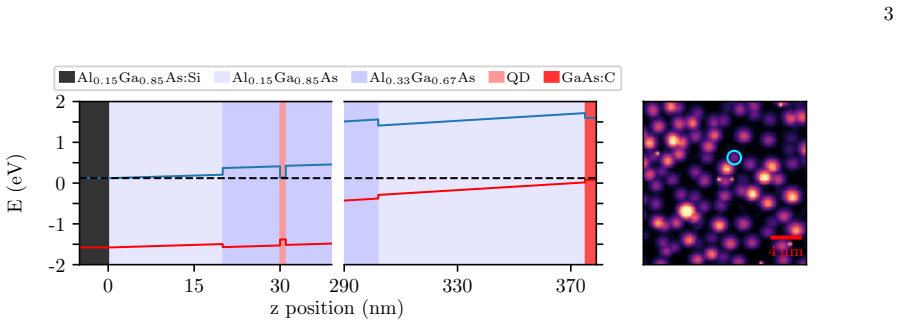


read the original abstract
Semiconductor quantum dots are a promising platform for generating single and entangled photons.Still, their use is limited even in the most advanced structures by changes in the charge state of the quantum dot and its environment. Here, we present detailed time-resolved resonance fluorescence measurements on a single charge-tunable GaAs quantum dot, shedding new light on the spectral shadows invoked by the complex impurity environment. Detuning-dependent measurements reveal the existence of multiple Stark-shifted resonances, which are associated with rare spectral jumps smaller than the homogeneous linewidth and, therefore, typically concealed in the measurement noise. We observe similar environmentally induced Stark shifts for both the neutral exciton and negatively charged trion transitions, while the positively and doubly negatively charged trions exhibit significant differences. Our investigation quantifies the underlying impurity charge dynamics over a range from well below milliseconds to seconds, revealing that the hole occupation of the positively charged trion transition is constrained by rapid hole loss and slow hole recapture dynamics. Utilizing a second non-resonant laser, we increase the hole occupancy by over an order of magnitude and identify both a prolonged hole residence time and an enhanced hole tunneling rate into the quantum dot. These findings are supported by complementary spin noise spectroscopy measurements, which offer a significantly higher bandwidth compared to the time-resolved resonance fluorescence measurements.
Editorial analysis
A structured set of objections, weighed in public.
Referee Report
Summary. The manuscript reports time-resolved resonance fluorescence measurements on a single charge-tunable GaAs quantum dot. Detuning-dependent data reveal multiple narrow resonances interpreted as Stark-shifted lines arising from rare environmental charge fluctuations that produce spectral jumps smaller than the homogeneous linewidth. The work quantifies impurity charge dynamics over sub-millisecond to second timescales, highlights differences in behavior between the neutral exciton, negative trion, positive trion, and doubly negative trion transitions, and demonstrates that a non-resonant laser can increase hole occupancy by more than an order of magnitude. Complementary spin-noise spectroscopy measurements with higher bandwidth are used to corroborate the resonance-fluorescence results.
Significance. If the central interpretation holds, the results provide direct experimental access to sub-linewidth spectral diffusion mechanisms that limit the performance of quantum-dot single-photon sources. The differential charge-state dependence, the extraction of hole residence and tunneling rates, and the cross-validation with spin noise constitute concrete, falsifiable constraints on models of the impurity environment. These findings are relevant to ongoing efforts to stabilize quantum-dot emission for quantum information applications.
major comments (1)
- [detuning-dependent measurements] § on detuning-dependent resonance fluorescence: the claim that the observed multiple resonances are caused exclusively by discrete Stark shifts from impurity charge-state changes would be strengthened by an explicit quantitative comparison (e.g., expected jump-size distribution versus measured resonance separations) that rules out continuous spectral diffusion or laser-induced artifacts at the same scale.
minor comments (2)
- [Abstract] Abstract: missing space after the period in 'photons.Still'.
- [Results] The manuscript would benefit from a brief statement of the criteria used to select the 'multiple resonances' (e.g., signal-to-noise threshold or fitting constraints) to allow readers to assess possible selection bias.
Simulated Author's Rebuttal
We thank the referee for the positive assessment of our work and for the constructive suggestion regarding the detuning-dependent measurements. We address the comment below and will incorporate the requested strengthening in the revised manuscript.
read point-by-point responses
-
Referee: § on detuning-dependent resonance fluorescence: the claim that the observed multiple resonances are caused exclusively by discrete Stark shifts from impurity charge-state changes would be strengthened by an explicit quantitative comparison (e.g., expected jump-size distribution versus measured resonance separations) that rules out continuous spectral diffusion or laser-induced artifacts at the same scale.
Authors: We agree that an explicit quantitative comparison would further strengthen the interpretation. In the revised version we will add a histogram of the observed resonance separations extracted from the detuning-dependent scans and compare it directly to the distribution of Stark shifts expected from single-impurity charge-state changes (using the known dipole moments and typical impurity densities in GaAs). We will also show that continuous spectral diffusion at the observed scale would produce a smooth broadening of the resonance rather than the distinct, time-persistent lines we record, and we will include control data acquired at reduced resonant-laser power and with the non-resonant laser alone to exclude laser-induced artifacts. revision: yes
Circularity Check
No significant circularity
full rationale
This is an experimental measurement paper focused on time-resolved resonance fluorescence and spin-noise spectroscopy of a single GaAs quantum dot. The central claims rest on direct observations of detuning-dependent resonances, time traces of spectral jumps, and differential behavior across charge states, without any mathematical derivation, model fitting, or ansatz that reduces the reported results to inputs by construction. No load-bearing self-citations, uniqueness theorems, or parameter predictions appear in the presented work; the findings are supported by raw data and internal consistency checks that remain independent of the paper's own outputs.
Axiom & Free-Parameter Ledger
free parameters (1)
- hole residence and tunneling rates
axioms (1)
- domain assumption Observed frequency shifts arise from the DC Stark effect due to local electric fields produced by nearby impurity charge states.
Lean theorems connected to this paper
-
IndisputableMonolith/Cost/FunctionalEquation.leanwashburn_uniqueness_aczel unclear?
unclearRelation between the paper passage and the cited Recognition theorem.
Detuning-dependent measurements reveal the existence of multiple Stark-shifted resonances... four clearly distinguishable states... fitted by four pseudo-Voigt functions
What do these tags mean?
- matches
- The paper's claim is directly supported by a theorem in the formal canon.
- supports
- The theorem supports part of the paper's argument, but the paper may add assumptions or extra steps.
- extends
- The paper goes beyond the formal theorem; the theorem is a base layer rather than the whole result.
- uses
- The paper appears to rely on the theorem as machinery.
- contradicts
- The paper's claim conflicts with a theorem or certificate in the canon.
- unclear
- Pith found a possible connection, but the passage is too broad, indirect, or ambiguous to say the theorem truly supports the claim.
Reference graph
Works this paper leans on
-
[1]
Non resonnant excitation case for X + Following the classical switching time analysis out- lined above, Fig. 11(a) presents forX + the probability density for nonresonant excitation at aP NRE of 222nW and a detuning of∆E = 0.3 µeV. At this detuning, not all shadow resonances of theX + transition, which are visible in Fig. 8(b), can be clearly resolved, al...
-
[2]
L. Zhai, M. C. Löbl, G. N. Nguyen, J. Ritzmann, A. Javadi, C. Spinnler, A. D. Wieck, A. Ludwig, and R. J. Warburton, Nature Communications11, 4745 (2020)
work page 2020
-
[3]
J. Neuwirth, F. Basso Basset, M. B. Rota, E. Roccia, C. Schimpf, K. D. Jöns, A. Rastelli, and R. Trotta, Materials for Quantum Technology1, 043001 (2021)
work page 2021
-
[4]
Y.ArakawaandM.J.Holmes,AppliedPhysicsReviews 7, 021309 (2020)
work page 2020
- [5]
-
[6]
A. V. Kuhlmann, J. Houel, A. Ludwig, L. Greuter, D. Reuter, A. D. Wieck, M. Poggio, and R. J. Warbur- ton, Nature Physics9, 570 (2013)
work page 2013
- [7]
- [8]
-
[9]
N. Ha, T. Mano, Y.-L. Chou, Y.-N. Wu, S.-J. Cheng, J. Bocquel, P. M. Koenraad, A. Ohtake, Y. Sakuma, K. Sakoda, and T. Kuroda, Physical Review B92, 075306 (2015)
work page 2015
-
[10]
A. Al-Ashouri, A. Kurzmann, B. Merkel, A. Ludwig, A. D. Wieck, A. Lorke, and M. Geller, Nano Letters 19, 135 (2019)
work page 2019
- [11]
-
[12]
A. Kurzmann, A. Ludwig, A. D. Wieck, A. Lorke, and M. Geller, Nano Letters16, 3367 (2016)
work page 2016
-
[13]
J. Wiegand, D. S. Smirnov, J. Osberghaus, L. Abaspour, J. Hübner, and M. Oestreich, Physical Review B 98, 125426 (2018)
work page 2018
-
[14]
A. Kurzmann, P. Stegmann, J. Kerski, R. Schott, A. Ludwig, A. D. Wieck, J. König, A. Lorke, and M. Geller, Physical Review Letters122, 247403 (2019)
work page 2019
-
[15]
P. Lochner, A. Kurzmann, J. Kerski, P. Stegmann, J. König, A. D. Wieck, A. Ludwig, A. Lorke, and M. Geller, Nano Letters20, 1631 (2020)
work page 2020
-
[16]
P. Lochner, J. Kerski, A. Kurzmann, A. D. Wieck, A. Ludwig, M. Geller, and A. Lorke, Physical Review B 103, 075426 (2021)
work page 2021
- [17]
-
[18]
H. G. Babin, J. Ritzmann, N. Bart, M. Schmidt, T. Kruck, L. Zhai, M. C. Löbl, G. N. Nguyen, C. Spinnler, L. Ranasinghe, R. J. Warburton, C. Heyn, A. D. Wieck, and A. Ludwig, Nanomaterials11, 2703 (2021)
work page 2021
-
[19]
S. F. C. da Silva, G. Undeutsch, B. Lehner, S. Manna, T. M. Krieger, M. Reindl, C. Schimpf, R. Trotta, and A. Rastelli, Applied Physics Letters119, 120502 (2021)
work page 2021
-
[20]
A. V. Kuhlmann, J. Houel, D. Brunner, A. Ludwig, D. Reuter, A. D. Wieck, and R. J. Warburton, Review of Scientific Instruments84, 073905 (2013)
work page 2013
-
[21]
We observed that the polarization extinction exhibits a significant wavelength dependence, making the ad- ditional color filter essential for the far-detuned non- resonant laser
-
[22]
Excelitas SPCM-AQRH-15-FC, saturation rate: 37MHz
-
[23]
Alazartech ATS9360, operated at a sampling rate of 180MHz
-
[24]
Attocube ANSxyz100std/LT, ANPx102/RES/LT/HV and ANPz102/RES/LT/HV
-
[25]
X. Xu, A. Andreev, and D. A. Williams, New Journal of Physics 10, 053036 (2008)
work page 2008
-
[26]
P. W. Fry, I. E. Itskevich, D. J. Mowbray, M. S. Skol- nick, J. J. Finley, J. A. Barker, E. P. O’Reilly, L. R. Wilson, I. A. Larkin, P. A. Maksym, M. Hopkinson, M. Al-Khafaji, J. P. R. David, A. G. Cullis, G. Hill, and J. C. Clark, Physical Review Letters84, 733 (2000)
work page 2000
-
[27]
Strictly speaking, these values contain a very small systematic error, as both photon leakage and dark counts (⪅ 1kHz) are always present
-
[28]
J. D. Mar, X. L. Xu, J. J. Baumberg, F. S. F. Brossard, A. C. Irvine, C. Stanley, and D. A. Williams, Physical Review B 83, 075306 (2011), publisher: American Physical Society
work page 2011
-
[29]
The neighboring QDs have a significantly larger transi- tion energy, which probably inhibits charge changes at moderate VG
-
[30]
B. Chen, Q.-M. Zhang, and J. Bernholc, Physical Re- view B 49, 2985 (1994)
work page 1994
-
[31]
K. J. Beernink, R. L. Thornton, G. B. Anderson, and M. A. Emanuel, Applied Physics Letters 66, 2522 (1995). 11
work page 1995
-
[32]
P. M. Mooney, Journal of Applied Physics 67, R1 (1990)
work page 1990
- [33]
- [34]
-
[35]
B. Vest, B. Fix, J. Jaeck, and R. Haïdar, Journal of the European Optical Society-Rapid Publications12, 26 (2016)
work page 2016
-
[36]
R. Dahbashi, J. Hübner, F. Berski, K. Pierz, and M. Oestreich, Physical Review Letters 112, 156601 (2014)
work page 2014
-
[37]
J. Wiegand, D. S. Smirnov, J. Hübner, M. M. Glazov, and M. Oestreich, Physical Review B 97, 081403 (2018)
work page 2018
- [38]
-
[39]
M. M. Glazov and V. S. Zapasskii, Optics Express23, 11713 (2015)
work page 2015
discussion (0)
Sign in with ORCID, Apple, or X to comment. Anyone can read and Pith papers without signing in.