Efficient Gaussian State Preparation in Quantum Circuits
Pith reviewed 2026-05-19 02:18 UTC · model grok-4.3
The pith
A quantum circuit prepares approximate Gaussian states by using single-qubit rotations followed by the quantum Fourier transform.
A machine-rendered reading of the paper's core claim, the machinery that carries it, and where it could break.
Core claim
The authors demonstrate that single-qubit rotations can form an exponential amplitude profile whose quantum Fourier transform yields an approximate discrete Gaussian distribution with high fidelity, and that pruning small controlled-phase angles in the transform reduces total gate complexity to near-linear scaling in the number of qubits while preserving the approximation quality.
What carries the argument
The composition of single-qubit rotations that generate an exponential amplitude profile followed by the quantum Fourier transform that maps the profile to a Gaussian-like distribution.
Load-bearing premise
The quantum Fourier transform of the exponential amplitude profile produces a close enough discrete Gaussian approximation and that pruning small controlled-phase gates does not add unacceptable error.
What would settle it
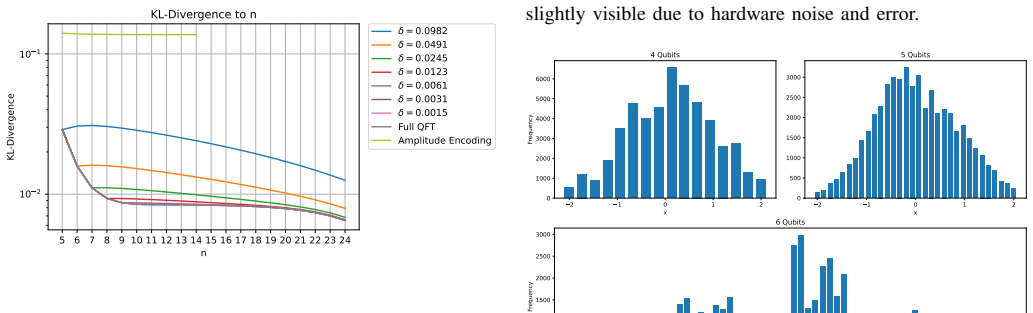
Run the circuit for four or five qubits on a simulator or device, measure the output probabilities, and verify whether the fidelity to the target discrete Gaussian stays above 0.95 and whether pruning changes that fidelity by more than a few percent.
Figures



read the original abstract
Gaussian states hold a fundamental place in quantum mechanics, quantum information, and quantum computing. Many subfields, including quantum simulation of continuous-variable systems, quantum chemistry, and quantum machine learning, rely on the ability to accurately and efficiently prepare states that reflect a Gaussian profile in their probability amplitudes. Although Gaussian states are natural in continuous-variable systems, the practical interest in digital, gate-based quantum computers demands discrete approximations of Gaussian distributions over a computational basis of size \(2^n\). Because of the exponential scaling of naive amplitude-encoding approaches and the cost of certain block-encoding or Hamiltonian simulation techniques, a resource-efficient preparation of approximate Gaussian states is required. In this work, we propose and analyze a circuit-based approach that starts with single-qubit rotations to form an exponential amplitude profile and then applies the quantum Fourier transform to map those amplitudes into an approximate Gaussian distribution. We demonstrate that this procedure achieves high fidelity with the target Gaussian state while allowing optional pruning of small controlled-phase angles in the quantum Fourier transform, thus reducing gate complexity to near-linear in \(\mathcal{O}(n)\). We conclude that the proposed technique is a promising route to make Gaussian states accessible on noisy quantum hardware and to pave the way for scalable implementations on future devices. The implementation of this algorithm is available at the Classiq library: https://github.com/classiq/classiq-library.
Editorial analysis
A structured set of objections, weighed in public.
Referee Report
Summary. The paper claims to provide an efficient method for preparing approximate Gaussian states on quantum circuits by preparing an exponential amplitude profile with single-qubit rotations and then applying the quantum Fourier transform, with optional pruning of small controlled-phase gates to achieve O(n) complexity while maintaining high fidelity.
Significance. If validated, this technique could significantly reduce the resources needed for Gaussian state preparation in applications such as quantum simulation of continuous-variable systems, quantum chemistry, and quantum machine learning on gate-based quantum computers. The open-source implementation in the Classiq library is a positive aspect for reproducibility.
major comments (2)
- [Initial amplitude profile preparation] The assertion that single-qubit rotations form an 'exponential amplitude profile' whose QFT yields a Gaussian is problematic. Independent single-qubit rotations prepare a product state whose amplitudes factorize according to the binary digits of the basis state index, typically resulting in amplitudes dependent on Hamming weight rather than a geometric sequence a_k ∝ r^k for integer k. This does not generally produce the claimed discrete Gaussian approximation after QFT. Please specify the exact circuit and amplitude formula used (likely in the Methods or Results section) and demonstrate how it achieves the geometric profile.
- [Pruning analysis] The section on gate pruning in the QFT lacks a rigorous error bound for the fidelity loss as a function of the pruning threshold, n, and the Gaussian parameter. Without this, the claim of controllable error with O(n) gates is not fully supported. Standard AQFT error analyses do not directly apply here.
minor comments (2)
- [Abstract] The abstract mentions 'high fidelity' and 'near-linear in O(n)' but does not include any specific numerical results, fidelity values, or comparisons to other methods. Adding these would improve clarity.
- [Implementation] While the GitHub link is provided, ensure that the code includes examples with explicit fidelity measurements for various n and pruning thresholds.
Simulated Author's Rebuttal
We thank the referee for the careful review and constructive comments on our manuscript. The feedback identifies key areas for clarification in the circuit construction and for strengthening the theoretical support of the pruning analysis. We address each point below and will revise the manuscript accordingly to improve clarity and rigor.
read point-by-point responses
-
Referee: [Initial amplitude profile preparation] The assertion that single-qubit rotations form an 'exponential amplitude profile' whose QFT yields a Gaussian is problematic. Independent single-qubit rotations prepare a product state whose amplitudes factorize according to the binary digits of the basis state index, typically resulting in amplitudes dependent on Hamming weight rather than a geometric sequence a_k ∝ r^k for integer k. This does not generally produce the claimed discrete Gaussian approximation after QFT. Please specify the exact circuit and amplitude formula used (likely in the Methods or Results section) and demonstrate how it achieves the geometric profile.
Authors: We appreciate this clarification request. The single-qubit rotations use qubit-dependent angles chosen to produce exactly the geometric profile a_k ∝ r^k. For qubit j (bit weight 2^j), the rotation angle θ_j is selected so that the amplitude ratio for |1⟩ versus |0⟩ equals r^{2^j} (normalized by the overall factor). The resulting product-state amplitude for computational basis state |k⟩ with bits b_j is then ∏_j α_j(b_j) ∝ ∏_j (r^{2^j})^{b_j} = r^{∑ 2^j b_j} = r^k. This is a standard technique for preparing geometric states via product rotations. We will add the explicit angle formula, the short algebraic demonstration above, and a circuit diagram with the varying θ_j to the Methods section. revision: yes
-
Referee: [Pruning analysis] The section on gate pruning in the QFT lacks a rigorous error bound for the fidelity loss as a function of the pruning threshold, n, and the Gaussian parameter. Without this, the claim of controllable error with O(n) gates is not fully supported. Standard AQFT error analyses do not directly apply here.
Authors: We agree that an analytical error bound would strengthen the claims. While numerical experiments in the manuscript already demonstrate high fidelity (>0.99) for pruning thresholds that reduce gate count to O(n), we will derive a rigorous bound in the revised manuscript. The difference between the full and pruned QFT unitaries can be bounded in operator norm by the sum of the absolute values of the discarded controlled-phase angles. Propagating this through the initial state (whose norm is bounded independently of n for fixed Gaussian width) yields an explicit fidelity lower bound that depends on the pruning threshold, n, and the Gaussian parameter σ. This derivation will be added to the Pruning Analysis section, together with a brief comparison to why standard AQFT bounds require adjustment for the non-uniform initial state. revision: yes
Circularity Check
No circularity: method composes standard gates and compares to external Gaussian target
full rationale
The derivation begins with single-qubit rotations to prepare an exponential amplitude profile, applies the quantum Fourier transform, and evaluates fidelity against an independent target Gaussian distribution. No equation defines the output Gaussian in terms of the input profile or vice versa; the approximation is asserted by explicit construction and numerical demonstration rather than by renaming or self-referential fitting. No load-bearing self-citations, uniqueness theorems, or ansatzes imported from prior author work appear in the provided description. The central claim therefore remains independent of its own outputs.
Axiom & Free-Parameter Ledger
free parameters (1)
- pruning threshold for controlled-phase angles
axioms (1)
- domain assumption The quantum Fourier transform maps an exponential amplitude vector to a discrete Gaussian-like distribution with controllable error.
Forward citations
Cited by 1 Pith paper
-
PyEncode: An Open-Source Library for Structured Quantum State Preparation
PyEncode supplies verified Qiskit circuits and gate-count predictors for exact amplitude encoding of sparse, step, square, Walsh, Fourier, geometric, Hamming, staircase, Dicke, and polynomial vectors.
Reference graph
Works this paper leans on
-
[1]
M. A. Nielsen and I. L. Chuang, Quantum Computation and Quantum Information: 10th Anniversary Edition . Cambridge University Press, 2010
work page 2010
-
[2]
Temporal-mode continuous-variable cluster states using linear optics,
N. C. Menicucci, “Temporal-mode continuous-variable cluster states using linear optics,”Phys. Rev. A, vol. 83, p. 062314, Jun 2011. [Online]. Available: https://link.aps.org/doi/10.1103/PhysRevA.83.062314
-
[3]
Wavefunction preparation and resampling using a quantum computer
A. Kitaev and W. A. Webb, “Wavefunction preparation and resampling using a quantum computer,” 2008, arXiv:0801.0342
work page internal anchor Pith review Pith/arXiv arXiv 2008
-
[4]
The theory of variational hybrid quantum-classical algorithms,
J. R. McClean, J. Romero, R. Babbush, and A. Aspuru-Guzik, “The theory of variational hybrid quantum-classical algorithms,” New Journal of Physics , vol. 18, no. 2, p. 023023, Feb. 2016. [Online]. Available: http://dx.doi.org/10.1088/1367-2630/18/2/023023
-
[5]
Option pricing using quantum computers,
N. Stamatopoulos, D. J. Egger, Y . Sun, C. Zoufal, R. Iten, N. Shen, and S. Woerner, “Option pricing using quantum computers,” Quantum, vol. 4, p. 291, Jul. 2020. [Online]. Available: http: //dx.doi.org/10.22331/q-2020-07-06-291
-
[6]
Derivative pricing using quantum signal processing,
N. Stamatopoulos and W. J. Zeng, “Derivative pricing using quantum signal processing,” Quantum, vol. 8, p. 1322, Apr. 2024. [Online]. Available: http://dx.doi.org/10.22331/q-2024-04-30-1322
-
[7]
An approximate fourier transform useful in quantum factoring,
D. Coppersmith, “An approximate fourier transform useful in quantum factoring,” 2002. [Online]. Available: https://arxiv.org/abs/quant-ph/ 0201067
work page 2002
-
[8]
C. P. Williams, Explorations in Quantum Computing, 2nd ed., ser. Texts in Computer Science. Springer London, 2011
work page 2011
-
[9]
A. Gily ´en, Y . Su, G. H. Low, and N. Wiebe, “Quantum singular value transformation and beyond: exponential improvements for quantum matrix arithmetics,” in Proceedings of the 51st Annual ACM SIGACT Symposium on Theory of Computing , ser. STOC ’19. ACM, Jun. 2019, p. 193–204. [Online]. Available: http: //dx.doi.org/10.1145/3313276.3316366
-
[10]
Quantum state preparation of normal distributions using matrix product states,
J. Iaconis, S. Johri, and E. Y . Zhu, “Quantum state preparation of normal distributions using matrix product states,” npj Quantum Information , vol. 10, p. 15, 2024
work page 2024
-
[11]
Quantum support vector machine for big data classification,
P. Rebentrost, M. Mohseni, and S. Lloyd, “Quantum support vector machine for big data classification,” Phys. Rev. Lett. , vol. 113, no. 13, p. 130503, 2014
work page 2014
-
[12]
Quantum principal compo- nent analysis,
S. Lloyd, M. Mohseni, and P. Rebentrost, “Quantum principal compo- nent analysis,” Nature Physics, vol. 10, no. 9, pp. 631–633, 2014
work page 2014
-
[13]
Efficient quantum circuits for ac- curate state preparation of smooth, differentiable functions,
A. Holmes and A. Y . Matsuura, “Efficient quantum circuits for ac- curate state preparation of smooth, differentiable functions,” 2020, arXiv:2005.04351
-
[14]
The efficient preparation of normal distributions in quantum registers,
A. G. Rattew, Y . Sun, P. Minssen, and M. Pistoia, “The efficient preparation of normal distributions in quantum registers,” Quantum, vol. 5, p. 609, 2021
work page 2021
-
[15]
Quantum unary approach to option pricing,
S. Ramos-Calderer, A. P ´erez-Salinas, D. Garc´ıa-Mart´ın, C. Bravo-Prieto, J. Cortada, J. Planagum `a, and J. I. Latorre, “Quantum unary approach to option pricing,” 2019, arXiv:1912.01618
-
[16]
Quantum generative adversarial networks for learning and loading random distributions,
C. Zoufal, A. Lucchi, and S. Woerner, “Quantum generative adversarial networks for learning and loading random distributions,” npj Quantum Information, vol. 5, p. 16, 2019
work page 2019
-
[17]
Quantum generative adversarial learning in a superconducting quantum circuit,
L. Hu, S.-H. Wu, W. Cai, Y . Ma, X. Mu, Y . Xu, H. Wang, Y . Song, D.-L. Deng, and C.-L. Zou, “Quantum generative adversarial learning in a superconducting quantum circuit,” Science Advances, vol. 5, no. 1, p. eaav2761, 2019
work page 2019
-
[18]
A logarithmic-depth quantum carry-lookahead adder
T. G. Draper, S. A. Kutin, E. M. Rains, and K. M. Svore, “A logarithmic- depth quantum carry-lookahead adder,” 2004, arXiv:quant-ph/0406142
work page internal anchor Pith review Pith/arXiv arXiv 2004
-
[19]
Quantum speedup of monte carlo methods,
A. Montanaro, “Quantum speedup of monte carlo methods,” Proc. R. Soc. A, vol. 471, no. 2181, p. 20150301, 2015
work page 2015
-
[20]
S. Woerner and D. J. Egger, “Quantum risk analysis,” npj Quantum Information, vol. 5, p. 15, 2019
work page 2019
-
[21]
Option pricing using quantum computers,
N. Stamatopoulos, D. J. Egger, Y . Sun, C. Zoufal, R. Iten, N. Shen, and S. Woerner, “Option pricing using quantum computers,” Quantum, vol. 4, p. 291, 2020
work page 2020
-
[22]
Quantum algorithm for linear systems of equations,
A. W. Harrow, A. Hassidim, and S. Lloyd, “Quantum algorithm for linear systems of equations,”Phys. Rev. Lett., vol. 103, no. 15, p. 150502, 2009
work page 2009
-
[23]
Quantum computational finance: Monte carlo pricing of financial derivatives,
P. Rebentrost, B. Gupt, and T. R. Bromley, “Quantum computational finance: Monte carlo pricing of financial derivatives,” Phys. Rev. A , vol. 98, no. 2, p. 022321, 2018
work page 2018
-
[24]
Quantum machine learning: a classical perspective,
C. Ciliberto, M. Herbster, A. D. Ialongo, M. Pontil, A. Rocchetto, S. Severini, and L. Wossnig, “Quantum machine learning: a classical perspective,” Proc. Roy. Soc. A , vol. 474, no. 2209, p. 20170551, 2018
work page 2018
-
[25]
Addition on a quantum computer,
T. G. Draper, “Addition on a quantum computer,” 2000, arXiv:quant- ph/0008033
discussion (0)
Sign in with ORCID, Apple, or X to comment. Anyone can read and Pith papers without signing in.