REVIEW 3 major objections 4 minor 20 references
Relax-and-Cut for Temporal SCUC Decomposition
T0 review · 3 major / 4 minor · reviewed 2026-08-06 · deepseek-v4-flash
Pith's one-line read The paper claims that relaxing integrality in a look-ahead window while keeping near-term decisions integer lets a temporal decomposition of security-constrained unit commitment produce solutions within 1% of the monolithic optimum using…
desk verdict A genuinely useful heuristic for large-scale SCUC with a real soft spot: the sub-1% gap claim is against a non-certified baseline, not the true optimum. read the letter →
The pith
A machine-rendered reading of the paper's core claim, the machinery that carries it, and where it could break.
The reading
What carries the argument
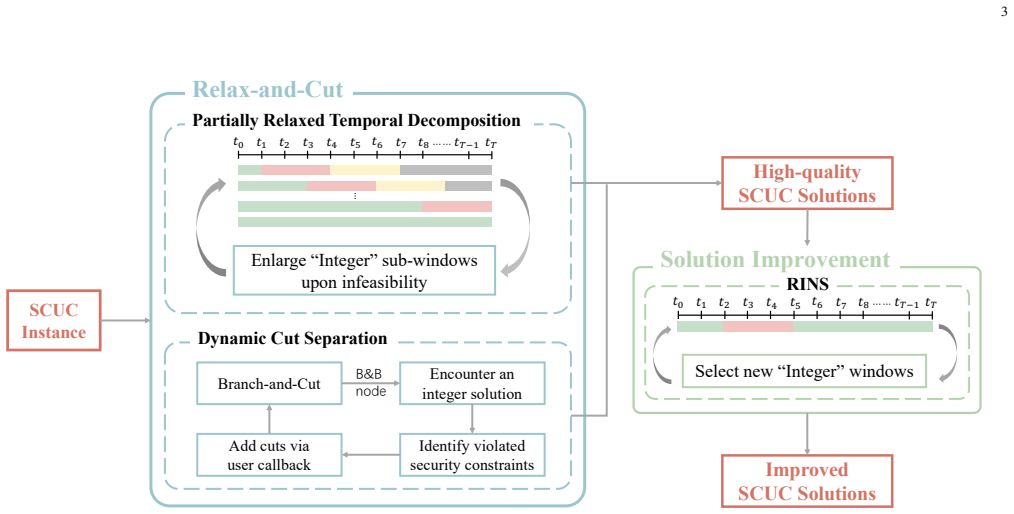
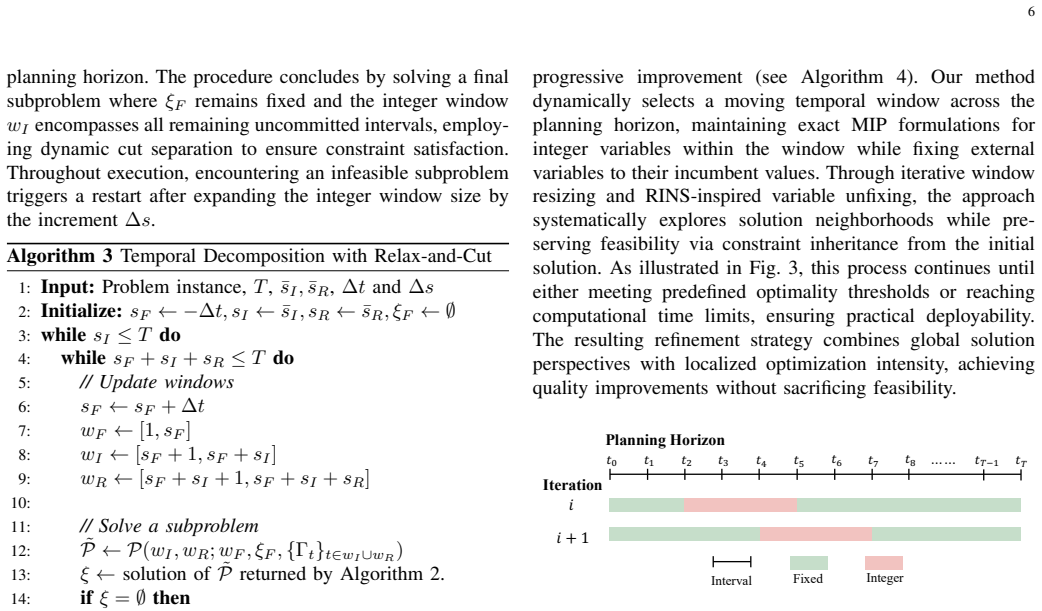
The machinery is a four-way temporal partition: fixed, integer, relaxed, and ignored windows. Each subproblem is the partially relaxed program $SCUC^{PR}$ of length $s_I + s_R$, in which commitment variables in the first $s_I$ periods are binary and those in the next $s_R$ periods are continuous. After each solve, the first $\Delta t$ periods of the integer window are frozen into the fixed window, state is passed forward by Algorithm 1, and the windows advance. Security constraints are enforced by a callback: whenever branch-and-cut finds an integer solution, the violated N-1 constraints are separated and added as cuts inside the same solve. An optional RINS pass then re-optimizes a rolling window with everything else fixed, cutting the average primal gap from 0.67% to 0.37% at a 13% runtime increase.
What would settle it
On a reported instance, perturb the demand in the relaxed window by ±20% while keeping the integer window unchanged and then fix the first $\Delta t$ periods; if the objective degrades by more than one percentage point relative to the unperturbed run, the method's near-optimality rests on an accurate look-ahead rather than on the relaxation itself.
Extended reading notes
Core claim
On its own terms, the paper claims that the sequence of partially relaxed subproblems — where the first $s_I$ periods keep binary commitments and the next $s_R$ periods relax them to $[0,1]$, with N-1 security cuts added inside branch-and-cut — yields feasible, near-optimal SCUC schedules. In the twenty-instance benchmark, TD-R+Cut attains an average primal gap of 0.9% versus 2.8% for the temporal-decomposition baseline and produces solutions in 59 seconds on average, roughly one-fifth of the monolithic solver's 281 seconds; on the largest 13,659-bus case it solves in 730 seconds. The paper presents this as evidence that the relaxed look-ahead window transmits enough future cost and feasibility information to prevent the myopic decisions that degrade short-window decomposition, and that dynamic cut separation avoids the repeated cold starts of constraint-filtering approaches.
Load-bearing premise
The whole method leans on the belief that when you relax commitment decisions in the look-ahead window, the relaxed problem still gives a truthful enough picture of future cost and feasibility that freezing the first few periods of its solution is nearly as good as solving those periods with full future information.
Editorial extensions
If this is right
- On benchmark systems above 1,000 buses, the method brings average primal gaps from about 2.8% (prior temporal decomposition) down to 0.9%, while halving the decomposition baseline's solve time.
- On the largest instances, the method solves systems with over 13,000 buses and roughly 14,000 contingencies in about 730 seconds, a regime where the monolithic model either takes hours or returns no feasible solution.
- Dynamic cut separation inside branch-and-cut yields a feasible solution earlier than iterative constraint filtering because the solver does not restart from scratch; the ablation study attributes part of the speed gain to this.
- With eight threads, TD-R+Cut scales better than the baselines (e.g., 48% time reduction on one 6,515-bus instance versus 26% for the monolithic approach), suggesting the design is well suited to parallel deployment.
Reading between the lines
- The same partial-relaxation trick could transfer to any rolling-horizon mixed-integer problem whose future coupling is through continuous state variables; the boundary between 'integer now' and 'relaxed later' would need to be tuned per problem.
- A natural performance bound to test next is whether the relaxed window's LP dual value provides a lower bound on the cost-to-go; if it does, the fixed-$\Delta t$ commitment policy inherits a regret proportional to the relaxation gap, which the paper does not state.
- The single-parameter validation ($s_I=s_R=\Delta t=6$, $\Delta s=2$) leaves open whether the 0.9% average gap depends delicately on that setting; a sweep over window lengths would show how robust the claim is.
Editorial analysis
A structured set of objections, weighed in public.
Referee Report
Summary. The paper proposes a relax-and-cut temporal decomposition framework for the Security-Constrained Unit Commitment (SCUC) problem. The method solves a sequence of subproblems with three temporal windows: fixed, integer-constrained, and relaxed-integer look-ahead, which extends the planning horizon without keeping all integer variables. Security constraints are enforced dynamically through callbacks within branch-and-cut, rather than being enumerated upfront. An optional RINS-based refinement step improves the incumbent solution. The authors evaluate the method on 20 large MATPOWER instances, reporting that their TD-R+Cut method achieves relative gaps below 1% versus a monolithic Gurobi baseline while using about one-fifth of the runtime, and that it outperforms a conventional temporal decomposition baseline. The paper includes pseudocode, ablation studies, parallel-scaling results, and a public implementation repository.
Significance. If the claimed results hold, the method would be a practically valuable heuristic for large-scale SCUC, where monolithic MILP solvers are often impractical. The paper has concrete strengths: the algorithmic description is clear, the code is publicly available, and the experimental design includes ablations for the two main innovations, parallel performance evaluation, and comparison against several baselines. The dynamic cut-separation mechanism embedded in branch-and-bound is a sensible engineering contribution. However, the central quantitative claim—'optimality gaps below 1%'—is not actually supported by the reported experiments, because the reference baseline is not a certified optimal solution. This weakens the headline contribution and requires revision.
major comments (3)
- [Section VI.A, Table II]
- [Table II and Table III, 9241pegase row]
- [Section VI (Configuration and Case Study)]
minor comments (4)
- [Section II, Eq. (4)]
- [Section VI.A]
- [Section VI.A, Table II]
- [Figure 7]
Circularity Check
No load-bearing circularity: the relax-and-cut solution is evaluated against external Gurobi baselines; the only self-citation is inspirational [18], and the headline 'optimality gap' concern is a benchmark-validity issue, not a circular derivation.
-
other
[Section III, paragraph before Eq. (9); also Section I contribution list]
"Inspired by recent advances [17], [18], our method strategically limits the optimization window to balance computational tractability with solution quality."
Reference [18] shares authors with this paper, making this a self-citation. It is not load-bearing: the partial-relaxation subproblem in Eq. (9), the state-propagation Algorithm 1, and the numerical comparisons against Gurobi-based Full+TF and TD+TF baselines do not derive any theorem or parameter from [18]. The cited work is used only as general inspiration for window limitation, so no equation or fitted value reduces to a self-cited result.
full rationale
The derivation chain is self-contained at the algorithmic level. SCUC formulation (8) follows standard unit-commitment modeling [2]; subproblem (9) is explicitly defined by the paper with its own integer/relaxed window partition; Algorithm 2 separates all N-1 constraints exactly at integer nodes; Algorithm 1 propagates state across subproblems; Algorithm 3 is a constructive heuristic with hand-set window sizes (sI=sR=Delta t=6, Delta s=2) that are not fitted to the reported gaps. Reported gaps are objective differences between TD-R+Cut and Full+TF or TD+TF solutions obtained by Gurobi, i.e., an external benchmark rather than a parameter fitted to force the headline. The only self-citation is [18], used as inspiration, not as a load-bearing theorem. Two caveats belong to correctness risk rather than circularity: (1) Full+TF is not a certified optimum (Gurobi 0.1% MIP gap plus transmission filtering), so calling the relative differences 'optimality gaps below 1%' is not strictly supported; (2) the central look-ahead premise that relaxing wR preserves enough future information has no theoretical bound and is tested for one parameter setting. Neither caveat makes the prediction equivalent to an input by construction, so the circularity score remains low.
Assumptions & free parameters
free parameters (5)
- Integer window size sI =
6
- Relaxed window size sR =
6
- Advance step Δt =
6
- Infeasibility increment Δs =
2
- RINS sliding window (size, step) =
12, 9
assumptions (4)
- standard math Gurobi's branch-and-cut solves each SCUC subproblem to the specified MIP gap.
- domain assumption DC power flow with PTDFs accurately models line flow limits and N-1 contingencies.
- ad hoc to paper Relaxing integrality of commitment variables in the look-ahead window wR preserves enough future information to make near-term fixes near-optimal.
- domain assumption Checking all security constraints only at integer solutions and adding violated ones as cuts yields a final incumbent feasible for the full N-1 set.
Cite this review
Pith. "Pith review of Relax-and-Cut for Temporal SCUC Decomposition." pith.science (2026). https://pith.science/paper/JXZASM7Z
@misc{pith2026250720465,
  author       = {Pith},
  title        = {Pith review of: Relax-and-Cut for Temporal SCUC Decomposition},
  year         = {2026},
  howpublished = {\url{https://pith.science/paper/JXZASM7Z}},
  note         = {Machine review of arXiv:2507.20465}
}
read the original abstract
The Security-Constrained Unit Commitment (SCUC) problem presents formidable computational challenges due to its combinatorial complexity, large-scale network dimensions, and numerous security constraints. While conventional temporal decomposition methods achieve computational tractability through fixed short-term time windows, this limited look-ahead capability often results in suboptimal, myopic solutions. We propose an innovative relax-and-cut framework that alleviates these limitations through two key innovations. First, our enhanced temporal decomposition strategy maintains integer variables for immediate unit commitment decisions while relaxing integrality constraints for future time periods, thereby extending the optimization horizon without compromising tractability. Second, we develop a dynamic cutting-plane mechanism that selectively incorporates N-1 contingency constraints during the branch-and-cut process, avoiding the computational burden of complete upfront enumeration. The framework optionally employs a Relaxation-Induced Neighborhood Search procedure for additional solution refinement when computational resources permit. Comprehensive numerical experiments demonstrate the effectiveness of our approach on large-scale systems up to 13,000 buses. The proposed method can achieve optimality gaps below 1% while requiring only 20% of the computation time of monolithic Gurobi solutions. Compared to existing decomposition approaches, our framework provides superior performance, simultaneously reducing primal gaps by 60% and doubling solution speed. These significant improvements make our method particularly well-suited for practical SCUC implementations where both solution quality and computational efficiency are crucial.
Figures

Figures from the paper (4 more)


Reference graph
Works this paper leans on
-
[1]
Convex Hulls for the Unit Commitment Polytope
K. Pan and Y . Guan, “Convex hulls for the unit commitment polytope,” arXiv preprint arXiv:1701.08943 , 2017
work page Pith review arXiv 2017
-
[2]
On mixed-integer pro- gramming formulations for the unit commitment problem,
B. Knueven, J. Ostrowski, and J.-P. Watson, “On mixed-integer pro- gramming formulations for the unit commitment problem,” INFORMS Journal on Computing , 2020
work page 2020
-
[3]
A polyhedral study of the integrated minimum- up/-down time and ramping polytope,
K. Pan and Y . Guan, “A polyhedral study of the integrated minimum- up/-down time and ramping polytope,”arXiv preprint arXiv:1604.02184, 2016
arXiv 2016
-
[4]
Which unit-commitment formulation is best? a comparison framework,
D. A. Tejada-Arango, S. Lumbreras, P. S ´anchez-Mart´ın, and A. Ramos, “Which unit-commitment formulation is best? a comparison framework,” IEEE Transactions on Power Systems , 2019
work page 2019
-
[5]
Temporal decomposi- tion for security-constrained unit commitment,
F. Safdarian, A. Mohammadi, and A. Kargarian, “Temporal decomposi- tion for security-constrained unit commitment,” IEEE Transactions on Power Systems, 2019
work page 2019
-
[6]
Temporal decomposition for improved unit commitment in power system production cost modeling,
K. Kim, A. Botterud, and F. Qiu, “Temporal decomposition for improved unit commitment in power system production cost modeling,” IEEE Transactions on Power Systems , vol. 33, no. 5, pp. 5276–5287, 2018
work page 2018
-
[7]
Decomposable formulation of transmission constraints for decentralized power systems optimization,
´A. S. Xavier, S. S. Dey, and F. Qiu, “Decomposable formulation of transmission constraints for decentralized power systems optimization,” INFORMS Journal on Computing , 2024
work page 2024
-
[8]
Fast identification of inactive security constraints in scuc problems,
Q. Zhai, X. Guan, J. Cheng, and H. Wu, “Fast identification of inactive security constraints in scuc problems,” IEEE Transactions on Power Systems, 2010
work page 2010
Show all 20 references
-
[9]
Acceleration of umbrella constraint discovery in generation scheduling problems,
A. J. Ardakani and F. Bouffard, “Acceleration of umbrella constraint discovery in generation scheduling problems,” IEEE Transactions on Power Systems, 2014
2014
-
[10]
Im- proving large scale day-ahead security constrained unit commitment performance,
Y . Chen, A. Casto, F. Wang, Q. Wang, X. Wang, and J. Wan, “Im- proving large scale day-ahead security constrained unit commitment performance,” IEEE Transactions on Power Systems , 2016
2016
-
[11]
Security constrained unit commitment using line outage distribution factors,
D. A. Tejada-Arango, P. S ´anchez-Martın, and A. Ramos, “Security constrained unit commitment using line outage distribution factors,” IEEE Transactions on power systems , 2017
2017
-
[12]
Umbrella contingencies in security-constrained optimal power flow,
F. Bouffard, F. D. Galiana, and J. M. Arroyo, “Umbrella contingencies in security-constrained optimal power flow,” in 15th Power systems computation conference, PSCC , 2005
2005
-
[13]
Identification of umbrella constraints in dc-based security-constrained optimal power flow,
A. J. Ardakani and F. Bouffard, “Identification of umbrella constraints in dc-based security-constrained optimal power flow,” IEEE Transactions on Power Systems, 2013
2013
-
[14]
Transmission constraint filtering in large-scale security-constrained unit commitment,
A. S. Xavier, F. Qiu, F. Wang, and P. R. Thimmapuram, “Transmission constraint filtering in large-scale security-constrained unit commitment,” IEEE Transactions on Power Systems , 2019
2019
-
[15]
Exploring relaxation induced neighborhoods to improve mip solutions,
E. Danna, E. Rothberg, and C. L. Pape, “Exploring relaxation induced neighborhoods to improve mip solutions,” Mathematical Programming, 2005
2005
-
[16]
Time domain parti- tioning of electricity production cost simulations,
C. Barrows, M. Hummon, W. Jones, and E. Hale, “Time domain parti- tioning of electricity production cost simulations,” National Renewable Energy Lab.(NREL), Golden, CO (United States), Tech. Rep., 2014
2014
-
[17]
The machine learning for combinatorial optimization competition (ml4co): Results and insights,
M. Gasse, S. Bowly, Q. Cappart, J. Charfreitag, L. Charlin, D. Ch ´etelat, A. Chmiela, J. Dumouchelle, A. Gleixner, A. M. Kazachkov et al., “The machine learning for combinatorial optimization competition (ml4co): Results and insights,” in NeurIPS 2021 competitions and demonst...
2021
-
[18]
Efficient primal heuristics for mixed-integer linear programs,
A. Wang, L. Yang, S. Lai, X. Luo, X. Zhou, H. Huang, S. Shao, Y . Zhu, D. Zhang, and T. Quan, “Efficient primal heuristics for mixed-integer linear programs,” arXiv preprint arXiv:2202.02725 , 2022
2022 arXiv
-
[19]
Unitcommit- ment. jl: A julia/jump optimization package for security-constrained unit commitment (version 0.3),
A. S. Xavier, A. M. Kazachkov, O. Yurdakul, and F. Qiu, “Unitcommit- ment. jl: A julia/jump optimization package for security-constrained unit commitment (version 0.3),” JuMP Optimization Package for Security- Constrained Unit Commitment (Version 0.3), Zenodo , 2022
2022
-
[20]
Mat- power: Steady-state operations, planning, and analysis tools for power systems research and education,
R. D. Zimmerman, C. E. Murillo-S ´anchez, and R. J. Thomas, “Mat- power: Steady-state operations, planning, and analysis tools for power systems research and education,” IEEE Transactions on power systems , 2010
2010
Reviewed August 6, 2026 · model on record in the stance chip above.
Discussion (0). Continue with ORCID to comment.