REVIEW 4 major objections 4 minor 1 cited by
AgroBench: Vision-Language Model Benchmark in Agriculture
T0 review · 4 major / 4 minor · reviewed 2026-08-15 · deepseek-v4-flash
Pith's one-line read A new expert-annotated benchmark of 4,342 agricultural questions shows most open-source vision-language models score near chance on weed identification.
desk verdict A genuinely useful expert-annotated agricultural VLM benchmark, but the human validation and label-validity evidence are weaker than the headline claims and need tightening before the 'VLMs lack agricultural knowledge' conclusion fully lands. read the letter →
The pith
A machine-rendered reading of the paper's core claim, the machinery that carries it, and where it could break.
The reading
What carries the argument
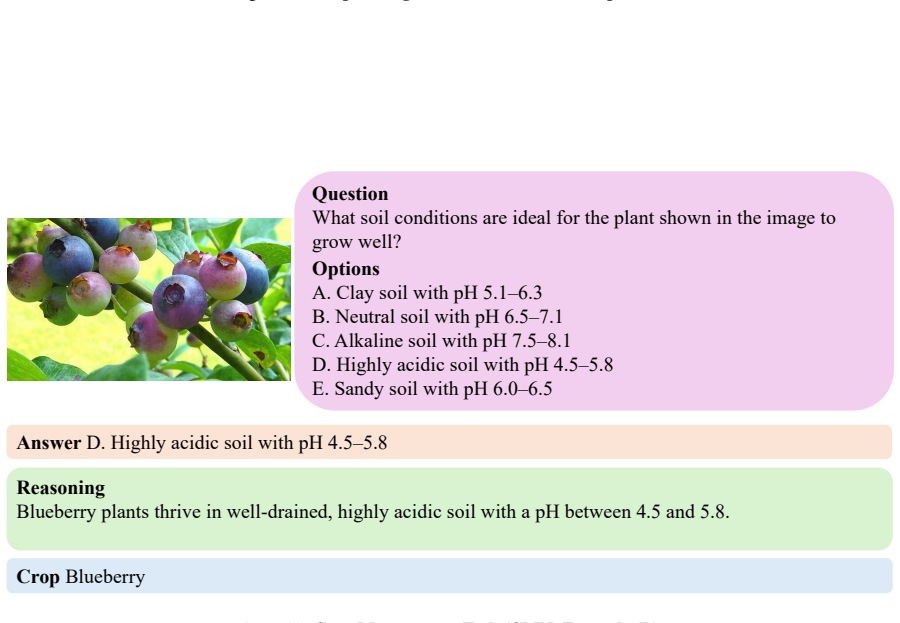
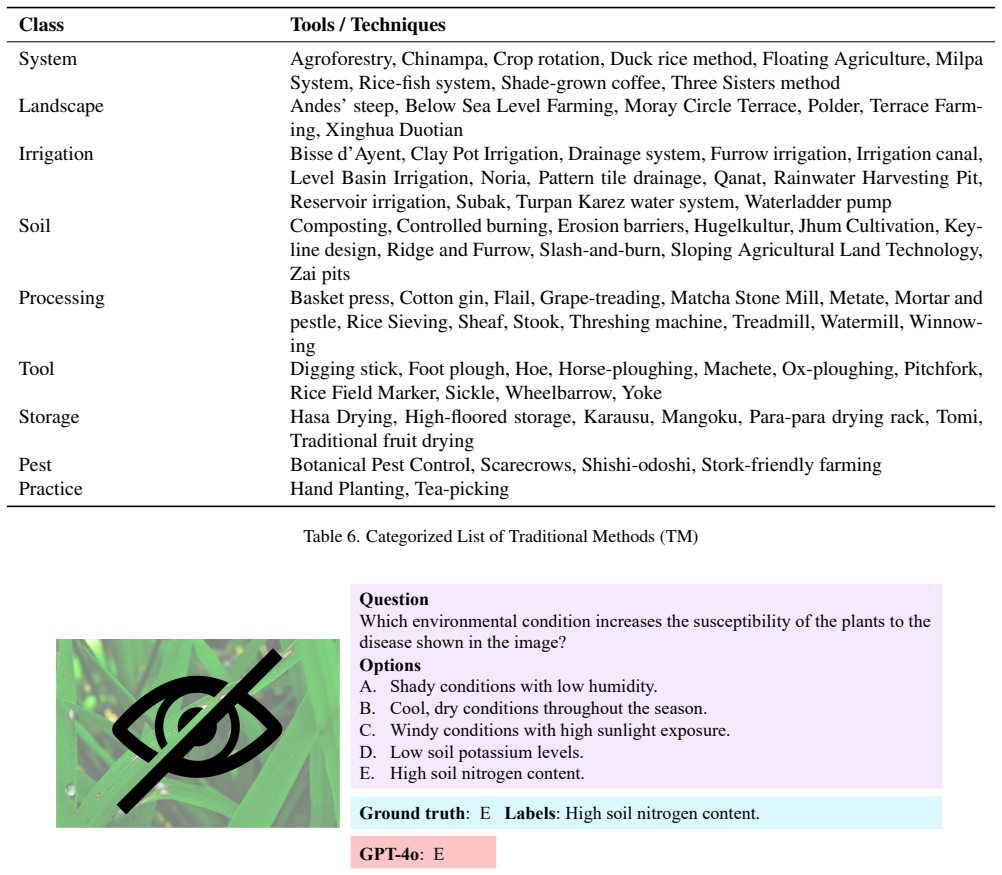
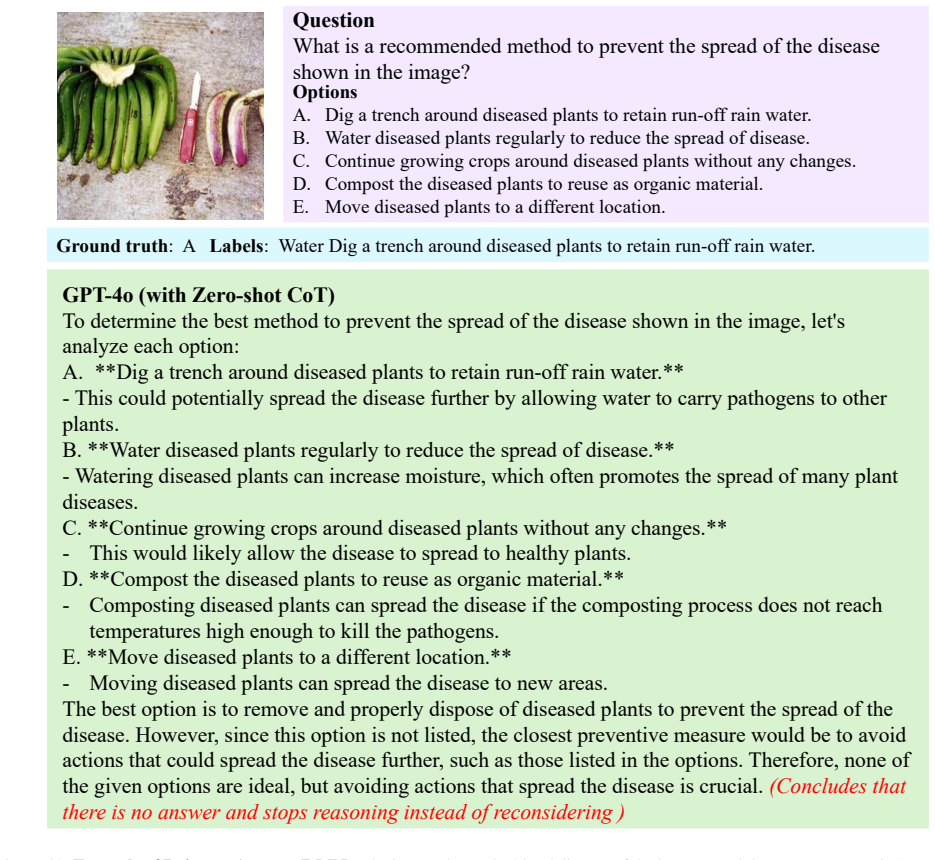
The central machinery is AgroBench itself, a benchmark organized as seven vision-language tasks, each using five-option multiple-choice questions with a single correct answer. Images were curated from licensed and public sources, with one author holding a Ph.D. in agriculture selecting clear images and another set of agricultural degree-holders reviewing the QA pairs. For the identification tasks, the benchmark deliberately includes misleading distractor options—diseases with similar symptoms, pests associated with the target crop, and weeds of similar appearance. AgroBench also computes task accuracy as an average across tasks rather than QA count, so that large categories do not dominate the overall score. This design is what lets the paper attribute failures to category-specific knowledge gaps.
What would settle it
If an independent panel of agronomists—who have not seen the benchmark—took the weed and disease identification questions under the same five-option, forced-choice format and also scored near the 20 percent random baseline, that would indicate the benchmark is measuring label ambiguity or unanswerable questions rather than VLM capability. Since the paper's own human validation shows agricultural degree-holders scoring 20-25 percent on these tasks, this check is directly relevant; a larger panel reproducing near-chance human accuracy would force a reinterpretation of the claim that VLMs specifically lack fine-grained agricultural knowledge.
Extended reading notes
Core claim
The central discovery of this paper is the construction and evaluation of AgroBench, an expert-annotated, multiple-choice benchmark of 4,342 QA pairs across seven agricultural tasks. On this benchmark, the authors establish that current vision-language models, and open-source models in particular, are far from reliable on fine-grained agricultural identification: weed identification proves the hardest task, with most open-source models performing near the random baseline, and disease identification also scores well below the management tasks. The paper's evaluation further shows that closed-source models outperform open-source models on average, and that the most common error type is lack of knowledge (51.92 percent), followed by perceptual error (32.69 percent). The authors argue that these results demonstrate the need for more fine-grained agricultural visual knowledge in VLMs and that AgroBench can serve as a comprehensive evaluation tool for future agricultural VLM development.
Load-bearing premise
The correct answers supplied by the expert annotators are accurate and unambiguous, so that a low model score is evidence of a model limitation rather than a bad or debatable question.
Editorial extensions
If this is right
- Open-source vision-language models are not yet ready for weed identification in real farm settings; most perform near random guessing on the 108 weed species covered.
- Improving fine-grained visual knowledge—especially for weeds, pests, and subtle disease symptoms—is a concrete next target for agricultural VLM development, since over half of errors are traced to missing knowledge rather than perception or reasoning.
- Because closed-source models clearly outperform open-source ones on average, model scale and web-scale training appear to matter for agricultural expertise; progress in open-source agricultural AI can be measured against the closed-source scores in AgroBench.
- The five-option multiple-choice format and per-task score averaging make AgroBench a stable, reproducible yardstick for comparing future models, including both identification and management-related tasks.
Reading between the lines
- The near-chance human scores on weed and disease identification in the paper's own validation raise the possibility that many items are extremely difficult even for trained agronomists, so a directly usable AgriBench variant might need to distinguish 'model lacks knowledge' from 'question is borderline unanswerable' before being used to certify field-ready AI.
- A natural next experiment is to measure how much accuracy improves when a model is given access to a weed or plant encyclopedia as retrieval context; since most errors are classified as lack of knowledge, retrieval-augmented answering is a testable extension of the paper's diagnosis.
- If the benchmark were expanded with per-question expert confidence ratings or multiple independent labelers, it could be used to quantify label noise and produce a difficulty-calibrated subset for tracking VLM progress on truly diagnostic items.
Signed reviews
Editorial analysis
A structured set of objections, weighed in public.
Referee Report
Summary. AgroBench introduces a seven-task, five-option multiple-choice benchmark for evaluating vision-language models (VLMs) in agriculture, comprising 4,342 QA pairs over crop/disease/pest/weed identification and crop/disease management, machine usage, and traditional methods. The authors evaluate four closed-source and eight open-source VLMs in a zero-shot setting, report a human validation on a subset, and conclude that closed-source models outperform open-source ones and that fine-grained identification — especially weed identification (WID) — remains difficult, with open-source VLMs performing close to random. The dataset and evaluation code are released, and an error analysis attributes most failures to lack of knowledge and perceptual errors.
Significance. If the benchmark's labels and images are valid, AgroBench is a useful evaluation resource: it is broader in task coverage and category counts than prior synthetic agricultural VLM benchmarks, and the human-validation attempt and error taxonomy are valuable. The claim that current VLMs lack fine-grained agricultural knowledge, particularly for weed identification, is plausible and practically important. However, the validity of the ground-truth labels for the fine-grained identification tasks is not established, and the human validation itself is at odds with the central claim: agriculture-degree participants scored at or near chance on WID (20.0%) and DID (25.0%). The reported random baseline is also miscalibrated, with several task baselines below the 20% chance level. These issues mean the headline conclusion currently rests on an unverified yardstick. The paper's strengths — broad task design, expert-authored management questions, and model/error analysis — could survive a revision that establishes label quality and recalibrates the baselines.
major comments (4)
- [Table 2; §3.2, §4.1] The human validation does not establish that the fine-grained identification labels are usable. Table 2 reports human accuracy of 20.0% on WID and 25.0% on DID for participants with at least a bachelor's degree in agriculture, while the five-option chance level is 20%. With human experts at or near chance, the possibility that many WID/DID items are ambiguous or that the distractor sets are too confusable cannot be dismissed. The central claim in the abstract and §4.2 that VLMs perform close to random in weed identification and that this reflects a lack of fine-grained VLM knowledge therefore requires an expert label-ability study (for example, independent expert annotation with per-item agreement, or a larger human evaluation) to rule out the alternative that the benchmark is measuring label uncertainty rather than model competence. The current text does not report inter-annotator agreement, and each item was answered by only two raters.
- [Table 2; §4.2] The Random Choice baseline is miscalibrated. For five-option questions the expected accuracy is exactly 20%, yet the reported Random Choice values range from 15.64% to 22.11%, including DMN 15.64%, WID 17.90%, CMN 16.06%, and TM 19.31%. These sub-20% values are used to support the 'close to random' conclusion for open-source VLMs on WID. A proper baseline should be 20% with sampling variability reported (e.g., binomial confidence intervals or a multi-seed Monte Carlo average). As reported, the comparison is not statistically grounded; for instance, EMU2Chat's 23.81% WID accuracy is numerically close to 20%, but the paper provides no error bars to establish what 'close' means relative to the 55.17% of Gemini 1.5-Pro.
- [§4.1, Table 2 caption, §4.2] The human validation protocol is described inconsistently, and the human–model comparison is not matched on the same items. Section 4.1 states that 28 students answered 20 questions each, yielding 280 questions with two responses per question (560 responses), while the Table 2 caption says validation was on 80 samples per task, which would be 560 samples for seven tasks. More importantly, human scores are computed on this small subset, whereas all model scores are computed on the full test sets (e.g., DID has 1,502 QA pairs); the §4.2 statement that 'closed-source VLMs achieve better results than humans' is therefore not a like-for-like comparison. The authors should either evaluate models on the identical human subset or collect human responses on a matched sample of the full set.
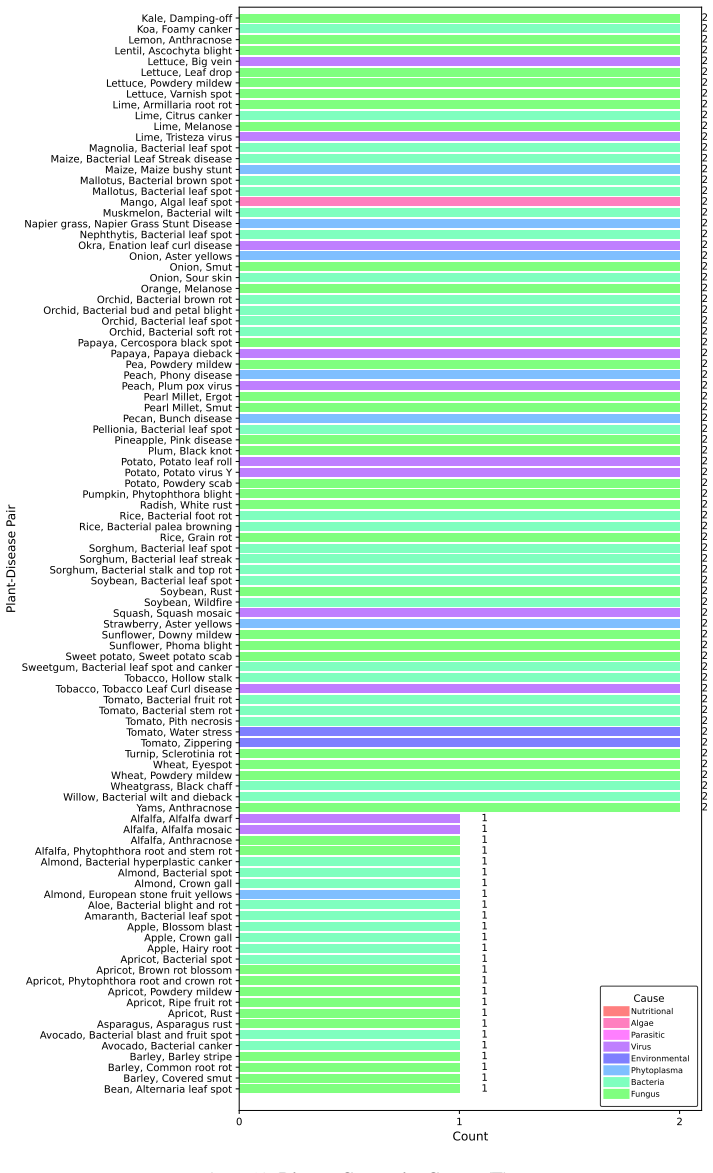
- [Abstract; §3.1; §3.2; Figure 1; Figures 8–13] The dataset is described as covering '682 disease categories' in the abstract and Figure 1, but §3.1 states that DID provides 682 crop-disease combinations covering 370 disease categories. Appendix Figures 8–13 plot 'Plant-Disease Pair' counts, confirming that 682 is the number of crop-disease pairs, not distinct diseases. This overstates the category coverage and should be corrected throughout. In addition, §3.2 states that WID images and labels are inherited from existing datasets [11,23,24,42] with code that crops images and assigns bounding boxes; no expert re-annotation of weed species is described. Since WID is the headline task on which open VLMs are 'close to random', the provenance of its labels is directly relevant to the main conclusion and must be clarified, and ideally validated by expert re-annotation.
minor comments (4)
- [Table 3 caption] The caption says text-only performance is 'close to random', but the reported text-only overall accuracies are 29.71% (GPT-4o) and 37.49% (LLaVA-Next-8B) versus the random baseline of 19.03%; this phrasing is misleading and should be revised.
- [References [6] and [7]] References [6] and [7] list the same paper ('Are we on the right way for evaluating large vision-language models?') and should be merged or one removed.
- [Figure 5 caption] There is a typo in the Figure 5 caption: 'T wo-shot' should be 'Two-shot'.
- [Figure 6] The x-axis label 'T otal' contains an erroneous space and should be 'Total'.
Circularity Check
No circularity: AgroBench is an empirical evaluation with no fitted inputs, and its central claims do not reduce to any self-citation or definitional identity.
full rationale
The paper's central claim — that open-source VLMs score near random on weed identification and that error analysis attributes most failures to lack of knowledge — rests on measuring fixed models on expert-labeled QA pairs. There is no derivation chain in the sense the circularity audit targets: no parameters are fitted, no quantity is defined in terms of another and then 'predicted', no uniqueness theorem is invoked, and no prior work by the authors carries a load-bearing argument. The only caveat that could undermine the headline is external validity of labels: Section 3.2 reports a single annotator (a Ph.D. in Agriculture) with review by other agricultural degree holders, and Table 2 shows agriculture-degree participants scoring only 20.0% on WID and 25.0% on DID. That is a validity concern about whether the images carry enough evidence or whether the five-option format is fair, not circularity: the model scores are not generated from, or constrained by, those human scores. The text-only ablation (Table 3) shows that removing images drops performance substantially, which is an independent check on task design rather than a tautology. Weed identification labels are inherited from external datasets [11,23,24,42], which raises provenance and reproducibility questions but creates no circular loop: external labels are inputs, not outputs of the paper's evaluation. No prediction here reduces to its own input by construction, so a non-finding (score 0) is the honest result.
Assumptions & free parameters
assumptions (3)
- domain assumption Ground-truth labels in AgroBench are correct and unambiguous as annotated by the author agronomist and reviewed by others.
- domain assumption Images are representative of real-world farm conditions and unambiguous for the target labels.
- domain assumption The multiple-choice QA format with five options measures VLM agricultural knowledge.
Cite this review
Pith. "Pith review of AgroBench: Vision-Language Model Benchmark in Agriculture." pith.science (2026). https://pith.science/paper/MEG7LJEH
@misc{pith2026250720519,
  author       = {Pith},
  title        = {Pith review of: AgroBench: Vision-Language Model Benchmark in Agriculture},
  year         = {2026},
  howpublished = {\url{https://pith.science/paper/MEG7LJEH}},
  note         = {Machine review of arXiv:2507.20519}
}
read the original abstract
Precise automated understanding of agricultural tasks such as disease identification is essential for sustainable crop production. Recent advances in vision-language models (VLMs) are expected to further expand the range of agricultural tasks by facilitating human-model interaction through easy, text-based communication. Here, we introduce AgroBench (Agronomist AI Benchmark), a benchmark for evaluating VLM models across seven agricultural topics, covering key areas in agricultural engineering and relevant to real-world farming. Unlike recent agricultural VLM benchmarks, AgroBench is annotated by expert agronomists. Our AgroBench covers a state-of-the-art range of categories, including 203 crop categories and 682 disease categories, to thoroughly evaluate VLM capabilities. In our evaluation on AgroBench, we reveal that VLMs have room for improvement in fine-grained identification tasks. Notably, in weed identification, most open-source VLMs perform close to random. With our wide range of topics and expert-annotated categories, we analyze the types of errors made by VLMs and suggest potential pathways for future VLM development. Our dataset and code are available at https://dahlian00.github.io/AgroBenchPage/ .
Figures


Figures from the paper (37 more)









Forward citations
Cited by 1 Pith paper
-
Visual-Language-Guided Task Planning for Horticultural Robots
A vision-language model drives a simulated greenhouse robot through simple crop-inspection tasks with ~87% success, but long multi-target tasks collapse to under 10% success.
Reference graph
Works this paper leans on
-
[1]
Paddy doctor: A visual image dataset for automated paddy disease classification and benchmarking
Petchiammal A, Briskline Kiruba S, Murugan D, and Pan- darasamy Arjunan. Paddy doctor: A visual image dataset for automated paddy disease classification and benchmarking. IEEE Dataport, 2022. 2, 3
work page 2022
-
[2]
Flamingo: a visual language model for few-shot learning
Jean-Baptiste Alayrac, Jeff Donahue, Pauline Luc, An- toine Miech, Iain Barr, Yana Hasson, Karel Lenc, Arthur Mensch, Katie Millican, Malcolm Reynolds, Roman Ring, Eliza Rutherford, Serkan Cabi, Tengda Han, Zhitao Gong, Sina Samangooei, Marianne Monteiro, Jacob Menick, Se- bastian Borgeaud, Andrew Brock, Aida Nematzadeh, Sa- hand Sharifzadeh, Mikolaj Bink...
work page 2022
-
[3]
Abderraouf Amrani, Ferdous Sohel, Dean Diepeveen, David Murray, and Michael G.K. Jones. Deep learning-based de- tection of aphid colonies on plants from a reconstructed bras- sica image dataset. Computers and Electronics in Agricul- ture, 205:107587, 2023. 2
work page 2023
-
[4]
Agrogpt: Efficient agricultural vision-language model with expert tuning
Muhammad Awais, Ali Husain Salem Abdulla Alharthi, Amandeep Kumar, Hisham Cholakkal, and Rao Muham- mad Anwer. Agrogpt: Efficient agricultural vision-language model with expert tuning. arXiv preprint arXiv:2410.08405,
-
[5]
Jinze Bai, Shuai Bai, Yunfei Chu, Zeyu Cui, Kai Dang, Xi- aodong Deng, Yang Fan, Wenbin Ge, Yu Han, Fei Huang, Binyuan Hui, Luo Ji, Mei Li, Junyang Lin, Runji Lin, Day- iheng Liu, Gao Liu, Chengqiang Lu, Keming Lu, Jianxin Ma, Rui Men, Xingzhang Ren, Xuancheng Ren, Chuanqi Tan, Sinan Tan, Jianhong Tu, Peng Wang, Shijie Wang, Wei Wang, Shengguang Wu, Benfe...
arXiv 2023
-
[7]
Lin Chen, Jinsong Li, Xiaoyi Dong, Pan Zhang, Yuhang Zang, Zehui Chen, Haodong Duan, Jiaqi Wang, Yu Qiao, Dahua Lin, et al. Are we on the right way for evaluating large vision-language models? arXiv preprint arXiv:2403.20330,
-
[8]
Pali: A jointly-scaled multilingual language- image model
Xi Chen, Xiao Wang, Soravit Changpinyo, AJ Piergiovanni, Piotr Padlewski, Daniel Salz, Sebastian Alexander Good- man, Adam Grycner, Basil Mustafa, Lucas Beyer, Alexander Kolesnikov, Joan Puigcerver, Nan Ding, Keran Rong, Has- san Akbari, Gaurav Mishra, Linting Xue, Ashish Thapliyal, James Bradbury, Weicheng Kuo, Mojtaba Seyedhosseini, Chao Jia, Burcu Kara...
work page 2023
-
[9]
Daniel Cores, Michael Dorkenwald, Manuel Mucientes, Cees G. M. Snoek, and Yuki M. Asano. Tvbench: Redesign- ing video-language evaluation. 2024. 3
work page 2024
Show all 56 references
-
[10]
tomato- village
Mamta Gehlot, Rakesh Saxena, and Geeta Gandhi. “tomato- village”: a dataset for end-to-end tomato disease detection in a real-world environment. Multimedia Systems, 29:1–24,
-
[11]
Perrenial plants detection, 2021
Benedikt Geisler. Perrenial plants detection, 2021. 5
2021
-
[12]
A crop/weed field im- age dataset for the evaluation of computer vision based pre- cision agriculture tasks
Sebastian Haug and J ¨orn Ostermann. A crop/weed field im- age dataset for the evaluation of computer vision based pre- cision agriculture tasks. In Proc. European Conference on Computer Vision (ECCV), pages 105–116. Springer, 2014. 3
2014
-
[13]
Image classification for cssvd detection in cacao plants
Atuhurra Jesse, N’guessan Yves-Roland Douha, and Pabi- tra Lenka. Image classification for cssvd detection in cacao plants. arXiv preprint 2405.04535, 2024. 2, 3
2024 arXiv
-
[14]
BLIP: Bootstrapping language-image pre-training for unified vision-language understanding and generation
Junnan Li, Dongxu Li, Caiming Xiong, and Steven Hoi. BLIP: Bootstrapping language-image pre-training for unified vision-language understanding and generation. In Proceed- ings of the 39th International Conference on Machine Learn- ing, pages 12888–12900. PMLR, 2022. 3
2022
-
[15]
BLIP-2: Bootstrapping language-image pre-training with frozen image encoders and large language models
Junnan Li, Dongxu Li, Silvio Savarese, and Steven Hoi. BLIP-2: Bootstrapping language-image pre-training with frozen image encoders and large language models. In Pro- ceedings of the 40th International Conference on Machine Learning, pages 19730–19742. PMLR, 2023. 3
2023
-
[16]
Mvbench: A comprehensive multi- modal video understanding benchmark
Kunchang Li, Yali Wang, Yinan He, Yizhuo Li, Yi Wang, Yi Liu, Zun Wang, Jilan Xu, Guo Chen, Ping Luo, Limin Wang, and Yu Qiao. Mvbench: A comprehensive multi- modal video understanding benchmark. In CVPR, 2024. 3
2024
-
[17]
Improved baselines with visual instruction tuning
Haotian Liu, Chunyuan Li, Yuheng Li, and Yong Jae Lee. Improved baselines with visual instruction tuning. arXiv:2310.03744, 2023. 2, 3
2023 arXiv
-
[18]
Visual instruction tuning
Haotian Liu, Chunyuan Li, Qingyang Wu, and Yong Jae Lee. Visual instruction tuning. In NeurIPS, 2023. 2, 3, 6, 12
2023
-
[19]
Llava-next: Im- proved reasoning, ocr, and world knowledge, 2024
Haotian Liu, Chunyuan Li, Yuheng Li, Bo Li, Yuanhan Zhang, Sheng Shen, and Yong Jae Lee. Llava-next: Im- proved reasoning, ocr, and world knowledge, 2024. 2, 6, 12
2024
-
[20]
A multimodal bench- mark dataset and model for crop disease diagnosis
Xiang Liu, Zhaoxiang Liu, Huan Hu, Zezhou Chen, Kohou Wang, Kai Wang, and Shiguo Lian. A multimodal bench- mark dataset and model for crop disease diagnosis. In Proc. European Conference on Computer Vision (ECCV), 2024. 2, 3
2024
-
[21]
Masks-to-skeleton: Multi-view mask-based 9 tree skeleton extraction with 3d gaussian splatting
Xinpeng Liu, Kanyu Xu, Risa Shinoda, Hiroaki Santo, and Fumio Okura. Masks-to-skeleton: Multi-view mask-based 9 tree skeleton extraction with 3d gaussian splatting. Sensors, 25(14), 2025. 2
2025
-
[22]
Canopy-attention-yolov4-based immature/mature apple fruit detection on dense-foliage tree architectures for early crop load estimation
Shenglian Lu, Wenkang Chen, Xin Zhang, and Manoj Kar- kee. Canopy-attention-yolov4-based immature/mature apple fruit detection on dense-foliage tree architectures for early crop load estimation. Computers and Electronics in Agricul- ture, 193:106696, 2022. 2
2022
-
[23]
Cottonweeddet3
Yuzhen Lu. Cottonweeddet3. kaggle, 2022. 5
2022
-
[24]
Open Plant Phenotype Database of Common Weeds in Denmark, 2020
Simon Leminen Madsen, Solvejg Kopp Mathiassen, Mads Dyrmann, Morten Stigaard Laursen, Laura-Carlota Paz, and Rasmus Nyholm Jørgensen. Open Plant Phenotype Database of Common Weeds in Denmark, 2020. 5
2020
-
[25]
A novel dataset of guava fruit for grading and classification
Abdul Khalique Maitlo, Abdul Aziz, Hassnian Raza, and Neelam Abbas. A novel dataset of guava fruit for grading and classification. Data in Brief, 49:109462, 2023. 2
2023
-
[26]
ChartQA: A benchmark for question answer- ing about charts with visual and logical reasoning
Ahmed Masry, Do Long, Jia Qing Tan, Shafiq Joty, and Ena- mul Hoque. ChartQA: A benchmark for question answer- ing about charts with visual and logical reasoning. In Find- ings of the Association for Computational Linguistics: ACL 2022, pages 2263–2279, Dublin, Ireland, 2022. ...
2022
-
[27]
Nakayama, Jose M
Jo ˜ao Matos, Shan Chen, Siena Placino, Yingya Li, Juan Car- los Climent Pardo, Daphna Idan, Takeshi Tohyama, David Restrepo, Luis F. Nakayama, Jose M. M. Pascual-Leone, Guergana Savova, Hugo Aerts, Leo A. Celi, A. Ian Wong, Danielle S. Bitterman, and Jack Gallifant. Worldmedq...
2024
-
[28]
Khapra, and Pratyush Kumar
Nitesh Methani, Pritha Ganguly, Mitesh M. Khapra, and Pratyush Kumar. Plotqa: Reasoning over scientific plots. In WACV, pages 1516–1525, 2020. 2, 3
2020
-
[29]
Mohanty, David P
Sharada P. Mohanty, David P. Hughes, and Marcel Salath ´e. Using deep learning for image-based plant disease detection. Frontiers in Plant Science, 7, 2016. 3
2016
-
[30]
Video-bench: A com- prehensive benchmark and toolkit for evaluating video-based large language models, 2023
Munan Ning, Bin Zhu, Yujia Xie, Bin Lin, Jiaxi Cui, Lu Yuan, Dongdong Chen, and Li Yuan. Video-bench: A com- prehensive benchmark and toolkit for evaluating video-based large language models, 2023. 3
2023
-
[31]
Deepweeds: A multiclass weed species image dataset for deep learning
Alex Olsen, Dmitry A Konovalov, Bronson Philippa, Peter Ridd, Jake C Wood, Jamie Johns, Wesley Banks, Benjamin Girgenti, Owen Kenny, James Whinney, et al. Deepweeds: A multiclass weed species image dataset for deep learning. Scientific reports, 9(1):2058, 2019. 3
2019
-
[32]
Gpt-4o, 2024
OpenAI. Gpt-4o, 2024. Accessed: 2024-11-13. 2, 3, 6, 12
2024
-
[33]
Gpt-4o mini, 2024
OpenAI. Gpt-4o mini, 2024. Accessed: 2024-11-13. 2, 6, 12
2024
-
[34]
In- dian rice disease dataset (irdd), 2023
Chiranjit Pal, Imon Mukherjee, Sanjay Chatterji, Sanjoy Pratihar, Pabitra Mitra, and Partha Pratim Chakrabarti. In- dian rice disease dataset (irdd), 2023. 2, 3
2023
-
[35]
Learning transferable visual models from natural language supervision
Alec Radford, Jong Wook Kim, Chris Hallacy, Aditya Ramesh, Gabriel Goh, Sandhini Agarwal, Girish Sastry, Amanda Askell, Pamela Mishkin, Jack Clark, Gretchen Krueger, and Ilya Sutskever. Learning transferable visual models from natural language supervision. In ICML, 2021. 3
2021
-
[36]
Multimedeval: A benchmark and a toolkit for evaluating medical vision-language models, 2024
Corentin Royer, Bjoern Menze, and Anjany Sekuboyina. Multimedeval: A benchmark and a toolkit for evaluating medical vision-language models, 2024. 3
2024
-
[37]
Coffee and cashew nut dataset: A dataset for detection, classification, and yield estimation for machine learning applications
Rahman Sanya, Ann Lisa Nabiryo, Jeremy Francis Tusubira, Sudi Murindanyi, Andrew Katumba, and Joyce Nakatumba- Nabende. Coffee and cashew nut dataset: A dataset for detection, classification, and yield estimation for machine learning applications. Data in Brief, 52:109952, 2024. 2
2024
-
[38]
A novel dataset of potato leaf disease in uncon- trolled environment
Nabila Husna Shabrina, Siwi Indarti, Rina Maharani, Di- nar Ajeng Kristiyanti, Irmawati, Niki Prastomo, and Tika Adilah M. A novel dataset of potato leaf disease in uncon- trolled environment. Data in Brief, 52:109955, 2024. 2
2024
-
[39]
Transformer-based ripeness segmentation for tomatoes
Risa Shinoda, Hirokatsu Kataoka, Kensho Hara, and Ry- ozo Noguchi. Transformer-based ripeness segmentation for tomatoes. Smart Agricultural Technology, 4:100196, 2023. 2
2023
-
[40]
Sbs figures: Pre-training figure qa from stage-by-stage synthesized images, 2024
Risa Shinoda, Kuniaki Saito, Shohei Tanaka, Tosho Hira- sawa, and Yoshitaka Ushiku. Sbs figures: Pre-training figure qa from stage-by-stage synthesized images, 2024. 3
2024
-
[41]
Plantdoc: A dataset for visual plant disease detection
Davinder Singh, Naman Jain, Pranjali Jain, Pratik Kayal, Sudhakar Kumawat, and Nipun Batra. Plantdoc: A dataset for visual plant disease detection. InProc. ACM IKDD CoDS and COMAD, page 249–253, 2020. 2, 3
2020
-
[42]
The cropandweed dataset: A multi-modal learning approach for efficient crop and weed manipulation
Daniel Steininger, Andreas Trondl, Gerardus Croonen, Julia Simon, and Verena Widhalm. The cropandweed dataset: A multi-modal learning approach for efficient crop and weed manipulation. In WACV, pages 3729–3738, 2023. 3, 5
2023
-
[43]
Timbervision: A multi-task dataset and frame- work for log-component segmentation and tracking in au- tonomous forestry operations
Daniel Steininger, Julia Simon, Andreas Trondl, and Markus Murschitz. Timbervision: A multi-task dataset and frame- work for log-component segmentation and tracking in au- tonomous forestry operations. In Proceedings of the IEEE/CVF Winter Conference on Applications of Compute...
2025
-
[44]
Generative multimodal models are in-context learners
Quan Sun, Yufeng Cui, Xiaosong Zhang, Fan Zhang, Qiy- ing Yu, Zhengxiong Luo, Yueze Wang, Yongming Rao, Jingjing Liu, Tiejun Huang, and Xinlong Wang. Generative multimodal models are in-context learners. arXiv preprint arXiv:2312.13286, 2023. 3, 6
2023 arXiv
-
[45]
Generative pretraining in mul- timodality
Quan Sun, Qiying Yu, Yufeng Cui, Fan Zhang, Xiaosong Zhang, Yueze Wang, Hongcheng Gao, Jingjing Liu, Tiejun Huang, and Xinlong Wang. Generative pretraining in mul- timodality. arXiv preprint arXiv:2307.05222 , 2023. 2, 3, 12
2023 arXiv
-
[46]
Gemini 1.5: Unlocking multimodal understanding across millions of tokens of context, 2024
Google Gemini Team. Gemini 1.5: Unlocking multimodal understanding across millions of tokens of context, 2024. 2, 3, 6, 12
2024
-
[47]
Sugarcane leaf dataset: A dataset for disease de- tection and classification for machine learning applications
Sandip Thite, Yogesh Suryawanshi, Kailas Patil, and Prawit Chumchu. Sugarcane leaf dataset: A dataset for disease de- tection and classification for machine learning applications. Data in Brief, 53:110268, 2024. 2, 3
2024
-
[48]
Agri-llava: Knowledge-infused large multimodal assistant on agricultural pests and diseases
Liqiong Wang, Teng Jin, Jinyu Yang, Ales Leonardis, Fangyi Wang, and Feng Zheng. Agri-llava: Knowledge-infused large multimodal assistant on agricultural pests and diseases. arXiv preprint arXiv:2412.02158, 2024. 2
2024 arXiv
-
[49]
Agripest: A large-scale domain-specific bench- mark dataset for practical agricultural pest detection in the wild
Rujing Wang, Liu Liu, Chengjun Xie, Po Yang, Rui Li, and Man Zhou. Agripest: A large-scale domain-specific bench- mark dataset for practical agricultural pest detection in the wild. Sensors, 21(5), 2021. 2, 3
2021
-
[50]
Cogvlm: Visual expert for pretrained language models
Weihan Wang, Qingsong Lv, Wenmeng Yu, Wenyi Hong, Ji Qi, Yan Wang, Junhui Ji, Zhuoyi Yang, Lei Zhao, Xixuan 10 Song, Jiazheng Xu, Bin Xu, Juanzi Li, Yuxiao Dong, Ming Ding, and Jie Tang. Cogvlm: Visual expert for pretrained language models. In NeurIPS, 2024. 2, 3, 6, 12
2024
-
[51]
Emu3: Next-token prediction is all you need
Xinlong Wang, Xiaosong Zhang, Zhengxiong Luo, Quan Sun, Yufeng Cui, Jinsheng Wang, Fan Zhang, Yueze Wang, Zhen Li, Qiying Yu, et al. Emu3: Next-token prediction is all you need. arXiv preprint arXiv:2409.18869, 2024. 3
2024 arXiv
-
[52]
Benchmarking in-the-wild multimodal disease recognition and a versatile baseline
Tianqi Wei, Zhi Chen, Zi Huang, and Xin Yu. Benchmarking in-the-wild multimodal disease recognition and a versatile baseline. In Proc. ACM International Conference on Multi- media (ACMMM), 2024. 2, 3
2024
-
[53]
Ip102: A large-scale benchmark dataset for insect pest recognition
Xiaoping Wu, Chi Zhan, Yukun Lai, Ming-Ming Cheng, and Jufeng Yang. Ip102: A large-scale benchmark dataset for insect pest recognition. In CVPR, pages 8787–8796, 2019. 2, 3
2019
-
[54]
Crop identification using deep learning on lucas crop cover photos
Momchil Yordanov, Rapha ¨el d’Andrimont, Laura Martinez- Sanchez, Guido Lemoine, Dominique Fasbender, and Marijn van der Velde. Crop identification using deep learning on lucas crop cover photos. Sensors, 23(14), 2023. 2
2023
-
[55]
Mmmu: A massive multi-discipline multimodal understand- ing and reasoning benchmark for expert agi
Xiang Yue, Yuansheng Ni, Kai Zhang, Tianyu Zheng, Ruoqi Liu, Ge Zhang, Samuel Stevens, Dongfu Jiang, Weiming Ren, Yuxuan Sun, Cong Wei, Botao Yu, Ruibin Yuan, Ren- liang Sun, Ming Yin, Boyuan Zheng, Zhenzhu Yang, Yibo Liu, Wenhao Huang, Huan Sun, Yu Su, and Wenhu Chen. Mmmu: A...
2024
-
[56]
Mmmu-pro: A more robust multi-discipline multimodal un- derstanding benchmark
Xiang Yue, Tianyu Zheng, Yuansheng Ni, Yubo Wang, Kai Zhang, Shengbang Tong, Yuxuan Sun, Botao Yu, Ge Zhang, Huan Sun, Yu Su, Wenhu Chen, and Graham Neubig. Mmmu-pro: A more robust multi-discipline multimodal un- derstanding benchmark. arXiv preprint arXiv:2409.02813 ,
-
[2024]
Statistics This section provides detailed statistics of AgroBench
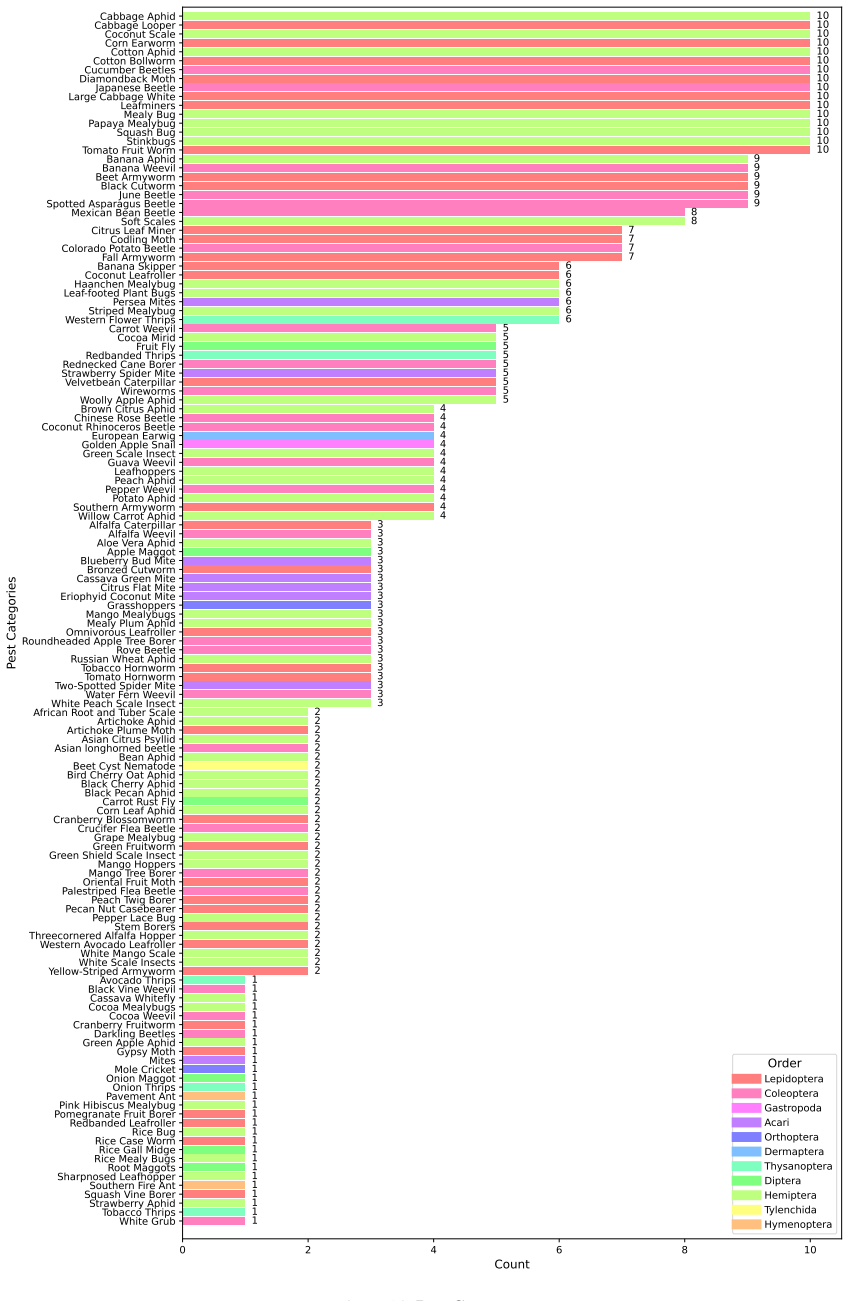
2, 3 11 A. Statistics This section provides detailed statistics of AgroBench. In Figs. 8, 9, 10, 11, 12, and 13, we present the distribution of 682 plant-disease categories, categorized by the cause of the disease. The distribution of 134 pest categories is shown in Fig. 14, a...
2024
Reviewed August 15, 2026 · model on record in the stance chip above.
Discussion (0). Continue with ORCID to comment.