REVIEW 4 major objections 7 minor 38 references
Fusing CFD and measurement data using transfer learning
T0 review · 4 major / 7 minor · reviewed 2026-08-15 · deepseek-v4-flash
Pith's one-line read Transfer learning fuses dense CFD with sparse wind-tunnel data and beats gappy POD on unseen conditions.
desk verdict A solid engineering paper that does what it says—a mesh-free transfer-learning surrogate that beats gappy POD on transonic data—but the headline claim about inheriting measurement accuracy is only as good as the assumption that the measurements are error-free, which the authors openly concede. read the letter →
The pith
A machine-rendered reading of the paper's core claim, the machinery that carries it, and where it could break.
The reading
What carries the argument
The load-bearing object is a coordinate-based multilayer perceptron whose inputs are freestream Mach number, angle of attack, spatial coordinates, and surface normals, and whose output is the pressure coefficient. It is trained in two stages: pre-training on dense CFD data (min-max scaled inputs, ELU hidden layers, exponential learning-rate decay, early stopping) teaches the spatial structure of the flow; fine-tuning on sparse measurements with the first two layers frozen and a learning rate two orders of magnitude smaller corrects systematic CFD error without destroying learned features. The mesh-free formulation is what lets the two data sources live on different grids, and the partial freezing is what lets a tiny measurement set adjust the whole surface solution.
What would settle it
Take a set of held-out sensor sections, fine-tune the network on the remaining sections using synthetic measurements with a known additive bias, and check whether the predicted pressure at the held-out points shifts by the same bias; if it does, the model transfers measurement error to the whole surface and the fusion claim reduces to trusting the sensors.
Extended reading notes
Core claim
On the surface pressure distribution of the common research model, the paper claims that an MLP pre-trained on about ten million CFD grid-point samples and fine-tuned on roughly eight thousand sparse measurement samples can correct the systematic error between rigid CFD and aero-elastic reality, with the fine-tuned network outperforming gappy POD on unseen data (full-test RMSE 1.47e-2 versus 1.87e-2). The central discovery is that freezing only the first two layers and re-training the remaining 84 percent of parameters with a small learning rate is enough to transfer measurement accuracy across the whole spatial domain, including spanwise sections that lie between sensor rows. The multi-point strategy, which fine-tunes on several flow conditions and predicts an unseen one, reaches the same RMSE as single-point fine-tuning, showing that the correction generalizes in parameter space. Unlike gappy POD, the model is mesh-free and parametric, so it evaluates at arbitrary coordinates and flow conditions.
Load-bearing premise
The method assumes wind-tunnel measurements are error-free ground truth, so any bias in the measurements is copied onto the entire predicted surface.
Editorial extensions
If this is right
- Fused pressure predictions are available at arbitrary spatial coordinates and arbitrary flow conditions, not just at the measured sensor locations or the original CFD grid.
- Fine-tuning on a handful of measurement conditions generalizes to unseen conditions about as well as fine-tuning on the exact condition, so measurements can be shared across the parameter space.
- Near shocks, the neural network avoids the nonphysical oscillations of gappy POD and locates the shock more accurately, which matters for structural loads and performance.
- The two-stage recipe is architecture-agnostic and can be applied to graph neural networks or other models, potentially improving accuracy further.
Reading between the lines
- If wind-tunnel measurements carry a bias the authors do not model, the fine-tuned network will inherit that bias on the entire surface; the paper's own conclusion flags this ground-truth assumption as the place to add uncertainty handling.
- Because the inputs are coordinates plus flow parameters and the formulation is mesh-free, the same two-stage recipe should transfer to other distributed surface quantities, such as skin friction or heat flux, where CFD grids and sensor locations also differ.
- The multi-point strategy's success suggests a testable design rule: adding more flow conditions to the fine-tuning set can substitute for dense spatial sensors, since a few sections sufficed to correct spanwise trends.
Signed reviews
Editorial analysis
A structured set of objections, weighed in public.
Referee Report
Summary. This paper proposes a two-stage transfer-learning method for fusing CFD and wind-tunnel pressure data on aircraft surfaces. A multilayer perceptron with inputs (Mach number, angle of attack, surface coordinates, surface normals) is pre-trained on roughly 10 million samples from 80 rigid RANS solutions of the NASA common research model, then fine-tuned on sparse measurements while the first two layers remain frozen; the number of retrained layers and the fine-tuning learning rate are chosen by a second hyperparameter optimization. The authors compare a single-point strategy (fine-tune and predict at the same flow condition) with a multi-point strategy (fine-tune on several conditions, predict at unseen conditions), benchmarking both against Bayesian gappy POD. Validation uses (i) synthetic measurements extracted from aeroelastic CFD to enable whole-surface RMSE comparisons (Table 2: full-test RMSE 1.47e-2 for both NN strategies versus 1.87e-2 for gappy POD and 4.09e-2 for the base network) and (ii) real ETW wind-tunnel data with two spanwise sections held out, where the NN is shown qualitatively to match the measurements better than gappy POD, particularly at transonic shocks. The authors explicitly note in Sec. 5 that the method treats measurements as ground truth despite their known uncertainties.
Significance. If the results hold, the paper provides a useful nonlinear alternative to gappy POD for aerodynamic data fusion, with two concrete advantages that the experiments support: mesh-free prediction at arbitrary surface coordinates, and a multi-point strategy that predicts at flow conditions for which no measurement exists. The transonic comparison is the most convincing element: the NN reproduces shock location and strength where the linear POD basis produces nonphysical oscillations (Figs. 5-8). The paper is also commendably explicit about its limitations (measurements treated as ground truth; no uncertainty quantification). The main reservations concern the strength of the evidence: the comparative claim rests on a single run without error bars, the gappy POD baseline's truncation rank is unreported, the synthetic measurements are noise-free by construction, and the real-data validation is qualitative. These are fixable within the scope of a revision. The methodological novelty is incremental rather than foundational, but the application to heterogeneous-resolution data with systematic-error correction is a worthwhile contribution to the data-fusion literature.
major comments (4)
- [Sec. 5; Secs. 4.3-4.4] The central claim that the fused model 'inherits the high accuracy from the measurement data' (Abstract and Sec. 2) rests on treating wind-tunnel measurements as error-free ground truth, an assumption the authors themselves concede in Sec. 5 ('the chosen approach in this work assumes the measurements as ground truth, although they usually feature several sources of uncertainty'). The synthetic validation in Sec. 4.3 uses noise-free measurements extracted from the same aeroelastic CFD family as the reference, so it shares the solver's modeling assumptions and cannot reveal how sensor bias, tap-position error, or tunnel interference propagate through fine-tuning; the real-data validation in Sec. 4.4 checks only agreement with the held-out measurement sections, which is consistent with the model having inherited any systematic bias in the measurements. I request a sensitivity experiment in which realistic measurement error is injected into the synthetic measurements (for example, additive Gaussian noise at levels reported for pressure taps, or a systematic bias applied to a subset of sensors), with the RMSE reported as a function of the noise amplitude. This is an external-validity gap rather than an internal inconsistency, but it directly bears on the paper's central value proposition.
- [Table 2 and Sec. 4.3] The quantitative comparison between methods is reported as single RMSE values with no error bars, repeated trials, or per-condition statistics. Because fine-tuning re-trains about 84% of the network parameters on only 8,096 samples, run-to-run variance is a real concern, and the reported difference between the best NN (1.47e-2) and gappy POD (1.87e-2) cannot be judged for statistical significance. In particular, the fact that the single-point and multi-point strategies yield exactly the same full-test RMSE to three significant figures suggests either a single seed or rounding that hides a real difference. I request that the fine-tuning runs be repeated over several seeds (at least five) and reported as mean plus/minus standard deviation, along with a per-condition breakdown of the RMSE over the entire test set.
- [Sec. 3 and Table 2] The truncation rank r of the POD basis for the gappy POD baseline is never reported, nor is the treatment of the noise covariance Sigma in Eq. (4) specified for the noise-free synthetic measurements. Since r controls the baseline's bias-variance trade-off, the reader cannot judge whether the gappy POD results in Table 2 are representative of the method at its best: too small an r underfits the transonic shocks and too large an r amplifies noise. Please state the value(s) of r used and how it was selected for both the synthetic and the real-data experiments, and specify how the sigma^2 term in Eqs. (5)-(6) was regularized when the synthetic measurements are noiseless.
- [Sec. 4.4 and Figs. 7-8] The real-data validation is reported only through qualitative figures; no quantitative error metric is given for the held-out sections 3 and 9. Since the measurements at those sections provide an obvious ground truth, an RMSE or mean-absolute-error comparison between the NN variants and gappy POD at the held-out sensor positions should be added; this would make the claim that 'the neural network outperforms the gappy POD' (Sec. 4.4) verifiable rather than visual. In particular, Fig. 8 shows noticeable deviations in shock strength and position at section 9, and a quantitative statement would clarify the extent of the extrapolation error.
minor comments (7)
- [Sec. 4.3] The word 'Teble' in the sentence referring to Table 2 should be 'Table'.
- [Sec. 5] In the final paragraph, 'it can applied to' should be 'it can be applied to'.
- [Eq. (4)] The dimensions in Eq. (4) are inconsistent as written: L(delta) is stated to be in R^{N x m} and U_r in R^{N x r}, so the product L(delta) U_r is undefined; presumably a transposed observation operator, e.g., L(delta)^T U_r, is intended. The same issue appears in the definition of x = L(delta) U_r below Eq. (5).
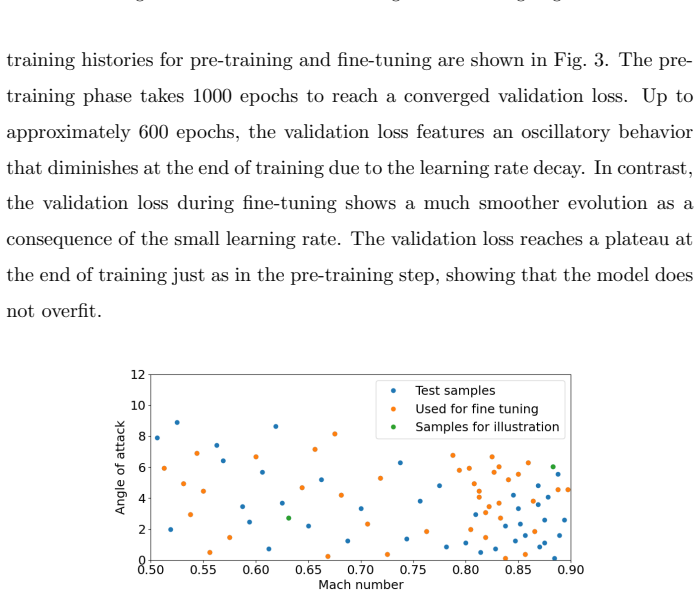
- [Sec. 4.2] Please clarify whether the hyperparameter optimization for fine-tuning used only the 'orange' fine-tuning samples of Fig. 4 or also the 'blue' test samples; as written, the optimization is 'based on the synthetic measurement data described in Sec. 4.3,' which could be read as including the test conditions.
- [Table 2] The number of flow conditions in the 'Entire test data set' row of Table 2 is not stated; please report it so the reader can assess the aggregation.
- [Sec. 4.2] The pre-training data set is described as approximately 10 million samples from 80 CFD solutions, which implies about 125,000 surface points per condition; since the computational grid contains 22 x 10^6 points, it would help to state explicitly that only the surface mesh (or a subsampled version) is used for training.
- [General] The manuscript does not state whether the trained models or the fine-tuning implementation will be made available; for a methods paper with a stochastic training pipeline, releasing the code and the data splits would substantially aid reproducibility.
Circularity Check
No significant circularity: fine-tuning is evaluated on held-out flow conditions and held-out sensor sections, so the reported RMSE improvements are genuine predictions.
full rationale
The paper's derivation chain is self-contained against external benchmarks. The neural network is pre-trained on rigid CFD data (Sec. 4.2), then fine-tuned on sparse measurement data; the central quantitative claim (Table 2) is computed on the entire test data set, which for the multi-point strategy consists of flow conditions not used in fine-tuning, and for the single-point strategy consists of spatial locations not used in fine-tuning (Sec. 4.3). The comparison with gappy POD uses the same rigid CFD snapshots and the same sparse measurements for both methods, so the RMSE values (1.47e-2 vs. 1.87e-2) are not forced by construction. The real-data validation in Sec. 4.4 likewise holds out sensor sections 3 and 9 during training, so agreement at those sections measures spatial generalization rather than memorization. The fine-tuning hyperparameters were selected on synthetic measurement data (Sec. 4.2), but hyperparameters do not determine the specific test outputs, so this is not a fitted-input-called-prediction issue. The architecture is adopted from the authors' prior work [18], and the gappy POD baseline from [24] includes a co-author, but neither citation is used as a uniqueness theorem or to forbid alternatives; the comparison is computed in this paper. The Sec. 5 admission that 'the chosen approach in this work assumes the measurements as ground truth' is an external-validity limitation about measurement noise and bias, not a circularity: even a biased measurement target is an independent target, and the model's ability to match it on held-out sections is still a genuine prediction. No equation in the paper is defined in terms of its own fitted output, and no prediction reduces by construction to a training input.
Assumptions & free parameters
free parameters (6)
- MLP weights and biases =
Not enumerated; ~37k parameters for 9 hidden layers of 64 units
- Pre-training hyperparameters =
lr=1e-3, decay=0.995, 9 layers, 64 units
- Fine-tuning hyperparameters =
lr=3e-5, decay=0.998, 7 of 9 layers re-trained
- POD truncation rank r for gappy POD baseline =
Not reported
- Gappy POD kernel hyperparameters theta0, theta1, theta2 =
Not reported
- Train/validation split ratio for CFD pre-training =
80/20 random split
assumptions (5)
- domain assumption RANS CFD with the Spalart-Allmaras model is a useful low-fidelity (or cheaper) source of spatially dense training data.
- domain assumption The aeroelastic coupled simulations provide a suitable 'truth' for synthetic measurements in the validation.
- domain assumption Wind-tunnel measurements are treated as ground truth with zero systematic or random error during fine-tuning.
- domain assumption A multilayer perceptron with coordinates, normals, Mach number, and angle of attack as inputs can represent surface pressure distributions including shocks at arbitrary points on the geometry.
- standard math Standard linear algebra and Gaussian process regression results used for the gappy POD baseline are correct.
Cite this review
Pith. "Pith review of Fusing CFD and measurement data using transfer learning." pith.science (2026). https://pith.science/paper/OUIUNX72
@misc{pith2026250720576,
  author       = {Pith},
  title        = {Pith review of: Fusing CFD and measurement data using transfer learning},
  year         = {2026},
  howpublished = {\url{https://pith.science/paper/OUIUNX72}},
  note         = {Machine review of arXiv:2507.20576}
}
read the original abstract
Aerodynamic analysis during aircraft design usually involves methods of varying accuracy and spatial resolution, which all have their advantages and disadvantages. It is therefore desirable to create data-driven models which effectively combine these advantages. Such data fusion methods for distributed quantities mainly rely on proper orthogonal decomposition as of now, which is a linear method. In this paper, we introduce a non-linear method based on neural networks combining simulation and measurement data via transfer learning. The network training accounts for the heterogeneity of the data, as simulation data usually features a high spatial resolution, while measurement data is sparse but more accurate. In a first step, the neural network is trained on simulation data to learn spatial features of the distributed quantities. The second step involves transfer learning on the measurement data to correct for systematic errors between simulation and measurement by only re-training a small subset of the entire neural network model. This approach is applied to a multilayer perceptron architecture and shows significant improvements over the established method based on proper orthogonal decomposition by producing more physical solutions near nonlinearities. In addition, the neural network provides solutions at arbitrary flow conditions, thus making the model useful for flight mechanical design, structural sizing, and certification. As the proposed training strategy is very general, it can also be applied to more complex neural network architectures in the future.
Figures


Figures from the paper (5 more)


Reference graph
Works this paper leans on
-
[1]
Z.-H. Han, Zimmermann, S. G¨ ortz, Alternative cokriging method for variable-fidelity surrogate modeling, AIAA Journal 50 (5) (2012) 1205–
work page 2012
-
[2]
Z.-H. Han, R. Zimmermann, S. G¨ ortz, A new cokriging method for variable- fidelity surrogate modeling of aerodynamic data, in: 48th AIAA Aerospace sciences meeting, 2010, p. 1225
work page 2010
-
[3]
Z.-H. Han, S. G¨ ortz, Hierarchical kriging model for variable- fidelity surrogate modeling, AIAA Journal 50 (9) (2012) 1885–1896. doi:10.2514/1.J051354
-
[4]
Z.-H. Han, S. G¨ ortz, R. Zimmermann, Improving variable-fidelity sur- rogate modeling via gradient-enhanced kriging and a generalized hybrid bridge function, Aerospace Science and Technology 25 (1) (2013) 177–189. doi:10.1016/j.ast.2012.01.006
-
[5]
A. Feldstein, D. Lazzara, N. Princen, K. Willcox, Multifidelity data fu- sion: Application to blended-wing-body multidisciplinary analysis under uncertainty, AIAA Journal 58 (2) (2020) 889–906. doi:10.2514/1.J058388. 21
-
[6]
Y. Kuya, K. Takeda, X. Zhang, A. I. J. Forrester, Multifidelity surrogate modeling of experimental and computational aerodynamic data sets, AIAA Journal 49 (2) (2011) 289–298. doi:10.2514/1.J050384
-
[7]
S. Choi, J. J. Alonso, I. M. Kroo, M. Wintzer, Multifidelity design op- timization of low-boom supersonic jets, Journal of Aircraft 45 (1) (2008) 106–118. doi:10.2514/1.28948
-
[8]
A. I. Forrester, A. S´ obester, A. J. Keane, Multi-fidelity optimization via surrogate modelling, Proceedings of the Royal Society A: Mathe- matical, Physical and Engineering Sciences 463 (2088) (2007) 3251–3269. doi:10.1098/rspa.2007.1900
arXiv 2007
Show all 38 references
-
[9]
A. J. Keane, Wing optimization using design of experiment, response sur- face, and data fusion methods, Journal of Aircraft 40 (4) (2003) 741–750. doi:10.2514/2.3153
2003 doi
-
[10]
Stradtner, C
M. Stradtner, C. M. Liersch, P. Bekemeyer, An aerodynamic variable- fidelity modelling framework for a low-observable ucav, Aerospace Science and Technology 107 (2020) 106232. doi:10.1016/j.ast.2020.106232
2020
-
[11]
D. J. Lucia, P. S. Beran, W. A. Silva, Reduced-order modeling: new ap- proaches for computational physics, Progress in Aerospace Sciences 40 (1-2) (2004) 51–117. doi:10.1016/j.paerosci.2003.12.001
2004 doi
-
[12]
Fossati, Evaluation of aerodynamic loads via reduced-order methodol- ogy, AIAA Journal 53 (8) (2015) 2389–2405
M. Fossati, Evaluation of aerodynamic loads via reduced-order methodol- ogy, AIAA Journal 53 (8) (2015) 2389–2405. doi:10.2514/1.J053755
2015 doi
-
[13]
Iuliano, D
E. Iuliano, D. Quagliarella, Proper orthogonal decomposition, surrogate modelling and evolutionary optimization in aerodynamic design, Comput- ers & Fluids 84 (2013) 327–350. doi:10.1016/j.compfluid.2013.06.007
2013 doi
-
[14]
Ripepi, M
M. Ripepi, M. J. Verveld, N. W. Karcher, T. Franz, M. Abu-Zurayk, S. G¨ ortz, T. M. Kier, Reduced-order models for aerodynamic applica- tions, loads and mdo, CEAS Aeronautical Journal 9 (1) (2018) 171–193. doi:10.1007/s13272-018-0283-6. 22
2018 doi
-
[15]
Franz, R
T. Franz, R. Zimmermann, S. G¨ ortz, N. Karcher, Interpolation-based reduced-order modelling for steady transonic flows via manifold learning, International Journal of Computational Fluid Dynamics 28 (3-4) (2014) 106–121. doi:10.1080/10618562.2014.918695
2014
-
[16]
Yilmaz, B
E. Yilmaz, B. German, A convolutional neural network approach to training predictors for airfoil performance, in: 18th AIAA/ISSMO Multidisciplinary Analysis and Optimization Conference, American Institute of Aeronautics and Astronautics, Reston, Virginia, 2017. doi:10.2514/6.2017-3660
2017 doi
-
[17]
Sabater, P
C. Sabater, P. St¨ urmer, P. Bekemeyer, Fast predictions of aircraft aerody- namics using deep-learning techniques, AIAA Journal 60 (9) (2022) 5249–
2022
-
[18]
Hines, P
D. Hines, P. Bekemeyer, Graph neural networks for the prediction of air- craft surface pressure distributions, Aerospace Science and Technology 137 (2023) 108268. doi:10.1016/j.ast.2023.108268
2023
-
[19]
Bertram, C
A. Bertram, C. Othmer, R. Zimmermann, Towards real-time vehicle aero- dynamic design via multi-fidelity data-driven reduced order modeling, in: 2018 AIAA/ASCE/AHS/ASC Structures, Structural Dynamics, and Ma- terials Conference, American Institute of Aeronautics and Astronautic...
2018 doi
-
[20]
S. A. Renganathan, K. Harada, D. N. Mavris, Aerodynamic data fusion toward the digital twin paradigm, AIAA Journal 58 (9) (2020) 3902–3918. doi:10.2514/1.J059203
2020 doi
-
[21]
Everson, L
R. Everson, L. Sirovich, Karhunen–lo` eve procedure for gappy data, Journal of the Optical Society of America A 12 (8) (1995) 1657. doi:10.1364/JOSAA.12.001657
1995 doi
-
[22]
Bui-Thanh, M
T. Bui-Thanh, M. Damodaran, K. Willcox, Aerodynamic data reconstruc- tion and inverse design using proper orthogonal decomposition, AIAA Jour- nal 42 (8) (2004) 1505–1516. doi:10.2514/1.2159. 23
2004 doi
-
[23]
Mifsud, A
M. Mifsud, A. Vendl, L.-U. Hansen, S. G¨ ortz, Fusing wind-tunnel measurements and cfd data using constrained gappy proper orthogonal decomposition, Aerospace Science and Technology 86 (2019) 312–326. doi:10.1016/j.ast.2018.12.036
2019 doi
-
[24]
Bertram, P
A. Bertram, P. Bekemeyer, M. Held, Bayesian gappy proper orthogo- nal decomposition for aerodynamic data fusion, AIAA Journal (2023) 1– 13doi:10.2514/1.J062356
2023 doi
-
[25]
N. B. Erichson, L. Mathelin, Z. Yao, S. L. Brunton, M. W. Ma- honey, J. N. Kutz, Shallow neural networks for fluid flow reconstruc- tion with limited sensors, Proceedings of the Royal Society A: Mathe- matical, Physical and Engineering Sciences 476 (2238) (2020) 20200097. doi:...
2020
-
[26]
G¨ uemes, S
A. G¨ uemes, S. Discetti, A. Ianiro, B. Sirmacek, H. Azizpour, R. Vinuesa, From coarse wall measurements to turbulent velocity fields through deep learning, Physics of Fluids 33 (7) (2021) 075121. doi:10.1063/5.0058346
2021 doi
-
[27]
Arzani, J.-X
A. Arzani, J.-X. Wang, R. M. D’Souza, Uncovering near-wall blood flow from sparse data with physics-informed neural networks, Physics of Fluids 33 (7) (2021) 071905. doi:10.1063/5.0055600
2021 doi
-
[28]
Yilmaz, P
E. Yilmaz, P. Bekemeyer, Predicting onflow parameters using transfer learning for domain and task adaptation. URL http://arxiv.org/pdf/2506.14784v1
-
[29]
Z. Wang, X. Liu, J. Yu, H. Wu, H. Lyu, A general deep transfer learning framework for predicting the flow field of airfoils with small data, Comput- ers & Fluids 251 (2023) 105738. doi:10.1016/j.compfluid.2022.105738
2023
-
[30]
Vassberg, M
J. Vassberg, M. Dehaan, M. Rivers, R. Wahls, Development of a common research model for applied cfd validation studies, in: 26th AIAA Applied Aerodynamics Conference, American Institute of Aeronautics and Astro- nautics, Reston, Virigina, 2008. doi:10.2514/6.2008-6919. 24
2008 doi
-
[31]
S. Keye, V. K. Togiti, O. P. Brodersen, Dlr results of the sixth aiaa compu- tational fluid dynamics drag prediction workshop, in: 35th AIAA Applied Aerodynamics Conference, American Institute of Aeronautics and Astro- nautics, 2017. doi:10.2514/6.2017-4232
2017 doi
-
[32]
doi:10.2514/6.2024-4333
Alexander Barklage, Lars Reimer, Philipp Bekemeyer, Outlier detection for distributed pressure measurements, in: AIAA AVIATION FORUM AND ASCEND 2024, American Institute of Aeronautics and Astronautics, 2024. doi:10.2514/6.2024-4333
2024 doi
-
[33]
Kroll, S
N. Kroll, S. Langer, A. Schw¨ oppe, The dlr flow solver tau - status and recent algorithmic developments, in: 52nd Aerospace Sciences Meeting, American Institute of Aeronautics and Astronautics, 2014. doi:10.2514/6.2014-0080
2014 doi
-
[34]
Spalart, S
P. Spalart, S. Allmaras, A one-equation turbulence model for aerodynamic flows, in: 30th Aerospace Sciences Meeting and Exhibit, American Institute of Aeronautics and Astronautics, 1992. doi:10.2514/6.1992-439
1992 doi
-
[35]
Boyet, Eswirp: European strategic wind tunnels improved research po- tential program overview, CEAS Aeronautical Journal 9 (2) (2018) 249–
G. Boyet, Eswirp: European strategic wind tunnels improved research po- tential program overview, CEAS Aeronautical Journal 9 (2) (2018) 249–
2018
-
[268]
doi:10.1007/s13272-018-0305-4. 25
-
[1210]
doi:10.2514/1.J051243
-
[5261]
doi:10.2514/1.J061234
Reviewed August 15, 2026 · model on record in the stance chip above.
Discussion (0). Continue with ORCID to comment.