REVIEW 4 major objections 6 minor 1 cited by
DAMS:Dual-Branch Adaptive Multiscale Spatiotemporal Framework for Video Anomaly Detection
T0 review · 4 major / 6 minor · reviewed 2026-08-06 · deepseek-v4-flash
Pith's one-line read This paper claims that its DAMS dual-branch architecture reaches 94.67% frame-level AUC on UCF-Crime and 84.00% average precision on XD-Violence for weakly supervised video anomaly detection, outperforming the prior methods it compares…
desk verdict The architecture is a plausible combination of known pieces, but the UCF-Crime SOTA claim rests on an unablated ten-fold feature protocol, and the loss ablation text contradicts its own table. read the letter →
The pith
A machine-rendered reading of the paper's core claim, the machinery that carries it, and where it could break.
The reading
What carries the argument
The load-bearing object is the Adaptive Multiscale Time Pyramid Network (AMTPN), a three-stage cascade: Temporal Pyramid Pooling applies average pooling and 1D convolution at four kernel scales ({1,3,9,27}) to the input feature sequence; Adaptive Feature Fusion learns per-sample softmax weights over the scales and mixes them; and a Temporal Context Enhancer applies channel-wise attention with a residual transformer-style block. CBAM (Convolutional Block Attention Module) follows, applying sequential channel and temporal attention to the fused representation. The parallel CLIP branch turns the same frames into pseudo-labels through softmax over cosine similarity between CLIP visual and textual embeddings, and those labels enter the loss through focal and triplet terms. The argument is that this pipeline converts a weakly labeled video into a multiscale, semantically aligned representation whose anomaly scores are better calibrated than single-path fixed-scale predecessors.
What would settle it
Run DAMS on UCF-Crime with the same standard I3D features used by the baselines, dropping the ten-fold spatial augmentation, and compare the AUC; if it falls to the 86-90% range of the prior methods while the XD-Violence AP stays near 84%, the UCF-Crime claim is explained by the feature protocol rather than the architecture.
Extended reading notes
Core claim
On the paper's terms, the discovery is that multiscale temporal modeling and cross-modal semantic guidance can be combined in one weakly supervised framework without the usual trade-off between short-range localization and long-range context. The AMTPN part pools the input feature sequence at temporal scales {1,3,9,27}, learns adaptive fusion weights per sample, and recalibrates channels through a temporal context enhancer; CBAM then reweights the result across channel and temporal positions. In parallel, CLIP text-image similarity scores are thresholded into frame-level pseudo-labels that feed a focal loss and a triplet contrastive loss, with the three loss terms balanced by learned uncertainty weights. The paper reports that this combination reaches 94.67% AUC@ROC on UCF-Crime and 84.00% AP on XD-Violence, and its ablations show each component contributes, with adaptive feature fusion the largest single contributor on UCF-Crime.
Load-bearing premise
The load-bearing premise is that the ten-fold spatially augmented 1024-dimensional I3D features used for UCF-Crime are a fair 'identical protocol' match to the standard I3D features used by the listed baselines, so the reported AUC gain is attributable to the architecture rather than to the feature preprocessing.
Editorial extensions
If this is right
- If the reported numbers hold under matched input features, the UCF-Crime frame-level AUC jumps from the high 80s to about 95%, a large practical gain for surveillance systems that only have video-level labels.
- The ablations indicate that adaptive per-sample fusion of temporal scales, rather than any single fixed scale, carries most of the performance, so future multiscale designs should learn the fusion weights rather than grid-search them.
- The CLIP pseudo-label branch supplies frame-level supervision without manual annotation, so the same dual-branch recipe is a candidate for other weakly supervised video tasks, including temporal action localization and violence detection.
- The uncertainty-weighted combination of focal, classification, and triplet losses is presented as a reusable training scheme for detectors that have access to a semantic prior like CLIP.
Reading between the lines
- The XD-Violence result is the cleaner test of the architecture: it uses the same 5-crop I3D-RGB features as the listed baselines, so the 4.8-point AP gain is not exposed to the feature-protocol objection that applies to UCF-Crime.
- If the UCF-Crime advantage survives a controlled feature-protocol test, then weakly supervised detectors may be able to absorb large vision-language priors without frame-level labels, which would transfer to other weakly labeled video tasks like temporal action localization.
- A testable extension is to swap CLIP for a video-language or open-vocabulary model in the pseudo-label branch and measure whether rare anomaly categories benefit more than common ones.
- Because the paper acknowledges that precomputed CLIP pseudo-labels can carry domain bias, a natural next step is to make the semantic branch trainable end-to-end so the teacher labels are updated as the student improves.
Editorial analysis
A structured set of objections, weighed in public.
Referee Report
Summary. The paper proposes DAMS, a dual-branch weakly supervised video anomaly detection framework. The main branch combines an Adaptive Multi-scale Temporal Pyramid Network (AMTPN) with a Convolutional Block Attention Module (CBAM) for multiscale temporal and channel-spatial modeling; a parallel branch uses CLIP to generate frame-level pseudo-labels that provide semantic guidance through an auxiliary focal loss and a triplet contrastive loss. The total loss is weighted by learned homoscedastic uncertainty terms. Experiments on UCF-Crime and XD-Violence report a frame-level AUC@ROC of 94.67% and an AP of 84.00%, which the authors claim are statistically significant improvements over prior state-of-the-art methods, with ablation studies analyzing the contributions of AMTPN, CBAM, and the individual loss terms.
Significance. If the reported results are robust and attributable to the proposed architecture, the dual-branch design is a plausible and potentially useful contribution: it combines multiscale temporal aggregation, attention-based feature recalibration, and CLIP-based semantic pseudo-labels in one weakly supervised pipeline. The benchmarks are standard, the ablation structure is reasonable, and the idea of using CLIP pseudo-labels as an external prior is not circular. However, the paper's central claims are currently undermined by an unablated evaluation-protocol change on UCF-Crime, by unsupported statistical-significance statements based on single runs, and by internal inconsistencies between the ablation text and the ablation tables. These issues prevent the results from being accepted at face value.
major comments (4)
- [4.4.2, 4.3] The UCF-Crime state-of-the-art claim is not established because the evaluation protocol is not matched to the baselines. Section 4.4.2 states that a ten-fold spatial sampling augmentation strategy was applied to the I3D-RGB features, producing 1024-dimensional inputs, and then claims this is 'under identical protocol conditions' to Table 2 baselines such as CRFD, MSL, and MGFN, which use standard I3D/TSN/C3D features. The augmentation is mentioned in Section 4.3 as a 'ten-crop data augmentation strategy' applied at test time, but it is never ablated. A substantial part of the 4.78-point gap over CRFD could therefore come from the enriched input representation rather than from the AMTPN/CBAM/CLIP architecture. The authors need to report results on the standard features used by the baselines, or ablate the augmentation protocol explicitly, before the architectural superiority claim can be evaluated.
- [4.4.1, 4.5.2] The paper repeatedly uses the phrase 'statistically significantly superior' and 'statistically significant' (Sections 4.4.1 and 4.5.2), but all tables report single-run point estimates with no error bars, no number of random seeds, and no significance tests. For example, Table 1 reports 84.00% AP for DAMS versus 80.11% for MGFN on XD-Violence, and Table 5 reports 94.67% versus 90.73% for CA-only on UCF-Crime, but no variance or p-values are provided. Without multiple runs or a statistical test, the significance claims are unsupported, and the margins may be within run-to-run noise. The authors should report mean and standard deviation over at least three seeds and perform a paired test where appropriate.
- [4.5.3, Table 6] The loss-ablation description does not match Table 6. The text credits the triplet loss with gains of 22.84% and 5.00% on UCF-Crime and XD-Violence, respectively, but the table's rows imply that these values are the gains of the full model over the cls-only baseline (94.67 - 71.83 = 22.84 and 84.00 - 79.00 = 5.00). The incremental contribution of the triplet loss is instead 19.58 AUC points on UCF-Crime (91.41 - 71.83) and 1.67 AP points on XD-Violence (80.67 - 79.00), if the second row is cls+trip. Either the table rows are mislabeled or the text numbers are wrong. The contribution analysis of the three loss terms cannot be checked as written, so the authors must correct this inconsistency.
- [4.5.1, Table 3] The AMTPN ablation text reports improvements of 17.6% in AUC@ROC on UCF-Crime and 10.80% in AUC@PR on XD-Violence, but Table 3 does not support these numbers. The full model gains over the baseline are 16.43 AUC points on UCF-Crime and 6.93 AP points on XD-Violence; the AMTPN-only variant gains 9.21 AUC points and 5.94 AP points. None of these values match the text. Additionally, the text refers to 'AUC@PR' where the tables report AP, and the figures use yet another axis label (AUC@PR). The authors need to reconcile the text, tables, and figures so that each ablation claim is directly traceable to the reported numbers.
minor comments (6)
- [Abstract, Section 5] The framework name is inconsistent: the abstract and introduction define DAMS as 'Dual-Branch Adaptive Multiscale Spatiotemporal Framework', while the conclusion calls it the 'Adaptive Multiscale Spatial-Temporal Attention Framework'. Please use one name throughout.
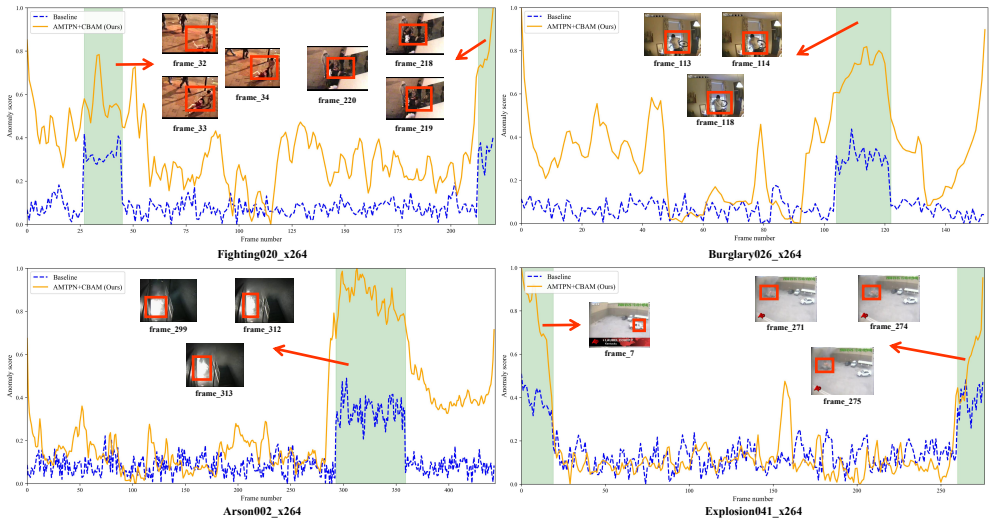
- [Figure 5] The caption text for Figure 5 refers to 'AMSTAD' identifying anomalous regions, but the proposed model is called DAMS. This appears to be a typo from a different method and should be corrected.
- [Figures 3 and 4] Figures 3 and 4 use axis labels 'AUC@PR' and 'AUC@ROC', whereas the tables report 'AP' and 'AUC'. Please unify the metric notation so the ablation plots can be read against the tables.
- [Section 3.2.4] Equation (8) defines a Complementarity Index using mutual information terms, but these quantities are never estimated or reported in the experiments. Please clarify whether this index is a conceptual motivation or a computed quantity, and if computed, provide the estimation procedure.
- [Section 4.3] The hyperparameter optimization via Optuna is described only as selecting dataset-specific scale configurations and other settings; no validation split, search ranges, or final hyperparameter values are reported. Please provide the actual configuration so that readers can assess the risk of selection bias.
- [Sections 4.5.5 and 4.5.6] The visualizations in Figures 6 and 7 are qualitative and are described in subjective terms such as 'more stable feature normalization' and 'information distribution becomes more balanced'. Please either add quantitative support or reduce the strength of the claims.
Circularity Check
No circularity found: the DAMS benchmark claims rest on held-out evaluations, and no derived quantity reduces to its own input or to a self-citation.
full rationale
The DAMS paper reports empirical results on the external UCF-Crime and XD-Violence benchmarks using held-out test splits, with the proposed architecture trained under video-level weak labels and evaluated with frame-level metrics. No equation in the method section defines a target quantity in terms of the quantity it is claimed to predict: the AMTPN, CBAM, and CLIP pseudo-label losses are all specified using input features, pretrained CLIP embeddings, and video-level labels, not using the reported AUC/AP values. CLIP is an external pretrained vision-language model, so the pseudo-label supervision is an outside prior rather than a quantity the paper constructs from its own outputs. The paper contains no load-bearing self-citations: the references are to prior work by other groups, and none of the central premises (multiscale temporal modeling, attention, CLIP guidance) is justified solely by a citation to the present authors. The main correctness concerns are the unablated ten-fold spatial augmentation protocol in Section 4.4.2, which is not used by the Table 2 baselines, and the apparent mismatch between the text in Section 4.5.3 and the numbers in Table 6; however, these are comparison-fairness and reporting issues rather than circularity, because they do not make any reported quantity equivalent by construction to a fitted parameter or to the method's own definitions. Thus the appropriate circularity score is 0.
Assumptions & free parameters
free parameters (7)
- Temporal pyramid scales S =
[1,3,9,27] for both datasets
- CLIP pseudo-label threshold tau =
not reported
- Focal loss parameters alpha_t and gamma =
not reported
- Triplet margin m =
not reported
- Uncertainty weights sigma_1, sigma_2, sigma_3 =
learned, initial values not reported
- CLIP scaling lambda and softmax temperature tau =
not reported
- TCE reduction ratio r and CBAM kernel size k =
not reported
assumptions (3)
- domain assumption CLIP zero-shot vision-language similarity is a reliable frame-level anomaly prior.
- domain assumption Fixed I3D features and the ten-fold spatial augmentation protocol provide a fair representation for all compared methods.
- ad hoc to paper The selected temporal scales {1,3,9,27} generalize across anomaly durations without overfitting the validation set.
Cite this review
Pith. "Pith review of DAMS:Dual-Branch Adaptive Multiscale Spatiotemporal Framework for Video Anomaly Detection." pith.science (2026). https://pith.science/paper/XLALS7XF
@misc{pith2026250720629,
  author       = {Pith},
  title        = {Pith review of: DAMS:Dual-Branch Adaptive Multiscale Spatiotemporal Framework for Video Anomaly Detection},
  year         = {2026},
  howpublished = {\url{https://pith.science/paper/XLALS7XF}},
  note         = {Machine review of arXiv:2507.20629}
}
read the original abstract
The goal of video anomaly detection is tantamount to performing spatio-temporal localization of abnormal events in the video. The multiscale temporal dependencies, visual-semantic heterogeneity, and the scarcity of labeled data exhibited by video anomalies collectively present a challenging research problem in computer vision. This study offers a dual-path architecture called the Dual-Branch Adaptive Multiscale Spatiotemporal Framework (DAMS), which is based on multilevel feature decoupling and fusion, enabling efficient anomaly detection modeling by integrating hierarchical feature learning and complementary information. The main processing path of this framework integrates the Adaptive Multiscale Time Pyramid Network (AMTPN) with the Convolutional Block Attention Mechanism (CBAM). AMTPN enables multigrained representation and dynamically weighted reconstruction of temporal features through a three-level cascade structure (time pyramid pooling, adaptive feature fusion, and temporal context enhancement). CBAM maximizes the entropy distribution of feature channels and spatial dimensions through dual attention mapping. Simultaneously, the parallel path driven by CLIP introduces a contrastive language-visual pre-training paradigm. Cross-modal semantic alignment and a multiscale instance selection mechanism provide high-order semantic guidance for spatio-temporal features. This creates a complete inference chain from the underlying spatio-temporal features to high-level semantic concepts. The orthogonal complementarity of the two paths and the information fusion mechanism jointly construct a comprehensive representation and identification capability for anomalous events. Extensive experimental results on the UCF-Crime and XD-Violence benchmarks establish the effectiveness of the DAMS framework.
Figures


Figures from the paper (4 more)



Forward citations
Cited by 1 Pith paper
-
Privacy-Aware Video Anomaly Detection through Orthogonal Subspace Projection
A new orthogonal projection module for video anomaly detection suppresses facial attributes via weak face-presence signals and cosine alignment while preserving anomaly-relevant features like pose and motion.
Reference graph
Works this paper leans on
-
[44]
Cbam: Convolutional block attention module
Sanghyun Woo, Jongchan Park, Joon-Young Lee, and In So Kweon. Cbam: Convolutional block attention module. InProceedings of the Europeanconferenceoncomputervision(ECCV) ,pages3–19,2018
work page 2018
-
[1]
Anja Delić, Matej Grcić, and Siniša Šegvić. Sequential keypoint density estimator: an overlooked baseline of skeleton-based video anomaly detection.arXiv preprint arXiv:2506.18368, 2025
work page Pith review arXiv 2025
-
[2]
Xinyi Zhao, Congjing Zhang, Pei Guo, Wei Li, Lin Chen, Chaoyue Zhao,andShuaiHuang. Smarthome-bench:Acomprehensivebench- mark for video anomaly detection in smart homes using multi-modal large language models. InProceedings of the Computer Vision and Pattern Recognition Conference, pages 3975–3985, 2025
work page 2025
-
[3]
Track any anomalous object: A granular video anomaly detection pipeline
Yuzhi Huang, Chenxin Li, Haitao Zhang, Zixu Lin, Yunlong Lin, Hengyu Liu, Wuyang Li, Xinyu Liu, Jiechao Gao, Yue Huang, et al. Track any anomalous object: A granular video anomaly detection pipeline. InProceedings of the Computer Vision and Pattern Recog- nition Conference, pages 8689–8699, 2025
work page 2025
-
[4]
Juntong Li, Lingwei Dang, Yukun Su, Yun Hao, Qingxin Xiao, Yongwei Nie, and Qingyao Wu. Memoryout: Learning principal features via multimodal sparse filtering network for semi-supervised video anomaly detection.arXiv preprint arXiv:2506.02535, 2025
-
[5]
Vau- r1: Advancing video anomaly understanding via reinforcement fine- tuning
Liyun Zhu, Qixiang Chen, Xi Shen, and Xiaodong Cun. Vau- r1: Advancing video anomaly understanding via reinforcement fine- tuning. arXiv preprint arXiv:2505.23504, 2025
arXiv 2025
-
[6]
Chao Huang, Benfeng Wang, Jie Wen, Chengliang Liu, Wei Wang, Li Shen, and Xiaochun Cao. Vad-r1: Towards video anomaly rea- soning via perception-to-cognition chain-of-thought.arXiv preprint arXiv:2505.19877, 2025
arXiv 2025
-
[7]
Weakly- supervised video anomaly detection with snippet anomalous atten- tion
Yidan Fan, Yongxin Yu, Wenhuan Lu, and Yahong Han. Weakly- supervised video anomaly detection with snippet anomalous atten- tion. IEEE Transactions on Circuits and Systems for Video Technol- ogy, 34(7):5480–5492, 2024
work page 2024
Show all 64 references
-
[8]
Mist: Multiple instance self-training framework for video anomaly detection
Jia-Chang Feng, Fa-Ting Hong, and Wei-Shi Zheng. Mist: Multiple instance self-training framework for video anomaly detection. In Proceedings of the IEEE/CVF conference on computer vision and pattern recognition, pages 14009–14018, 2021
2021
-
[9]
Self-training multi-sequence learningwithtransformerforweaklysupervisedvideoanomalydetec- tion
Shuo Li, Fang Liu, and Licheng Jiao. Self-training multi-sequence learningwithtransformerforweaklysupervisedvideoanomalydetec- tion. Proceedings of the AAAI Conference on Artificial Intelligence, 36(2):1395–1403, 2022
2022
-
[10]
Weakly-supervised video anomaly detection with robust temporal feature magnitude learning
YuTian,GuansongPang,YuanhongChen,RajvinderSingh,JohanW Verjans, and Gustavo Carneiro. Weakly-supervised video anomaly detection with robust temporal feature magnitude learning. InPro- ceedings of the IEEE/CVF international conference on computer vision, pages 4975–4986, 2021
2021
-
[11]
Self-supervised sparse representation for video anomaly detection
Jhih-Ciang Wu, He-Yen Hsieh, Ding-Jie Chen, Chiou-Shann Fuh, and Tyng-Luh Liu. Self-supervised sparse representation for video anomaly detection. In European Conference on Computer Vision, pages 729–745. Springer, 2022
2022
-
[12]
Claws: Clustering assisted weakly supervised learn- ing with normalcy suppression for anomalous event detection
Muhammad Zaigham Zaheer, Arif Mahmood, Marcella Astrid, and Seung-Ik Lee. Claws: Clustering assisted weakly supervised learn- ing with normalcy suppression for anomalous event detection. In EuropeanConferenceonComputerVision ,pages358–376.Springer, 2020
2020
-
[13]
Dual memory units with uncertainty regulation for weakly supervised video anomaly detec- tion
Hang Zhou, Junqing Yu, and Wei Yang. Dual memory units with uncertainty regulation for weakly supervised video anomaly detec- tion. Proceedings of the AAAI Conference on Artificial Intelligence, 37(3):3769–3777, 2023
2023
-
[14]
Sup- port vector machines for multiple-instance learning
StuartAndrews,IoannisTsochantaridis,andThomasHofmann. Sup- port vector machines for multiple-instance learning. Advances in neural information processing systems, 15, 2002
2002
-
[15]
Multiple instance learning for soft bags via top instances
Weixin Li and Nuno Vasconcelos. Multiple instance learning for soft bags via top instances. InProceedings of the ieee conference oncomputervisionandpatternrecognition ,pages4277–4285,2015
2015
-
[16]
FeiShenandJinhuiTang.Imagpose:Aunifiedconditionalframework for pose-guided person generation.Advances in neural information processing systems, 37:6246–6266, 2024
2024
-
[17]
Enhancing aerial object detection with selective frequency interaction network
Weijie Weng, Mengwan Wei, Junchi Ren, and Fei Shen. Enhancing aerial object detection with selective frequency interaction network. IEEE Transactions on Artificial Intelligence, 1(1):1–12, 2024
2024
-
[18]
Lr- fpn: Enhancing remote sensing object detection with location refined feature pyramid network
Hanqian Li, Ruinan Zhang, Ye Pan, Junchi Ren, and Fei Shen. Lr- fpn: Enhancing remote sensing object detection with location refined feature pyramid network. In2024 International Joint Conference on Neural Networks (IJCNN), pages 1–8. IEEE, 2024
2024
-
[19]
Learning spatiotemporal features with 3d convolu- tionalnetworks
Du Tran, Lubomir Bourdev, Rob Fergus, Lorenzo Torresani, and Manohar Paluri. Learning spatiotemporal features with 3d convolu- tionalnetworks. InProceedingsoftheIEEEinternationalconference on computer vision, pages 4489–4497, 2015
2015
-
[20]
Real-world anomaly detection in surveillance videos
Waqas Sultani, Chen Chen, and Mubarak Shah. Real-world anomaly detection in surveillance videos. InProceedings of the IEEE confer- ence on computer vision and pattern recognition, pages 6479–6488, 2018
2018
-
[21]
Quovadis,actionrecognition? a new model and the kinetics dataset
JoaoCarreiraandAndrewZisserman. Quovadis,actionrecognition? a new model and the kinetics dataset. Inproceedings of the IEEE Conference on Computer Vision and Pattern Recognition, pages 6299–6308, 2017
2017
-
[22]
Not only look, but also listen: Learning multimodal violence detection under weak supervision
Peng Wu, Jing Liu, Yujia Shi, Yujia Sun, Fangtao Shao, Zhaoyang Wu, and Zhiwei Yang. Not only look, but also listen: Learning multimodal violence detection under weak supervision. InEuropean conference on computer vision, pages 322–339. Springer, 2020
2020
-
[23]
Pedestrian- specific bipartite-aware similarity learning for text-based person re- trieval
Fei Shen, Xiangbo Shu, Xiaoyu Du, and Jinhui Tang. Pedestrian- specific bipartite-aware similarity learning for text-based person re- trieval. InProceedingsofthe31thACMInternationalConferenceon Multimedia, 2023
2023
-
[24]
Triplet con- trastive learning for unsupervised vehicle re-identification
Fei Shen, Xiaoyu Du, Liyan Zhang, and Jinhui Tang. Triplet con- trastive learning for unsupervised vehicle re-identification. arXiv preprint arXiv:2301.09498, 2023
2023 arXiv
-
[25]
Git: Graph interactive transformer for vehicle re-identification.IEEE Transactions on Image Processing, 2023
Fei Shen, Yi Xie, Jianqing Zhu, Xiaobin Zhu, and Huanqiang Zeng. Git: Graph interactive transformer for vehicle re-identification.IEEE Transactions on Image Processing, 2023
2023
-
[26]
Con- volutional neural networks on graphs with fast localized spectral filtering
MichaëlDefferrard,XavierBresson,andPierreVandergheynst. Con- volutional neural networks on graphs with fast localized spectral filtering. Advances in neural information processing systems, 29, 2016
2016
-
[27]
Imagdressing-v1:Customizablevirtualdressing
FeiShen,XinJiang,XinHe,HuYe,CongWang,XiaoyuDu,Zechao Li,andJinhuiTang. Imagdressing-v1:Customizablevirtualdressing. In Proceedings of the AAAI Conference on Artificial Intelligence, volume 39, pages 6795–6804, 2025
2025
-
[28]
Advancingpose-guidedimagesynthesiswithprogressiveconditional diffusionmodels
Fei Shen, Hu Ye, Jun Zhang, Cong Wang, Xiao Han, and Yang Wei. Advancingpose-guidedimagesynthesiswithprogressiveconditional diffusionmodels. In TheTwelfthInternationalConferenceonLearn- ing Representations, 2024
2024
-
[29]
At- tention is all you need.Advances in neural information processing systems, 30, 2017
AshishVaswani,NoamShazeer,NikiParmar,JakobUszkoreit,Llion Jones, Aidan N Gomez, Łukasz Kaiser, and Illia Polosukhin. At- tention is all you need.Advances in neural information processing systems, 30, 2017
2017
-
[30]
Convolutional transformer based dualdiscriminatorgenerativeadversarialnetworksforvideoanomaly detection
Xinyang Feng, Dongjin Song, Yuncong Chen, Zhengzhang Chen, Jingchao Ni, and Haifeng Chen. Convolutional transformer based dualdiscriminatorgenerativeadversarialnetworksforvideoanomaly detection. InProceedings of the 29th ACM international conference on multimedia, pages 5546–5...
2021
-
[31]
Anomalynet: An anomaly detection network for video surveillance.IEEE Transactions on Information Forensics and Security, 14(10):2537–2550, 2019
JoeyTianyiZhou,JiaweiDu,HongyuanZhu,XiPeng,YongLiu,and Rick Siow Mong Goh. Anomalynet: An anomaly detection network for video surveillance.IEEE Transactions on Information Forensics and Security, 14(10):2537–2550, 2019
2019
-
[32]
A variational bayesian approach to robust sensor fusion based on student-t distribution
Hao Zhu, Henry Leung, and Zhongshi He. A variational bayesian approach to robust sensor fusion based on student-t distribution. Information Sciences, 221:201–214, 2013
2013
-
[33]
Learnable expansion of graph operators for multi-modal feature fu- sion
DexuanDing,LeiWang,LiyunZhu,TomGedeon,andPiotrKoniusz. Learnable expansion of graph operators for multi-modal feature fu- sion. arXiv preprint arXiv:2410.01506, 2024
2024 arXiv
-
[34]
Cross-modal fusion and attention mechanism for weakly super- vised video anomaly detection
Ayush Ghadiya, Purbayan Kar, Vishal Chudasama, and Pankaj Was- nik. Cross-modal fusion and attention mechanism for weakly super- vised video anomaly detection. In Proceedings of the IEEE/CVF Conference on Computer Vision and Pattern Recognition, pages 1965–1974, 2024
1965
-
[35]
Audio-visual collaborative learning for weakly supervised video anomaly detection.IEEE Transactions on Multimedia, 2025
Jingke Meng, Huilin Tian, Ge Lin, Jian-Fang Hu, and Wei-Shi Zheng. Audio-visual collaborative learning for weakly supervised video anomaly detection.IEEE Transactions on Multimedia, 2025
2025
-
[36]
Multimodal and multiscale feature fusion for weakly supervised video anomaly detection
Wenwen Sun, Lin Cao, Yanan Guo, and Kangning Du. Multimodal and multiscale feature fusion for weakly supervised video anomaly detection. Scientific Reports, 14(1):22835, 2024
2024
-
[37]
Vadclip: Adapting vision- language models for weakly supervised video anomaly detection
Peng Wu, Xuerong Zhou, Guansong Pang, Lingru Zhou, Qingsen Yan, Peng Wang, and Yanning Zhang. Vadclip: Adapting vision- language models for weakly supervised video anomaly detection. In Proceedings of the AAAI Conference on Artificial Intelligence, volume 38(6), pages 6074–6082, 2024
2024
-
[38]
InProceedingsoftheIEEEconferenceoncomputervision and pattern recognition, pages 733–742, 2016
Mahmudul Hasan, Jonghyun Choi, Jan Neumann, Amit K Roy- Chowdhury,andLarrySDavis.Learningtemporalregularityinvideo sequences. InProceedingsoftheIEEEconferenceoncomputervision and pattern recognition, pages 733–742, 2016
2016
-
[39]
A revisit of sparse coding based anomaly detection in stacked rnn framework
Weixin Luo, Wen Liu, and Shenghua Gao. A revisit of sparse coding based anomaly detection in stacked rnn framework. InProceedings oftheIEEEinternationalconferenceoncomputervision ,pages341– 349, 2017
2017
-
[40]
InProceedings of the IEEE conference on computer vision and pattern recognition, pages 6536–6545, 2018
WenLiu,WeixinLuo,DongzeLian,andShenghuaGao.Futureframe prediction for anomaly detection–a new baseline. InProceedings of the IEEE conference on computer vision and pattern recognition, pages 6536–6545, 2018
2018
-
[41]
Learning memory-guided normality for anomaly detection
Hyunjong Park, Jongyoun Noh, and Bumsub Ham. Learning memory-guided normality for anomaly detection. InProceedings of the IEEE/CVF conference on computer vision and pattern recogni- tion, pages 14372–14381, 2020
2020
-
[42]
Spatiotemporal pyramid network for video action recognition
Yunbo Wang, Mingsheng Long, Jianmin Wang, and Philip S Yu. Spatiotemporal pyramid network for video action recognition. In ProceedingsoftheIEEEconferenceonComputerVisionandPattern Recognition, pages 1529–1538, 2017
2017
-
[43]
Graphconvolutionallabelnoisecleaner:Trainaplug-and- play action classifier for anomaly detection
Jia-Xing Zhong, Nannan Li, Weijie Kong, Shan Liu, Thomas H Li, andGeLi. Graphconvolutionallabelnoisecleaner:Trainaplug-and- play action classifier for anomaly detection. InProceedings of the IEEE/CVF conference on computer vision and pattern recognition, pages 1237–1246, 2019
2019
-
[45]
Video anomaly detection with multi-scale feature and temporal in- formation fusion.Neurocomputing, 423:264–273, 2021
Yiheng Cai, Jiaqi Liu, Yajun Guo, Shaobin Hu, and Shinan Lang. Video anomaly detection with multi-scale feature and temporal in- formation fusion.Neurocomputing, 423:264–273, 2021
2021
-
[46]
Video anomaly detection via self-supervised and spatio-temporal proxy tasks learning.Pattern Recognition, 158:111021, 2025
Qingyang Yang, Chuanxu Wang, Peng Liu, Zitai Jiang, and Jiajiong Li. Video anomaly detection via self-supervised and spatio-temporal proxy tasks learning.Pattern Recognition, 158:111021, 2025
2025
-
[47]
Weakly supervised video anomaly detection and localization with spatio-temporal prompts
Peng Wu, Xuerong Zhou, Guansong Pang, Zhiwei Yang, Qingsen Yan, Peng Wang, and Yanning Zhang. Weakly supervised video anomaly detection and localization with spatio-temporal prompts. In Proceedings of the 32nd ACM International Conference on Multime- dia, pages 9301–9310, 2024
2024
-
[48]
Video anomaly detection via spatio-temporal pseudo-anomaly generation: A unified approach
Ayush K Rai, Tarun Krishna, Feiyan Hu, Alexandru Drimbarean, Kevin McGuinness, Alan F Smeaton, and Noel E O’connor. Video anomaly detection via spatio-temporal pseudo-anomaly generation: A unified approach. InProceedings of the IEEE/CVF Conference on Computer Vision and Patter...
2024
-
[49]
Audio-visual event localization in unconstrained videos
Yapeng Tian, Jing Shi, Bochen Li, Zhiyao Duan, and Chenliang Xu. Audio-visual event localization in unconstrained videos. In ProceedingsoftheEuropeanconferenceoncomputervision(ECCV) , pages 247–263, 2018
2018
-
[50]
Weakly supervised video anomaly detection via center-guided discriminative learning
Boyang Wan, Yuming Fang, Xue Xia, and Jiajie Mei. Weakly supervised video anomaly detection via center-guided discriminative learning. arXiv preprint arXiv:2104.07268, 2021
2021 arXiv
-
[51]
Dualconditioned motion diffusion for pose-based video anomaly detection.Proceed- ings of the AAAI Conference on Artificial Intelligence, 39(7):7700– 7708, 2025
HongsongWang,AndiXu,PinleDing,andJieGui. Dualconditioned motion diffusion for pose-based video anomaly detection.Proceed- ings of the AAAI Conference on Artificial Intelligence, 39(7):7700– 7708, 2025
2025
-
[52]
Learning transferable visual mod- elsfromnaturallanguagesupervision
Alec Radford, Jong Wook Kim, Chris Hallacy, Aditya Ramesh, Gabriel Goh, Sandhini Agarwal, Girish Sastry, Amanda Askell, Pamela Mishkin, Jack Clark, et al. Learning transferable visual mod- elsfromnaturallanguagesupervision. In Internationalconferenceon machine learning, pages ...
2021
-
[53]
Mmvad: A vision-language model for cross-domain video anomaly detection with contrastive learningandscale-adaptiveframesegmentation
Debojyoti Biswas and Jelena Tesic. Mmvad: A vision-language model for cross-domain video anomaly detection with contrastive learningandscale-adaptiveframesegmentation. ExpertSystemswith Applications, page 127857, 2025
2025
-
[54]
The infor- mation bottleneck method.arXiv preprint physics/0004057, 2000
Naftali Tishby, Fernando C Pereira, and William Bialek. The infor- mation bottleneck method.arXiv preprint physics/0004057, 2000
2000 arXiv
-
[55]
Deep variational information bottleneck
Alexander A Alemi, Ian Fischer, Joshua V Dillon, and Kevin Mur- phy. Deep variational information bottleneck. arXiv preprint arXiv:1612.00410, 2016
2016 arXiv
-
[56]
Temporalconvolutional network with complementary inner bag loss for weakly supervised anomalydetection
JiangongZhang,LaiyunQing,andJunMiao. Temporalconvolutional network with complementary inner bag loss for weakly supervised anomalydetection. In2019IEEEInternationalConferenceonImage Processing (ICIP), pages 4030–4034. IEEE, 2019
2019
-
[57]
Batchfeaturestandardizationnet- workwithtripletlossforweakly-supervisedvideoanomalydetection
ShuhanYi,ZheyiFan,andDiWu. Batchfeaturestandardizationnet- workwithtripletlossforweakly-supervisedvideoanomalydetection. Image and Vision Computing, 120:104397, 2022
2022
-
[58]
Learningcausaltemporalrelationandfeature discrimination for anomaly detection.IEEE Transactions on Image Processing, 30:3513–3527, 2021
PengWuandJingLiu. Learningcausaltemporalrelationandfeature discrimination for anomaly detection.IEEE Transactions on Image Processing, 30:3513–3527, 2021
2021
-
[59]
Normality guided multiple instance learning for weakly supervised video anomaly detection
Seongheon Park, Hanjae Kim, Minsu Kim, Dahye Kim, and Kwanghoon Sohn. Normality guided multiple instance learning for weakly supervised video anomaly detection. InProceedings of the IEEE/CVF winter conference on applications of computer vision, pages 2665–2674, 2023
2023
-
[60]
Diffusion-based normality pre-training for weakly supervised video anomaly detection.Expert Systems with Applications, 251:124013, 2024
Suvramalya Basak and Anjali Gautam. Diffusion-based normality pre-training for weakly supervised video anomaly detection.Expert Systems with Applications, 251:124013, 2024
2024
-
[61]
Mgfn: Magnitude-contrastive glance- and-focus network for weakly-supervised video anomaly detection
Yingxian Chen, Zhengzhe Liu, Baoheng Zhang, Wilton Fok, Xiao- juan Qi, and Yik-Chung Wu. Mgfn: Magnitude-contrastive glance- and-focus network for weakly-supervised video anomaly detection. In Proceedings of the AAAI Conference on Artificial Intelligence, volume 37(1), pages 3...
2023
-
[62]
Clip- driven multi-scale instance learning for weakly supervised video anomaly detection
Zhangbin Qian, Jiawei Tan, Zhilong Ou, and Hongxing Wang. Clip- driven multi-scale instance learning for weakly supervised video anomaly detection. In 2024 IEEE International Conference on Multimedia and Expo (ICME), pages 1–6. IEEE, 2024
2024
-
[63]
Transformer-enabled weakly supervised abnormal event detection in intelligent video surveillance systems.Engineering Applications of Artificial Intelligence, 139:109496, 2025
Shalmiya Paulraj and Subramaniyaswamy Vairavasundaram. Transformer-enabled weakly supervised abnormal event detection in intelligent video surveillance systems.Engineering Applications of Artificial Intelligence, 139:109496, 2025
2025
-
[64]
Tds-net: Transformer enhanced dual-stream network for video anomaly detection.Expert Systems with Applications, 256:124846, 2024
AdnanHussain,WaseemUllah,NomanKhan,ZulfiqarAhmadKhan, Min Je Kim, and Sung Wook Baik. Tds-net: Transformer enhanced dual-stream network for video anomaly detection.Expert Systems with Applications, 256:124846, 2024
2024
Reviewed August 6, 2026 · model on record in the stance chip above.
Discussion (0). Sign in to comment.