REVIEW 3 major objections 9 minor 61 references
KASportsFormer: Kinematic Anatomy Enhanced Transformer for 3D Human Pose Estimation on Short Sports Scene Video
T0 review · 3 major / 9 minor · reviewed 2026-08-06 · deepseek-v4-flash
Pith's one-line read KASportsFormer reports that explicit bone and limb tokens improve 3D pose estimation on short sports clips.
desk verdict A clean incremental architecture for sports 3D HPE whose internal ablations are convincing, but the SOTA claim rests on leaky custom splits and single runs. read the letter →
The pith
A machine-rendered reading of the paper's core claim, the machinery that carries it, and where it could break.
The reading
What carries the argument
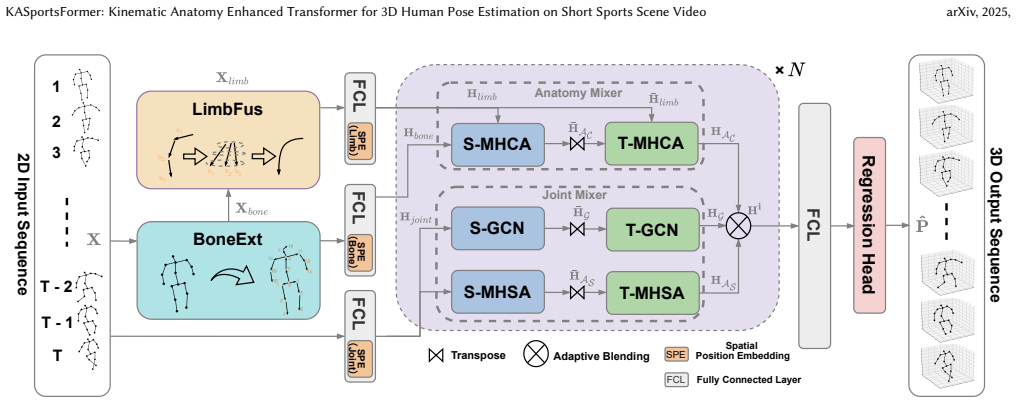
The load-bearing machinery is the anatomy extraction and fusion pair plus a cross-modal attention mixer. BoneExt converts a 2D pose into directed bone vectors by chaining joints from the pelvis, recording each bone's normalized direction and length plus an averaged ultra-bone; LimbFus then groups these bones into limbs, each encoded by a small MLP that treats x-direction, y-direction, and length separately, and supplements anatomically inspired limbs with non-biological hyper-limbs. The Anatomy Mixer runs multi-head cross-attention first over space then over time, with bone tokens as queries and limb tokens as keys and values, so the network reconciles single-bone kinematics with limb-level motion. A joint stream with self-attention and graph convolution preserves coordinate-level detail, and adaptive blending merges the three streams at every layer before the regression head.
What would settle it
Take KASportsFormer and MotionAGFormer-L, train and test both on the standard SportsPose and WorldPose evaluation splits with exactly 27-frame clips whose source subjects and game timestamps are fully disjoint from training, and compare MPJPE; if the difference falls within run-to-run noise or reverses, the short-video anatomy advantage is an artifact of the custom split rather than a property of the model.
Extended reading notes
Core claim
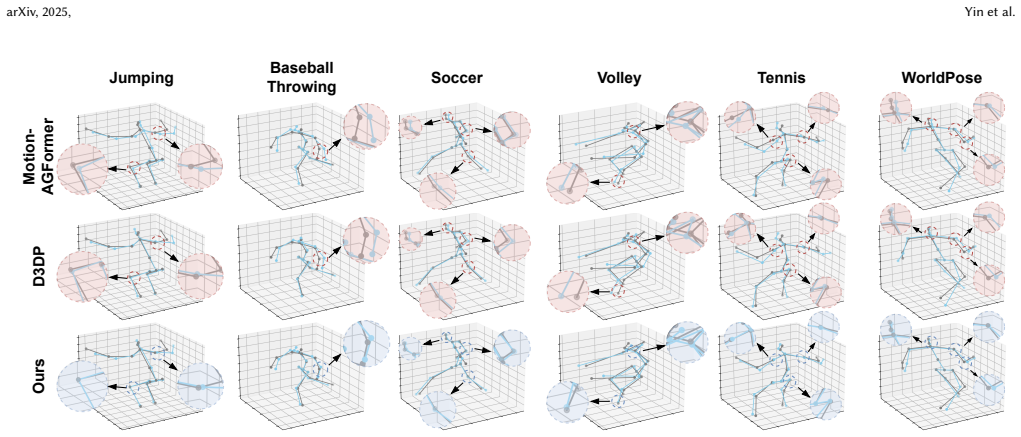
The paper's central claim is that the human skeleton carries two complementary kinematic descriptions—bones as directed vectors with length and direction, and limbs as fused groups of bones—and that forcing a pose transformer to exchange information between these descriptions makes it more accurate on brief sports actions. KASportsFormer decomposes each 2D frame into bone vectors, averages them into an ultra-bone, and then composes the bones into limb tokens, including non-anatomical hyper-limbs such as left shoulder to right hip. Inside each transformer layer, the bone stream supplies queries to a spatial then temporal multi-head cross-attention whose keys and values come from the limb stream, while a parallel joint stream runs self-attention and graph-convolution mixing for fine positions. The three outputs are adaptively blended and passed onward. The authors report that this design beats previous methods on both SportsPose and WorldPose at 27-frame input length, with the clearest visual improvements at limb junctions and fast-moving extremities.
Load-bearing premise
The state-of-the-art claim stands on the authors' own random subject split of SportsPose and random per-game split of WorldPose; if these splits are unrepresentative of standard evaluation or leak subject, scene, or temporal context between training and test clips, the reported gains of roughly 0.1 to 1.5 mm may not reproduce outside this setup.
Editorial extensions
If this is right
- Short-clip robustness: the gains on 27-frame inputs imply that anatomy streams can partially substitute for the temporal context that longer clips would provide, so sports analysis systems can use shorter windows without losing as much accuracy.
- Noise tolerance: larger improvements under HRNet-detected keypoints than under ground-truth projected keypoints suggest the anatomy representation is particularly useful when the 2D inputs are noisy, a common condition in broadcast sports video.
- Action-specific behavior: the action breakdown shows the biggest MPJPE reductions on throw, tennis, jump, and volley, while soccer detection input slightly regresses; the authors attribute this to limited perception of limb acceleration in kicking.
- Module simplicity: the ablation finding that a small 16-hidden-unit MLP performs best implies the limb fuser does not need a large network, so the anatomy branch adds modest parameters relative to the baselines.
- Clean-input performance: on WorldPose ground-truth 2D keypoints, KASportsFormer reaches 8.5 mm MPJPE, indicating the benefit is not only a robustness effect under noise but also improves reconstruction given clean poses.
Reading between the lines
- Editorial extension: because the reported gains rest on the paper's own random subject split of SportsPose and random per-game split of WorldPose, a re-run under the datasets' standard evaluation protocols could shift the margins of 0.1 to 1.5 mm, and clip-level leakage should be checked before accepting the numbers as benchmark state of the art.
- Editorial extension: if bone-length stability is the active ingredient, the same bone-plus-limb tokenization should transfer to other short-clip pose tasks such as dance, rehabilitation, or sports science workflows, and could be tested by swapping in a non-sports short-clip benchmark.
- Editorial extension: the design keeps the limb stream fixed to the raw input rather than feeding it blended features; ablating this choice would reveal whether a frozen kinematic context is essential or whether letting limbs adapt would help further.
Editorial analysis
A structured set of objections, weighed in public.
Referee Report
Summary. The manuscript proposes KASportsFormer, a 2D-to-3D lifting transformer for short (27-frame) monocular sports video. It augments the joint coordinate stream with two hand-designed anatomy streams: BoneExt converts a frame into bone direction and length tokens (including an averaged 'ultra-bone'), and LimbFus composes bones into biological and imaginary 'hyper-limb' tokens through per-limb MLPs. An anatomy mixer performs spatial and temporal multi-head cross-attention using bone queries and limb keys/values, in parallel with a MotionAGFormer-style joint MHSA/GCN mixer, followed by adaptive blending. The model is trained with per-joint position and velocity losses. All baselines are retrained on the same 27-frame custom splits; the authors report MPJPE/P-MPJPE improvements on SportsPose (58.0 mm DET MPJPE) and WorldPose (34.2 mm DET MPJPE) and claim state-of-the-art performance. Code and models are promised at a GitHub repository.
Significance. Strengths: the proposed bone and limb features are deterministic functions of the input coordinates, and all trainable components are supervised by ground-truth pose and velocity losses, so there is no circularity in the contribution claim. The experimental setup is internally consistent: every baseline is retrained on the same 27-frame protocol, and the ablations in Table 5 show that each module (BoneExt, LimbFus, MHCA) contributes to the reported result. Release of code and models is a concrete reproducibility asset. If the protocol concerns are resolved, the paper is a solid incremental architecture contribution that may be useful for sports-analysis applications. However, the headline 'state-of-the-art' claim currently rests on custom and potentially leaky splits, on single runs, and on margins as small as 0.1 mm, so the benchmark-level significance is not yet established.
major comments (3)
- [Section 4.1 (WorldPose), Table 3] The WorldPose evaluation protocol is the load-bearing assumption behind the SOTA claim. The text says clips of each game are 'randomly categorize[d]' into training and testing sets; because clips from the same broadcast game share camera calibration, players, field appearance, and possibly temporally adjacent frames, this per-clip split can leak game-specific cues into training. The reported DET MPJPE gain of 1.4 mm over MotionAGFormer-B and GT gain of 0.8 mm over MotionBERT (Table 3) could therefore reflect scene/player memorization rather than generalization to unseen games. Please evaluate on held-out games (or the official WorldPose protocol), clarify the ambiguous '26 clip sources' sentence, and report whether any training and testing clips are temporally overlapping. Unless the held-out-game numbers show the same margin, the Section 4.3 SOTA statement should be restricted to the custom split.
- [Section 4.1 (SportsPose), Table 1] The SportsPose evaluation also uses a custom protocol: the paper says the dataset is 'randomly divide[n]' into a 7-subject test set, without demonstrating that this matches the official SportsPose benchmark split. Because all baselines are retrained on the same split, the internal ranking is controlled. However, the claim that KASportsFormer 'achieved the current state-of-the-art (SOTA) performance on 27 frame video clips' implies comparability to published benchmark results, which is not valid unless the official evaluation protocol is used. Please either adopt the official SportsPose split or explicitly frame Table 1 as results on a custom protocol, and avoid the SOTA label in that case.
- [Tables 1-3] All results are single runs, with no standard deviation or significance testing. Improvements over the next-best method are as small as 0.1 mm (SportsPose GT P-MPJPE relative to D3DP, Table 1) and 0.2-0.4 mm on several per-action rows in Table 2. Without repeated seeds, these margins are within typical run-to-run variance for transformer pose-lifting models. Please report mean and standard deviation over at least three seeds for the main comparisons, or otherwise temper the claims that depend on these small margins.
minor comments (9)
- [Abstract / Table 3] The abstract reports WorldPose MPJPE as 34.3 mm, but Table 3 reports 34.2 mm; please reconcile.
- [Section 4.3 (WorldPose)] The sentence 'we outperformed D3DP by 0.8mm MPJPE and 0.4mm P-MPJPE' does not match Table 3: the 0.8 mm GT MPJPE gap is relative to MotionBERT, the GT P-MPJPE gap to MotionBERT is 0.6 mm, while the gaps to D3DP are 10.3 mm and 2.7 mm. Please correct the text or the table.
- [Table 3 caption] The caption says 'Qualitative comparison' but the table is quantitative; change it to 'Quantitative comparison'.
- [Section 3.2, Eq. (3)] The term 'descendant' is not clearly defined; for a directed bone from a joint toward the root, the closer node is usually the parent or ancestor. Please state the bone-direction convention explicitly.
- [Section 3.3, Eq. (9)] The text defines H^i_AC, H^i_AS, and H^i_G as the outputs of layer i, but Eq. (9) blends H^{i-1}_AC, H^{i-1}_AS, and H^{i-1}_G; clarify whether the blending uses current or previous layer outputs.
- [Table 4] The caption says 'number of hidden layers' while the text describes h_id as the hidden layer dimension; these are different quantities and should be made consistent.
- [Section 4.1] Please report the random seeds used for the custom SportsPose and WorldPose splits, and specify the exact HRNet checkpoint used for detected keypoints, so that the protocol is reproducible.
- [Typos] There are minor typos: 'eacy type' in Section 3.2 and 'Abalation' in the Table 5 caption.
- [Overall comparison] The proposed model has 29.3 M parameters versus 18.9 M for MotionAGFormer-L; a parameter-matched baseline or a MotionAGFormer-L augmented with the same anatomy branches would help attribute the reported gain to the proposed components rather than to additional capacity.
Circularity Check
No significant circularity: the anatomy features are deterministic functions of the input coordinates, and the SOTA claim rests on supervised training and external benchmark comparisons rather than on a fitted prediction or a self-citation chain.
full rationale
This paper is an empirical architecture study. The central claim is that KASportsFormer improves 3D HPE accuracy on SportsPose and WorldPose, and the evidence is supervised training with ground-truth 3D pose and velocity losses (Eq. 1-2) followed by comparison with retrained baselines. The bone and limb features are constructed deterministically from the input 2D coordinates via Eq. 3-5, and then passed through learned transformer modules; no output quantity is reinserted as an input or fitted parameter. The self-citations (e.g., [37], [43], [44]) appear only as related work or sports-analysis context and do not carry the derivation or the SOTA claim. There is no uniqueness theorem, no ansatz smuggled in via citation, and no renaming of a known result. The only substantive concern is whether the custom train/test splits for SportsPose and WorldPose match official benchmarks, which is an evaluation-protocol question rather than circular reasoning. Therefore no circular step is present.
Assumptions & free parameters
free parameters (5)
- lambda_v (velocity loss weight)
- LimbFus hidden size h_id =
16
- Number of transformer layers N =
26
- Feature dimension d =
128
- GCN neighbor number K =
2
assumptions (4)
- domain assumption Bone directions and lengths are sufficient and informative kinematic features for 3D pose reconstruction.
- ad hoc to paper Manual composition of J limbs from bones, including imaginary hyper-limb connections, captures kinematic interactions relevant to sports.
- domain assumption Short video clips of 27 frames are the right regime for sports pose estimation.
- domain assumption WorldPose clip-level split ensures independence between train and test.
Cite this review
Pith. "Pith review of KASportsFormer: Kinematic Anatomy Enhanced Transformer for 3D Human Pose Estimation on Short Sports Scene Video." pith.science (2026). https://pith.science/paper/M672GSAY
@misc{pith2026250720763,
  author       = {Pith},
  title        = {Pith review of: KASportsFormer: Kinematic Anatomy Enhanced Transformer for 3D Human Pose Estimation on Short Sports Scene Video},
  year         = {2026},
  howpublished = {\url{https://pith.science/paper/M672GSAY}},
  note         = {Machine review of arXiv:2507.20763}
}
read the original abstract
Recent transformer based approaches have demonstrated impressive performance in solving real-world 3D human pose estimation problems. Albeit these approaches achieve fruitful results on benchmark datasets, they tend to fall short of sports scenarios where human movements are more complicated than daily life actions, as being hindered by motion blur, occlusions, and domain shifts. Moreover, due to the fact that critical motions in a sports game often finish in moments of time (e.g., shooting), the ability to focus on momentary actions is becoming a crucial factor in sports analysis, where current methods appear to struggle with instantaneous scenarios. To overcome these limitations, we introduce KASportsFormer, a novel transformer based 3D pose estimation framework for sports that incorporates a kinematic anatomy-informed feature representation and integration module. In which the inherent kinematic motion information is extracted with the Bone Extractor (BoneExt) and Limb Fuser (LimbFus) modules and encoded in a multimodal manner. This improved the capability of comprehending sports poses in short videos. We evaluate our method through two representative sports scene datasets: SportsPose and WorldPose. Experimental results show that our proposed method achieves state-of-the-art results with MPJPE errors of 58.0mm and 34.3mm, respectively. Our code and models are available at: https://github.com/jw0r1n/KASportsFormer
Figures

Reference graph
Works this paper leans on
-
[1]
Peter Bauer, Arij Bouazizi, Ulrich Kressel, and Fabian B Flohr. 2023. Weakly supervised multi-modal 3d human body pose estimation for autonomous driving. In 2023 IEEE Intelligent Vehicles Symposium (IV) . IEEE, 1–7
work page 2023
-
[2]
Hanyuan Chen, Jun-Yan He, Wangmeng Xiang, Zhi-Qi Cheng, Wei Liu, Hanbing Liu, Bin Luo, Yifeng Geng, and Xuansong Xie. 2023. Hdformer: High-order di- rected transformer for 3d human pose estimation. arXiv preprint arXiv:2302.01825 (2023)
arXiv 2023
-
[3]
Tianlang Chen, Chen Fang, Xiaohui Shen, Yiheng Zhu, Zhili Chen, and Jiebo Luo. 2021. Anatomy-aware 3d human pose estimation with bone-based pose decomposition. IEEE Transactions on Circuits and Systems for Video Technology 32, 1 (2021), 198–209
work page 2021
-
[4]
Yilun Chen, Zhicheng Wang, Yuxiang Peng, Zhiqiang Zhang, Gang Yu, and Jian Sun. 2018. Cascaded pyramid network for multi-person pose estimation. In Proceedings of the IEEE conference on computer vision and pattern recognition . 7103–7112
work page 2018
-
[5]
Sungho Chun, Sungbum Park, and Ju Yong Chang. 2023. Learnable human mesh triangulation for 3d human pose and shape estimation. In Proceedings of the IEEE/CVF winter conference on applications of computer vision . 2850–2859
work page 2023
-
[6]
Jia Gong, Zhipeng Fan, Qiuhong Ke, Hossein Rahmani, and Jun Liu. 2022. Meta agent teaming active learning for pose estimation. In Proceedings of the IEEE/CVF Conference on Computer Vision and Pattern Recognition . 11079–11089
work page 2022
-
[7]
Guleryuz and Christine Kaeser-Chen
Onur G. Guleryuz and Christine Kaeser-Chen. 2018. Fast Lifting for 3D Hand Pose Estimation in AR/VR Applications. In 2018 25th IEEE International Conference on Image Processing (ICIP). 106–110. doi:10.1109/ICIP.2018.8451559
-
[8]
Chih-Hsiang Hsu and Jyh-Shing Roger Jang. 2024. BLAPose: Enhancing 3D Human Pose Estimation with Bone Length Adjustment. arXiv preprint arXiv:2410.20731 (2024)
work page Pith review arXiv 2024
Show all 61 references
-
[9]
Rongtian Huo, Qing Gao, Jing Qi, and Zhaojie Ju. 2023. 3D Human Pose Esti- mation in Video for Human-Computer/Robot Interaction. In Intelligent Robotics and Applications, Huayong Yang, Honghai Liu, Jun Zou, Zhouping Yin, Lianqing Liu, Geng Yang, Xiaoping Ouyang, and Zhiyong Wa...
2023
-
[10]
Christian Keilstrup Ingwersen, Christian Møller Mikkelstrup, Janus Nørtoft Jensen, Morten Rieger Hannemose, and Anders Bjorholm Dahl. 2023. Sportspose- a dynamic 3d sports pose dataset. In Proceedings of the IEEE/CVF Conference on Computer Vision and Pattern Recognition . 5219–5228
2023
-
[11]
Catalin Ionescu, Dragos Papava, Vlad Olaru, and Cristian Sminchisescu. 2014. Human3.6M: Large Scale Datasets and Predictive Methods for 3D Human Sensing in Natural Environments. IEEE Transactions on Pattern Analysis and Machine Intelligence 36, 7 (jul 2014), 1325–1339
2014
-
[12]
Zaedul Islam and A Ben Hamza. 2024. Multi-hop graph transformer network for 3D human pose estimation. Journal of Visual Communication and Image Representation 101 (2024), 104174
2024
-
[13]
Tianjian Jiang, Johsan Billingham, Sebastian Müksch, Juan Zarate, Nicolas Evans, Martin R Oswald, Marc Polleyfeys, Otmar Hilliges, Manuel Kaufmann, and Jie Song. 2024. WorldPose: A world cup dataset for global 3D human pose estimation. In European Conference on Computer Vision...
2024
-
[14]
Wenhao Li, Hong Liu, Runwei Ding, Mengyuan Liu, Pichao Wang, and Wenming Yang. 2022. Exploiting temporal contexts with strided transformer for 3d human pose estimation. IEEE Transactions on Multimedia 25 (2022), 1282–1293
2022
-
[15]
Wenhao Li, Hong Liu, Hao Tang, Pichao Wang, and Luc Van Gool. 2022. Mh- former: Multi-hypothesis transformer for 3d human pose estimation. In Pro- ceedings of the IEEE/CVF conference on computer vision and pattern recognition . 13147–13156
2022
-
[16]
Wenhao Li, Mengyuan Liu, Hong Liu, Pichao Wang, Jialun Cai, and Nicu Sebe
-
[17]
Belongie, Lubomir D
Tsung-Yi Lin, Michael Maire, Serge J. Belongie, Lubomir D. Bourdev, Ross B. Gir- shick, James Hays, Pietro Perona, Deva Ramanan, Piotr Doll’a r, and C. Lawrence Zitnick. 2014. Microsoft COCO: Common Objects in Context.CoRR abs/1405.0312 (2014). arXiv:1405.0312 http://arxiv.org...
2014 arXiv
-
[18]
Ruixu Liu, Ju Shen, He Wang, Chen Chen, Sen-ching Cheung, and Vijayan Asari
-
[19]
Matthew Loper, Naureen Mahmood, Javier Romero, Gerard Pons-Moll, and Michael J. Black. 2015. SMPL: A Skinned Multi-Person Linear Model. ACM Trans. Graphics (Proc. SIGGRAPH Asia) 34, 6 (Oct. 2015), 248:1–248:16
2015
-
[20]
Julieta Martinez, Rayat Hossain, Javier Romero, and James J Little. 2017. A simple yet effective baseline for 3d human pose estimation. In Proceedings of the IEEE international conference on computer vision . 2640–2649
2017
-
[21]
Soroush Mehraban, Vida Adeli, and Babak Taati. 2024. Motionagformer: En- hancing 3d human pose estimation with a transformer-gcnformer network. In Proceedings of the IEEE/CVF winter conference on applications of computer vision . 6920–6930
2024
-
[22]
Dushyant Mehta, Oleksandr Sotnychenko, Franziska Mueller, Weipeng Xu, Mo- hamed Elgharib, Pascal Fua, Hans-Peter Seidel, Helge Rhodin, Gerard Pons-Moll, and Christian Theobalt. 2020. XNect: real-time multi-person 3D motion capture with a single RGB camera. ACM Transactions on ...
2020
-
[23]
Dushyant Mehta, Oleksandr Sotnychenko, Franziska Mueller, Weipeng Xu, Sri- nath Sridhar, Gerard Pons-Moll, and Christian Theobalt. 2018. Single-Shot Multi- Person 3D Pose Estimation From Monocular RGB. arXiv:1712.03453 [cs.CV] https://arxiv.org/abs/1712.03453
2018 arXiv
-
[24]
Dushyant Mehta, Srinath Sridhar, Oleksandr Sotnychenko, Helge Rhodin, Mo- hammad Shafiei, Hans-Peter Seidel, Weipeng Xu, Dan Casas, and Christian Theobalt. 2017. Vnect: Real-time 3d human pose estimation with a single rgb camera. Acm transactions on graphics (tog) 36, 4 (2017), 1–14
2017
-
[25]
Adam Paszke, Sam Gross, Soumith Chintala, Gregory Chanan, Edward Yang, Zachary DeVito, Zeming Lin, Alban Desmaison, Luca Antiga, and Adam Lerer
-
[26]
Georgios Pavlakos, Xiaowei Zhou, and Kostas Daniilidis. 2018. Ordinal depth supervision for 3d human pose estimation. In Proceedings of the IEEE conference on computer vision and pattern recognition . 7307–7316
2018
-
[27]
Georgios Pavlakos, Xiaowei Zhou, Konstantinos G Derpanis, and Kostas Dani- ilidis. 2017. Coarse-to-fine volumetric prediction for single-image 3D human pose. In Proceedings of the IEEE conference on computer vision and pattern recognition . 7025–7034
2017
-
[28]
Dario Pavllo, Christoph Feichtenhofer, David Grangier, and Michael Auli. 2019. 3d human pose estimation in video with temporal convolutions and semi-supervised training. In Proceedings of the IEEE/CVF conference on computer vision and pattern recognition. 7753–7762
2019
-
[29]
Jihua Peng, Yanghong Zhou, and PY Mok. 2024. Ktpformer: Kinematics and trajectory prior knowledge-enhanced transformer for 3d human pose estima- tion. In Proceedings of the IEEE/CVF Conference on Computer Vision and Pattern Recognition. 1123–1132
2024
-
[30]
Xiaoye Qian, Youbao Tang, Ning Zhang, Mei Han, Jing Xiao, Ming-Chun Huang, and Ruei-Sung Lin. 2023. Hstformer: Hierarchical spatial-temporal transformers for 3d human pose estimation. arXiv preprint arXiv:2301.07322 (2023)
2023 arXiv
-
[31]
N Dinesh Reddy, Laurent Guigues, Leonid Pishchulin, Jayan Eledath, and Srini- vasa G Narasimhan. 2021. Tessetrack: End-to-end learnable multi-person artic- ulated 3d pose tracking. In Proceedings of the IEEE/CVF conference on computer vision and pattern recognition . 15190–15200
2021
-
[32]
Wenkang Shan, Zhenhua Liu, Xinfeng Zhang, Shanshe Wang, Siwei Ma, and Wen Gao. 2022. P-stmo: Pre-trained spatial temporal many-to-one model for 3d human pose estimation. In European Conference on Computer Vision . Springer, 461–478
2022
-
[33]
Wenkang Shan, Zhenhua Liu, Xinfeng Zhang, Zhao Wang, Kai Han, Shanshe Wang, Siwei Ma, and Wen Gao. 2023. Diffusion-based 3d human pose estimation with multi-hypothesis aggregation. In Proceedings of the IEEE/CVF International Conference on Computer Vision . 14761–14771
2023
-
[34]
Weijie Su, Xizhou Zhu, Chenxin Tao, Lewei Lu, Bin Li, Gao Huang, Yu Qiao, Xiaogang Wang, Jie Zhou, and Jifeng Dai. 2023. Towards all-in-one pre-training via maximizing multi-modal mutual information. In Proceedings of the IEEE/CVF Conference on Computer Vision and Pattern Reco...
2023
-
[35]
Ke Sun, Bin Xiao, Dong Liu, and Jingdong Wang. 2019. Deep high-resolution representation learning for human pose estimation. InProceedings of the IEEE/CVF conference on computer vision and pattern recognition . 5693–5703
2019
-
[36]
Xiao Sun, Bin Xiao, Fangyin Wei, Shuang Liang, and Yichen Wei. 2018. Integral human pose regression. In Proceedings of the European conference on computer vision (ECCV). 529–545
2018
-
[37]
Tomohiro Suzuki, Ryota Tanaka, Kazuya Takeda, and Keisuke Fujii. 2024. Pseudo- label based unsupervised fine-tuning of a monocular 3D pose estimation model for sports motions. In Proceedings of the IEEE/CVF Conference on Computer Vision and Pattern Recognition. 3315–3324
2024
-
[38]
Ryota Tanaka, Tomohiro Suzuki, and Keisuke Fujii. 2024. 3D Pose-Based Temporal Action Segmentation for Figure Skating: A Fine-Grained and Jump Procedure- Aware Annotation Approach. In Proceedings of the 7th ACM International Work- shop on Multimedia Content Analysis in Sports ...
2024
-
[39]
Zhenhua Tang, Zhaofan Qiu, Yanbin Hao, Richang Hong, and Ting Yao. 2023. 3d human pose estimation with spatio-temporal criss-cross attention. In Proceedings of the IEEE/CVF Conference on Computer Vision and Pattern Recognition . 4790– 4799
2023
-
[40]
Ashish Vaswani, Noam Shazeer, Niki Parmar, Jakob Uszkoreit, Llion Jones, Aidan N Gomez, Łukasz Kaiser, and Illia Polosukhin. 2017. Attention is all you need. Advances in neural information processing systems 30 (2017)
2017
-
[41]
Jinglin Xu, Yijie Guo, and Yuxin Peng. 2024. Finepose: Fine-grained prompt- driven 3d human pose estimation via diffusion models. In Proceedings of the IEEE/CVF Conference on Computer Vision and Pattern Recognition . 561–570
2024
-
[42]
Yufei Xu, Jing Zhang, Qiming Zhang, and Dacheng Tao. 2022. Vitpose: Simple vision transformer baselines for human pose estimation. Advances in neural information processing systems 35 (2022), 38571–38584
2022
-
[43]
Calvin Yeung, Kenjiro Ide, and Keisuke Fujii. 2024. Autosoccerpose: Automated 3d posture analysis of soccer shot movements. In Proceedings of the IEEE/CVF Conference on Computer Vision and Pattern Recognition . 3214–3224
2024
-
[44]
Calvin Yeung, Tomohiro Suzuki, Ryota Tanaka, Zhuoer Yin, and Keisuke Fujii
-
[45]
Bruce XB Yu, Zhi Zhang, Yongxu Liu, Sheng-hua Zhong, Yan Liu, and Chang Wen Chen. 2023. Gla-gcn: Global-local adaptive graph convolutional network for 3d human pose estimation from monocular video. In Proceedings of the IEEE/CVF international conference on computer vision . 8818–8829
2023
-
[46]
Jiahui Yu, Zirui Wang, Vijay Vasudevan, Legg Yeung, Mojtaba Seyedhosseini, and Yonghui Wu. 2022. Coca: Contrastive captioners are image-text foundation models. arXiv preprint arXiv:2205.01917 (2022)
2022 arXiv
-
[47]
Weihao Yu, Mi Luo, Pan Zhou, Chenyang Si, Yichen Zhou, Xinchao Wang, Jiashi Feng, and Shuicheng Yan. 2022. Metaformer is actually what you need for vision. In Proceedings of the IEEE/CVF conference on computer vision and pattern recognition. 10819–10829
2022
-
[48]
Jianfeng Zhang, Yujun Cai, Shuicheng Yan, Jiashi Feng, et al. 2021. Direct multi- view multi-person 3d pose estimation. Advances in Neural Information Processing Systems 34 (2021), 13153–13164
2021
-
[49]
Jinlu Zhang, Zhigang Tu, Jianyu Yang, Yujin Chen, and Junsong Yuan. 2022. Mixste: Seq2seq mixed spatio-temporal encoder for 3d human pose estimation in video. In Proceedings of the IEEE/CVF conference on computer vision and pattern recognition. 13232–13242
2022
-
[50]
Xinyi Zhang, Qiqi Bao, Qinpeng Cui, Wenming Yang, and Qingmin Liao. 2025. Pose Magic: Efficient and Temporally Consistent Human Pose Estimation with a Hybrid Mamba-GCN Network. arXiv:2408.02922 [cs.CV] https://arxiv.org/abs/ 2408.02922
2025 arXiv
-
[51]
Zhe Zhang, Chunyu Wang, Weichao Qiu, Wenhu Qin, and Wenjun Zeng. 2021. Adafuse: Adaptive multiview fusion for accurate human pose estimation in the wild. International Journal of Computer Vision 129 (2021), 703–718. arXiv, 2025, Yin et al
2021
-
[52]
Qitao Zhao, Ce Zheng, Mengyuan Liu, Pichao Wang, and Chen Chen. 2023. Poseformerv2: Exploring frequency domain for efficient and robust 3d human pose estimation. In Proceedings of the IEEE/CVF conference on computer vision and pattern recognition. 8877–8886
2023
-
[53]
Ce Zheng, Sijie Zhu, Matias Mendieta, Taojiannan Yang, Chen Chen, and Zheng- ming Ding. 2021. 3d human pose estimation with spatial and temporal transform- ers. In Proceedings of the IEEE/CVF international conference on computer vision . 11656–11665
2021
-
[54]
Kun Zhou, Xiaoguang Han, Nianjuan Jiang, Kui Jia, and Jiangbo Lu. 2019. Hem- lets pose: Learning part-centric heatmap triplets for accurate 3d human pose estimation. In Proceedings of the IEEE/CVF international conference on computer vision. 2344–2353
2019
-
[55]
Kun Zhou, Xiaoguang Han, Nianjuan Jiang, Kui Jia, and Jiangbo Lu. 2021. HEMlets PoSh: Learning Part-Centric Heatmap Triplets for 3D Human Pose and Shape Estimation. arXiv:2003.04894 [cs.CV] https://arxiv.org/abs/2003.04894
2021 arXiv
-
[56]
Wentao Zhu, Xiaoxuan Ma, Zhaoyang Liu, Libin Liu, Wayne Wu, and Yizhou Wang. 2023. Motionbert: A unified perspective on learning human motion repre- sentations. In Proceedings of the IEEE/CVF International Conference on Computer Vision. 15085–15099
2023
-
[57]
Zhuofan Zong, Guanglu Song, and Yu Liu. 2023. Detrs with collaborative hybrid assignments training. In Proceedings of the IEEE/CVF international conference on computer vision. 6748–6758
2023
-
[2017]
In NIPS-W
Automatic differentiation in PyTorch. In NIPS-W
-
[2020]
In Proceedings of the IEEE/CVF conference on computer vision and pattern recognition
Attention mechanism exploits temporal contexts: Real-time 3d human pose reconstruction. In Proceedings of the IEEE/CVF conference on computer vision and pattern recognition. 5064–5073
-
[2024]
In Proceedings of the IEEE/CVF Conference on Computer Vision and Pattern Recognition
Hourglass tokenizer for efficient transformer-based 3D human pose estima- tion. In Proceedings of the IEEE/CVF Conference on Computer Vision and Pattern Recognition. 604–613
-
[2025]
arXiv preprint arXiv:2503.07499 (2025)
AthletePose3D: A benchmark dataset for 3D human pose estimation and kinematic validation in athletic movements. arXiv preprint arXiv:2503.07499 (2025)
2025 arXiv
Reviewed August 6, 2026 · model on record in the stance chip above.
Discussion (0). Sign in to comment.