Phase structure of below-threshold harmonics in aligned molecules: a few-level model system
Pith reviewed 2026-05-19 02:47 UTC · model grok-4.3
The pith
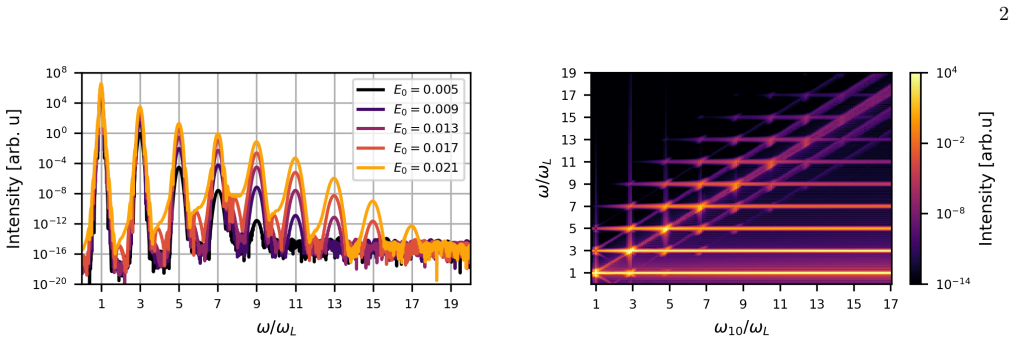
In few-level models of aligned molecules, below-threshold harmonic phases alternate by π between successive odd orders below the dressed-state transition energy but stay constant above it, producing mirrored polarization in orthogonal four-
A machine-rendered reading of the paper's core claim, the machinery that carries it, and where it could break.
Core claim
In a two-level system the phase of emitted harmonics alternates by π between successive odd orders for photon energies below the transition energy between dominant field-dressed states and remains constant above it; a four-level model of two uncoupled orthogonal two-level systems produces lower-order harmonics that follow the driving-field polarization and higher-order harmonics that exhibit mirrored polarization.
What carries the argument
Few-level model Hamiltonians consisting of a two-level system and a four-level system formed from two uncoupled orthogonal two-level systems with selected transition frequencies and orthogonal dipoles.
If this is right
- Lower-order harmonics in the four-level model follow the polarization of the linearly polarized driving field.
- Higher-order harmonics exhibit a mirrored polarization relative to the driving field.
- Analogous phase alternation and polarization features may occur in aligned systems possessing orthogonal transition dipoles.
- The transition energy between dominant field-dressed states marks the boundary between alternating and constant phase regimes.
Where Pith is reading between the lines
- Phase control via alignment could allow selective filtering of specific harmonic orders in molecular targets.
- The orthogonal-dipole construction may generalize to other nonlinear optical processes in aligned media.
- Including weak coupling between the orthogonal subsystems could test the robustness of the polarization mirroring.
Load-bearing premise
The assumption that the chosen few-level Hamiltonians with selected transition frequencies and orthogonal dipoles are sufficient to capture the essential phase and polarization physics of below-threshold harmonics without requiring additional levels, continuum states, or full molecular potential surfaces.
What would settle it
Direct computation or measurement of whether the phase of successive odd below-threshold harmonics alternates by exactly π in a two-level system or whether polarization mirrors in the corresponding four-level orthogonal model.
Figures


read the original abstract
We utilize few-level model systems to analyze the polarization and phase properties of below-threshold harmonics generated from aligned molecules. In a two-level system, we find that the phase of emitted harmonics undergoes a distinct change. For harmonics with photon energies below the transition energy between the dominant field-dressed states, the phase alternates by $\pi$ between successive odd harmonic orders. In contrast, the phase remains constant for harmonics above the transition energy. Exploiting this behavior, we construct a four-level model composed of two uncoupled two-level systems aligned along orthogonal directions. We demonstrate that with selected transition frequencies lower-order harmonics follow the polarization of the linearly polarized driving field while higher-order harmonics exhibit a mirrored polarization. The model predicts that aligned systems with orthogonal transition dipoles may show analogous phase and polarization features in the below-threshold regime.
Editorial analysis
A structured set of objections, weighed in public.
Referee Report
Summary. The paper utilizes few-level model systems to analyze the polarization and phase properties of below-threshold harmonics generated from aligned molecules. In a two-level system, the phase of emitted harmonics alternates by π between successive odd orders for photon energies below the transition energy between dominant field-dressed states and remains constant above it. Exploiting this, the authors construct a four-level model of two uncoupled orthogonal two-level systems with selected transition frequencies, demonstrating that lower-order harmonics follow the polarization of the linearly polarized driving field while higher-order harmonics exhibit mirrored polarization. The model predicts that aligned systems with orthogonal transition dipoles may show analogous phase and polarization features in the below-threshold regime.
Significance. If the results hold, this work offers a transparent few-level framework for understanding phase alternation and polarization switching in below-threshold molecular harmonic generation. The explicit construction with chosen transition frequencies and orthogonal dipoles makes the derivations reproducible and isolates the mechanisms behind the reported behaviors, which could inform interpretations of attosecond experiments on aligned molecules. The paper ships a parameter-explicit model system, allowing direct verification of the phase and polarization claims.
major comments (2)
- [Four-level model construction] Four-level model: The mirrored-polarization effect for higher-order harmonics is a direct consequence of treating the two orthogonal two-level systems as strictly uncoupled, with transition frequencies chosen so that one subsystem dominates lower harmonics and the other higher harmonics. The manuscript should examine whether this separation survives under weak residual couplings (e.g., non-adiabatic or continuum-induced terms) that would be present in a real molecular electronic manifold.
- [Two-level system analysis] Two-level system: The phase-alternation result is shown only for the isolated two-level case. The paper does not demonstrate that the alternation persists when the subsystem is placed inside the four-level construction or when small interactions between the orthogonal channels are introduced.
minor comments (2)
- The abstract would benefit from a short statement on the range of transition frequencies used relative to typical molecular scales to help readers assess generality.
- Clarify the precise definition of 'mirrored polarization' by referencing the relevant equation or figure panel that quantifies the polarization rotation or sign change.
Simulated Author's Rebuttal
We thank the referee for the positive assessment and constructive comments on our manuscript. We address each major comment below and indicate the revisions made to strengthen the presentation of our few-level model.
read point-by-point responses
-
Referee: [Four-level model construction] Four-level model: The mirrored-polarization effect for higher-order harmonics is a direct consequence of treating the two orthogonal two-level systems as strictly uncoupled, with transition frequencies chosen so that one subsystem dominates lower harmonics and the other higher harmonics. The manuscript should examine whether this separation survives under weak residual couplings (e.g., non-adiabatic or continuum-induced terms) that would be present in a real molecular electronic manifold.
Authors: We agree that the mirrored-polarization effect is tied to the assumption of strictly uncoupled subsystems. Our four-level construction is deliberately minimal to isolate the role of orthogonal transition dipoles and selected transition frequencies. In the revised manuscript we have added a short discussion of robustness under weak residual couplings. Using a perturbative treatment we show that when the coupling strength remains much smaller than the frequency separation between the two subsystems, the dominance of each subsystem in its respective harmonic range is preserved to leading order, although small quantitative shifts in the transition point may appear. This addition clarifies the model's scope without extending beyond the few-level framework. revision: yes
-
Referee: [Two-level system analysis] Two-level system: The phase-alternation result is shown only for the isolated two-level case. The paper does not demonstrate that the alternation persists when the subsystem is placed inside the four-level construction or when small interactions between the orthogonal channels are introduced.
Authors: The phase alternation is an intrinsic property of each isolated two-level subsystem. Because the four-level model is assembled from two independent (uncoupled) two-level systems, the phase behavior transfers directly: harmonics dominated by the lower-frequency subsystem alternate by π while those dominated by the higher-frequency subsystem remain phase-constant. We have revised the manuscript to make this inheritance explicit by adding cross-references between the two-level analysis and the four-level results. The effect of small interactions between channels is now treated in the new robustness discussion referenced above. revision: yes
Circularity Check
Explicit few-level models with chosen parameters yield phase/polarization behaviors by direct solution; no circular reduction to inputs or self-citations.
full rationale
The paper defines two-level and four-level Hamiltonians with explicitly selected transition frequencies and orthogonal dipoles to illustrate below-threshold harmonic properties. The reported phase alternation (π between odd orders below transition energy) and polarization mirroring in the four-level case follow directly from solving the time-dependent Schrödinger equation in these constructed systems. No parameters are fitted to external data and then relabeled as predictions, no self-citation chain justifies a uniqueness theorem, and the abstract and model construction make the choices transparent rather than smuggling an ansatz. The derivation is therefore self-contained within the chosen models.
Axiom & Free-Parameter Ledger
free parameters (1)
- transition frequencies
axioms (1)
- domain assumption Few-level approximation suffices for below-threshold harmonics
Reference graph
Works this paper leans on
-
[1]
K. C. Kulander, K. J. Schafer, and J. L. Krause, Dy- namics of short-pulse excitation, ionization and harmonic conversion, in Super-Intense Laser-Atom Physics , edited by B. Piraux, A. L’Huillier, and K. Rz¸ a˙ zewski (Springer US, Boston, MA, 1993) pp. 95–110
work page 1993
-
[2]
P. B. Corkum, Plasma perspective on strong field mul- tiphoton ionization, Physical Review Letters 71, 1994 (1993)
work page 1994
- [3]
-
[4]
F. Dong, Y. Tian, S. Yu, S. Wang, S. Yang, and Y. Chen, Polarization properties of below-threshold har- monics from aligned molecules h2+ in linearly polarized laser fields, Opt. Express 23, 18106 (2015)
work page 2015
-
[5]
W.-H. Xiong, L.-Y. Peng, and Q. Gong, Recent progress of below-threshold harmonic generation, Journal of Physics B 50, 032001 (2017)
work page 2017
- [6]
-
[7]
D. C. Yost, T. R. Schibli, J. Ye, J. L. Tate, J. Hostetter, M. B. Gaarde, and K. J. Schafer, Vacuum-ultraviolet fre- quency combs from below-threshold harmonics, Nature Physics 5, 815 (2009)
work page 2009
-
[8]
M. Zhu, J. Zhang, L. Hua, Z. Xiao, S. Xu, X. Lai, and X. Liu, Molecular structural effects in below- and near- threshold harmonics in xuv-comb generation, Physical Review A 104, 043111 (2021)
work page 2021
-
[9]
D. Martinez, High-order harmonic generation and dy- namic localization in a driven two-level system, a non- perturbative solution using the floquet–green formalism, Journal of Physics A 38, 9979 (2005)
work page 2005
-
[10]
F. Gauthey, C. H. Keitel, P. L. Knight, and A. Maquet, Phase of harmonics from strongly driven two-level atoms, Physical Review A 55, 615 (1997)
work page 1997
-
[11]
Figueira De Morisson Faria and I
C. Figueira De Morisson Faria and I. Rotter, High-order harmonic generation in a driven two-level atom: Periodic level crossings and three-step processes, Physical Review A 66, 013402 (2002)
work page 2002
- [12]
-
[13]
M. B. Gaarde and K. J. Schafer, Enhancement of many high-order harmonics via a single multiphoton resonance, Physical Review A 64, 013820 (2001)
work page 2001
-
[14]
E. S. Toma, P. Antoine, A. de Bohan, and H. G. Muller, Resonance-enhanced high-harmonic generation, Journal of Physics B 32, 5843 (1999)
work page 1999
-
[15]
R. A. Ganeev, M. Suzuki, M. Baba, H. Kuroda, and T. Ozaki, Strong resonance enhancement of a single har- monic generated in the extreme ultraviolet range, Optics letters 31, 1699 (2006)
work page 2006
-
[16]
S.-K. Son, S. Han, and S.-I. Chu, Floquet formulation for the investigation of multiphoton quantum interference in a superconducting qubit driven by a strong ac field, Physical Review A 79, 032301 (2009)
work page 2009
-
[17]
I. Ivanov and A. Kheifets, Resonant enhancement of generation of harmonics, Physical Review A 78, 053406 (2008)
work page 2008
-
[18]
M. Lein, N. Hay, R. Velotta, J. P. Marangos, and P. Knight, Role of the intramolecular phase in high- harmonic generation, Physical Review Letters88, 183903 (2002)
work page 2002
-
[19]
F.-E. Wiechmann, S. Sch¨ opa, L. Bielke, S. Rindel- hardt, S. Patchkovskii, F. Morales, M. Richter, D. Bauer, and F. Fennel, High-order harmonic generation in organic molecular crystals (2025), https://arxiv.org/abs/2505.02432
-
[20]
J. Itatani, J. Levesque, D. Zeidler, H. Niikura, H. P´ epin, J.-C. Kieffer, P. B. Corkum, and D. M. Villeneuve, Tomo- graphic imaging of molecular orbitals, Nature 432, 867 5 (2004)
work page 2004
discussion (0)
Sign in with ORCID, Apple, or X to comment. Anyone can read and Pith papers without signing in.