Precision spectral estimation at sub-Hz frequencies: closed-form posteriors and Bayesian noise projection
Pith reviewed 2026-05-19 03:33 UTC · model grok-4.3
The pith
Bayesian analysis of Wishart periodograms yields closed-form posteriors for cross-spectral quantities at any sub-Hz frequency.
A machine-rendered reading of the paper's core claim, the machinery that carries it, and where it could break.
Core claim
For multivariate Gaussian time series the periodogram at a fixed frequency follows a Wishart distribution; exact integration of this likelihood against suitable priors on the cross-spectral density matrix produces closed-form expressions for the marginal posteriors of individual power spectral densities, pairwise and multiple coherences, and the joint posterior of the full matrix, plus analogous closed forms for susceptibilities and residual background PSD in a linear noise-projection setting.
What carries the argument
Exact analytic marginalization of the Wishart likelihood for the periodogram against conjugate or chosen priors on the cross-spectral density matrix.
If this is right
- Spectral quantities and their uncertainties can be computed exactly even when only a single long stretch of data is available.
- Coherence and noise-coupling estimates carry rigorous Bayesian credible intervals without large-sample approximations.
- Noise-projection filters and residual backgrounds are inferred jointly with the full spectral matrix.
- The same closed-form expressions apply at every frequency bin independently.
Where Pith is reading between the lines
- The closed forms could support sequential updating as new data segments arrive in real-time monitoring.
- Extensions to mildly non-stationary series might be obtained by allowing the prior parameters to vary slowly with time.
- Similar exact posteriors could be derived for other matrix-variate likelihoods that admit conjugate integration.
Load-bearing premise
The underlying time series are multivariate Gaussian.
What would settle it
A direct comparison showing that the observed histogram of periodogram matrices from the data deviates systematically from the Wishart shape expected under the Gaussian model.
Figures


read the original abstract
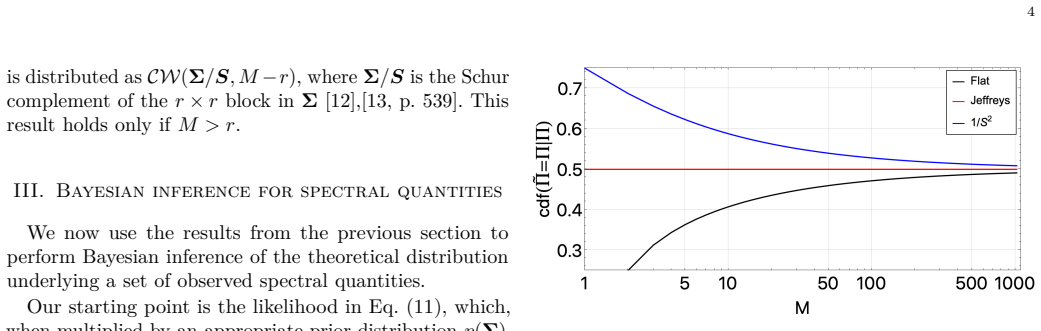
We consider the problem of estimating cross-spectral quantities in the low-frequency regime, where long observation times limit averaging over large ensembles of periodograms, thereby preventing the use of approximate Gaussian statistics. This case is relevant for precision low-frequency gravitational experiments such as LISA and LISA Pathfinder. We present a Bayesian method for estimating spectral quantities in multivariate Gaussian time series. The approach, based on periodograms and Wishart statistics, yields closed-form expressions at any given frequency for the marginal posterior distributions of the individual power spectral densities, the pairwise coherence, and the multiple coherence, as well as for the joint posterior distribution of the full cross-spectral density matrix. In the context of noise projection -- where one series is modeled as a linear combination of filtered versions of the others, plus a background component -- the method also provides closed-form posteriors for both the susceptibilities, i.e., the filter transfer functions, and the power spectral density of the background. We apply the method to data from the LISA Pathfinder mission, showing effective decorrelation of temperature-induced acceleration noise and reliable estimation of its coupling coefficient.
Editorial analysis
A structured set of objections, weighed in public.
Referee Report
Summary. The manuscript proposes a Bayesian method for estimating cross-spectral quantities (PSDs, coherences, and the full cross-spectral density matrix) in multivariate Gaussian time series at sub-Hz frequencies. It exploits the Wishart distribution of single-frequency periodograms together with conjugate inverse-Wishart priors to obtain closed-form marginal posteriors; the framework is extended to a linear noise-projection model that yields closed-form posteriors for susceptibilities and residual background PSD. The method is demonstrated on LISA Pathfinder data, where it is used to decorrelate temperature-induced acceleration noise.
Significance. If the conjugacy arguments hold exactly, the work supplies a computationally efficient, approximation-free route to Bayesian spectral inference precisely where long observation times preclude ensemble averaging. This is directly relevant to LISA and similar precision gravitational experiments. The explicit closed-form marginals for coherence and the matrix-variate posterior constitute a clear technical advance over MCMC-based alternatives, and the LISA Pathfinder application provides a concrete, falsifiable demonstration of noise-projection performance.
major comments (1)
- [§3.2] §3.2 (noise-projection extension): the claim that the joint posterior for susceptibilities and residual PSD remains inverse-Wishart after marginalization over the linear filter coefficients is load-bearing for the closed-form assertion. The manuscript should display the explicit integration step (or the resulting matrix-variate marginal) to confirm that frequency-dependent filtering does not break conjugacy or introduce hidden approximations.
minor comments (2)
- [Abstract and §2.1] The abstract and §2.1 should state the precise form of the inverse-Wishart scale matrix prior (e.g., whether it is data-independent or uses a small number of pseudo-observations) so that readers can immediately reproduce the marginal expressions.
- [Figure 3] Figure 3 (LISA Pathfinder posterior plots): the frequency axis and the number of independent periodogram segments used should be stated in the caption to allow direct comparison with the theoretical Wishart degrees of freedom.
Simulated Author's Rebuttal
We thank the referee for their careful reading of the manuscript and for the constructive comment on the noise-projection extension. We address the point below and will revise the manuscript to incorporate the requested clarification.
read point-by-point responses
-
Referee: [§3.2] §3.2 (noise-projection extension): the claim that the joint posterior for susceptibilities and residual PSD remains inverse-Wishart after marginalization over the linear filter coefficients is load-bearing for the closed-form assertion. The manuscript should display the explicit integration step (or the resulting matrix-variate marginal) to confirm that frequency-dependent filtering does not break conjugacy or introduce hidden approximations.
Authors: We agree that the explicit marginalization step should be shown to confirm the closed-form result. In the revised manuscript we will add the derivation in §3.2. The noise-projection model is linear in the frequency-domain susceptibilities at each frequency bin. With the Wishart likelihood for the periodogram and the conjugate inverse-Wishart prior on the cross-spectral density matrix, the joint posterior for the susceptibilities and residual background PSD follows from standard multivariate conjugate updating. Marginalizing the susceptibilities (which enter as regression coefficients) produces an inverse-Wishart marginal for the residual PSD whose scale matrix is the residual sum of squares after projection onto the orthogonal complement of the filter space. Because the analysis is performed independently at each frequency, frequency-dependent filtering introduces no cross-frequency terms and preserves exact conjugacy under the Gaussian assumption; no hidden approximations are required. revision: yes
Circularity Check
No significant circularity; derivation follows directly from Wishart conjugacy
full rationale
The paper's central results are closed-form marginal posteriors for PSDs, coherences, and the cross-spectral matrix obtained by integrating the Wishart likelihood (arising from multivariate Gaussian time series) against an inverse-Wishart prior. This is a standard conjugate update whose marginals (inverse-gamma, beta, matrix-variate) are known independently of the present work. The noise-projection extension treats susceptibilities as linear regression coefficients and the residual as a separate Wishart term, again preserving exact conjugacy and closed-form marginals. No parameter is fitted to a data subset and then relabeled as a prediction, no self-citation supplies a load-bearing uniqueness theorem, and no ansatz is smuggled in. The derivation is therefore self-contained against external mathematical benchmarks.
Axiom & Free-Parameter Ledger
axioms (1)
- domain assumption The observed time series are jointly multivariate Gaussian.
Lean theorems connected to this paper
-
IndisputableMonolith/Cost/FunctionalEquation.leanwashburn_uniqueness_aczel unclear?
unclearRelation between the paper passage and the cited Recognition theorem.
The approach, based on periodograms and Wishart statistics, yields closed-form expressions... inverse-Wishart prior yields an inverse-Wishart posterior whose marginals... are available in closed form
-
IndisputableMonolith/Foundation/AbsoluteFloorClosure.leanabsolute_floor_iff_bare_distinguishability unclear?
unclearRelation between the paper passage and the cited Recognition theorem.
We assume that data are Gaussian... joint sampling distribution... complex Wishart distribution
What do these tags mean?
- matches
- The paper's claim is directly supported by a theorem in the formal canon.
- supports
- The theorem supports part of the paper's argument, but the paper may add assumptions or extra steps.
- extends
- The paper goes beyond the formal theorem; the theorem is a base layer rather than the whole result.
- uses
- The paper appears to rely on the theorem as machinery.
- contradicts
- The paper's claim conflicts with a theorem or certificate in the canon.
- unclear
- Pith found a possible connection, but the passage is too broad, indirect, or ambiguous to say the theorem truly supports the claim.
Reference graph
Works this paper leans on
-
[1]
P. D. Welch, “The use of fast Fourier transform for the esti- mation of power spectra: a method based on time averaging over short, modified periodograms,” IEEE Trans. Audio and Electroacoustics, vol. 15, no. 2, pp. 70–73, 1967
work page 1967
-
[2]
A. Papoulis and S. Pillai, Probability, Random Variables, and Stochastic Processes, ser. McGraw-Hill series in electrical engi- neering: Communications and signal processing. Tata McGraw- Hill, 2002
work page 2002
-
[3]
M. Armano et al. , “In-depth analysis of LISA Pathfinder perfor- mance results: Time evolution, noise projection, physical models, and implications for LISA,” Phys. Rev. D , vol. 110, p. 042004, Aug 2024
work page 2024
-
[4]
Beyond the Required LISA Free-Fall Performance: New LISA Pathfinder Results down to 20 µHz,
——, “Beyond the Required LISA Free-Fall Performance: New LISA Pathfinder Results down to 20 µHz,” Phys. Rev. Lett. , vol. 120, p. 061101, 2 2018
work page 2018
-
[5]
Sub-Femto- g Free Fall for Space-Based Gravitational Wave Observatories: LISA Pathfinder Results,
——, “Sub-Femto- g Free Fall for Space-Based Gravitational Wave Observatories: LISA Pathfinder Results,” Phys. Rev. Lett. , vol. 116, p. 231101, 2016
work page 2016
-
[6]
M. Armano, H. Audley, J. Baird, M. Bassan, P. Binetruy, M. Born, D. Bortoluzzi, E. Castelli, A. Cavalleri, A. Cesarini et al. , “Nano-Newton electrostatic force actuators for femto- Newton-sensitive measurements: System performance test in the LISA Pathfinder mission,” Phys. Rev. D , vol. 109, p. 102009, May 2024
work page 2024
-
[7]
Improved spectrum estimation from digitized time series on a logarithmic frequency axis,
M. Tr¨ obs and G. Heinzel, “Improved spectrum estimation from digitized time series on a logarithmic frequency axis,” Measurement, vol. 39, pp. 120–129, 02 2006
work page 2006
-
[8]
S. Vitale, L. Sala, and D. Vetrugno, “An optimised variant of the periodogram method for noise power spectral density estimation in LISA hardware testing,” University of Trento, Tech. Rep. LISA-UTN-INST-TN-0035, 2025
work page 2025
-
[9]
N. R. Goodman, “Statistical Analysis Based on a Certain Multivariate Complex Gaussian Distribution (An Introduction),” The Annals of Mathematical Statistics , vol. 34, no. 1, pp. 152–177, 03 1963
work page 1963
-
[10]
Expectations of Functions of Complex Wishart Matrix,
D. K. Nagar and A. K. Gupta, “Expectations of Functions of Complex Wishart Matrix,” Acta Applicandae Mathematicae, vol. 113, no. 3, pp. 265–288, 03 2011
work page 2011
-
[11]
G. Carter, C. Knapp, and A. Nuttall, “Estimation of the magnitude-squared coherence function via overlapped fast Fourier transform processing,” IEEE Transactions on Audio and Electroacoustics, vol. 21, no. 4, pp. 337–344, 08 1973
work page 1973
-
[12]
Schur complements and statistics,
D. V. Ouellette, “Schur complements and statistics,” Linear Algebra and its Applications , vol. 36, pp. 187–295, 03 1981
work page 1981
-
[13]
C. R. Rao, Ed., Linear Statistical Inference and its Applications , ser. Wiley Series in Probability and Statistics. Hoboken, NJ, USA: John Wiley & Sons, Inc., 1973
work page 1973
-
[14]
An invariant form for the prior probability in estimation problems,
H. Jeffreys, “An invariant form for the prior probability in estimation problems,” Proceedings of the Royal Society of London. Series A. Mathematical and Physical Sciences , vol. 186, no. 1007, pp. 453–461, 1946
work page 1946
-
[15]
The inverted complex Wishart distribution and its application to spectral estimation,
P. Shaman, “The inverted complex Wishart distribution and its application to spectral estimation,” J. Multivar. Anal. , vol. 10, no. 1, pp. 51–59, 03 1980
work page 1980
-
[16]
A. M. Mathai, S. B. Provost, and H. J. Haubold, Multivariate statistical analysis in the real and complex domains . Springer Nature, 2022
work page 2022
-
[17]
On posterior distributions for signals in gaussian noise with unknown covariance matrix,
L. Svensson and M. Lundberg, “On posterior distributions for signals in gaussian noise with unknown covariance matrix,”IEEE Transactions on Signal Processing , vol. 53, no. 9, pp. 3554–3571, 2005
work page 2005
-
[18]
The Multivariate t-Distribution Associated with a Set of Normal Sample Deviates,
E. Coornish, “The Multivariate t-Distribution Associated with a Set of Normal Sample Deviates,” Australian Journal of Physics , vol. 7, no. 4, p. 532, 1954
work page 1954
-
[19]
Some windows with very good sidelobe behavior,
A. H. Nuttall, “Some windows with very good sidelobe behavior,” IEEE Transactions on Acoustics, Speech, and Signal Processing , vol. 29, no. 1, pp. 84–91, 1981
work page 1981
-
[20]
Complex singular Wishart matrices and applications,
T. Ratnarajah and R. Vaillancourt, “Complex singular Wishart matrices and applications,” Computers & Mathematics with Applications, vol. 50, no. 3, pp. 399–411, 2005
work page 2005
-
[21]
Is the rank of the sum of two positive semi-definite matrices larger than their individual ranks?
S. M. S. Exchange), “Is the rank of the sum of two positive semi-definite matrices larger than their individual ranks?” Mathematics Stack Exchange, (version: 2017-02-20). [Online]. Available: https://math.stackexchange.com/q/2153772
discussion (0)
Sign in with ORCID, Apple, or X to comment. Anyone can read and Pith papers without signing in.