REVIEW 4 major objections 4 minor 34 references
$S^3$LAM: Surfel Splatting SLAM for Geometrically Accurate Tracking and Mapping
T0 review · 4 major / 4 minor · reviewed 2026-08-06 · deepseek-v4-flash
Pith's one-line read S3LAM claims that replacing 3D Gaussian ellipsoids with oriented 2D Gaussian surfels makes RGB-D SLAM both geometrically more accurate and far more robust to large viewpoint changes, with a depth-distortion adaptive rendering rule and an…
desk verdict Solid, relevant Gaussian-surfel SLAM with a genuinely useful convergence-basin analysis and a plausible radial Jacobian, but it overclaims 'state-of-the-art' and needs error bars, a real GauS-SLAM comparison, and a careful look at the asymmetric adaptive-rendering rule before I'd trust the numbers. read the letter →
The pith
A machine-rendered reading of the paper's core claim, the machinery that carries it, and where it could break.
The reading
What carries the argument
The central object is the 2D Gaussian surfel: a flat, oriented Gaussian primitive defined by a center $p_k$, two tangent vectors $t_u$ and $t_v$ with scales $s_u, s_v$, a normal $t_w = t_u \times t_v$, an opacity $\alpha_k$ and a color $c_k$. Rays intersect its plane to get local $(u,v)$ coordinates, and $\alpha$ blending over these plane intersections produces color, depth, and normal images. Two mechanisms carry the argument: (1) an adaptive mapping rule that computes a depth-distortion term $D_d = \sum_{i,j} \omega_i \omega_j |z_i - z_j|$ over each pixel's surfel stack, and when $D_d$ exceeds a threshold $\tau$ replaces averaged depth and normal with the values of the max-weight surfel (only when the averaged depth is larger), sharpening edges without punching holes in planes; and (2) an analytic pose Jacobian on the Lie algebra of SE(3) that, unlike the 3DGS Jacobian, includes the radial gradient $\partial \hat{t}_r / \partial T_{CW}$ of the center-to-intersection vector, giving the optimizer a rotational signal that aligns camera orientation with the reconstructed surface. The convergence-basin experiment measures how often pose optimization from perturbed initial poses converges within 1 cm to the target, and attributes the wide basin to this radial term.
What would settle it
Run the paper's convergence-basin protocol with the radial-gradient term zeroed out: if the success-rate gap versus 3DGS pose optimization does not collapse, the radial term is not what widens the basin. A second check: on a planar scene with simulated depth noise, measure whether the adaptive $D(x) > D_c(x)$ substitution ever corrupts flat regions, visible as a drop in reconstruction F1.
Extended reading notes
Core claim
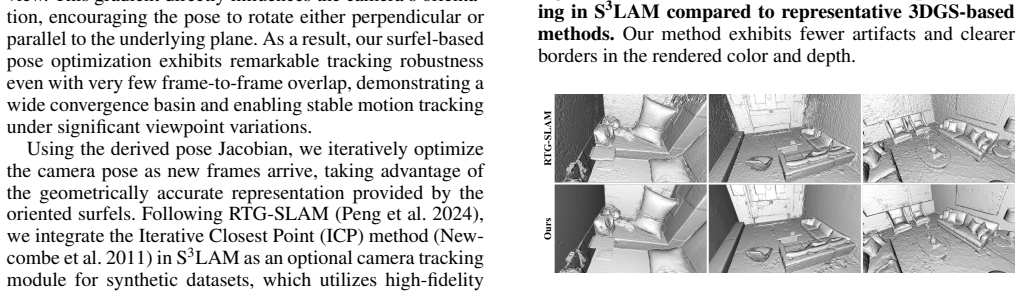
S3LAM's central discovery is that the geometric nature of the scene primitive matters for both mapping and tracking: oriented surfels carry an explicit normal and a well-defined ray-plane intersection, so depth rendering is no longer a weighted average of Gaussian centers but a blending of per-ray intersection points. The paper derives the full SE(3) Jacobian of this rendering (Eq. 10) and shows it contains an extra radial component, the gradient of the vector from the surfel center to the ray-surfel intersection point, which gives the pose optimizer a direct signal to rotate the camera so its rays hit surfaces at the correct location. On the mapping side, the paper introduces a depth-distortion term (Eq. 6) computed from the blending weights and depths; pixels whose distortion exceeds a threshold are rendered by the dominant surfel rather than by opacity-weighted averaging, and this substitution is applied only when the rendered depth exceeds the dominant-surfel depth, preserving planar regions. The combined system tracks poses on ScanNet++ sequences with very small inter-frame overlap where SplaTAM fails, and reconstructs Replica geometry with precision and recall balanced at an F1 of 91.9, at 8.12 FPS and 4.2 GB memory.
Load-bearing premise
The load-bearing premise is that a thresholded depth-distortion value reliably flags unfinished geometry in real-time SLAM, so that swapping in the dominant surfel's depth and normal on those pixels sharpens edges without damaging flat regions.
Editorial extensions
If this is right
- SLAM systems that adopt oriented surfel primitives can track through abrupt viewpoint changes—rotations and teleportations of the kind in ScanNet++—that force 3DGS-based trackers to fail or to be truncated to short sequences.
- Geometric reconstruction quality (F1, accuracy, completion) on standard indoor benchmarks reaches parity with NeRF-based SLAM while running at 8 FPS and using a fraction of the memory, removing a main practical obstacle to real-time use.
- The analytic radial-gradient Jacobian gives a principled route to widen pose convergence basins, which could extend to other splatting-based trackers and to initialization of registration problems in general.
- The depth-distortion adaptive rendering suggests that treating per-pixel uncertainty during rasterization is a lightweight alternative to denser surfel stores for real-time reconstruction of sharp edges.
Reading between the lines
- A stress test with simulated depth noise on predominantly planar scenes would establish how often the conditional substitution $D(x) > D_c(x)$ corrupts planar geometry, a failure mode the paper does not analyze.
- The radial-gradient analysis suggests a general principle: any renderer whose depth is defined by ray-primitive intersections, rather than weighted primitive centers, inherits a rotational gradient that can act as a free orientation prior; applying the same derivation to other surface-aware primitives may reproduce the convergence gain.
- Because the paper only evaluates RGB-D SLAM, the same Jacobian could be ported as an initialization prior for point-cloud registration or visual odometry loops, where the convergence-basin question is the same.
Editorial analysis
A structured set of objections, weighed in public.
Referee Report
Summary. This paper presents S3LAM, an RGB-D SLAM system built on 2D Gaussian surfel splatting. The scene is represented by oriented 2D Gaussians, and mapping optimizes color, depth, and normal losses with an adaptive rendering rule that replaces alpha-blended depth and normal with the max-blend-weight surfel's values when a depth-distortion uncertainty term exceeds a threshold and the blended depth is farther. Tracking optimizes the SE(3) pose using an analytic Jacobian derived from the surfel splatting model, including a radial component that the authors argue improves convergence under large viewpoint changes. Experiments on Replica, TUM-RGBD, and ScanNet++ report state-of-the-art or competitive tracking and reconstruction metrics, together with a convergence-basin analysis and ablations of the adaptive mapping and pose Jacobian components.
Significance. The paper targets a genuine limitation of 3DGS-based SLAM: the lack of explicit surface orientation in both mapping and pose optimization. If the stated results hold, the oriented-surfel representation with the analytic pose Jacobian is a meaningful step forward, and the convergence-basin comparison is a concrete, falsifiable test that is more informative than average ATE alone. The adaptive rendering idea is simple and cheap. However, the empirical support is currently weakened by single-run metrics without error bars, a central derivation that is deferred to a supplementary appendix that is not provided, an ablation whose control condition does not match the main result table, and a one-sided substitution rule that may systematically bias occlusion boundaries. These issues prevent me from recommending acceptance in the current form.
major comments (4)
- [§4.1, Eq. (6)–(7)] The adaptive substitution rule is asymmetric and can systematically relabel occlusion-boundary pixels as foreground. Consider a background pixel whose ray passes through the footprint of a foreground surfel; if that foreground surfel has the largest blending weight, Eq. (7) selects its depth, and because the alpha-blended depth is a weighted average of foreground and background depths, the condition D(x) > D_c(x) holds, so the pixel is replaced by the foreground depth. This expands foreground silhouettes by roughly the surfel footprint and can bias the claimed edge-sharpening improvement in Table 6; since the tracking loss in Eq. (8) uses the same rendered depth, it can also affect pose optimization. The only ablation is a whole-scene evaluation on Replica with no error bars and no second dataset, so a localized error of a few centimeters would not be detected. Please add a per-pixel analysis at occlusion boundaries, evaluate on a second dataset, report error bars, and provide a formal or empirical characterization of when the one-sided rule is safe.
- [§4.2, Eq. (9)–(10)] The central tracking contribution relies on the analytic Jacobian of the tangent vectors, but the derivation is only referenced as 'supplementary material,' which is not included with this submission. Without this derivation, the claimed advantage of the radial gradient and the 'w/o radial' ablation in Table 7 cannot be checked. Please include the full derivation in the paper, or at minimum state the exact closed-form expressions used to compute the terms in Eq. (10).
- [Table 7] The ablation's 'Ours' row (0.68, 1.21, 1.43, 1.69 cm on S0, S1*, S1, S2) does not match the main ScanNet++ results in Table 5 (0.35, 0.42, 0.51, 1.11 cm). No explanation is given for the discrepancy; if the ablation uses a different protocol, fewer iterations, or a different keyframe setting, the comparison against 'w/o depth loss' and 'w/o radial' is not controlled. Please reconcile the two tables or specify precisely what differs.
- [Tables 3–5] All tracking and reconstruction tables report single-run metrics without error bars. Several reported differences are small (e.g., Table 3 Replica average 0.38 vs. 0.39 for SplaTAM; Table 4 fr2/xyz 1.16 vs. 1.24), and ScanNet++ trajectories with teleportations and large rotations may be sensitive to initialization and random seeds. Please report the number of runs and standard deviations, or otherwise justify why single-run evaluation is sufficient for the claims.
minor comments (4)
- [Table 6] The first row of Table 6 appears misaligned: the 3DGS row reads Acc.=2.80, P.=3.71, Comp.=74.8, R.=70.1, F1=72.3, L1=2.21. Precision cannot be 3.71% and completion cannot be 74.8 cm; likely the intended values are Acc.=2.80, P.=74.8, Comp.=3.71, R.=70.1, F1=72.3, L1=2.21. Please fix the column alignment.
- [Eq. (7)] The notation D_c(x) = arg max_ω_k z_k is an abuse of notation: arg max returns the surfel index, not a depth value. Define k* = argmax_k ω_k and then D_c = z_{k*}, N_c = t_w^{k*}.
- [Experiments, Baselines] There is a typo in the Baselines paragraph: 'performation' should be 'performance'.
- [§5.3, Figure 7] The convergence-basin protocol would be easier to interpret if the authors reported the number of sampled initial poses per distance, the exact pose-optimization settings used for MonoGS, and error bars or confidence intervals on the success-rate estimates.
Circularity Check
No circular derivation: pose Jacobian is analytical, adaptive rendering is a heuristic tested against external benchmarks, and self-cited baselines are not load-bearing.
full rationale
The paper's central claims are not circular. The pose Jacobian in Eq. 10 is derived analytically from the forward surfel-splatting rendering model of Eqs. 1-4; it introduces the radial gradient component as a mathematical consequence of ray-surfel intersection, and no fitted constant is forced into the convergence claim. The adaptive surface mapping in Eqs. 6-7 uses a depth-distortion heuristic computed from rendered alpha weights and depths, not from the evaluation targets; its improvement over mean/median depth is an empirical ablation on Replica, and the potential background-edge relabeling failure is a robustness concern, not a definitional reduction. The convergence-basin protocol measures success by proximity to a ground-truth pose, and the ScanNet++/TUM/Replica ATE results are evaluated against external trajectories, so the predictions are not constructed from the method's own outputs. The only author-overlapping citation (RTG-SLAM, Peng et al. 2024, which includes co-author Y. Liu) is used for baseline comparison and for standard surfel addition/deletion and optional ICP integration; it does not justify the core representation or the adaptive rendering claims. The stated limitation about degraded performance with low-quality depth sensors is acknowledged and does not affect the circularity assessment. Overall, the derivation chain is self-contained; hyperparameter tuning on the same benchmark family is ordinary practice, not circularity.
Assumptions & free parameters
free parameters (6)
- Distortion threshold tau =
5e-6
- Mapping loss weights gamma_D and gamma_N =
gamma_D=1.0, gamma_N=0.1
- Surfel addition thresholds delta_T, delta_d, delta_c =
delta_T=0.5, delta_d=0.1, delta_c=0.1
- Keyframe thresholds delta_r, delta_t =
not reported
- Optimization schedule =
every 6 frames, 50 iterations; final refinement at 10x keyframe iterations
- Convergence-basin evaluation grid =
3x3 views with 0.1m spacing; success within 1cm
assumptions (4)
- standard math Lie algebra SE(3) pose parametrization and the Jacobian chain rule from Sola et al. 2021 are valid for the surfel rendering pipeline.
- domain assumption The normal map computed from spatial gradients of the depth map is a reliable supervision signal.
- ad hoc to paper Depth distortion D_d, inherited from Mip-NeRF 360, is a valid uncertainty metric for unfinished surfel regions in real-time SLAM.
- ad hoc to paper Replacing blended depth and normal with the max-blend-weight surfel value, conditioned on D > D_c, preserves large planar surfaces while sharpening edges.
Cite this review
Pith. "Pith review of $S^3$LAM: Surfel Splatting SLAM for Geometrically Accurate Tracking and Mapping." pith.science (2026). https://pith.science/paper/OKTUDMQM
@misc{pith2026250720854,
  author       = {Pith},
  title        = {Pith review of: $S^3$LAM: Surfel Splatting SLAM for Geometrically Accurate Tracking and Mapping},
  year         = {2026},
  howpublished = {\url{https://pith.science/paper/OKTUDMQM}},
  note         = {Machine review of arXiv:2507.20854}
}
abstract
We propose $S^3$LAM, a novel RGB-D SLAM system that leverages 2D surfel splatting to achieve highly accurate geometric representations for simultaneous tracking and mapping. Unlike existing 3DGS-based SLAM approaches that rely on 3D Gaussian ellipsoids, we utilize 2D Gaussian surfels as primitives for more efficient scene representation. By focusing on the surfaces of objects in the scene, this design enables $S^3$LAM to reconstruct high-quality geometry, benefiting both mapping and tracking. To address inherent SLAM challenges including real-time optimization under limited viewpoints, we introduce a novel adaptive surface rendering strategy that improves mapping accuracy while maintaining computational efficiency. We further derive camera pose Jacobians directly from 2D surfel splatting formulation, highlighting the importance of our geometrically accurate representation that improves tracking convergence. Extensive experiments on both synthetic and real-world datasets validate that $S^3$LAM achieves state-of-the-art performance. Code will be made publicly available.
Figures


Figures from the paper (4 more)



Reference graph
Works this paper leans on
-
[1]
T.; Mildenhall, B.; Verbin, D.; Srinivasan, P
Barron, J. T.; Mildenhall, B.; Verbin, D.; Srinivasan, P. P.; and Hedman, P. 2022. Mip-NeRF 360: Unbounded Anti-Aliased Neural Radiance Fields. In Proceedings of the IEEE/CVF Conference on Computer Vision and Pattern Recognition (CVPR), 5470--5479. IEEE
work page 2022
-
[2]
Cao, Y.-P.; Kobbelt, L.; and Hu, S.-M. 2018. Real-time high-accuracy three-dimensional reconstruction with consumer RGB-D cameras. ACM Transactions on Graphics (TOG), 37(5): 1--16
work page 2018
-
[3]
Curless, B.; and Levoy, M. 1996. A volumetric method for building complex models from range images. In Proceedings of the 23rd annual conference on Computer graphics and interactive techniques, 303--312
work page 1996
-
[4]
Dai, A.; Nie ner, M.; Zoll \"o fer, M.; Izadi, S.; and Theobalt, C. 2017. BundleFusion: Real-time Globally Consistent 3D Reconstruction using On-the-fly Surface Re-integration. ACM Transactions on Graphics 2017 (TOG)
work page 2017
-
[5]
Dai, P.; Xu, J.; Xie, W.; Liu, X.; Wang, H.; and Xu, W. 2024. High-quality surface reconstruction using gaussian surfels. In ACM SIGGRAPH 2024 Conference Papers, 1--11. ACM
work page 2024
-
[6]
Davison, A. J.; Reid, I. D.; Molton, N. D.; and Stasse, O. 2007. MonoSLAM: Real-Time Single Camera SLAM. IEEE Transactions on Pattern Analysis and Machine Intelligence, 29(6): 1052--1067
work page 2007
-
[7]
Hu, J.; Chen, X.; Feng, B.; Li, G.; Yang, L.; Bao, H.; Zhang, G.; and Cui, Z. 2025. Cg-slam: Efficient dense rgb-d slam in a consistent uncertainty-aware 3d gaussian field. In European Conference on Computer Vision, 93--112. Springer, Springer
work page 2025
-
[8]
Huang, B.; Yu, Z.; Chen, A.; Geiger, A.; and Gao, S. 2024. 2d gaussian splatting for geometrically accurate radiance fields. In ACM SIGGRAPH 2024 conference papers, 1--11. ACM
work page 2024
Show all 34 references
-
[9]
Huang, J.; Huang, S.-S.; Song, H.; and Hu, S.-M. 2021. Di-fusion: Online implicit 3d reconstruction with deep priors. In Proceedings of the IEEE/CVF Conference on Computer Vision and Pattern Recognition, 8932--8941. Computer Vision Foundation / IEEE
2021
-
[10]
M.; Yang, G.; Scherer, S.; Ramanan, D.; and Luiten, J
Keetha, N.; Karhade, J.; Jatavallabhula, K. M.; Yang, G.; Scherer, S.; Ramanan, D.; and Luiten, J. 2024. SplaTAM: Splat Track & Map 3D Gaussians for Dense RGB-D SLAM. In Proceedings of the IEEE/CVF Conference on Computer Vision and Pattern Recognition, 21357--21366. IEEE
2024
-
[11]
Kerbl, B.; Kopanas, G.; Leimk \"u hler, T.; and Drettakis, G. 2023. 3D Gaussian Splatting for Real-Time Radiance Field Rendering. ACM Transactions on Graphics, 42(4): 139--1
2023
-
[12]
H.; and Davison, A
Matsuki, H.; Murai, R.; Kelly, P. H.; and Davison, A. J. 2024. Gaussian splatting slam. In Proceedings of the IEEE/CVF Conference on Computer Vision and Pattern Recognition, 18039--18048
2024
-
[13]
P.; Tancik, M.; Barron, J
Mildenhall, B.; Srinivasan, P. P.; Tancik, M.; Barron, J. T.; Ramamoorthi, R.; and Ng, R. 2021. Nerf: Representing scenes as neural radiance fields for view synthesis. Communications of the ACM, 65(1): 99--106
2021
-
[14]
J.; Gelfand, N.; Pottmann, H.; and Guibas, L
Mitra, N. J.; Gelfand, N.; Pottmann, H.; and Guibas, L. 2004. Registration of point cloud data from a geometric optimization perspective. In Proceedings of the 2004 Eurographics/ACM SIGGRAPH symposium on Geometry processing, 22--31
2004
-
[15]
A.; Izadi, S.; Hilliges, O.; Molyneaux, D.; Kim, D.; Davison, A
Newcombe, R. A.; Izadi, S.; Hilliges, O.; Molyneaux, D.; Kim, D.; Davison, A. J.; Kohi, P.; Shotton, J.; Hodges, S.; and Fitzgibbon, A. 2011. KinectFusion: Real-time dense surface mapping and tracking. In 2011 10th IEEE International Symposium on Mixed and Augmented Reality, 127--136
2011
-
[16]
A.; Lovegrove, S
Newcombe, R. A.; Lovegrove, S. J.; and Davison, A. J. 2011. DTAM: Dense tracking and mapping in real-time. In 2011 international conference on computer vision, 2320--2327. IEEE, IEEE
2011
-
[17]
Peng, Z.; Shao, T.; Liu, Y.; Zhou, J.; Yang, Y.; Wang, J.; and Zhou, K. 2024. Rtg-slam: Real-time 3d reconstruction at scale using gaussian splatting. In ACM SIGGRAPH 2024 Conference Papers, 1--11
2024
-
[18]
Ruetz, F.; Hernández, E.; Pfeiffer, M.; Oleynikova, H.; Cox, M.; Lowe, T.; and Borges, P. 2019. OVPC Mesh: 3D Free-space Representation for Local Ground Vehicle Navigation. In 2019 International Conference on Robotics and Automation (ICRA), 8648--8654. IEEE
2019
-
[19]
Sandstr \"o m, E.; Li, Y.; Van Gool, L.; and Oswald, M. R. 2023. Point-slam: Dense neural point cloud-based slam. In Proceedings of the IEEE/CVF International Conference on Computer Vision, 18433--18444. IEEE
2023
-
[20]
Solà, J.; Deray, J.; and Atchuthan, D. 2021. A micro Lie theory for state estimation in robotics. arXiv:1812.01537
2021 arXiv
-
[21]
J.; Mur-Artal, R.; Ren, C.; Verma, S.; et al
Straub, J.; Whelan, T.; Ma, L.; Chen, Y.; Wijmans, E.; Green, S.; Engel, J. J.; Mur-Artal, R.; Ren, C.; Verma, S.; et al. 2019. The Replica dataset: A digital replica of indoor spaces. arXiv preprint arXiv:1906.05797
2019 arXiv
-
[22]
Sturm, J.; Engelhard, N.; Endres, F.; Burgard, W.; and Cremers, D. 2012. A benchmark for the evaluation of RGB-D SLAM systems. In 2012 IEEE/RSJ international conference on intelligent robots and systems, 573--580. IEEE, IEEE
2012
-
[23]
Su, Y.; Chen, L.; Zhang, K.; Zhao, Z.; Hou, C.; and Yu, Z. 2025. GauS-SLAM: Dense RGB-D SLAM with Gaussian Surfels. arXiv:2505.01934
2025 arXiv
-
[24]
Sucar, E.; Liu, S.; Ortiz, J.; and Davison, A. J. 2021. imap: Implicit mapping and positioning in real-time. In Proceedings of the IEEE/CVF international conference on computer vision, 6229--6238. IEEE
2021
-
[25]
Sucar, E.; Wada, K.; and Davison, A. 2020. NodeSLAM: Neural object descriptors for multi-view shape reconstruction. In 2020 International Conference on 3D Vision (3DV), 949--958. IEEE
2020
-
[26]
Teed, Z.; and Deng, J. 2021. Droid-slam: Deep visual slam for monocular, stereo, and rgb-d cameras. Advances in neural information processing systems, 34: 16558--16569
2021
-
[27]
F.; Glocker, B.; Davison, A
Whelan, T.; Salas-Moreno, R. F.; Glocker, B.; Davison, A. J.; and Leutenegger, S. 2016. ElasticFusion: Real-time dense SLAM and light source estimation. The International Journal of Robotics Research, 35(14): 1697--1716
2016
-
[28]
Yan, C.; Qu, D.; Xu, D.; Zhao, B.; Wang, Z.; Wang, D.; and Li, X. 2024. Gs-slam: Dense visual slam with 3d gaussian splatting. In Proceedings of the IEEE/CVF Conference on Computer Vision and Pattern Recognition, 19595--19604. IEEE
2024
-
[29]
Yang, X.; Li, H.; Zhai, H.; Ming, Y.; Liu, Y.; and Zhang, G. 2022. Vox-Fusion: Dense Tracking and Mapping with Voxel-based Neural Implicit Representation. In 2022 IEEE International Symposium on Mixed and Augmented Reality (ISMAR), 499--507. IEEE
2022
-
[30]
Yeshwanth, C.; Liu, Y.-C.; Nie ner, M.; and Dai, A. 2023. ScanNet++: A High-Fidelity Dataset of 3D Indoor Scenes. In Proceedings of the International Conference on Computer Vision ( ICCV ) , 12--22. IEEE
2023
-
[31]
Zhi, S.; Bloesch, M.; Leutenegger, S.; and Davison, A. J. 2019. Scenecode: Monocular dense semantic reconstruction using learned encoded scene representations. In Proceedings of the IEEE/CVF Conference on Computer Vision and Pattern Recognition, 11776--11785. IEEE
2019
-
[32]
R.; and Pollefeys, M
Zhu, Z.; Peng, S.; Larsson, V.; Xu, W.; Bao, H.; Cui, Z.; Oswald, M. R.; and Pollefeys, M. 2022. Nice-slam: Neural implicit scalable encoding for slam. In Proceedings of the IEEE/CVF conference on computer vision and pattern recognition, 12786--12796. IEEE
2022
-
[33]
, " * write output.state after.block = add.period write newline
ENTRY address archivePrefix author booktitle chapter edition editor eid eprint howpublished institution isbn journal key month note number organization pages publisher school series title type volume year label extra.label sort.label short.list INTEGERS output.state before.all...
-
[34]
write newline
" write newline "" before.all 'output.state := FUNCTION n.dashify 't := "" t empty not t #1 #1 substring "-" = t #1 #2 substring "--" = not "--" * t #2 global.max substring 't := t #1 #1 substring "-" = "-" * t #2 global.max substring 't := while if t #1 #1 substring * t #2 gl...
Reviewed August 6, 2026 · model on record in the stance chip above.
Discussion (0). Continue with ORCID to comment.