REVIEW 5 major objections 6 minor 1 cited by
Zero-Shot Learning with Subsequence Reordering Pretraining for Compound-Protein Interaction
T0 review · 5 major / 6 minor · reviewed 2026-08-06 · deepseek-v4-flash
Pith's one-line read Subsequence-reordering pretraining lifts zero-shot compound-protein prediction, with AUROC up 13.98% and AUPRC up 36.36% on unseen pairs.
desk verdict A useful empirical idea — subsequence reordering for CPI — with a real data-reporting gap that needs fixing before the headline zero-shot numbers can be trusted. read the letter →
The pith
A machine-rendered reading of the paper's core claim, the machinery that carries it, and where it could break.
The reading
What carries the argument
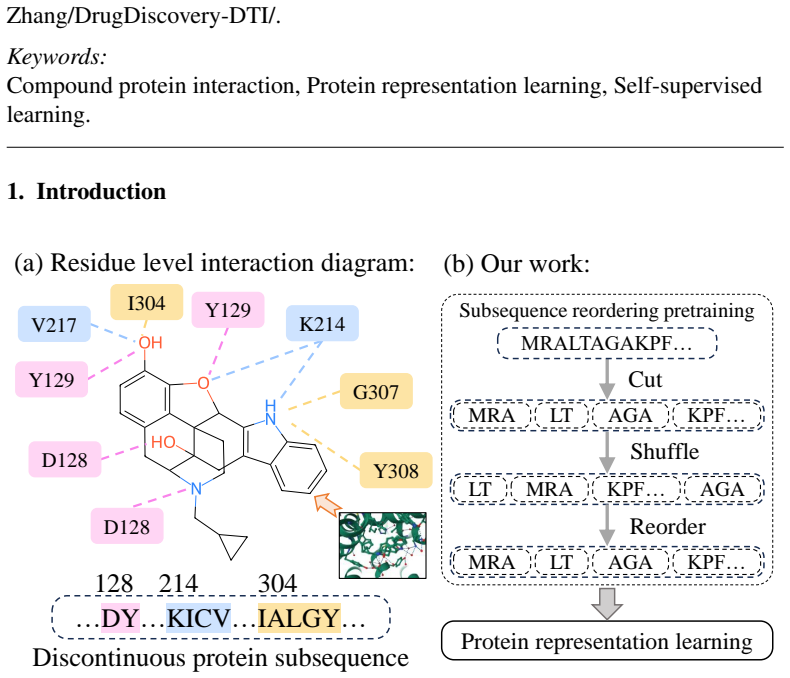
The load-bearing object is the subsequence-reordering pretext task. A protein sequence is cut by RAcut into n variable-length fragments, padded to uniform length, and permuted by a binary shuffle matrix P; the Transformer encoder sees the shuffled fragments, and its output is converted by iterative row and column normalization into a doubly stochastic matrix Q trained to match P. Because P is discrete, the doubly stochastic relaxation makes the permutation target differentiable. RAcut provides length-variable augmentation, and identity or 15% amino-acid masking adds noise. Recovering the original fragment order is intended to force the encoder to represent the spatiotemporal constraints behind protein folding and therefore the discontinuous residue contacts that form binding pockets.
What would settle it
Compute the same zero-shot Unseen-Both AUROC and AUPRC on a held-out set of proteins whose folds and binding-site geometries are known, and check whether the encoder's attention maps or learned embeddings place distant-in-sequence residues in spatial proximity; if reordering accuracy does not correlate with contact prediction quality, the folding-relevance claim is in doubt.
Extended reading notes
Core claim
The central claim is that the order of a protein's subsequences carries binding-relevant information, and that forcing an encoder to reconstruct that order teaches non-local dependencies that transfer to compounds and proteins never seen in training. The paper reports that adding PSRP-CPI to DrugBAN, PerceiverCPI, SiamDTI, MGNDTI, and PSC-CPI improves almost all baselines across Seen-Both, Unseen-Compound, Unseen-Protein, and Unseen-Both scenarios, with the strongest and most consistent gains in Unseen-Both. On BioSNAP the largest Unseen-Both improvements are 13.98% in AUROC and 36.36% in AUPRC, both for DrugBAN; on BindingDB, Davis, and KIBA the integrated module improves most baselines, with small degradations on the smallest Davis dataset attributed to limited data. Under identical data and model conditions, subsequence reordering beats amino-acid masking and two contrastive pretraining objectives on all four datasets while matching or exceeding large-scale protein language models on BindingDB and KIBA despite pretraining on roughly four thousand sequences.
Load-bearing premise
The load-bearing premise is that solving the reordering puzzle on proteins from the downstream training set teaches the encoder binding-relevant non-local dependencies that transfer to proteins never seen in training, rather than memorizing dataset-specific sequence statistics such as fragment lengths, residue composition, or homology to training proteins.
Editorial extensions
If this is right
- Zero-shot CPI, especially the Unseen-Both setting where neither compound nor protein appeared in training, can be improved by a sequence-only pretraining objective that needs no structures, texts, or external sequence corpora.
- A pretraining set as small as the downstream training data, roughly four thousand proteins on BioSNAP, is enough for reordering pretraining to help, whereas mask-based and contrastive objectives under the same data conditions can hurt performance.
- The gains transfer across architectures: the same pretrained encoder lifts five different CPI baselines, indicating that the improvement lives in the protein representation rather than in any single fusion module.
- The number of subsequence fragments matters, with performance rising then falling as n grows, which supports the idea that inter-fragment dependencies rather than purely local context carry the signal.
- Because the encoder is frozen during fine-tuning, the reported gains isolate the quality of the pretrained representation from changes in the downstream classifier.
Reading between the lines
- The mechanism story could be tested directly: if reordering pretraining truly learns folding-relevant geometry, the encoder's attention or embeddings should show contact-like structure at residue pairs that are distant in sequence but close in three-dimensional structure, a check the paper does not report.
- A cheaper proxy for the same inductive bias may exist: instead of full permutation recovery, training on pairwise order decisions or shuffled-domain detection might capture most of the gain while scaling to longer proteins and more fragments.
- The Unseen-Both gains on BioSNAP are concentrated in AUPRC, which suggests reordering pretraining mostly improves ranking of rare positive pairs rather than the overall decision boundary; future work could separate recall at low false-positive rates.
- Because the method pretrains on downstream training proteins, its zero-shot generalization may partly reflect dataset-specific fragment statistics; applying it to an external, structurally annotated benchmark would clarify whether the learned dependencies are general folding rules or benchmark-specific shortcuts.
Editorial analysis
A structured set of objections, weighed in public.
Referee Report
Summary. The paper proposes PSRP-CPI, a self-supervised pretraining method for compound–protein interaction (CPI) prediction. Protein sequences are split into variable-length subsequences by a random augmentation strategy (RAcut), shuffled, and fed to a Transformer encoder that is trained to recover the original subsequence order; the order-recovery problem is relaxed to predicting a doubly-stochastic matrix via Sinkhorn normalization, with an optional amino-acid masking noise. The pretrained protein encoder is then frozen and integrated into several CPI baseline models. Experiments on BioSNAP in four split scenarios (Seen-Both, Unseen-Comp, Unseen-Prot, Unseen-Both) and on BindingDB, Davis, and KIBA in the Unseen-Both setting report consistent AUROC/AUPRC improvements over baselines, with the largest gains in Unseen-Both (up to +13.98% AUROC and +36.36% AUPRC). The paper also compares PSRP-CPI with protein language models and with three same-data pretraining objectives (AA-Mask, sequence–structure contrastive learning, sequence–text contrastive learning), reporting that PSRP-CPI outperforms the same-data alternatives on all four datasets.
Significance. If the reported results are unbiased, the paper makes a useful contribution: a data-efficient, sequence-only pretraining objective that improves zero-shot CPI prediction without external protein databases or 3D structures. The manuscript has several strengths: the method is simple and clearly described; the ablation in Table 7 shows that each component (shuffle, RAcut, I/M noise) contributes; Table 6 provides a same-data, same-architecture comparison against three alternative pretraining objectives, which is the most direct evidence for the central claim; and the authors state that code is available. However, the evaluation has gaps that directly affect the headline numbers: the BioSNAP split counts are internally inconsistent, Table 2 lacks the error bars the text promises, hyperparameters appear to be tuned on test-scenario metrics, and the split protocols for the three additional datasets are not described. These issues are fixable and do not, in my assessment, invalidate the core idea, but they must be addressed before the empirical claims can be considered reliable.
major comments (5)
- [§4.1, Table 1] The BioSNAP split sizes are internally inconsistent with the dataset size. Section 4.1 reports 4,166 (Seen-Both), 5,410 (Unseen-Comp), 5,082 (Unseen-Prot), and 1,540 (Unseen-Both) pairs, which sum to 16,198 pairs, whereas Table 1 states that BioSNAP contains 27,464 interactions. The paper never explains where the remaining 11,266 pairs are discarded. If pairs are removed by the length caps (maximum protein length 1,200, maximum atoms 290) or by deduplication, the reported zero-shot results apply to a filtered subset whose composition may differ systematically from the full benchmark. Please provide an exact derivation of the 16,198 pairs and account for all 27,464 interactions, or report results on the unfiltered split.
- [§4.2, Table 2] The text states that five independent runs were conducted and that each metric's mean and standard deviation are reported, but Table 2 reports only point estimates (no standard deviations), while Table 3 reports mean±std for two datasets. Several deltas in Table 2 are small (e.g., SiamDTI Seen-Both AUROC −0.48%, MGNDTI Unseen-Comp AUROC 0.00%), so without variance estimates or significance tests the reader cannot judge whether these differences are meaningful. Please report standard deviations for all tables or clearly indicate which differences are statistically reliable.
- [§4.5, Fig. 5, Fig. 6] The hyperparameter analysis appears to select the number of subsequences n, the number of Transformer layers, and the maximum sequence length based on AUROC measured on the Unseen-Both test scenario. For example, Fig. 5(a) plots Unseen-Both AUROC as a function of n and Fig. 6 plots AUROC across scenarios as a function of layer count, with the final choices n=24 and 8 layers justified by these plots. If these choices were made on test-set performance, the reported zero-shot results are optimistically biased. Please describe the validation procedure used for hyperparameter selection, or hold out a validation split that is not used for final test reporting.
- [§3.3, §4.4] The central mechanistic claim—that solving the subsequence reordering puzzle teaches the encoder binding-relevant, non-local dependencies—is supported only by an appeal to Anfinsen's dogma and by the UMAP visualization in Fig. 4, which shows clustering by protein family. Family clustering does not directly demonstrate that the learned representations capture interaction-relevant spatial geometry. Please provide a more direct probe, such as contact-map prediction, binding-site residue enrichment, or an attention analysis on proteins with known binding pockets, or alternatively soften the mechanistic interpretation to what the current evidence supports.
- [§4.1, Tables 3 and 4] The evaluation protocol for the Unseen-Both setting on BindingDB, Davis, and KIBA is not specified. The paper says only that these datasets are used to evaluate the Unseen-Both setting, without stating how unseen proteins and compounds are selected, how many pairs are in each split, or whether the same split construction was used as for BioSNAP. Without this information, the results in Tables 3 and 4 are not reproducible and cannot be compared across methods in a controlled way. Please provide the split construction details for all datasets.
minor comments (6)
- [Table 2] The column header 'Avarage' is a typo and should read 'Average'.
- [§4.2] In the paragraph after Table 3, 'the PSCR method' appears to be a typo for 'PSRP'.
- [§4.1, Table 1] Table 1 lists 4,505 compounds for BioSNAP, while Section 4.1 says the dataset includes 4,510 compounds; these numbers should be reconciled.
- [§4.1] The phrase 'excluding Seenboth' and the spacing in 'Seen-Both' are inconsistent; please use a single consistent name for this scenario throughout the text.
- [§3.3] The claim that the standard deviation across five pretraining trials is less than 0.3% is stated in the text but no supporting numbers are shown; please report the actual values or cite the relevant table.
- [Table 6 and §4.2] The naming of the contrastive baselines is inconsistent (e.g., 'BioTexts Sequences CL' in Table 6 versus 'BioTexts Sequences CL' and 'Sequences Structure CL' in Table 5); please use uniform labels.
Circularity Check
No significant circularity: the pretraining objective and the downstream zero-shot CPI evaluation are distinct and not forced by construction.
full rationale
The paper's derivation chain is self-contained. The pretraining loss (Eq. 5) trains a protein encoder to predict, from a shuffled protein subsequence vector, a doubly-stochastic matrix Q that approximates the known shuffle matrix P; this is a self-supervised task on the protein sequence itself. The reported claims are downstream CPI metrics (AUROC/AUPRC) computed on held-out compound-protein pairs with independent interaction labels, so the prediction is not the pretraining input by construction. The ablation study (Table 7) and the comparison against AA-Mask and contrastive pretraining under identical data and model conditions (Table 6) provide an internally controlled evaluation. The invocation of Anfinsen's dogma and PSC-CPI's split procedure are external or methodological citations, not load-bearing self-citations. The only self-citation, SiamDTI [26], is used as one of five baselines, and the paper reports consistent gains on four other baseline methods, so the central claim does not reduce to that citation. Concerns about the unexplained difference between the BioSNAP split sizes (16,198 vs. 27,464) and hyperparameter selection on the target scenario are correctness and reproducibility risks, not circularity in the derivation sense.
Assumptions & free parameters
free parameters (3)
- Number of protein subsequences n =
24
- Number of Transformer encoder layers =
8
- Maximum protein sequence length Lmax =
1200
assumptions (5)
- domain assumption Protein tertiary structure and binding-relevant contacts are determined by the amino acid sequence, so recovering subsequence order recovers folding constraints (Anfinsen's dogma).
- domain assumption Learning to reorder subsequences transfers to compound-protein interaction prediction for proteins outside the training set.
- domain assumption A Transformer with self-attention can represent long-range interdependencies between discontinuous protein subsequences.
- standard math Sinkhorn normalization converts a positive matrix to a doubly stochastic matrix and is differentiable with unrolled gradients.
- domain assumption Negative compound-protein pairs in BioSNAP, BindingDB, Davis, and KIBA are valid non-interaction labels.
Cite this review
Pith. "Pith review of Zero-Shot Learning with Subsequence Reordering Pretraining for Compound-Protein Interaction." pith.science (2026). https://pith.science/paper/SRI4UM6T
@misc{pith2026250720925,
  author       = {Pith},
  title        = {Pith review of: Zero-Shot Learning with Subsequence Reordering Pretraining for Compound-Protein Interaction},
  year         = {2026},
  howpublished = {\url{https://pith.science/paper/SRI4UM6T}},
  note         = {Machine review of arXiv:2507.20925}
}
read the original abstract
Given the vastness of chemical space and the ongoing emergence of previously uncharacterized proteins, zero-shot compound-protein interaction (CPI) prediction better reflects the practical challenges and requirements of real-world drug development. Although existing methods perform adequately during certain CPI tasks, they still face the following challenges: (1) Representation learning from local or complete protein sequences often overlooks the complex interdependencies between subsequences, which are essential for predicting spatial structures and binding properties. (2) Dependence on large-scale or scarce multimodal protein datasets demands significant training data and computational resources, limiting scalability and efficiency. To address these challenges, we propose a novel approach that pretrains protein representations for CPI prediction tasks using subsequence reordering, explicitly capturing the dependencies between protein subsequences. Furthermore, we apply length-variable protein augmentation to ensure excellent pretraining performance on small training datasets. To evaluate the model's effectiveness and zero-shot learning ability, we combine it with various baseline methods. The results demonstrate that our approach can improve the baseline model's performance on the CPI task, especially in the challenging zero-shot scenario. Compared to existing pre-training models, our model demonstrates superior performance, particularly in data-scarce scenarios where training samples are limited. Our implementation is available at https://github.com/Hoch-Zhang/PSRP-CPI.
Figures


Figures from the paper (3 more)


Forward citations
Cited by 1 Pith paper
-
Valid Property-Enhanced Contrastive Learning for Targeted Optimization & Resampling for Novel Drug Design
VECTOR+ combines contrastive learning and Gaussian mixture sampling to generate novel, synthetically plausible inhibitors from low-data datasets, with improved docking scores over known compounds.
Reference graph
Works this paper leans on
-
[1]
K. Y . Gao, A. Fokoue, H. Luo, A. Iyengar, S. Dey, P. Zhang, et al., Inter- pretable drug target prediction using deep neural representation., in: IJCAI, V ol. 2018, 2018, pp. 3371–3377
work page 2018
-
[2]
Y . Ding, J. Tang, F. Guo, Identification of drug–target interactions via dual laplacian regularized least squares with multiple kernel fusion, Knowledge- Based Systems 204 (2020) 106254
work page 2020
-
[3]
B. Gao, B. Qiang, H. Tan, Y . Jia, M. Ren, M. Lu, J. Liu, W.-Y . Ma, Y . Lan, Drugclip: Contrasive protein-molecule representation learning for virtual screening, Advances in Neural Information Processing Systems 36 (2024)
work page 2024
-
[4]
L. Wu, Y . Huang, C. Tan, Z. Gao, B. Hu, H. Lin, Z. Liu, S. Z. Li, Psc- cpi: Multi-scale protein sequence-structure contrasting for efficient and gen- eralizable compound-protein interaction prediction, in: Proceedings of the AAAI Conference on Artificial Intelligence, V ol. 38, 2024, pp. 310–319
work page 2024
- [5]
-
[6]
H. ¨Ozt¨urk, A. ¨Ozg¨ur, E. Ozkirimli, Deepdta: deep drug–target binding affin- ity prediction, Bioinformatics 34 (17) (2018) i821–i829
work page 2018
- [7]
-
[8]
I. Lee, J. Keum, H. Nam, Deepconv-dti: Prediction of drug-target interac- tions via deep learning with convolution on protein sequences, PLoS com- putational biology 15 (6) (2019) e1007129
work page 2019
Show all 50 references
-
[9]
Tsubaki, K
M. Tsubaki, K. Tomii, J. Sese, Compound–protein interaction prediction with end-to-end learning of neural networks for graphs and sequences, Bioinformatics 35 (2) (2019) 309–318
2019
-
[10]
Radford, J
A. Radford, J. W. Kim, C. Hallacy, A. Ramesh, G. Goh, S. Agarwal, G. Sas- try, A. Askell, P. Mishkin, J. Clark, et al., Learning transferable visual mod- els from natural language supervision, in: International conference on ma- chine learning, PMLR, 2021, pp. 8748–8763
2021
-
[11]
Robinson, T
L. Robinson, T. Atkinson, L. Copoiu, P. Bordes, T. PIERROT, T. D. Barrett, Contrasting sequence with structure: Pre-training graph representations with plms, in: NeurIPS 2023 AI for Science Workshop, 2023
2023
-
[12]
H. Zhao, S. Liu, M. Chang, H. Xu, J. Fu, Z. Deng, L. Kong, Q. Liu, Gimlet: A unified graph-text model for instruction-based molecule zero-shot learn- ing, Advances in Neural Information Processing Systems 36 (2023) 5850– 5887
2023
-
[13]
K. Li, X. Gong, J. Wu, W. Hu, Contrastive learning drug response models from natural language supervision, in: Proceedings of the Thirty-Third In- ternational Joint Conference on Artificial Intelligence, 2024, pp. 2126–2134
2024
-
[14]
Rives, J
A. Rives, J. Meier, T. Sercu, S. Goyal, Z. Lin, J. Liu, D. Guo, M. Ott, C. L. Zitnick, J. Ma, et al., Biological structure and function emerge from scaling unsupervised learning to 250 million protein sequences, Proceedings of the National Academy of Sciences 118 (15) (2021) e...
2021
-
[15]
Ahmed, M
E. Ahmed, M. Heinzinger, C. Dallago, G. Rihawi, Y . Wang, L. Jones, T. Gibbs, T. Feher, C. Angerer, S. Martin, et al., Prottrans: towards cracking 23 the language of life’s code through self-supervised deep learning and high performance computing, bioRxiv (2020)
2020
-
[16]
Sledzieski, R
S. Sledzieski, R. Singh, L. Cowen, B. Berger, Adapting protein language models for rapid dti prediction, bioRxiv (2022) 2022–11
2022
-
[17]
Y . You, Y . Shen, Cross-modality and self-supervised protein embedding for compound–protein affinity and contact prediction, Bioinformatics 38 (Sup- plement 2) (2022) ii68–ii74
2022
-
[18]
Vaswani, Attention is all you need, Advances in Neural Information Pro- cessing Systems (2017)
A. Vaswani, Attention is all you need, Advances in Neural Information Pro- cessing Systems (2017)
2017
-
[19]
W. Lu, Q. Wu, J. Zhang, J. Rao, C. Li, S. Zheng, Tankbind: Trigonometry- aware neural networks for drug-protein binding structure prediction, Ad- vances in neural information processing systems 35 (2022) 7236–7249
2022
-
[20]
Q. Pei, K. Gao, L. Wu, J. Zhu, Y . Xia, S. Xie, T. Qin, K. He, T.-Y . Liu, R. Yan, Fabind: Fast and accurate protein-ligand binding, Advances in Neu- ral Information Processing Systems 36 (2024)
2024
-
[21]
H. Chen, J. Li, Learning data-driven drug-target-disease interaction via neu- ral tensor network, in: International joint conference on artificial intelligence (IJCAI), 2020
2020
-
[22]
Q. Zhao, H. Zhao, K. Zheng, J. Wang, Hyperattentiondti: improving drug– protein interaction prediction by sequence-based deep learning with atten- tion mechanism, Bioinformatics 38 (3) (2022) 655–662
2022
-
[23]
Nguyen, G
N.-Q. Nguyen, G. Jang, H. Kim, J. Kang, Perceiver cpi: a nested cross- attention network for compound–protein interaction prediction, Bioinfor- matics 39 (1) (2023) btac731
2023
-
[24]
Zheng, Y
S. Zheng, Y . Li, S. Chen, J. Xu, Y . Yang, Predicting drug–protein interaction using quasi-visual question answering system, Nature Machine Intelligence 2 (2) (2020) 134–140
2020
-
[25]
P. Bai, F. Miljkovi´c, B. John, H. Lu, Interpretable bilinear attention network with domain adaptation improves drug–target prediction, Nature Machine Intelligence 5 (2) (2023) 126–136. 24
2023
-
[26]
Zhang, X
H. Zhang, X. Gong, S. Pan, J. Wu, B. Du, W. Hu, A cross-field fusion strat- egy for drug-target interaction prediction, arXiv preprint arXiv:2405.14545 (2024)
2024 arXiv
-
[27]
X. Chen, X. Zheng, Z. Li, M. Ma, M. Zhang, Self-supervised visual– textual prompt learning for few-shot grading of gastric intestinal metaplasia, Knowledge-Based Systems 301 (2024) 112303
2024
-
[28]
D. Li, J. Jin, L. Zou, H. Zhao, Fspdf: Few-shot learning with progressive dual-domain feature fusion via self-supervised learning, Knowledge-Based Systems (2025) 113389
2025
-
[29]
Z. Lin, H. Akin, R. Rao, B. Hie, Z. Zhu, W. Lu, N. Smetanin, R. Verkuil, O. Kabeli, Y . Shmueli, et al., Evolutionary-scale prediction of atomic-level protein structure with a language model, Science 379 (6637) (2023) 1123– 1130
2023
-
[30]
Brandes, D
N. Brandes, D. Ofer, Y . Peleg, N. Rappoport, M. Linial, Proteinbert: a uni- versal deep-learning model of protein sequence and function, Bioinformatics 38 (8) (2022) 2102–2110
2022
-
[31]
Y . Bai, K. Gu, Y . Sun, W. Wang, Bi-level graph neural networks for drug- drug interaction prediction, arXiv preprint arXiv:2006.14002 (2020)
2020 arXiv
-
[32]
H. Shen, L. C. Price, T. Bahadori, F. Seeger, Improving generalizability of protein sequence models with data augmentations, bioRxiv (2021) 2021–02
2021
-
[33]
R. Sun, L. Wu, H. Lin, Y . Huang, S. Z. Li, Enhancing protein predictive models via proteins data augmentation: A benchmark and new directions, arXiv preprint arXiv:2403.00875 (2024)
2024 arXiv
-
[34]
C. P. Ponting, R. R. Russell, The natural history of protein domains, Annual review of biophysics and biomolecular structure 31 (1) (2002) 45–71
2002
-
[35]
T. Chen, S. Kornblith, M. Norouzi, G. Hinton, A simple framework for con- trastive learning of visual representations, in: International conference on machine learning, PMLR, 2020, pp. 1597–1607
2020
-
[36]
Zhang, M
Z. Zhang, M. Xu, A. R. Jamasb, V . Chenthamarakshan, A. Lozano, P. Das, J. Tang, Protein representation learning by geometric structure pretraining, in: The Eleventh International Conference on Learning Representations, 2023. 25
2023
-
[37]
C. B. Anfinsen, Principles that govern the folding of protein chains, Science 181 (4096) (1973) 223–230
1973
-
[38]
K. A. Dill, J. L. MacCallum, The protein-folding problem, 50 years on, sci- ence 338 (6110) (2012) 1042–1046
2012
-
[39]
D. S. Marks, L. J. Colwell, R. Sheridan, T. A. Hopf, A. Pagnani, R. Zecchina, C. Sander, Protein 3d structure computed from evolutionary sequence varia- tion, PloS one 6 (12) (2011) e28766
2011
-
[40]
A. D. Moore, ˚A. K. Bj¨orklund, D. Ekman, E. Bornberg-Bauer, A. Elofsson, Arrangements in the modular evolution of proteins, Trends in biochemical sciences 33 (9) (2008) 444–451
2008
-
[41]
Sinkhorn, A relationship between arbitrary positive matrices and doubly stochastic matrices, The annals of mathematical statistics 35 (2) (1964) 876– 879
R. Sinkhorn, A relationship between arbitrary positive matrices and doubly stochastic matrices, The annals of mathematical statistics 35 (2) (1964) 876– 879
1964
-
[42]
Santa Cruz, B
R. Santa Cruz, B. Fernando, A. Cherian, S. Gould, Deeppermnet: Visual permutation learning, in: Proceedings of the IEEE Conference on Computer Vision and Pattern Recognition, 2017, pp. 3949–3957
2017
-
[43]
Zitnik, R
M. Zitnik, R. Sosi ˇc, S. Maheshwari, J. Leskovec, BioSNAP Datasets: Stan- ford biomedical network dataset collection, http://snap.stanford. edu/biodata (2018)
2018
-
[44]
M. K. Gilson, T. Liu, M. Baitaluk, G. Nicola, L. Hwang, J. Chong, Bind- ingdb in 2015: a public database for medicinal chemistry, computational chemistry and systems pharmacology, Nucleic acids research 44 (D1) (2016) D1045–D1053
2016
-
[45]
M. I. Davis, J. P. Hunt, S. Herrgard, P. Ciceri, L. M. Wodicka, G. Pallares, M. Hocker, D. K. Treiber, P. P. Zarrinkar, Comprehensive analysis of kinase inhibitor selectivity, Nature biotechnology 29 (11) (2011) 1046–1051
2011
-
[46]
J. Tang, A. Szwajda, S. Shakyawar, T. Xu, P. Hintsanen, K. Wennerberg, T. Aittokallio, Making sense of large-scale kinase inhibitor bioactivity data sets: a comparative and integrative analysis, Journal of Chemical Informa- tion and Modeling 54 (3) (2014) 735–743. 26
2014
-
[47]
L. Peng, X. Liu, M. Chen, W. Liao, J. Mao, L. Zhou, Mgndti: A drug- target interaction prediction framework based on multimodal representation learning and the gating mechanism, Journal of Chemical Information and Modeling 64 (16) (2024) 6684–6698
2024
-
[48]
M. Xu, X. Yuan, S. Miret, J. Tang, Protst: Multi-modality learning of protein sequences and biomedical texts, in: International Conference on Machine Learning, PMLR, 2023, pp. 38749–38767
2023
-
[49]
McInnes, J
L. McInnes, J. Healy, J. Melville, Umap: Uniform manifold approximation and projection for dimension reduction, arXiv preprint arXiv:1802.03426 (2018)
2018 arXiv
-
[50]
Akdel, D
M. Akdel, D. E. Pires, E. P. Pardo, J. J ¨anes, A. O. Zalevsky, B. M ´esz´aros, P. Bryant, L. L. Good, R. A. Laskowski, G. Pozzati, et al., A structural biol- ogy community assessment of alphafold2 applications, Nature Structural & Molecular Biology 29 (11) (2022) 1056–1067. 27
2022
Reviewed August 6, 2026 · model on record in the stance chip above.
Discussion (0). Continue with ORCID to comment.