REVIEW 5 major objections 6 minor 41 references
PROVCREATOR: Synthesizing Complex Heterogenous Graphs with Node and Edge Attributes
T0 review · 5 major / 6 minor · reviewed 2026-08-06 · deepseek-v4-flash
Pith's one-line read PROVCREATOR shows that complex heterogeneous graphs with rich node and edge attributes can be generated by serializing them into token sequences and fine-tuning a transformer LLM, producing synthetic provenance and knowledge graphs that…
desk verdict ProvCreator is a solid engineering contribution with genuine downstream evidence; the weak spots are evaluation rigor (no error bars, regex validity) and an overbroad general-graph claim, not the core method. read the letter →
The pith
A machine-rendered reading of the paper's core claim, the machinery that carries it, and where it could break.
The reading
What carries the argument
The central mechanism is the graph-to-sequence encoder and its inverse decoder built on a custom token vocabulary (<bog>, <eog>, <bon>, <eon>, <boe>, <nodex>, <ntypej>, <etypek>, <bof>, <eof>). It serializes a graph by iterating edges in a fixed order—timestamps in provenance data, topological sort otherwise—and interleaving structural markers with attribute text, so the sequence losslessly determines the graph. This compact representation (35% of tokens vs plain JSON on provenance data, 22% on IntelliGraph) fits large graphs into the LLM context window and enables end-to-end learnable generation. Decoding relies on token filtering and a state-machine parser that uses anchor tokens to recover from invalid tokens.
What would settle it
Take a provenance dataset without timestamps and train PROVCREATOR twice on the same graphs: once with the topological-sort ordering and once with a fixed but random edge order. If validity and downstream classification F1 are statistically indistinguishable between the two, the edge-order assumption is not load-bearing; if the random-order model collapses, the ordering is essential. Alternatively, remove the token-filtering and parser recovery during sampling and measure validity; if validity drops sharply, the reported validity rates are a property of the constrained decoding, not of the generation model itself.
Extended reading notes
Core claim
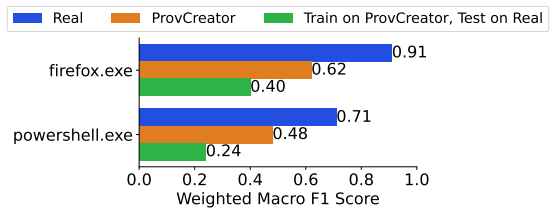
The central claim is that a lossless graph-to-sequence encoder, combined with a pretrained transformer LLM and a constraint-aware decoder, can jointly model graph topology and high-dimensional node and edge attributes well enough to produce realistic synthetic graphs. The paper operationalizes this by encoding each edge and its attributes into tokens, interleaving node attributes when nodes first appear, using a deterministic edge order (timestamps for provenance graphs, topological sort for general graphs). The LLM is fine-tuned with LoRA on these sequences; at generation time, token filtering and a state-machine parser with anchor tokens ensure structural validity. Evaluations on firefox.exe and powershell.exe provenance graphs show lower maximum-mean-discrepancy scores than GDSS on six structural metrics, attribute validity rates above 93%, and on IntelliGraph datasets, 86–94% valid graphs compared with near zero for the benchmark baselines. A downstream GNN classification task trained on PROVCREATOR-generated graphs retains 65–70% of real-data F1, indicating preserved class signal.
Load-bearing premise
The model assumes that a fixed edge ordering (by timestamps or topological sort) encodes the semantic dependencies between structure and attributes; if the ordering is arbitrary or uninformative, the LLM must learn a convention that may not generalize, and the validity results could be an artifact of the decoding constraints rather than of the learned distribution.
Editorial extensions
If this is right
- Organizations can generate synthetic provenance graphs for training security ML detectors, sidestepping privacy and sharing restrictions on real syscall traces.
- The same serialization recipe should apply to any graph with serializable node and edge attributes and a natural edge order—event logs, knowledge graphs, temporal networks—making LLM-based generation a general graph tool.
- Because the backbone is an LLM, users can condition generation with prompts to produce graphs matching specific contexts, such as particular command-line arguments, which diffusion baselines cannot easily do.
- The downstream classification result suggests synthetic graphs can be used for data augmentation to mitigate class imbalance, not merely as a stand-in for real graphs.
Reading between the lines
- An open question the paper leaves implicit is how much of the reported graph-validity rate comes from the constrained decoding (token filtering plus parser recovery) rather than from the generative model itself; an ablation that disables these guards would isolate the model's true capability.
- Because the serialization depends on a total edge order, using PROVCREATOR on graphs without timestamps requires imposing a topological order; a robustness test varying the ordering convention would show whether the learned distribution depends on that choice.
- The reported graph sizes are in the thousands of tokens, so scaling to enterprise-scale provenance graphs (millions of edges) will likely require hierarchical or chunked generation; the paper does not yet demonstrate this.
- The embedding-fidelity comparison uses doc2vec on random walks, which is sensitive to the serialized text; a structure-aware graph embedding would provide a complementary check of whether the synthetic graphs truly match real graph topology.
Editorial analysis
A structured set of objections, weighed in public.
Referee Report
Summary. The paper presents PROVCREATOR, a framework that casts synthetic graph generation for heterogeneous graphs with rich node and edge attributes as autoregressive sequence generation with a transformer-based LLM. It introduces a tokenization scheme with special tokens for graph structure and attributes, a state-machine parser that recovers from invalid tokens, and uses LoRA fine-tuning of LLaMA-3 on serialized graphs. The method is evaluated on provenance graphs from Firefox and PowerShell and on IntelliGraph knowledge graphs, reporting structural MMD metrics, attribute validity rates, embedding cosine similarity, and downstream classification performance. The paper argues that joint generation of structure and semantics yields better fidelity than a diffusion baseline and better validity than IntelliGraph baselines.
Significance. If the results hold, PROVCREATOR is a valuable contribution: it is among the first to apply LLM-based sequence generation to complex heterogeneous graphs with high-dimensional textual attributes, and it demonstrates that joint modeling of topology and attributes is feasible. The compact tokenization and lossless reconstruction (subject to the maximum-node limitation) are useful engineering contributions, and the downstream classification experiment suggests practical utility for data augmentation in security domains. The authors provide a reproducibility code link, which strengthens the paper. However, the significance is tempered by the evaluation gaps detailed below; the central claim of order-invariant general graph generation is not yet fully supported.
major comments (5)
- [3.1, Algorithm 1] The encoding requires a well-defined edge order, and for general graphs the paper proposes a topological sort. A topological sort is defined only for acyclic graphs and it orders nodes rather than edges; many knowledge graphs (including those in IntelliGraph) are cyclic and have no natural edge ordering. The tokenization algorithm therefore imposes an arbitrary, dataset-specific ordering, and the learned autoregressive distribution may reflect that ordering rather than an order-invariant graph distribution. The paper should either restrict the claim to timestamped graphs or provide an order-invariant encoding and demonstrate that generated structures are independent of the chosen order.
- [4.1, Table 2] The MMD values are reported without any error bars, confidence intervals, or statistical tests, and the computation of MMD is not described (e.g., the kernel, bandwidth, number of graph samples, and whether the metrics are computed on graphs of matched size). The structural-fidelity claim rests on these numbers, so the reader cannot determine whether the differences between GDSS and PROVCREATOR are significant. Please provide the full MMD estimation protocol and repeat experiments over multiple random seeds.
- [4.2, Table 3 and Table 6] Attribute validity is measured solely by regular-expression matching. A generated string can match a regex while being semantically incoherent (for example, an executable name that is syntactically a Windows path but does not correspond to any real binary or to the process's behavior). The paper's claim of capturing 'semantic fidelity' is therefore not substantiated by the reported metric. Consider supplementing with human evaluation or a semantic plausibility check (e.g., known program paths, embedding-based similarity to real attribute distributions).
- [4.3, Table 4] The comparison against the IntelliGraph baselines is confounded: the baselines generate attributes as sampled numbers, whereas PROVCREATOR generates attributes as free-form text, and only the best-performing baselines are shown. The footnote acknowledges the difference but the conclusion that PROVCREATOR 'outperforms the baseline models by a large margin' is not justified under a mismatched protocol. Moreover, PROVCREATOR receives 0.00 on syn-tipr and wd-articles; the explanation that evaluation criteria are 'strict' is not quantified. A fair evaluation would use the same attribute representation or, at minimum, report performance under identical validity criteria.
- [3.1] The tokenizer injects exactly N node tokens to represent 'up to N nodes,' but the paper never states what happens when a graph contains more than N nodes. If such graphs are truncated or dropped, the claimed lossless encoding (Section 1, Section 3.1) is false for a nontrivial portion of the input distribution. Please specify the value of N, the maximum graph size in the datasets, and the handling of oversized graphs.
minor comments (6)
- [3, 3.3] The model name is inconsistent: 'LLama3-3.2-3B' in Section 3 and 'LLaMA3-3.2B' in Section 3.3; please correct and specify the exact checkpoint.
- [A.1, Algorithm 1] There is a typo in the last line of the algorithm: 'Suence S' should be 'sequence S'.
- [Table 4] The header '% Novel & Vaild Graphs' has a typo ('Vaild' should be 'Valid').
- [Figure 3] The caption does not explain what the 'Baseline' bar represents beyond 'randomly sampled node attributes'; please clarify that the baseline uses real structures with random attributes and report error bars.
- [2.2] The relationship types are capitalized inconsistently ('READ,WRITE,CREATE andEXECUTE'); please fix the formatting.
- [References] The in-text citation 'Feng et al.' and some other reference entries are incomplete; ensure all references have full author lists and years.
Circularity Check
No significant circularity: the generation pipeline is trained on real serialized graphs and evaluated against external structural metrics and held-out real transfer tasks.
full rationale
PROVCREATOR's central claim is that heterogeneous graph generation can be formulated as sequence generation via a tokenization scheme and an LLM. This is an architectural design choice, not a derived result that secretly reuses its own conclusions. The evaluation anchors are external: structure fidelity is measured by MMD on standard graph statistics against a GDSS baseline; embedding fidelity uses doc2vec embeddings of random walks; downstream utility is tested by training a GNN on synthetic graphs and evaluating on held-out real traces. These metrics are not fitted parameters of the model. The attribute validity rates in Table 3 are based on author-defined regex rules, and those rules are not used during training or generation, so the measurement is weak but not circular. The IntelliGraph fallback to the first edge type for invalid generated text is a disclosed decoding repair; it affects one component of validity but does not make the overall structural validity result a tautology. The main limitation identified by a skeptical reading is the edge-ordering assumption in Section 3.1: for general graphs without timestamps, the topological sort may be non-unique or undefined on cyclic graphs, so the learned sequence distribution may be order-specific. However, this is a correctness and generalization concern about the encoding's inductive bias, not a circularity in which the prediction reduces to its input by construction. No load-bearing self-citations or imported uniqueness theorems appear; prior author works cited are domain background. Therefore, no circular step meets the bar of being quotably reducible to its own inputs.
Assumptions & free parameters
free parameters (3)
- Maximum number of nodes N in the tokenizer =
not reported
- Ordering convention for general graphs =
topological sort
- Context length and truncation behavior =
not reported
assumptions (4)
- domain assumption An LLM fine-tuned on serialized graph token sequences will learn a distribution over graphs that approximates the training distribution of graphs.
- domain assumption Real provenance graphs of firefox.exe and powershell.exe contain enough per-class signal that a GNN can learn to classify command-line arguments from them.
- ad hoc to paper The regex rules in Table 6 are a valid proxy for semantic correctness of generated attributes.
- domain assumption The MMD between graph statistics computed on 1000 samples is a reliable measure of distributional fidelity.
invented entities (1)
-
Special graph token vocabulary (<bog>, <eog>, <bon>, <eon>, <boe>, <bof>, <eof>, <nodei>, <ntypej>, <etypek>)
independent evidence
Cite this review
Pith. "Pith review of PROVCREATOR: Synthesizing Complex Heterogenous Graphs with Node and Edge Attributes." pith.science (2026). https://pith.science/paper/4TEEWE56
@misc{pith2026250720967,
  author       = {Pith},
  title        = {Pith review of: PROVCREATOR: Synthesizing Complex Heterogenous Graphs with Node and Edge Attributes},
  year         = {2026},
  howpublished = {\url{https://pith.science/paper/4TEEWE56}},
  note         = {Machine review of arXiv:2507.20967}
}
read the original abstract
The rise of graph-structured data has driven interest in graph learning and synthetic data generation. While successful in text and image domains, synthetic graph generation remains challenging -- especially for real-world graphs with complex, heterogeneous schemas. Existing research has focused mostly on homogeneous structures with simple attributes, limiting their usefulness and relevance for application domains requiring semantic fidelity. In this research, we introduce ProvCreator, a synthetic graph framework designed for complex heterogeneous graphs with high-dimensional node and edge attributes. ProvCreator formulates graph synthesis as a sequence generation task, enabling the use of transformer-based large language models. It features a versatile graph-to-sequence encoder-decoder that 1. losslessly encodes graph structure and attributes, 2. efficiently compresses large graphs for contextual modeling, and 3. supports end-to-end, learnable graph generation. To validate our research, we evaluate ProvCreator on two challenging domains: system provenance graphs in cybersecurity and knowledge graphs from IntelliGraph Benchmark Dataset. In both cases, ProvCreator captures intricate dependencies between structure and semantics, enabling the generation of realistic and privacy-aware synthetic datasets.
Figures


Figures from the paper (6 more)


Reference graph
Works this paper leans on
-
[1]
write newline
" write newline "" before.all 'output.state := FUNCTION n.dashify 't := "" t empty not t #1 #1 substring "-" = t #1 #2 substring "--" = not "--" * t #2 global.max substring 't := t #1 #1 substring "-" = "-" * t #2 global.max substring 't := while if t #1 #1 substring * t #2 global.max substring 't := if while FUNCTION format.date year duplicate empty "emp...
-
[2]
https://github.com/linux-audit/, 2015
The linux audit framework. https://github.com/linux-audit/, 2015
work page 2015
-
[3]
Event tracing for windows (etw) - windows drivers | microsoft docs. https://docs.microsoft.com/en-us/windows-hardware/drivers/devtest/event-tracing-for-windows--etw-, 2019
work page 2019
-
[4]
A learning-based data augmentation for network anomaly detection
Mohammad Al Olaimat, Dongeun Lee, Youngsoo Kim, Jonghyun Kim, and Jinoh Kim. A learning-based data augmentation for network anomaly detection. In 2020 29th International Conference on Computer Communications and Networks (ICCCN), 2020
work page 2020
-
[5]
Survivalism: Systematic Analysis of Windows Malware Living-Off-The-Land
Frederick Barr-Smith, Xabier Ugarte-Pedrero, Mariano Graziano, Riccardo Spolaor, and Ivan Martinovic. Survivalism: Systematic Analysis of Windows Malware Living-Off-The-Land . In IEEE Symposium on Security and Privacy (SP), 2021
work page 2021
-
[6]
Bryan Cantrill. Dtrace. In Large Installation System Administration Conference (LISA), 2005
work page 2005
-
[7]
Graph generative pre-trained transformer, 2025
Xiaohui Chen, Yinkai Wang, Jiaxing He, Yuanqi Du, Soha Hassoun, Xiaolin Xu, and Li-Ping Liu. Graph generative pre-trained transformer, 2025. URL https://arxiv.org/abs/2501.01073
arXiv 2025
-
[8]
Exploring the potential of large language models (llms) in learning on graphs
Zhikai Chen, Haitao Mao, Hang Li, Wei Jin, Haifang Wen, Xiaochi Wei, Shuaiqiang Wang, Dawei Yin, Wenqi Fan, Hui Liu, and Jiliang Tang. Exploring the potential of large language models (llms) in learning on graphs. ArXiv, abs/2307.03393, 2023
arXiv 2023
Show all 41 references
-
[9]
Kairos: Practical Intrusion Detection and Investigation using Whole-system Provenance
Zijun Cheng, Qiujian Lv, Jinyuan Liang, Yan Wang, Degang Sun, Thomas Pasquier, and Xueyuan Han. Kairos: Practical Intrusion Detection and Investigation using Whole-system Provenance . In IEEE Symposium on Security and Privacy (SP), 2024
2024
-
[10]
On generating network traffic datasets with synthetic attacks for intrusion detection
Carlos Garcia Cordero, Emmanouil Vasilomanolakis, Aidmar Wainakh, Max M\" u hlh\" a user, and Simin Nadjm-Tehrani. On generating network traffic datasets with synthetic attacks for intrusion detection. 2021
2021
-
[11]
Generation of a new ids test dataset: Time to retire the kdd collection
Gideon Creech and Jiankun Hu. Generation of a new ids test dataset: Time to retire the kdd collection. In 2013 IEEE wireless communications and networking conference (WCNC), 2013
2013
-
[12]
Cubuk, Barret Zoph, Dandelion Mané, Vijay Vasudevan, and Quoc V
Ekin D. Cubuk, Barret Zoph, Dandelion Mané, Vijay Vasudevan, and Quoc V. Le. AutoAugment: Learning Augmentation Strategies From Data . 2019
2019
-
[13]
Feng, Varun Gangal, Jason Wei, Sarath Chandar, Soroush Vosoughi, Teruko Mitamura, and Eduard Hovy
Steven Y. Feng, Varun Gangal, Jason Wei, Sarath Chandar, Soroush Vosoughi, Teruko Mitamura, and Eduard Hovy. A Survey of Data Augmentation Approaches for NLP
-
[14]
Windows Based Data Sets for Evaluation of Robustness of Host Based Intrusion Detection Systems (IDS) to Zero-Day and Stealth Attacks
Waqas Haider, Gideon Creech, Yi Xie, and Jiankun Hu. Windows Based Data Sets for Evaluation of Robustness of Host Based Intrusion Detection Systems (IDS) to Zero-Day and Stealth Attacks . 2016
2016
-
[15]
UNICORN: Runtime Provenance-Based Detector for Advanced Persistent Threats
Xueyuan Han, Thomas Pasquier, Adam Bates, James Mickens, and Margo Seltzer. UNICORN: Runtime Provenance-Based Detector for Advanced Persistent Threats . In Network and Distributed System Security Symposium (NDSS), 2020
2020
-
[16]
Sigl: Securing software installations through deep graph learning
Xueyuan Han, Xiao Yu, Thomas Pasquier, Ding Li, Junghwan Rhee, James Mickens, Margo Seltzer, and Haifeng Chen. Sigl: Securing software installations through deep graph learning. In USENIX Security Symposium (SEC), 2021
2021
-
[17]
NoDoze: Combatting Threat Alert Fatigue with Automated Provenance Triage
Wajih Ul Hassan, Shengjian Guo, Ding Li, Zhengzhang Chen, Kangkook Jee, Zhichun Li, and Adam Bates. NoDoze: Combatting Threat Alert Fatigue with Automated Provenance Triage. In Network and Distributed System Security Symposium (NDSS), 2019
2019
-
[18]
Magic: Detecting advanced persistent threats via masked graph representation learning
Zian Jia, Yun Xiong, Yuhong Nan, Yao Zhang, Jinjing Zhao, and Mi Wen. Magic: Detecting advanced persistent threats via masked graph representation learning. In USENIX Security Symposium (SEC), 2024
2024
-
[19]
Score-based generative modeling of graphs via the system of stochastic differential equations
Jaehyeong Jo, Seul Lee, and Sung Ju Hwang. Score-based generative modeling of graphs via the system of stochastic differential equations. In International Conference on Machine Learning, 2022. URL https://api.semanticscholar.org/CorpusID:246634850
2022
-
[20]
Backtracking intrusions
Samuel T King and Peter M Chen. Backtracking intrusions . In Proceedings of the nineteenth ACM symposium on Operating systems principles, 2003
2003
-
[21]
Distributed representations of sentences and documents
Quoc Le and Tomas Mikolov. Distributed representations of sentences and documents. In International conference on machine learning, pp.\ 1188--1196. PMLR, 2014 a
2014
-
[22]
Le and Tomas Mikolov
Quoc V. Le and Tomas Mikolov. Distributed representations of sentences and documents. 2014 b
2014
-
[23]
SNAP Datasets : Stanford large network dataset collection
Jure Leskovec and Andrej Krevl. SNAP Datasets : Stanford large network dataset collection. http://snap.stanford.edu/data, June 2014
2014
-
[24]
Efficient dynamic attributed graph generation, 2024 a
Fan Li, Xiaoyang Wang, Dawei Cheng, Cong Chen, Ying Zhang, and Xuemin Lin. Efficient dynamic attributed graph generation, 2024 a . URL https://arxiv.org/abs/2412.08810
2024 arXiv
-
[25]
Potluru, and Pan Li
Mufei Li, Eleonora Kreačić, Vamsi K. Potluru, and Pan Li. Graphmaker: Can diffusion models generate large attributed graphs?, 2024 b . URL https://arxiv.org/abs/2310.13833
2024 arXiv
-
[26]
Towards a Timely Causality Analysis for Enterprise Security
Yushan Liu, Mu Zhang, Ding Li, Kangkook Jee, Zhichun Li, Zhenyu Wu, Junghwan Rhee, and Prateek Mittal. Towards a Timely Causality Analysis for Enterprise Security . In Network and Distributed System Security Symposium (NDSS), 2018
2018
-
[27]
Evading provenance-based ml detectors with adversarial system actions
Kunal Mukherjee, Josh Wiedemeier, Tianhao Wang, James Wei, Feng Chen, Muhyun Kim, Murat Kantarcioglu, and Kangkook Jee. Evading provenance-based ml detectors with adversarial system actions. In USENIX Security Symposium (SEC), 2023
2023
-
[28]
Proviot: Detecting stealthy attacks in iot through federated edge-cloud security
Kunal Mukherjee, Joshua Wiedemeier, Qi Wang, Junpei Kamimura, John Junghwan Rhee, James Wei, Zhichun Li, Xiao Yu, Lu-An Tang, Jiaping Gui, et al. Proviot: Detecting stealthy attacks in iot through federated edge-cloud security. In International Conference on Applied Cryptograp...
2024
-
[29]
Cosmos world foundation model platform for physical ai, 2025
NVIDIA, :, Niket Agarwal, Arslan Ali, Maciej Bala, Yogesh Balaji, Erik Barker, Tiffany Cai, Prithvijit Chattopadhyay, Yongxin Chen, Yin Cui, Yifan Ding, Daniel Dworakowski, Jiaojiao Fan, Michele Fenzi, Francesco Ferroni, Sanja Fidler, Dieter Fox, Songwei Ge, Yunhao Ge, Jinwei ...
2025 arXiv
-
[30]
FLASH: A Comprehensive Approach to Intrusion Detection via Provenance Graph Representation Learning
Mati Ur Rehman, Hadi Ahmadi, and Wajih Ul Hassan. FLASH: A Comprehensive Approach to Intrusion Detection via Provenance Graph Representation Learning . In IEEE Symposium on Security and Privacy (SP), 2024
2024
-
[31]
Intelligraphs: Datasets for benchmarking knowledge graph generation
Thiviyan Thanapalasingam, Emile van Krieken, Peter Bloem, and Paul Groth. Intelligraphs: Datasets for benchmarking knowledge graph generation. arXiv preprint arXiv:2307.06698, 2023
2023 arXiv
-
[32]
Digress: Discrete denoising diffusion for graph generation
Clement Vignac, Igor Krawczuk, Antoine Siraudin, Bohan Wang, Volkan Cevher, and Pascal Frossard. Digress: Discrete denoising diffusion for graph generation. In The Eleventh International Conference on Learning Representations, 2023. URL https://openreview.net/forum?id=UaAD-Nu86WX
2023
-
[33]
Can language models solve graph problems in natural language? In Thirty-seventh Conference on Neural Information Processing Systems, 2023
Heng Wang, Shangbin Feng, Tianxing He, Zhaoxuan Tan, Xiaochuang Han, and Yulia Tsvetkov. Can language models solve graph problems in natural language? In Thirty-seventh Conference on Neural Information Processing Systems, 2023. URL https://openreview.net/forum?id=UDqHhbqYJV
2023
-
[34]
You Are What You Do: Hunting Stealthy Malware via Data Provenance Analysis
Qi Wang, Wajih Ul Hassan, Ding Li, Kangkook Jee, Xiao Yu, Kexuan Zou, Junghwan Rhee, Zhengzhang Chen, Wei Cheng, Carl A Gunter, and Haifeng Chen. You Are What You Do: Hunting Stealthy Malware via Data Provenance Analysis . In Network and Distributed System Security Symposium (...
2020
-
[35]
A survey on knowledge distillation of large language models, 2024
Xiaohan Xu, Ming Li, Chongyang Tao, Tao Shen, Reynold Cheng, Jinyang Li, Can Xu, Dacheng Tao, and Tianyi Zhou. A survey on knowledge distillation of large language models, 2024. URL https://arxiv.org/abs/2402.13116
2024 arXiv
-
[36]
Mooney, and Bradley A
Chao Yan, Yao Yan, Zhiyu Wan, Ziqi Zhang, Larsson Omberg, Justin Guinney, Sean D. Mooney, and Bradley A. Malin. A Multifaceted benchmarking of synthetic electronic health record generation models . 2022
2022
-
[37]
Data Augmentation for Graph Neural Networks
Tong Zhao, Yozen Liu, Leonardo Neves, Oliver Woodford, Meng Jiang, and Neil Shah. Data Augmentation for Graph Neural Networks
-
[38]
Graph Data Augmentation for Graph Machine Learning: A Survey
Tong Zhao, Wei Jin, Yozen Liu, Yingheng Wang, Gang Liu, Stephan Günnemann, Neil Shah, and Meng Jiang. Graph Data Augmentation for Graph Machine Learning: A Survey . 2022
2022
-
[39]
@esa (Ref
\@ifxundefined[1] #1\@undefined \@firstoftwo \@secondoftwo \@ifnum[1] #1 \@firstoftwo \@secondoftwo \@ifx[1] #1 \@firstoftwo \@secondoftwo [2] @ #1 \@temptokena #2 #1 @ \@temptokena \@ifclassloaded agu2001 natbib The agu2001 class already includes natbib coding, so you should ...
-
[40]
\@lbibitem[] @bibitem@first@sw\@secondoftwo \@lbibitem[#1]#2 \@extra@b@citeb \@ifundefined br@#2\@extra@b@citeb \@namedef br@#2 \@nameuse br@#2\@extra@b@citeb \@ifundefined b@#2\@extra@b@citeb @num @parse #2 @tmp #1 NAT@b@open@#2 NAT@b@shut@#2 \@ifnum @merge>\@ne @bibitem@firs...
-
[41]
<>| ]+\\)*[^\\/:*?\
@open @close @open @close and [1] URL: #1 \@ifundefined chapter * \@mkboth \@ifxundefined @sectionbib * \@mkboth * \@mkboth\@gobbletwo \@ifclassloaded amsart * \@ifclassloaded amsbook * \@ifxundefined @heading @heading NAT@ctr thebibliography [1] @ \@biblabel @NAT@ctr \@bibset...
2025
Reviewed August 6, 2026 · model on record in the stance chip above.
Discussion (0). Sign in to comment.