REVIEW 3 major objections 5 minor 68 references
Emergence of Classicality in Wigner's Friend Scenarios
T0 review · 3 major / 5 minor · reviewed 2026-08-06 · deepseek-v4-flash
Pith's one-line read Wigner–Friend-type disagreements can survive a decohering environment when the Friend and the environment are made of multiple qubits.
desk verdict The EWFS/LF bound is solid and worth taking seriously; the headline 'genuine WF effect' in the simple QD model is a classical state-discrimination artifact, not a quantum effect. read the letter →
The pith
A machine-rendered reading of the paper's core claim, the machinery that carries it, and where it could break.
The reading
What carries the argument
The machinery is a broadcasting Hamiltonian—a pointer-basis projector on the system coupled to conditional Hamiltonians on every qubit of the Friend and environment—together with a pinching map that dephases the initial state in the Hamiltonian eigenbasis, producing an SBS-like Lab state $\rho_L = \sum_i p_i |i\rangle\langle i|_S \otimes \rho_F^{(i)} \otimes \rho_E^{(i)}$ with small non-objectivity. The Friend's optimal SBS assignment uses the optimal discrimination projectors $\Pi_F^{(i)}$ and $\Pi_E^{(i)}$ that optimally discriminate the conditional states; Wigner's candidate whole-Lab measurement $M^0_L/M^1_L$ is built from combinations of these projectors with pointer projectors on the system, and asks whether the Friend and environment indices agree. The argument proceeds by comparing the disagreement $\Delta$ for this POVM with the state-discrimination error $\epsilon$ for the i-basis measurement, declaring a genuine Wigner–Friend effect only when $\Delta \gg \epsilon$.
What would settle it
Simulate the WF-QD model with the Friend's assignment computed from optimal discrimination projectors evaluated on states averaged over many random Hamiltonian samples (or on a reduced description that omits the environment), instead of the actual conditional states of a single run; if the resulting disagreement $\Delta$ falls to the level of $\epsilon$, the reported Wigner–Friend effect is an artifact of the Friend's unrealistic perfect knowledge.
Extended reading notes
Core claim
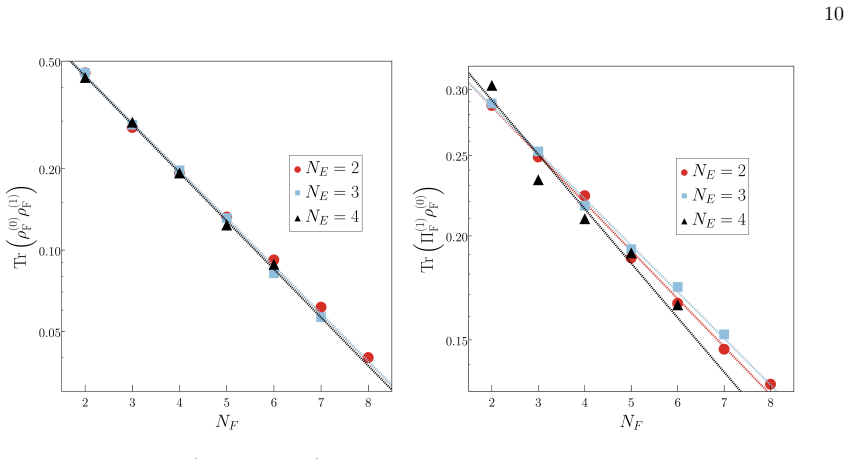
The central claim is that a Wigner–Friend effect—a disagreement in probability assignments between Wigner and his Friend that cannot be written off as measurement inaccuracy—survives in a quantum-Darwinism model of the Friend's measurement. In the WF-QD model the post-measurement Lab state is spectrum-broadcast-like rather than exactly a spectrum broadcast structure, so the Friend's optimal assignment, built from optimal discrimination projectors on her own macrofraction and on the environment, differs from Wigner's state. For the measurement $M^0_L$, which asks whether the Friend and the environment record the same outcome, the paper finds numerically that the disagreement parameter $\Delta$ lies between roughly 0.3 and 0.4 while the state-discrimination error $\epsilon$ lies between $10^{-5}$ and 0.012, so $\Delta \gg \epsilon$. The paper therefore claims to have satisfied the goal of observing Wigner's Friend effects in this model, identifies the effect as a novel form that exploits coherence between the Friend and the environment, and reports hints that the effect decreases as the Friend grows, signalling the emergence of classicality.
Load-bearing premise
The load-bearing premise is that the Friend can build her best post-measurement state from projectors that perfectly distinguish the exact conditional states of her own qubits and of the inaccessible environment; without that detailed knowledge her assignment would differ, and the large disagreement reported for the whole-Lab measurement (built from the same projectors) would not be a fair measure of the Wigner–Friend effect.
Editorial extensions
If this is right
- If the WF-QD result is correct, Wigner–Friend-type disagreements are not an artifact of single-qubit idealisations; they can persist in a decohering Lab with a multi-qubit Friend and environment.
- In the extended scenario, any measurement governed by a broadcasting Hamiltonian produces a separable post-measurement state of the two Labs, so Local Friendliness inequalities cannot be violated under that dynamics.
- The model's non-objectivity loosens the LF inequality to $\langle CHSH \rangle \le 2 + 4\epsilon$, making violation impossible once $\epsilon \ge (\sqrt{2}-1)/2 \approx 0.207$; numerically, that threshold is exceeded for small Friends (2–4 qubits) and only crossed for larger ones.
- Unequal pointer probabilities ($p_0 \ne p_1$) erase the clear $\Delta \gg \epsilon$ separation in the simple scenario, so the reported genuine WF effect is specific to the equal-probability case and the particular $M^0_L$ measurement.
- The size-dependent decline of the effect in the equal-probability case hints that WF effects vanish in the thermodynamic limit, marking the emergence of classicality as the Friend grows.
Reading between the lines
- A natural extension is to replace the Friend's ideal assignment (built from the exact conditional states of her macrofraction and the environment) with a coarse-grained or averaged description; the paper's own 'Bad Friend' comparison suggests that any realistic lack of such knowledge would shrink $\Delta$, so the reported effect can be read as an upper bound on what a physically situated Friend co
- The $\epsilon \ge 0.207$ threshold for LF violations suggests a concrete numerical search: for intermediate Friend sizes, the non-objectivity correction is small enough that violations might reappear if a non-broadcasting Hamiltonian supplies the $\sigma$ terms needed for entanglement between Labs; the paper leaves this window open.
- Because $M^0_L$ is essentially an objectivity check—it tests whether the Friend and environment record the same outcome—the WF effect here is tied to the same mechanism that produces consensus in quantum Darwinism; one could test whether any whole-Lab observable yields $\Delta \gg \epsilon$, or whether $M^0_L$ is special.
Editorial analysis
A structured set of objections, weighed in public.
Referee Report
Summary. The paper models Wigner's Friend (WF) scenarios using a quantum-Darwinism (QD) framework, in which the Friend's measurement is a unitary equilibration process governed by a broadcasting Hamiltonian. After the measurement, the lab state is a pinched, SBS-like state (Eq. 17). The authors define a criterion for a 'genuine WF effect' by comparing the disagreement Δ between Wigner and the Friend for a carefully chosen measurement M_L^0 (Eq. A6) with a parameter ε representing the inaccuracy of Wigner's readout of the Friend's outcome (Eq. 20). Numerically, they report Δ≈0.3–0.4 while ε∈[10^-5,0.012], which they interpret as evidence for a novel WF effect in the presence of a decohering environment. The paper also analyzes extended WF scenarios, showing that the broadcasting-Hamiltonian model yields separable post-measurement states (so LF inequalities cannot be violated), and that non-objectivity modifies the LF inequalities to a bound 2+4ε. The central positive claim of a novel WF effect in the WF-QD model is the focus of this report.
Significance. If the claimed novel WF effect in Sec. II D were valid, it would provide an interesting bridge between quantum Darwinism and Wigner's Friend scenarios, and the EWFS restrictions (Sec. III B, Eq. 40) are a useful quantitative result that connects state-discrimination error to the violation of Local Friendliness. The paper is clearly written and the numerical work is extensive, with well-documented methods (Appendices A and C). However, the main numerical claim is undermined by the definition of ε and by the classical nature of the chosen measurement M_L^0. The EWFS part, which is more robust, could form a solid but more modest contribution; the 'novel WF effect' as presented is not demonstrated by the reported evidence.
major comments (3)
- [Sec. II D, Eqs. (20) and (24)] The parameter ε defined in Eq. (20) is not the state-discrimination error. For p0=p1, Eq. (25) shows that P^W(i=0)=p0(1+e0−e1), so ε=|P^W(0)−P^F(0)|=½|e0−e1|. This is the difference between the two Helstrom success probabilities, not the probability of error. If the noise is symmetric (e0≈e1), ε≈0 even when the actual readout error is large (e.g., e0=e1=0.8 gives ε=0 with a 20% error). Therefore the reported values ε∈[10^-5,0.012] do not guarantee that Wigner can accurately read the Friend's outcome, and the criterion Δ≫ε in Eq. (23) is insufficient to establish a genuine WF effect.
- [Sec. II D, Eq. (A6)] The measurement M_L^0 is a parity check on the Helstrom outcomes of the Friend and the environment. Because the pinched post-measurement state in Eq. (17) is a separable mixture over the pointer outcome i of product states, the probability of disagreement Δ for M_L^0 equals Σ_i p_i [e_i(1−f_i)+(1−e_i)f_i], which is exactly the disagreement probability of two noisy classical channels reading the same classical bit i. No inter-branch coherence survives the pinching map (σ=0 in Eq. (13)), so the state admits a classical hidden-variable model. The claimed 'coherence between Friend and environment' mentioned in Sec. IV is not present in the model; the disagreement arises from the Friend's assignment of noiseless projectors (Eq. 18) instead of the actual noisy states, which is a classical model-misspecification.
- [Sec. II C, Eq. (18) and Appendix A 2] The Friend's optimal SBS-state assignment in Eq. (18) is constructed from the Helstrom projectors Π_F^(i) and Π_E^(i) that optimally discriminate the true post-measurement states ρ_F^(i) and ρ_E^(i). Wigner's j-measurement M_L^0 in Eq. (A6) is built from exactly these same projectors. This creates a circularity: the large Δ reported for M_L^0 measures, in part, the mismatch between the Friend's assumed perfectly distinguishable states and the actual noisy states, while both the Friend's assignment and Wigner's measurement are tailored to the true states. A real Friend, who by assumption has limited access to the environment, would not know the exact ρ_E^(i), and her assignment would differ; the reported comparison is therefore not a fair representation of the WF disagreement in a realistic setting.
minor comments (5)
- [Sec. II C, Eq. (20)] The definition ε:=|P^W(i)−P^F(i)| does not specify which outcome i is used; the numerical results later refer to i=0. The formula should be stated with an explicit index, e.g., ε=|P^W(0)−P^F(0)|.
- [Fig. 4 and Sec. II D] The claim of an 'emergence of classicality' with increasing NF is based on visual trends and best-fit lines that are only guides to the eye; the authors should provide a more quantitative assessment, especially since Appendix C shows the opposite trend for p0≠p1.
- [Sec. III B, Eq. (39)] The parameter ε defined in Eq. (39) for the EWFS case is a genuine average state-discrimination error (1 − Σ_c p(c) Tr(Π_(c)_C ρ_(c)_C)), which is conceptually different from the ε defined in Eq. (20) as |P^W(i)−P^F(i)|. This inconsistency in notation should be clarified.
- [Sec. II C, around Eq. (14)] The authors note that their use of 'non-objectivity' is non-standard, but the term is still potentially confusing. A brief sentence explaining the relationship to the standard QD notion of objectivity (and why the weaker notion is sufficient for their argument) would improve readability.
- [Appendix A 2, Eq. (A6)] The POVM elements M_L^0 and M_L^1 are not normalized projectors but sums of product POVM elements; the text could state explicitly that they form a valid POVM (i.e., M_L^0 + M_L^1 = 1_L) and that the individual Helstrom elements are projectors in the two-outcome case considered.
Circularity Check
The Δ≫ε WF-effect claim is built from the same Helstrom projectors on both sides: P_F(j=0)=1 is fixed by construction, Δ reduces to a classical parity error, and ε is only an asymmetry of Helstrom fidelities.
-
self definitional
[Sec. II C, Eq. (18); Appendix A 2, Eq. (A6), Fig. 4]
"ρF_L = Σ_i p_i|i⟩⟨i|_S ⊗ Π(i)_F/Tr(Π(i)_F) ⊗ Π(i)_E/Tr(Π(i)_E), where the Π F and Π E represent the optimal effective description by the Friend of herself and her Lab’s environment [14, 40–43]. ... M 0_L = Π 0_S ⊗ Π 0_F ⊗ Π 0_E + Π 0_S ⊗ Π 1_F ⊗ Π 1_E + Π 1_S ⊗ Π 0_F ⊗ Π 0_E + Π 1_S ⊗ Π 1_F ⊗ Π 1_E."
Inserting the Friend state (18) into Tr(M_L^0 ρ^F_L) gives p0·1 + p1·1 = 1 identically, because the POVM elements are products of the same Helstrom projectors used to define the Friend's assignment. Thus P^F(j=0)=1 is an identity, not a model prediction, and Δ = |1−P^W(j=0)| is exactly the probability that the Helstrom decisions on F and E disagree, i.e., a classical two-channel parity error. The Appendix A2 parenthetical only checks that Helstrom is optimal; it does not remove the double use of the same projectors on both sides of the WF comparison.
-
self definitional
[Sec. II D, Eqs. (20), (24)-(25), Fig. 4 caption]
"If p0 = p1 = 0.5, this reduces down to P W (i = 0) = p0 (1 + e0 − e1), meaning that the ϵ parameter introduced in Eq. (20) is merely a function of e0 − e1. ... ∆ >> ϵ for all the NF and NE considered here signifies a genuine Wigner’s Friend effect."
For p0=p1, Eq. (20) gives ε = 0.5|e0−e1|, so ε≈0 whenever the two Helstrom success probabilities are equal, even if both are poor (e.g., 0.8). The reported ε∈[1e−5,0.012] therefore only certifies e0≈e1, not that Wigner can read the Friend. Since Δ (previous step) is a parity error built from the same e_i, f_i, the inequality Δ≫ε is satisfied by symmetric classical readout noise. The criterion defining a 'genuine WF effect' is thus a self-referential comparison of two functions of the same Helstrom fidelities.
full rationale
The paper's QD simulations of non-objectivity versus NF (Fig. 3) and the EWFS modified-LF analysis are self-contained and not circular. The circularity is confined to the central WF-effect claim of Sec. II D: the Friend's SBS assignment (18) and Wigner's parity measurement (A6) are constructed from the same Helstrom projectors, forcing P_F(j=0)=1 and reducing Δ to a classical parity error. The paper briefly brackets a circularity worry in Appendix A2 but answers only the optimality of the POVM, not the shared-projector construction. Additionally, ε (Eq. 20) is not a total state-discrimination error for p0=p1; it is an asymmetry 0.5|e0−e1|, so the Δ≫ε test can pass for purely classical symmetric noise. Hence the headline 'genuine WF effect' is partially circular and definitional, while the size-dependence results and EWFS bounds retain independent content.
Assumptions & free parameters
assumptions (5)
- domain assumption Pinching map as post-measurement state
- domain assumption Broadcasting Hamiltonian without F-E coupling
- ad hoc to paper Friend's optimal SBS assignment uses true Helstrom projectors
- domain assumption Initial state with diagonal system and all environment qubits in |0>
- domain assumption GUE sampling for conditional Hamiltonians
Cite this review
Pith. "Pith review of Emergence of Classicality in Wigner's Friend Scenarios." pith.science (2026). https://pith.science/paper/YMLLHG4T
@misc{pith2026250721221,
  author       = {Pith},
  title        = {Pith review of: Emergence of Classicality in Wigner's Friend Scenarios},
  year         = {2026},
  howpublished = {\url{https://pith.science/paper/YMLLHG4T}},
  note         = {Machine review of arXiv:2507.21221}
}
read the original abstract
The Wigner's Friend (WF) thought experiment concerns quantum measurements by a 'superobserver' of an observer measuring a quantum system. Variations on the setup and its extended versions have seen a resurgence in recent years, in light of a series of no-go theorems that reveal new quantum effects and question the existence of absolute events. But most theoretical and experimental studies of WF scenarios have restricted themselves to a 'friend' composed of a single qubit with idealised measurement settings in an idealised lab. In this work, we consider a specific, unitary model of the interaction between the Friend and the system in the presence of a decohering environment. In particular, we study WF scenarios from the perspective of quantum Darwinism (QD). The QD framework is well-suited to studying the questions of observations and agents in quantum theory that WF scenarios raise, as it is concerned with how observers record objective information about a system with access only to its surroundings. Here we describe how to add environments to simple and extended WF scenarios in the QD framework, and present numerical results that study the emergence of classicality, in the form of the Friend's measurement result becoming more objective. In both the simple and extended cases, we also find that the model and the environment obfuscate genuine WF effects and introduce strong restrictions on them. However, we also find a novel form of WF effect that exploits coherence between the Friend and the environment.
Figures


Figures from the paper (6 more)


Reference graph
Works this paper leans on
-
[1]
P (a, b|x, y) = P c,d P (a, b, c, d|x, y)
-
[2]
P (a|c, d, x= 1 , y) = δac for all a, c, y ⇔ P (a = c|d, x= 1, y) = 1
-
[3]
P (b|c, d, x, y= 1) = δbd for all b, d, x ⇔ P (b = d|c, x, y= 1) = 1 • Local agency (LA) Freely chosen settings are uncorrelated with anything outside of their future light cone:
-
[4]
P (c, d|x, y) = P (c, d) (no super-determinism)
-
[5]
P (a|c, d, x, y) = P (a|c, d, x) (no-signaling)
-
[6]
P (b|c, d, x, y) = P (b|c, d, y) (no-signaling) In contrast to the simple Wigner’s Friend setup, we are now not concerned with how the two ‘Friends’ would model the post measurement state but rather whether measurements {Ax} and {By} by Alice and Bob can violate so-called Local Friendliness inequalities. They are derived from the LF assumptions analogous ...
-
[7]
This maximum violation occurs if, for ex- ample, A1 = 11 ⊗ |0⟩⟨0|C − 11 ⊗ |1⟩⟨1|C, A0 = |0, 0⟩ ⟨1, 1|LC − |1, 1⟩ ⟨0, 0|LC and analogously for B (see [3]). As in the QD-E case of Sec. II B, it is possible to describe a ‘EWFS-E’ case where a decohering environment is included inside Char- lie’s and Debbie’s Labs, EC and ED respectively. From the superobserv...
-
[8]
P (a = c|d, x= 1, y) ≥ 1 − ε 3′
P (a, b|x, y) = P c,d P (a, b, c, d|x, y) 2′. P (a = c|d, x= 1, y) ≥ 1 − ε 3′. P (b = d|c, x, y= 1) ≥ 1 − ε, which leads to modified LF-inequalities. For the CSHS-like expression in Eq. (26), these read ⟨CHSH⟩ ≤2 + 4ε, (40) which means the larger the non-objectivity is (which in turn means larger values for ε), the harder it is for Alice and Bob to violat...
Show all 68 references
-
[10]
Quantum theory as a universal physical theory
David Deutsch. Quantum theory as a universal physical theory. International Journal of Theo- retical Physics, 24(1):1–41, 1985
1985
-
[11]
A no-go theorem for observer- independent facts
ˇCaslav Brukner. A no-go theorem for observer- independent facts. Entropy, 20(5):350, 2018
2018
-
[12]
Quan- tum theory cannot consistently describe the use of itself
Daniela Frauchiger and Renato Renner. Quan- tum theory cannot consistently describe the use of itself. Nature communications , 9(1):3711, 2018
2018
-
[13]
A strong no-go theorem on the wigner’s friend paradox
Kok-Wei Bong, An ´ ıbal Utreras-Alarc´ on, Farzad Ghafari, Yeong-Cherng Liang, Nora Tischler, Eric G Cavalcanti, Geoff J Pryde, and Howard M Wiseman. A strong no-go theorem on the wigner’s friend paradox. Nature Physics , 16(12):1199–1205, 2020
2020
-
[14]
Experimental test of local observer independence
Massimiliano Proietti, Alexander Pickston, Francesco Graffitti, Peter Barrow, Dmytro Kundys, Cyril Branciard, Martin Ringbauer, and Alessandro Fedrizzi. Experimental test of local observer independence. Science advances, 5(9):eaaw9832, 2019
2019
-
[15]
Decoherence, einselec- tion, and the quantum origins of the classical
Wojciech Hubert Zurek. Decoherence, einselec- tion, and the quantum origins of the classical. Reviews of modern physics , 75(3):715, 2003
2003
-
[16]
Quantum decoher- ence
Maximilian Schlosshauer. Quantum decoher- ence. Physics Reports, 831:1–57, 2019
2019
-
[17]
Decoherence framework for wigner’s-friend experiments
Armando Rela˜ no. Decoherence framework for wigner’s-friend experiments. Physical Review A, 101(3):032107, 2020
2020
-
[18]
Quantum darwinism
Wojciech Hubert Zurek. Quantum darwinism. Nature physics, 5(3):181–188, 2009
2009
-
[19]
Roads to objectivity: quantum darwinism, spectrum broadcast structures, and strong quantum darwinism–a review
JK Korbicz. Roads to objectivity: quantum darwinism, spectrum broadcast structures, and strong quantum darwinism–a review. Quantum, 5:571, 2021
2021
-
[20]
Quantum theory of the classical: Einselection, envariance, quantum darwinism and extantons
Wojciech Hubert Zurek. Quantum theory of the classical: Einselection, envariance, quantum darwinism and extantons. Entropy, 24(11):1520, 2022
2022
-
[21]
Quantum measurements and equilibration: the emergence of objective reality via entropy maximisation
Emanuel Schwarzhans, Felix C Binder, Marcus Huber, and Maximilian PE Lock. Quantum measurements and equilibration: the emergence of objective reality via entropy maximisation. arXiv preprint arXiv:2302.11253 , 2023
2023
-
[22]
Equili- bration of objective observables in a dynamical model of quantum measurements.arXiv preprint arXiv:2403.18016, 2024
Sophie Engineer, Tom Rivlin, Sabine Wollmann, Mehul Malik, and Maximilian PE Lock. Equili- bration of objective observables in a dynamical model of quantum measurements.arXiv preprint arXiv:2403.18016, 2024
2024
-
[23]
Work estimation and work fluctuations in the presence of non-ideal measurements
Tiago Debarba, Gonzalo Manzano, Yelena Guryanova, Marcus Huber, and Nicolai Friis. Work estimation and work fluctuations in the presence of non-ideal measurements. New Jour- nal of Physics , 21(11):113002, 2019
2019
-
[24]
Ideal projective measurements have infi- nite resource costs
Yelena Guryanova, Nicolai Friis, and Marcus Huber. Ideal projective measurements have infi- nite resource costs. Quantum, 4:222, 2020
2020
-
[25]
Physics and metaphysics of wigner’s friends: Even performed premeasurements have no re- sults
Marek ˙Zukowski and Marcin Markiewicz. Physics and metaphysics of wigner’s friends: Even performed premeasurements have no re- sults. Physical Review Letters , 126(13):130402, 2021
2021
-
[26]
A finite- resource description of a measurement process and its implications for the” wigner’s friend” sce- nario
Fernando de Melo, Gabriel Dias Carvalho, Pe- dro S Correia, Paola Concha Obando, Thiago R de Oliveira, and Ra´ ul O Vallejos. A finite- resource description of a measurement process and its implications for the” wigner’s friend” sce- nario. arXiv preprint arXiv:2411.07327 , 2024
2024 arXiv
-
[27]
Inade- quacy of modal logic in quantum settings
Nuriya Nurgalieva and L ´ ıdia del Rio. Inade- quacy of modal logic in quantum settings. arXiv preprint arXiv:1804.01106, 2018
2018 arXiv
-
[28]
Thought experi- ments in a quantum computer
Nuriya Nurgalieva, Simon Mathis, L ´ ıdia del Rio, and Renato Renner. Thought experi- ments in a quantum computer. arXiv preprint arXiv:2209.06236, 2022
2022 arXiv
-
[29]
A” thoughtful” local friend- liness no-go theorem: a prospective experiment with new assumptions to suit
Howard M Wiseman, Eric G Cavalcanti, and Eleanor G Rieffel. A” thoughtful” local friend- liness no-go theorem: a prospective experiment with new assumptions to suit. Quantum, 7:1112, 2023
2023
-
[30]
Connecting extended wigner’s friend arguments and noncontextuality
Laurens Walleghem, Y ` ıl` e Y ¯ ıng, Rafael Wag- ner, and David Schmid. Connecting extended wigner’s friend arguments and noncontextuality. arXiv preprint arXiv:2409.07537 , 2024
2024 arXiv
-
[31]
Towards violations of local friendli- ness with quantum computers
William J Zeng, Farrokh Labib, and Vincent Russo. Towards violations of local friendli- ness with quantum computers. arXiv preprint arXiv:2409.15302, 2024
2024 arXiv
-
[32]
Remarks on the mind-body question
Eugene P Wigner. Remarks on the mind-body question. In Philosophical reflections and syn- theses, pages 247–260. Springer, 1995
1995
-
[33]
Essay review: Wigner’s view of physical reality
Michael Esfeld. Essay review: Wigner’s view of physical reality. Studies in History and Philoso- phy of Modern Physics , 30:145–154, 1999
1999
-
[34]
A review and analysis of six extended wigner’s friend arguments
David Schmid, Y ` ıl` e Y ¯ ıng, and Matthew Leifer. A review and analysis of six extended wigner’s friend arguments. arXiv preprint arXiv:2308.16220, 2023
2023 arXiv
-
[35]
It’s hard to think when someone hadamards your brain
Scott Aaronson. It’s hard to think when someone hadamards your brain. Blog Shtetl Optimized , 2018
2018
-
[36]
A no- go theorem for the persistent reality of wigner’s friend’s perception
Philippe Allard Gu´ erin, Veronika Baumann, Flavio Del Santo, and ˇCaslav Brukner. A no- go theorem for the persistent reality of wigner’s friend’s perception. Communications Physics , 4(1):93, 2021
2021
-
[37]
Wigner’s friend’s memory and the no-signaling principle
Veronika Baumann and ˇCaslav Brukner. Wigner’s friend’s memory and the no-signaling principle. Quantum, 8:1481, 2024. 19
2024
-
[38]
Against (unitary) interpretation (of quantum mechanics): removing the metaphysical load
Marek ˙Zukowski and Marcin Markiewicz. Against (unitary) interpretation (of quantum mechanics): removing the metaphysical load. arXiv preprint arXiv:2409.17061 , 2024
2024 arXiv
-
[39]
On the significance of wigner’s friend in contexts beyond quantum foundations
Caroline L Jones and Markus P Mueller. On the significance of wigner’s friend in contexts beyond quantum foundations. arXiv preprint arXiv:2402.08727, 2024
2024 arXiv
-
[40]
Unknown measurement statistics cannot be redundantly copied using finite resources
Tiago Debarba, Marcus Huber, and Nicolai Friis. Unknown measurement statistics cannot be redundantly copied using finite resources. arXiv preprint arXiv:2403.07660 , 2024
2024 arXiv
-
[41]
Wojciech H Zurek. Quantum reversibility is rel- ative, or does a quantum measurement reset initial conditions? Philosophical Transactions of the Royal Society A: Mathematical, Physical and Engineering Sciences , 376(2123):20170315, 2018
2018
-
[42]
Strong quantum darwinism and strong independence are equivalent to spectrum broadcast structure
Thao P Le and Alexandra Olaya-Castro. Strong quantum darwinism and strong independence are equivalent to spectrum broadcast structure. Physical review letters , 122(1):010403, 2019
2019
-
[43]
Quantum origins of objectivity
Ryszard Horodecki, JK Korbicz, and Pawe l Horodecki. Quantum origins of objectivity. Physical review A , 91(3):032122, 2015
2015
-
[44]
The meaning of redundancy and consensus in quantum objectivity
Diana A Chisholm, Luca Innocenti, and G Mas- simo Palma. The meaning of redundancy and consensus in quantum objectivity. Quantum, 7:1074, 2023
2023
-
[45]
Quantum mechanical evo- lution towards thermal equilibrium.Physical Re- view E , 79(6):061103, 2009
Noah Linden, Sandu Popescu, Anthony J Short, and Andreas Winter. Quantum mechanical evo- lution towards thermal equilibrium.Physical Re- view E , 79(6):061103, 2009
2009
-
[46]
Equilibration of quantum sys- tems and subsystems
Anthony J Short. Equilibration of quantum sys- tems and subsystems. New Journal of Physics , 13(5):053009, 2011
2011
-
[47]
Equilibration and Typ- icality in Quantum Processes
Pedro Figueroa Romero. Equilibration and Typ- icality in Quantum Processes . PhD thesis, Monash University, 2020
2020
-
[48]
A lower bound on the prob- ability of error in quantum state discrimination
Ashley Montanaro. A lower bound on the prob- ability of error in quantum state discrimination. In 2008 IEEE Information Theory Workshop , pages 378–380. IEEE, 2008
2008
-
[49]
Generic emergence of classical features in quantum darwinism
Fernando GSL Brandao, Marco Piani, and Pawe l Horodecki. Generic emergence of classical features in quantum darwinism. Nature commu- nications, 6(1):7908, 2015
2015
-
[50]
Monitoring of the process of system information broadcasting in time
Piotr Mironowicz, JK Korbicz, and Pawe l Horodecki. Monitoring of the process of system information broadcasting in time. Physical re- view letters , 118(15):150501, 2017
2017
-
[51]
Witnessing the non- objectivity of an unknown quantum dynamics
Davide Poderini, Giovanni Rodari, George Moreno, Emanuele Polino, Ranieri Nery, Alessia Suprano, Cristhiano Duarte, Fabio Sciarrino, and Rafael Chaves. Witnessing the non- objectivity of an unknown quantum dynamics. arXiv preprint arXiv:2211.15638 , 2022
2022 arXiv
-
[52]
No-go the- orem based on incomplete information of wigner about his friend
Zhen-Peng Xu, Jonathan Steinberg, H Chau Nguyen, and Otfried G¨ uhne. No-go the- orem based on incomplete information of wigner about his friend. Physical Review A , 107(2):022424, 2023
2023
-
[54]
Quan- tum state discrimination
Stephen M Barnett and Sarah Croke. Quan- tum state discrimination. Advances in Optics and Photonics , 1(2):238–278, 2009
2009
-
[55]
Ob- jectivity (or lack thereof): Comparison between predictions of quantum darwinism and spec- trum broadcast structure
Thao P Le and Alexandra Olaya-Castro. Ob- jectivity (or lack thereof): Comparison between predictions of quantum darwinism and spec- trum broadcast structure. Physical Review A , 98(3):032103, 2018
2018
-
[56]
First principles numerical demonstration of emergent decoherent histories
Philipp Strasberg, Teresa E Reinhard, and Joseph Schindler. First principles numerical demonstration of emergent decoherent histories. Physical Review X , 14(4):041027, 2024
2024
-
[57]
Stable facts, relative facts
Andrea Di Biagio and Carlo Rovelli. Stable facts, relative facts. Foundations of Physics , 51:1–13, 2021
2021
-
[58]
Relating wigner’s friend scenarios to nonclassical causal compatibility, monogamy relations, and fine tuning
Y ` ıl` e Y ¯ ıng, Marina Maciel Ansanelli, Andrea Di Biagio, Elie Wolfe, and Eric Gama Cav- alcanti. Relating wigner’s friend scenarios to nonclassical causal compatibility, monogamy relations, and fine tuning. arXiv preprint arXiv:2309.12987, 2023
2023 arXiv
-
[59]
Emergence of noncontextuality un- der quantum darwinism
Roberto D Baldij˜ ao, Rafael Wagner, Cristhi- ano Duarte, B´ arbara Amaral, and Marcelo Terra Cunha. Emergence of noncontextuality un- der quantum darwinism. PRX Quantum , 2(3):030351, 2021
2021
-
[60]
Events in quantum mechanics are maximally non-absolute
George Moreno, Ranieri Nery, Cristhiano Duarte, and Rafael Chaves. Events in quantum mechanics are maximally non-absolute. Quan- tum, 6:785, 2022
2022
-
[61]
A general quan- tum circuit framework for extended wigner’s friend scenarios: logically and causally consis- tent reasoning without absolute measurement events
V Vilasini and Mischa P Woods. A general quan- tum circuit framework for extended wigner’s friend scenarios: logically and causally consis- tent reasoning without absolute measurement events. arXiv preprint arXiv:2209.09281 , 2022
2022 arXiv
-
[62]
Qutip: An open-source python framework for the dynamics of open quantum systems
J Robert Johansson, Paul D Nation, and Franco Nori. Qutip: An open-source python framework for the dynamics of open quantum systems. Computer physics communications , 183(8):1760–1772, 2012
2012
-
[63]
Generic appear- ance of objective results in quantum measure- ments
Jaros law K Korbicz, Edgar A Aguilar, Piotr ´Cwikli´ nski, and P Horodecki. Generic appear- ance of objective results in quantum measure- ments. Physical Review A , 96(3):032124, 2017
2017
-
[64]
Random matrices , volume
Madan Lal Mehta. Random matrices , volume
-
[65]
From quantum chaos and eigenstate thermalization to statisti- cal mechanics and thermodynamics
Luca D 'Alessio, Yariv Kafri, Anatoli Polkovnikov, and Marcos Rigol. From quantum chaos and eigenstate thermalization to statisti- cal mechanics and thermodynamics. Advances in Physics , 65(3):239–362, May 2016
2016
-
[66]
Cvxpy: A 20 python-embedded modeling language for convex optimization
Steven Diamond and Stephen Boyd. Cvxpy: A 20 python-embedded modeling language for convex optimization. Journal of Machine Learning Re- search, 17(83):1–5, 2016
2016
-
[67]
The quantum rashomon ef- fect: A strengthened frauchiger-renner argu- ment
Jochen Szangolies. The quantum rashomon ef- fect: A strengthened frauchiger-renner argu- ment. arXiv preprint arXiv:2011.12716 , 2020. 21 Appendix A: Details of the numerical models
2011
-
[68]
Numerically, this is represented in our model by a broadcasting Hamiltonian being applied to an initially uncor- related state of S, F, and E
The WF-QD dynamical model of decoherence and measurement In the WF-QD model outlined in the main text, the state ρL represents the entire Lab, including the system, the Friend, and the environment, after the Friend has made her measurement. Numerically, this is represented in ...
-
[69]
In 22 conventional WF scenarios, it is assumed that the former is trivial
Wigner’s Measurements In the WF-QD scenario, Wigner chooses to make one of two different measurements: an i-basis mea- surement on the Friend’s quantum system ρF , or a j-basis measurement on the Lab as a whole. In 22 conventional WF scenarios, it is assumed that the former is...
-
[70]
Charlie and Debbie each have a qubit that is half of an entangled pair, and they perform a two-outcome measurement in the computational basis on their qubit
Details of the EWFS-QD model Much of the numerical implementation of the EWFS-QD model is identical to that of the WF-QD scenario’s implementation. Charlie and Debbie each have a qubit that is half of an entangled pair, and they perform a two-outcome measurement in the computa...
Reviewed August 6, 2026 · model on record in the stance chip above.
Discussion (0). Sign in to comment.