REVIEW 2 major objections 6 minor 46 references
The Augmented Tree Tensor Network Cookbook
T0 review · 2 major / 6 minor · reviewed 2026-08-06 · deepseek-v4-flash
Pith's one-line read An augmented tree tensor network—a TTN with a layer of unitary disentanglers—gives higher ground-state accuracy than MPS or TTN at fixed computational resources for large 2D lattices near a quantum critical point.
desk verdict A genuinely useful aTTN implementation guide, but the headline benchmark advantage over TTN near criticality is not fully supported without convergence checks. read the letter →
The pith
A machine-rendered reading of the paper's core claim, the machinery that carries it, and where it could break.
The reading
What carries the argument
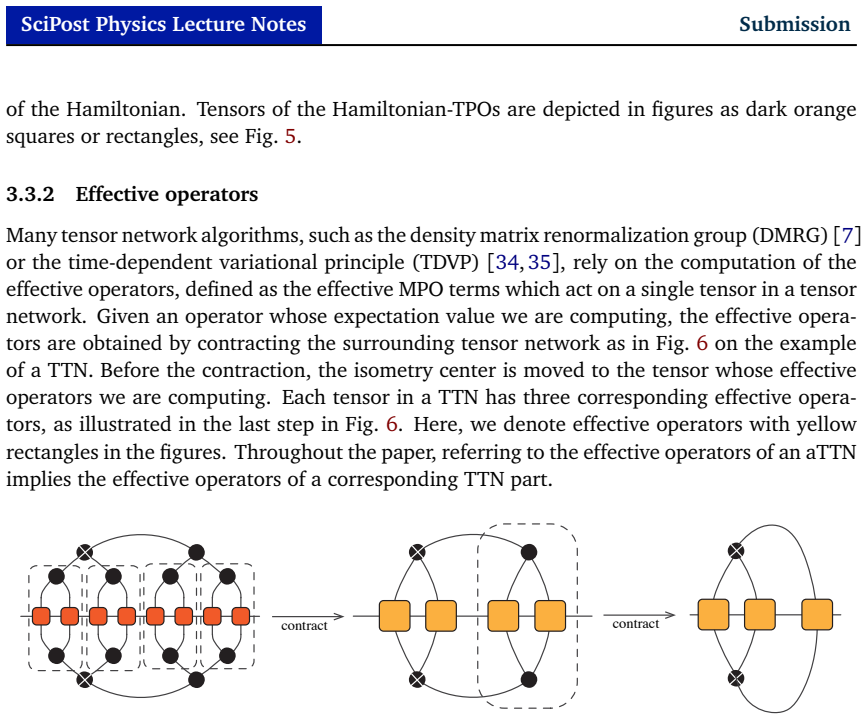
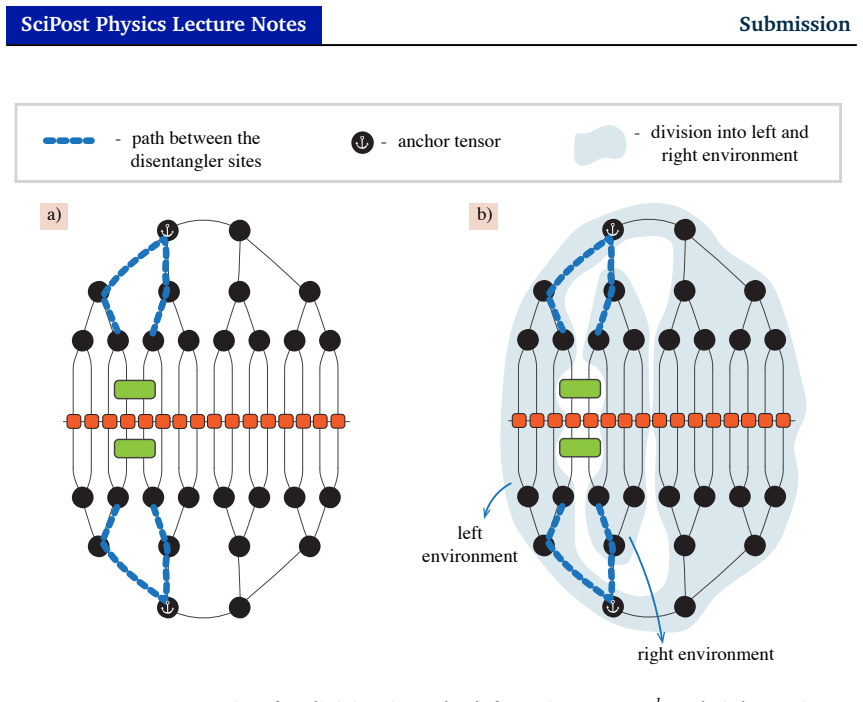
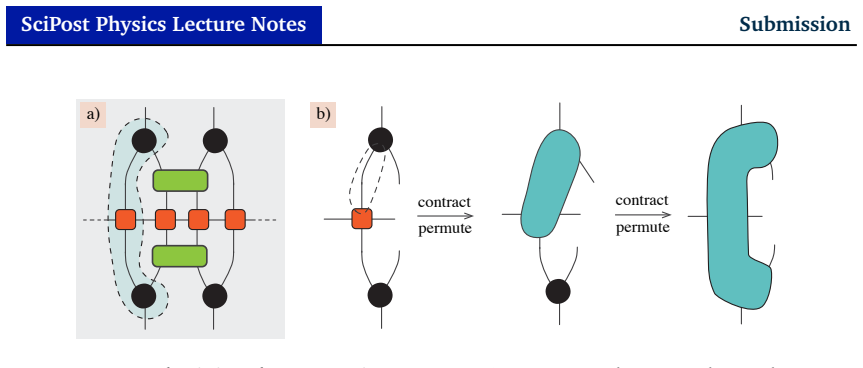
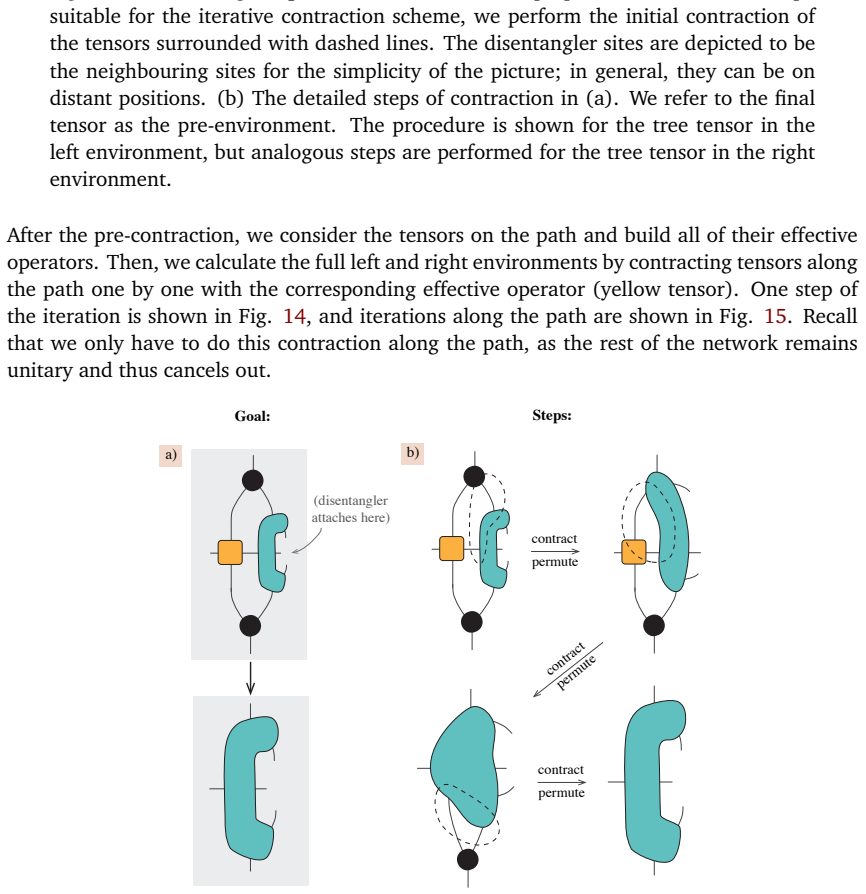
The augmented tree tensor network (aTTN): a tree tensor network whose lowest physical layer is preceded by a layer of two-site unitary gates (disentanglers), each attached to a pair of physical sites. The disentanglers absorb short-range entanglement and are optimized one at a time by freezing the conjugate gate, contracting the surrounding tensor network into a global environment $\Gamma_k$, and taking $u_k = -VU^\dagger$ from the singular value decomposition $\Gamma_k = U\sigma V^\dagger$, iterated to self-consistency. After the disentangler layer is found, the Hamiltonian is mapped to an auxiliary one, $H' = D(u)HD^\dagger(u)$, by contracting the disentanglers into the Hamiltonian's tensor-product-operator (TPO) terms, and a variational TTN sweep (DMRG) is run on the auxiliary Hamiltonian; measuring an observable proceeds the same way, by contracting the disentangler layer into the observable before evaluating it on the TTN. The TPO representation of the Hamiltonian is what lets each energy contribution be split into terms that touch a given disentangler and terms that do not.
What would settle it
Repeat the $32\times 32$ Ising benchmark at $h=3$ with many more disentangler-optimization sweeps and with random restarts, and compare the best aTTN energy at $m=160$ against the TTN at $m=400$; if the aTTN advantage shrinks or vanishes, the claimed advantage depends on the optimization stopping point rather than on the ansatz.
Extended reading notes
Core claim
The central claim is that appending one layer of unitary disentanglers to a tree tensor network improves the accuracy-to-cost tradeoff of ground-state searches in two dimensions, provided the lattice is large enough and the state is sufficiently entangled. In the $32\times 32$ square-lattice Ising model at transverse field $h=3$, near the critical point $h_c\approx 3.044$, the aTTN with bond dimension $m=160$ reaches lower energy densities than a TTN with $m=400$, and lower than the best MPS at $m=1200$, within the same memory budget. The advantage concentrates close to the critical point and grows with lattice size, because larger lattices allow more disentanglers and produce more long-range interactions that the disentanglers capture. For the triangular Heisenberg model the aTTN does not outperform TTN or MPS within the same resources, which the authors attribute to the larger number of Hamiltonian terms inflating the memory prefactor and to geometric restrictions that leave fewer viable disentangler positions. The memory cost of the aTTN scales with bond dimension $m$ as $O(m^3)$, the same as a TTN, with a constant prefactor about 6.5--10.9 times larger depending on model and size.
Load-bearing premise
The benchmark conclusions assume that the disentangler optimization converges to a sufficiently good disentangler layer within the fixed number of sweeps and iterations used; the paper does not analyze the convergence of that optimization.
Editorial extensions
If this is right
- The aTTN gives lower ground-state energy than the TTN at every bond dimension tested for the $32\times 32$ Ising model near criticality.
- For $32\times 32$ lattices near the critical point, the aTTN at $m=160$ beats both the TTN at $m=400$ and the best MPS within the same memory resources, while for $16\times 16$ lattices the MPS remains competitive.
- The memory cost of the aTTN scales as $O(m^3)$, identical to the TTN, with a prefactor roughly 6.5--9.8 times larger for the Ising model and 8.7--10.9 times larger for the Heisenberg model.
- Far from the critical point, where entanglement is low, a higher-bond-dimension TTN outperforms the aTTN at the same resource budget.
- For the triangular Heisenberg model, the aTTN does not outperform TTN or MPS with the given resources; the authors identify the memory overhead of many enlarged Hamiltonian terms and the reduced number of allowed disentangler positions as the causes.
Reading between the lines
- The authors leave the compression of overlapping Hamiltonian TPO terms after disentangler contraction as future work; a concrete test of the paper's resource analysis would be to measure peak GPU memory before and after such a compression and check whether the aTTN's advantageous regime widens.
- The empirical finding that one TTN-only sweep before disentangler optimization works best suggests the disentangler optimization can get trapped; a testable extension is to run multiple random restarts or a longer disentangler schedule to see whether the reported energies improve further.
- Since the aTTN is a subclass of MERA with one disentangler layer, the cookbook's measurement recipes should carry over to other single-layer MERA-inspired ansätze; a natural test is to apply the same contraction strategy to a two-dimensional MERA with only the bottom layer disentangled.
- The authors name time evolution as the next step; a direct benchmark would compare aTTN time evolution against MPS TDVP for a quench in the 2D transverse-field Ising model, looking for the same near-critical advantage seen in ground-state energies.
Editorial analysis
A structured set of objections, weighed in public.
Referee Report
Summary. The paper is a detailed lecture-note guide to the augmented tree tensor network (aTTN) ansatz. It explains the network geometry, the ground state search algorithm (including both a MERA-like self-consistent disentangler optimization and a sketched gradient-descent alternative), the environment contractions, the construction of the auxiliary Hamiltonian MPO after the disentangler layer is applied, and the measurement of local and non-local observables. The authors provide an open-source implementation within the Quantum TEA library and benchmark the algorithm on the square-lattice quantum Ising model and the triangular-lattice Heisenberg model for lattices up to 32x32. The central claim is that the aTTN offers advantages in accuracy relative to computational cost compared with MPS and TTN for large two-dimensional lattices near quantum critical points, while keeping the same polynomial scaling of memory with bond dimension as the TTN; the paper also honestly reports that the aTTN does not outperform the alternatives on the triangular Heisenberg model.
Significance. If the benchmark claims hold, this is a valuable contribution to the tensor-network lecture-note literature. The paper gives a concrete, implementable recipe with explicit contraction steps and complexity estimates, and it ships reproducible assets: open-source code, Zenodo datasets, Figshare figures, and pedagogical notebooks. The honest reporting of the negative Heisenberg result is a particular strength, as is the explicit analysis of memory-scaling prefactors. The main significance risk is that the central accuracy-per-cost comparison near the Ising critical point currently lacks sweep-convergence evidence for the compared bond dimensions, so the quantitative advantage of the aTTN over the TTN is not yet fully established. If the convergence checks requested below confirm the comparison, the paper would be a solid and useful contribution.
major comments (2)
- [Sec. 6.2.1 (Figs. 28-29)] The central comparison -- aTTN at m=160 outperforming TTN at m=400 for the 32x32 Ising model at h=3 -- is made under a fixed protocol of 30 DMRG sweeps (stated in Sec. 6) without reporting sweep-convergence data for these runs. The only convergence plot, Fig. 27(b), is for h=1 in the bulk phase, and the caption itself limits the convergence statement to 'far away from criticality'; moreover, that plot shows convergence with bond dimension, not with the number of sweeps. Near h_c ~ 3.044 the TTN optimization at m=400 may plausibly converge more slowly than at h=1, and if the m=400 TTN is not converged after 30 sweeps, the energy differences in Fig. 29 could reflect the sweep cutoff rather than the representational advantage of the aTTN. The S_TTN study in Sec. 6.3 concerns the aTTN's disentangler schedule and does not address TTN convergence at the compared bond dimensions. Please provide energy versus sweep number (or an equivalent convergence diagnostic) for the TTN at m=400 and the aTTN at m=160 at h=3, and state how the 30-sweep cutoff was chosen.
- [Sec. 4.1.1 and Secs. 6.2-6.3] The MERA-like disentangler optimization is described as iterating 'until convergence', but the number of self-consistent iterations N_i and the convergence criterion are not reported for any of the benchmark runs. The aTTN results in Figs. 28-31 therefore have an uncharacterized optimization tolerance, and the benchmark numbers cannot be reproduced from the text alone. Please report N_i (or the stopping criterion and typical values) for the Sec. 6.2 runs, and ideally provide a short study of disentangler-optimization convergence at h=3. This concern is less likely to bias the comparison against the aTTN, because an unconverged disentangler layer would make the aTTN appear worse, but it is still needed to support the quantitative claims and the cost model in Sec. 4.4.1.
minor comments (6)
- [Eq. (7)] The (2,1) entry of the correlation matrix is printed as <o^a_1 o^b_2>, identical to the (1,2) entry; it should presumably read <o^a_2 o^b_1> for i != j.
- [References] Reference [4] contains a typo: 'Physical Reviev Letters' should be 'Physical Review Letters'.
- [References] Reference [10] lists the first author as 'M. Eisert, Jens Cramer and M. B. Plenio'; the correct author list is 'J. Eisert, M. Cramer, and M. B. Plenio'.
- [References] References [24] and [27] share the same title ('Area law and real-space renormalization'), which may confuse readers; please differentiate them, since Ref. [27] is a distinct work by Qian and Qin.
- [Sec. 6.2.1] The sentence 'All three energy densities are within 10^-5 difference' is ambiguous; please specify that this is the difference in energy density and at which bond dimensions the comparison is made.
- [Sec. 6.2] The statement that 'the largest bond dimension shown corresponds to the largest possible with the assigned memory resources' is not marked in the figures; marking the largest reachable point in Figs. 28 and 30 (or stating it in the captions) would make the resource-limited comparison easier to read.
Circularity Check
No significant circularity: the benchmark advantages are new empirical results, not derived from fitted inputs or self-citations.
full rationale
The paper's core contribution is an implementation cookbook plus benchmarks; there is no derivation chain in which an output coincides with an input by construction. The aTTN ansatz and the disentangler-optimization procedure are explicitly attributed to Refs. [25,26] in Secs. 2 and 4.1.1, and the area-law statement of Sec. 2 is cited to Ref. [25], but these are antecedents, not the benchmark conclusions. The quantitative claims (Figs. 27-31, Tables 1-2) are generated by the authors' open-source Quantum TEA code on the transverse-field Ising and triangular Heisenberg models; energy densities, runtimes, and peak GPU memory are measured quantities, not fitted to enforce the claimed advantage. Memory-scaling exponents are obtained by fitting A*m^alpha to measured peak memory, yet the paper reports these as fits with uncertainties, not as predictions. The resource-constrained comparison 'best energy with aTTN m=160 vs TTN m=400' in Fig. 29 is an empirical benchmark under fixed memory, not a parameter tuned to force the conclusion. The fixed 30-sweep protocol, especially at h=3, raises a convergence-risk concern, but a potential slow-convergence artifact is a correctness and robustness issue, not circularity. Self-citations to Refs. [25,26,28] are present but are not load-bearing for the central benchmark outcome, and no uniqueness theorem or alternative-forbidding ansatz is imported. Thus the circularity score is low.
Assumptions & free parameters
assumptions (3)
- domain assumption The aTTN ansatz is capable of encoding the area law of entanglement in any number of dimensions
- domain assumption The disentangler optimization algorithm (MERA-like) converges to a good local minimum for the systems studied
- domain assumption The Hilbert curve mapping preserves the relevant correlations for the studied 2D models
Cite this review
Pith. "Pith review of The Augmented Tree Tensor Network Cookbook." pith.science (2026). https://pith.science/paper/R4R5DQF2
@misc{pith2026250721236,
  author       = {Pith},
  title        = {Pith review of: The Augmented Tree Tensor Network Cookbook},
  year         = {2026},
  howpublished = {\url{https://pith.science/paper/R4R5DQF2}},
  note         = {Machine review of arXiv:2507.21236}
}
abstract
An augmented tree tensor network (aTTN) is a tensor network ansatz constructed by applying a layer of unitary disentanglers to a tree tensor network. The disentanglers absorb a part of the system's entanglement. This makes aTTNs suitable for simulating higher-dimensional lattices, where the entanglement increases with the lattice size even for states that obey the area law. These lecture notes serve as a detailed guide for implementing the aTTN algorithms. We present a variational algorithm for ground state search and discuss the measurement of observables, and offer an open-source implementation within the Quantum TEA library. We benchmark the performance of the ground state search for different parameters and hyperparameters in the square lattice quantum Ising model and the triangular lattice Heisenberg model for up to $32 \times 32$ spins. The benchmarks identify the regimes where the aTTNs offer advantages in accuracy relative to computational cost compared to matrix product states and tree tensor networks.
Figures


Figures from the paper (28 more)








Reference graph
Works this paper leans on
-
[1]
S. Montangero, Introduction to Tensor Network Methods: Numerical simulations of low- dimensional many-body quantum systems, Springer (2018)
work page 2018
-
[2]
P . Silvi, F . Tschirsich, M. Gerster, J. Jünemann, D. Jaschke, M. Rizzi and S. Montangero, The Tensor Networks Anthology: Simulation techniques for many-body quantum lattice systems, SciPost Physics Lecture Notes 8 (2019), doi:10.21468/SciPostPhysLectNotes.8. 36 SciPost Physics Lecture Notes Submission
-
[3]
M. C. Bañuls, Tensor Network Algorithms: A Route Map , Annual Review of Condensed Matter Physics 14(1), 173 (2023), doi:10.1146 /annurev-conmatphys-040721-022705
work page 2023
-
[4]
S. Östlund and S. Rommer, Thermodynamic Limit of Density Matrix Renormalization , Physical Reviev Letters 75(19) (1995), doi:10.1103 /PhysRevLett.75.3537
work page 1995
-
[5]
G. Vidal, Efficient Classical Simulation of Slightly Entangled Quantum Computations, Phys- ical Review Letters 91(14) (2003), doi:10.1103 /PhysRevLett.91.147902
work page 2003
-
[6]
F . Verstraete and J. I. Cirac,Matrix product states represent ground states faithfully, Phys- ical Review B 73(094423) (2006), doi:10.1103 /PhysRevB.73.094423
work page 2006
-
[7]
U. Schollwöck, The density-matrix renormalization group in the age of matrix product states, Annals of Physics 326(1), 96 (2011), doi:10.1016 /j.aop.2010.09.012
work page 2011
-
[8]
M. B. Hastings, An area law for one-dimensional quantum systems, Journal of Statistical Mechanics 2007(P08024) (2007), doi:10.1088 /1742-5468/2007/08/P08024
work page 2007
Show all 46 references
- [9]
-
[10]
Eisert, Jens Cramer and M
M. Eisert, Jens Cramer and M. B. Plenio, Colloquium: Area laws for the entanglement entropy, Rev. Mod. Phys. 82(277) (2010), doi:10.1103 /RevModPhys.82.277
2010
- [11]
-
[12]
Verstraete, M
F . Verstraete, M. M. Wolf, D. Pérez-García and J. I. Cirac, Criticality, the Area law, and the Computational Power of Projected Entangled Pair States , Physical Review Letters 96(220601) (2006), doi:10.1103 /PhysRevLett.96.220601
2006
-
[13]
J. I. Cirac, D. Pérez-García, N. Schuch and F . Verstraete, Matrix product states and pro- jected entangled pair states: Concepts, symmetries, theorems , Reviews of Modern Physics 93(045003) (2021), doi:10.1103 /RevModPhys.93.045003
2021
-
[14]
Vidal, Entanglement Renormalization, Physical Review Letters 93(220405) (2007), doi:10.1103/PhysRevLett.99.220405
G. Vidal, Entanglement Renormalization, Physical Review Letters 93(220405) (2007), doi:10.1103/PhysRevLett.99.220405
2007 doi
-
[15]
Evenbly and G
G. Evenbly and G. Vidal,Quantum Criticality with the Multi-scale Entanglement Renormal- ization Ansatz, chapter in a book Strongly Correlated Systems, Springer, doi:10.1007/978- 3-642-35106-8_4 (2013)
2013 doi
-
[16]
Lubasch, J
M. Lubasch, J. I. Cirac and M.-C. Bañuls, Algorithms for finite projected entangled pair states, Phys. Rev. B 90(064425) (2014), doi:10.1103 /PhysRevB.90.064425
2014
-
[17]
D. A. Puente, E. L. Weerda, K. Schröder and M. Rizzi,Efficient optimization and conceptual barriers in variational finite Projected Entangled-Pair states , Phys. Rev. B 111(195120) (2025), doi:10.1103 /PhysRevB.111.195120
2025
-
[18]
Evenbly and G
G. Evenbly and G. Vidal, Algorithms for entanglement renormalization, Physical Review B 79(144108) (2009), doi:10.1103 /PhysRevB.79.144108
2009
-
[19]
Evenbly and G
G. Evenbly and G. Vidal,Entanglement Renormalization in Two Spatial Dimensions, Phys- ical Review Letters 102(180406) (2009), doi:10.1103 /PhysRevLett.102.180406. 37 SciPost Physics Lecture Notes Submission
2009
-
[20]
Y. Shi, L. Duan and G. Vidal, Classical simulation of quantum many-body systems with a tree tensor network , Physical Review A 74(022320) (2006), doi:10.1103/PhysRevA.74.022320
2006 doi
-
[21]
Silvi, V
P . Silvi, V . Giovannetti, S. Montangero, M. Rizzi, J. I. Cirac and R. Fazio, Homoge- neous binary trees as ground states of quantum critical Hamiltonians , Physical Review A 81(062335) (2010), doi:10.1103 /PhysRevA.81.062335
2010
-
[22]
Gerster, P
M. Gerster, P . Silvi, M. Rizzi, R. Fazio, T . Calarco and S. Montangero,Unconstrained tree tensor network: An adaptive gauge picture for enhanced performance , Physical Review B 90(125154) (2014), doi:10.1103 /PhysRevB.90.125154
2014
-
[23]
Tagliacozzo, G
L. Tagliacozzo, G. Evenbly and G. Vidal, Simulation of two-dimensional quantum sys- tems using a tree tensor network that exploits the entropic area law , Physical Review B 80(235127) (2009), doi:10.1103 /PhysRevB.80.235127
2009
-
[24]
A. J. Ferris, Area law and real-space renormalization , Physical Review B 87(125139) (2013), doi:10.1103 /PhysRevB.87.125139
2013
-
[25]
Felser, Tree tensor networks for high-dimensional quantum systems and beyond , Phd thesis, Universität des Saarlandes, doi:10.22028 /D291-35211 (2022)
T . Felser, Tree tensor networks for high-dimensional quantum systems and beyond , Phd thesis, Universität des Saarlandes, doi:10.22028 /D291-35211 (2022)
2022
-
[26]
Felser, S
T . Felser, S. Notarnicola and S. Montangero, Efficient Tensor Network Ansatz for High- Dimensional Quantum Many-Body Problems , Phys. Rev. Lett. 126(170603) (2021), doi:10.1007/s10955-014-1042-8
2021 doi
-
[27]
Qian and M
X. Qian and M. Qin, Area law and real-space renormalization , Physical Review B 105(205102) (2022), doi:10.1103 /PhysRevB.105.205102
2022
-
[28]
Baccari, D
F . Baccari, D. Bacilieri, M. Ballarin, F . P . Barone, F . Campaioli, G. Cataldi, A. Coppi, A. Costantini, A. Datta, A. De Girolamo, D. Jaschke, S. B. Koži ´c et al., Quantum TEA: qtealeaves, doi:10.5281 /zenodo.10498928 (2024)
2024
-
[29]
Reini´c, L
N. Reini´c, L. Paveši´c, S. Montangero and D. Jaschke, aTTNs in Quantum TEA - the user guide, https: //baltig.infn.it/qpd/attn-cookbook/-/tree/main (2025)
2025
-
[30]
Orús, A Practical Introduction to Tensor Networks: Matrix Product States and Projected Entangled Pair States , Annals of Physics 349, 117 (2014), doi:10.1016/j.aop.2014.06.013
R. Orús, A Practical Introduction to Tensor Networks: Matrix Product States and Projected Entangled Pair States , Annals of Physics 349, 117 (2014), doi:10.1016/j.aop.2014.06.013
2014 doi
- [31]
-
[32]
Perez-Garcia, F
D. Perez-Garcia, F . Verstraete, M. M. Wolf and J. I. Cirac, Matrix product state representations, Quantum Information and Computation 7(5&6), 401 (2007), doi:10.26421/QIC7.5-6-1
2007 doi
-
[33]
Van Damme, J
M. Van Damme, J. Haegeman, I. McCulloch and L. Vanderstraeten, Efficient higher- order matrix product operators for time evolution , SciPost Physics 17(135) (2024), doi:10.21468/SciPostPhys.17.5.135
2024 doi
-
[34]
Haegeman, J
J. Haegeman, J. I. Cirac, T . J. Osborne, I. Pižorn, H. Verschelde and F . Verstraete,Time- Dependent Variational Principle for Quantum Lattices , Phys. Rev. Lett. 107(070601) (2011), doi:10.1103 /PhysRevLett.107.070601. 38 SciPost Physics Lecture Notes Submission
2011
-
[35]
Haegeman, C
J. Haegeman, C. Lubich, I. Oseledets, B. Vandereycken and F . Verstraete, Unifying time evolution and optimization with matrix product states, Phys. Rev. B 94(165116) (2016), doi:10.1103/PhysRevB.94.165116
2016 doi
-
[36]
Lehtovaara, J
L. Lehtovaara, J. Toivanen and J. Eloranta, Solution of time-independent Schrödinger equation by the imaginary time propagation method , Journal of Computational Physics 221(1) (2016), doi:10.1016 /j.jcp.2006.06.006
2016
-
[37]
Paeckel, T
S. Paeckel, T . Köhler, A. Swoboda, R. S. Manmana, U. Schollwöck and C. Hubig, Time- evolution methods for matrix-product states , Annals of Physics 411(167998) (2019), doi:10.1016/j.aop.2019.167998
2019
-
[38]
Gerster, M
M. Gerster, M. Rizzi, P . Silvi, M. Dalmonte and S. Montangero,Fractional quantum Hall ef- fect in the interacting Hofstadter model via tensor networks, Physical Review B96(195123) (2017), doi:10.1103 /PhysRevB.96.195123
2017
-
[39]
Hauru, M
M. Hauru, M. Van Damme and J. Haegeman,Riemannian optimization of isometric tensor networks, SciPost Physics 10(040) (2021), doi:10.21468 /SciPostPhys.10.2.040
2021
-
[40]
Cataldi, A
G. Cataldi, A. Abedi, G. Magnifico, S. Notarnicola, N. Dalla Pozza, V . Giovannetti and S. Montangero, Hilbert curve vs Hilbert space: exploiting fractal 2D covering to increase tensor network efficiency, Quantum 5, 556 (2021), doi:10.22331 /q-2021-09-29-556
2021
-
[41]
H. W . J. Blöte and Y. Deng,Cluster Monte Carlo simulation of the transverse Ising model , Physical Review E 66(066110) (2002), doi:10.1103 /PhysRevE.66.066110
2002
- [42]
-
[43]
D. Wu, R. Rossi, F . Vicentini, N. Astrakhantsev, F . Becca, X. Cao, J. Carrasquilla, F . Ferrari, A. Georges, M. Hibat-Allah, M. Imada, A. M. Läuchli et al. , Varia- tional benchmarks for quantum many-body problems , Science 386(6719), 296 (2024), doi:10.1126/science.adg9774
2024 doi
-
[44]
S. A. Khandoker, J. M. Abedin and M. Hibat-Allah, Supplementing recurrent neural net- works with annealing to solve combinatorial optimization problems , Machine Learning: Science and Technology 4(1) (2023), doi:10.1088 /2632-2153/acb895
2023
-
[45]
Reini´c, L
N. Reini´c, L. Paveši´c, S. Montangero and D. Jaschke, Datasets for the aTTN Cookbook , doi:10.5281/zenodo.15879227 (2025)
2025 doi
-
[46]
Reini´c, L
N. Reini´c, L. Paveši´c, S. Montangero and D. Jaschke, Figures for the aTTN Cookbook , doi:10.6084/m9.figshare.29562320 (2025). 39
2025 doi
Reviewed August 6, 2026 · model on record in the stance chip above.
Discussion (0). Continue with ORCID to comment.