REVIEW 4 major objections 5 minor 36 references
Large Language Model-Enhanced Reinforcement Learning for Diverse and Novel Recommendations
T0 review · 4 major / 5 minor · reviewed 2026-08-06 · deepseek-v4-flash
Pith's one-line read LAAC claims an untuned LLM, used as a reference policy in an adversarial actor-critic loop, improves recommender accuracy, diversity, and novelty on MovieLens-1M.
desk verdict LAAC is a plausible incremental extension of ATAC, but the empirical case is underpowered; the entropy/accuracy tension flagged in review is not the fatal flaw it first looks like. read the letter →
The pith
A machine-rendered reading of the paper's core claim, the machinery that carries it, and where it could break.
The reading
What carries the argument
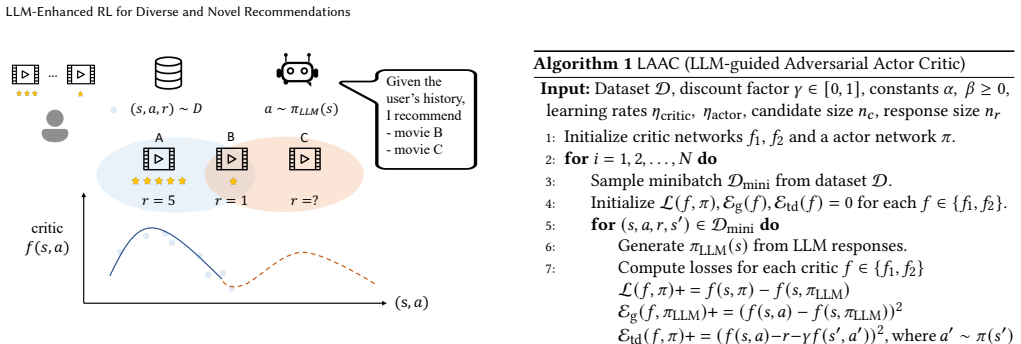
The load-bearing object is the minimax objective of Eq. (1): $\max_\pi \mathbb{E}[f(s,\pi)-f(s,\pi_{\mathrm{LLM}})]$, with the critic trained to minimize the same difference plus $\alpha E_g$ and $\beta E_{td}$. The LLM reference $\pi_{\mathrm{LLM}}$ is approximated operationally by prompting an LLM with 100 randomly sampled candidate items and treating its 10 returned suggestions as a uniform distribution. The grounding loss $E_g=\mathbb{E}[(f(s,a)-f(s,\pi_{\mathrm{LLM}}))^2]$ anchors critic values of LLM-suggested items to the values of observed actions, while the TD loss $E_{td}=\mathbb{E}[(f(s,a)-r-\gamma f(s',\pi))^2]$ keeps in-sample values realistic; together they are designed to keep the critic optimistic for novel items without overestimating them. The actor is then updated to beat the LLM policy according to the critic, using two critic networks as a double-Q heuristic.
What would settle it
Compare the trained critic's values for LLM-suggested items with their actual held-out ratings on MovieLens-1M; if the rank correlation is near zero or negative, the critic is not optimistic-but-grounded, and LAAC's improvement over baselines must come from something other than the mechanism the paper describes.
Extended reading notes
Core claim
The paper's central discovery is that an adversarial actor-critic loop, seeded by an untuned LLM reference policy, can replace the random exploration used by prior RL recommenders with targeted exploration of items the LLM deems plausible. In the training objective, the critic minimizes $f(s,\pi)-f(s,\pi_{\mathrm{LLM}})$ plus a grounding loss that pulls the critic values of LLM suggestions toward values of observed actions and a temporal-difference loss that keeps dataset actions Bellman-consistent, while the actor maximizes the same difference. LAAC reports that the resulting policy improves hit rate, NDCG, cumulative reward, coverage, and novel-item coverage over GRU4Rec and SMORL on MovieLens-1M, and that the gains hold when training on a male-only skewed subset and evaluating on the original distribution. The experiments also show a tunable trade-off: raising the grounding weight $\alpha$ improves accuracy while lowering novelty, and setting the TD weight $\beta$ too low hurts reward when the dataset contains mostly poor ratings.
Load-bearing premise
The load-bearing premise is that the trained critic values LLM-suggested items optimistically but not overestimated, so that steering the policy toward whatever the critic favors surfaces good new items rather than bad ones.
Editorial extensions
If this is right
- If LAAC is right, recommender systems can add diversity and novelty without training or fine-tuning an LLM, which removes the main compute barrier to LLM-guided exploration.
- The adversarial reference-policy recipe should transfer to other offline RL settings where a frozen policy proposes actions beyond the logged data and a critic decides which proposals to trust.
- The coefficients $\alpha$ and $\beta$ give operators a direct accuracy-versus-novelty dial instead of requiring a new reward function or model for each objective.
- Training on skewed user data still produced competitive accuracy and diversity when evaluated on the original distribution, indicating the LLM reference can supply coverage that majority-only training data lacks.
Reading between the lines
- A cheap test of the mechanism: replace the LLM reference with a uniform-random policy over the same 100-candidate samples. If most of the diversity gain survives, the contribution is the adversarial grounding machinery rather than the LLM's semantic knowledge.
- The policy entropy reported for LAAC is much higher than for GRU4Rec, so a deployed system would need to check ranking calibration and business metrics beyond rating reward before relying on this diversity.
- At the scale tested (160 users, about 26,511 transitions), the 100-candidate sampling approximation of $\pi_{\mathrm{LLM}}$ may be a bottleneck; larger catalogs would require re-estimating how much of the LLM's knowledge actually enters training.
- The same scheme is a natural fit for exploratory recommendation in non-entertainment domains, such as jobs, papers, or products, whenever an LLM can propose candidates and logged reward data exists.
Editorial analysis
A structured set of objections, weighed in public.
Referee Report
Summary. The paper proposes LAAC, an offline RL method for sequential recommendation that uses an LLM as a reference policy within an adversarial actor-critic framework. The actor is trained to outperform the LLM's suggestions while the critic is regularized by a grounding loss and a TD loss, aiming to keep critic values for LLM-suggested items optimistic yet anchored to well-estimated dataset actions. The method is evaluated on a filtered MovieLens-1M dataset, comparing accuracy (HR@k, NDCG@k), reward (R@k), diversity (CV@k, entropy), and novelty (NCV@k, NC@k) against GRU4Rec and SMORL, as well as against raw LLM policies. The authors report that LAAC achieves simultaneous improvements in relevance, diversity, and novelty, and shows robustness when training data are skewed by gender.
Significance. If the reported results are correct, LAAC would be a practical and computationally cheap way to inject LLM knowledge into sequential recommendation without fine-tuning the LLM, addressing a real deployment bottleneck. The paper combines a principled adversarial offline-RL formulation with LLM-generated candidate actions, and it includes ablations of the two regularization coefficients, which is a useful design analysis. However, the central empirical claim rests on a single small dataset and, as detailed below, the headline numbers in Table 1 are mutually inconsistent under the stated metric definitions. The evaluation also lacks confidence intervals, significance tests, and LLM-based baselines, so the current evidence does not yet support the abstract's broad claims.
major comments (4)
- The reported numbers in Table 1 are internally inconsistent under the stated metric definitions. The LLM policy π_Llama3 has entropy 2.2747, which matches ln(10) and confirms that entropy is measured in natural units over the 10-item recommendation support. LAAC(Llama3) is reported with entropy 8.0594, which corresponds to an effective support of e^8.0594 ≈ 3,161 items, i.e., essentially uniform over the 3,503-item catalog. A near-uniform policy over the full catalog would have expected HR@5 ≈ 5/3,503 ≈ 0.0014, but the table reports HR@5 = 0.0458, about 33 times larger. The same policy would place a novel (bottom-50% popularity) item at rank 1 in roughly half of the 5,090 test sequences, i.e., NC@1 ≈ 2,545, but the table reports NC@1 = 268. Its CV@10 would be near 1 because 5,090 sequences of 10 near-random recommendations would cover essentially all items, but the table reports CV@10 = 0.69. No evaluation protocol described in Section 3.1.4 reconciles these discrepancies. Since the central claim of "diversity with aligned relevance" (Section 3.2.2) depends on exactly these numbers, the empirical evidence for the paper's main contribution is not currently supported.
- The double-Q implementation described in Section 2.3.2 is not a double-Q method. In Algorithm 1, both critics f1 and f2 are updated with the identical loss L(f,π) + α E_g(f,π_LLM) + β E_td(f,π), and the actor is updated using only f1. There is no minimum-of-two-critics target, no alternating use of the critics, and no target network. Standard double-Q heuristics (e.g., TD3 or SAC) reduce overestimation by using the minimum of two independently maintained critics in the target computation. Training two copies with the same objective and no interaction does not provide that correction. The paper identifies overestimation of LLM-suggested items' values as a core risk, so this implementation choice should be either fixed to a genuine double-Q formulation or explicitly framed as a heuristic that relies on regularization alone.
- The evaluation is too limited to support the abstract's claim that LAAC "outperforms existing baselines in diversity, novelty, and accuracy." The experiments use a single dataset (MovieLens-1M) filtered to 160 users and 26,511 samples, and only two non-LLM baselines (GRU4Rec and SMORL) are compared. There are no comparisons to LLM-based recommenders, such as zero-shot LLM prompting with a proper ranker, a LoRA-finetuned LLM, or the LLM-as-environment RL method of [32]. The paper also states that all models were trained 50 times with different seeds, but no error bars, standard deviations, or significance tests are reported anywhere. The robustness claim in Section 3.2.3 is based on a single artificial skew (male-only training data). I would ask the authors to report confidence intervals and significance tests, add at least one LLM-based baseline, and ideally validate on a second dataset or domain.
- The adversarial objective in Eq. (1) is stated without any theoretical analysis. The paper invokes the guarantees of ATAC [7] and its model-based extension [4] to justify the framework, but the objective here is modified by the grounding loss E_g and the TD regularization E_td. These terms change the fixed point of the game, so the cited guarantee that the learned policy outperforms the behavior/reference policy does not automatically transfer. The claim in Section 2.1.3 that "this adversarial training setup guarantees that the resulting policy provably outperforms the behavior policy" is therefore misleading when applied to the LAAC objective. Either the authors should provide a formal statement (with assumptions) of what the modified game optimizes, or they should clearly describe LAAC as a heuristic and remove the implication of a proof.
minor comments (5)
- Typo: "minimiax" should be "minimax".
- Formatting issue: "1,1091,687" should be "1,109 1,687".
- The TD loss E_td is defined in Eq. (1) with f(s',π), the expected value under the policy, but Algorithm 1 line 7 accumulates the squared error using f(s',a') for a single sample a' ~ π(s'). These are different targets. The authors should clarify which objective is actually optimized in the experiments and align the text with the code.
- The definition of R@k as "the sum of user ratings for the top-k recommendations" is ambiguous: it is not clear whether this is a per-user sum, a per-sequence sum, or a total over all test sequences. The reported magnitudes in Tables 1 and 2 should be reconciled with the rating scale [1,5].
- The filtering step leaves only 160 users and 26,511 samples from MovieLens-1M, which is a very small subset. The paper should state this more prominently and justify the random subsampling of ratings, as it may affect the diversity and novelty metrics.
Circularity Check
No significant circularity: LAAC is an empirical method evaluated on held-out data; its LLM-guided adversarial objective is a design choice, not a tautology.
full rationale
The paper's core claim is empirical: LAAC improves diversity, novelty, and accuracy on MovieLens. The training objective in Eq. (1) is a design choice derived from the adversarial offline RL framework of [4,7]; it does not presuppose the reported metric values. The LLM reference policy is explicitly constructed as uniform over 10 items sampled from 100 candidates (Sec. 2.3.1), and its reported entropy is simply log 10 by construction; this is a definitional property of the baseline, not a prediction of LAAC. The actor and critic are trained with the stated losses and evaluated on a held-out split (Secs. 3.1.1, 3.1.4), so the reported gains are not fitted to the test set. The regularization terms E_g and E_td are hyperparameters (alpha, beta) that are varied in Sec. 3.2 and shown to trade off reward and novelty; this is an empirical analysis, not a tautology. There is no load-bearing self-citation: refs [4,7] are external and provide the adversarial formulation; the authors do not import a uniqueness theorem from their own prior work. The skeptic's observation that LAAC's reported entropy (~8.06 nats) is inconsistent with the reported HR@5 and NC@1 is a serious internal-consistency/correctness concern about the empirical tables, but it is not a case of a derivation reducing to its inputs; it does not make the method circular. Overall, no circular step is identifiable from the paper's equations or citations.
Assumptions & free parameters
free parameters (6)
- alpha (grounding regularizer weight) =
1.0
- beta (TD regularizer weight) =
1.0
- gamma (discount factor) =
0.99
- n_c (candidate set size) =
100
- n_r (response size) =
10
- learning rates =
eta_critic=0.01, eta_actor=0.001
assumptions (4)
- domain assumption Sequential recommendation can be modeled as an MDP with state as the last five watched items and reward as the user rating.
- domain assumption The offline dataset D consists of valid (s,a,r,s') transitions and is representative enough to train a policy, despite coming from only 160 users.
- ad hoc to paper The adversarial game-theoretic framework of ATAC [7,4] with a reference policy remains valid when the reference is an LLM policy and the critic loss includes grounding and TD regularizers.
- domain assumption The LLM, when prompted with random candidate sets, provides a useful distribution over novel items that a small policy can profitably refine.
Cite this review
Pith. "Pith review of Large Language Model-Enhanced Reinforcement Learning for Diverse and Novel Recommendations." pith.science (2026). https://pith.science/paper/HOWEAL6G
@misc{pith2026250721274,
  author       = {Pith},
  title        = {Pith review of: Large Language Model-Enhanced Reinforcement Learning for Diverse and Novel Recommendations},
  year         = {2026},
  howpublished = {\url{https://pith.science/paper/HOWEAL6G}},
  note         = {Machine review of arXiv:2507.21274}
}
read the original abstract
In recommendation systems, diversity and novelty are essential for capturing varied user preferences and encouraging exploration, yet many systems prioritize click relevance. While reinforcement learning (RL) has been explored to improve diversity, it often depends on random exploration that may not align with user interests. We propose LAAC (LLM-guided Adversarial Actor Critic), a novel method that leverages large language models (LLMs) as reference policies to suggest novel items, while training a lightweight policy to refine these suggestions using system-specific data. The method formulates training as a bilevel optimization between actor and critic networks, enabling the critic to selectively favor promising novel actions and the actor to improve its policy beyond LLM recommendations. To mitigate overestimation of unreliable LLM suggestions, we apply regularization that anchors critic values for unexplored items close to well-estimated dataset actions. Experiments on real-world datasets show that LAAC outperforms existing baselines in diversity, novelty, and accuracy, while remaining robust on imbalanced data, effectively integrating LLM knowledge without expensive fine-tuning.
Figures

Reference graph
Works this paper leans on
-
[32]
Jie Wang, Alexandros Karatzoglou, Ioannis Arapakis, and Joemon M. Jose. Rein- forcement learning-based recommender systems with large language models for state reward and action modeling. SIGIR ’24, page 375–385, 2024
work page 2024
-
[7]
Adversarially trained actor critic for offline reinforcement learning
Ching-An Cheng, Tengyang Xie, Nan Jiang, and Alekh Agarwal. Adversarially trained actor critic for offline reinforcement learning. In Proceedings of the 39th International Conference on Machine Learning , 2022
work page 2022
-
[4]
Adversarial model for offline reinforcement learning
Mohak Bhardwaj, Tengyang Xie, Byron Boots, Nan Jiang, and Ching-An Cheng. Adversarial model for offline reinforcement learning. In Advances in Neural Information Processing Systems, volume 36, pages 1245–1269, 2023
work page 2023
-
[1]
Llama 3 model card
AI@Meta. Llama 3 model card. 2024
2024
-
[2]
The claude 3 model family: Opus, sonnet, haiku
Anthropic. The claude 3 model family: Opus, sonnet, haiku. 2024
2024
-
[3]
Keqin Bao, Jizhi Zhang, Yang Zhang, Wenjie Wang, Fuli Feng, and Xiangnan He. Tallrec: An effective and efficient tuning framework to align large language model with recommendation. RecSys ’23, page 1007–1014, 2023
work page 2023
-
[5]
Stochastic approximation with two time scales
Vivek S Borkar. Stochastic approximation with two time scales. Systems & Control Letters, 29(5):291–294, 1997
work page 1997
-
[6]
Jin Chen, Zheng Liu, Xu Huang, Chenwang Wu, Qi Liu, Gangwei Jiang, Yuanhao Pu, Yuxuan Lei, Xiaolong Chen, Xingmei Wang, et al. When large language models meet personalization: Perspectives of challenges and opportunities.arXiv preprint arXiv:2307.16376, 2023
arXiv 2023
Show all 36 references
-
[8]
On the properties of neural machine translation: Encoder-decoder approaches
Kyunghyun Cho, Bart Van Merriënboer, Dzmitry Bahdanau, and Yoshua Bengio. On the properties of neural machine translation: Encoder-decoder approaches. arXiv preprint arXiv:1409.1259, 2014
2014 arXiv
-
[9]
A review of modern recommender systems using generative models (gen-recsys)
Yashar Deldjoo, Zhankui He, Julian McAuley, Anton Korikov, Scott Sanner, Arnau Ramisa, René Vidal, Maheswaran Sathiamoorthy, Atoosa Kasirzadeh, and Silvia LLM-Enhanced RL for Diverse and Novel Recommendations Milano. A review of modern recommender systems using generative mode...
2024
-
[10]
Bert: Pre- training of deep bidirectional transformers for language understanding
Jacob Devlin, Ming-Wei Chang, Kenton Lee, and Kristina Toutanova. Bert: Pre- training of deep bidirectional transformers for language understanding. arXiv preprint arXiv:1810.04805, 2018
2018 arXiv
-
[11]
Recommender systems in the era of large language models (llms)
Wenqi Fan, Zihuai Zhao, Jiatong Li, Yunqing Liu, Xiaowei Mei, Yiqi Wang, Jiliang Tang, and Qing Li. Recommender systems in the era of large language models (llms). arXiv preprint arXiv:2307.02046, 2023
2023 arXiv
-
[12]
Addressing function approxi- mation error in actor-critic methods
Scott Fujimoto, Herke Hoof, and David Meger. Addressing function approxi- mation error in actor-critic methods. In International Conference on Machine Learning, pages 1587–1596. PMLR, 2018
2018
-
[13]
Soft actor- critic: Off-policy maximum entropy deep reinforcement learning with a stochas- tic actor
Tuomas Haarnoja, Aurick Zhou, Pieter Abbeel, and Sergey Levine. Soft actor- critic: Off-policy maximum entropy deep reinforcement learning with a stochas- tic actor. In International conference on machine learning, pages 1861–1870. PMLR, 2018
2018
-
[14]
Maxwell Harper and Joseph A
F. Maxwell Harper and Joseph A. Konstan. The movielens datasets: History and context. ACM Trans. Interact. Intell. Syst. , 5(4), 2015
2015
-
[15]
Large lan- guage models as zero-shot conversational recommenders
Zhankui He, Zhouhang Xie, Rahul Jha, Harald Steck, Dawen Liang, Yesu Feng, Bodhisattwa Prasad Majumder, Nathan Kallus, and Julian Mcauley. Large lan- guage models as zero-shot conversational recommenders. CIKM ’23, 2023
2023
-
[16]
Session-based recommendations with recurrent neural networks
Balázs Hidasi, Alexandros Karatzoglou, Linas Baltrunas, and Domonkos Tikk. Session-based recommendations with recurrent neural networks. arXiv preprint arXiv:1511.06939, 2015
2015 arXiv
-
[17]
Towards universal sequence representation learning for recommender systems
Yupeng Hou, Shanlei Mu, Wayne Xin Zhao, Yaliang Li, Bolin Ding, and Ji-Rong Wen. Towards universal sequence representation learning for recommender systems. In Proceedings of the 28th ACM SIGKDD Conference on Knowledge Discovery and Data Mining , pages 585–593, 2022
2022
-
[18]
Lora: Low-rank adaptation of large language models
Edward J Hu, Yelong Shen, Phillip Wallis, Zeyuan Allen-Zhu, Yuanzhi Li, Shean Wang, Lu Wang, and Weizhu Chen. Lora: Low-rank adaptation of large language models. arXiv preprint arXiv:2106.09685, 2021
2021 arXiv
-
[19]
Human-centric dialog training via offline reinforcement learning
Natasha Jaques, Judy Hanwen Shen, Asma Ghandeharioun, Craig Ferguson, Agata Lapedriza, Noah Jones, Shixiang Gu, and Rosalind Picard. Human-centric dialog training via offline reinforcement learning. In Bonnie Webber, Trevor Cohn, Yulan He, and Yang Liu, editors, Proceedings of...
2020
-
[20]
Cumulated gain-based evaluation of ir techniques
Kalervo Järvelin and Jaana Kekäläinen. Cumulated gain-based evaluation of ir techniques. ACM Transactions on Information Systems (TOIS) , 2002
2002
-
[21]
Kingma and Jimmy Ba
Diederik P. Kingma and Jimmy Ba. Adam: A method for stochastic optimization. In 3rd International Conference on Learning Representations , 2015
2015
-
[22]
How can recommender systems benefit from large language models: A survey
Jianghao Lin, Xinyi Dai, Yunjia Xi, Weiwen Liu, Bo Chen, Xiangyang Li, Chenxu Zhu, Huifeng Guo, Yong Yu, Ruiming Tang, et al. How can recommender systems benefit from large language models: A survey. arXiv preprint arXiv:2306.05817, 2023
2023 arXiv
-
[23]
Pre-train, prompt, and predict: A systematic survey of prompting methods in natural language processing
Pengfei Liu, Weizhe Yuan, Jinlan Fu, Zhengbao Jiang, Hiroaki Hayashi, and Gra- ham Neubig. Pre-train, prompt, and predict: A systematic survey of prompting methods in natural language processing. ACM Computing Surveys, 55(9):1–35, 2023
2023
-
[24]
Diversity-promoting deep reinforcement learning for interactive recommendation
Yong Liu, Zhiqi Shen, Yinan Zhang, and Lizhen Cui. Diversity-promoting deep reinforcement learning for interactive recommendation. ICCSE ’21, page 132–139, 2022
2022
-
[25]
Convergent temporal-difference learning with arbitrary smooth function approximation
Hamid Reza Maei, Csaba Szepesvari, Shalabh Bhatnagar, Doina Precup, David Silver, and Richard S Sutton. Convergent temporal-difference learning with arbitrary smooth function approximation. In NIPS, pages 1204–1212, 2009
2009
-
[26]
Recent advances in natural language processing via large pre-trained language models: A survey
Bonan Min, Hayley Ross, Elior Sulem, Amir Pouran Ben Veyseh, Thien Huu Nguyen, Oscar Sainz, Eneko Agirre, Ilana Heintz, and Dan Roth. Recent advances in natural language processing via large pre-trained language models: A survey. ACM Computing Surveys, 56(2):1–40, 2023
2023
-
[27]
Training language models to follow instructions with human feedback.Advances in Neural Information Processing Systems , 35:27730–27744, 2022
Long Ouyang, Jeffrey Wu, Xu Jiang, Diogo Almeida, Carroll Wainwright, Pamela Mishkin, Chong Zhang, Sandhini Agarwal, Katarina Slama, Alex Ray, et al. Training language models to follow instructions with human feedback.Advances in Neural Information Processing Systems , 35:2773...
2022
-
[28]
Proximal policy optimization algorithms
John Schulman, Filip Wolski, Prafulla Dhariwal, Alec Radford, and Oleg Klimov. Proximal policy optimization algorithms. arXiv preprint ArXiv:1707.06347, 2017
2017 arXiv
-
[29]
Choosing the best of both worlds: Diverse and novel recom- mendations through multi-objective reinforcement learning
Dusan Stamenkovic, Alexandros Karatzoglou, Ioannis Arapakis, Xin Xin, and Kleomenis Katevas. Choosing the best of both worlds: Diverse and novel recom- mendations through multi-objective reinforcement learning. WSDM, 2022
2022
-
[30]
Learning to summarize with human feedback
Nisan Stiennon, Long Ouyang, Jeffrey Wu, Daniel Ziegler, Ryan Lowe, Chelsea Voss, Alec Radford, Dario Amodei, and Paul F Christiano. Learning to summarize with human feedback. In H. Larochelle, M. Ranzato, R. Hadsell, M.F. Balcan, and H. Lin, editors, Advances in Neural Inform...
2020
-
[31]
Llama: Open and efficient foundation language models
Hugo Touvron, Thibaut Lavril, Gautier Izacard, Xavier Martinet, Marie-Anne Lachaux, Timothée Lacroix, Baptiste Rozière, Naman Goyal, Eric Hambro, Faisal Azhar, et al. Llama: Open and efficient foundation language models. arXiv preprint arXiv:2302.13971, 2023
2023 arXiv
-
[33]
Transrec: Learning transferable recommendation from mixture-of-modality feedback
Jie Wang, Fajie Yuan, Mingyue Cheng, Joemon M Jose, Chenyun Yu, Beibei Kong, Xiangnan He, Zhijin Wang, Bo Hu, and Zang Li. Transrec: Learning transferable recommendation from mixture-of-modality feedback. arXiv preprint arXiv:2206.06190, 2022
2022
-
[34]
Behavior regularized offline rein- forcement learning
Yifan Wu, George Tucker, and Ofir Nachum. Behavior regularized offline rein- forcement learning. arXiv preprint ArXiv:1911.11361, 2019
1911 arXiv
-
[35]
A survey of large language models
Wayne Xin Zhao, Kun Zhou, Junyi Li, Tianyi Tang, Xiaolei Wang, Yupeng Hou, Yingqian Min, Beichen Zhang, Junjie Zhang, Zican Dong, et al. A survey of large language models. arXiv preprint arXiv:2303.18223, 2023
2023 arXiv
-
[36]
Drn: A deep reinforcement learning framework for news recommendation
Guanjie Zheng, Fuzheng Zhang, Zihan Zheng, Yang Xiang, Nicholas Jing Yuan, Xing Xie, and Zhenhui Li. Drn: A deep reinforcement learning framework for news recommendation. In Proceedings of the World Wide Web Conference , 2018
2018
Reviewed August 6, 2026 · model on record in the stance chip above.
Discussion (0). Sign in to comment.