REVIEW 3 major objections 6 minor 1 cited by
Pushing the Limits of LLMs in Quantum Operations
T0 review · 3 major / 6 minor · reviewed 2026-08-06 · deepseek-v4-flash
Pith's one-line read The paper claims that four publicly available LLMs produce executable quantum gate designs for 80% of a 25-prompt benchmark, with Gemini the fastest overall.
desk verdict A transparent but under-powered benchmark: the timing ranking has no variance, and the 80% success rate is contradicted by the paper's own 23/25 table. read the letter →
The pith
A machine-rendered reading of the paper's core claim, the machinery that carries it, and where it could break.
The reading
What carries the argument
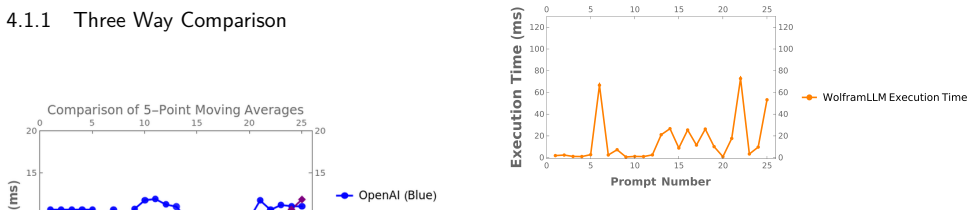
The argument is carried by a benchmark harness built in Wolfram Mathematica: 25 quantum gate synthesis prompts (Pauli gates, Bell states, Deutsch's algorithm, quantum Fourier transform, teleportation, among others) are sent to each LLM, the per-prompt response time is recorded through the Mathematica connection, the programmatic output between the START and END markers is filtered into Python3, and that code is executed twice in a Jupyter Notebook on a fixed testbed machine. The final speed ranking is computed as the average, over the 25 prompts, of the LLM response time plus the Python execution time, with a separate ServiceConnect time measured for three of the four models to gauge networking latency.
What would settle it
Re-run the same 25 prompts several times per model, isolating the model's generation time from network latency by timing the Mathematica request locally, and check whether Gemini still has the lowest average total time; if the ordering changes under repetition, the central speed claim is overturned.
Extended reading notes
Core claim
On the paper's own terms, the central discovery is an empirical ranking: given the same 25 quantum-circuit prompts, Google Gemini produced the fastest overall working code when both the model's response time and the Python execution time of the generated code are averaged together (1.35 s), followed by WolframLLM (1.75 s), OpenAI ChatGPT (2.62 s), and DeepSeek (6.12 s). Every model compiled 80% of the prompts, and no model beat the others in success rate; the failures were prompt-specific, with only Prompt 13 failing for multiple models and with different error types. The ranking is unchanged when the measured service-connect times are factored in, and it holds even though DeepSeek had the fastest average Python execution time (4.38 ms) and lowest memory usage (49.90 KB). The authors interpret the result as evidence that publicly available LLMs are already fast and reasonably reliable generators of quantum gate designs.
Load-bearing premise
The speed ranking assumes that a single response from each LLM for each prompt is representative of that model's performance, with no repeated trials or variance estimates and with network latency included in the recorded times.
Editorial extensions
If this is right
- If the 80% compilation rate holds across other gate-synthesis prompt sets, general-purpose LLMs become a viable first-pass tool for producing quantum circuit code, with a human or automated checker catching the remaining 20%.
- A standardized benchmark of this kind can be rerun as new LLM versions appear, turning 'which model is fastest at quantum gate design' into a continuously measurable quantity rather than an anecdotal comparison.
- The fact that most outputs rely on the Qiskit framework suggests that LLM training data is skewed toward one quantum programming ecosystem, which could shape which quantum software stack new users adopt.
- If response time continues to dominate total time, then reducing network and inference latency matters more than optimizing the generated Python code for end-to-end quantum design speed.
Reading between the lines
- A natural next test is to scale the prompt set from 25 to several hundred and stratify by difficulty, which would tell whether the 80% success rate is stable or an artifact of the particular prompt mix.
- Because DeepSeek had the fastest generated-code execution and lowest memory usage but the slowest LLM response, the paper hints that speed rankings are sensitive to whether the bottleneck is model generation or code efficiency; weighting the two components differently could reverse the overall ranking.
- For practical LLM-assisted quantum work, the more consequential finding may be the uniform 80% compile rate rather than Gemini's speed: even the slowest model finishes in about 6 seconds, so reliability, not latency, is what currently limits fully automated gate synthesis.
- The paper's 'interoperability' framing suggests a research program in which LLMs serve as a natural-language-to-circuit layer above quantum hardware, but the data measure compilation success and gate-design correctness only indirectly, not full unitary fidelity.
Editorial analysis
A structured set of objections, weighed in public.
Referee Report
Summary. The paper presents a benchmark of four publicly available LLMs (WolframLLM, OpenAI ChatGPT, Google Gemini, and DeepSeek) for generating quantum gate designs. Prompts for 25 quantum tasks were issued through Wolfram Mathematica; the resulting code was extracted and executed in Python, with measurements of LLM response time (including network latency), Python execution time, lines of code, memory usage, and compilation success. The authors claim that Gemini is the fastest overall LLM and that the tested models achieved working quantum operations 80% of the time. The manuscript includes prompt tables, an error table, and links to a public repository with raw outputs.
Significance. If the benchmark were statistically and methodologically sound, it would be a useful reference point for LLM-based quantum gate synthesis and for the broader interoperability agenda the authors advocate. The main strengths are the concrete prompt set, the public repository of raw outputs, and the transparency about the testbed. However, the two headline claims, the Gemini-fastest ranking and the 80% success rate, are not supported by the reported evidence: the speed comparison rests on single observations per prompt with no variance estimates and includes network latency, while the success-rate figure contradicts the paper's own compilation table. These issues are load-bearing, so the current version does not justify its central conclusions.
major comments (3)
- [Section 4, Tables 1 and 6] The headline speed ranking is not supported by the reported measurements. Each of the 25 prompts was sent once per LLM, with no repeated trials, no standard deviations or confidence intervals, and the timings include network/service latency as the Abstract explicitly states; in addition, the LLM versions and test dates are not pinned. Because Table 1 averages one observation per prompt, a single slow or fast response can change the Gemini/WolframLLM/OpenAI ordering. Table 6 compounds the problem by averaging Table 1 (seconds) with Table 3 (milliseconds), so the 'overall' ranking is effectively the one-shot LLM response-time ranking with negligible contribution from Python execution time. Repeating each prompt multiple times and reporting distributions, or performing paired per-prompt comparisons, is necessary before claiming that Gemini is fastest.
- [Abstract, Section 4.5, Section 4.6, Table 7] The claimed 80% success rate is internally inconsistent with the paper's own data. Table 7 lists exactly two non-compiling prompts per model, and Section 4.6 reports 23 compiled programs out of 25, which is 92%, not 80%. The 80% figure is repeated in the Abstract and Section 5, so it is not a one-off typo. The authors should correct the success-rate calculation, or explain what additional criterion beyond compilation produces the 80% number, and ensure that all statements of the accuracy claim are consistent.
- [Section 4.6 and Tables 8–12] The paper does not describe how the Eval Criteria listed in the prompt tables were applied to the compiled outputs, nor how 'successes' were counted beyond compilation. Since 'working quantum operations' is one of the two headline claims, the evaluation protocol should be specified in enough detail to be reproduced, for example whether correctness was checked by unitary comparison, statevector inspection, measurement statistics, or manual review. Without this, the reader cannot verify that the compiled programs actually satisfy the intended quantum operations.
minor comments (6)
- [Abstract] The opening line of the abstract contains run-together words ('ArtificialIntelligenceLargeLanguageModel'); the manuscript has numerous similar spacing and formatting issues that should be corrected by copyediting.
- [Section 3] The exact LLM model identifiers (e.g., GPT-4o versus ChatGPT-4, Gemini 1.5 versus 2.0, DeepSeek-V3) are not stated, and the dates of the queries are not given; because these services change rapidly, this information is essential for reproducibility.
- [Section 4.3.1] The statement that OpenAI and WolframLLM had identical average lines of code and are 'population-wise, identical!' is confusing; identical averages do not imply identical populations, and the paragraph should be reworded to avoid this implication.
- [Abstract and Introduction] The claim of being the 'first benchmarking study' is difficult to reconcile with the existing LLM quantum-code benchmarks cited in references [25]–[27]; the novelty claim should be qualified, for example as the first speed-focused comparison of publicly available LLM chat services for gate synthesis.
- [Section 4.2] The statement that each Python program was executed twice, with the second execution logged, is welcome; however, no analogous repetition is reported for the LLM response times, which are the dominant contribution to the overall ranking.
- [Section 5] The claim that including ServiceConnect times 'does not change these rankings' is not demonstrated, since WolframLLM has no ServiceConnect measurement and the corrected numbers are not tabulated.
Circularity Check
No significant circularity: the paper is an empirical external benchmark with no derivation chain whose conclusions could reduce to their inputs.
full rationale
The paper's central claims are direct measurements, not derived predictions. The 'fastest LLM' result is a restatement of recorded execution times (Table 1 and Table 6), and the '80% success rate' is a tally of compile outcomes; neither quantity is fitted, defined in terms of itself, or justified by a self-citation. No uniqueness theorem, ansatz, or known result is repackaged as a discovery. The averaging procedure that combines seconds and milliseconds in Table 6 is statistically questionable, and the 80% figure conflicts with the paper's own 23-of-25 compiled programs (92%), but these are correctness or reporting concerns, not circularity. The benchmarking is self-contained as an external measurement of LLM behavior over a public prompt set, so the appropriate circularity score is 0.
Assumptions & free parameters
assumptions (3)
- domain assumption LLM response time is stable enough for a single measurement per prompt to rank models.
- domain assumption Compile-and-run success is a valid measure of a correct quantum operation.
- domain assumption The 25 handpicked prompts represent the space of quantum gate design tasks.
Cite this review
Pith. "Pith review of Pushing the Limits of LLMs in Quantum Operations." pith.science (2026). https://pith.science/paper/PXLDO2DY
@misc{pith2026250721327,
  author       = {Pith},
  title        = {Pith review of: Pushing the Limits of LLMs in Quantum Operations},
  year         = {2026},
  howpublished = {\url{https://pith.science/paper/PXLDO2DY}},
  note         = {Machine review of arXiv:2507.21327}
}
read the original abstract
What is the fastest Artificial Intelligence Large Language Model (AI LLM) for generating quantum operations? To answer this, we present the first benchmarking study comparing popular and publicly available AI models tasked with creating quantum gate designs. The Wolfram Mathematica framework was used to interface with the 4 AI LLMs, including WolframLLM, OpenAI ChatGPT, Google Gemini, and DeepSeek. This comparison evaluates both the time taken by each AI LLM platform to generate quantum operations (including networking times), as well as the execution time of these operations in Python, within Jupyter Notebook. Our results show that overall, Gemini is the fastest AI LLM in producing quantum gate designs. At the same time, the AI LLMs tested achieved working quantum operations 80% of the time. These findings highlight a promising horizon where publicly available Large Language Models can become fast collaborators with quantum computers, enabling rapid quantum gate synthesis and paving the way for greater interoperability between two remarkable and cutting-edge technologies.
Figures


Figures from the paper (15 more)




Forward citations
Cited by 1 Pith paper
-
Qiskit Code Migration with LLMs
A taxonomy-guided RAG system with LLMs reduces hallucinations and improves migration suggestions for Qiskit code compared to unconstrained retrieval.
Reference graph
Works this paper leans on
-
[1]
Quantum computing in the nisq era and beyond,
J. Preskill, “Quantum computing in the nisq era and beyond,” Quantum, vol. 2, p. 79, 2018. [Online]. Available: https://doi.org/10.22331/q-2018-08-06-79
-
[2]
K. Brown, “Quantum error correction now!” Invited lecture at JST Moonshot Symposium, Japan Science and Technology Agency (JST), July 18, 2023, 2023. [Online]. Available: https://www.jst.go.jp/moonshot/sympo/20230718/material/1_4_ken_brown.pdf
-
[3]
Relaxing hardware requirements for surface code circuits using time-dynamics,
M. McEwen, D. Bacon, and C. Gidney, “Relaxing hardware requirements for surface code circuits using time-dynamics,” Quantum, vol. 7, p. 1172, 2023. [Online]. Available: https://doi.org/10.22331/q-2023-11-07-1172
-
[4]
Fault-tolerant hyperbolic floquet quantum error correcting codes,
A. Fahimniya, H. Dehghani, K. Bharti, S. Mathew, A. J. Kollár, A. V. Gorshkov, and M. J. Gullans, “Fault-tolerant hyperbolic floquet quantum error correcting codes,” 2023. [Online]. Available: https://doi.org/10.48550/arXiv.2309.10033
-
[5]
Quantum error correction and architectures: A tutorial,
K. Brown and M. Newman, “Quantum error correction and architectures: A tutorial,” 2024. [Online]. Available: https://brownlab.pratt.duke.edu/
work page 2024
-
[6]
D. H. McIntyre, Quantum Mechanics. Cambridge University Press, 2022. [Online]. Available: https://doi.org/10.1017/9781009310598
-
[7]
Most quantum states are too entangled to be useful as computational resources,
D. Gross, S. T. Flammia, and J. Eisert, “Most quantum states are too entangled to be useful as computational resources,” Phys. Rev. Lett. , vol. 102, no. 19, p. 190501, May 2009. [Online]. Available: https://doi.org/10.1103/PhysRevLett.102.190501
-
[8]
A survey of quantum learning theory,
S. Arunachalam and R. de Wolf, “A survey of quantum learning theory,” 2017. [Online]. Available: https://doi.org/10.1145/3106700.3106710
Show all 30 references
-
[9]
Quantum computers,
T. D. Ladd, F. Jelezko, R. Laflamme, Y. Nakamura, C. Monroe, and J. L. O’Brien, “Quantum computers,” Nature, vol. 464, no. 7285, pp. 45–53, 2010. [Online]. Available: https://doi.org/10.1038/nature08812
2010 doi
-
[10]
Optical quantum computing,
J. L. O’Brien, “Optical quantum computing,”Science, vol. 318, no. 5856, pp. 1567–1570, 2007. [Online]. Available: https://doi.org/10.1126/science.1156956
2007 doi
-
[11]
Information content of the gravitational field of a quantum superposition,
A. Belenchia, R. M. Wald, F. Giacomini, E. Castro-Ruiz, C. Brukner, and M. Aspelmeyer, “Information content of the gravitational field of a quantum superposition,” International Journal of Modern Physics D , vol. 28, no. 14, p. 1943001, 2019. [Online]. Available: https://doi.o...
-
[12]
Exploiting chemistry and molecular systems for quantum information science,
M. R. Wasielewski et al. , “Exploiting chemistry and molecular systems for quantum information science,” Nat. Rev. Chem. , vol. 4, no. 9, pp. 490–504, 2020. [Online]. Available: https://doi.org/10.1038/s41570-020-0210-7
2020 doi
-
[13]
Decoherence effects on superpositions of chiral states in a chiral molecule,
M. Bahrami, A. Shafiee, and A. Bassi, “Decoherence effects on superpositions of chiral states in a chiral molecule,” Physical Chemistry Chemical Physics , vol. 14, no. 25, pp. 9214–9218, 2012. [Online]. Available: https://doi.org/10.48550/arXiv.1202.0201
-
[14]
Quantum metrology from a quantum information science perspective,
G. Tóth and I. Apellaniz, “Quantum metrology from a quantum information science perspective,” Journal of Physics A: Mathematical and Theoretical , vol. 47, no. 42, p. 424006, 2014. [Online]. Available: https://doi.org/10.1088/1751-8113/47/42/424006
2014 doi
-
[15]
Non-abelian anyons and topological quantum computation,
C. Nayak, S. H. Simon, A. Stern, M. Freedman, and S. D. Sarma, “Non-abelian anyons and topological quantum computation,” Rev. Mod. Phys. , vol. 80, no. 3, pp. 1083–1159, 2008. [Online]. Available: https://doi.org/10.1103/RevModPhys.80.1083
2008 doi
-
[16]
Trapped-ion quantum computing: Progress and challenges,
C. D. Bruzewicz, J. Chiaverini, R. McConnell, and J. M. Sage, “Trapped-ion quantum computing: Progress and challenges,” Applied Physics Reviews , vol. 6, no. 2, p. 021314, 2019. [Online]. Available: https://doi.org/10.1063/1.5088164 16
2019 doi
-
[17]
Elucidating reaction mechanisms on quantum computers,
M. Reiher, N. Wiebe, K. M. Svore, D. Wecker, and M. Troyer, “Elucidating reaction mechanisms on quantum computers,” Proc. Natl. Acad. Sci. U.S.A , vol. 114, no. 29, pp. 7555–7560, 2017. [Online]. Available: https://doi.org/10.1073/pnas.1619152114
2017 doi
-
[18]
A one-way quantum computer,
R. Raussendorf and H. J. Briegel, “A one-way quantum computer,” Phys. Rev. Lett. , vol. 86, no. 22, p. 5188, 2001. [Online]. Available: https://doi.org/10.1103/PhysRevLett.86.5188
2001 doi
-
[19]
Blueprint for a scalable photonic fault-tolerant quantum computer,
J. E. Bourassa, R. N. Alexander, M. Vasmer, A. Patil, I. Tzitrin, T. Matsuura, I. Dhandet al., “Blueprint for a scalable photonic fault-tolerant quantum computer,”Quantum, vol. 5, p. 392,
-
[20]
Projectq: an open source software framework for quantum computing,
D. S. Steiger, T. Häner, and M. Troyer, “Projectq: an open source software framework for quantum computing,” Quantum, vol. 2, p. 49, 2018. [Online]. Available: https: //doi.org/10.22331/q-2018-01-31-49
2018 doi
-
[21]
Data-centric machine learning in quantum information science,
S. Lohani, J. M. Lukens, R. T. Glasser, T. A. Searles, and B. T. Kirby, “Data-centric machine learning in quantum information science,” Machine Learning: Science and Technology , vol. 3, no. 4, p. 04LT01, 2022. [Online]. Available: https://doi.org/10.1088/2632-2153/ac96b5
2022 doi
-
[22]
Quantum computation with quantum dots,
D. Loss and D. P. DiVincenzo, “Quantum computation with quantum dots,” Phys. Rev. A , vol. 57, no. 1, p. 120, 1998. [Online]. Available: https://doi.org/10.1103/PhysRevA.57.120
1998 doi
-
[23]
Fault-tolerant quantum computation by anyons,
A. Y. Kitaev, “Fault-tolerant quantum computation by anyons,” Annals of Physics , vol. 303, no. 1, pp. 2–30, 2003. [Online]. Available: https://doi.org/10.1016/S0003-4916(02)00018-0
2003 doi
-
[24]
The next revolution in computational simulations: Harnessing ai and quantum computing in molecular dynamics,
A. Lappala, “The next revolution in computational simulations: Harnessing ai and quantum computing in molecular dynamics,” Current Opinion in Structural Biology , vol. 89, p. 102919,
-
[25]
Qiskit code assistant: Training llms for generating quantum computing code,
N. Dupuis, L. Buratti, S. Vishwakarma, A. V. Forrat, D. Kremer, I. Faro, R. Puri, and J. Cruz-Benito, “Qiskit code assistant: Training llms for generating quantum computing code,”
-
[26]
Qiskit humaneval: An evaluation benchmark for quantum code generative models,
S. Vishwakarma, F. Harkins, S. Golecha, V. S. Bajpe, N. Dupuis, L. Buratti, D. Kremer, I. Faro, R. Puri, and J. Cruz-Benito, “Qiskit humaneval: An evaluation benchmark for quantum code generative models,” in 2024 IEEE International Conference on Quantum Computing and Engineeri...
2024
-
[27]
Pennylang: Pioneering llm-based quantum code generation with a novel pennylane-centric dataset,
A. Basit, N. Innan, H. Asif, M. Shao, M. Kashif, A. Marchisio, and M. Shafique, “Pennylang: Pioneering llm-based quantum code generation with a novel pennylane-centric dataset,” 2025. [Online]. Available: https://doi.org/10.48550/arXiv.2503.02497 17
- [28]
-
[2021]
Available: https://doi.org/10.22331/q-2021-02-22-392
[Online]. Available: https://doi.org/10.22331/q-2021-02-22-392
2021 doi
-
[2024]
Available: https://doi.org/10.1016/j.sbi.2024.102919
[Online]. Available: https://doi.org/10.1016/j.sbi.2024.102919
2024
Reviewed August 6, 2026 · model on record in the stance chip above.
Discussion (0). Sign in to comment.