REVIEW 3 major objections 6 minor 1 cited by
High-resolution Measurements of Thermal Conductivity Matrix and Search for Thermal Hall Effect in La$_2$CuO$_4$
T0 review · 3 major / 6 minor · reviewed 2026-08-06 · deepseek-v4-flash
Pith's one-line read This paper reports that high-resolution field-sweep measurements resolve no thermal Hall signal in La2CuO4 between 2 and 20 K in fields up to 10 T, setting an upper bound 10 to 30 times smaller than previously reported signals.
desk verdict A careful null result that challenges a high-profile thermal Hall claim, but the unquantified hysteresis residual in the in-out subtraction keeps the bound from being fully closed. read the letter →
The pith
A machine-rendered reading of the paper's core claim, the machinery that carries it, and where it could break.
The reading
What carries the argument
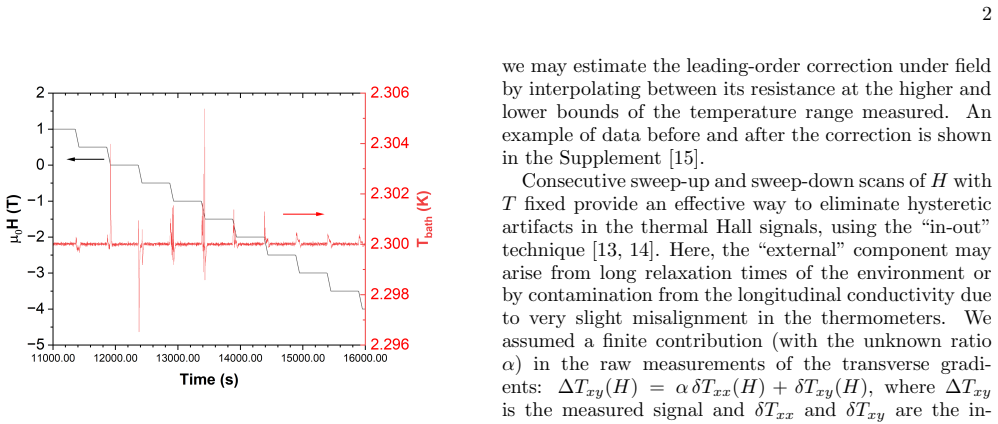
The field-swept (FS) protocol is the load-bearing experimental mechanism: instead of cooling in a fixed field, H is stepped in increments of 0.1 to 1 T with T rigorously regulated, waiting 3 to 8 minutes after each step so that magnetocaloric and eddy-current temperature spikes (1 to 6 mK, relaxing in 1 to 10 ms) die out before data are acquired. The in-out antisymmetrization, deltaTxy(H) = 1/2 (DeltaTxy(H) - DeltaT*xy(-H)), cancels the longitudinal contamination alpha deltaTxx under the assumption deltaTxx(H) = deltaT*xx(-H). The authors also perform in-situ thermometer calibration under field, with heat current off, to correct for the magnetoresistance of the thermometers.
What would settle it
A direct measurement of the hysteresis-loop asymmetry: if the difference between up-sweep and down-sweep branches of deltaTxx, evaluated at the same |H|, exceeds the claimed transverse resolution (about 30 microK at 2.3 K), then the in-out antisymmetrization is not exactly cancelling longitudinal contamination, and the null result could be questioned. Alternatively, repeating the measurement on the same crystals at H = 15 T and finding no signal would directly contradict the 15-T report, while finding a signal would reveal a steep field threshold.
Extended reading notes
Core claim
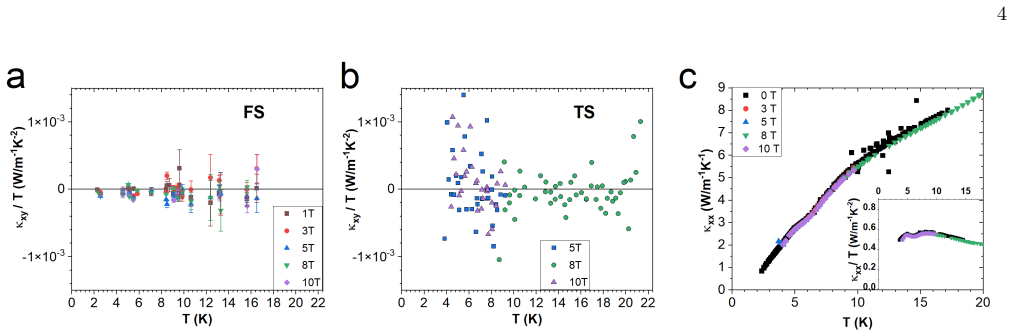
The central claim is a null result with a quantified bound: in as-grown La2CuO4 crystals with Neel temperature near 255 K, neither field-sweep nor temperature-sweep protocols resolve a thermal Hall conductivity, and the conservative upper bound on |kappa_xy/T| is 1e-4 $Wm^{-1}$$K^{-2}$ across 2 to 20 K in H up to 10 T. The authors emphasize that their resolution is 10 to 30 times smaller than the magnitude reported in Ref. [8], where kappa_xy/T was approximately 3e-3 W/$mK^{2}$ near 7 K in 15 T, and that their resolution is independent of T from 2 to 10 K, incompatible with the exponential decay claimed previously. They attribute the high resolution to the field-sweep protocol, in which the bath temperature is actively regulated, post-step relaxation spikes (magnetocaloric and eddy-current) are waited out, and the in-out antisymmetrization cancels longitudinal contamination. The paper also documents an unexplained weak anomaly near 7 K in kappa_xx/T and a field-induced up-turn in kappa_xx at low T, while noting that the absence of a resolvable Hall signal is intrinsic and not an experimental artifact.
Load-bearing premise
The in-out subtraction assumes the longitudinal contamination in the transverse channel is exactly antisymmetric under field reversal; the paper's own data show weak hysteresis in the longitudinal channel, and if that hysteresis is not perfectly antisymmetric, the subtraction could cancel a real signal or create a spurious one.
Editorial extensions
If this is right
- The previously reported large, exponentially decaying thermal Hall signal in undoped La2CuO4 is not reproduced at fields up to 10 T, so chiral-phonon explanations based on that signal lose their main empirical support for this material.
- Sample stoichiometry becomes a plausible controlling variable: if the effect is extrinsic, its magnitude should vary with preparation, and the paper names deoxygenation as one possible difference.
- The 10 to 30 times tighter upper bound sets a new benchmark that future thermal Hall experiments on cuprate parent compounds must beat or explain.
- The documented hysteretic contamination in the longitudinal channel implies that naive antisymmetrization of transverse gradients can produce spurious Hall-like signals, so the field-sweep protocol with careful relaxation control should become standard for small-signal searches.
- The linear suppression of kappa_xx with H and the low-T up-turn above 7.5 T are new field-dependence features that invite theoretical explanation.
Reading between the lines
- If the null result holds generally, the reported thermal Hall signals in other cuprate parent and pseudogap materials may also contain a large extrinsic component, such as resonant skew scattering by defects, rather than an intrinsic chiral-phonon response.
- The hysteresis asymmetry the authors note could be tested directly: measuring the up- and down-sweep branches of deltaTxx at fixed T and checking whether the difference is antisymmetric under H -> -H would quantify the residual systematic error in any in-out subtraction.
- The unexplained 7-K anomaly in kappa_xx/T may be a signature of a low-energy magnetic or structural mode; a targeted specific-heat or neutron-scattering measurement near 7 K could test whether it is intrinsic.
- A direct extension would be to repeat the measurement at 15 T and below 2 K: if a signal still fails to appear, the upper bound would directly confront the conditions of the original report.
Signed reviews
Editorial analysis
A structured set of objections, weighed in public.
Referee Report
Summary. The manuscript reports high-resolution measurements of the longitudinal (κxx) and transverse (κxy) thermal conductivity in the parent cuprate La2CuO4, using both field-sweep (FS) and temperature-sweep (TS) protocols, for temperatures 2–20 K and magnetic fields up to 10 T. The authors find no resolvable thermal Hall signal and set a conservative upper bound |κxy/T| < 1×10^-4 W m^-1 K^-2, which is 10–30 times smaller than the signal reported by Grissonnanche et al. (2020) in the same material. The longitudinal conductivity κxx/T agrees well with previous studies, and weak hysteretic features near ±(4–7) T are observed and attributed to the metamagnetic transition of the weakly canted antiferromagnetic order.
Significance. If correct, this null result is significant for the ongoing debate on the thermal Hall effect in cuprate parent compounds and the chiral-phonon scenario. The paper's strengths include a detailed description of the FS protocol, explicit treatment of relaxation spikes, in-situ thermometer calibration with magnetoresistance correction, and the use of in-out symmetrization. The authors also provide a conservative upper bound and acknowledge the hazard of naive antisymmetrization. However, the central claim is not yet fully supported because key systematic uncertainties—specifically the hysteresis residual in the in-out subtraction and the statistical basis of the upper bound—are not quantified.
major comments (3)
- [IIA, III C2, Fig. 4] The in-out subtraction δTxy(H) = ½[ΔTxy(H) − ΔTxy*(−H)] removes longitudinal contamination αδTxx only if δTxx is exactly symmetric under field reversal. The hysteresis in ΔTxx presented in Fig. 4(a) violates this condition in the field interval ±(4–7) T, leaving a residual ½α[δTxx_up(H) − δTxx_down(−H)] in the extracted signal. The paper neither measures α nor translates the observed hysteresis into an upper bound on this residual in κxy/T units. Given the stated conversion 30 µK ↔ 4×10^-5 W m^-1 K^-2, a residual of only ~75 µK in the transverse channel would saturate the claimed bound. The authors' own remark that 'a naive antisymmetrization in ΔTxy could result in a misleading thermal Hall signal' (Sec. III C2) shows that this is a known hazard, yet no quantitative residual-subtraction analysis is provided. The null result is therefore not yet demonstrated to be robust against this systematic.
- [III C3, Fig. 3] The conservative upper bound is justified by the statement that averaging the curves 'by eye' suggests a weak signal of about 0.1×10^-3 W m^-1 K^-2, but that this conclusion is 'seen to be invalid' when the curves are displaced (Sec. III C3). This is not a quantitative analysis. For a null result that claims to improve on previous bounds by an order of magnitude, the bound should be derived from a statistical analysis (e.g., mean and standard deviation of κxy/T over the measured field and temperature range, and a test for a field-odd component). Such an analysis would also establish whether the apparent positive offsets at 5.5 and 10.6 K are statistically significant.
- [IIB, Fig. 2b] The temperature-sweep data are offered as confirmation of the FS null result, but the TS protocol does not apply the in-out cancellation and is therefore subject to the same longitudinal contamination and hysteresis effects, with no correction. Because the TS data are also substantially noisier (as acknowledged in Sec. IIIA), they cannot provide independent confirmation. The paper should either apply an equivalent quantitative cancellation analysis to the TS data, or explicitly exclude them from the upper-bound claim.
minor comments (6)
- [IIA, IIIA] Sec. IIA states a resolution of ±100 µK at 2.3 K, while Sec. IIIA quotes δTxy ≈ 30 µK; please reconcile these numbers and state the resolution consistently.
- [IIIA] The statement that the resolution bounds for ΔTxy are independent of T from 2 to 10 K appears to conflict with the later statement that the He-3 insert stability degrades at higher temperatures; please clarify the temperature dependence of the resolution.
- [IIIB] There are several typographical errors, e.g., 'nomincal' for 'nominal' in Sec. IIIB and 'thermal hall' for 'thermal Hall' in the abstract; these should be corrected.
- [IIIC2, Fig. 4] The caption of Fig. 4(a) is confusing: it says solid circles are the down sweep from 10 T to −10 T and hollow ones the up sweep, but the text in Sec. III C2 says 'Open and solid red circles correspond to up-field and down-field scans, respectively.' Please make the caption and text consistent.
- [Abstract, IIIA, IV] The abstract and Sec. IV quote the upper bound as 1×10^-4 W m^-1 K^-2, while Sec. IIIA says the resolution threshold is 10^-5 to 10^-4 W m^-1 K^-2; please state a single, precise number with the conditions under which it applies.
- [Data availability] No raw data or data repository is mentioned; given the importance of the null result, the authors should make the raw data for Figs. 2–4 available.
Circularity Check
Experimental null result is self-contained; no circular derivation beyond minor methodological self-citations.
full rationale
The paper's central claim is an experimental null result: an upper bound |κxy/T| < 1e-4 Wm^-1K^-2 (Abstract; Sec. IIIA; Sec. IIIC3). This bound is extracted directly from measured transverse temperature gradients ΔTxy in field sweeps, with no fitted parameter fed back into the bound. The in-out antisymmetrization δTxy = 1/2[ΔTxy(H) − ΔTxy*(−H)] assumes δTxx(H) = δTxx*(−H); the paper itself flags hysteresis in the longitudinal channel and warns that 'a naive antisymmetrization in ΔTxy could result in misleading thermal Hall signals' (Sec. IIIC2, Fig. 4). That is an acknowledged systematic limitation, not a circular step: the null value is not defined to equal an input, and the result could in principle be wrong if the symmetry assumption fails. The protocols adopted from Refs. [13,14] (Princeton theses from the same laboratory) are methodological borrowings, not the source of the claimed physics; the result is benchmarked against the independent published value in Ref. [8] (Grissonnanche et al.), and the paper's κxx/T agrees with prior independent measurements. The exponential fit in Fig. S6 is a side analysis of κxx/T and does not enter the thermal-Hall upper bound. No equation in the paper reduces to its own input, and no fitted parameter is relabeled as a prediction. The only self-citation load is minor and methodological (Refs. 13,14), justifying at most a score of 1, not circularity.
Assumptions & free parameters
free parameters (1)
- Exponential fit parameters for kappa_xx/T =
T0 = 16.5 K; A and C not reported
assumptions (3)
- domain assumption The sample is in the diffusive heat transport regime, so Fourier's law applies and thermometers measure a well-defined local temperature gradient.
- domain assumption The longitudinal contamination deltaTxx is exactly antisymmetric under field reversal: deltaTxx(H) = deltaT*xx(-H).
- domain assumption The thermometers' magnetoresistance can be corrected by interpolating between their resistances at the higher and lower bounds of the measured temperature range.
Cite this review
Pith. "Pith review of High-resolution Measurements of Thermal Conductivity Matrix and Search for Thermal Hall Effect in La$_2$CuO$_4$." pith.science (2026). https://pith.science/paper/GTUKMPXB
@misc{pith2026250721403,
  author       = {Pith},
  title        = {Pith review of: High-resolution Measurements of Thermal Conductivity Matrix and Search for Thermal Hall Effect in La$_2$CuO$_4$},
  year         = {2026},
  howpublished = {\url{https://pith.science/paper/GTUKMPXB}},
  note         = {Machine review of arXiv:2507.21403}
}
abstract
We investigated the longitudinal thermal conductivity $\kappa_{xx}$ and thermal hall conductivity $\kappa_{xy}$ in La$_2$CuO$_4$ at temperatures $T$ between 2 and 20 K in magnetic fields $H$ up to 10 T. Within the temperature and field intervals studied, we do not resolve any thermal Hall signal with a conservative upper bound of $|\kappa_{xy}/T| <1\times10^{-4}$ ${\rm Wm^{-1}K^{-2}}$. The longitudinal thermal conductivity $\kappa_{xx}/T$ agrees well with previous studies, in both magnitude and $T$ dependence. In both channels, we performed measurements using the field-sweep protocol. To achieve high resolution, we carefully took into account relaxation effects after each step-increase in $H$. At low $T$, we find a linear decrease in $\kappa/T$ vs. $H$, as well as weak hysteresis near the meta-magnetic transition of the spin degrees.
Figures

Figures from the paper (1 more)

Forward citations
Cited by 1 Pith paper
-
Phonon Thermal Hall Effect: The Roles of Disorder, Annealing, and Metallic Contacts
In SrTiO3, the phonon thermal Hall signal is strong in clean crystals, weak in disordered ones, partially restored by air annealing without changing thermal conductivity, and identical with metallic or insulating cont...
Reference graph
Works this paper leans on
-
[1]
Weak suppression of κxx at high fields In Fig.3, we focus on the field dependence and present the data obtained via the FS protocol (with T indicated by the color scale). The rather high N´ eel temperature (TN ∼ 255K) implies that the magnetic order is well established at 4 K. Hence κxx should vary weakly with H. Indeed, the field profiles are rather flat...
-
[2]
Figure 4a plots the change in ∆ Txx without any symmetrization in field scans at 10.5 K
Hysteresis from weak ferromagnetism In this section, we discuss the weak hysteretic features observed in raw data of both longitudinal and transverse temperature gradients, which comes from the small fer- romagnetic moment previously analyzed in neutron scat- tering experiments [17–20]. Figure 4a plots the change in ∆ Txx without any symmetrization in fie...
-
[3]
3b we plot field profiles of the transverse ther- mal signal (expressed as κxy/T )
Upper bound for thermal Hall conductivity In Fig. 3b we plot field profiles of the transverse ther- mal signal (expressed as κxy/T ). The color scale indi- cates the temperature. The dashed line indicates our resolution. For clarity, we replot each of 13 curves verti- cally displaced in Fig. 3c with T given on the right (at each T , the zero value is draw...
-
[4]
Keimer, S
B. Keimer, S. A. Kivelson, M. R. Norman, S. Uchida, and J. Zaanen, From quantum matter to high-temperature superconductivity in copper oxides, Nature 518, 179 (2015)
2015
-
[5]
H. Katsura, N. Nagaosa, and P. A. Lee, Theory of the thermal Hall effect in quantum magnets, Physical review letters 104, 066403 (2010)
work page 2010
-
[6]
H. Lee, J. H. Han, and P. A. Lee, Thermal Hall effect of spins in a paramagnet, Physical Review B 91, 125413 (2015)
work page 2015
- [7]
- [8]
Show all 26 references
-
[9]
Matsumoto and S
R. Matsumoto and S. Murakami, Theoretical prediction of a rotating magnon wave packet in ferromagnets, Phys- ical review letters 106, 197202 (2011)
2011
-
[10]
L. E. Chern, E. Z. Zhang, and Y. B. Kim, Sign structure of thermal Hall conductivity and topological magnons for in-plane field polarized Kitaev magnets, Physical Review Letters 126, 147201 (2021)
2021
-
[11]
Grissonnanche, S
G. Grissonnanche, S. Th´ eriault, A. Gourgout, M.-E. Boulanger, E. Lefran¸ cois, A. Ataei, F. Lalibert´ e, M. Dion, J.-S. Zhou, S. Pyon, et al., Chiral phonons in the pseudo- gap phase of cuprates, Nature Physics 16, 1108 (2020)
2020
-
[12]
Grissonnanche, A
G. Grissonnanche, A. Legros, S. Badoux, E. Lefran¸ cois, V. Zatko, M. Lizaire, F. Lalibert´ e, A. Gourgout, J.-S. Zhou, S. Pyon, et al., Giant thermal Hall conductivity in the pseudogap phase of cuprate superconductors, Nature 571, 376 (2019)
2019
-
[13]
Sun, J.-Y
X.-Q. Sun, J.-Y. Chen, and S. A. Kivelson, Large extrin- sic phonon thermal Hall effect from resonant scattering, Physical Review B 106, 144111 (2022)
2022
-
[14]
H. Guo, D. G. Joshi, and S. Sachdev, Resonant ther- mal Hall effect of phonons coupled to dynamical defects, Proceedings of the National Academy of Sciences 119, e2215141119 (2022)
2022
-
[15]
Flebus and A
B. Flebus and A. MacDonald, Charged defects and phonon Hall effects in ionic crystals, Physical Review B 105, L220301 (2022)
2022
-
[16]
Hirschberger, Quasiparticle excitations with Berry curvation in insulating magnets and Weyl semimetals , Phd thesis, Princeton University (2017)
M. Hirschberger, Quasiparticle excitations with Berry curvation in insulating magnets and Weyl semimetals , Phd thesis, Princeton University (2017)
2017
-
[17]
Czajka, Exotic thermal transport in a Kitaev magnet , Phd thesis, Princeton University (2022)
P. Czajka, Exotic thermal transport in a Kitaev magnet , Phd thesis, Princeton University (2022)
2022
-
[18]
See Supplemental Material
-
[19]
C. Hess, B. B¨ uchner, U. Ammerahl, L. Colonescu, F. Heidrich-Meisner, W. Brenig, and A. Revcolevschi, Magnon Heat Transport in Doped La 2CuO4, Physical review letters 90, 197002 (2003)
2003
-
[20]
T. Thio, T. R. Thurston, N. W. Preyer, P. J. Picone, M. A. Kastner, H. P. Jenssen, D. R. Gabbe, C. Y. Chen, R. J. Birgeneau, and A. Aharony, Antisymmetric ex- change and its influence on the magnetic structure and conductivity of La 2CuO4, Phys. Rev. B 38, 905 (1988)
1988
-
[21]
T. Thio, C. Y. Chen, B. S. Freer, D. R. Gabbe, H. P. Jenssen, M. A. Kastner, P. J. Picone, N. W. Preyer, and R. J. Birgeneau, Magnetoresistance and the spin- flop transition in single-crystal La 2CuO4+y, Phys. Rev. B 41, 231 (1990)
1990
-
[22]
Kastner, R
M. Kastner, R. Birgeneau, T. Thurston, P. Picone, H. Jenssen, D. Gabbe, M. Sato, K. Fukuda, S. Shamoto, Y. Endoh, et al. , Neutron-scattering study of the transi- tion from antiferromagnetic to weak ferromagnetic order in La2CuO4, Physical Review B 38, 6636 (1988)
1988
-
[23]
Reehuis, C
M. Reehuis, C. Ulrich, K. Prokeˇ s, A. Gozar, G. Blum- berg, S. Komiya, Y. Ando, P. Pattison, and B. Keimer, Crystal structure and high-field magnetism of La 2CuO4, Phys. Rev. B 73, 144513 (2006)
2006
-
[24]
Cheong, J
S.-W. Cheong, J. Thompson, and Z. Fisk, Properties of La2CuO4 and related compounds, Physica C: Supercon- ductivity 158, 109 (1989)
1989
-
[25]
X. Hu, A. Sapkota, V. O. Garlea, G. D. Gu, I. A. Za- liznyak, and J. M. Tranquada, Spin canting and lattice symmetry in La 2CuO4, Physical Review B 107, 094413 (2023)
2023
-
[26]
Cheong, J
S.-W. Cheong, J. Thompson, Z. Fisk, and G. Gruner, Magnetic field dependence of the 3D ordering in La2CuO4−δ, Solid State Communications 66, 1019 (1988). 9 SUPPLEMENT AL FIGURES FIG. S5: Comparing results of longitudinal thermal conductivity measured via temperature sweeps (TS...
1988
Reviewed August 6, 2026 · model on record in the stance chip above.
Discussion (0). Continue with ORCID to comment.