PVD-ONet: A Multi-scale Neural Operator Method for Singularly Perturbed Boundary Layer Problems
Pith reviewed 2026-05-19 03:06 UTC · model grok-4.3
The pith
Prandtl-Van Dyke matching conditions embedded in neural architectures solve singularly perturbed boundary layer problems where standard physics-informed networks fail.
A machine-rendered reading of the paper's core claim, the machinery that carries it, and where it could break.
Core claim
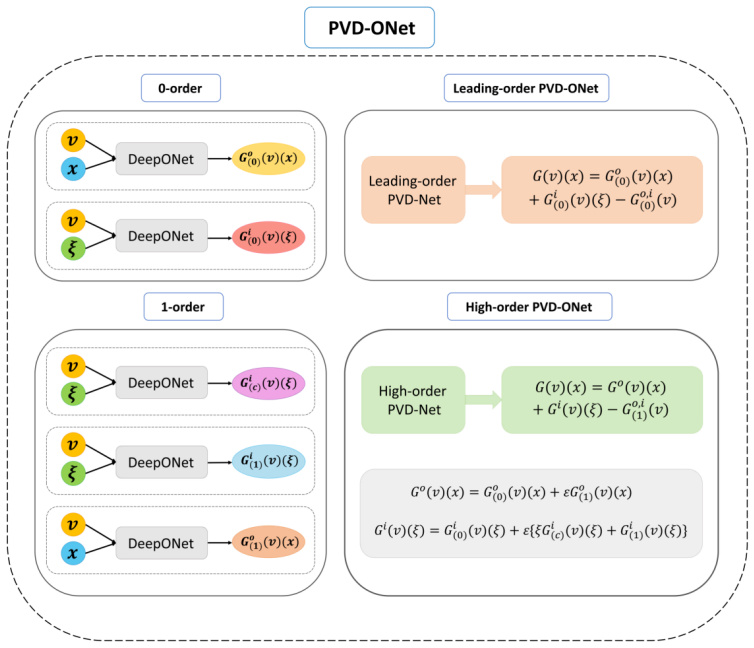
PVD-Net uses a two-network architecture together with Prandtl's matching condition to produce stable solutions for stability-focused tasks and a five-network architecture together with Van Dyke's matching principle to resolve fine-scale layer structures for accuracy-focused tasks; PVD-ONet generalizes the same idea by composing multiple DeepONet modules that learn the solution operator directly from the governing equations, enabling instant evaluation on new initial conditions without retraining.
What carries the argument
Multi-network neural architectures that enforce Prandtl or Van Dyke matching conditions between inner boundary-layer and outer solutions as soft constraints in the loss.
If this is right
- The methods produce more accurate solutions than existing physics-informed baselines on second-order equations with both constant and variable coefficients.
- The same architectures handle internal-layer problems without special tuning.
- PVD-ONet delivers instant predictions for entire families of boundary-layer problems once trained.
- The framework recovers the unknown scaling exponent that controls boundary-layer thickness from sparse data alone.
Where Pith is reading between the lines
- The same matching-based decomposition could be applied to other multi-scale problems such as reaction-diffusion systems or high-Reynolds-number flows.
- Extending the approach to three-dimensional or time-dependent singularly perturbed equations would test its generality beyond the one-dimensional cases shown.
- Because the operator version learns families of solutions, it may serve as a fast surrogate inside optimization loops that vary the perturbation parameter.
Load-bearing premise
The classical Prandtl and Van Dyke matching rules remain accurate and stable when they are added as soft constraints inside the neural-network loss for the singularly perturbed problems considered.
What would settle it
Numerical failure to converge or large pointwise errors on the standard convection-diffusion test problem with small diffusion coefficient and known exact solution would falsify the claim.
Figures





read the original abstract
Physics-informed neural networks and Physics-informed DeepONet excel in solving partial differential equations; however, they often fail to converge for singularly perturbed problems. To address this, we propose two novel frameworks, Prandtl-Van Dyke neural network(PVD-Net) and its operator learning extension Prandtl-Van Dyke Deep Operator Network (PVD-ONet), which rely solely on governing equations without data. To address varying task-specific requirements, both PVD-Net and PVD-ONet are developed in two distinct versions, tailored respectively for stability-focused and high-accuracy modeling. The leading-order PVD-Net adopts a two-network architecture combined with Prandtl's matching condition, targeting stability-prioritized scenarios. The high-order PVD-Net employs a five-network design with Van Dyke's matching principle to capture fine-scale boundary layer structures, making it ideal for high-accuracy scenarios. PVD-ONet generalizes PVD-Net to the operator learning setting by assembling multiple DeepONet modules, directly mapping initial conditions to solution operators and enabling instant predictions for an entire family of boundary layer problems without retraining. Numerical experiments (second-order equations with constant and variable coefficients, and internal layer problems) show that the proposed methods consistently outperform existing baselines. Moreover, beyond forward prediction, the proposed framework can be extended to inverse problems. It enables the inference of the scaling exponent governing boundary layer thickness from sparse data, providing potential for practical applications.
Editorial analysis
A structured set of objections, weighed in public.
Referee Report
Summary. The manuscript proposes Prandtl-Van Dyke neural network (PVD-Net) and its DeepONet extension (PVD-ONet) for singularly perturbed boundary-layer problems. Two variants are introduced: a two-network architecture using Prandtl matching for stability and a five-network architecture using Van Dyke matching for higher accuracy. The methods embed classical asymptotic matching conditions as soft penalties in the physics-informed loss and extend to operator learning for mapping initial conditions to solution operators. Numerical experiments on second-order equations (constant and variable coefficients) and internal-layer problems are said to show consistent outperformance over baselines; the framework is also applied to inverse inference of the boundary-layer scaling exponent from sparse data.
Significance. If the central claims are substantiated, the work offers a principled way to incorporate asymptotic structure into PINN/DeepONet training for stiff singularly perturbed problems where standard physics-informed approaches often fail to converge. The operator-learning generalization and the inverse-problem capability are potentially useful for families of problems and parameter identification. Credit is due for grounding the architectures in established matching principles rather than ad-hoc regularization.
major comments (2)
- [Section 3.2] Section 3.2 (five-network high-order PVD-Net): the claim that Van Dyke matching as a soft penalty produces accurate composite solutions for variable-coefficient problems requires explicit verification. For variable-coefficient outer expansions the matching relations involve slow-variable-dependent coefficients; it is not shown that the relative weighting of the matching term is sufficient to prevent the optimizer from satisfying PDE residuals while violating higher-order asymptotic consistency inside the layer. A quantitative check (e.g., pointwise deviation from the matched asymptotic expansion at selected orders) is needed to support the reported superiority.
- [Numerical experiments] Numerical experiments section: the abstract and introduction assert consistent outperformance and successful inverse inference, yet no error tables, convergence plots with respect to network width/depth, or ablation studies isolating the contribution of the matching penalties are referenced. Without these, the load-bearing claim that the Prandtl/Van Dyke constraints are responsible for the improvement cannot be evaluated.
minor comments (2)
- Notation for the composite solution and the inner/outer networks should be introduced once with a clear diagram; repeated re-definition across sections reduces readability.
- The description of the two-network versus five-network architectures would benefit from an explicit statement of which matching orders are retained in each case.
Simulated Author's Rebuttal
Thank you for the constructive review of our manuscript arXiv:2507.21437. We address each major comment below and describe the revisions we will implement to strengthen the presentation.
read point-by-point responses
-
Referee: [Section 3.2] Section 3.2 (five-network high-order PVD-Net): the claim that Van Dyke matching as a soft penalty produces accurate composite solutions for variable-coefficient problems requires explicit verification. For variable-coefficient outer expansions the matching relations involve slow-variable-dependent coefficients; it is not shown that the relative weighting of the matching term is sufficient to prevent the optimizer from satisfying PDE residuals while violating higher-order asymptotic consistency inside the layer. A quantitative check (e.g., pointwise deviation from the matched asymptotic expansion at selected orders) is needed to support the reported superiority.
Authors: We agree that explicit quantitative verification is required to confirm asymptotic consistency for the five-network architecture on variable-coefficient problems. In the revised manuscript we will add a dedicated verification subsection that reports pointwise deviations between the learned composite solution and the matched asymptotic expansion (including slow-variable-dependent coefficients) at the orders retained in the Van Dyke matching. These checks will be performed at representative points inside and outside the layer to demonstrate that the soft penalty enforces the required matching without allowing the optimizer to trade off higher-order consistency against PDE residuals. revision: yes
-
Referee: [Numerical experiments] Numerical experiments section: the abstract and introduction assert consistent outperformance and successful inverse inference, yet no error tables, convergence plots with respect to network width/depth, or ablation studies isolating the contribution of the matching penalties are referenced. Without these, the load-bearing claim that the Prandtl/Van Dyke constraints are responsible for the improvement cannot be evaluated.
Authors: We acknowledge that the current numerical section would benefit from more systematic quantitative support. We will expand the experiments section to include (i) comprehensive error tables for all forward and inverse test cases, (ii) convergence plots versus network width and depth, and (iii) ablation studies that systematically vary the weighting of the Prandtl and Van Dyke matching terms while holding all other hyperparameters fixed. These additions will directly isolate the contribution of the asymptotic matching penalties to the observed improvements over baselines. revision: yes
Circularity Check
No significant circularity; derivation rests on classical external matching principles and PDE residuals
full rationale
The paper defines PVD-Net and PVD-ONet by embedding Prandtl's matching condition (two-network version) and Van Dyke's matching principle (five-network version) as soft constraints inside a composite loss that also includes the governing PDE residuals. These matching rules are standard results from the classical asymptotic analysis literature (Prandtl, Van Dyke) and are not derived from or fitted to the present networks' outputs. The operator-learning extension assembles DeepONet modules to map initial conditions to solution operators without introducing any self-referential definition or fitted parameter that is later relabeled as a prediction. Numerical claims are supported by direct comparison against baselines on the same PDEs; no load-bearing step reduces by construction to a self-citation or to a quantity defined in terms of the target result. The framework therefore remains self-contained against external benchmarks.
Axiom & Free-Parameter Ledger
free parameters (1)
- network topology choice
axioms (1)
- domain assumption Prandtl matching condition and Van Dyke matching principle accurately glue inner and outer solutions for the boundary-layer problems under study.
Reference graph
Works this paper leans on
-
[1]
F. M. White, J. Majdalani, Viscous fluid flow, Vol. 3, McGraw-Hill New York, 2006
work page 2006
-
[2]
F. M. White, Fluid mechanics 8th edition (2017)
work page 2017
-
[3]
W. Schoppa, F. Hussain, A large-scale control strategy for drag reduction in turbulent boundary layers, Physics of Fluids 10 (5) (1998) 1049–1051. doi:https://doi.org/10.1063/1.869789
-
[4]
J. D. Anderson, Hypersonic and high temperature gas dynamics, AIAA, 1989
work page 1989
-
[5]
Anderson, Fundamentals of Aerodynamics, McGraw Hill, 2011
J. Anderson, Fundamentals of Aerodynamics, McGraw Hill, 2011
work page 2011
-
[6]
E. L. Reiss, Symmetric bending of thick circular plates, Journal of the Society for Industrial and Applied Mathematics 10 (4) (1962) 596–609. doi:https://doi.org/10.1137/0110045
-
[7]
W.-Z. Chien, Large deflection of a circular clamped plate under uniform pressure, Chinese Journal of Physics 7 (2) (1947) 102–113
work page 1947
-
[8]
W. E. Alzheimer, R. Davis, Unsymmetrical bending of prestressed annular plates, Journal of the Engineering Mechanics Division 94 (4) (1968) 905–918. doi:https://doi.org/10.1061/JMCEA3.0001000
- [9]
-
[10]
A. H. Nayfeh, Perturbation methods, John Wiley & Sons, 2024
work page 2024
-
[11]
Prandtl, On fluid motions with very small friction, Verhldg 3 (1904) 484–491
L. Prandtl, On fluid motions with very small friction, Verhldg 3 (1904) 484–491
work page 1904
-
[12]
Von K´ arm´ an, Uber laminare und turbulente reibung, Z
T. Von K´ arm´ an, Uber laminare und turbulente reibung, Z. Angew. Math. Mech. 1 (1921) 233–252. doi:https://doi. org/10.1002/zamm.19210010401
-
[13]
Van Dyke, Higher approximations in boundary-layer theory part 1
M. Van Dyke, Higher approximations in boundary-layer theory part 1. general analysis, Journal of Fluid Mechanics 14 (2) (1962) 161–177. doi:https://doi.org/10.1017/S0022112062001147
-
[14]
Van Dyke, Higher approximations in boundary-layer theory part 2
M. Van Dyke, Higher approximations in boundary-layer theory part 2. application to leading edges, Journal of Fluid Mechanics 14 (4) (1962) 481–495. doi:https://doi.org/10.1017/S0022112062001391. 31
-
[15]
Van Dyke, Higher approximations in boundary-layer theory part 3
M. Van Dyke, Higher approximations in boundary-layer theory part 3. parabola in uniform stream, Journal of Fluid Mechanics 19 (1) (1964) 145–159. doi:https://doi.org/10.1017/S002211206400060X
-
[16]
R. E. O’Malley, A boundary value problem for certain nonlinear second order differential equations with a small parameter, Archive for Rational Mechanics and Analysis 29 (1968) 66–74
work page 1968
-
[17]
R. E. O’Malley, Topics in singular perturbations, Advances in Mathematics 2 (4) (1968) 365–470. doi:https://doi.org/ 10.1016/0001-8708(68)90023-6
-
[18]
R. E. O’Malley, Boundary value problems for linear systems of ordinary differential equations involving many small parameters, Journal of Mathematics and Mechanics 18 (9) (1969) 835–855
work page 1969
-
[19]
R. E. O’Malley, Boundary layer methods for nonlinear initial value problems, SIAM Review 13 (4) (1971) 425–434. doi:https://doi.org/10.1137/1013091
-
[20]
A. H. Nayfeh, A generalized method for treating singular perturbation problems, Stanford University, 1964
work page 1964
-
[21]
A. H. Nayfeh, A comparison of three perturbation methods for earth-moon-spaceship problem, AIAA Journal 3 (9) (1965) 1682–1687. doi:https://doi.org/10.2514/3.3226
-
[22]
A. H. Nayfeh, A perturbation method for treating nonlinear oscillation problems, Journal of Mathematics and Physics 44 (1-4) (1965) 368–374. doi:https://doi.org/10.1002/sapm1965441368
-
[23]
T. J. Hughes, The finite element method: linear static and dynamic finite element analysis, Courier Corporation, 2012
work page 2012
-
[24]
R. Eymard, T. Gallou¨ et, R. Herbin, Finite volume methods, Handbook of Numerical Analysis 7 (2000) 713–1018. doi: https://doi.org/10.1016/S1570-8659(00)07005-8
-
[25]
J. C. Strikwerda, Finite difference schemes and partial differential equations, SIAM, 2004
work page 2004
-
[26]
J. Ling, A. Kurzawski, J. Templeton, Reynolds averaged turbulence modelling using deep neural networks with embedded invariance, Journal of Fluid Mechanics 807 (2016) 155–166. doi:https://doi.org/10.1017/jfm.2016.615
-
[27]
P. A. Srinivasan, L. Guastoni, H. Azizpour, P. Schlatter, R. Vinuesa, Predictions of turbulent shear flows using deep neural networks, Physical Review Fluids 4 (5) (2019) 054603. doi:https://doi.org/10.1103/PhysRevFluids.4.054603
-
[28]
C. Jiang, R. Vinuesa, R. Chen, J. Mi, S. Laima, H. Li, An interpretable framework of data-driven turbulence modeling using deep neural networks, Physics of Fluids 33 (5) (2021) 055133. doi:https://doi.org/10.1063/5.0048909
-
[29]
S. L. Brunton, B. R. Noack, P. Koumoutsakos, Machine learning for fluid mechanics, Annual Review of Fluid Mechanics 52 (1) (2020) 477–508. doi:https://doi.org/10.1146/annurev-fluid-010719-060214
-
[30]
Journal of Computational Physics 378, 686–707
M. Raissi, P. Perdikaris, G. E. Karniadakis, Physics-informed neural networks: A deep learning framework for solving forward and inverse problems involving nonlinear partial differential equations, Journal of Computational Physics 378 (2019) 686–707. doi:https://doi.org/10.1016/j.jcp.2018.10.045
-
[31]
L. Lu, X. Meng, Z. Mao, G. E. Karniadakis, DeepXDE: A deep learning library for solving differential equations, SIAM Review 63 (1) (2021) 208–228. doi:https://doi.org/10.1137/19M1274067
-
[32]
A. Arzani, J.-X. Wang, R. M. D’Souza, Uncovering near-wall blood flow from sparse data with physics-informed neural networks, Physics of Fluids 33 (7) (2021) 071905. doi:https://doi.org/10.1063/5.0055600
-
[33]
W. Ji, W. Qiu, Z. Shi, S. Pan, S. Deng, Stiff-pinn: Physics-informed neural network for stiff chemical kinetics, The Journal of Physical Chemistry A 125 (36) (2021) 8098–8106. doi:https://pubs.acs.org/doi/10.1021/acs.jpca.1c05102
-
[34]
S. Cai, Z. Mao, Z. Wang, M. Yin, G. E. Karniadakis, Physics-informed neural networks (PINNs) for fluid mechanics: A review, Acta Mechanica Sinica 37 (12) (2021) 1727–1738
work page 2021
-
[35]
Z. Mao, A. D. Jagtap, G. E. Karniadakis, Physics-informed neural networks for high-speed flows, Computer Methods in Applied Mechanics and Engineering 360 (2020) 112789. doi:https://doi.org/10.1016/j.cma.2019.112789
-
[36]
C. Rao, H. Sun, Y. Liu, Physics-informed deep learning for incompressible laminar flows, Theoretical and Applied Me- chanics Letters 10 (3) (2020) 207–212. doi:https://doi.org/10.1016/j.taml.2020.01.039
-
[37]
K. Shukla, A. D. Jagtap, J. L. Blackshire, D. Sparkman, G. E. Karniadakis, A physics-informed neural network for 32 quantifying the microstructural properties of polycrystalline nickel using ultrasound data: A promising approach for solving inverse problems, IEEE Signal Processing Magazine 39 (1) (2021) 68–77. doi:10.1109/MSP.2021.3118904
-
[38]
G. E. Karniadakis, I. G. Kevrekidis, L. Lu, P. Perdikaris, S. Wang, L. Yang, Physics-informed machine learning, Nature Reviews Physics 3 (6) (2021) 422–440
work page 2021
-
[39]
A. Arzani, K. W. Cassel, R. M. D’Souza, Theory-guided physics-informed neural networks for boundary layer problems with singular perturbation, Journal of Computational Physics 473 (2023) 111768. doi:https://doi.org/10.1016/j.jcp. 2022.111768
-
[40]
A. D. Jagtap, G. E. Karniadakis, Extended physics-informed neural networks (XPINNs): A generalized space-time domain decomposition based deep learning framework for nonlinear partial differential equations, Communications in Computa- tional Physics 28 (5) (2020) 2002–2041. doi:https://doi.org/10.4208/cicp.oa-2020-0164
-
[41]
M. A. Nabian, R. J. Gladstone, H. Meidani, Efficient training of physics-informed neural networks via importance sampling, Computer-Aided Civil and Infrastructure Engineering 36 (8) (2021) 962–977. doi:https://doi.org/10.1111/mice.12685
-
[42]
S. Wang, H. Wang, P. Perdikaris, On the eigenvector bias of Fourier feature networks: From regression to solving multi- scale PDEs with physics-informed neural networks, Computer Methods in Applied Mechanics and Engineering 384 (2021) 113938. doi:https://doi.org/10.1016/j.cma.2021.113938
- [43]
-
[44]
L. Zhang, G. He, Multi-scale-matching neural networks for thin plate bending problem, Theoretical and Applied Mechanics Letters 14 (1) (2024) 100494. doi:https://doi.org/10.1016/j.taml.2024.100494
-
[45]
F. Cao, F. Gao, X. Guo, D. Yuan, Physics-informed neural networks with parameter asymptotic strategy for learning singularly perturbed convection-dominated problem, Computers & Mathematics with Applications 150 (2023) 229–242. doi:https://doi.org/10.1016/j.camwa.2023.09.030
-
[46]
J. Huang, R. Qiu, J. Wang, Y. Wang, Multi-scale physics-informed neural networks for solving high reynolds number boundary layer flows based on matched asymptotic expansions, Theoretical and Applied Mechanics Letters 14 (2) (2024) 100496. doi:https://doi.org/10.1016/j.taml.2024.100496
-
[47]
Z. Li, N. Kovachki, K. Azizzadenesheli, B. Liu, K. Bhattacharya, A. Stuart, A. Anandkumar, Neural operator: Graph kernel network for partial differential equations (2020). arXiv:2003.03485
work page internal anchor Pith review Pith/arXiv arXiv 2020
-
[48]
L. Lu, P. Jin, G. Pang, Z. Zhang, G. E. Karniadakis, Learning nonlinear operators via DeepONet based on the universal approximation theorem of operators, Nature Machine Intelligence 3 (3) (2021) 218–229
work page 2021
-
[49]
Z. Li, N. Kovachki, K. Azizzadenesheli, B. Liu, K. Bhattacharya, A. Stuart, A. Anandkumar, Fourier neural operator for parametric partial differential equations (2020). arXiv:2010.08895
work page internal anchor Pith review Pith/arXiv arXiv 2020
-
[50]
N. Kovachki, Z. Li, B. Liu, K. Azizzadenesheli, K. Bhattacharya, A. Stuart, A. Anandkumar, Neural operator: Learning maps between function spaces with applications to PDEs, Journal of Machine Learning Research 24 (89) (2023) 1–97
work page 2023
- [51]
-
[52]
S. Wang, H. Wang, P. Perdikaris, Learning the solution operator of parametric partial differential equations with physics- informed DeepONets, Science Advances 7 (40) (2021) eabi8605. doi:10.1126/sciadv.abi8605
-
[53]
Erd´ elyi, An expansion procedure for singular perturbations, Atti Accad
A. Erd´ elyi, An expansion procedure for singular perturbations, Atti Accad. Sci. Torino Cl. Sci. Fis. Mat. Nat, 1961
work page 1961
-
[54]
A. G. Baydin, B. A. Pearlmutter, A. A. Radul, J. M. Siskind, Automatic differentiation in machine learning: a survey, Journal of Machine Learning Research 18 (153) (2018) 1–43
work page 2018
-
[55]
D. P. Kingma, J. Ba, Adam: A method for stochastic optimization (2014). arXiv:1412.6980
work page internal anchor Pith review Pith/arXiv arXiv 2014
-
[56]
D. C. Liu, J. Nocedal, On the limited memory BFGS method for large scale optimization, Mathematical Programming 45 (1) (1989) 503–528. 33
work page 1989
discussion (0)
Sign in with ORCID, Apple, or X to comment. Anyone can read and Pith papers without signing in.