REVIEW 4 major objections 6 minor 10 references
Evo-DKD: Dual-Knowledge Decoding for Autonomous Ontology Evolution in Large Language Models
T0 review · 4 major / 6 minor · reviewed 2026-08-06 · deepseek-v4-flash
Pith's one-line read The paper claims that pairing structured ontology edits with natural-language justification improves autonomous LLM-driven ontology evolution more than either output alone.
desk verdict Not a dual-decoder paper—a prompt-ablation of a single 1.1B model, with a central claim the experiments cannot support. read the letter →
The pith
A machine-rendered reading of the paper's core claim, the machinery that carries it, and where it could break.
The reading
What carries the argument
The central object is the dual-knowledge decoding loop. In the proposed architecture, a structured decoder generates ontology-compatible triples while an unstructured decoder generates free-text reasoning; an attention-based gating module computes a weight $\alpha_t$ at each step to blend or switch between the two output distributions. A validation module then checks the proposed edit against ontology constraints and asks whether the textual explanation actually justifies it, and only passing edits are written back into the knowledge base, whose updated state becomes context for the next iteration. In the implemented experiments this machinery is simulated by prompting a single fine-tuned decoder in three modes—structured-only, unstructured-only, and full dual-decoder—with the same model weights in all three.
What would settle it
A decisive check would be to train or obtain a true dual-decoder model with the described attention gating, and compare it to the prompt-based single-decoder simulation on the same 120 evaluation examples. If the real dual-decoder fails to beat the simulation, or if the simulation matches a plain single-decoder given the same combined prompt template, then the observed gains come from the output format and not from dual-stream coordination. A cheaper falsifier is to run the full dual-decoder mode with the explanation placed before the triple and see whether precision drops.
Extended reading notes
Core claim
On its own terms, the paper establishes that jointly generating a structured triple and a textual justification, with the explanation used to cross-check the edit before injection into the knowledge base, produces more precise and more explainable ontology updates than either stream alone. A worked healthcare case shows a new input about Ozempic being converted into the triple (Ozempic, manages, weight) with a supporting sentence, after which a retrieval-augmented QA pipeline can answer a question it previously could not answer. The paper claims this closed loop—propose, validate, inject, feed back into context—is the mechanism that makes LLM-driven knowledge base maintenance sustainable. It does not claim to have trained a real dual-decoder system; it states that the dual-decoder dynamics are approximated with carefully designed prompting on a single fine-tuned model.
Load-bearing premise
The load-bearing premise is that prompting a single model to output a triple followed by an explanation is a faithful stand-in for the proposed gated dual-decoder architecture, so the measured improvements are attributed to the architecture rather than to the prompt format. If that premise gives way, the central architectural claims are unsupported.
Editorial extensions
If this is right
- If the joint-generation claim is correct, knowledge graphs and ontologies can be extended from raw text with less human curation while keeping each addition auditable.
- Closed-loop injection means downstream tasks that retrieve from the knowledge base inherit newly learned facts, as illustrated by the Ozempic QA example.
- The validation step filters edits that fail consistency checks or lack textual support, which should reduce harmful hallucinations propagating into the ontology.
- The balanced precision-recall profile the paper reports suggests the combined mode is usable in settings where both avoiding false edits and catching true ones matter.
- The framework positions the LLM as an active editor of its own knowledge store, opening a path toward continual-learning systems rather than fixed models with static retrieval.
Reading between the lines
- Because the evaluation compares prompting modes on one model rather than a trained dual-decoder, an equally consistent reading is that simply requesting both a triple and an explanation in one prompt improves output; the architectural gating story remains untested. This is an editorial inference, not a claim the paper makes.
- A testable extension would be to train an actual structured decoder and text decoder with the proposed gating and compare against the prompt-simulated mode on identical data; the paper leaves this as future work.
- The gains may depend on the explanation appearing after the triple in the output; swapping the order, varying explanation length, and using a different base model would clarify whether the mechanism is coordination or merely extra inference.
- The same joint-decoding idea could transfer to other schema-constrained tasks, such as database ETL or metadata extraction, wherever each structured write needs a human-auditable reason.
Editorial analysis
A structured set of objections, weighed in public.
Referee Report
Summary. The paper proposes Evo-DKD, a framework for autonomous ontology evolution that combines a structured decoding stream (generating ontology edits) with an unstructured decoding stream (generating natural-language justifications), coordinated by an attention-based gating mechanism, followed by a validation and knowledge-base integration loop. Experiments use a TinyLlama-1.1B model fine-tuned on 600 synthetic examples, with three prompting modes intended to emulate structured-only, unstructured-only, and full dual-decoder behavior, evaluated on 120 author-curated examples across healthcare, semantic search, and cultural heritage domains. The paper reports that the Full Dual-Decoder mode outperforms the two single-mode baselines on triple extraction accuracy, explanation quality, and an 'LLM-Judge' score, and presents a qualitative RAG case study in healthcare. However, the implementation described in Sections 4.1 and 5.1 is a single decoder with different prompting strategies, not the dual-decoder architecture with gating defined in Section 3, and the claimed closed-loop validation is never executed in the experiments.
Significance. If the dual-decoder architecture with dynamic gating had been implemented and evaluated, the idea of coordinating structured ontology edits with textual justifications would be a relevant contribution to LLM-driven knowledge-base maintenance. The paper is transparent about the simulation in Sections 4.1 and 6.4, which is a point in its favor. Nevertheless, as it stands, the work is a prompt-ablation study on a single fine-tuned decoder; the central claim that Evo-DKD outperforms baselines is not supported because the system evaluated is not the system defined in Section 3. The evaluation also relies on a sentiment classifier mislabeled as an 'LLM-Judge', a small non-representative test set with no error bars, and a self-referential validation design. The significance of the claimed results is therefore not established.
major comments (4)
- [§3.1–3.2, §4.1, §5.1] The central claim is unsupported because the experimental system is not the architecture described in the paper. Section 3.1–3.2 defines Evo-DKD as two parallel decoders coordinated by an attention-based gating router (Eq. 1 for alpha_t and Eq. 2 for the mixture). Section 4.1 states: 'Our implementation utilizes a single-decoder approach, subtly simulating dual-decoder functionalities via carefully designed chat-based prompting.' Section 5.1 confirms that the three modes 'varied only the prompting strategy ... without changing model weights or architecture.' Thus the experiments compare three prompting strategies applied to one TinyLlama-1.1B checkpoint, not the proposed dual-decoder/gating system, so the abstract's and conclusion's attribution of gains to 'the dual-decoder design and gating router' is not justified.
- [§3.3.1, §5.5] The claimed closed-loop validation is neither independently designed nor actually exercised. Section 3.3.1 states that the validation uses 'the LLM itself to evaluate whether the explanation indeed provides evidence for the structured claim,' which is a self-referential check. Moreover, the experiments in Section 5 never run this validation module; the Section 5.5 case study inserts the triple (Ozempic, manages, weight) directly into the knowledge graph without any demonstrated consistency or justification check. The 'closed-loop autonomous updating' behavior is therefore not demonstrated beyond a single manual insertion.
- [§4.2, §5.2.3] The 'LLM-Judge Score' is not produced by an LLM. Section 4.2 says: 'We used a DistilBERT classifier (lvwerra/distilbert-imdb) to produce the LLM-Judge Score.' This is a sentiment-analysis model, not an LLM judge. Using a sentiment classifier to measure 'the overall credibility and quality of the generated explanations' is not a valid qualitative metric, and the statements in Section 5.2.3 about an 'independent qualitative metric' and an 'external evaluator's perspective' are unsupported.
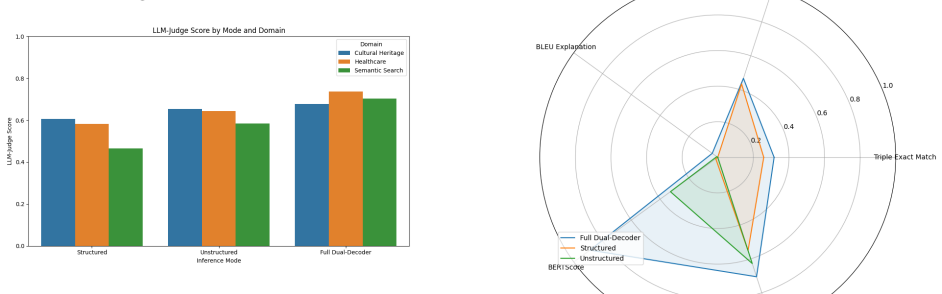
- [§4.3, §5.1] The quantitative evaluation is too thin to establish 'consistent outperformance.' Section 5.1 reports results on 40 examples per domain (120 total) with no error bars, confidence intervals, or significance tests. Section 4.3 reports high scores on 'test data' but does not describe any held-out split, and it is unclear how these numbers relate to the 120 curated examples of Section 5.1. The absence of any statistical analysis makes the reported improvements across modes unreliable.
minor comments (6)
- [§1] A typo appears in Section 1: 'ontologies must be continuously update' should be 'ontologies must be continuously updated.'
- [§5.2.2] The heading 'Explanation Quality (BERTScore and BLEU:)' contains a stray colon after 'BLEU'.
- [§5] The figures (Figures 2–8) are referenced but not included in the text; the manuscript should provide the actual numeric scores in tables so that the claims can be independently verified.
- [§4.1, §5.1] Section 4.1 describes 600 synthetic training examples, while Section 5.1 describes 120 curated evaluation pairs; the relationship between these sets and the construction of the evaluation pairs should be clarified.
- [§5.5] The RAG case study uses a Gemini-powered LLM and a semantic similarity function, but no details are given for the retrieval function, the encoding of the KG context, or the prompt used with Gemini, making the case study non-reproducible.
- [Abstract, §7] The abstract and conclusion state that results 'confirm the contributions of the dual-decoder design and gating router,' which contradicts the explicit admission in Sections 4.1 and 6.4 that the actual dual-decoder training is deferred to future work; these statements should be reconciled.
Circularity Check
The central empirical claim reduces to output-format definitions: the 'Full Dual-Decoder' mode is a prompt that emits both a triple and an explanation, while the baselines are defined to emit only one, so the reported win is built into the metric setup. The validation module also lets the model judge its own explanations, and the RAG case study seeds the answer into the graph before retrieving it.
-
self definitional
[Section 5.1 and Section 5.2.1 (experimental modes and triple metrics)]
"Full Dual-Decoder: Simulates both streams jointly by prompting for structured triples followed by explanatory text. ... The scores are 0 for Unstructured-only approach because it doesn’t generate any triples to evaluate these metrics."
The 'Full Dual-Decoder' mode is defined as a prompt that produces both a structured triple and an explanation, while Structured-only produces only a triple and Unstructured-only produces only an explanation. The evaluation then measures both triple extraction accuracy and explanation quality (BLEU, BERTScore, LLM-Judge). Consequently, the Full mode necessarily scores nonzero on both metric families, and each baseline necessarily scores zero on the family it cannot produce. The paper's headline claim that Full Dual-Decoder 'outperforms baselines' is therefore entailed by the mode definitions and metric choice, not by any coordinated gating or dual-decoder computation.
-
other
[Section 3.3.1 (Validation Module, Justification Cross-Check)]
"Justification Cross-Check: We parse or interpret the unstructured explanation to assess factual support for the edit. We use the LLM itself to evaluate whether the explanation indeed provides evidence for the structured claim."
The validation mechanism is supposed to ensure that only high-confidence, factually supported edits enter the ontology, but the judge is the same LLM that generated the explanation. The check reduces to the model agreeing with its own output: a proposed edit is 'validated' when the model says its own explanation justifies it. No independent evidence or external consistency source is introduced at this step. Section 6.1 even frames this as the LLM having to 'convince itself' of a fact. Thus the claimed validation is self-referential by construction and cannot provide the independent factual support that the paper's closed-loop narrative requires.
1 more flagged steps
-
self definitional
[Section 5.5.2 (RAG case study with updated knowledge graph)]
"When provided with a new input “Ozempic helps manage weight loss in diabetic patients”, Evo-DKD successfully generated the structured triple (Ozempic, manages, weight) ... By immediately integrating this newly extracted triple into the knowledge graph, downstream retrieval-augmented generation (RAG) significantly improved."
The RAG query, 'What drugs are used for weight loss in diabetes?', is answered by the triple (Ozempic, manages, weight), which was directly supplied in the user input before any retrieval. The demonstration inserts the answer into the knowledge graph and then shows that the answer is retrievable. This improvement is true by construction: a fact that directly answers the query, once stored, will be retrieved. It does not test autonomous ontology evolution, dual-decoder coordination, or the gating router, and it therefore cannot provide independent evidence for the system's claimed capabilities.
full rationale
The paper is not an ordinary self-contained experimental study: the architecture described in Section 3 (parallel structured and unstructured decoders plus an attention gating router) is never instantiated. Section 4.1 states that the implementation 'utilizes a single-decoder approach, subtly simulating dual-decoder functionalities via carefully designed chat-based prompting,' and Section 5.1 confirms that the three modes differ only in prompting strategy, 'without changing model weights or architecture.' The central abstract claim—that Evo-DKD outperforms structured-only or unstructured-only decoding—is therefore not a test of the proposed architecture. Part of that claim is circular in the narrow sense: the 'Full Dual-Decoder' prompt is defined to emit both output types, the single-mode prompts are defined to emit only one, and the metrics reward exactly those output types, so the Full mode's advantage is partially built into the comparison. The validation module adds a second self-referential loop by using the same LLM to certify its own explanations. The RAG case study completes the pattern by seeding the answer into the graph before retrieving it. These are not cases of parameter fitting or self-citation; the cited literature is external and not load-bearing. The circularity is concentrated in the experimental definitions and in the self-validating design, which together give the appearance of confirming the dual-decoder/gating contributions without ever running them. Because the central result is partly forced by construction rather than fully independent evidence, a score of 6 is appropriate.
Assumptions & free parameters
assumptions (5)
- ad hoc to paper Prompt-based mode control adequately approximates the intended dual-decoder architecture and gating mechanism.
- domain assumption A fine-tuned TinyLlama-1.1B on 600 synthetic examples can perform reliable autonomous ontology evolution.
- domain assumption The LLM's self-generated explanations are valid evidence for the correctness of proposed ontology edits.
- domain assumption Curated evaluation sets of 40 examples per domain are representative of the three application domains.
- ad hoc to paper The DistilBERT-imdb sentiment classifier provides a valid 'LLM-Judge' quality score for explanations.
invented entities (3)
-
Dual-decoder LLM architecture with structured and unstructured streams
-
Attention-based dynamic gating mechanism
-
Closed-loop autonomous validation module
Cite this review
Pith. "Pith review of Evo-DKD: Dual-Knowledge Decoding for Autonomous Ontology Evolution in Large Language Models." pith.science (2026). https://pith.science/paper/6GZ3IBM6
@misc{pith2026250721438,
  author       = {Pith},
  title        = {Pith review of: Evo-DKD: Dual-Knowledge Decoding for Autonomous Ontology Evolution in Large Language Models},
  year         = {2026},
  howpublished = {\url{https://pith.science/paper/6GZ3IBM6}},
  note         = {Machine review of arXiv:2507.21438}
}
read the original abstract
Ontologies and knowledge graphs require continuous evolution to remain comprehensive and accurate, but manual curation is labor intensive. Large Language Models (LLMs) possess vast unstructured knowledge but struggle with maintaining structured consistency. We propose Evo-DKD, a novel dual-decoder framework for autonomous ontology evolution that combines structured ontology traversal with unstructured text reasoning. Evo-DKD introduces two parallel decoding streams within an LLM: one decoder generates candidate ontology edits (e.g., new concepts or relations) while the other produces natural-language justifications. A dynamic attention-based gating mechanism coordinates the two streams, deciding at each step how to blend structured and unstructured knowledge. Due to GPU constraints, we simulate the dual-decoder behavior using prompt-based mode control to approximate coordinated decoding in a single-stream mode. The system operates in a closed reasoning loop: proposed ontology edits are validated (via consistency checks and cross-verification with the text explanations) and then injected into the knowledge base, which in turn informs subsequent reasoning. We demonstrate Evo-DKD's effectiveness on use cases including healthcare ontology refinement, semantic search improvement, and cultural heritage timeline modeling. Experiments show that Evo-DKD outperforms baselines using structured-only or unstructured-only decoding in both precision of ontology updates and downstream task performance. We present quantitative metrics and qualitative examples, confirming the contributions of the dual-decoder design and gating router. Evo-DKD offers a new paradigm for LLM-driven knowledge base maintenance, combining the strengths of symbolic and neural reasoning for sustainable ontology evolution.
Figures


Figures from the paper (5 more)



Reference graph
Works this paper leans on
-
[1]
Hamed Babaei Giglou, Jennifer D’Souza, and Sören Auer. 2023. LLMs4OL: Large Language Models for Ontology Learning. In The Semantic Web – ISWC 2023: 22nd International Semantic Web Conference, Athens, Greece, November 6–10, 2023, Proceedings, Part I (Athens, Greece). Springer-Verlag, Berlin, Heidelberg, 408–427. https://doi.org/10.1007/978-3-031-47240-4_22
-
[2]
Andrew Carlson, Justin Betteridge, Bryan Kisiel, Burr Settles, Estevam R. Hr- uschka, and Tom M. Mitchell. 2010. Toward an architecture for never-ending language learning. In Proceedings of the Twenty-Fourth AAAI Conference on Artifi- cial Intelligence (Atlanta, Georgia) (AAAI’10). AAAI Press, 1306–1313
work page 2010
-
[3]
Claire Gardent, Anastasia Shimorina, Shashi Narayan, and Laura Perez-Beltrachini
-
[4]
Timo Schick, Jane Dwivedi-Yu, Roberto Dessi, Roberta Raileanu, Maria Lomeli, Eric Hambro, Luke Zettlemoyer, Nicola Cancedda, and Thomas Scialom. 2023. Toolformer: Language Models Can Teach Themselves to Use Tools. In Thirty- seventh Conference on Neural Information Processing Systems . https://openreview. net/forum?id=Yacmpz84TH
work page 2023
-
[5]
Yixuan Su, David Vandyke, Sihui Wang, Yimai Fang, and Nigel Collier. 2021. Plan- then-Generate: Controlled Data-to-Text Generation via Planning. In Findings of the Association for Computational Linguistics: EMNLP 2021 , Marie-Francine Moens, Xuanjing Huang, Lucia Specia, and Scott Wen-tau Yih (Eds.). Association for Computational Linguistics, Punta Cana, ...
-
[6]
Mikel Val-Calvo, Mikel Egaña Aranguren, Juan Mulero-Hernández, Ginés Almagro- Hernández, Prashant Deshmukh, José Antonio Bernabé-Díaz, Paola Espinoza- Arias, José Luis Sánchez-Fernández, Juergen Mueller, and Jesualdo Tomás Fernández-Breis. 2025. OntoGenix: Leveraging Large Language Models for en- hanced ontology engineering from datasets. Information Proc...
arXiv 2025
-
[7]
Liang Yao, Jiazhen Peng, Chengsheng Mao, and Yuan Luo. 2025. Exploring Large Language Models for Knowledge Graph Completion. arXiv:2308.13916 [cs.CL] https://arxiv.org/abs/2308.13916
arXiv 2025
-
[8]
Shunyu Yao, Jeffrey Zhao, Dian Yu, Nan Du, Izhak Shafran, Karthik R Narasimhan, and Yuan Cao. 2023. ReAct: Synergizing Reasoning and Acting in Language Models. In The Eleventh International Conference on Learning Representations . https://openreview.net/forum?id=WE_vluYUL-X 8
work page 2023
Show all 10 references
-
[9]
Fouad Zablith, Grigoris Antoniou, Mathieu d’Aquin, Giorgos Flouris, Haridimos Kondylakis, Enrico Motta, Dimitris Plexousakis, and Marta Sabou. 2015. Ontology evolution: A process-centric survey. The Knowledge Engineering Review 30 (01 2015), 45–75. https://doi.org/10.1017/S026...
2015 doi
-
[2017]
InProceedings of the 55th Annual Meeting of the Association for Computational Linguistics (Volume 1: Long Papers), Regina Barzilay and Min-Yen Kan (Eds.)
Creating Training Corpora for NLG Micro-Planners. InProceedings of the 55th Annual Meeting of the Association for Computational Linguistics (Volume 1: Long Papers), Regina Barzilay and Min-Yen Kan (Eds.). Association for Computational Linguistics, Vancouver, Canada, 179–188. h...
Reviewed August 6, 2026 · model on record in the stance chip above.
Discussion (0). Sign in to comment.