REVIEW 3 major objections 5 minor 63 references
An Angular-Temporal Interaction Network for Light Field Object Tracking in Low-Light Scenes
T0 review · 3 major / 5 minor · reviewed 2026-08-06 · deepseek-v4-flash
Pith's one-line read By replacing raw light field views with an epipolar-plane structure image and gating attention to geometric structure points, ATINet achieves state-of-the-art low-light object tracking on the new R8LUT benchmark.
desk verdict A useful new task and ESI representation, but the dataset description needs fixing before the SOTA numbers can be trusted. read the letter →
The pith
A machine-rendered reading of the paper's core claim, the machinery that carries it, and where it could break.
The reading
What carries the argument
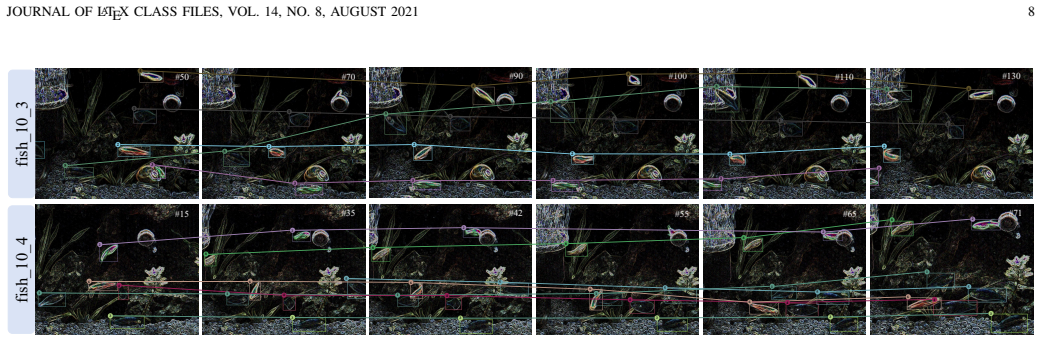
The machinery is the ESI representation: a 2D image $S = \sqrt{S_H^2 + S_T^2}$, where $S_H$ and $S_T$ are first-order angular gradients of horizontal and vertical epipolar-plane images computed at the central view $u=U/2$, $v=V/2$ with step $d=1$. This turns the 4D light field's sparse geometric cues into a dense image that an ordinary CNN-transformer tracker can ingest, while discarding appearance redundancy. The second piece is GAS, a plug-in attention gate: a Gumbel-Softmax prediction module partitions patch embeddings into geometric and non-geometric groups, and a relation matrix restricts self- and cross-frame attention to the geometric group. The third piece is a self-supervised loss $L_M = \|D_\phi(E \odot M) - E \odot (1-M)\|^2$ that masks part of the structure embeddings and trains a lightweight decoder to reconstruct them from the other frame's embeddings, with spatial-attention dropout to push the network toward using inter-frame rather than intra-frame cues.
What would settle it
Compute the ESI from off-center angular views (for example $u = U/2 \pm k$ with $k > 1$, or $v = V/2 \pm k$) and run the same ATINet pipeline on R8LUT; if any off-center ESI variant matches or exceeds the central-view ESI on success or precision, the claim that central-view first-order gradients capture the needed structure is wrong. A more controlled test uses synthetic light fields in which two similar objects share identical central-view angular gradient profiles but differ only in off-center views, checking whether the tracker can still distinguish them.
Extended reading notes
Core claim
The paper's central claim is that the angular structure of a light field carries the target-discrimination signal that low-light RGB images lack. Concretely, it claims that geometric structure points — locations in the epipolar plane where the first-order angular gradient is maximal — can be collapsed into a single 2D ESI without losing the information needed for tracking, and that a tracker trained on this representation outperforms trackers trained on RGB views or on raw light field representations. The ablation studies support the claim by showing that ESI input alone barely helps a standard tracker, that the GAS attention gate accounts for most of the gain, and that the self-supervised temporal loss adds a further improvement, with all three components together yielding the state-of-the-art numbers.
Load-bearing premise
The representation assumes that the object boundaries needed for low-light tracking appear as first-order brightness changes along the angular dimension at the central viewpoint; if the decisive information lives in off-center angular views, the ESI discards it before the network sees the data.
Editorial extensions
If this is right
- If the paper is right, low-light tracking no longer needs raw intensity across many viewpoints: a single 2D structure image carries enough angular-geometric information to localize and follow targets.
- The GAS result implies that attention for light field tracking should be gated toward geometric structure points; dense self-attention over all patches actively hurts target-background discrimination.
- The self-supervised loss shows that light field video features can be learned without dense annotation, which matters because light field video datasets are scarce.
- Because the same ESI and GAS modules transfer to multiple object tracking through a re-identification branch, the recipe generalizes beyond single-target tracking to association.
- The R8LUT benchmark gives future light field trackers a common low-light testbed with both SOT and MOT protocols.
Reading between the lines
- Editorial inference: the ESI construction is not specific to tracking; the same angular-gradient collapse could be offered as an input representation for other low-light light field tasks such as depth estimation, saliency, or segmentation, but the paper does not test those.
- Editorial inference: computing ESI from first-order gradients should make it inherently more invariant to global illumination shifts than raw intensity; a direct test would be to compare ATINet under synthetic brightness augmentation against a variant trained on intensity images.
- Editorial inference: the central-view-only gradient ($u=U/2$, $v=V/2$, $d=1$) is the simplest possible choice; extending ESI to fuse gradients from multiple angular baselines might help on fast-moving or motion-blurred targets, at some cost in redundancy.
- Editorial inference: since R8LUT was captured with a 5×5 angular-resolution light field camera, it is untested how the method's gains transfer to cameras with different angular grids; a natural extension is a cross-camera evaluation.
Editorial analysis
A structured set of objections, weighed in public.
Referee Report
Summary. The paper proposes ATINet, a light field object tracking framework for low-light scenes, built on a new epipolar-plane structure image (ESI) representation that encodes geometric structure via angular gradients, plus a geometry adaptive selection (GAS) module and a self-supervised loss (SSL) for angular-temporal feature learning. The authors also introduce R8LUT, a new light field low-light video dataset for single object tracking (SOT) and multiple object tracking (MOT), and report state-of-the-art results on it: ATINet achieves 0.64 success, 0.79 precision, and 0.81 normalized precision on SOT, while AMTrack achieves 87.5 MOTA and 85.4 IDF1 on MOT. The paper includes ablations showing each proposed component contributes positively, and visualizations illustrating the claimed benefits.
Significance. If the results hold, the paper makes a useful contribution by introducing a compact angular representation (ESI) that reduces light field redundancy, and by demonstrating that explicit geometric-structure selection and self-supervised temporal learning can improve tracking in low-light conditions. The attempt to create a light field video tracking benchmark and to extend the method to MOT is also valuable for the community. The ablation studies are internally consistent and provide evidence that GAS and SSL each matter. However, the empirical claims rest entirely on a dataset whose description is internally inconsistent, and the ESI derivation contains mathematical errors that need correction. These issues currently prevent independent verification of the state-of-the-art claims.
major comments (3)
- [§IV-A] The dataset statistics are internally contradictory and prevent reproduction. The text states that after filtering, 3,500 high-quality light fields remain, forming 26 light field video sequences of about 150 frames each. It then says the MOT training subset contains 26 videos with 1,800 samples and the testing subset includes an equivalent number of videos, totaling 1,500 samples. If there are only 26 videos total, there cannot be 26 training videos plus an equivalent number of test videos. Furthermore, the SOT split is described as 102 training videos with 3,500 samples and 71 test videos with 15,380 samples, giving 173 videos and 18,880 samples total, which far exceeds the 3,500 retained light fields and the 26-video MOT collection. Since the SOT set is assembled from MOT objects, the paper must clarify the exact relationship between the MOT and SOT splits and rule out train/test leakage between the two tasks. As written, the reported SOTA numbers (Tables I and II) cannot be checked against a consistent benchmark.
- [§III-A, Eqs. (1)-(3)] The derivation of the ESI gradient is mathematically unclear and appears to contain typos. Eq. (1) defines L'_u as a weighted sum of three neighboring values plus a noise term, which is not a gradient. Eq. (2) then states a separate rational expression that is said to follow from Taylor series expansion, but the expression contains duplicated terms (L(u+dl) appears twice) and inconsistent signs (the last term uses L(u-dr) rather than L(u+dr)), and it does not reduce to the central difference in Eq. (3) when dl=dr=d. Please rewrite the derivation carefully, define all symbols, and confirm that Eq. (3) is the actual operational definition used to compute ESI. This matters because the entire method is built on this representation.
- [Tables I, II, III-VI] No error bars, confidence intervals, or significance tests are reported, and several performance differences are small (e.g., SOT success 0.64 vs. 0.63 for GRM in Table I; MOTA 87.5 vs. 87.3 for Trades in Table II). With single runs and no variance estimates, the claimed improvements could be run-to-run noise. Since the dataset split is also inconsistent, the empirical foundation for the SOTA claim is currently fragile. Please provide multiple-run statistics or at least report the variance across seeds, and ideally release the dataset splits and evaluation code.
minor comments (5)
- [§IV-A, implementation details] The text says 'the mask rate in ALS is set at 0.5'; this should presumably read 'SSL' rather than 'ALS'.
- [Throughout] Several typographical errors need correction: 'low-ligtht' in §IV-B.1, 'obejct' in §III-B, and 'V ondrick' in §II-C.
- [§IV-A] The phrase 'as illustrated in Fig. 3' refers to Figure 3, which depicts the GAS method, not the dataset construction pipeline; please use the correct figure reference.
- [Table V] Table V is referred to as 'Table 5' in the text; please standardize the table numbering and citations.
- [§IV-C.5] The sentence 'In the proposed GAS, GAS is embedded into all layer of neurons in the baseline model' is grammatically awkward; consider rephrasing to 'all layers of the baseline model'.
Circularity Check
No significant circularity; ESI, GAS, and SSL are derived from light field geometry and trained with standard losses, not from the tracking metrics they aim to predict.
full rationale
The paper's derivation chain is self-contained and does not reduce to its inputs. The ESI representation is explicitly constructed from first-order angular gradients of EPIs (Eqs. 1-4) with a fixed central-view choice and d=1; no parameter is fitted to tracking results and then relabeled as a prediction. The GAS module is a learned, trainable selector whose relation matrix and Gumbel-Softmax partition depend on embeddings and training losses, not on the reported success/precision/MOTA numbers. The SSL objective (Eq. 13) is a masked-reconstruction loss inspired by DropMAE and is used only during training; it is not a renamed evaluation metric. The authors' self-citations (e.g., [11], [18]) provide prior light field processing context and a baseline competitor (LFtrack), but they are not invoked as a load-bearing uniqueness theorem or as a substitute for the proposed derivation. The dataset is self-created, but evaluating a method on a new dataset is not circular reasoning. The internally inconsistent train/test sample counts in Section IV-A are a serious reproducibility and verifiability concern, and the small performance margins over strong baselines deserve scrutiny, but those are correctness/benchmark-integrity issues, not circularity of the derivation. No equation or fitted parameter is equivalent by construction to the claimed tracking outcome.
Assumptions & free parameters
free parameters (6)
- Angular gradient step d =
1
- Central angular index u=U/2 =
U/2
- Central angular index v=V/2 =
V/2
- SSL mask ratio =
0.5
- Loss weights lambda_1, lambda_2, lambda_3 =
not reported
- Gumbel-Softmax temperature =
not reported
assumptions (4)
- standard math Taylor series central difference approximates the angular derivative of EPI brightness.
- domain assumption Abrupt changes in light ray directions at object boundaries are captured by angular gradient maxima and delineate target contours in low light.
- ad hoc to paper A learned binary partition of patch embeddings into geometric and non-geometric groups (GAS) selects the structure points relevant for tracking.
- domain assumption Masked reconstruction with inter-frame attention dropout encourages temporal motion cues.
Cite this review
Pith. "Pith review of An Angular-Temporal Interaction Network for Light Field Object Tracking in Low-Light Scenes." pith.science (2026). https://pith.science/paper/UKOFWYYW
@misc{pith2026250721460,
  author       = {Pith},
  title        = {Pith review of: An Angular-Temporal Interaction Network for Light Field Object Tracking in Low-Light Scenes},
  year         = {2026},
  howpublished = {\url{https://pith.science/paper/UKOFWYYW}},
  note         = {Machine review of arXiv:2507.21460}
}
read the original abstract
High-quality 4D light field representation with efficient angular feature modeling is crucial for scene perception, as it can provide discriminative spatial-angular cues to identify moving targets. However, recent developments still struggle to deliver reliable angular modeling in the temporal domain, particularly in complex low-light scenes. In this paper, we propose a novel light field epipolar-plane structure image (ESI) representation that explicitly defines the geometric structure within the light field. By capitalizing on the abrupt changes in the angles of light rays within the epipolar plane, this representation can enhance visual expression in low-light scenes and reduce redundancy in high-dimensional light fields. We further propose an angular-temporal interaction network (ATINet) for light field object tracking that learns angular-aware representations from the geometric structural cues and angular-temporal interaction cues of light fields. Furthermore, ATINet can also be optimized in a self-supervised manner to enhance the geometric feature interaction across the temporal domain. Finally, we introduce a large-scale light field low-light dataset for object tracking. Extensive experimentation demonstrates that ATINet achieves state-of-the-art performance in single object tracking. Furthermore, we extend the proposed method to multiple object tracking, which also shows the effectiveness of high-quality light field angular-temporal modeling.
Figures


Figures from the paper (5 more)



Reference graph
Works this paper leans on
-
[2]
Light field reconstruction via deep adaptive fusion of hybrid lenses,
J. Jin, M. Guo, J. Hou, H. Liu, and H. Xiong, “Light field reconstruction via deep adaptive fusion of hybrid lenses,”IEEE Transactions on Pattern Analysis and Machine Intelligence, 2023
work page 2023
-
[3]
Light-field depth estimation via epipolar plane image analysis and locally linear embedding,
Y . Zhang, H. Lv, Y . Liu, H. Wang, X. Wang, Q. Huang, X. Xiang, and Q. Dai, “Light-field depth estimation via epipolar plane image analysis and locally linear embedding,”IEEE Transactions on Circuits and Systems for Video Technology, vol. 27, no. 4, pp. 739–747, 2016
work page 2016
-
[4]
Autoregressive visual tracking,
X. Wei, Y . Bai, Y . Zheng, D. Shi, and Y . Gong, “Autoregressive visual tracking,” inProceedings of the IEEE/CVF Conference on Computer Vision and Pattern Recognition, 2023, pp. 9697–9706
2023
-
[5]
Joint feature learning and relation modeling for tracking: A one-stream framework,
B. Ye, H. Chang, B. Ma, S. Shan, and X. Chen, “Joint feature learning and relation modeling for tracking: A one-stream framework,” inEuropean Conference on Computer Vision. Springer, 2022, pp. 341– 357
2022
-
[6]
Atom: Accurate tracking by overlap maximization,
M. Danelljan, G. Bhat, F. S. Khan, and M. Felsberg, “Atom: Accurate tracking by overlap maximization,” inProceedings of the IEEE/CVF conference on computer vision and pattern recognition, 2019, pp. 4660– 4669
work page 2019
-
[7]
Masked autoencoders are scalable vision learners,
K. He, X. Chen, S. Xie, Y . Li, P. Doll ´ar, and R. Girshick, “Masked autoencoders are scalable vision learners,” in2022 IEEE/CVF Confer- ence on Computer Vision and Pattern Recognition (CVPR), 2022, pp. 15 979–15 988
2022
-
[8]
Deep light field spatial super-resolution using heterogeneous imaging,
Y . Chen, G. Jiang, M. Yu, H. Xu, and Y .-S. Ho, “Deep light field spatial super-resolution using heterogeneous imaging,”IEEE Transactions on Visualization and Computer Graphics, 2022
work page 2022
-
[9]
Disen- tangling light fields for super-resolution and disparity estimation,
Y . Wang, L. Wang, G. Wu, J. Yang, W. An, J. Yu, and Y . Guo, “Disen- tangling light fields for super-resolution and disparity estimation,”IEEE Transactions on Pattern Analysis and Machine Intelligence, vol. 45, no. 1, pp. 425–443, 2022
work page 2022
Show all 63 references
-
[10]
Accurate depth and nor- mal maps from occlusion-aware focal stack symmetry,
M. Strecke, A. Alperovich, and B. Goldluecke, “Accurate depth and nor- mal maps from occlusion-aware focal stack symmetry,” inProceedings of the IEEE Conference on Computer Vision and Pattern Recognition, 2017, pp. 2814–2822
2017
-
[11]
Lfbcnet: Light field boundary-aware and cascaded interaction network for salient object detection,
M. Wang, F. Shi, X. Cheng, M. Zhao, Y . Zhang, C. Jia, W. Tian, and S. Chen, “Lfbcnet: Light field boundary-aware and cascaded interaction network for salient object detection,” inProceedings of the 30th ACM International Conference on Multimedia, 2022, pp. 3430–3439
2022
-
[12]
Combining implicit-explicit view correlation for light field semantic segmentation,
R. Cong, D. Yang, R. Chen, S. Wang, Z. Cui, and H. Sheng, “Combining implicit-explicit view correlation for light field semantic segmentation,” inProceedings of the IEEE/CVF Conference on Computer Vision and Pattern Recognition, 2023, pp. 9172–9181
2023
-
[13]
Opal: Occlusion pattern aware loss for unsupervised light field disparity estimation,
P. Li, J. Zhao, J. Wu, C. Deng, Y . Han, H. Wang, and T. Yu, “Opal: Occlusion pattern aware loss for unsupervised light field disparity estimation,”IEEE Transactions on Pattern Analysis and Machine In- telligence, 2023
2023
-
[14]
Beyond photometric consistency: Geometry-based occlusion-aware unsupervised light field disparity estimation,
W. Zhou, L. Lin, Y . Hong, Q. Li, X. Shen, and E. E. Kuruoglu, “Beyond photometric consistency: Geometry-based occlusion-aware unsupervised light field disparity estimation,”IEEE Transactions on Neural Networks and Learning Systems, 2023
2023
-
[15]
A novel occlusion-aware vote cost for light field depth estimation,
K. Han, W. Xiang, E. Wang, and T. Huang, “A novel occlusion-aware vote cost for light field depth estimation,”IEEE Transactions on Pattern Analysis and Machine Intelligence, vol. 44, no. 11, pp. 8022–8035, 2021
2021
-
[16]
Shape estimation from shading, defocus, and correspondence using light-field angular coherence,
M. W. T. P. P. Srinivasan, S. H. S. Rusinkiewicz, and J. M. R. Ramamoor- thi, “Shape estimation from shading, defocus, and correspondence using light-field angular coherence,”IEEE Transactions on Pattern Analysis and Machine Intelligence, vol. 39, no. 3, 2017. JOURNAL OF LATEX...
2017
-
[17]
Light field saliency detection with deep convolutional networks,
J. Zhang, Y . Liu, S. Zhang, R. Poppe, and M. Wang, “Light field saliency detection with deep convolutional networks,”IEEE Transactions on Image Processing, vol. 29, pp. 4421–4434, 2020
2020
-
[18]
Visual object tracking based on light-field imaging in the presence of similar distractors,
M. Wang, F. Shi, X. Cheng, M. Zhao, Y . Zhang, C. Jia, W. Tian, and S. Chen, “Visual object tracking based on light-field imaging in the presence of similar distractors,”IEEE Transactions on Industrial Informatics, vol. 19, no. 3, pp. 2705–2716, 2022
2022
-
[19]
Tracking objects as points,
X. Zhou, V . Koltun, and P. Kr ¨ahenb¨uhl, “Tracking objects as points,” in European conference on computer vision. Springer, 2020, pp. 474–490
2020
-
[20]
Mixformer: End-to-end tracking with iterative mixed attention,
Y . Cui, C. Jiang, L. Wang, and G. Wu, “Mixformer: End-to-end tracking with iterative mixed attention,” inProceedings of the IEEE/CVF Conference on Computer Vision and Pattern Recognition, 2022, pp. 13 608–13 618
2022
-
[21]
Track to detect and segment: An online multi-object tracker,
J. Wu, J. Cao, L. Song, Y . Wang, M. Yang, and J. Yuan, “Track to detect and segment: An online multi-object tracker,” inProceedings of the IEEE/CVF conference on computer vision and pattern recognition, 2021, pp. 12 352–12 361
2021
-
[22]
Transforming model prediction for tracking,
C. Mayer, M. Danelljan, G. Bhat, M. Paul, D. P. Paudel, F. Yu, and L. Van Gool, “Transforming model prediction for tracking,” inPro- ceedings of the IEEE/CVF conference on computer vision and pattern recognition, 2022, pp. 8731–8740
2022
-
[23]
Bytetrack: Multi-object tracking by associating every detection box,
Y . Zhang, P. Sun, Y . Jiang, D. Yu, F. Weng, Z. Yuan, P. Luo, W. Liu, and X. Wang, “Bytetrack: Multi-object tracking by associating every detection box,” inEuropean conference on computer vision. Springer, 2022, pp. 1–21
2022
-
[24]
Geometry auxiliary salient object detection for light fields via graph neural networks,
Q. Zhang, S. Wang, X. Wang, Z. Sun, S. Kwong, and J. Jiang, “Geometry auxiliary salient object detection for light fields via graph neural networks,”IEEE Transactions on Image Processing, vol. 30, pp. 7578–7592, 2021
2021
-
[25]
Eco: Efficient convolution operators for tracking,
M. Danelljan, G. Bhat, F. Shahbaz Khan, and M. Felsberg, “Eco: Efficient convolution operators for tracking,” inProceedings of the IEEE conference on computer vision and pattern recognition, 2017, pp. 6638– 6646
2017
-
[26]
Probabilistic regression for visual tracking,
M. Danelljan, L. V . Gool, and R. Timofte, “Probabilistic regression for visual tracking,” inProceedings of the IEEE/CVF conference on computer vision and pattern recognition, 2020, pp. 7183–7192
2020
-
[27]
Learning discrim- inative model prediction for tracking,
G. Bhat, M. Danelljan, L. V . Gool, and R. Timofte, “Learning discrim- inative model prediction for tracking,” inProceedings of the IEEE/CVF international conference on computer vision, 2019, pp. 6182–6191
2019
-
[28]
Fully-convolutional siamese networks for object tracking,
L. Bertinetto, J. Valmadre, J. F. Henriques, A. Vedaldi, and P. H. Torr, “Fully-convolutional siamese networks for object tracking,” inComputer Vision–ECCV 2016 Workshops: Amsterdam, The Netherlands, October 8-10 and 15-16, 2016, Proceedings, Part II 14. Springer, 2016, pp. 850–865
2016
-
[30]
Learning the model update for siamese trackers,
L. Zhang, A. Gonzalez-Garcia, J. V . D. Weijer, M. Danelljan, and F. S. Khan, “Learning the model update for siamese trackers,” inProceedings of the IEEE/CVF international conference on computer vision, 2019, pp. 4010–4019
2019
-
[31]
Unsuper- vised deep representation learning for real-time tracking,
N. Wang, W. Zhou, Y . Song, C. Ma, W. Liu, and H. Li, “Unsuper- vised deep representation learning for real-time tracking,”International Journal of Computer Vision, vol. 129, pp. 400–418, 2021
2021
-
[32]
Swintrack: A simple and strong baseline for transformer tracking,
L. Lin, H. Fan, Z. Zhang, Y . Xu, and H. Ling, “Swintrack: A simple and strong baseline for transformer tracking,”Advances in Neural Information Processing Systems, vol. 35, pp. 16 743–16 754, 2022
2022
-
[33]
Self-supervised video representation learning by uncovering spatio-temporal statistics,
J. Wang, J. Jiao, L. Bao, S. He, W. Liu, and Y .-h. Liu, “Self-supervised video representation learning by uncovering spatio-temporal statistics,” IEEE Transactions on Pattern Analysis and Machine Intelligence, vol. 44, no. 7, pp. 3791–3806, 2022
2022
-
[34]
Self-supervised visual feature learning with deep neural networks: A survey,
L. Jing and Y . Tian, “Self-supervised visual feature learning with deep neural networks: A survey,”IEEE Transactions on Pattern Analysis and Machine Intelligence, vol. 43, no. 11, pp. 4037–4058, 2021
2021
-
[35]
Tracking emerges by colorizing videos,
C. V ondrick, A. Shrivastava, A. Fathi, S. Guadarrama, and K. Murphy, “Tracking emerges by colorizing videos,” inProceedings of the Euro- pean conference on computer vision (ECCV), 2018, pp. 391–408
2018
-
[36]
Bert: Pre-training of deep bidirectional transformers for language understanding,
J. Devlin, M.-W. Chang, K. Lee, and K. Toutanova, “Bert: Pre-training of deep bidirectional transformers for language understanding,” inNorth American Chapter of the Association for Computational Linguistics,
-
[37]
Masked motion encoding for self-supervised video representation learning,
X. Sun, P. Chen, L. Chen, C. Li, T. H. Li, M. Tan, and C. Gan, “Masked motion encoding for self-supervised video representation learning,” in Proceedings of the IEEE/CVF Conference on Computer Vision and Pattern Recognition, 2023, pp. 2235–2245
2023
-
[38]
Siamese masked autoen- coders,
A. Gupta, J. Wu, J. Deng, and L. Fei-Fei, “Siamese masked autoen- coders,”arXiv preprint arXiv:2305.14344, 2023
2023 arXiv
-
[39]
Explicit visual prompting for low-level structure segmentations,
W. Liu, X. Shen, C.-M. Pun, and X. Cun, “Explicit visual prompting for low-level structure segmentations,” inProceedings of the IEEE/CVF Conference on Computer Vision and Pattern Recognition, 2023, pp. 19 434–19 445
2023
-
[40]
Dropmae: Masked autoencoders with spatial-attention dropout for tracking tasks,
Q. Wu, T. Yang, Z. Liu, B. Wu, Y . Shan, and A. B. Chan, “Dropmae: Masked autoencoders with spatial-attention dropout for tracking tasks,” inProceedings of the IEEE/CVF Conference on Computer Vision and Pattern Recognition, 2023, pp. 14 561–14 571
2023
-
[41]
Raytrix gmbh
“Raytrix gmbh.” https://raytrix.de/.Accessed:2019-02-03
2019
-
[42]
Mot16: A benchmark for multi-object tracking,
A. Milan, L. Leal-Taix ´e, I. Reid, S. Roth, and K. Schindler, “Mot16: A benchmark for multi-object tracking,”arXiv preprint arXiv:1603.00831, 2016
2016 arXiv
-
[43]
Online object tracking: A benchmark,
Y . Wu, J. Lim, and M. Yang, “Online object tracking: A benchmark,” in2013 IEEE Conference on Computer Vision and Pattern Recognition, 2013, pp. 2411–2418
2013
-
[44]
Evaluating multiple object tracking performance: the clear mot metrics,
K. Bernardin and R. Stiefelhagen, “Evaluating multiple object tracking performance: the clear mot metrics,”EURASIP Journal on Image and Video Processing, vol. 2008, pp. 1–10, 2008
2008
-
[45]
Performance measures and a data set for multi-target, multi-camera tracking,
E. Ristani, F. Solera, R. Zou, R. Cucchiara, and C. Tomasi, “Performance measures and a data set for multi-target, multi-camera tracking,” in European conference on computer vision. Springer, 2016, pp. 17–35
2016
-
[46]
High performance visual tracking with siamese region proposal network,
B. Li, J. Yan, W. Wu, Z. Zhu, and X. Hu, “High performance visual tracking with siamese region proposal network,” inProceedings of the IEEE conference on computer vision and pattern recognition, 2018, pp. 8971–8980
2018
-
[47]
Siamrpn++: Evolution of siamese visual tracking with very deep networks,
B. Li, W. Wu, Q. Wang, F. Zhang, J. Xing, and J. Yan, “Siamrpn++: Evolution of siamese visual tracking with very deep networks,” in Proceedings of the IEEE/CVF conference on computer vision and pattern recognition, 2019, pp. 4282–4291
2019
-
[48]
Deeper and wider siamese networks for real- time visual tracking,
Z. Zhang and H. Peng, “Deeper and wider siamese networks for real- time visual tracking,” inProceedings of the IEEE/CVF conference on computer vision and pattern recognition, 2019, pp. 4591–4600
2019
-
[49]
Siamfc++: Towards robust and accurate visual tracking with target estimation guidelines,
Y . Xu, Z. Wang, Z. Li, Y . Yuan, and G. Yu, “Siamfc++: Towards robust and accurate visual tracking with target estimation guidelines,” in Proceedings of the AAAI conference on artificial intelligence, vol. 34, no. 07, 2020, pp. 12 549–12 556
2020
-
[50]
Siamcar: Siamese fully convolutional classification and regression for visual tracking,
D. Guo, J. Wang, Y . Cui, Z. Wang, and S. Chen, “Siamcar: Siamese fully convolutional classification and regression for visual tracking,” inProceedings of the IEEE/CVF conference on computer vision and pattern recognition, 2020, pp. 6269–6277
2020
-
[51]
Siamese anchor proposal network for high-speed aerial tracking,
C. Fu, Z. Cao, Y . Li, J. Ye, and C. Feng, “Siamese anchor proposal network for high-speed aerial tracking,” in2021 IEEE International Conference on Robotics and Automation (ICRA). IEEE, 2021, pp. 510–516
2021
-
[52]
Stmtrack: Template-free visual tracking with space-time memory networks,
Z. Fu, Q. Liu, Z. Fu, and Y . Wang, “Stmtrack: Template-free visual tracking with space-time memory networks,” inProceedings of the IEEE/CVF conference on computer vision and pattern recognition, 2021, pp. 13 774–13 783
2021
-
[53]
Trtr: Visual tracking with trans- former,
M. Zhao, K. Okada, and M. Inaba, “Trtr: Visual tracking with trans- former,”arXiv preprint arXiv:2105.03817, 2021
2021 arXiv
-
[54]
Beyond sot: Tracking multiple generic objects at once,
C. Mayer, M. Danelljan, M.-H. Yang, V . Ferrari, L. Van Gool, and A. Kuznetsova, “Beyond sot: Tracking multiple generic objects at once,” inProceedings of the IEEE/CVF Winter Conference on Applications of Computer Vision, 2024, pp. 6826–6836
2024
-
[55]
Exploring enhanced contextual information for video-level object tracking,
B. Kang, X. Chen, S. Lai, Y . Liu, Y . Liu, and D. Wang, “Exploring enhanced contextual information for video-level object tracking,” in Proceedings of the AAAI Conference on Artificial Intelligence, vol. 39, no. 4, 2025, pp. 4194–4202
2025
-
[56]
Learning spatio-temporal transformer for visual tracking,
B. Yan, H. Peng, J. Fu, D. Wang, and H. Lu, “Learning spatio-temporal transformer for visual tracking,” inProceedings of the IEEE/CVF international conference on computer vision, 2021, pp. 10 448–10 457
2021
-
[57]
Backbone is all your need: A simplified architecture for visual object tracking,
B. Chen, P. Li, L. Bai, L. Qiao, Q. Shen, B. Li, W. Gan, W. Wu, and W. Ouyang, “Backbone is all your need: A simplified architecture for visual object tracking,” inEuropean Conference on Computer Vision. Springer, 2022, pp. 375–392
2022
-
[58]
Mixformerv2: Efficient fully transformer tracking,
Y . Cui, T. Song, G. Wu, and L. Wang, “Mixformerv2: Efficient fully transformer tracking,”Advances in Neural Information Processing Sys- tems, vol. 36, 2024
2024
-
[59]
Zoom- track: Target-aware non-uniform resizing for efficient visual tracking,
Y . Kou, J. Gao, B. Li, G. Wang, W. Hu, Y . Wang, and L. Li, “Zoom- track: Target-aware non-uniform resizing for efficient visual tracking,” Advances in Neural Information Processing Systems, vol. 36, 2024
2024
-
[60]
Generalized relation modeling for transformer tracking,
S. Gao, C. Zhou, and J. Zhang, “Generalized relation modeling for transformer tracking,” inProceedings of the IEEE/CVF Conference on Computer Vision and Pattern Recognition, 2023, pp. 18 686–18 695. JOURNAL OF LATEX CLASS FILES, VOL. 14, NO. 8, AUGUST 2021 12
2023
-
[61]
Odtrack: Online dense temporal token learning for visual tracking,
Y . Zheng, B. Zhong, Q. Liang, Z. Mo, S. Zhang, and X. Li, “Odtrack: Online dense temporal token learning for visual tracking,” inAAAI, 2024
2024
-
[62]
Su- track: Towards simple and unified single object tracking,
X. Chen, B. Kang, W. Geng, J. Zhu, Y . Liu, D. Wang, and H. Lu, “Su- track: Towards simple and unified single object tracking,” inProceedings of the AAAI Conference on Artificial Intelligence, vol. 39, no. 2, 2025, pp. 2239–2247
2025
-
[63]
Hybrid-sort: Weak cues matter for online multi-object tracking,
M. Yang, G. Han, B. Yan, W. Zhang, J. Qi, H. Lu, and D. Wang, “Hybrid-sort: Weak cues matter for online multi-object tracking,” in Proceedings of the AAAI Conference on Artificial Intelligence, vol. 38, no. 7, 2024, pp. 6504–6512
2024
-
[64]
Sparsetrack: Multi- object tracking by performing scene decomposition based on pseudo- depth,
Z. Liu, X. Wang, C. Wang, W. Liu, and X. Bai, “Sparsetrack: Multi- object tracking by performing scene decomposition based on pseudo- depth,”IEEE Transactions on Circuits and Systems for Video Technol- ogy, 2025
2025
-
[2019]
Available: https://api.semanticscholar.org/CorpusID: 52967399
[Online]. Available: https://api.semanticscholar.org/CorpusID: 52967399
Reviewed August 6, 2026 · model on record in the stance chip above.
Discussion (0). Sign in to comment.