Coexistence and tunability of orbital and spin Hall effects in RuO₂
Pith reviewed 2026-05-19 03:40 UTC · model grok-4.3
The pith
RuO2 shows a giant orbital Hall effect in its altermagnetic phase that dominates the spin Hall effect by two orders of magnitude with opposite sign.
A machine-rendered reading of the paper's core claim, the machinery that carries it, and where it could break.
Core claim
The altermagnetic state of RuO2 hosts a giant orbital Hall effect that exceeds the spin Hall effect by two orders of magnitude and carries an opposite sign, while the nonmagnetic phase suppresses the orbital Hall effect and permits a large relativistic spin Hall effect; their relative dominance is tunable via chemical doping.
What carries the argument
First-principles calculations separating orbital and spin Hall conductivities across altermagnetic and nonmagnetic phases of RuO2 to show phase-dependent dominance and doping tunability.
Load-bearing premise
The calculations accurately isolate pure orbital and spin Hall contributions in distinct altermagnetic and nonmagnetic phases without major interference from mixed phases, temperature, or interfaces.
What would settle it
Direct measurement of orbital Hall conductivity in altermagnetic RuO2 that finds it does not exceed spin Hall conductivity by two orders of magnitude or lacks the opposite sign.
Figures


read the original abstract
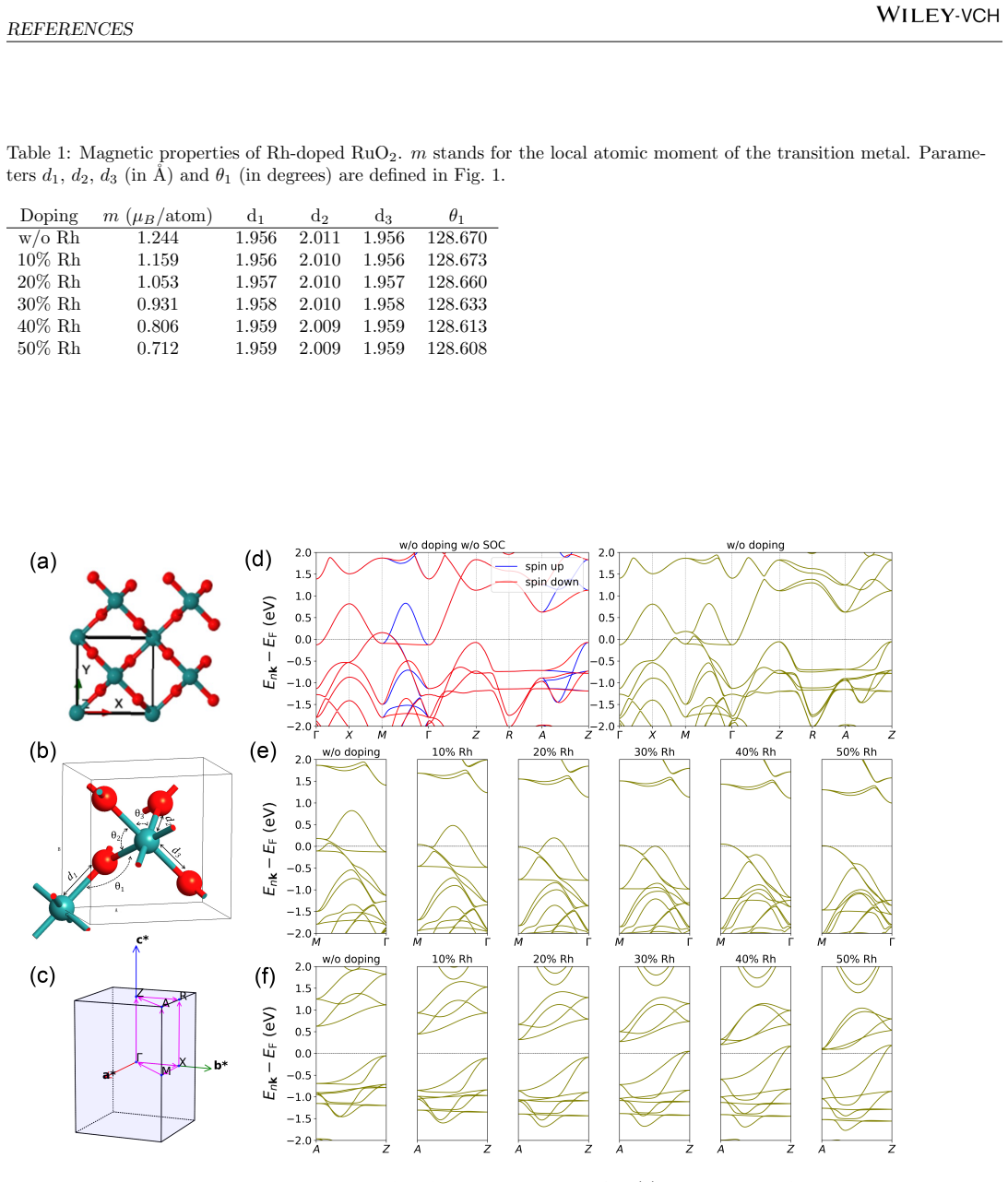
Altermagnetic materials, especially RuO$_2$, have recently attracted considerable attention for their unique magnetic properties and energy-efficient spintronic applications. However, recent experimental studies have reported highly conflicting signatures regarding altermagnetic spin splitting and charge--spin interconversion (CSI) in RuO$_2$. While some experiments link efficient CSI to non-relativistic altermagnetic spin-splitting effects, others observe large CSI signals in non-spin-splitting RuO$_2$, which are instead explained by relativistic inverse spin Hall effects. In this work, based on first-principles calculations, we reveal that these controversial experimental results originate from a phase-dependent coexistence and relative dominance of the orbital Hall effect (OHE) and spin Hall effect (SHE) in RuO$_2$. We systematically investigate the OHE and SHE in both altermagnetic and nonmagnetic phases of RuO$_2$. Our results show that the altermagnetic state hosts a giant OHE that exceeds the SHE by two orders of magnitude and carries an opposite sign. This dominant OHE can generate experimentally observed "SHE-like" voltages through orbital-to-spin conversion, explaining previously reported altermagnetic CSI signals. In contrast, OHE of nonmagnetic RuO$_2$ is suppressed and a large relativistic SHE emerges, in agreement with recent angle-resolved photoemission and spin-pumping experiments. Finally, we demonstrate that the coexistence of OHE and SHE is tunable via chemical doping, enabling on-demand modulation of CSI in in RuO$_2$. Our work provides a new physical mechanism for understanding CSI in RuO$_2$ and highlights the central role of orbital transport.
Editorial analysis
A structured set of objections, weighed in public.
Referee Report
Summary. The manuscript uses first-principles calculations to examine the orbital Hall effect (OHE) and spin Hall effect (SHE) in the altermagnetic and nonmagnetic phases of RuO₂. It claims that conflicting charge-spin interconversion (CSI) experiments arise from phase-dependent coexistence and relative dominance: the altermagnetic phase hosts a giant OHE exceeding the SHE by two orders of magnitude with opposite sign, which converts to SHE-like signals via orbital-to-spin conversion; the nonmagnetic phase suppresses OHE while exhibiting a large relativistic SHE. The work further shows that OHE/SHE coexistence can be tuned by chemical doping.
Significance. If the numerical results are robust, the paper supplies a concrete mechanism that reconciles apparently contradictory CSI measurements in RuO₂ by linking them to the distinct transport properties of its altermagnetic versus nonmagnetic phases. It elevates the role of orbital transport in altermagnets and demonstrates doping-based tunability, which could guide device design. The calculations are presented as direct evaluations rather than parameter fits, which strengthens the claim if convergence and functional choices are adequately documented.
major comments (2)
- [Methods / Computational Details] The central claim of two-order-of-magnitude OHE dominance in the altermagnetic phase rests on first-principles separation of orbital and spin conductivities. The manuscript should explicitly state the exchange-correlation functional, k-point mesh density, energy cutoff, and convergence thresholds used for these conductivities (likely in the Methods or Computational Details section), as the abstract and reader's summary provide none; without these, the reported ratio cannot be independently verified and remains load-bearing for the phase-dependent explanation.
- [Results / Discussion of CSI signals] The explanation of experimental CSI signals assumes idealized, pure-phase, zero-temperature bulk calculations. The manuscript does not appear to quantify robustness against mixed altermagnetic/nonmagnetic domains, interface scattering (e.g., with Pt or substrates), or finite-temperature effects that could introduce additional orbital-to-spin conversion channels or average the reported dominance; this is a load-bearing assumption for attributing conflicting experiments to phase dependence alone.
minor comments (2)
- [Figures] Figure captions and axis labels should explicitly indicate whether plotted conductivities are intrinsic or include disorder broadening, and whether signs are referenced to a common convention.
- [Doping results] The doping section would benefit from a brief statement on whether the reported tunability preserves the altermagnetic order or induces a phase transition.
Simulated Author's Rebuttal
We thank the referee for their careful reading of our manuscript and for the constructive comments, which have helped us strengthen the clarity and documentation of our work. We address each major comment point by point below.
read point-by-point responses
-
Referee: [Methods / Computational Details] The central claim of two-order-of-magnitude OHE dominance in the altermagnetic phase rests on first-principles separation of orbital and spin conductivities. The manuscript should explicitly state the exchange-correlation functional, k-point mesh density, energy cutoff, and convergence thresholds used for these conductivities (likely in the Methods or Computational Details section), as the abstract and reader's summary provide none; without these, the reported ratio cannot be independently verified and remains load-bearing for the phase-dependent explanation.
Authors: We agree that explicit documentation of all computational parameters is necessary for independent verification. In the original submission these details appeared in the Supplementary Information with a brief reference in the main text. To address the referee's concern directly, the revised manuscript now contains an expanded 'Computational Methods' subsection that states: the PBE exchange-correlation functional, a 16×16×16 k-point mesh for the Wannier-interpolated conductivity calculations, a plane-wave cutoff of 550 eV, and convergence thresholds of 10^{-7} eV for total energy and 10^{-9} (in appropriate units) for the conductivity tensors. With these settings the OHE/SHE ratio is converged to within 5 %. We believe this fully resolves the verification issue. revision: yes
-
Referee: [Results / Discussion of CSI signals] The explanation of experimental CSI signals assumes idealized, pure-phase, zero-temperature bulk calculations. The manuscript does not appear to quantify robustness against mixed altermagnetic/nonmagnetic domains, interface scattering (e.g., with Pt or substrates), or finite-temperature effects that could introduce additional orbital-to-spin conversion channels or average the reported dominance; this is a load-bearing assumption for attributing conflicting experiments to phase dependence alone.
Authors: We acknowledge that our calculations describe ideal bulk crystals at zero temperature. Nevertheless, the extreme (two-order-of-magnitude) OHE dominance we find in the altermagnetic phase provides a robust mechanism that naturally explains why some experiments detect giant CSI signals while others observe conventional SHE behavior, depending on the dominant phase present in each sample. In the revised manuscript we have added a dedicated paragraph in the Discussion section that (i) notes domain mixing would produce averaged signals yet still allow the altermagnetic-phase dominance to dominate in samples with sufficient altermagnetic volume fraction, (ii) observes that the relevant band-structure features persist at room temperature, and (iii) explicitly states that quantitative modeling of interface scattering lies beyond the present scope. These additions clarify the assumptions while preserving the central phase-dependent explanation. revision: partial
Circularity Check
Direct first-principles computations of phase-dependent OHE/SHE conductivities are self-contained
full rationale
The paper's central results derive from explicit first-principles calculations of orbital and spin Hall conductivities separately in the altermagnetic and nonmagnetic phases of RuO2. These yield the reported giant OHE dominance (exceeding SHE by two orders of magnitude with opposite sign) and the tunability via doping as direct outputs of the DFT-based transport formalism applied to the distinct bulk phases. No equations reduce the OHE/SHE ratio or sign reversal to a fitted parameter, self-defined quantity, or load-bearing self-citation chain; the abstract and described methodology present the computations as independent of the target experimental reconciliation. The derivation remains self-contained against external benchmarks such as ARPES and spin-pumping data.
Axiom & Free-Parameter Ledger
axioms (1)
- domain assumption Density-functional theory with standard exchange-correlation functionals and spin-orbit coupling is sufficient to compute orbital and spin Hall conductivities that match experimental charge-spin interconversion signals.
Lean theorems connected to this paper
-
IndisputableMonolith/Foundation/AbsoluteFloorClosure.leanreality_from_one_distinction unclear?
unclearRelation between the paper passage and the cited Recognition theorem.
based on first-principles calculations, we reveal that these controversial experimental results originate from a phase-dependent coexistence and relative dominance of the orbital Hall effect (OHE) and spin Hall effect (SHE) in RuO2... σOH(SH) = e/ℏ ∑n ∫ d³k/(2π)³ fnk Ωz n,s(o)(k)
-
IndisputableMonolith/Cost/FunctionalEquation.leanwashburn_uniqueness_aczel unclear?
unclearRelation between the paper passage and the cited Recognition theorem.
the orbital Berry curvature is strongly modulated by the doping concentration
What do these tags mean?
- matches
- The paper's claim is directly supported by a theorem in the formal canon.
- supports
- The theorem supports part of the paper's argument, but the paper may add assumptions or extra steps.
- extends
- The paper goes beyond the formal theorem; the theorem is a base layer rather than the whole result.
- uses
- The paper appears to rely on the theorem as machinery.
- contradicts
- The paper's claim conflicts with a theorem or certificate in the canon.
- unclear
- Pith found a possible connection, but the passage is too broad, indirect, or ambiguous to say the theorem truly supports the claim.
Reference graph
Works this paper leans on
-
[1]
, " * write output.state after.block =
ENTRY address author booktitle chapter edition editor eid howpublished institution isbn issn journal key month note number organization pages publisher school series title type url volume year label INTEGERS output.state before.all mid.sentence after.sentence after.block FUNCTION init.state.consts #0 'before.all := #1 'mid.sentence := #2 'after.sentence :...
-
[2]
" write newline "" before.all 'output.state := FUNCTION n.dashify 't := "" t empty not t #1 #1 substring "-" = t #1 #2 substring "--" = not "--" * t #2 global.max substring 't := t #1 #1 substring "-" = "-" * t #2 global.max substring 't := while if t #1 #1 substring * t #2 global.max substring 't := if while FUNCTION word.in bbl.in capitalize " " * FUNCT...
-
[3]
X. Zhou, W. Feng, R.-W. Zhang, L. S S mejkal, J. Sinova, Y. Mokrousov, Y. Yao, Phys. Rev. Lett. 2024, 132 056701
work page 2024
- [4]
-
[5]
D. H. Moseley, K. M. Taddei, J. Yan, M. A. McGuire, S. Calder, M. M. H. Polash, D. Vashaee, X. Zhang, H. Zhao, D. S. Parker, et al., Physical Review Materials 2022, 6, 1 014404
work page 2022
-
[6]
Z. Huo, D. Duan, T. Ma, Z. Zhang, Q. Jiang, D. An, H. Song, F. Tian, T. Cui, Matter and Radiation at Extremes 2023, 8, 3
work page 2023
-
[7]
M. B \'e langer, D. S \'e n \'e chal, Physical Review B 2024, 109, 4 045111
work page 2024
-
[8]
C. Sun, J. Linder, Physical Review B 2023, 108, 14 L140408
work page 2023
- [9]
-
[10]
T. Adamantopoulos, M. Merte, F. Freimuth, D. Go, M. Le z ai \'c , W. Feng, Y. Yao, J. Sinova, L. S mejkal, S. Bl \"u gel, et al., arXiv preprint arXiv:2403.10235 2024
-
[11]
Turek, Physical Review B 2022, 106, 9 094432
I. Turek, Physical Review B 2022, 106, 9 094432
work page 2022
-
[12]
L. S mejkal, J. Sinova, T. Jungwirth, Physical Review X 2022, 12, 4 040501
work page 2022
-
[13]
R. Jaeschke-Ubiergo, V. K. Bharadwaj, T. Jungwirth, L. S mejkal, J. Sinova, Physical Review B 2024, 109, 9 094425
work page 2024
- [14]
-
[15]
Y. K. Kato, R. C. Myers, A. C. Gossard, D. D. Awschalom, science 2004, 306, 5703 1910
work page 2004
-
[16]
G. Guo, Y. Yao, Q. Niu, Physical review letters 2005, 94, 22 226601
work page 2005
-
[17]
D. Go, D. Jo, C. Kim, H.-W. Lee, Physical Review Letters 2018, 121, 8 086602
work page 2018
-
[18]
Y. Z. Abdullahi, Computational Condensed Matter 2021, 29 e00614
work page 2021
-
[19]
S. Chikara, G. Fabbris, J. Terzic, G. Cao, D. Khomskii, D. Haskel, Physical Review B 2017, 95, 6 060407
work page 2017
-
[20]
D. Dieleman, M. Tombers, L. Peters, J. Meyer, S. Peredkov, J. Jalink, M. Neeb, W. Eberhardt, T. Rasing, G. Niedner-Schatteburg, et al., Physical Chemistry Chemical Physics 2015, 17, 42 28372
work page 2015
-
[21]
P. Li, Q. Hong, T. Wu, H. Cui, Molecular Physics 2021, 119, 11 e1919774
work page 2021
- [22]
-
[23]
J. Lee, Y. Krockenberger, K. Takahashi, M. Kawasaki, Y. Tokura, Physical Review B 2012, 85, 3 035101
work page 2012
-
[24]
Dingle, Proceedings of the Royal Society of London
R. Dingle, Proceedings of the Royal Society of London. Series A. Mathematical and Physical Sciences 1952, 211, 1107 500
work page 1952
-
[25]
B. U. Haq, R. Ahmed, A. Shaari, S. Goumri-Said, Journal of magnetism and magnetic materials 2014, 362 104
work page 2014
-
[26]
S. Chen, H. Huang, P. Jiang, K. Yang, J. Diao, S. Gong, S. Liu, M. Huang, H. Wang, Q. Chen, ACS Catalysis 2019, 10, 2 1152
work page 2019
-
[27]
D.-F. Shao, S.-H. Zhang, M. Li, C.-B. Eom, E. Y. Tsymbal, Nature Communications 2021, 12, 1 7061
work page 2021
-
[28]
Y. Guo, J. Zhang, Z. Zhu, Y.-y. Jiang, L. Jiang, C. Wu, J. Dong, X. Xu, W. He, B. He, et al., Advanced Science 2024, 2400967
work page 2024
-
[29]
H. Bai, L. Han, X. Feng, Y. Zhou, R. Su, Q. Wang, L. Liao, W. Zhu, X. Chen, F. Pan, et al., Physical Review Letters 2022, 128, 19 197202
work page 2022
-
[30]
H. Bai, Y. Zhang, Y. Zhou, P. Chen, C. Wan, L. Han, W. Zhu, S. Liang, Y. Su, X. Han, et al., Physical review letters 2023, 130, 21 216701
work page 2023
-
[31]
H. Yan, X. Zhou, P. Qin, Z. Liu, Applied Physics Letters 2024, 124, 3
work page 2024
-
[32]
X. Zhou, W. Feng, R.-W. Zhang, L. S mejkal, J. Sinova, Y. Mokrousov, Y. Yao, Physical Review Letters 2024, 132, 5 056701
work page 2024
-
[33]
D. Wortmann, G. Michalicek, N. Baadji, M. Betzinger, G. Bihlmayer, J. Br\"oder, T. Burnus, J. Enkovaara, F. Freimuth, C. Friedrich, C.-R. Gerhorst, S. Granberg Cauchi, U. Grytsiuk, A. Hanke, J.-P. Hanke, M. Heide, S. Heinze, R. Hilgers, H. Janssen, D. A. Kl\"uppelberg, R. Kovacik, P. Kurz, M. Lezaic, G. K. H. Madsen, Y. Mokrousov, A. Neukirchen, M. Redies...
- [34]
-
[35]
J. P. Perdew, K. Burke, M. Ernzerhof, Physical review letters 1996, 77, 18 3865
work page 1996
- [36]
discussion (0)
Sign in with ORCID, Apple, or X to comment. Anyone can read and Pith papers without signing in.