REVIEW 3 major objections 5 minor 123 references
Multifunctional physical reservoir computing in soft tensegrity robots
T0 review · 3 major / 5 minor · reviewed 2026-08-06 · deepseek-v4-flash
Pith's one-line read The paper shows that one trained linear readout can turn a simulated soft tensegrity robot into a multistable system whose behaviors are selected by which face of the icosahedral body touches the ground.
desk verdict A credible simulation proof-of-concept that one readout can hold multiple behaviors in a soft tensegrity robot, but the general claim rests on a single GA-selected case and needs replication. read the letter →
The pith
A machine-rendered reading of the paper's core claim, the machinery that carries it, and where it could break.
The reading
What carries the argument
The central object is the closed-loop feedback law $u(t+\tau)=W r(t)$, where $r(t)\in\mathbb{R}^{48}$ holds the lengths and velocities of the 24 passive tendons and $W\in\mathbb{R}^{2\times 48}$ is obtained by ridge regression over concatenated open-loop data from two simulations. The identity doing the work is that two behaviors' trajectories are separated in this high-dimensional state space, so a single linear map can send each trajectory to its own next motor command. The robot body's 20 triangular faces, arising from its equilibrium shape as Jessen's orthogonal icosahedron, provide a coarse partition of the state space that determines which attractor is reached.
What would settle it
Build a physical six-bar tensegrity robot with the same geometry, tendon stiffness, damping, and actuator placement, run the identical open-loop training with the two Lissajous targets, and close the loop from the two final states. The central claim fails if the crawl and the on-the-spot oscillation do not reappear, or if the reported face-to-attractor map (for example, face 17 giving crawling and face 13 giving oscillation) is not reproducible across trials.
Extended reading notes
Core claim
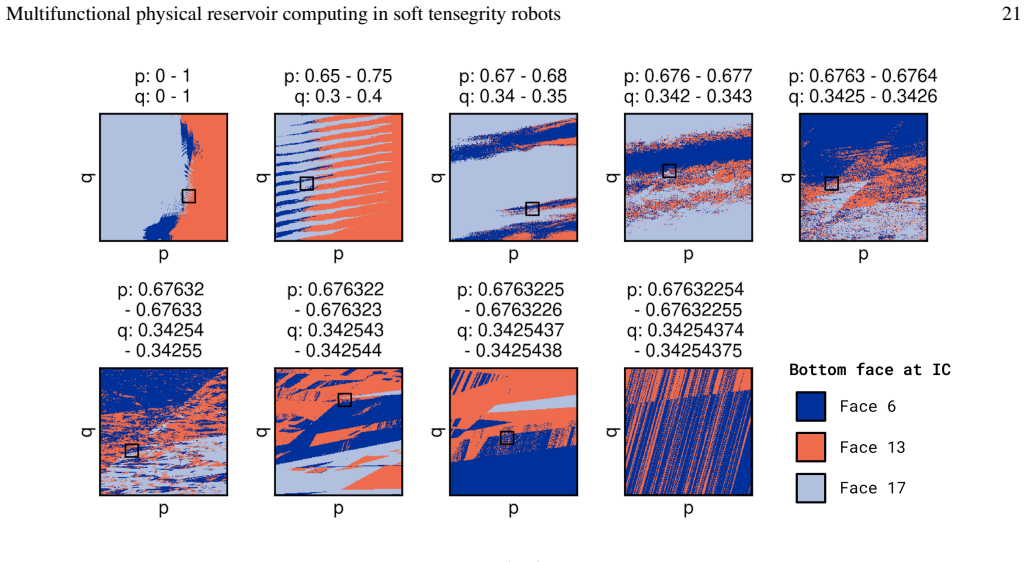
On the authors' own terms, the discovery is that a 48-dimensional reservoir state made of passive-tendon lengths and velocities is enough for a single linear readout, $W = DR^\top(RR^\top+\beta I)^{-1}$, to reconstruct two different target motor signals once the loop is closed. The two outputs, a fast forward crawl (0.465 m/s, about 31 body lengths per minute) and an on-the-spot oscillation with one active actuator, are coexisting attractors of the closed-loop system. From the 20 initial states defined by each icosahedron face as the bottom face, the system converges to seven attractors in total: Attractor A from face 17, Attractor B from face 13, a fixed point from faces 3, 8, 15, 18, and 19, and periodic, quasi-periodic, or chaotic-looking attractors from the remaining faces. The bottom face is the main selector, and a perturbation that rolls the robot to a different face switches the behavior. The authors also map the regions of tendon stiffness where both trained attractors can be learned, and they classify bifurcations caused by parameter changes before training as pre-learning and after training as post-learning.
Load-bearing premise
The entire result rests on the simulation: MuJoCo's soft-contact and elastic-tendon models must faithfully represent a real tensegrity robot's dynamics, because the attractors, basins, and bifurcations are all computed from simulated trajectories and no hardware validation is reported.
Editorial extensions
If this is right
- A single set of readout weights can control multiple qualitatively different robot behaviors, so behavior-specific controllers or additional readout modules are not needed for each gait.
- Behavior selection can be achieved by changing the robot's initial body configuration, for example by nudging it onto a different bottom face, instead of by switching control parameters.
- Untrained attractors are intrinsic outcomes of learning in an embodied system, so failed or unintended training results can be studied as a source of novel behaviors rather than discarded.
- The region of tendon-stiffness parameters in which both trained attractors can be reconstructed defines a practical operating envelope for multifunctionality on this morphology.
- Because the training procedure only needs separated trajectories and a linear readout, the approach transfers to other physical reservoirs, including photonic, spintronic, and quantum systems.
Reading between the lines
- Editorial inference: if the bottom-face-to-attractor correspondence is a general property of this morphology, the number of faces of the tensegrity structure gives a natural upper bound on the number of coexisting behaviors, so body geometry directly sets behavioral capacity.
- Editorial inference: the extreme final-state sensitivity near the basin boundary could be used as a deterministic physical random number generator or probabilistic behavior selector, since tiny changes in the driving parameters decide which attractor appears.
- Editorial inference: the results suggest a content-addressable memory interpretation in which a short preview of a target behavior, not a full open-loop drive, might suffice to select the attractor; this could be tested by varying the preview length.
- Editorial inference: post-learning bifurcations imply that gradual tendon aging or damage, without any retraining, could push the robot from one trained gait into new untrained gaits, turning wear into a potential source of behavioral diversity.
Editorial analysis
A structured set of objections, weighed in public.
Referee Report
Summary. This paper proposes multifunctional physical reservoir computing (MF-PRC) on a simulated six-bar tensegrity robot. Two Lissajous motor-signal targets are optimized with NSGA-II; a single linear readout is trained by ridge regression on 48-dimensional passive-tendon measurements from open-loop simulations; in closed loop, the same readout is claimed to reproduce both target behaviors from their respective initial states. The authors then characterize the resulting multistable system: attractors from 20 bottom-face initial conditions (two trained and five untrained), basin structure in a (p,q)-interpolated input plane, post-learning and pre-learning bifurcations under tendon-stiffness changes, and regions of multifunctionality. The central claim, stated in Section VI, is that one readout can control multiple coexisting behaviors whenever their dynamical trajectories are separated in state space.
Significance. The paper gives a transparent simulation proof-of-concept: physical parameters (Table II), evolutionary settings (Appendix B), classification thresholds (Appendix C), and sensor-level basin data (Appendix D) are all reported, which is a real strength. If the central claim is confirmed, the work would be a useful step toward exploiting body dynamics for multifunctional robot control and for studying untrained attractors in embodied systems. Its significance is currently limited by the single selected phenotype and by the heuristic nature of the attractor classification; the general principle in Section VI goes beyond what is demonstrated.
major comments (3)
- [III C, IV B, VI] The strongest claim in Section VI rests on a single phenotype from Generation 73 of one NSGA-II run (Table I). Because the third fitness objective F3 explicitly rewards closed-loop reconstruction accuracy of the chosen targets, the selected pair is not an independent sample from the space of possible targets; it is a favorable draw from a search whose objectives include learnability. All subsequent analyses in Sections IV C through IV F use the same trained readout W from that phenotype. To support the general statement that "the same trained weights of the readout layer can be re-used ... as long as their dynamical trajectories are separated in the high-dimensional state space," the authors should either provide multiple independent GA seeds, repeated training runs, or tests on non-evolved target pairs, or explicitly restrict the conclusion to a case study.
- [Appendix C, IV C] Attractor G is classified as non-periodic and "likely to be a chaotic attractor" solely from a heuristic autocorrelation threshold (δ_ACF = 0.95) and from the absence of distinct peaks in the power spectrum. This is insufficient to establish chaos or even non-periodicity on a finite-time series; a long-period quasi-periodic orbit or a long transient could satisfy the same criteria. Please add quantitative diagnostics such as a maximal Lyapunov exponent estimate or the 0-1 test for chaos, or relabel the category as "unclassified non-periodic." This matters because Section IV F later refers to "strange attractors" in the parameter space.
- [IV E, IV F] The bifurcation statements in Section IV E and the "regions of multifunctionality" in Section IV F are obtained by classifying deterministic single runs at discrete parameter values using the hand-set thresholds of Appendix C. Since the system is deterministic, repeated runs would not add sampling noise, but the classification boundaries themselves are threshold-dependent, and no sensitivity analysis over δ_E and δ_ACF is reported. For example, the identification of a supercritical Hopf bifurcation at k_act ≈ 372.5 N/m in Fig. 8(b) relies on distinguishing a stable fixed point from a small periodic orbit, which is exactly where the threshold choice matters. Please either show that the reported bifurcation locations are robust to reasonable threshold variations or present them as qualitative observations rather than quantitative bifurcation points.
minor comments (5)
- [IV A, IV B] The manuscript says a phenotype from Generation 73 is picked as a representative case, but it does not state the selection rule among the many phenotypes in the final generations; specifying the criterion (e.g., rank on F3, Pareto-front position) would make the case study more reproducible.
- [Appendix C] There are copyediting errors in this appendix: "cateogized," "categtorization," and "aformentioned" should be corrected, and the acronym ACF is defined twice.
- [IV C] The statement that "the two-dimensional output dynamics is a good representation of the entire system dynamics because the current system is globally coupled" is an assertion; a supporting argument or citation is needed, otherwise this should be phrased as a working assumption.
- [IV D] Please clarify that the equivalence between the basin boundary and the boundary of bottom faces is established only for the sampled (p,q) region and not for the full high-dimensional state space, since the current wording could be read as a global statement.
- [Data Availability] The data availability statement is vague; given the complexity of the MuJoCo simulation and the evolutionary search, releasing the simulation model and the optimization code would substantially aid reproducibility.
Circularity Check
No significant circularity: the central multifunctionality result is an empirical simulation outcome, not a derivation from its own inputs; self-citations are background/terminology and not load-bearing.
full rationale
The paper contains no derivation chain whose conclusion is equivalent to its inputs by construction. The readout W is fit by ridge regression (Eq. 4) to open-loop reservoir measurements and target motor signals; the closed-loop behavior is then obtained by feeding W r(t) back into MuJoCo. Whether the closed-loop system actually reproduces the targets, possesses additional untrained attractors, or changes under stiffness variations is an empirical outcome, and the paper reports failures (unstable closed-loop simulations, imperfect reconstructions) alongside the successful Generation-73 case. The GA's third objective F3 explicitly optimizes target pairs for learnability, so the selected phenotype is not an independent sample; this limits the generality of the concluding claim that trajectory separation alone suffices for readout reuse, but it does not make the demonstrated coexistence of Attractors A-G, the basin analysis, or the bifurcation diagrams equivalent to the fitness objectives because those results are measured after training and were not optimized. The attractor classification thresholds in Appendix C are heuristic, yet the qualitative coexistence of seven attractors is also visible in the time series and phase plots, so the threshold choice does not define the result into existence. Self-citations appear in background (e.g., ref. 56 for tensegrity locomotion and ref. 98 for the terms pre-/post-learning bifurcations), but none is load-bearing: the central MF-PRC demonstration is self-contained in the paper's own simulations. The acknowledged idealizations in Appendix A (bidirectional tendons, instantaneous restlength changes, no hardware) are threats to physical validity, not circularity. Overall, no step reduces a 'prediction' to a fitted input or imports a uniqueness claim from the authors' prior work.
Assumptions & free parameters
free parameters (4)
- Multifunctional readout weights W (2x48) =
trained by ridge regression, values not tabulated
- Target Lissajous parameters (a_i, omega_i, phi_i, b_i) =
Table I values for the Generation 73 phenotype
- Ridge regularization beta =
0.01
- Attractor classification thresholds =
delta_E = 0.30, delta_E = 0.01, delta_ACF = 0.95
assumptions (3)
- domain assumption MuJoCo simulation dynamics faithfully represent the relevant tensegrity robot behavior
- ad hoc to paper Heuristic attractor classification via NRMSE and autocorrelation thresholds correctly identifies attractor types
- domain assumption The 20 bottom faces are a sufficient coarse-grained partition of the state space for attractor selection
Cite this review
Pith. "Pith review of Multifunctional physical reservoir computing in soft tensegrity robots." pith.science (2026). https://pith.science/paper/LVCKZB3D
@misc{pith2026250721496,
  author       = {Pith},
  title        = {Pith review of: Multifunctional physical reservoir computing in soft tensegrity robots},
  year         = {2026},
  howpublished = {\url{https://pith.science/paper/LVCKZB3D}},
  note         = {Machine review of arXiv:2507.21496}
}
read the original abstract
Recent studies have demonstrated that the dynamics of physical systems can be utilized for the desired information processing under the framework of physical reservoir computing (PRC). Robots with soft bodies are examples of such physical systems, and their nonlinear body-environment dynamics can be used to compute and generate the motor signals necessary for the control of their own behavior. In this simulation study, we extend this approach to control and embed not only one but also multiple behaviors into a type of soft robot called a tensegrity robot. The resulting system, consisting of the robot and the environment, is a multistable dynamical system that converges to different attractors from varying initial conditions. Furthermore, attractor analysis reveals that there exist "untrained attractors" in the state space of the system outside the training data. These untrained attractors reflect the intrinsic properties and structures of the tensegrity robot and its interactions with the environment. The impacts of these recent findings in PRC remain unexplored in embodied AI research. We here illustrate their potential to understand various features of embodied cognition that have not been fully addressed to date.
Figures


Figures from the paper (10 more)



Reference graph
Works this paper leans on
-
[1]
author author R. D. \ Beer ,\ title title A dynamical systems perspective on agent-environment interaction , \ @noop journal journal Artificial intelligence \ volume 72 ,\ pages 173--215 ( year 1995 ) NoStop
1995
-
[2]
author author W. H. \ Warren ,\ title title The dynamics of perception and action , \ @noop journal journal Psychological review \ volume 113 ,\ pages 358 ( year 2006 ) NoStop
2006
-
[3]
author author O. Khatib ,\ title title Real-time obstacle avoidance for manipulators and mobile robots , \ @noop journal journal The international journal of robotics research \ volume 5 ,\ pages 90--98 ( year 1986 ) NoStop
1986
-
[4]
Sch \"o ner , author M
author author G. Sch \"o ner , author M. Dose , \ and\ author C. Engels ,\ title title Dynamics of behavior: Theory and applications for autonomous robot architectures , \ @noop journal journal Robotics and autonomous systems \ volume 16 ,\ pages 213--245 ( year 1995 ) NoStop
1995
-
[5]
author author J. S. \ Johnson , author J. P. \ Spencer , \ and\ author G. Sch \"o ner ,\ title title Moving to higher ground: The dynamic field theory and the dynamics of visual cognition , \ @noop journal journal New ideas in psychology \ volume 26 ,\ pages 227--251 ( year 2008 ) NoStop
2008
-
[6]
author author S. Schaal ,\ title title Dynamic movement primitives-a framework for motor control in humans and humanoid robotics , \ in\ @noop booktitle Adaptive motion of animals and machines \ ( publisher Springer ,\ year 2006 )\ pp.\ pages 261--280 NoStop
2006
-
[7]
author author A. J. \ Ijspeert , author J. Nakanishi , author H. Hoffmann , author P. Pastor , \ and\ author S. Schaal ,\ title title Dynamical movement primitives: learning attractor models for motor behaviors , \ @noop journal journal Neural computation \ volume 25 ,\ pages 328--373 ( year 2013 ) NoStop
2013
-
[8]
Saveriano , author F
author author M. Saveriano , author F. J. \ Abu-Dakka , author A. Kramberger , \ and\ author L. Peternel ,\ title title Dynamic movement primitives in robotics: A tutorial survey , \ @noop journal journal The International Journal of Robotics Research \ volume 42 ,\ pages 1133--1184 ( year 2023 ) NoStop
2023
Show all 123 references
-
[9]
author author S. M. \ Khansari-Zadeh \ and\ author A. Billard ,\ title title Learning stable nonlinear dynamical systems with gaussian mixture models , \ @noop journal journal IEEE Transactions on Robotics \ volume 27 ,\ pages 943--957 ( year 2011 ) NoStop
2011
-
[10]
Taga , author Y
author author G. Taga , author Y. Yamaguchi , \ and\ author H. Shimizu ,\ title title Self-organized control of bipedal locomotion by neural oscillators in unpredictable environment , \ @noop journal journal Biological cybernetics \ volume 65 ,\ pages 147--159 ( year 1991 ) NoStop
1991
-
[11]
Tani \ and\ author S
author author J. Tani \ and\ author S. Nolfi ,\ title title Learning to perceive the world as articulated: an approach for hierarchical learning in sensory-motor systems , \ @noop journal journal Neural Networks \ volume 12 ,\ pages 1131--1141 ( year 1999 ) NoStop
1999
-
[12]
Tani , author M
author author J. Tani , author M. Ito , \ and\ author Y. Sugita ,\ title title Self-organization of distributedly represented multiple behavior schemata in a mirror system: reviews of robot experiments using rnnpb , \ @noop journal journal Neural Networks \ volume 17 ,\ pages ...
2004
-
[13]
author author A. J. \ Ijspeert , author A. Crespi , author D. Ryczko , \ and\ author J.-M. \ Cabelguen ,\ title title From swimming to walking with a salamander robot driven by a spinal cord model , \ @noop journal journal science \ volume 315 ,\ pages 1416--1420 ( year 2007 ) NoStop
2007
-
[14]
Steingrube , author M
author author S. Steingrube , author M. Timme , author F. W \"o rg \"o tter , \ and\ author P. Manoonpong ,\ title title Self-organized adaptation of a simple neural circuit enables complex robot behaviour , \ @noop journal journal Nature physics \ volume 6 ,\ pages 224--230 (...
2010
-
[15]
Kuniyoshi \ and\ author S
author author Y. Kuniyoshi \ and\ author S. Suzuki ,\ title title Dynamic emergence and adaptation of behavior through embodiment as coupled chaotic field , \ in\ @noop booktitle IEEE/RSJ International Conference on Intelligent Robots and Systems ,\ Vol. volume 2 \ ( organizat...
2004
-
[16]
Pfeifer , author M
author author R. Pfeifer , author M. Lungarella , \ and\ author F. Iida ,\ title title Self-organization, embodiment, and biologically inspired robotics , \ @noop journal journal science \ volume 318 ,\ pages 1088--1093 ( year 2007 ) NoStop
2007
-
[17]
author author Y. Kuniyoshi ,\ title title Fusing autonomy and sociality via embodied emergence and development of behaviour and cognition from fetal period , \ @noop journal journal Philosophical Transactions of the Royal Society B \ volume 374 ,\ pages 20180031 ( year 2019 ) NoStop
2019
-
[18]
Chi , author Y
author author Y. Chi , author Y. Li , author Y. Zhao , author Y. Hong , author Y. Tang , \ and\ author J. Yin ,\ title title Bistable and multistable actuators for soft robots: Structures, materials, and functionalities , \ @noop journal journal Advanced Materials \ volume 34 ...
2022
-
[19]
Bhovad , author J
author author P. Bhovad , author J. Kaufmann , \ and\ author S. Li ,\ title title Peristaltic locomotion without digital controllers: Exploiting multi-stability in origami to coordinate robotic motion , \ @noop journal journal Extreme Mechanics Letters \ volume 32 ,\ pages 100...
2019
-
[20]
Pagano , author T
author author A. Pagano , author T. Yan , author B. Chien , author A. Wissa , \ and\ author S. Tawfick ,\ title title A crawling robot driven by multi-stable origami , \ @noop journal journal Smart Materials and Structures \ volume 26 ,\ pages 094007 ( year 2017 ) NoStop
2017
-
[21]
Rothemund , author A
author author P. Rothemund , author A. Ainla , author L. Belding , author D. J. \ Preston , author S. Kurihara , author Z. Suo , \ and\ author G. M. \ Whitesides ,\ title title A soft, bistable valve for autonomous control of soft actuators , \ @noop journal journal Science Ro...
2018
-
[22]
Flynn , author V
author author A. Flynn , author V. A. \ Tsachouridis , \ and\ author A. Amann ,\ title title Multifunctionality in a reservoir computer , \ @noop journal journal Chaos: An Interdisciplinary Journal of Nonlinear Science \ volume 31 ( year 2021 ) NoStop
2021
-
[23]
Flynn , author V
author author A. Flynn , author V. A. \ Tsachouridis , \ and\ author A. Amann ,\ title title Seeing double with a multifunctional reservoir computer , \ @noop journal journal Chaos: An Interdisciplinary Journal of Nonlinear Science \ volume 33 ( year 2023 ) NoStop
2023
-
[24]
Flynn ,\ title Theory and applications of multifunctional reservoir computers ,\ @noop Ph.D
author author A. Flynn ,\ title Theory and applications of multifunctional reservoir computers ,\ @noop Ph.D. thesis ,\ school University College Cork ( year 2023 ) NoStop
2023
-
[25]
O'Hagan , author A
author author J. O'Hagan , author A. Keane , \ and\ author A. Flynn ,\ title title Confabulation dynamics in a reservoir computer: Filling in the gaps with untrained attractors , \ @noop journal journal arXiv preprint arXiv:2505.04792 \ ( year 2025 ) NoStop
2025 arXiv
-
[26]
Du , author H
author author Y. Du , author H. Luo , author J. Guo , author J. Xiao , author Y. Yu , \ and\ author X. Wang ,\ title title Multifunctional reservoir computing , \ @noop journal journal Physical Review E \ volume 111 ,\ pages 035303 ( year 2025 ) NoStop
2025
-
[27]
Lu \ and\ author D
author author Z. Lu \ and\ author D. S. \ Bassett ,\ title title Invertible generalized synchronization: A putative mechanism for implicit learning in neural systems , \ @noop journal journal Chaos: An Interdisciplinary Journal of Nonlinear Science \ volume 30 ( year 2020 ) NoStop
2020
-
[28]
Inoue , author K
author author K. Inoue , author K. Nakajima , \ and\ author Y. Kuniyoshi ,\ title title Designing spontaneous behavioral switching via chaotic itinerancy , \ @noop journal journal Science advances \ volume 6 ,\ pages eabb3989 ( year 2020 ) NoStop
2020
-
[29]
\ Kong , author G
author author L.-W. \ Kong , author G. A. \ Brewer , \ and\ author Y.-C. \ Lai ,\ title title Reservoir-computing based associative memory and itinerancy for complex dynamical attractors , \ @noop journal journal Nature Communications \ volume 15 ,\ pages 4840 ( year 2024 ) NoStop
2024
-
[30]
author author K. Nakajima ,\ title title Physical reservoir computing—an introductory perspective , \ @noop journal journal Japanese Journal of Applied Physics \ volume 59 ,\ pages 060501 ( year 2020 ) NoStop
2020
-
[31]
Nakajima , author T
author author K. Nakajima , author T. Li , author H. Hauser , \ and\ author R. Pfeifer ,\ title title Exploiting short-term memory in soft body dynamics as a computational resource , \ @noop journal journal Journal of The Royal Society Interface \ volume 11 ,\ pages 20140437 (...
2014
-
[32]
Nakajima , author H
author author K. Nakajima , author H. Hauser , author T. Li , \ and\ author R. Pfeifer ,\ title title Information processing via physical soft body , \ @noop journal journal Scientific reports \ volume 5 ,\ pages 10487 ( year 2015 ) NoStop
2015
-
[33]
Nakajima , author H
author author K. Nakajima , author H. Hauser , author T. Li , \ and\ author R. Pfeifer ,\ title title Exploiting the dynamics of soft materials for machine learning , \ @noop journal journal Soft robotics \ volume 5 ,\ pages 339--347 ( year 2018 ) NoStop
2018
-
[34]
Hasegawa , author M
author author T. Hasegawa , author M. Austin , author H. Sumioka , author Y. Kuniyoshi , \ and\ author K. Nakajima ,\ title title Takorobo: Towards closed-loop body-driven locomotion processing , \ in\ @noop booktitle Artificial Life Conference Proceedings 36 ,\ series and num...
2024
-
[35]
Zhao , author K
author author Q. Zhao , author K. Nakajima , author H. Sumioka , author H. Hauser , \ and\ author R. Pfeifer ,\ title title Spine dynamics as a computational resource in spine-driven quadruped locomotion , \ in\ @noop booktitle IEEE/RSJ International Conference on Intelligent ...
2013
-
[36]
Horii , author K
author author Y. Horii , author K. Inoue , author S. Nishikawa , author K. Nakajima , author R. Niiyama , \ and\ author Y. Kuniyoshi ,\ title title Physical reservoir computing in a soft swimming robot , \ in\ @noop booktitle ALIFE 2021: The 2021 Conference on Artificial Life ...
2021
-
[37]
Bhovad \ and\ author S
author author P. Bhovad \ and\ author S. Li ,\ title title Physical reservoir computing with origami and its application to robotic crawling , \ @noop journal journal Scientific Reports \ volume 11 ,\ pages 13002 ( year 2021 ) NoStop
2021
-
[38]
Wang \ and\ author S
author author J. Wang \ and\ author S. Li ,\ title title Building intelligence in the mechanical domain—harvesting the reservoir computing power in origami to achieve information perception tasks , \ @noop journal journal Advanced Intelligent Systems \ volume 5 ,\ pages 230008...
2023
-
[39]
Tanaka , author S.-H
author author K. Tanaka , author S.-H. \ Yang , author Y. Tokudome , author Y. Minami , author Y. Lu , author T. Arie , author S. Akita , author K. Takei , \ and\ author K. Nakajima ,\ title title Flapping-wing dynamics as a natural detector of wind direction , \ @noop journal...
2021
-
[40]
Yu , author S
author author Z. Yu , author S. H. \ Sadati , author S. Perera , author H. Hauser , author P. R. \ Childs , \ and\ author T. Nanayakkara ,\ title title Tapered whisker reservoir computing for real-time terrain identification-based navigation , \ @noop journal journal Scientifi...
2023
-
[41]
Sakurai , author M
author author R. Sakurai , author M. Nishida , author T. Jo , author Y. Wakao , \ and\ author K. Nakajima ,\ title title Durable pneumatic artificial muscles with electric conductivity for reliable physical reservoir computing , \ @noop journal journal Journal of Robotics and ...
2022
-
[42]
Hayashi , author T
author author H. Hayashi , author T. Kawase , author T. Miyazaki , author M. Sogabe , author Y. Nakajima , \ and\ author K. Kawashima ,\ title title Online assistance control of a pneumatic gait assistive suit using physical reservoir computing exploiting air dynamics , \ in\ ...
2022
-
[43]
Akashi , author Y
author author N. Akashi , author Y. Kuniyoshi , author T. Jo , author M. Nishida , author R. Sakurai , author Y. Wakao , \ and\ author K. Nakajima ,\ title title Embedding bifurcations into pneumatic artificial muscle , \ @noop journal journal Advanced Science \ ,\ pages 23044...
2024
-
[44]
Caluwaerts , author M
author author K. Caluwaerts , author M. D'Haene , author D. Verstraeten , \ and\ author B. Schrauwen ,\ title title Locomotion without a brain: physical reservoir computing in tensegrity structures , \ @noop journal journal Artificial life \ volume 19 ,\ pages 35--66 ( year 20...
2013
-
[45]
Caluwaerts , author J
author author K. Caluwaerts , author J. Despraz , author A. I s c en , author A. P. \ Sabelhaus , author J. Bruce , author B. Schrauwen , \ and\ author V. SunSpiral ,\ title title Design and control of compliant tensegrity robots through simulation and hardware validation , \ ...
2014
-
[46]
Fujita , author S
author author K. Fujita , author S. Yonekura , author S. Nishikawa , author R. Niiyama , \ and\ author Y. Kuniyoshi ,\ title title Environmental and structural effects on physical reservoir computing with tensegrity , \ @noop journal journal Journal of the Institute of Industr...
2018
-
[47]
Bliss , author T
author author T. Bliss , author T. Iwasaki , \ and\ author H. Bart-Smith ,\ title title Central pattern generator control of a tensegrity swimmer , \ @noop journal journal IEEE/ASME Transactions on Mechatronics \ volume 18 ,\ pages 586--597 ( year 2012 ) NoStop
2012
-
[48]
author author B. T. \ Mirletz , author P. Bhandal , author R. D. \ Adams , author A. K. \ Agogino , author R. D. \ Quinn , \ and\ author V. SunSpiral ,\ title title Goal-directed cpg-based control for tensegrity spines with many degrees of freedom traversing irregular terrain ...
2015
-
[49]
Rieffel \ and\ author J.-B
author author J. Rieffel \ and\ author J.-B. \ Mouret ,\ title title Adaptive and resilient soft tensegrity robots , \ @noop journal journal Soft robotics \ volume 5 ,\ pages 318--329 ( year 2018 ) NoStop
2018
-
[50]
Vespignani , author J
author author M. Vespignani , author J. M. \ Friesen , author V. SunSpiral , \ and\ author J. Bruce ,\ title title Design of superball v2, a compliant tensegrity robot for absorbing large impacts , \ in\ @noop booktitle IEEE/RSJ International Conference on Intelligent Robots a...
2018
-
[51]
author author R. L. \ Baines , author J. W. \ Booth , \ and\ author R. Kramer-Bottiglio ,\ title title Rolling soft membrane-driven tensegrity robots , \ @noop journal journal IEEE Robotics and Automation Letters \ volume 5 ,\ pages 6567--6574 ( year 2020 ) NoStop
2020
-
[52]
Peng , author H
author author H. Peng , author H. Yang , author F. Li , author C. Yang , \ and\ author N. Song ,\ title title A unified framework for mechanical modeling and control of tensegrity robots , \ @noop journal journal Mechanism and Machine Theory \ volume 191 ,\ pages 105498 ( year...
2024
-
[53]
Wang , author K
author author Z. Wang , author K. Li , author Q. He , \ and\ author S. Cai ,\ title title A light-powered ultralight tensegrity robot with high deformability and load capacity , \ @noop journal journal Advanced Materials \ volume 31 ,\ pages 1806849 ( year 2019 ) NoStop
2019
-
[54]
Zappetti , author S
author author D. Zappetti , author S. Mintchev , author J. Shintake , \ and\ author D. Floreano ,\ title title Bio-inspired tensegrity soft modular robots , \ in\ @noop booktitle Biomimetic and Biohybrid Systems: 6th International Conference \ ( organization Springer ,\ year 2...
2017
-
[55]
author author D. S. \ Shah , author J. W. \ Booth , author R. L. \ Baines , author K. Wang , author M. Vespignani , author K. Bekris , \ and\ author R. Kramer-Bottiglio ,\ title title Tensegrity robotics , \ @noop journal journal Soft robotics \ volume 9 ,\ pages 639--656 ( ye...
2022
-
[56]
Terajima , author K
author author R. Terajima , author K. Inoue , author S. Yonekura , author K. Nakajima , \ and\ author Y. Kuniyoshi ,\ title title Behavioral diversity generated from body--environment interactions in a simulated tensegrity robot , \ @noop journal journal IEEE Robotics and Auto...
2021
-
[57]
Doney , author A
author author K. Doney , author A. Petridou , author J. Karaul , author A. Khan , author G. Liu , \ and\ author J. Rieffel ,\ title title Behavioral repertoires for soft tensegrity robots , \ in\ @noop booktitle IEEE Symposium Series on Computational Intelligence \ ( organizat...
2020
-
[58]
Kobayashi , author H
author author R. Kobayashi , author H. Nabae , \ and\ author K. Suzumori ,\ title title Active-bending six-bar tensegrity modular robot driven by thin artificial muscles , \ @noop journal journal IEEE Robotics and Automation Letters \ ( year 2023 a ) NoStop
2023
-
[59]
Kobayashi , author H
author author R. Kobayashi , author H. Nabae , \ and\ author K. Suzumori ,\ title title Large torsion thin artificial muscles tensegrity structure for twist manipulation , \ @noop journal journal IEEE Robotics and Automation Letters \ volume 8 ,\ pages 1207--1214 ( year 2023 b...
2023
-
[60]
author author D. E. \ Ingber , author N. Wang , \ and\ author D. Stamenovi \'c ,\ title title Tensegrity, cellular biophysics, and the mechanics of living systems , \ @noop journal journal Reports on Progress in Physics \ volume 77 ,\ pages 046603 ( year 2014 ) NoStop
2014
-
[61]
author author C. Paul ,\ title title Morphological computation: A basis for the analysis of morphology and control requirements , \ @noop journal journal Robotics and Autonomous Systems \ volume 54 ,\ pages 619--630 ( year 2006 ) NoStop
2006
-
[62]
author author J. A. \ Rieffel , author F. J. \ Valero-Cuevas , \ and\ author H. Lipson ,\ title title Morphological communication: exploiting coupled dynamics in a complex mechanical structure to achieve locomotion , \ @noop journal journal Journal of the royal society interfa...
2010
-
[63]
Todorov , author T
author author E. Todorov , author T. Erez , \ and\ author Y. Tassa ,\ title title Mujoco: A physics engine for model-based control , \ in\ @noop booktitle IEEE/RSJ international conference on intelligent robots and systems \ ( organization IEEE ,\ year 2012 )\ pp.\ pages 5026-...
2012
-
[64]
Gorkavyy \ and\ author D
author author V. Gorkavyy \ and\ author D. Kalinin ,\ title title On model flexibility of the jessen orthogonal icosahedron , \ @noop journal journal Beitr \"a ge zur Algebra und Geometrie/Contributions to Algebra and Geometry \ volume 57 ,\ pages 607--622 ( year 2016 ) NoStop
2016
-
[65]
echo state
author author H. Jaeger ,\ title title The “echo state” approach to analysing and training recurrent neural networks-with an erratum note , \ @noop journal journal Bonn, Germany: German National Research Center for Information Technology GMD Technical Report \ volume 148 ,\ pa...
2001
-
[66]
Maass , author T
author author W. Maass , author T. Natschl \"a ger , \ and\ author H. Markram ,\ title title Real-time computing without stable states: A new framework for neural computation based on perturbations , \ @noop journal journal Neural computation \ volume 14 ,\ pages 2531--2560 ( ...
2002
-
[67]
Verstraeten , author B
author author D. Verstraeten , author B. Schrauwen , author M. d’Haene , \ and\ author D. Stroobandt ,\ title title An experimental unification of reservoir computing methods , \ @noop journal journal Neural networks \ volume 20 ,\ pages 391--403 ( year 2007 ) NoStop
2007
-
[68]
Fernando \ and\ author S
author author C. Fernando \ and\ author S. Sojakka ,\ title title Pattern recognition in a bucket , \ in\ @noop booktitle European conference on artificial life \ ( organization Springer ,\ year 2003 )\ pp.\ pages 588--597 NoStop
2003
-
[69]
author author M. R. \ Dranias , author H. Ju , author E. Rajaram , \ and\ author A. M. \ VanDongen ,\ title title Short-term memory in networks of dissociated cortical neurons , \ @noop journal journal Journal of Neuroscience \ volume 33 ,\ pages 1940--1953 ( year 2013 ) NoStop
1940
-
[70]
Ishida , author T
author author N. Ishida , author T. I. \ Shiramatsu , author T. Kubota , author D. Akita , \ and\ author H. Takahashi ,\ title title Quantification of information processing capacity in living brain as physical reservoir , \ @noop journal journal Applied Physics Letters \ volu...
2023
-
[71]
Cai , author Z
author author H. Cai , author Z. Ao , author C. Tian , author Z. Wu , author H. Liu , author J. Tchieu , author M. Gu , author K. Mackie , \ and\ author F. Guo ,\ title title Brain organoid reservoir computing for artificial intelligence , \ @noop journal journal Nature Electr...
2023
-
[72]
Van der Sande , author D
author author G. Van der Sande , author D. Brunner , \ and\ author M. C. \ Soriano ,\ title title Advances in photonic reservoir computing , \ @noop journal journal Nanophotonics \ volume 6 ,\ pages 561--576 ( year 2017 ) NoStop
2017
-
[73]
Zhang , author W
author author L. Zhang , author W. Hong , author S. Li , author W. Pan , author L. Yan , author B. Luo , \ and\ author X. Zou ,\ title title Multifunctional photonic reservoir computing based on semiconductor laser with optical feedback , \ @noop journal journal IEEE Photonics...
2025
-
[74]
Torrejon , author M
author author J. Torrejon , author M. Riou , author F. A. \ Araujo , author S. Tsunegi , author G. Khalsa , author D. Querlioz , author P. Bortolotti , author V. Cros , author K. Yakushiji , author A. Fukushima , et al. ,\ title title Neuromorphic computing with nanoscale spin...
2017
-
[75]
Furuta , author K
author author T. Furuta , author K. Fujii , author K. Nakajima , author S. Tsunegi , author H. Kubota , author Y. Suzuki , \ and\ author S. Miwa ,\ title title Macromagnetic simulation for reservoir computing utilizing spin dynamics in magnetic tunnel junctions , \ @noop journ...
2018
-
[76]
Tsunegi , author T
author author S. Tsunegi , author T. Taniguchi , author K. Nakajima , author S. Miwa , author K. Yakushiji , author A. Fukushima , author S. Yuasa , \ and\ author H. Kubota ,\ title title Physical reservoir computing based on spin torque oscillator with forced synchronization ...
2019
-
[77]
Akashi , author T
author author N. Akashi , author T. Yamaguchi , author S. Tsunegi , author T. Taniguchi , author M. Nishida , author R. Sakurai , author Y. Wakao , \ and\ author K. Nakajima ,\ title title Input-driven bifurcations and information processing capacity in spintronics reservoirs ...
2020
-
[78]
Akashi , author Y
author author N. Akashi , author Y. Kuniyoshi , author S. Tsunegi , author T. Taniguchi , author M. Nishida , author R. Sakurai , author Y. Wakao , author K. Kawashima , \ and\ author K. Nakajima ,\ title title A coupled spintronics neuromorphic approach for high-performance r...
2022
-
[79]
Tsunegi , author T
author author S. Tsunegi , author T. Kubota , author A. Kamimaki , author J. Grollier , author V. Cros , author K. Yakushiji , author A. Fukushima , author S. Yuasa , author H. Kubota , author K. Nakajima , et al. ,\ title title Information processing capacity of spintronic os...
2023
-
[80]
Yamaguchi , author S
author author T. Yamaguchi , author S. Tsunegi , author K. Nakajima , \ and\ author T. Taniguchi ,\ title title Computational capability for physical reservoir computing using a spin-torque oscillator with two free layers , \ @noop journal journal Physical Review B \ volume 10...
2023
-
[81]
Fujii \ and\ author K
author author K. Fujii \ and\ author K. Nakajima ,\ title title Harnessing disordered-ensemble quantum dynamics for machine learning , \ @noop journal journal Physical Review Applied \ volume 8 ,\ pages 024030 ( year 2017 ) NoStop
2017
-
[82]
Nakajima , author K
author author K. Nakajima , author K. Fujii , author M. Negoro , author K. Mitarai , \ and\ author M. Kitagawa ,\ title title Boosting computational power through spatial multiplexing in quantum reservoir computing , \ @noop journal journal Physical Review Applied \ volume 11 ...
2019
-
[83]
Ghosh , author K
author author S. Ghosh , author K. Nakajima , author T. Krisnanda , author K. Fujii , \ and\ author T. C. \ Liew ,\ title title Quantum neuromorphic computing with reservoir computing networks , \ @noop journal journal Advanced Quantum Technologies \ volume 4 ,\ pages 2100053 ...
2021
-
[84]
Fujii \ and\ author K
author author K. Fujii \ and\ author K. Nakajima ,\ title title Quantum reservoir computing: a reservoir approach toward quantum machine learning on near-term quantum devices , \ @noop journal journal Reservoir Computing: Theory, Physical Implementations, and Applications \ ,\...
2021
-
[85]
author author Q. H. \ Tran \ and\ author K. Nakajima ,\ title title Learning temporal quantum tomography , \ @noop journal journal Physical review letters \ volume 127 ,\ pages 260401 ( year 2021 ) NoStop
2021
-
[86]
Kubota , author Y
author author T. Kubota , author Y. Suzuki , author S. Kobayashi , author Q. H. \ Tran , author N. Yamamoto , \ and\ author K. Nakajima ,\ title title Temporal information processing induced by quantum noise , \ @noop journal journal Physical Review Research \ volume 5 ,\ page...
2023
-
[87]
Hauser , author A
author author H. Hauser , author A. J. \ Ijspeert , author R. M. \ F \"u chslin , author R. Pfeifer , \ and\ author W. Maass ,\ title title Towards a theoretical foundation for morphological computation with compliant bodies , \ @noop journal journal Biological cybernetics \ v...
2011
-
[88]
Hauser , author A
author author H. Hauser , author A. J. \ Ijspeert , author R. M. \ F \"u chslin , author R. Pfeifer , \ and\ author W. Maass ,\ title title The role of feedback in morphological computation with compliant bodies , \ @noop journal journal Biological cybernetics \ volume 106 ,\ ...
2012
-
[89]
Lu , author B
author author Z. Lu , author B. R. \ Hunt , \ and\ author E. Ott ,\ title title Attractor reconstruction by machine learning , \ @noop journal journal Chaos: An Interdisciplinary Journal of Nonlinear Science \ volume 28 ( year 2018 ) NoStop
2018
-
[90]
Morra , author A
author author J. Morra , author A. Flynn , author A. Amann , \ and\ author M. Daley ,\ title title Multifunctionality in a connectome-based reservoir computer , \ in\ @noop booktitle IEEE International Conference on Systems, Man, and Cybernetics \ ( organization IEEE ,\ year 2...
2023
-
[91]
author author T. L. \ Carroll ,\ title title Creating new chaotic signals with reservoir computers , \ @noop journal journal Chaos, Solitons & Fractals \ volume 164 ,\ pages 112688 ( year 2022 ) NoStop
2022
-
[92]
Kabayama , author Y
author author T. Kabayama , author Y. Kuniyoshi , author K. Aihara , \ and\ author K. Nakajima ,\ title title Designing chaotic attractors: A semisupervised approach , \ 10.1103/PhysRevE.111.034207 journal journal Phys. Rev. E \ volume 111 ,\ pages 034207 ( year 2025 ) NoStop
-
[93]
Deb , author A
author author K. Deb , author A. Pratap , author S. Agarwal , \ and\ author T. Meyarivan ,\ title title A fast and elitist multiobjective genetic algorithm: Nsga-ii , \ @noop journal journal IEEE transactions on evolutionary computation \ volume 6 ,\ pages 182--197 ( year 2002...
2002
-
[94]
Grebogi , author S
author author C. Grebogi , author S. W. \ McDonald , author E. Ott , \ and\ author J. A. \ Yorke ,\ title title Final state sensitivity: an obstruction to predictability , \ @noop journal journal Physics Letters A \ volume 99 ,\ pages 415--418 ( year 1983 ) NoStop
1983
-
[95]
Nagler \ and\ author P
author author J. Nagler \ and\ author P. Richter ,\ title title How random is dice tossing? \ @noop journal journal Physical Review E—Statistical, Nonlinear, and Soft Matter Physics \ volume 78 ,\ pages 036207 ( year 2008 ) NoStop
2008
-
[96]
Kapitaniak , author J
author author M. Kapitaniak , author J. Strzalko , author J. Grabski , \ and\ author T. Kapitaniak ,\ title title The three-dimensional dynamics of the die throw , \ @noop journal journal Chaos: An Interdisciplinary Journal of Nonlinear Science \ volume 22 ( year 2012 ) NoStop
2012
-
[97]
Akashi , author K
author author N. Akashi , author K. Nakajima , \ and\ author Y. Kuniyoshi ,\ title title Unpredictable as dice: analyzing riddled basin structures in a passive dynamic walker , \ in\ @noop booktitle International symposium on micro-nanomechatronics and human science \ ( organi...
2019
-
[98]
Terasaki \ and\ author K
author author Y. Terasaki \ and\ author K. Nakajima ,\ title title Thermodynamic limit in learning period three , \ @noop journal journal arXiv preprint arXiv:2405.08825 \ ( year 2024 ) NoStop
2024 arXiv
-
[99]
Pfeifer \ and\ author J
author author R. Pfeifer \ and\ author J. Bongard ,\ @noop title How the body shapes the way we think: a new view of intelligence \ ( publisher MIT press ,\ year 2006 ) NoStop
2006
-
[100]
Pfeifer , author F
author author R. Pfeifer , author F. Iida , \ and\ author M. Lungarella ,\ title title Cognition from the bottom up: on biological inspiration, body morphology, and soft materials , \ @noop journal journal Trends in cognitive sciences \ volume 18 ,\ pages 404--413 ( year 2014 ) NoStop
2014
-
[101]
author author Y. Kuniyoshi ,\ title title From embodiment to super-embodiment: An approach to open-ended and human aligned intelligence/mind , \ @noop journal journal International Journal of Humanoid Robotics \ volume 21 ,\ pages 2350029 ( year 2024 ) NoStop
2024
-
[102]
author author A. J. \ Ijspeert ,\ title title Central pattern generators for locomotion control in animals and robots: a review , \ @noop journal journal Neural networks \ volume 21 ,\ pages 642--653 ( year 2008 ) NoStop
2008
-
[103]
author author S. H. \ Collins , author M. Wisse , \ and\ author A. Ruina ,\ title title A three-dimensional passive-dynamic walking robot with two legs and knees , \ @noop journal journal The International Journal of Robotics Research \ volume 20 ,\ pages 607--615 ( year 2001 ) NoStop
2001
-
[104]
author author D. N. \ Beal , author F. S. \ Hover , author M. S. \ Triantafyllou , author J. C. \ Liao , \ and\ author G. V. \ Lauder ,\ title title Passive propulsion in vortex wakes , \ @noop journal journal Journal of fluid mechanics \ volume 549 ,\ pages 385--402 ( year 20...
2006
-
[105]
Nakano , author K
author author K. Nakano , author K. Inoue , author M. Gunji , author H. Mochiyama , author R. Niiyama , author K. Nakajima , \ and\ author Y. Kuniyoshi ,\ title title Kinesthetic sensing exploiting the active interaction between the environment and an ostrich-neck-inspired man...
2023
-
[106]
Jaeger ,\ @noop title Short term memory in echo state networks , \ type Tech
author author H. Jaeger ,\ @noop title Short term memory in echo state networks , \ type Tech. Rep. \ ( institution GMD Forschungszentrum Informationstechnik ,\ year 2001 ) NoStop
2001
-
[107]
Dambre , author D
author author J. Dambre , author D. Verstraeten , author B. Schrauwen , \ and\ author S. Massar ,\ title title Information processing capacity of dynamical systems , \ @noop journal journal Scientific reports \ volume 2 ,\ pages 514 ( year 2012 ) NoStop
2012
-
[108]
Kubota , author H
author author T. Kubota , author H. Takahashi , \ and\ author K. Nakajima ,\ title title Unifying framework for information processing in stochastically driven dynamical systems , \ @noop journal journal Physical Review Research \ volume 3 ,\ pages 043135 ( year 2021 ) NoStop
2021
-
[109]
\ Kong , author H.-W
author author L.-W. \ Kong , author H.-W. \ Fan , author C. Grebogi , \ and\ author Y.-C. \ Lai ,\ title title Machine learning prediction of critical transition and system collapse , \ @noop journal journal Physical Review Research \ volume 3 ,\ pages 013090 ( year 2021 ) NoStop
2021
-
[110]
Fan , author L.-W
author author H. Fan , author L.-W. \ Kong , author Y.-C. \ Lai , \ and\ author X. Wang ,\ title title Anticipating synchronization with machine learning , \ @noop journal journal Physical Review Research \ volume 3 ,\ pages 023237 ( year 2021 ) NoStop
2021
-
[111]
author author J. Z. \ Kim , author Z. Lu , author E. Nozari , author G. J. \ Pappas , \ and\ author D. S. \ Bassett ,\ title title Teaching recurrent neural networks to infer global temporal structure from local examples , \ @noop journal journal Nature Machine Intelligence \ ...
2021
-
[112]
Patel , author D
author author D. Patel , author D. Canaday , author M. Girvan , author A. Pomerance , \ and\ author E. Ott ,\ title title Using machine learning to predict statistical properties of non-stationary dynamical processes: System climate, regime transitions, and the effect of stoch...
2021
-
[113]
Fan , author L
author author H. Fan , author L. Wang , author Y. Du , author Y. Wang , author J. Xiao , \ and\ author X. Wang ,\ title title Learning the dynamics of coupled oscillators from transients , \ @noop journal journal Physical Review Research \ volume 4 ,\ pages 013137 ( year 2022 ) NoStop
2022
-
[114]
Tadokoro , author A
author author S. Tadokoro , author A. Yamaguchi , author T. Namiki , \ and\ author I. Tsuda ,\ title title Trans-bifurcation prediction of dynamics in terms of extreme learning machines with control inputs , \ @noop journal journal arXiv preprint arXiv:2410.13289 \ ( year 2024...
-
[115]
Lungarella \ and\ author O
author author M. Lungarella \ and\ author O. Sporns ,\ title title Information self-structuring: Key principle for learning and development , \ in\ @noop booktitle The 4th International Conference on Development and Learning \ ( organization IEEE ,\ year 2005 )\ pp.\ pages 25-...
2005
-
[116]
Zhu , author K
author author Z. Zhu , author K. Lin , author A. K. \ Jain , \ and\ author J. Zhou ,\ title title Transfer learning in deep reinforcement learning: A survey , \ @noop journal journal IEEE Transactions on Pattern Analysis and Machine Intelligence \ volume 45 ,\ pages 13344--133...
2023
-
[117]
Jang , author A
author author E. Jang , author A. Irpan , author M. Khansari , author D. Kappler , author F. Ebert , author C. Lynch , author S. Levine , \ and\ author C. Finn ,\ title title Bc-z: Zero-shot task generalization with robotic imitation learning , \ in\ @noop booktitle Conference...
2022
-
[118]
Lungarella , author G
author author M. Lungarella , author G. Metta , author R. Pfeifer , \ and\ author G. Sandini ,\ title title Developmental robotics: a survey , \ @noop journal journal Connection science \ volume 15 ,\ pages 151--190 ( year 2003 ) NoStop
2003
-
[119]
Asada , author K
author author M. Asada , author K. Hosoda , author Y. Kuniyoshi , author H. Ishiguro , author T. Inui , author Y. Yoshikawa , author M. Ogino , \ and\ author C. Yoshida ,\ title title Cognitive developmental robotics: A survey , \ @noop journal journal IEEE transactions on aut...
2009
-
[120]
Cangelosi , author G
author author A. Cangelosi , author G. Metta , author G. Sagerer , author S. Nolfi , author C. Nehaniv , author K. Fischer , author J. Tani , author T. Belpaeme , author G. Sandini , author F. Nori , et al. ,\ title title Integration of action and language knowledge: A roadmap...
2010
-
[121]
Taniguchi , author S
author author T. Taniguchi , author S. Murata , author M. Suzuki , author D. Ognibene , author P. Lanillos , author E. Ugur , author L. Jamone , author T. Nakamura , author A. Ciria , author B. Lara , et al. ,\ title title World models and predictive coding for cognitive and d...
2023
-
[122]
R \"o hm , author D
author author A. R \"o hm , author D. J. \ Gauthier , \ and\ author I. Fischer ,\ title title Model-free inference of unseen attractors: Reconstructing phase space features from a single noisy trajectory using reservoir computing , \ @noop journal journal Chaos: An Interdiscip...
2021
-
[123]
\ Fortin , author F.-M
author author F.-A. \ Fortin , author F.-M. \ De Rainville , author M.-A. \ Gardner , author M. Parizeau , \ and\ author C. Gagn\'e ,\ title title DEAP : Evolutionary algorithms made easy , \ @noop journal journal Journal of Machine Learning Research \ volume 13 ,\ pages 2171-...
2012
Reviewed August 6, 2026 · model on record in the stance chip above.
Discussion (0). Continue with ORCID to comment.