REVIEW 4 major objections 6 minor 31 references
LITE: A Learning-Integrated Topological Explorer for Multi-Floor Indoor Environments
T0 review · 4 major / 6 minor · reviewed 2026-08-06 · deepseek-v4-flash
Pith's one-line read A floor-stair graph lets 2D explorers cover multi-floor buildings.
desk verdict A useful multi-floor exploration system where the 2D policy work is solid but the stair detector—the load-bearing component—has unmeasured generalization, making the central claim conditional. read the letter →
The pith
A machine-rendered reading of the paper's core claim, the machinery that carries it, and where it could break.
The reading
What carries the argument
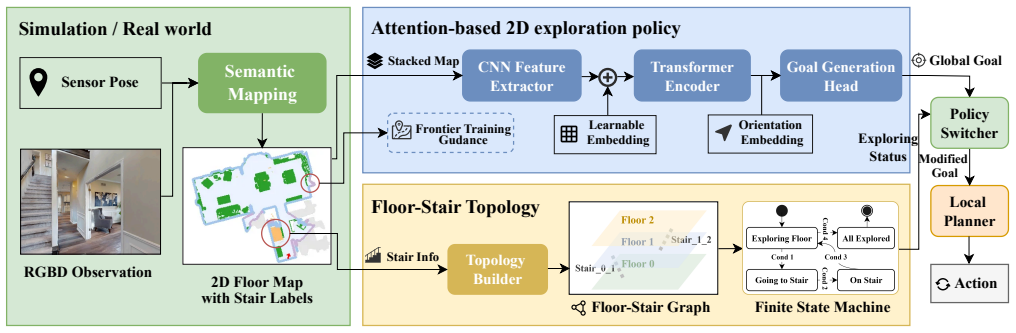
The load-bearing object is the floor-stair topology graph $G=(V,E)$, where each node is a floor's 2D grid map and each edge is a stairway, maintained online by a YOLO11-based instance segmentation model. A finite state machine over four states (ExploringFloor, GoingToStair, OnStair, AllExplored) decides when the current floor is done, directs the agent to the nearest stair center, guides it through the stair, and stops when no new stair edges appear. The 2D policy that runs inside this graph is an attention-based explorer: a CNN extracts features from an $8 \times L \times L$ stacked local-and-global map, a transformer encoder with positional embeddings captures long-range spatial dependencies, and a goal-generation head emits a global goal, while a frontier-distance reward biases training toward informative regions. The Fast Marching Method supplies local paths to each global goal.
What would settle it
Measure the stair detector's precision and recall against hand-labeled stair masks in the same simulated multi-floor scenes used for evaluation and in a set of real staircases with varied lighting. If any nontrivial fraction of stairways is missed, the finite state machine never leaves ExploringFloor and the agent cannot complete the second floor.
Extended reading notes
Core claim
The discovery is a representational reduction: by treating stairs, not geometry, as the only inter-floor coupling, LITE reduces multi-floor exploration to repeated instances of 2D exploration plus a finite state machine. On single-floor benchmarks, LITE-2D reports higher coverage ratio (0.918 vs. 0.901), higher coverage area, higher area weighted by path length, and higher success rate (0.473 vs. 0.407) than the strongest baseline, with ablations attributing the gains to the attention mechanism, the frontier guidance reward, and the orientation embedding. In six multi-floor scenes, the framework averages 0.929 coverage ratio and finishes in 1708 steps, and every baseline explorer placed inside the same topology completes multi-floor exploration. A real-world trial on a quadruped robot in a four-floor teaching building builds a three-floor topology while exploring the first two floors, supporting the generalization claim.
Load-bearing premise
The load-bearing premise is that the stair detector, trained on 1,511 self-labeled internet images, recognizes stairs in the unseen simulated scenes and the real teaching building without scene-specific fine-tuning; every transition between floors depends on a successful detection.
Editorial extensions
If this is right
- If the central claim is right, a 2D reinforcement-learning explorer can be deployed in multi-floor buildings without any 3D training data or 3D observation space.
- The topology is method-agnostic: frontier-based and sampling-based explorers placed in the same graph also complete multi-floor exploration in the paper's six test scenes, though with lower efficiency and more steps.
- The attention mechanism is doing real work: removing it drops coverage ratio from 0.918 to 0.902 and success rate from 0.473 to 0.380, close to the strongest baseline without attention.
- Frontier guidance is what keeps the agent from skipping hard-to-reach regions; its removal lowers area-per-path-length and success rate more than coverage ratio.
- The hardware gap can be bridged: the real quadruped used a different sensor suite and controller than training, and the stair model transferred without fine-tuning.
Reading between the lines
- The same finite state machine should transfer to elevators, ramps, and escalators once the semantic detector is retrained for those transition types; the paper only demonstrates stairs.
- The paper's stair-detection accuracy (0.954 mAP 50-95) is reported only on the detector's own internet-image dataset, so the robustness of floor transitions inside the simulated and real scenes is not directly measured; a held-out stair-mask evaluation on those scenes would separate exploration-policy gains from perception luck.
- Because the finite state machine creates a topology edge only when a stair is detected, a missed stair freezes the agent on the current floor; the system's sensitivity to detector threshold choices is a natural stress test.
Editorial analysis
A structured set of objections, weighed in public.
Referee Report
Summary. The paper presents LITE, a multi-floor exploration system that combines a floor-stair topological graph, a YOLO11-based stair detector, and an attention-based 2D exploration policy trained with PPO. The 2D policy selects global goals from an 8-channel stacked map; a finite state machine uses detected stairs to transition between floors. Experiments compare LITE-2D to frontier, sampling, and neural baselines on HM3D and MP3D, ablate components, test on six HM3D multi-floor scenes, and demonstrate a real-world quadruped deployment.
Significance. If the claims hold, the main significance is a practical recipe for lifting 2D exploration policies to multi-floor buildings without 3D RL, plus evidence that attention-based goal selection improves over prior global-goal policies. The 2D experiments include standard deviations and three ablations, and the trained policy generalizes to held-out MP3D scenes; a real-world validation is a useful bonus. The main weaknesses are that the multi-floor result hinges on an unvalidated stair detector and that the reported gains over ANS Global are small and not statistically supported, so the central 'significantly outperforms' claim is stronger than the evidence.
major comments (4)
- [Algorithms 1 and 2, §IV-D-1, §V-C] The multi-floor architecture depends on the YOLO11 stair detector as the sole mechanism for creating topology edges and triggering floor transitions, but its performance on HM3D and real-world data is never evaluated. The detector is trained on 1,511 self-labeled internet images and its reported mAP (0.954) is only on that dataset; in §V-C it is 'directly deployed' on six HM3D scenes, and in §V-D on a teaching building, with no detection recall/precision on those data. A missed stair prevents the edge from being created (Algorithm 1 lines 4-5 and 11-13), so the FSM never leaves the floor; a false positive can send the agent toward a nonexistent transition. This is not an internal inconsistency, but it is an unvalidated empirical generalization at the system's single point of failure. Please report per-scene stair detection performance on the test scenes and, ideally, the number of successful floor transitions for each scene; without this, the multi-floor claim is unverified.
- [§V-B, Table I] The claim that LITE-2D "significantly outperforms" ANS Global is not supported statistically. The reported gains are CR +1.7% and SR +6.6%, and the standard deviations overlap (0.918 ± 0.071 vs 0.901 ± 0.097). No significance tests or per-scene paired comparisons are provided. Please add paired statistical tests (e.g., paired bootstrap or Wilcoxon signed-rank) and/or per-scene results to substantiate the claimed significance.
- [Table III] The multi-floor comparison reports only aggregate mean CR and steps over six scenes, without variance, per-scene results, or any measure of stair detection/transition success. With n = 6 scenes and no variance, the claim that LITE-2D outperforms other methods in multi-floor exploration is not established. Please provide a per-scene table with CR, steps, and floor-transition outcomes (e.g., number of successful stair transitions, detection recall per scene).
- [§IV-C-4, Table I] The frontier guidance reward in Eq. (2) embeds the frontier-selection heuristic into training. Since the comparison in Table I includes frontier-based baselines, the reported improvements may partly reflect the incorporation of frontier information into the reward rather than a fundamentally superior exploration policy. The ablation in Table II shows that the frontier reward helps, but the comparison to frontier baselines should be framed accordingly, or the policy should be compared to baselines trained with the same frontier signal. This does not invalidate the method, but it tempers the "significantly outperforms all baselines" claim.
minor comments (6)
- [Abstract/Introduction] The term "Learning-Intergrated" in the Introduction should be "Learning-Integrated"; the conclusion repeats the typo as "leaning-integrated".
- [§V-C] The first sentence of §V-C, "We further perform experiments in 6 multi-floor indoor environments of HM3D to c the ability," is incomplete; "to c" should likely be "to test".
- [§V-D] The statement that LITE "constructs the two-floor environment to a three-floor topology" is confusing; if the real building has two explored floors and two stair edges, please describe the topology precisely.
- [Table II] The ablation results report no standard deviations, while Table I includes them; please add standard deviations to Table II for consistency and to assess variability.
- [Eq. (1)] The notation A(at|st, πθ) in Problem 1 is unclear; it should be clarified that A is the covered area at time t given the action, state, and policy parameters.
- [Figure 2] The label "Frontier TrainingGudance" contains a typo, and the orientation embedding is not clearly defined in the text; please provide a concise definition.
Circularity Check
No significant circularity: the 2D policy is trained with an explicit frontier-shaping reward that is ablated and tested on held-out scenes, the floor-stair topology is an algorithmic construction, and the only self-citation is a non-load-bearing local-planner reference.
full rationale
LITE's two claimed results are the attention-based 2D exploration policy and the floor-stair topology for multi-floor exploration. The 2D policy is trained with a reward consisting of area information gain plus an explicit frontier-distance shaping term (Eq. 2). This is a learning signal, not a test-time fit: the policy must combine the shaping reward with information gain, and the paper ablates it (LITE-2D w.o. Frontier), so the reported HM3D/MP3D gains over Nearest/Utility Frontier and ANS Global are not forced by construction. No parameter is fitted to the evaluation scenes, and MP3D is a held-out generalization set. The multi-floor framework is an algorithmic construction: Algorithm 1 grows a graph from YOLO11 stair detections and Algorithm 2 is a deterministic FSM. The stair detector is trained on 1,511 internet images and deployed on HM3D and the real building without a held-out detection evaluation; that is an empirical generalization risk, not a circular derivation, because the detector outputs are inputs to the topology, not predictions derived from the topology. The only self-citation is [31], used as a local planner in the real-world validation; it is a component and not load-bearing for the main claims. Accordingly, no step reduces by definition or by self-citation to its own inputs; score 2 reflects a single minor, non-load-bearing self-citation.
Assumptions & free parameters
free parameters (3)
- lambda =
not reported
- Dmax and Dmin =
not reported
- Tthre =
not reported
assumptions (5)
- domain assumption Information in indoor 3D environments is dense within a floor but sparse between floors, so floor-stair topology is sufficient for multi-floor exploration.
- domain assumption The YOLO11 stair segmentation model trained on 1,511 internet images generalizes to unseen HM3D scenes and the real-world building without fine-tuning.
- ad hoc to paper Stairs can be modeled as rectangles in top-down view, and the perpendicular bisector of the short side gives a valid goal for climbing.
- domain assumption The stacked 2D map (local and global obstacle/explored channels) is a sufficient state representation for learning exploration goals.
- standard math The Fast March Method produces valid local paths to the selected global goals.
Cite this review
Pith. "Pith review of LITE: A Learning-Integrated Topological Explorer for Multi-Floor Indoor Environments." pith.science (2026). https://pith.science/paper/QL3JLZ4J
@misc{pith2026250721517,
  author       = {Pith},
  title        = {Pith review of: LITE: A Learning-Integrated Topological Explorer for Multi-Floor Indoor Environments},
  year         = {2026},
  howpublished = {\url{https://pith.science/paper/QL3JLZ4J}},
  note         = {Machine review of arXiv:2507.21517}
}
read the original abstract
This work focuses on multi-floor indoor exploration, which remains an open area of research. Compared to traditional methods, recent learning-based explorers have demonstrated significant potential due to their robust environmental learning and modeling capabilities, but most are restricted to 2D environments. In this paper, we proposed a learning-integrated topological explorer, LITE, for multi-floor indoor environments. LITE decomposes the environment into a floor-stair topology, enabling seamless integration of learning or non-learning-based 2D exploration methods for 3D exploration. As we incrementally build floor-stair topology in exploration using YOLO11-based instance segmentation model, the agent can transition between floors through a finite state machine. Additionally, we implement an attention-based 2D exploration policy that utilizes an attention mechanism to capture spatial dependencies between different regions, thereby determining the next global goal for more efficient exploration. Extensive comparison and ablation studies conducted on the HM3D and MP3D datasets demonstrate that our proposed 2D exploration policy significantly outperforms all baseline explorers in terms of exploration efficiency. Furthermore, experiments in several 3D multi-floor environments indicate that our framework is compatible with various 2D exploration methods, facilitating effective multi-floor indoor exploration. Finally, we validate our method in the real world with a quadruped robot, highlighting its strong generalization capabilities.
Figures


Figures from the paper (2 more)


Reference graph
Works this paper leans on
-
[1]
F. Niroui, K. Zhang, Z. Kashino, and G. Nejat, “Deep reinforcement learning robot for search and rescue applications: Exploration in unknown cluttered environments,” IEEE Robotics and Automation Letters, vol. 4, no. 2, pp. 610–617, 2019
work page 2019
-
[2]
Informed sampling exploration path planner for 3d reconstruction of large scenes,
Y . Kompis, L. Bartolomei, R. Mascaro, L. Teixeira, and M. Chli, “Informed sampling exploration path planner for 3d reconstruction of large scenes,” IEEE Robotics and Automation Letters , vol. 6, no. 4, pp. 7893–7900, 2021
work page 2021
-
[3]
Shapeshifter: A multi-agent, multi-modal robotic platform for explo- ration of titan,
A. Tagliabue, S. Schneider, M. Pavone, and A.-a. Agha-mohammadi, “Shapeshifter: A multi-agent, multi-modal robotic platform for explo- ration of titan,” in 2020 IEEE aerospace conference . IEEE, 2020, pp. 1–13
work page 2020
-
[4]
A frontier-based approach for autonomous exploration,
B. Yamauchi, “A frontier-based approach for autonomous exploration,” in Proceedings 1997 IEEE International Symposium on Computational Intelligence in Robotics and Automation CIRA’97. ’Towards New Com- putational Principles for Robotics and Automation’ . IEEE, 1997, pp. 146–151
1997
-
[5]
Receding horizon
A. Bircher, M. Kamel, K. Alexis, H. Oleynikova, and R. Siegwart, “Receding horizon” next-best-view” planner for 3d exploration,” in 2016 IEEE international conference on robotics and automation (ICRA). IEEE, 2016, pp. 1462–1468
2016
-
[6]
Graph-based subterranean exploration path planning using aerial and legged robots,
T. Dang, M. Tranzatto, S. Khattak, F. Mascarich, K. Alexis, and M. Hutter, “Graph-based subterranean exploration path planning using aerial and legged robots,” Journal of Field Robotics , vol. 37, no. 8, pp. 1363–1388, 2020
work page 2020
-
[7]
Navigation strategies for exploring indoor environments,
H. H. Gonz ´alez-Banos and J.-C. Latombe, “Navigation strategies for exploring indoor environments,” The International Journal of Robotics Research, vol. 21, no. 10-11, pp. 829–848, 2002
work page 2002
-
[8]
On distance utility in the exploration task,
M. Kulich, J. Faigl, and L. P ˇreuˇcil, “On distance utility in the exploration task,” in 2011 ieee international conference on robotics and automation. IEEE, 2011, pp. 4455–4460
work page 2011
Show all 31 references
-
[9]
Learning to explore using active neural slam,
D. S. Chaplot, D. Gandhi, S. Gupta, A. Gupta, and R. Salakhutdi- nov, “Learning to explore using active neural slam,” arXiv preprint arXiv:2004.05155, 2020
2004 arXiv
-
[10]
Ariadne: A reinforcement learning approach using attention-based deep networks for exploration,
Y . Cao, T. Hou, Y . Wang, X. Yi, and G. Sartoretti, “Ariadne: A reinforcement learning approach using attention-based deep networks for exploration,” in 2023 IEEE International Conference on Robotics and Automation (ICRA) . IEEE, 2023, pp. 10 219–10 225
2023
-
[11]
Fast and compute-efficient sampling-based local exploration planning via distribution learning,
L. Schmid, C. Ni, Y . Zhong, R. Siegwart, and O. Andersson, “Fast and compute-efficient sampling-based local exploration planning via distribution learning,” IEEE Robotics and Automation Letters , vol. 7, no. 3, pp. 7810–7817, 2022
2022
-
[12]
Yolov11: An overview of the key architectural enhancements,
R. Khanam and M. Hussain, “Yolov11: An overview of the key architectural enhancements,” arXiv preprint arXiv:2410.17725 , 2024
2024 arXiv
-
[13]
A multi-resolution frontier-based planner for autonomous 3d explo- ration,
A. Batinovic, T. Petrovic, A. Ivanovic, F. Petric, and S. Bogdan, “A multi-resolution frontier-based planner for autonomous 3d explo- ration,” IEEE Robotics and Automation Letters, vol. 6, no. 3, pp. 4528– 4535, 2021
2021
-
[14]
History-aware autonomous exploration in confined environments us- ing mavs,
C. Witting, M. Fehr, R. B ¨ahnemann, H. Oleynikova, and R. Siegwart, “History-aware autonomous exploration in confined environments us- ing mavs,” in 2018 IEEE/RSJ International Conference on Intelligent Robots and Systems (IROS) . IEEE, 2018, pp. 1–9
2018
-
[15]
An efficient sampling-based method for online informative path planning in unknown environments,
L. Schmid, M. Pantic, R. Khanna, L. Ott, R. Siegwart, and J. Nieto, “An efficient sampling-based method for online informative path planning in unknown environments,” IEEE Robotics and Automation Letters, vol. 5, no. 2, pp. 1500–1507, 2020
2020
-
[16]
Autonomous exploration under uncertainty via deep reinforcement learning on graphs,
F. Chen, J. D. Martin, Y . Huang, J. Wang, and B. Englot, “Autonomous exploration under uncertainty via deep reinforcement learning on graphs,” in 2020 IEEE/RSJ International Conference on Intelligent Robots and Systems (IROS) . IEEE, 2020, pp. 6140–6147
2020
-
[17]
Learning-based path planning for autonomous exploration of sub- terranean environments,
R. Reinhart, T. Dang, E. Hand, C. Papachristos, and K. Alexis, “Learning-based path planning for autonomous exploration of sub- terranean environments,” in 2020 IEEE International Conference on Robotics and Automation (ICRA) . IEEE, 2020, pp. 1215–1221
2020
-
[18]
Where to look next: Learning viewpoint recom- mendations for informative trajectory planning,
M. Lodel, B. Brito, A. Serra-G ´omez, L. Ferranti, R. Babu ˇska, and J. Alonso-Mora, “Where to look next: Learning viewpoint recom- mendations for informative trajectory planning,” in 2022 International Conference on Robotics and Automation (ICRA) . IEEE, 2022, pp. 4466–4472
2022
-
[19]
Deep reinforcement learning for autonomous ground vehicle exploration without a-priori maps,
S. Sivashangaran and A. Eskandarian, “Deep reinforcement learning for autonomous ground vehicle exploration without a-priori maps,” arXiv preprint arXiv:2301.04036 , 2023
2023 arXiv
-
[20]
Deep reinforcement learning-based large-scale robot exploration,
Y . Cao, R. Zhao, Y . Wang, B. Xiang, and G. Sartoretti, “Deep reinforcement learning-based large-scale robot exploration,” IEEE Robotics and Automation Letters , 2024
2024
-
[21]
An autonomous unmanned aerial vehicle system for fast exploration of large complex indoor environments,
V . Kr ´atk`y, P. Petr ´aˇcek, T. B ´aˇca, and M. Saska, “An autonomous unmanned aerial vehicle system for fast exploration of large complex indoor environments,” Journal of field robotics , vol. 38, no. 8, pp. 1036–1058, 2021
2021
-
[22]
Development of an indoor delivery mobile robot for a multi-floor environment,
T. Kim, G. Kang, D. Lee, and D. H. Shim, “Development of an indoor delivery mobile robot for a multi-floor environment,” IEEE Access , 2024
2024
-
[23]
Object goal navigation using goal-oriented semantic exploration,
D. S. Chaplot, D. P. Gandhi, A. Gupta, and R. R. Salakhutdinov, “Object goal navigation using goal-oriented semantic exploration,” Advances in Neural Information Processing Systems , vol. 33, pp. 4247–4258, 2020
2020
-
[24]
Proximal policy optimization algorithms,
J. Schulman, F. Wolski, P. Dhariwal, A. Radford, and O. Klimov, “Proximal policy optimization algorithms,” arXiv preprint arXiv:1707.06347, 2017
2017 arXiv
-
[25]
A fast marching level set method for monotonically advancing fronts
J. A. Sethian, “A fast marching level set method for monotonically advancing fronts.” proceedings of the National Academy of Sciences , vol. 93, no. 4, pp. 1591–1595, 1996
1996
-
[26]
An image is worth 16x16 words: Transformers for image recognition at scale,
A. DOSOVITSKIY , “An image is worth 16x16 words: Transformers for image recognition at scale,” arXiv preprint arXiv:2010.11929 , 2020
2010 arXiv
-
[27]
Segment anything,
A. Kirillov, E. Mintun, N. Ravi, H. Mao, C. Rolland, L. Gustafson, T. Xiao, S. Whitehead, A. C. Berg, W.-Y . Lo, P. Doll ´ar, and R. Gir- shick, “Segment anything,” arXiv:2304.02643, 2023
2023 arXiv
-
[28]
Habitat 2.0: Training home assistants to rearrange their habitat,
A. Szot, A. Clegg, E. Undersander, E. Wijmans, Y . Zhao, J. Turner, N. Maestre, M. Mukadam, D. Chaplot, O. Maksymets, A. Gokaslan, V . V ondrus, S. Dharur, F. Meier, W. Galuba, A. Chang, Z. Kira, V . Koltun, J. Malik, M. Savva, and D. Batra, “Habitat 2.0: Training home assista...
2021
-
[29]
Habitat-matterport 3d dataset (HM3d): 1000 large-scale 3d environments for embodied AI,
S. K. Ramakrishnan, A. Gokaslan, E. Wijmans, O. Maksymets, A. Clegg, J. M. Turner, E. Undersander, W. Galuba, A. Westbury, A. X. Chang, M. Savva, Y . Zhao, and D. Batra, “Habitat-matterport 3d dataset (HM3d): 1000 large-scale 3d environments for embodied AI,” in Thirty-fifth C...
2021 arXiv
-
[30]
Matterport3d: Learning from rgb-d data in indoor environments,
A. Chang, A. Dai, T. Funkhouser, M. Halber, M. Niessner, M. Savva, S. Song, A. Zeng, and Y . Zhang, “Matterport3d: Learning from rgb-d data in indoor environments,” International Conference on 3D Vision (3DV), 2017
2017
-
[31]
Efficient motion planning based on kinodynamic model for quadruped robots following persons in confined spaces,
Z. Zhang, J. Yan, X. Kong, G. Zhai, and Y . Liu, “Efficient motion planning based on kinodynamic model for quadruped robots following persons in confined spaces,” IEEE/ASME Transactions on Mechatronics, vol. 26, pp. 1997–2006, 2021. [Online]. Available: https://api.semanticsch...
1997
Reviewed August 6, 2026 · model on record in the stance chip above.
Discussion (0). Sign in to comment.