REVIEW 4 major objections 4 minor 60 references
Optimizing Active Learning in Vision-Language Models via Parameter-Efficient Uncertainty Calibration
T0 review · 4 major / 4 minor · reviewed 2026-08-06 · deepseek-v4-flash
Pith's one-line read Calibrating uncertainty during training makes active learning pick better samples, beating entropy baselines and matching costly feature-based methods at linear cost.
desk verdict A useful Prompt-vs-LoRA comparison and a plausible calibrated-entropy method, but the headline AL gain is undermined by an unclear α selection protocol and small overlapping margins. read the letter →
The pith
A machine-rendered reading of the paper's core claim, the machinery that carries it, and where it could break.
The reading
What carries the argument
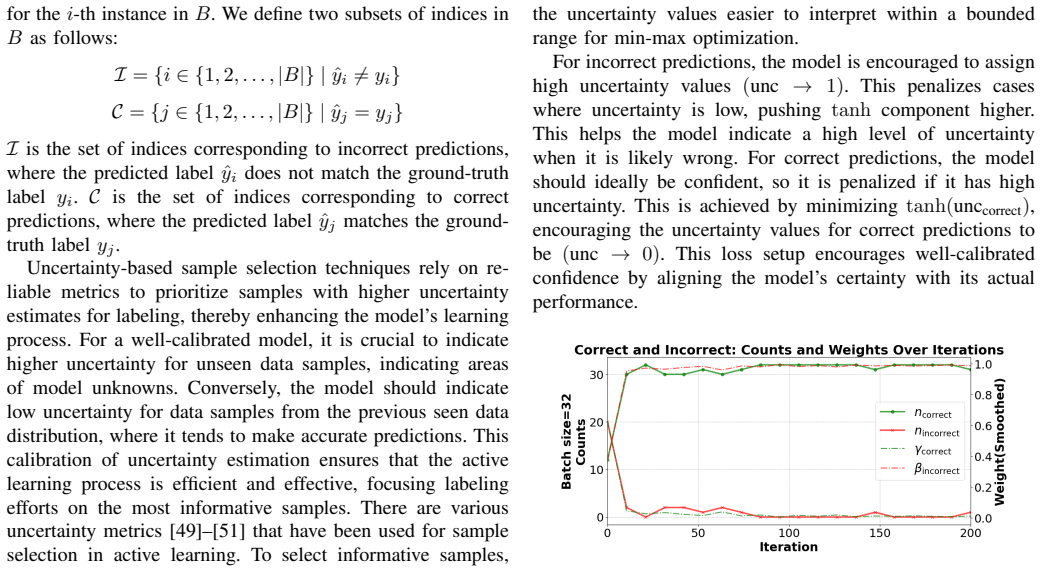
The machinery is the threshold-free calibration loss $L_{\text{calib}} = \gamma_{\text{correct}} L_C + \beta_{\text{incorrect}} L_I$, where $L_I$ pushes the tanh-scaled predictive entropy toward 1 on misclassified samples and $L_C$ pushes it toward 0 on correctly classified samples. The weights $\gamma_{\text{correct}}$ and $\beta_{\text{incorrect}}$ are set by the mini-batch counts of correct and incorrect predictions, and the calibration term is added to the cross-entropy loss with a linearly annealed coefficient $\alpha$. This loss converts statistics from the current labeled set into gradients that reshape the entropy ranking used to select unlabeled samples.
What would settle it
Measure the rank correlation between C-PEAL's calibrated entropy on unlabeled samples and the reduction in test error each unlabeled sample would produce if labeled, in one early active-learning cycle with a deliberately biased labeled pool; a non-positive correlation would show that the labeled-set calibration does not transfer to unlabeled informativeness.
Extended reading notes
Core claim
The central claim is that adding a threshold-free, differentiable uncertainty-calibration loss to parameter-efficient fine-tuning improves the informativeness of entropy-based sample selection. Within each mini-batch, the loss penalizes low entropy on misclassified examples and high entropy on correctly classified examples, using weights that adapt to the changing balance of correct and incorrect predictions, and an annealed coefficient that gradually raises the influence of the calibration term. The calibrated model then ranks the unlabeled pool by entropy and asks for labels on the top-scoring samples. The paper reports final-accuracy gains of roughly 1-3% over entropy baselines in prompt-learning setups, accuracy that is superior or competitive relative to BADGE at O(n) runtime, reduced expected calibration error across active-learning cycles, and further gains when the calibration loss is combined with LoRA adapters.
Load-bearing premise
The load-bearing premise is that optimizing the calibration loss on the current labeled set makes the entropy values of unlabeled samples rank them by true informativeness.
Editorial extensions
If this is right
- With prompt learning, C-PEAL raises final accuracy by roughly 1-3% over entropy selection across the four datasets, with the largest reported gain (+3.21%) on EuroSAT.
- On the ViT-B/32 prompt-learning setup, C-PEAL reaches an average accuracy of 79.43-80.10%, above BADGE's 78.67%, while keeping selection runtime in O(n) rather than O(n^2).
- Under LoRA, C-PEAL reaches 85.27% average accuracy versus 80.10% with prompt learning, and exceeds CLIP zero-shot performance on all four datasets.
- Expected calibration error decreases across active-learning cycles when the calibration loss is used, indicating that the model's confidence and accuracy become better aligned.
- The method remains compatible with the standard class-balanced few-shot active-learning loop, selecting B = K samples per cycle where K is the number of classes.
Reading between the lines
- The paper leaves implicit that the same calibration loss could steer other differentiable uncertainty scores, such as margin, BALD, or predictive variance, since the entropy function acts as a plug-in component; a direct comparison would test whether the calibration gains persist across uncertainty measures.
- The large LoRA-versus-prompt gap suggests that the fine-tuning parameterization, not the sampler, may be the dominant driver of early active-learning performance; one testable extension is running C-PEAL with adapters at different layers or ranks to separate these effects.
- The transfer claim could be stress-tested on non-representative initial labeled pools, such as a single skewed class, where labeled-set calibration may not improve unlabeled ranking; such a test would delimit when C-PEAL helps.
- Because the paper evaluates only four datasets with CLIP-style backbones, applying the loss to other vision-language architectures or to out-of-distribution detection tasks would check whether the calibration mechanism generalizes.
Editorial analysis
A structured set of objections, weighed in public.
Referee Report
Summary. This paper proposes C-PEAL, a few-shot active learning strategy for CLIP that adds a differentiable uncertainty-calibration loss to cross-entropy training under either prompt learning or LoRA. The loss penalizes high predictive entropy on correctly classified labeled examples and low predictive entropy on misclassified labeled examples, with dynamic per-mini-batch weights gamma and beta. At each AL cycle the model is retrained on the labeled set and selects the samples with the largest predictive entropy from the unlabeled pool. The authors report experiments on EuroSAT, Caltech101, DTD, and Oxford Pets with ResNet-50, ViT-B/16, and ViT-B/32, comparing against O(n) methods (Entropy, Softmax, Margin) and O(n^2) methods (Coreset, BADGE), and claim superior or comparable final accuracy with O(n) selection runtime. They also benchmark prompt learning against LoRA and report that LoRA gives substantially higher accuracy.
Significance. An O(n) selection method that reliably matches or beats BADGE would be practically useful for adapting large vision-language models, and the prompt-versus-LoRA comparison addresses an under-explored question in active learning. The calibration loss is simple, threshold-free, and adds little computational overhead, which are genuine strengths. The paper also reports multiple seeds, cycle-wise curves, and an explicit runtime comparison in Table I. However, the significance is currently undercut by the empirical protocol: the alpha hyperparameter is selected without a described validation split, several headline differences are within one standard deviation, and some cross-dataset claims are contradicted by the paper's own Table III. The claimed advantage therefore needs to be re-established with a valid tuning protocol before the results can be regarded as reliable evidence.
major comments (4)
- [V (Experiments and Discussion) and V-A (Active learning setup)] The paper never specifies a validation split for the grid search over alpha. Section V says alpha is chosen by 'conducting a grid search for alpha values in the range of 0.1 to 1.0, selecting the best-performing value,' and Section V-A describes a few-shot AL setup with no held-out labeled validation set; the only fully labeled data are the test sets of EuroSAT, Caltech101, DTD, and Oxford Pets. If 'best-performing' means best final test accuracy per dataset and backbone, then C-PEAL's comparison in Tables II-IV is an oracle-selected upper bound rather than a fair comparison against Entropy or BADGE, whose hyperparameters are not tuned in the same way. The sentence in Section IV-B that alpha 'primarily affects the speed of convergence, with minimal impact on final accuracy' makes the search both unexplained and potentially load-bearing. Please specify the validation split or nested procedure used, or report a sensitivity analysis over alpha that does not touch the test set.
- [V-B (Prompt learning Results) and Table III] The claim that 'our method outperforms approaches like BADGE across all datasets' is not supported by the paper's own cycle-wise results in Table III. For example, with R50 on DTD at Cycle 8, C-PEAL+INTERW is 58.25 +/- 1.77 versus BADGE at 58.43 +/- 0.73, and with ViT-B/16 on Caltech101 at Cycle 8, C-PEAL+INTERW is 94.23 +/- 0.28 versus BADGE at 94.44 +/- 0.13. Section V-D also concedes a -0.15% shortfall against BADGE on Caltech101 in another setting. The broad statement in Section V-B and the abstract should be qualified to the specific setup where it holds, or the cross-backbone claims should be revised to be consistent with Tables III and IV and Figure 6.
- [Tables II and III; Section V-A (seeds)] Many of the reported gains are not statistically supported. With only three seeds, several headline differences overlap within one standard deviation; for example, in Table II the base C-PEAL versus Entropy comparison is 61.0 +/- 0.09 versus 59.73 +/- 1.96 on DTD and 92.64 +/- 0.35 versus 92.41 +/- 0.50 on Caltech101. The larger EuroSAT gain of +3.21 pp (C-PEAL+INTERW 84.01 +/- 0.12 versus Entropy 80.80 +/- 2.88) is a single-dataset result and is subject to the unvalidated alpha protocol described above. Since Section V-A states that the same seeds are used consistently across methods, reporting paired seed-wise differences or increasing the number of seeds would establish whether the improvements are systematic rather than seed noise.
- [IV-A (Calibrated Uncertainty) and IV-C (Uncertainty Calibration in AL)] The load-bearing assumption is that minimizing the calibration loss on the current labeled set improves the entropy ranking of unlabeled samples in a way that increases AL selection quality. Figure 3 shows that C-PEAL lowers ECE, but lower ECE on the evaluated data does not by itself demonstrate that the highest-entropy samples after calibration are more informative for the next AL round. The paper should provide direct evidence for this transfer, for example by analyzing the composition of the selected sets, comparing selected-sample accuracy, or running an ablation that separates the effect of the calibration loss on training from the effect of entropy-based selection. Without such evidence, the mechanism linking the loss to the final-accuracy gains is asserted rather than demonstrated.
minor comments (4)
- [Section I, footnote 1] The code URL 'https://github.com/IntelLabs/C PEAL' contains a space and is not a valid URL; the repository cannot be audited in its current form.
- [Section IV-B] The sentence 'It is linearly annealed over training to gradually increase its influence...' appears twice verbatim, and the surrounding text is ambiguous about whether alpha is fixed (as stated in Section V-B for the base method) or annealed (as stated in Section IV-B). Please reconcile these descriptions.
- [Section V (Experiments)] The labels 'ViT-B/16 (Small)' and 'ViT-B/32 (Large)' are misleading: both are base-size ViT variants of the same parameter scale and differ mainly in patch size and sequence length.
- [Algorithm 1 and Section IV-A] Algorithm 1 says 'Initialize seed S' but the seed is not used in the pseudocode, and the symbol B denotes both a mini-batch in Section IV-A and the number of selected samples in Algorithm 1, which is confusing.
Circularity Check
No circularity: the calibration loss is a training signal, not a fitted stand-in for the reported accuracy, and the alpha grid search is a protocol concern rather than a definitional reduction.
full rationale
The paper's central claim is empirical: adding the calibration loss of Section IV-B to the AL training loop improves later test accuracy relative to entropy and BADGE. That claim is not derived by defining a quantity in terms of the target result. The loss L = L_CE + alpha*L_calib is a differentiable training objective computed on the current labeled mini-batch; the selection step then ranks unlabeled samples by predictive entropy. No equation equates the reported final accuracy to the loss or to the alpha hyperparameter. The alpha grid search in Section V, described as 'conducting a grid search for alpha values in the range of 0.1 to 1.0, selecting the best-performing value,' is a hyperparameter-selection protocol; if it was done on the test split, that is an evaluation-leakage risk, but alpha is not renamed as a prediction, so it is not a circular step under the stated criteria. The self-citations are background: [41] introduced AvUC, but the paper explicitly replaces it with a threshold-free tanh-based loss, and [30] is cited for related PEAL work rather than as the source of the reported gains. Baselines from [32] are rerun with the same seeds, so the comparison is self-contained. The malformed code URL and the unspecified validation split are reproducibility limitations, not circularity. Because no specific reduction can be exhibited by quoting the paper, the circularity score is 0.
Assumptions & free parameters
free parameters (2)
- alpha (calibration loss weight) =
not reported; grid searched over [0.1, 1.0] per dataset/backbone
- LoRA rank r =
r=4 for Oxford Pets, DTD, Caltech101; r=2 for EuroSAT
assumptions (3)
- domain assumption Improving entropy calibration on the labeled set improves the informativeness ranking of unlabeled samples in active learning.
- domain assumption Predictive entropy is a sufficient uncertainty statistic for informative sample selection.
- ad hoc to paper The dynamic weighting scheme (γ, β) and tanh scaling preserve gradients and improve convergence.
Cite this review
Pith. "Pith review of Optimizing Active Learning in Vision-Language Models via Parameter-Efficient Uncertainty Calibration." pith.science (2026). https://pith.science/paper/ZWRLTKTF
@misc{pith2026250721521,
  author       = {Pith},
  title        = {Pith review of: Optimizing Active Learning in Vision-Language Models via Parameter-Efficient Uncertainty Calibration},
  year         = {2026},
  howpublished = {\url{https://pith.science/paper/ZWRLTKTF}},
  note         = {Machine review of arXiv:2507.21521}
}
read the original abstract
Active Learning (AL) has emerged as a powerful approach for minimizing labeling costs by selectively sampling the most informative data for neural network model development. Effective AL for large-scale vision-language models necessitates addressing challenges in uncertainty estimation and efficient sampling given the vast number of parameters involved. In this work, we introduce a novel parameter-efficient learning methodology that incorporates uncertainty calibration loss within the AL framework. We propose a differentiable loss function that promotes uncertainty calibration for effectively selecting fewer and most informative data samples for fine-tuning. Through extensive experiments across several datasets and vision backbones, we demonstrate that our solution can match and exceed the performance of complex feature-based sampling techniques while being computationally very efficient. Additionally, we investigate the efficacy of Prompt learning versus Low-rank adaptation (LoRA) in sample selection, providing a detailed comparative analysis of these methods in the context of efficient AL.
Figures


Figures from the paper (3 more)


Reference graph
Works this paper leans on
-
[1]
Meta-adapter: An online few-shot learner for vision-language model,
L. Song, R. Xue, H. Wang, H. Sun, Y . Ge, Y . Shanet al., “Meta-adapter: An online few-shot learner for vision-language model,” Advances in Neural Information Processing Systems , vol. 36, pp. 55 361–55 374, 2023
work page 2023
-
[2]
Zero-shot visual reasoning by vision- language models: Benchmarking and analysis,
A. Nagar, S. Jaiswal, and C. Tan, “Zero-shot visual reasoning by vision- language models: Benchmarking and analysis,” in 2024 International Joint Conference on Neural Networks (IJCNN) . IEEE, 2024, pp. 1–8
work page 2024
-
[3]
Look before you leap: Unveiling the power of gpt-4v in robotic vision-language planning,
Y . Hu, F. Lin, T. Zhang, L. Yi, and Y . Gao, “Look before you leap: Unveiling the power of gpt-4v in robotic vision-language planning,” arXiv preprint arXiv:2311.17842 , 2023
arXiv 2023
-
[4]
Deepseek-vl: Towards real-world vision-language understanding,
H. Lu, W. Liu, B. Zhang, B. Wang, K. Dong, B. Liu, J. Sun, T. Ren, Z. Li, H. Yang et al., “Deepseek-vl: Towards real-world vision-language understanding,” CoRR, 2024
work page 2024
-
[5]
Active learning literature survey,
B. Settles, “Active learning literature survey,” University of Wisconsin- Madison Department of Computer Sciences, Technical Report 1648, 2009
work page 2009
-
[6]
A survey of deep active learning,
P. Ren, Y . Xiao, X. Chang, P.-Y . Huang, Z. Li, B. B. Gupta, X. Chen, and X. Wang, “A survey of deep active learning,” ACM computing surveys (CSUR), vol. 54, no. 9, pp. 1–40, 2021
work page 2021
-
[7]
Learning transferable visual models from natural language supervision,
A. Radford, J. W. Kim, C. Hallacy, A. Ramesh, G. Goh, S. Agarwal, G. Sastry, A. Askell, P. Mishkin, J. Clark et al., “Learning transferable visual models from natural language supervision,” in International conference on machine learning . PMLR, 2021, pp. 8748–8763
2021
-
[8]
Zero-shot text-to-image generation,
A. Ramesh, M. Pavlov, G. Goh, S. Gray, C. V oss, A. Radford, M. Chen, and I. Sutskever, “Zero-shot text-to-image generation,” in International conference on machine learning . Pmlr, 2021, pp. 8821–8831
work page 2021
Show all 60 references
-
[9]
Flava: A foundational language and vision alignment model,
A. Singh, R. Hu, V . Goswami, G. Couairon, W. Galuba, M. Rohrbach, and D. Kiela, “Flava: A foundational language and vision alignment model,” in Proceedings of the IEEE/CVF Conference on Computer Vision and Pattern Recognition , 2022, pp. 15 638–15 650
2022
-
[10]
Overconfidence is key: Verbalized uncertainty evaluation in large language and vision-language models,
T. Groot and M. Valdenegro Toro, “Overconfidence is key: Verbalized uncertainty evaluation in large language and vision-language models,” in Proceedings of the 4th Workshop on Trustworthy Natural Language Processing (TrustNLP 2024) , A. Ovalle, K.-W. Chang, Y . T. Cao, N. Mehr...
2024
-
[11]
Seeing is believing: Mitigating hallu- cination in large vision-language models via clip-guided decoding,
A. Deng, Z. Chen, and B. Hooi, “Seeing is believing: Mitigating hallu- cination in large vision-language models via clip-guided decoding,” in ICLR 2024 Workshop on Reliable and Responsible Foundation Models , 2024
2024
-
[12]
A survey on hallucination in large vision-language models,
H. Liu, W. Xue, Y . Chen, D. Chen, X. Zhao, K. Wang, L. Hou, R. Li, and W. Peng, “A survey on hallucination in large vision-language models,” arXiv preprint arXiv:2402.00253 , 2024
2024 arXiv
-
[13]
A survey of hallucination in large foundation models,
V . Rawte, A. Sheth, and A. Das, “A survey of hallucination in large foundation models,” arXiv preprint arXiv:2309.05922 , 2023
2023 arXiv
-
[14]
Can llms express their uncertainty? an empirical evaluation of confidence elicitation in llms,
M. Xiong, Z. Hu, X. Lu, Y . Li, J. Fu, J. He, and B. Hooi, “Can llms express their uncertainty? an empirical evaluation of confidence elicitation in llms,” arXiv preprint arXiv:2306.13063 , 2023
2023 arXiv
-
[15]
Lm-polygraph: Uncertainty estimation for language models,
E. Fadeeva, R. Vashurin, A. Tsvigun, A. Vazhentsev, S. Petrakov, K. Fedyanin, D. Vasilev, E. Goncharova, A. Panchenko, M. Panov et al., “Lm-polygraph: Uncertainty estimation for language models,” arXiv preprint arXiv:2311.07383, 2023
2023 arXiv
-
[16]
Enhancing trust in large language models with uncertainty-aware fine-tuning,
R. Krishnan, P. Khanna, and O. Tickoo, “Enhancing trust in large language models with uncertainty-aware fine-tuning,” arXiv preprint arXiv:2412.02904, 2024
2024 arXiv
-
[17]
Overconfidence is key: Verbalized uncertainty evaluation in large language and vision-language models,
T. Groot and M. Valdenegro-Toro, “Overconfidence is key: Verbalized uncertainty evaluation in large language and vision-language models,” arXiv preprint arXiv:2405.02917 , 2024
2024 arXiv
-
[18]
Activedc: Distribution calibration for active finetuning,
W. Xu, Z. Hu, Y . Lu, J. Meng, Q. Liu, and Y . Wang, “Activedc: Distribution calibration for active finetuning,” in Proceedings of the IEEE/CVF Conference on Computer Vision and Pattern Recognition (CVPR), June 2024, pp. 16 996–17 005
2024
-
[19]
Active finetuning: Exploiting annotation budget in the pretraining-finetuning paradigm,
Y . Xie, H. Lu, J. Yan, X. Yang, M. Tomizuka, and W. Zhan, “Active finetuning: Exploiting annotation budget in the pretraining-finetuning paradigm,” in Proceedings of the IEEE/CVF Conference on Computer Vision and Pattern Recognition , 2023, pp. 23 715–23 724
2023
-
[20]
Querying easily flip-flopped samples for deep active learning,
S. J. Cho, G. Kim, J. Lee, J. Shin, and C. D. Yoo, “Querying easily flip-flopped samples for deep active learning,” in The Twelfth International Conference on Learning Representations , 2024. [Online]. Available: https://openreview.net/forum?id=THUBTfSAS2
2024
-
[21]
Active learning for convolutional neural networks: A core-set approach,
O. Sener and S. Savarese, “Active learning for convolutional neural networks: A core-set approach,” arXiv preprint arXiv:1708.00489, 2017
2017 arXiv
-
[22]
Learning loss for active learning,
D. Yoo and I. S. Kweon, “Learning loss for active learning,” in Pro- ceedings of the IEEE/CVF conference on computer vision and pattern recognition, 2019, pp. 93–102
2019
-
[23]
Deep active learning for image classification,
H. Ranganathan, H. Venkateswara, S. Chakraborty, and S. Panchanathan, “Deep active learning for image classification,” in 2017 IEEE Interna- tional Conference on Image Processing (ICIP). IEEE, 2017, pp. 3934– 3938
2017
-
[24]
Entropy-based active learning for object detection with progressive diversity constraint,
J. Wu, J. Chen, and D. Huang, “Entropy-based active learning for object detection with progressive diversity constraint,” in Proceedings of the IEEE/CVF Conference on Computer Vision and Pattern Recognition , 2022, pp. 9397–9406
2022
-
[25]
Active learn- ing for deep object detection via probabilistic modeling,
J. Choi, I. Elezi, H.-J. Lee, C. Farabet, and J. M. Alvarez, “Active learn- ing for deep object detection via probabilistic modeling,” in Proceedings of the IEEE/CVF International Conference on Computer Vision , 2021, pp. 10 264–10 273
2021
-
[26]
Margin-based active learning for structured output spaces,
D. Roth and K. Small, “Margin-based active learning for structured output spaces,” in Machine Learning: ECML 2006: 17th European Conference on Machine Learning Berlin, Germany, September 18-22, 2006 Proceedings 17 . Springer, 2006, pp. 413–424
2006
-
[27]
A survey of deep active learning for foundation models,
T. Wan, K. Xu, T. Yu, X. Wang, D. Feng, B. Ding, and H. Wang, “A survey of deep active learning for foundation models,” Intelligent Computing, vol. 2, p. 0058, 2023
2023
-
[28]
Revisiting active learning in the era of vision foundation models,
S. R. Gupte, J. Aklilu, J. J. Nirschl, and S. Yeung-Levy, “Revisiting active learning in the era of vision foundation models,” Transactions on Machine Learning Research, 2024. [Online]. Available: https://openreview.net/forum?id=u8K83M9mbG
2024
-
[29]
Active learning over multiple domains in natural language tasks,
S. Longpre, J. Reisler, E. G. Huang, Y . Lu, A. Frank, N. Ramesh, and C. DuBois, “Active learning over multiple domains in natural language tasks,” arXiv preprint arXiv:2202.00254 , 2022
2022 arXiv
-
[30]
Parameter-efficient active learning for foundational models,
A. L. Narayanan, R. Krishnan, A. Machireddy, and M. Subedar, “Parameter-efficient active learning for foundational models,” 2024. [Online]. Available: https://arxiv.org/abs/2406.09296
2024 arXiv
-
[31]
Source- free continual adaptive learning with limited labels on evolving data drifts,
A. Machireddy, R. Krishnan, A. L. Narayanan, and O. Tickoo, “Source- free continual adaptive learning with limited labels on evolving data drifts,” in 2024 IEEE International Conference on Image Processing (ICIP). IEEE, 2024, pp. 416–422
2024
-
[32]
Active prompt learning in vision language models,
J. Bang, S. Ahn, and J.-G. Lee, “Active prompt learning in vision language models,” in Proceedings of the IEEE/CVF Conference on Computer Vision and Pattern Recognition , 2024, pp. 27 004–27 014
2024
-
[33]
Learning to prompt for vision- language models,
K. Zhou, J. Yang, C. C. Loy, and Z. Liu, “Learning to prompt for vision- language models,” International Journal of Computer Vision , vol. 130, no. 9, pp. 2337–2348, 2022
2022
-
[34]
One-shot active learning for image segmentation via contrastive learning and diversity-based sampling,
Q. Jin, M. Yuan, Q. Qiao, and Z. Song, “One-shot active learning for image segmentation via contrastive learning and diversity-based sampling,” Knowledge-Based Systems, vol. 241, p. 108278, 2022
2022
-
[35]
Few-shot object detection with foundation models,
G. Han and S.-N. Lim, “Few-shot object detection with foundation models,” in Proceedings of the IEEE/CVF Conference on Computer Vision and Pattern Recognition (CVPR) , June 2024, pp. 28 608–28 618
2024
-
[36]
A closer look at the few-shot adaptation of large vision-language models,
J. Silva-Rodr ´ıguez, S. Hajimiri, I. Ben Ayed, and J. Dolz, “A closer look at the few-shot adaptation of large vision-language models,” in Proceedings of the IEEE/CVF Conference on Computer Vision and Pattern Recognition (CVPR), June 2024, pp. 23 681–23 690
2024
-
[37]
Parameter efficient fine-tuning via cross block orchestration for segment anything model,
Z. Peng, Z. Xu, Z. Zeng, L. Xie, Q. Tian, and W. Shen, “Parameter efficient fine-tuning via cross block orchestration for segment anything model,” in Proceedings of the IEEE/CVF Conference on Computer Vision and Pattern Recognition (CVPR) , June 2024, pp. 3743–3752
2024
-
[38]
Pela: Learning parameter- efficient models with low-rank approximation,
Y . Guo, G. Wang, and M. Kankanhalli, “Pela: Learning parameter- efficient models with low-rank approximation,” in Proceedings of the IEEE/CVF Conference on Computer Vision and Pattern Recognition (CVPR), June 2024, pp. 15 699–15 709
2024
-
[39]
Maple: Multi-modal prompt learning,
M. U. Khattak, H. Rasheed, M. Maaz, S. Khan, and F. S. Khan, “Maple: Multi-modal prompt learning,” in Proceedings of the IEEE/CVF Conference on Computer Vision and Pattern Recognition , 2023, pp. 19 113–19 122
2023
-
[40]
Conditional prompt learning for vision-language models,
K. Zhou, J. Yang, C. C. Loy, and Z. Liu, “Conditional prompt learning for vision-language models,” in Proceedings of the IEEE/CVF confer- ence on computer vision and pattern recognition , 2022, pp. 16 816– 16 825
2022
-
[41]
Improving model calibration with accu- racy versus uncertainty optimization,
R. Krishnan and O. Tickoo, “Improving model calibration with accu- racy versus uncertainty optimization,” Advances in Neural Information Processing Systems, vol. 33, pp. 18 237–18 248, 2020
2020
-
[42]
Soft calibration objectives for neural net- works,
N. Cain, A. Karandikar, D. Tran, B. Lakshminarayanan, M. C. Mozer, J. Shlens, and R. Roelofs, “Soft calibration objectives for neural net- works,” in Advances in Neural Information Processing Systems , vol. 34. Curran Associates, Inc., 2021, pp. 25 888–25 900
2021
-
[43]
The power of scale for parameter-efficient prompt tuning,
B. Lester, R. Al-Rfou, and N. Constant, “The power of scale for parameter-efficient prompt tuning,” in Proceedings of the 2021 Conference on Empirical Methods in Natural Language Processing , 2021, pp. 3045–3059. [Online]. Available: https://aclanthology.org/ 2021.emnlp-main.243
2021
-
[44]
LoRA: Low-rank adaptation of large language models,
E. J. Hu, yelong shen, P. Wallis, Z. Allen-Zhu, Y . Li, S. Wang, L. Wang, and W. Chen, “LoRA: Low-rank adaptation of large language models,” in International Conference on Learning Representations , 2022. [Online]. Available: https://openreview.net/forum?id=nZeVKeeFYf9
2022
-
[45]
Deep batch active learning by diverse, uncertain gradient lower bounds,
J. T. Ash, C. Zhang, A. Krishnamurthy, J. Langford, and A. Agar- wal, “Deep batch active learning by diverse, uncertain gradient lower bounds,” arXiv preprint arXiv:1906.03671 , 2019
1906 arXiv
-
[46]
Robust contrastive active learning with feature-guided query strategies,
R. Krishnan, N. Ahuja, A. Sinha, M. Subedar, O. Tickoo, and R. Iyer, “Robust contrastive active learning with feature-guided query strategies,” arXiv preprint arXiv:2109.06873 , 2021
2021 arXiv
-
[47]
On calibration of modern neural networks,
C. Guo, G. Pleiss, Y . Sun, and K. Q. Weinberger, “On calibration of modern neural networks,” in International conference on machine learning. PMLR, 2017, pp. 1321–1330
2017
-
[48]
Obtaining well calibrated probabilities using bayesian binning,
M. P. Naeini, G. Cooper, and M. Hauskrecht, “Obtaining well calibrated probabilities using bayesian binning,” in Proceedings of the AAAI conference on artificial intelligence , vol. 29, no. 1, 2015
2015
-
[49]
A mathematical theory of communication,
C. E. Shannon, “A mathematical theory of communication,” Bell System Technical Journal, vol. 27, no. 3, pp. 379–423, 1948
1948
-
[50]
Bayesian active learning for classification and preference learning,
N. Houlsby, F. Husz ´ar, Z. Ghahramani, and M. Lengyel, “Bayesian active learning for classification and preference learning,” arXiv preprint arXiv:1112.5745, 2011
2011 arXiv
-
[51]
Deep deterministic uncertainty: A new simple baseline,
J. Mukhoti, A. Kirsch, J. van Amersfoort, P. H. Torr, and Y . Gal, “Deep deterministic uncertainty: A new simple baseline,” in Proceedings of the IEEE/CVF Conference on Computer Vision and Pattern Recognition , 2023, pp. 24 384–24 394
2023
-
[52]
Active learning for convolutional neural networks: A core-set approach,
O. Sener and S. Savarese, “Active learning for convolutional neural networks: A core-set approach,” in International Conference on Learning Representations , 2018. [Online]. Available: https: //openreview.net/forum?id=H1aIuk-RW
2018
-
[53]
Eurosat: A novel dataset and deep learning benchmark for land use and land cover classi- fication,
P. Helber, B. Bischke, A. Dengel, and D. Borth, “Eurosat: A novel dataset and deep learning benchmark for land use and land cover classi- fication,” IEEE Journal of Selected Topics in Applied Earth Observations and Remote Sensing , vol. 12, no. 7, pp. 2217–2226, 2019
2019
-
[54]
One-shot learning of object cate- gories,
L. Fei-Fei, R. Fergus, and P. Perona, “One-shot learning of object cate- gories,” IEEE transactions on pattern analysis and machine intelligence, vol. 28, no. 4, pp. 594–611, 2006
2006
-
[55]
Describing textures in the wild,
M. Cimpoi, S. Maji, I. Kokkinos, S. Mohamed, , and A. Vedaldi, “Describing textures in the wild,” in Proceedings of the IEEE Conf. on Computer Vision and Pattern Recognition (CVPR) , 2014
2014
-
[56]
Cats and dogs,
O. M. Parkhi, A. Vedaldi, A. Zisserman, and C. V . Jawahar, “Cats and dogs,” in IEEE Conference on Computer Vision and Pattern Recognition, 2012
2012
-
[57]
Deep residual learning for image recognition,
K. He, X. Zhang, S. Ren, and J. Sun, “Deep residual learning for image recognition,” in Proceedings of the IEEE conference on computer vision and pattern recognition , 2016, pp. 770–778
2016
-
[58]
An image is worth 16x16 words: Transformers for image recognition at scale,
A. Dosovitskiy, L. Beyer, A. Kolesnikov, D. Weissenborn, X. Zhai, T. Unterthiner, M. Dehghani, M. Minderer, G. Heigold, S. Gelly, J. Uszkoreit, and N. Houlsby, “An image is worth 16x16 words: Transformers for image recognition at scale,” in International Conference on Learning...
2021
- [59]
-
[60]
Low-rank few-shot adaptation of vision- language models,
M. Zanella and I. Ben Ayed, “Low-rank few-shot adaptation of vision- language models,” in Proceedings of the IEEE/CVF Conference on Computer Vision and Pattern Recognition Workshops , 2024, pp. 1593– 1603
2024
Reviewed August 6, 2026 · model on record in the stance chip above.
Discussion (0). Continue with ORCID to comment.