REVIEW 4 major objections 4 minor 115 references
Distributionally Robust Shape and Topology Optimization
T0 review · 4 major / 4 minor · reviewed 2026-08-06 · deepseek-v4-flash
Pith's one-line read This paper shows that distributionally robust shape and topology optimization—minimizing the worst expected cost over Wasserstein, moment, or CVaR ambiguity sets—can be rewritten as a single-level, augmented-variable problem, so…
desk verdict The framework is plausible, but the m=0 Wasserstein experiments solve an empty ambiguity set and the reported designs are artifacts; that needs fixing before the numerics can be trusted. read the letter →
The pith
A machine-rendered reading of the paper's core claim, the machinery that carries it, and where it could break.
The reading
What carries the argument
The mechanism that carries the argument is entropy penalization of the ambiguity constraint. The entropy-regularized Wasserstein distance $W_\varepsilon(P,Q)$ is defined by minimizing coupling cost plus $\varepsilon$ times the relative entropy of the coupling against a reference coupling; this turns the worst-case expectation into a strictly concave problem whose dual can be solved in closed form, producing the log-sum-exp formula. The parameter $\varepsilon$ acts as a smoothing parameter, and the reference variance $\sigma^2$ controls how far the ambiguity set can spread the nominal law. For moment sets, a reference Gaussian $Q_0$ plays the same role; for CVaR, the infimum representation $\mathrm{CVaR}_\beta(C(h,\cdot))=\inf_{\alpha}[\alpha+(1-\beta)^{-1}\int [C(h,\xi)-\alpha]_+\,dP(\xi)]$ is the entry point. The Lagrange multiplier $\lambda$ and the matrix variable $S$ in the moment case reveal whether the worst-case law actually saturates the ambiguity bound.
What would settle it
Solve one of the paper's test problems, for instance the cantilever of Section 3.3.1, for a decreasing sequence of $\varepsilon$ at fixed $\sigma^2$ and $m$, and compare against the exact Wasserstein formulation obtained by replacing the log-sum-exp term with the formal supremum limit of Remark 2.6. If the optimal designs and worst-case costs do not converge as $\varepsilon\to 0$, or if they jump discontinuously, the regularized formulation is not a faithful proxy for the claimed Wasserstein ball.
Extended reading notes
Core claim
The central claim is that the bilevel structure of distributionally robust optimal design is removable for three practical classes of ambiguity. Using convex duality, the paper rewrites $\sup_{Q\in A}\int C(h,\xi)\,dQ(\xi)$ as an infimum over auxiliary variables: for the Wasserstein set this is $\lambda m + \lambda\varepsilon\int_\Xi \log\left(\int_\Xi e^{(C(h,\zeta)-\lambda c(\xi,\zeta))/(\lambda\varepsilon)}\,d\nu_\xi(\zeta)\right)dP(\xi)$, for the moment set it is an infimum over $(\lambda,\tau,S)$ with a Gaussian reference law, and for CVaR constraints it augments the same formula with the parameter $\alpha$. Because these formulas expose only the cost function and its derivative, the method is agnostic to the design parameterization: it is applied to SIMP density-based topology optimization and to geometric shape optimization by boundary variations, in two and three space dimensions. The out-of-sample tables show that the robust designs trade a few percent of nominal compliance for a large reduction of compliance under unobserved load scenarios.
Load-bearing premise
The load-bearing premise is that the entropy-regularized quantity $W_\varepsilon$ used to define the ambiguity set is a faithful stand-in for the true Wasserstein distance at the chosen $\varepsilon$; in reality $W_\varepsilon$ is not a distance, and the paper lists the $\varepsilon\to 0$ consistency proof as open future work.
Editorial extensions
If this is right
- The same finite-element and adjoint machinery used for deterministic design can be reused: each robust objective evaluation only requires the cost and derivative for a handful of Monte Carlo parameter samples plus the scalar dual variables.
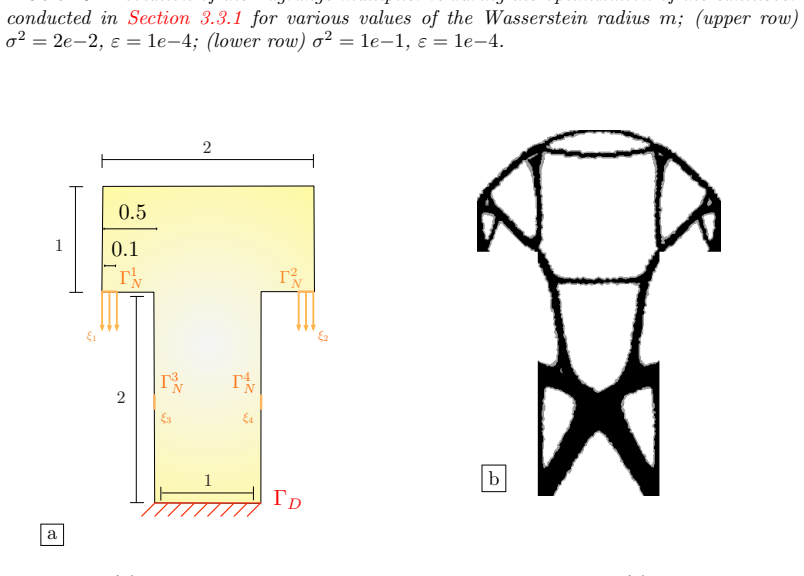
- Increasing the Wasserstein radius $m$ changes designs in interpretable ways—diagonal reinforcements in cantilevers, thicker wind-facing regions in masts—so $m$ can be used by practitioners as a tuning knob for conservativeness.
- Monitoring $\lambda$ during iterations diagnoses active constraints: when $\lambda$ goes to zero, enlarging the ambiguity set no longer affects the design, which can stop the optimization early.
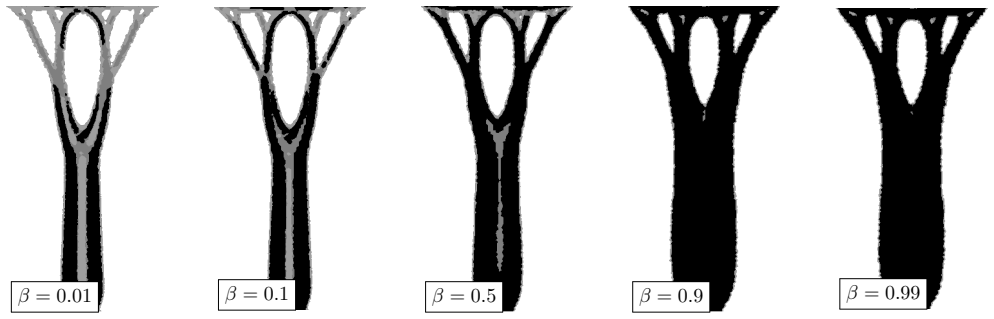
- Moment-based ambiguity sets output rounded re-entrant corners in L-shaped beams, a known stress-relief feature, and CVaR reliability constraints systematically increase structural volume as the threshold $\beta$ approaches 1.
- The single-level reformulations carry to 3D shape optimization, so the computational overhead is not tied to dimension but to the cost of solving the underlying elasticity equations.
Reading between the lines
- Editorial extension: if the $\varepsilon\to 0$ consistency proof that the authors list as future work succeeds, the method would also compute exact Wasserstein robust designs; if it fails, $\varepsilon$ should be treated as a genuine modeling parameter chosen by calibration, not merely a numerical regularization.
- Editorial extension: because the duality only needs the cost functional and its derivative, the same derivation should apply to thermal, fluid, and electromagnetic design problems wherever an adjoint state exists.
- Editorial extension: the paper freezes design-dependent ambiguity sets; a nested scheme that updates the nominal law as the design changes could model uncertainty that grows with the structure, at the price of returning to a bilevel loop.
- Editorial extension: with a single-sample nominal law $P=\delta_{\xi_0}$ and $m>0$, one could map the minimal radius $m$ needed to cover a target set of unobserved scenarios, giving a data-driven rule for choosing $m$ from the observed sample.
Editorial analysis
A structured set of objections, weighed in public.
Referee Report
Summary. The paper proposes distributionally robust optimal design formulations under three types of ambiguity: entropy-regularized Wasserstein balls, moment-based ambiguity sets, and distributionally robust conditional value at risk. It derives single-level duality reformulations in an abstract optimal-design framework and applies them to density-based topology optimization and level-set geometric shape optimization, with numerical experiments in 2D and 3D. The central claim is that the resulting designs anticipate load or material scenarios that are close to, but absent from, the nominal empirical distribution.
Significance. The scope is broad and the paper is a timely application of distributionally robust optimization to structural design; the abstract framework and the combination of topology and shape optimization are genuine strengths. If the duality statements and the finite-epsilon method are correct, the m>0 formulations provide a useful practical tool. However, the paper does not prove the epsilon-to-zero consistency needed for the Wasserstein interpretation, and a substantial part of the numerical evidence uses m=0, where the ambiguity set is empty and the dual objective is unbounded below. These issues leave the central claims plausible but not fully established.
major comments (4)
- [§2.2, Eqs. (2.9)–(2.10); §3.3.1, §3.3.2, §3.5, §4.3] The m=0 Wasserstein experiments are not well-posed. As acknowledged in Remark 2.4, Wε(P,P)>0 for finite ε; in fact, for an atomic nominal P, any Q with finite Wε(P,Q) must be absolutely continuous with respect to the reference conditional νξ, so no Q satisfies Wε(P,Q)≤0. Hence the ambiguity set AW in (2.9) is empty for m=0, the supremum in (2.10) is −∞, and the dual in (2.11) is unbounded below as λ→∞. The λ histories in Figure 6 for m=0 show exactly this divergence, and the designs labeled h∗_{m=0} in Sections 3.3.1, 3.3.2, 3.5, and 4.3, as well as the corresponding rows of Table 1, are not solutions of a distributionally robust problem. The authors should state a positivity condition for m, preferably m>inf_Q Wε(P,Q), and remove or reinterpret the m=0 computations.
- [§5, and §2.2] The consistency of the entropy-regularized ambiguity sets with their exact Wasserstein counterparts as ε→0 is explicitly deferred to future work in Section 5. Until this limit is proved, the numerical designs are certified only for the regularized ambiguity set, not for the Wasserstein ball advertised in the title and abstract. This does not invalidate the finite-ε method, but the paper should state this condition clearly and use terminology such as 'entropy-regularized Wasserstein' rather than 'Wasserstein' when describing the robustness guarantee.
- [§2.4.3, Proposition 2.4] As typeset, Proposition 2.4 is internally inconsistent: the left-hand side has an integral of f with respect to Q inside the minimization over α, while the right-hand side has an exponent f(ζ)−λc(ξ,ζ) with no dependence on α. The subsequent reformulation for DC(h,λ,α) correctly uses [C(h,ζ)−α]_+, indicating that the proposition should read [f(ζ)−α]_+ in both the inner objective and the exponent. Please correct the statement and verify the displayed equality.
- [§2.3, Proposition 2.2; Appendix B] Proposition 2.2 is a central duality statement for the moment-based method, but its rigorous proof is deferred to [93], a PhD thesis by one of the authors, with only a formal sketch in Appendix B. For a journal submission this is not self-contained. The authors should either include a complete proof or provide a publicly available, refereed reference; otherwise Sections 3.4 and 4.4 rest on an unverified statement.
minor comments (4)
- [§3.3.1, Figure 3 caption] The caption repeats 'when m=0' twice and the phrase 'for different values of σ2 when m=0' is redundant; please clarify which row corresponds to which ε.
- [§3.3.1] The text says that for m=0 the problem 'may not coincide' with the nominal problem, but it should also state that the ambiguity set can be empty; please add a cross-reference to Remark 2.4 and a discussion of the required lower bound on m.
- [Appendix B] There is a typo in the last paragraph: 'sued' should be 'used'.
- [Abstract and Section 5] The abstract and conclusion use 'Wasserstein distance' for the quantity Wε; please use 'entropy-regularized Wasserstein' or add an explicit caveat that the consistency with the unregularized distance is not proved.
Circularity Check
No significant circularity: the dual reformulations are worked out through convex duality rather than assumed, and the numerical claims are forward evaluations; the main self-citation (Proposition 2.2 to [93]) is a supporting lemma with an in-paper proof sketch.
full rationale
Walking the derivation chain, the tractable reformulations are obtained by convex dual arguments that are not equivalent to their inputs: Proposition 2.1 is quoted from the external reference [14] and sketched in Appendix A, Proposition 2.4 is a variation of the same calculation, and Proposition 2.3 is the standard CVaR representation. The one in-group citation, Proposition 2.2 from the thesis [93] by one of the authors, is a supporting lemma for the moment-based reformulation and is accompanied by an independent formal sketch in Appendix B; it is not itself the conclusion being tested. No parameter is fitted to the designs or to the out-of-sample scenarios: the numerical claims are forward evaluations of compliance and stress for prescribed loads, after optimizing the reformulated objectives. The m=0 Wasserstein experiments raise a separate well-posedness concern, since Remark 2.4 already notes that W_epsilon(P,P) is often different from 0 and Section 5 lists consistency with the exact Wasserstein problem as future work; that is a correctness and interpretation issue rather than a definitional circularity. The self-citation to [93] and the reuse of the entropy-regularized Wasserstein framework from [14,33] modestly increase scrutiny, but no central claim reduces to its own inputs by construction.
Assumptions & free parameters
free parameters (5)
- Wasserstein radius m =
0, 1, 5, 10 depending on experiment
- Entropy regularization epsilon =
1e-4 to 1e-2, also 0.01 and 0.001
- Reference coupling variance sigma^2 =
2e-3, 2e-2, 1e-1, 1e-3, 1e-2.5, 1e-0.5
- Moment ambiguity bounds m1, m2 =
e.g. (0,1), (1,1), (5,5), (10,10)
- CVaR threshold beta and safety level CT =
beta in {0.01, 0.1, 0.5, 0.9, 0.99}, CT=40 in bridge example
assumptions (5)
- domain assumption Existence of a compact finite-dimensional parameter space Xi with continuous cost functions and integrability of all probabilistic integrals
- standard math The infimum-supremum interchange in Appendices A and B is valid for the relevant functionals
- ad hoc to paper The entropy-regularized Wasserstein ambiguity set with finite epsilon approximates the intended exact Wasserstein ambiguity set as epsilon tends to 0
- domain assumption The physical model, SIMP interpolation, and linear elasticity boundary-value problems are accurate for the designs under consideration
- domain assumption A nominal law P reconstructed from one or a few samples is a reasonable reference
Cite this review
Pith. "Pith review of Distributionally Robust Shape and Topology Optimization." pith.science (2026). https://pith.science/paper/66G3NCWV
@misc{pith2026250721574,
  author       = {Pith},
  title        = {Pith review of: Distributionally Robust Shape and Topology Optimization},
  year         = {2026},
  howpublished = {\url{https://pith.science/paper/66G3NCWV}},
  note         = {Machine review of arXiv:2507.21574}
}
read the original abstract
This article aims to introduce the paradigm of distributional robustness from the field of convex optimization to tackle optimal design problems under uncertainty. We consider realistic situations where the physical model, and thereby the cost function of the design to be minimized depend on uncertain parameters. The probability distribution of the latter is itself known imperfectly, through a nominal law, reconstructed from a few observed samples. The distributionally robust optimal design problem is an intricate bilevel program which consists in minimizing the worst value of a statistical quantity of the cost function (typically, its expectation) when the law of the uncertain parameters belongs to a certain ``ambiguity set''. We address three classes of such problems: firstly, this ambiguity set is made of the probability laws whose Wasserstein distance to the nominal law is less than a given threshold; secondly, the ambiguity set is based on the first- and second-order moments of the actual and nominal probability laws. Eventually, a statistical quantity of the cost other than its expectation is made robust with respect to the law of the parameters, namely its conditional value at risk. Using techniques from convex duality, we derive tractable, single-level reformulations of these problems, framed over augmented sets of variables. Our methods are essentially agnostic of the optimal design framework; they are described in a unifying abstract framework, before being applied to multiple situations in density-based topology optimization and in geometric shape optimization. Several numerical examples are discussed in two and three space dimensions to appraise the features of the proposed techniques.
Figures


Figures from the paper (22 more)








Reference graph
Works this paper leans on
-
[93]
J. Prando, Distributionally robust shape and topology optimization , PhD thesis, Universit´ e Grenoble Alpes, 2025
work page 2025
-
[1]
E. Acar, G. Bayrak, Y. Jung, I. Lee, P. Ramu, and S. S. Ravichandran, Modeling, analysis, and optimization under uncertainties: a review , Structural and Multidisciplinary Optimization, 64 (2021), pp. 2909–2945
2021
-
[2]
Acerbi and D
C. Acerbi and D. Tasche, On the coherence of expected shortfall, Journal of banking & finance, 26 (2002), pp. 1487–1503
2002
-
[3]
Allaire and C
G. Allaire and C. Dapogny, A linearized approach to worst-case design in parametric and geometric shape optimization, Mathematical Models and Methods in Applied Sciences, 24 (2014), pp. 2199–2257
2014
-
[4]
, A deterministic approximation method in shape optimization under random uncertainties , SMAI Journal of computational mathematics, 1 (2015), pp. 83–143
2015
-
[5]
Allaire, C
G. Allaire, C. Dapogny, and P. Frey , Topology and geometry optimization of elastic structures by exact deformation of simplicial mesh , Comptes Rendus Mathematique, 349 (2011), pp. 999–1003
2011
-
[6]
, A mesh evolution algorithm based on the level set method for geometry and topology optimization , Structural and Multidisciplinary Optimization, 48 (2013), pp. 711–715
2013
-
[7]
, Shape optimization with a level set based mesh evolution method , Computer Methods in Applied Mechanics and Engineering, 282 (2014), pp. 22–53
2014
Show all 115 references
-
[8]
Allaire, C
G. Allaire, C. Dapogny, and F. Jouve , Shape and topology optimization , in Geometric partial differential equations, part II, A. Bonito and R. Nochetto eds., Handbook of Numerical Analysis, 22 (2021), pp. 1–132
2021
-
[9]
Allaire and F
G. Allaire and F. Jouve, Minimum stress optimal design with the level set method , Engineering analysis with boundary elements, 32 (2008), pp. 909–918
2008
-
[10]
Allaire, F
G. Allaire, F. Jouve, and A.-M. Toader , Structural optimization using sensitivity analysis and a level-set method , Journal of computational physics, 194 (2004), pp. 363–393
2004
-
[11]
Allaire and M
G. Allaire and M. Schoenauer , Conception optimale de structures , vol. 58, Springer, 2007
2007
-
[12]
Amstutz and M
S. Amstutz and M. Ciligot-Travain , A notion of compliance robustness in topology optimization , ESAIM: Control, Optimisation and Calculus of Variations, 22 (2016), pp. 64–87
2016
-
[13]
Azizian, F
W. Azizian, F. Iutzeler, and J. Malick , Exact generalization guarantees for (regularized) wasserstein distributionally robust models, Advances in Neural Information Processing Systems, 36 (2023), pp. 14584–14596
2023
-
[14]
, Regularization for wasserstein distributionally robust optimization , ESAIM: Control, Optimisation and Calculus of Variations, 29 (2023), p. 33
2023
-
[15]
Balarac, F
G. Balarac, F. Basile, P. B´enard, F. Bordeu, J.-B. Chapelier, L. Cirrottola, G. Caumon, C. Dapogny, P. Frey, A. Froehly, et al. , Tetrahedral remeshing in the context of large-scale numerical simulation and high performance computing, MathematicS In Action, 11 (2022), pp. 129–164
2022
-
[16]
M. P. Bendsoe and O. Sigmund, Topology optimization: theory, methods, and applications , Springer Science & Business Media, 2013
2013
-
[17]
Billingsley, Probability and measure, John Wiley & Sons, 2017
P. Billingsley, Probability and measure, John Wiley & Sons, 2017. 41
2017
-
[18]
Blanchard, D
P. Blanchard, D. J. Higham, and N. J. Higham , Accurately computing the log-sum-exp and softmax functions , IMA Journal of Numerical Analysis, 41 (2021), pp. 2311–2330
2021
-
[19]
Blanchet, J
J. Blanchet, J. Li, S. Lin, and X. Zhang , Distributionally robust optimization and robust statistics , arXiv preprint arXiv:2401.14655, (2024)
2024 arXiv
-
[20]
Blanchet, K
J. Blanchet, K. Murthy, and V. A. Nguyen , Statistical analysis of wasserstein distributionally robust estimators , in Tutorials in Operations Research: Emerging optimization methods and modeling techniques with applications, INFORMS, 2021, pp. 227–254
2021
-
[21]
C. Bui, C. Dapogny, and P. Frey , An accurate anisotropic adaptation method for solving the level set advection equation, International Journal for Numerical Methods in Fluids, 70 (2012), pp. 899–922
2012
-
[22]
E. L. Cardoso, G. Da Silva, and A. T. Beck, Robust topology optimization of compliant mechanisms with uncertainties in output stiffness , International Journal for Numerical Methods in Engineering, 119 (2019), pp. 532–547
2019
-
[23]
J. C ´ea, Conception optimale ou identification de formes, calcul rapide de la d´ eriv´ ee directionnelle de la fonction coˆ ut, ESAIM: Mathematical Modelling and Numerical Analysis, 20 (1986), pp. 371–402
1986
-
[24]
Chaudhuri, M
A. Chaudhuri, M. Norton, and B. Kramer , Risk-based design optimization via probability of failure, conditional value-at-risk, and buffered probability of failure , in AIAA Scitech 2020 Forum, 2020, p. 2130
2020
-
[25]
R. Chen, I. C. Paschalidis, et al. , Distributionally robust learning , Foundations and Trends ® in Optimization, 4 (2020), pp. 1–243
2020
-
[26]
S. Chen, W. Chen, and S. Lee, Level set based robust shape and topology optimization under random field uncertainties , Structural and Multidisciplinary Optimization, 41 (2010), pp. 507–524
2010
-
[27]
Cherkaev and E
A. Cherkaev and E. Cherkaeva , Optimal design for uncertain loading condition , in Homogenization: In Memory of Serguei Kozlov, World Scientific, 1999, pp. 193–213
1999
-
[28]
Cuturi, Sinkhorn distances: Lightspeed computation of optimal transport , Advances in neural information processing systems, 26 (2013)
M. Cuturi, Sinkhorn distances: Lightspeed computation of optimal transport , Advances in neural information processing systems, 26 (2013)
2013
-
[29]
Dapogny , totuto a tentative implementation of density-based topology implementation in python, https://github.com/dapogny/totuto, 2023
C. Dapogny , totuto a tentative implementation of density-based topology implementation in python, https://github.com/dapogny/totuto, 2023
2023
-
[30]
Dapogny, C
C. Dapogny, C. Dobrzynski, and P. Frey , Three-dimensional adaptive domain remeshing, implicit domain meshing, and applications to free and moving boundary problems , Journal of computational physics, 262 (2014), pp. 358–378
2014
-
[31]
Dapogny and F
C. Dapogny and F. Feppon, Shape optimization using a level set based mesh evolution method: an overview and tutorial , Hal preprint: https://hal.archives-ouvertes.fr/hal-03881641, (2022)
2022
-
[32]
Dapogny and P
C. Dapogny and P. Frey , Computation of the signed distance function to a discrete contour on adapted triangulation , Calcolo, 49 (2012), pp. 193–219
2012
-
[33]
Dapogny, F
C. Dapogny, F. Iutzeler, A. Meda, and B. Thibert, Entropy-regularized wasserstein distributionally robust shape and topology optimization, Structural and Multidisciplinary Optimization, 66 (2023), p. 42
2023
-
[34]
S. De, J. Hampton, K. Maute, and A. Doostan , Topology optimization under uncertainty using a stochastic gradient- based approach, 2019
2019
-
[35]
S. De, K. Maute, and A. Doostan , Reliability-based topology optimization using stochastic gradients , 2021
2021
-
[36]
, Topology optimization under microscale uncertainty using stochastic gradients , 2021
2021
-
[37]
De Gournay, G
F. De Gournay, G. Allaire, and F. Jouve , Shape and topology optimization of the robust compliance via the level set method, ESAIM: Control, Optimisation and Calculus of Variations, 14 (2008), pp. 43–70
2008
-
[38]
Dehghannasiri, X
R. Dehghannasiri, X. Qian, and E. R. Dougherty , Intrinsically bayesian robust karhunen-lo` eve compression, Signal Processing, 144 (2018), pp. 311–322
2018
-
[39]
Delage and Y
E. Delage and Y. Ye , Distributionally robust optimization under moment uncertainty with application to data-driven problems, Operations research, 58 (2010), pp. 595–612
2010
-
[40]
Drusvyatskiy and L
D. Drusvyatskiy and L. Xiao, Stochastic optimization with decision-dependent distributions, Mathematics of Operations Research, 48 (2023), pp. 954–998
2023
-
[41]
Eigel, J
M. Eigel, J. Neumann, R. Schneider, and S. Wolf , Risk averse stochastic structural topology optimization , Computer Methods in Applied Mechanics and Engineering, 334 (2018), pp. 470–482
2018
-
[42]
P. M. Esfahani and D. Kuhn , Data-driven distributionally robust optimization using the wasserstein metric: Perfor- mance guarantees and tractable reformulations , Mathematical Programming, 171 (2018), pp. 115–166
2018
-
[43]
Feppon, Null Space Optimizer, https://null-space-optimizer.readthedocs.io/en/latest/, 2023
F. Feppon, Null Space Optimizer, https://null-space-optimizer.readthedocs.io/en/latest/, 2023
2023
-
[44]
, Density-based topology optimization with the null space optimizer: a tutorial and a comparison , Structural and Multidisciplinary Optimization, 67 (2024), pp. 1–34
2024
-
[45]
Feppon, G
F. Feppon, G. Allaire, and C. Dapogny , Null space gradient flows for constrained optimization with applications to shape optimization, ESAIM: Control, Optimisation and Calculus of Variations, 26 (2020), p. 90
2020
-
[46]
Feydy, Analyse de donn´ ees g´ eom´ etriques, au del` a des convolutions, PhD thesis, Universit´ e Paris-Saclay, 2020
J. Feydy, Analyse de donn´ ees g´ eom´ etriques, au del` a des convolutions, PhD thesis, Universit´ e Paris-Saclay, 2020
2020
-
[47]
Fournier and A
N. Fournier and A. Guillin , On the rate of convergence in wasserstein distance of the empirical measure , 2013
2013
-
[48]
Grieshammer, L
M. Grieshammer, L. Pflug, M. Stingl, and A. Uihlein, The continuous stochastic gradient method: part i–convergence theory, Computational Optimization and Applications, 87 (2024), pp. 935–976
2024
-
[49]
977–1008
, The continuous stochastic gradient method: part ii–application and numerics , Computational Optimization and Applications, 87 (2024), pp. 977–1008
2024
-
[50]
Grigoriu, Simulation of stationary non-gaussian translation processes , Journal of engineering mechanics, 124 (1998), pp
M. Grigoriu, Simulation of stationary non-gaussian translation processes , Journal of engineering mechanics, 124 (1998), pp. 121–126. 42
1998
-
[51]
J. K. Guest and T. Igusa , Structural optimization under uncertain loads and nodal locations , Computer Methods in Applied Mechanics and Engineering, 198 (2008), pp. 116–124
2008
-
[52]
X. Guo, W. Bai, W. Zhang, and X. Gao, Confidence structural robust design and optimization under stiffness and load uncertainties, Computer Methods in Applied Mechanics and Engineering, 198 (2009), pp. 3378–3399
2009
-
[53]
X. Guo, W. Zhang, and L. Zhang , Robust structural topology optimization considering boundary uncertainties , Com- puter Methods in Applied Mechanics and Engineering, 253 (2013), pp. 356–368
2013
-
[54]
K. M. Hamdia, H. Ghasemi, X. Zhuang, and T. Rabczuk , Multilevel monte carlo method for topology optimization of flexoelectric composites with uncertain material properties , Engineering Analysis with Boundary Elements, 134 (2022), pp. 412–418
2022
-
[55]
G. A. Hanasusanto, V. Roitch, D. Kuhn, and W. Wiesemann , A distributionally robust perspective on uncertainty quantification and chance constrained programming, Mathematical Programming, 151 (2015), pp. 35–62
2015
-
[56]
A. M. Hasofer , An exact and invarient first order reliability format , J. Eng. Mech. Div., Proc. ASCE, 100 (1974), pp. 111–121
1974
-
[57]
Hecht, New development in freefem++ , Journal of numerical mathematics, 20 (2012), pp
F. Hecht, New development in freefem++ , Journal of numerical mathematics, 20 (2012), pp. 251–266
2012
-
[58]
Henrot and M
A. Henrot and M. Pierre , Shape Variation and Optimization , EMS Tracts in Mathematics Vol. 28, 2018
2018
-
[59]
Holmberg, C.-J
E. Holmberg, C.-J. Thore, and A. Klarbring , Worst-case topology optimization of self-weight loaded structures using semi-definite programming, Structural and Multidisciplinary Optimization, 52 (2015), pp. 915–928
2015
-
[60]
Hu and L
Z. Hu and L. J. Hong , Kullback-leibler divergence constrained distributionally robust optimization , Available at Opti- mization Online, 1 (2013), p. 9
2013
-
[61]
Jofre and A
L. Jofre and A. Doostan , Rapid aerodynamic shape optimization under parametric and turbulence model uncertainty: A stochastic gradient approach , 2021
2021
-
[62]
Y. Kanno, Structural reliability under uncertainty in moments: distributionally-robust reliability-based design optimiza- tion, Japan Journal of Industrial and Applied Mathematics, 39 (2021), p. 195–226
2021
-
[63]
M. G. Kapteyn, K. E. Willcox, and A. B. Philpott, Distributionally robust optimization for engineering design under uncertainty, International Journal for Numerical Methods in Engineering, 120 (2019), pp. 835–859
2019
-
[64]
Keshavarzzadeh, F
V. Keshavarzzadeh, F. Fernandez, and D. A. Tortorelli, Topology optimization under uncertainty via non-intrusive polynomial chaos expansion , Computer Methods in Applied Mechanics and Engineering, 318 (2017), pp. 120–147
2017
-
[65]
D. P. Kingma and J. Ba , Adam: A method for stochastic optimization , 2017
2017
-
[66]
D. P. Kouri and T. M. Surowiec , Risk-averse pde-constrained optimization using the conditional value-at-risk , SIAM Journal on Optimization, 26 (2016), pp. 365–396
2016
-
[67]
D. Kuhn, P. M. Esfahani, V. A. Nguyen, and S. Shafieezadeh-Abadeh, Wasserstein distributionally robust optimiza- tion: Theory and applications in machine learning , in Operations research & management science in the age of analytics, Informs, 2019, pp. 130–166
2019
-
[68]
D. Kuhn, S. Shafiee, and W. Wiesemann , Distributionally robust optimization , 2024
2024
-
[69]
Langelaar , Topology optimization for multi-axis machining , Computer Methods in Applied Mechanics and Engi- neering, 351 (2019), pp
M. Langelaar , Topology optimization for multi-axis machining , Computer Methods in Applied Mechanics and Engi- neering, 351 (2019), pp. 226–252
2019
-
[70]
B. S. Lazarov, M. Schevenels, and O. Sigmund, Topology optimization considering material and geometric uncertain- ties using stochastic collocation methods , Structural and Multidisciplinary optimization, 46 (2012), pp. 597–612
2012
-
[71]
F. Lin, X. F ang, and Z. Gao , Distributionally robust optimization: A review on theory and applications , Numerical Algebra, Control & Optimization, 12 (2022), p. 159
2022
-
[72]
J. Liu, A. T. Gaynor, S. Chen, Z. Kang, K. Suresh, A. Takezawa, L. Li, J. Kato, J. Tang, C. C. W ang, et al. , Current and future trends in topology optimization for additive manufacturing , Structural and Multidisciplinary Opti- mization, pp. 1–27
-
[73]
Q. Liu, J. Wu, X. Xiao, and L. Zhang , A note on distributionally robust optimization under moment uncertainty , Journal of Numerical Mathematics, 26 (2018), pp. 141–150
2018
-
[74]
Lo`eve, Probability theory, Courier Dover Publications, 2017
M. Lo`eve, Probability theory, Courier Dover Publications, 2017
2017
-
[75]
Mart´ınez-Frutos and D
J. Mart´ınez-Frutos and D. Herrero-P ´erez, Large-scale robust topology optimization using multi-gpu systems , Com- puter Methods in Applied Mechanics and Engineering, 311 (2016), pp. 393–414
2016
-
[76]
Martinez-Frutos, D
J. Martinez-Frutos, D. Herrero-Perez, M. Kessler, and F. Periago , Robust shape optimization of continuous structures via the level set method , Computer Methods in Applied Mechanics and Engineering, 305 (2016), pp. 271–291
2016
-
[77]
Maute, Topology optimization under uncertainty , in Topology optimization in structural and continuum mechanics, (2014), pp
K. Maute, Topology optimization under uncertainty , in Topology optimization in structural and continuum mechanics, (2014), pp. 457–471
2014
-
[78]
Merigot and B
Q. Merigot and B. Thibert , Optimal transport: discretization and algorithms , in Handbook of Numerical Analysis, vol. 22, Elsevier, 2021, pp. 133–212
2021
-
[79]
Michailidis, Manufacturing constraints and multi-phase shape and topology optimization via a level-set method , PhD thesis, 2014
G. Michailidis, Manufacturing constraints and multi-phase shape and topology optimization via a level-set method , PhD thesis, 2014
2014
-
[80]
Mohamed, M
S. Mohamed, M. Rosca, M. Figurnov, and A. Mnih , Monte carlo gradient estimation in machine learning , Journal of Machine Learning Research, 21 (2020), pp. 1–62
2020
-
[81]
E. F. Montesuma, F. M. N. Mboula, and A. Souloumiac , Recent advances in optimal transport for machine learning , IEEE Transactions on Pattern Analysis and Machine Intelligence, (2024)
2024
-
[82]
Murat and J
F. Murat and J. Simon , Sur le contrˆ ole par un domaine g´ eom´ etrique, Pr´ e-publication du Laboratoire d’Analyse Num´ erique,(76015), (1976). 43
1976
-
[83]
Nakao, R
H. Nakao, R. Jiang, and S. Shen , Distributionally robust partially observable markov decision process with moment- based ambiguity, SIAM Journal on Optimization, 31 (2021), pp. 461–488
2021
-
[84]
V. A. Nguyen, D. Kuhn, and P. Mohajerin Esfahani , Distributionally robust inverse covariance estimation: The wasserstein shrinkage estimator , Operations research, 70 (2022), pp. 490–515
2022
-
[85]
Nocedal and S
J. Nocedal and S. J. Wright , Numerical optimization 2nd , Springer, 2006
2006
-
[86]
Nutz, Introduction to entropic optimal transport , Lecture notes, Columbia University, (2021)
M. Nutz, Introduction to entropic optimal transport , Lecture notes, Columbia University, (2021)
2021
-
[87]
Osher and J
S. Osher and J. A. Sethian , Fronts propagating with curvature-dependent speed: algorithms based on hamilton-jacobi formulations, Journal of computational physics, 79 (1988), pp. 12–49
1988
-
[88]
Peyr ´e, M
G. Peyr ´e, M. Cuturi, et al. , Computational optimal transport: With applications to data science , Foundations and Trends in Machine Learning, 11 (2019), pp. 355–607
2019
-
[89]
Pflug and D
G. Pflug and D. Wozabal , Ambiguity in portfolio selection , Quantitative Finance, 7 (2007), pp. 435–442
2007
-
[90]
Pflug, M
L. Pflug, M. Stingl, and A. Uihlein , A stochastic method of moving asymptotes for topology optimization under uncertainty, arXiv preprint arXiv:2410.19428, (2024)
2024 arXiv
-
[91]
Pironneau, Finite element methods for fluids , Wiley Chichester, 1989
O. Pironneau, Finite element methods for fluids , Wiley Chichester, 1989
1989
-
[92]
Plessix, A review of the adjoint-state method for computing the gradient of a functional with geophysical applica- tions, Geophysical Journal International, 167 (2006), pp
R.-E. Plessix, A review of the adjoint-state method for computing the gradient of a functional with geophysical applica- tions, Geophysical Journal International, 167 (2006), pp. 495–503
2006
-
[94]
Rahimian and S
H. Rahimian and S. Mehrotra , Distributionally robust optimization: A review , arXiv preprint arXiv:1908.05659, (2019)
2019 arXiv
-
[95]
, Frameworks and results in distributionally robust optimization , Open Journal of Mathematical Optimization, 3 (2022), pp. 1–85
2022
-
[96]
R. T. Rockafellar and S. Uryasev , Conditional value-at-risk for general loss distributions , Journal of banking & finance, 26 (2002), pp. 1443–1471
2002
-
[97]
R. T. Rockafellar, S. Uryasev, et al., Optimization of conditional value-at-risk , Journal of risk, 2 (2000), pp. 21–42
2000
-
[98]
Santambrogio, Optimal transport for applied mathematicians , Birk¨ auser, 2015
F. Santambrogio, Optimal transport for applied mathematicians , Birk¨ auser, 2015
2015
-
[99]
Schwab and R
C. Schwab and R. A. Todor , Karhunen–lo` eve approximation of random fields by generalized fast multipole methods , Journal of Computational Physics, 217 (2006), pp. 100–122
2006
-
[100]
S ´ejourn´e, J
T. S ´ejourn´e, J. Feydy, F.-X. Vialard, A. Trouv ´e, and G. Peyr ´e, Sinkhorn divergences for unbalanced optimal transport, arXiv preprint arXiv:1910.12958, (2019)
2019 arXiv
-
[101]
J. A. Sethian , Fast marching methods, SIAM review, 41 (1999), pp. 199–235
1999
-
[102]
Sigmund and K
O. Sigmund and K. Maute, Topology optimization approaches, Structural and Multidisciplinary Optimization, 48 (2013), pp. 1031–1055
2013
-
[103]
Sokolowski and J.-P
J. Sokolowski and J.-P. Zol ´esio, Introduction to shape optimization , Springer, 1992
1992
-
[104]
Staib and S
M. Staib and S. Jegelka, Distributionally robust optimization and generalization in kernel methods , Advances in Neural Information Processing Systems, 32 (2019)
2019
-
[105]
Tootkaboni, A
M. Tootkaboni, A. Asadpoure, and J. K. Guest , Topology optimization of continuum structures under uncertainty–a polynomial chaos approach, Computer Methods in Applied Mechanics and Engineering, 201 (2012), pp. 263–275
2012
-
[106]
Uihlein, O
A. Uihlein, O. Sigmund, and M. Stingl , A 140 line matlab code for topology optimization problems with probabilistic parameters, arXiv preprint arXiv:2505.10421, (2025)
2025 arXiv
-
[107]
Villani, Optimal transport: old and new , vol
C. Villani, Optimal transport: old and new , vol. 338, Springer, 2009
2009
-
[108]
Vincent, W
F. Vincent, W. Azizian, F. Iutzeler, and J. Malick, skwdro: a library for wasserstein distributionally robust machine learning, arXiv preprint arXiv:2410.21231, (2024)
2024
-
[109]
W ang, B
C. W ang, B. Xu, Q. Meng, J. Rong, and Y. Zhao , Topology optimization of cast parts considering parting surface position, Advances in Engineering Software, 149 (2020), p. 102886
2020
-
[110]
W ang, R
J. W ang, R. Gao, and Y. Xie, Sinkhorn distributionally robust optimization , arXiv preprint arXiv:2109.11926, (2021)
2021 arXiv
-
[111]
M. Y. W ang, X. W ang, and D. Guo , A level set method for structural topology optimization , Computer methods in applied mechanics and engineering, 192 (2003), pp. 227–246
2003
-
[112]
M.-C. Yue, Y. Rychener, D. Kuhn, and V. A. Nguyen , A geometric unification of distributionally robust covariance estimators: Shrinking the spectrum by inflating the ambiguity set , arXiv preprint arXiv:2405.20124, (2024)
2024
-
[113]
Zhao and T
Y.-G. Zhao and T. Ono , A general procedure for first/second-order reliabilitymethod (form/sorm), Structural safety, 21 (1999), pp. 95–112
1999
-
[114]
M. Zhou, R. Fleury, Y.-K. Shyy, H. Thomas, and J. Brennan , Progress in topology optimization with manufacturing constraints, in 9th AIAA/ISSMO Symposium on multidisciplinary analysis and optimization, 2002, p. 5614
2002
-
[115]
B. Zhu, X. Zhang, H. Zhang, J. Liang, H. Zang, H. Li, and R. W ang , Design of compliant mechanisms using continuum topology optimization: A review , Mechanism and Machine Theory, 143 (2020), p. 103622. 44
2020
Reviewed August 6, 2026 · model on record in the stance chip above.
Discussion (0). Sign in to comment.