REVIEW 4 major objections 6 minor 40 references
Emerging Trends in Pseudo-Label Refinement for Weakly Supervised Semantic Segmentation with Image-Level Supervision
T0 review · 4 major / 6 minor · reviewed 2026-08-06 · deepseek-v4-flash
Pith's one-line read This review's central claim is that recent pseudo-label refinement for weakly supervised semantic segmentation with image-level labels falls into two families—internal supervision (consistency regularization and prototypical contrastive…
desk verdict Useful survey with a broken internal/external taxonomy; needs a fix before it can be trusted. read the letter →
The pith
A machine-rendered reading of the paper's core claim, the machinery that carries it, and where it could break.
The reading
What carries the argument
The organizing taxonomy is the central machinery. More specifically, the paper distinguishes 'internal supervision', where the model's own representations provide the auxiliary signal—split into consistency regularization (image-level, patch-level, class-patch-level, cross-model) and prototypical contrastive learning—from 'external supervision', where pretrained foundation models are the signal source—split into CLIP-based approaches (manual prompting, prompt learning, CLIP as backbone) and SAM-based approaches (post-processing, knowledge transfer). This scheme is doing the work of a lens: it lets the authors place each surveyed method in a cell and then read off open problems, such as the absence of cross-architecture consistency methods and the scarcity of domain-specific adaptations.
What would settle it
A concrete check: search for image-level WSSS pseudo-label refinement methods published 2020–2025 without the citation cutoff, using terms like 'pseudo-label refinement', 'CAM refinement', and 'weak segmentation'. If a noticeable share of the retrieved methods do not fit into consistency regularization, prototypical contrastive learning, CLIP-based, or SAM-based refinement, then the claim that these two supervision families comprehensively categorize the field would be falsified. A simpler quantitative version: compute the fraction of papers in a broad sample that the taxonomy can place; if that fraction is far below the paper's implied coverage, the taxonomy's comprehensiveness is in doubt.
Extended reading notes
Core claim
On the paper's own terms, the discovery is descriptive: the pseudo-label refinement literature from 2020 to 2025 is well captured by a two-branch taxonomy. Internal supervision covers consistency regularization—enforced at image, patch, class-patch, or cross-model level—and prototypical contrastive learning, in which class or image-specific prototypes serve as anchors to pull features together. External supervision covers CLIP-based methods, which use text prompts to suppress background or even act as the backbone, and SAM-based methods, which use class-agnostic masks at inference or transfer SAM knowledge into the classifier. The review also claims that cross-architecture consistency is rarely explored, that CLIP needs fine-tuning or prompt learning in specialized domains, and that domain-specific WSSS is an underexplored gap where prototype learning is a promising route.
Load-bearing premise
The paper's conclusions rest on the papers it chose to survey: one search string in two literature databases, a ten-citation minimum for 2020–2023 works, no such cutoff for 2024–2025, and manual snowballing. If that selection missed a substantial cluster of relevant methods or over-represented another, the taxonomy and the claimed gaps could be different.
Editorial extensions
If this is right
- New WSSS papers can be positioned quickly by asking whether they add supervision from inside the model or from an external signal source.
- CLIP-based refinement should be expected to transfer poorly to medical and remote sensing data unless the text prompts are learned or the model is fine-tuned.
- SAM is mainly useful at inference time for boundary-quality masks, while using SAM for training-time knowledge transfer is just beginning.
- Cross-architecture consistency—aligning heterogeneous features from CNN and ViT—is a named open problem that no current method solves.
- Prototypical contrastive learning is flagged as the most promising direction for domain-specific WSSS, especially with SAM-generated prototypes or modality-invariant prototypes.
Reading between the lines
- If the taxonomy is right, the design space is combinatorial: internal and external supervision can be composed (e.g., SAM-derived prototypes feeding contrastive learning), a combination the paper mentions only as a direction, not as a reviewed line of work.
- The ten-citation cutoff for 2020–2023 papers may systematically exclude short-lived but influential workshop papers or negative results, so the 'emerging trends' are likely weighted toward well-cited conference papers.
- The claim that domain-specific WSSS is underexplored could be tested quantitatively by counting papers per benchmark (PASCAL VOC, COCO, Cityscapes, medical, remote sensing) across the same years; the paper does not provide that count.
- A weaker but useful extension: the same internal/external lens may apply to other weak supervision settings (e.g., point, scribble, box) even though the paper restricts itself to image-level labels.
Editorial analysis
A structured set of objections, weighed in public.
Referee Report
Summary. This paper is a literature review of weakly supervised semantic segmentation (WSSS) with image-level labels, centered on pseudo-label refinement. The authors propose a taxonomy that splits recent methods into 'internal supervision' (consistency regularization and prototypical contrastive learning) and 'external supervision' (CLIP-based and SAM-based methods), and they discuss the challenges of applying these methods to domain-specific datasets. The review is based on a documented literature search using Google Scholar and the ACM Digital Library, with inclusion criteria based on citations and a snowballing strategy. The paper closes with future research directions, emphasizing cross-architecture consistency, foundation-model adaptation, and prototype learning for domain-specific tasks.
Significance. If the proposed taxonomy were internally consistent, this survey would be a timely and useful resource: it covers many recent 2022-2025 methods, provides tables with venue, code, backbone, and supervision information, and explicitly addresses domain-specific applications (medical imaging, remote sensing, driving scenes) that are often neglected in WSSS surveys. The authors also deserve credit for making their study design explicit and for including a snowballing strategy. However, the central contribution—the internal/external supervision distinction—is not a clean partition as presented. Several methods are placed in both categories, and the stated definition of internal supervision is contradicted by entries within the internal section. This undermines the taxonomy that the survey's conclusions depend on, so the main organizational claim needs substantial repair before the survey can be accepted as a reliable reference.
major comments (4)
- [Section 4.1 and Tables 1-3] The definition of internal supervision as 'without external supervision or knowledge' (Section 4.1, first paragraph) is not respected by the paper's own tables. FMA [31] appears in Table 2 as a 'Modality-bridged' prototype method with supervision I+T (image label + CLIP) and in Table 3 as a CLIP-based external method with supervision I+T+S. PBIP [23] is listed in Table 2 with supervision I+T. S&M [36] appears in Table 1 under consistency regularization with supervision I+S (saliency map). These entries violate the proposed boundary between internal and external supervision. Because the internal/external taxonomy is the paper's main contribution and is used to derive trend conclusions in Section 4.3 and future directions in Section 5, the paper should either redefine the categories as overlapping method families, or state a clear decision rule for handling methods that combine CLIP/SAM knowledge with prototype learning or consistency regularization, and then re-classify the affected entries consistently.
- [Table 1] The venue information for ACR is inconsistent: Table 1 lists ACR [21] as ICCVW'24, but reference [21] (Sun et al., All-pairs consistency learning) is published in ICCV 2023, pages 826-837. Since the paper positions itself as a reliable, updated review, all venue and year entries in the tables should be checked against their references. This issue also raises concerns about the accuracy of other table entries that were not cross-checked in this review.
- [Section 1 versus Section 4.2.2] Section 1 states that the paper only discusses techniques that optimize CAM generation during training, because post-processing is 'sensitive to noise in the initial CAM and cannot handle fundamental issue like spurious correlations.' However, Section 4.2.2 presents SAM-based post-processing as part of external supervision, and Table 4 includes SEPL [2], which is explicitly a post-processing method. This is a direct contradiction about the scope of the review. The authors should clarify whether post-processing methods are included or excluded and, if included, how the Section 1 dismissal of post-processing is reconciled with their treatment.
- [Section 3] The inclusion criterion requiring a minimum of 10 citations for papers published between 2020 and 2023, while papers from 2024 onward are included regardless of citation count, may bias the selected literature in ways that affect the paper's claims of being 'comprehensive' and identifying 'emerging trends.' For example, a 2023 paper with 9 citations that introduces a significant idea would be excluded, whereas a 2024 paper with 0 citations would be included. The authors should justify this criterion in relation to RQ1 and RQ2, or report sensitivity of the identified trends to the citation threshold. At minimum, they should acknowledge that the survey is not exhaustive and that the sampling procedure could miss important works.
minor comments (6)
- [Page 2, Section 1] There is a typo in the sentence 'To To address these limitations'; delete the duplicated 'To'.
- [Section 5] The heading 'F uture Directions' contains an erroneous space; it should read 'Future Directions'.
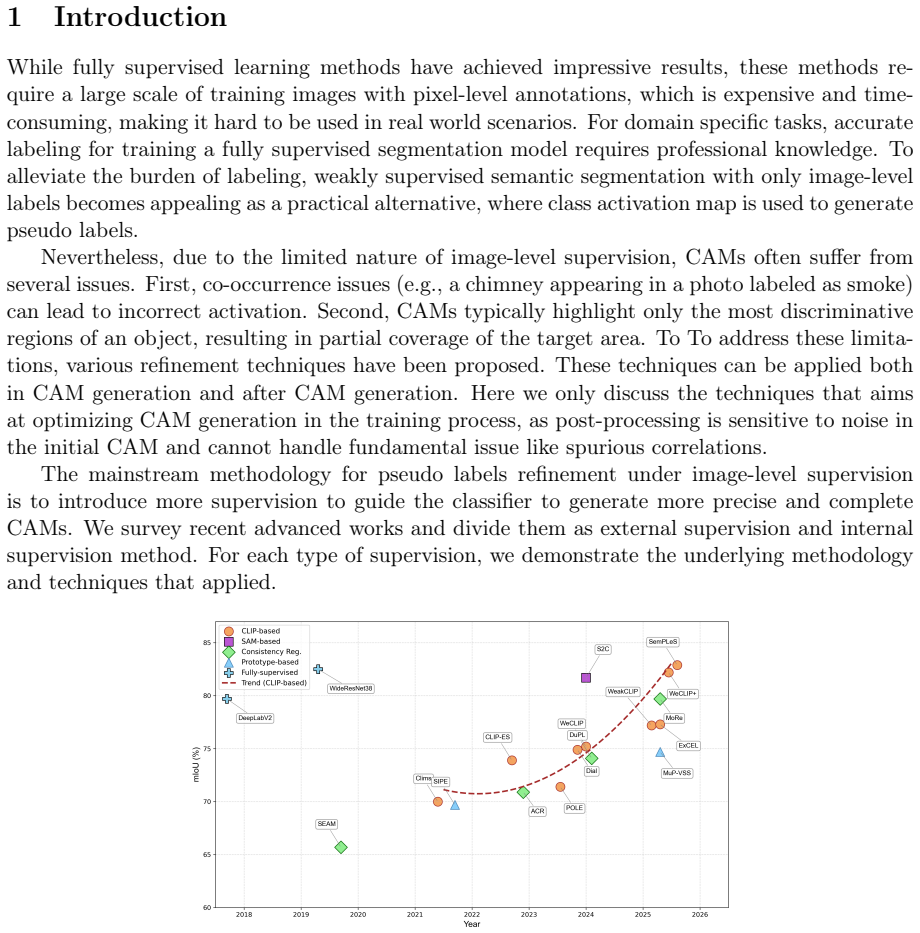
- [Figure 1] Figure 1 ('The performance of recent WSSS works on VOC test set') is not referenced anywhere in the text, and no analysis or discussion of the plotted performance values is provided. Either integrate the figure into the discussion or remove it.
- [Section 4.3 and Section 5] The claim that prototype learning 'seems to be a very powerful way' for domain-specific tasks is presented without supporting evidence from the surveyed methods. Consider adding concrete examples or a comparative discussion of results on domain-specific datasets, or soften the claim to reflect that it is a hypothesis.
- [Table 4] SEPL [2] is described in the reference list as an arXiv preprint (arXiv:2305.05803), but Table 4 lists its venue as NeurIPSW'23. Please verify the publication status and update the table or the reference accordingly.
- [Section 3] The exact search string is given, but the paper does not specify the search date, the number of hits retrieved, or the number of papers screened at each stage. Adding these numbers would make the study design reproducible.
Circularity Check
No significant circularity: descriptive review with no fitted predictions or load-bearing self-citations; taxonomy overlaps are consistency issues, not circular derivation.
full rationale
This paper is a descriptive literature review, not a derivation. Its central contribution is a taxonomy of pseudo-label refinement methods (internal vs. external supervision) plus qualitative trend observations, so there is no quantity being predicted from fitted inputs. I walked the claimed chain and found no step where an output equals its input by construction: no parameter is fitted and renamed as a prediction (pattern 2); no uniqueness theorem or ansatz is imported from the authors' prior work, and indeed the reference list contains no paper authored by Zheyuan Zhang or Wang Zhang (patterns 3, 4, 5); and the internal/external split is an authorial organizing scheme, not a renamed empirical result (pattern 6). The taxonomy's internal inconsistency is real but non-circular: Section 4.1 defines internal supervision as 'internal supervision without external supervision or knowledge', yet Table 2 lists FMA [31] and PBIP [23] with CLIP supervision ('I+T') and Section 4.1.2 says foundation models such as SAM or CLIP are used to construct prototypes, while Table 3 lists FMA again as a CLIP-based external method, and S&M [36] appears inside the consistency-regularization table with 'I+S' saliency supervision. That overlap is a partition/cataloguing defect that weakens the taxonomy's usefulness and belongs in a correctness report, but it is not circular: no derived claim or numeric trend is forced by the double listing, so it cannot make a result equivalent to its input. Similarly, the literature-selection protocol (Google Scholar and ACM search with citation thresholds plus snowballing) may bias coverage, but biased sampling is not circular reasoning. Honest non-finding: score 0.
Assumptions & free parameters
assumptions (3)
- domain assumption Post-processing methods are sensitive to noise in the initial CAM and cannot handle fundamental issues like spurious correlations (Section 1).
- domain assumption Citation thresholds (at least 10 citations for 2020-2023 papers, no threshold for 2024+) select representative mainstream works (Section 3).
- domain assumption Image-level supervision is the most cost-effective and practical annotation type (Section 2).
Cite this review
Pith. "Pith review of Emerging Trends in Pseudo-Label Refinement for Weakly Supervised Semantic Segmentation with Image-Level Supervision." pith.science (2026). https://pith.science/paper/MVYQ4NZI
@misc{pith2026250721587,
  author       = {Pith},
  title        = {Pith review of: Emerging Trends in Pseudo-Label Refinement for Weakly Supervised Semantic Segmentation with Image-Level Supervision},
  year         = {2026},
  howpublished = {\url{https://pith.science/paper/MVYQ4NZI}},
  note         = {Machine review of arXiv:2507.21587}
}
read the original abstract
Unlike fully supervised semantic segmentation, weakly supervised semantic segmentation (WSSS) relies on weaker forms of supervision to perform dense prediction tasks. Among the various types of weak supervision, WSSS with image level annotations is considered both the most challenging and the most practical, attracting significant research attention. Therefore, in this review, we focus on WSSS with image level annotations. Additionally, this review concentrates on mainstream research directions, deliberately omitting less influential branches. Given the rapid development of new methods and the limitations of existing surveys in capturing recent trends, there is a pressing need for an updated and comprehensive review. Our goal is to fill this gap by synthesizing the latest advancements and state-of-the-art techniques in WSSS with image level labels. Basically, we provide a comprehensive review of recent advancements in WSSS with image level labels, categorizing existing methods based on the types and levels of additional supervision involved. We also examine the challenges of applying advanced methods to domain specific datasets in WSSS,a topic that remains underexplored. Finally, we discuss the current challenges, evaluate the limitations of existing approaches, and outline several promising directions for future research. This review is intended for researchers who are already familiar with the fundamental concepts of WSSS and are seeking to deepen their understanding of current advances and methodological innovations.
Figures
Reference graph
Works this paper leans on
- [36]
-
[31]
X. Yang and X. Gong. Foundation model assisted weakly supervised semantic segmentation. InProceedings of the IEEE/CVF winter conference on applications of computer vision, pages 523–532, 2024
work page 2024
-
[23]
Q. Tang, L. Fan, M. Pagnucco, and Y. Song. Prototype-based image prompting for weakly supervised histopathological image segmentation. In Proceedings of the Computer Vision and Pattern Recognition Conference, pages 30271–30280, 2025
work page 2025
-
[21]
W. Sun, Y. Zhang, Z. Qin, Z. Liu, L. Cheng, F. Wang, Y. Zhong, and N. Barnes. All- pairs consistency learning forweakly supervised semantic segmentation. InProceedings of the IEEE/CVF International Conference on Computer Vision, pages 826–837, 2023
work page 2023
-
[2]
T. Chen, Z. Mai, R. Li, and W.-l. Chao. Segment anything model (sam) enhanced pseudo labels for weakly supervised semantic segmentation.arXiv preprint arXiv:2305.05803, 2023
arXiv 2023
-
[1]
Self-supervisedimage-specificprototypeexploration for weakly supervised semantic segmentation
Q.Chen, L.Yang, J.-H.Lai, andX.Xie. Self-supervisedimage-specificprototypeexploration for weakly supervised semantic segmentation. InProceedings of the IEEE/CVF conference on computer vision and pattern recognition, pages 4288–4298, 2022
work page 2022
-
[3]
Z. Chen and Q. Sun. Extracting class activation maps from non-discriminative features as well. In Proceedings of the IEEE/CVF conference on computer vision and pattern recogni- tion, pages 3135–3144, 2023
work page 2023
-
[4]
Z. Chen and Q. Sun. Weakly-supervised semantic segmentation with image-level labels: from traditional models to foundation models.ACM Computing Surveys, 57(5):1–29, 2025
work page 2025
Show all 40 references
-
[5]
A. Das, Y. Xian, D. Dai, and B. Schiele. Weakly-supervised domain adaptive semantic segmentation with prototypical contrastive learning. InProceedings of the IEEE/CVF Con- ference on Computer Vision and Pattern Recognition, pages 15434–15443, 2023
2023
-
[6]
Y. Du, Z. Fu, Q. Liu, and Y. Wang. Weakly supervised semantic segmentation by pixel- to-prototype contrast. InProceedings of the IEEE/CVF conference on computer vision and pattern recognition, pages 4320–4329, 2022
2022
-
[7]
S. Duan, X. Yang, and N. Wang. Multi-label prototype visual spatial search for weakly supervised semantic segmentation. In Proceedings of the Computer Vision and Pattern Recognition Conference, pages 30241–30250, 2025
2025
-
[8]
D. Kim, S. Lee, J. Choe, and H. Shim. Weakly supervised semantic segmentation for driving scenes. In Proceedings of the AAAI conference on artificial intelligence, volume 38, pages 2741–2749, 2024
2024
-
[9]
Kweon and K.-J
H. Kweon and K.-J. Yoon. From sam to cams: Exploring segment anything model for weakly supervised semantic segmentation. InProceedings of the IEEE/CVF Conference on Computer Vision and Pattern Recognition, pages 19499–19509, 2024
2024
-
[10]
J. Li, P. Zhou, C. Xiong, and S. C. Hoi. Prototypical contrastive learning of unsupervised representations. arXiv preprint arXiv:2005.04966, 2020
2005 arXiv
-
[11]
Lin, C.-Y
C.-S. Lin, C.-Y. Wang, Y.-C. F. Wang, and M.-H. Chen. Semples: Semantic prompt learning for weakly-supervised semantic segmentation.arXiv preprint arXiv:2401.11791, 2024
2024 arXiv
-
[12]
Y. Lin, M. Chen, W. Wang, B. Wu, K. Li, B. Lin, H. Liu, and X. He. Clip is also an efficient segmenter: A text-driven approach for weakly supervised semantic segmentation. In Proceedings of the IEEE/CVF Conference on Computer Vision and Pattern Recognition, pages 15305–15314, 2023
2023
-
[13]
Z. Lu, D. Chen, and D. Xue. Survey of weakly supervised semantic segmentation methods. In 2018 Chinese Control And Decision Conference (CCDC), pages 1176–1180. IEEE, 2018
2018
-
[14]
Misra and L
I. Misra and L. v. d. Maaten. Self-supervised learning of pretext-invariant representations. In Proceedings of the IEEE/CVF conference on computer vision and pattern recognition, pages 6707–6717, 2020
2020
-
[15]
Murugesan, R
B. Murugesan, R. Hussain, R. Bhattacharya, I. Ben Ayed, and J. Dolz. Prompting classes: exploring the power of prompt class learning in weakly supervised semantic segmentation. In Proceedings of the IEEE/CVF winter conference on applications of computer vision, pages 291–302, 2024. 9
2024
-
[16]
Park and H
J. Park and H. Shim. Precision matters: Precision-aware ensemble for weakly supervised semantic segmentation.arXiv preprint arXiv:2406.19638, 2024
2024 arXiv
-
[17]
Z. Peng, G. Wang, L. Xie, D. Jiang, W. Shen, and Q. Tian. Usage: A unified seed area generation paradigm for weakly supervised semantic segmentation. InProceedings of the IEEE/CVF International Conference on Computer Vision, pages 624–634, 2023
2023
-
[18]
Radford, J
A. Radford, J. W. Kim, C. Hallacy, A. Ramesh, G. Goh, S. Agarwal, G. Sastry, A. Askell, P. Mishkin, J. Clark, et al. Learning transferable visual models from natural language supervision. In International conference on machine learning, pages 8748–8763. PmLR, 2021
2021
-
[19]
S. Rong, B. Tu, Z. Wang, and J. Li. Boundary-enhanced co-training for weakly supervised semantic segmentation. InProceedings of the IEEE/CVF Conference on Computer Vision and Pattern Recognition, pages 19574–19584, 2023
2023
-
[20]
L. Ru, H. Zheng, Y. Zhan, and B. Du. Token contrast for weakly-supervised semantic segmentation. InProceedings of the IEEE/CVF Conference on Computer Vision and Pattern Recognition, pages 3093–3102, 2023
2023
-
[22]
F. Tang, Z. Xu, Z. Qu, W. Feng, X. Jiang, and Z. Ge. Hunting attributes: Context prototype-aware learning for weakly supervised semantic segmentation. InProceedings of the IEEE/CVF Conference on Computer Vision and Pattern Recognition, pages 3324–3334, 2024
2024
-
[24]
J. Wang, T. Dai, B. Zhang, S. Yu, E. G. Lim, and J. Xiao. Pot: Prototypical optimal transport for weakly supervised semantic segmentation. In Proceedings of the Computer Vision and Pattern Recognition Conference, pages 15055–15064, 2025
2025
-
[25]
Y. Wang, J. Zhang, M. Kan, S. Shan, and X. Chen. Self-supervised equivariant attention mechanism for weakly supervised semantic segmentation. InProceedings of the IEEE/CVF conference on computer vision and pattern recognition, pages 12275–12284, 2020
2020
-
[26]
Z. Wang, H. Chang, L. Bai, L. Chen, and X. Bi. A creative weak supervised semantic segmentation for remote sensing images. IEEE Transactions on Geoscience and Remote Sensing, 2024
2024
-
[27]
W. Wu, X. Qiu, S. Song, Z. Chen, X. Huang, F. Ma, and J. Xiao. Prompt categories cluster for weakly supervised semantic segmentation. InProceedings of the Computer Vision and Pattern Recognition Conference, pages 3198–3207, 2025
2025
-
[28]
Y. Wu, X. Ye, K. Yang, J. Li, and X. Li. Dupl: Dual student with trustworthy progres- sive learning for robust weakly supervised semantic segmentation. In Proceedings of the IEEE/CVF Conference on Computer Vision and Pattern Recognition, pages 3534–3543, 2024
2024
-
[29]
J. Xie, X. Hou, K. Ye, and L. Shen. Clims: Cross language image matching for weakly supervised semantic segmentation. InProceedings of the IEEE/CVF conference on computer vision and pattern recognition, pages 4483–4492, 2022. 10
2022
-
[30]
L. Xu, W. Ouyang, M. Bennamoun, F. Boussaid, and D. Xu. Learning multi-modal class-specific tokens for weakly supervised dense object localization. InProceedings of the IEEE/CVF Conference on Computer Vision and Pattern Recognition, pages 19596–19605, 2023
2023
-
[32]
Z. Yang, Y. Meng, K. Fu, S. Wang, and Z. Song. More: Class patch attention needs regularization for weakly supervised semantic segmentation. InProceedings of the AAAI Conference on Artificial Intelligence, volume 39, pages 9400–9408, 2025
2025
-
[33]
Zhang, S
B. Zhang, S. Yu, Y. Wei, Y. Zhao, and J. Xiao. Frozen clip: A strong backbone for weakly supervised semantic segmentation. InProceedings of the IEEE/CVF Conference on Computer Vision and Pattern Recognition, pages 3796–3806, 2024
2024
-
[34]
Zhang, C
F. Zhang, C. Gu, C. Zhang, and Y. Dai. Complementary patch for weakly supervised seman- tic segmentation. In Proceedings of the IEEE/CVF international conference on computer vision, pages 7242–7251, 2021
2021
-
[35]
Zhang, Y
M. Zhang, Y. Zhou, J. Zhao, Y. Man, B. Liu, and R. Yao. A survey of semi-and weakly supervised semantic segmentation of images.Artificial Intelligence Review, 53(6):4259–4288, 2020
2020
-
[37]
X. Zhao, Z. Yang, T. Dai, B. Zhang, and J. Xiao. Psdpm: Prototype-based secondary discriminative pixels mining for weakly supervised semantic segmentation. InProceedings of the IEEE/CVF Conference on Computer Vision and Pattern Recognition, pages 3437– 3446, 2024
2024
-
[38]
Exploringlow-resourcemedicalimage classification with weakly supervised prompt learning
F.Zheng, J.Cao, W.Yu, Z.Chen, N.Xiao, andY.Lu. Exploringlow-resourcemedicalimage classification with weakly supervised prompt learning. Pattern Recognition, 149:110250, 2024
2024
-
[39]
T. Zhou, M. Zhang, F. Zhao, and J. Li. Regional semantic contrast and aggregation for weakly supervised semantic segmentation. InProceedings of the IEEE/CVF conference on computer vision and pattern recognition, pages 4299–4309, 2022
2022
-
[40]
K. Zhu, N. N. Xiong, and M. Lu. A survey of weakly-supervised semantic segmentation. In 2023 IEEE 9th intl conference on big data security on cloud (BigDataSecurity), IEEE intl conference on high performance and smart computing,(HPSC) and IEEE intl conference on intelligent da...
2023
Reviewed August 6, 2026 · model on record in the stance chip above.
Discussion (0). Sign in to comment.