REVIEW 3 major objections 5 minor 1 cited by
A Neuro-Symbolic Approach for Probabilistic Reasoning on Graph Data
T0 review · 3 major / 5 minor · reviewed 2026-08-06 · deepseek-v4-flash
Pith's one-line read A trained graph neural network can be embedded as a probabilistic component inside a relational Bayesian network, preserving its semantics and opening the combined model to MAP reasoning.
desk verdict Solid neuro-symbolic framework, but the watershed demo's printed RBN doesn't match its stated λ-objective—worth reviewing if the authors fix or explain the code. read the letter →
The pith
A machine-rendered reading of the paper's core claim, the machinery that carries it, and where it could break.
The reading
What carries the argument
The load-bearing object is the RBN probability formula, especially the construct $\mathrm{COMBINE}\ W_{i,1}F_{k,1}(u),\dots,W_{i,d}F_{k,d}(u)\ \mathrm{WITH\ LOG\text{-}REG\ FORALL}\ u\ \mathrm{WHERE}\ neighbor(v,u)$, which rewrites the scalar message-passing update of a GNN as a symbolic formula; a full GNN is built from nested such formulas and terminates in a softmax over its final layer. A second mechanism is the likelihood graph, the computation graph that makes MAP inference local: flipping one query atom only requires re-evaluating its ancestors, and a greedy algorithm with Gibbs resampling of unobserved atoms walks toward a maximum. The third mechanism is a reduction: for a bounded random variable $X$, defining an auxiliary Boolean $\eta_X$ with $P(\eta_X=\mathrm{true}\mid X)=L(X)$, the min-max normalization of $X$, turns maximizing $\mathbb{E}[X]$ over control variables into MAP inference on $\eta_X=\mathrm{true}$, and conditioning on several such variables yields multi-objective tradeoffs. For the homophily application, an auxiliary attribute $\mathit{LH}$ encodes the match between predicted and estimated local homophily, and conditioning $\mathit{LH}=\mathrm{true}$ couples the otherwise independent GNN predictions.
What would settle it
Construct a synthetic graph with sharply fragmented local homophily, for example adjacent regions whose labels are strongly homophilic in one block and strongly heterophilic in the next, train a GNN on it, and run MAP inference with the paper's estimated local-homophily constraint. If the unconstrained GNN matches or beats the MAP variant on test nodes, then the propagated estimates have mis-specified the MAP objective and the claimed collective-classification gain does not hold in that regime.
Extended reading notes
Core claim
The paper's central discovery is an embedding: for the aggregate-combine-readout class of GNNs, every message-passing update can be written verbatim as a relational probability formula of an RBN, so a GNN trained for node or graph classification defines the conditional probability model of a target relation inside a fully generative RBN. Two implementations are given, one compiling the GNN into native RBN code and one linking an external GNN module into the RBN, and the paper claims both preserve the GNN's semantics and computational properties while fitting the RBN paradigm. Proposition 1 states that minimizing the GNN's cross-entropy loss and maximizing the RBN's likelihood are equivalent for the embedded component. On that basis, MAP inference over query atoms, computed on the RBN's likelihood graph, lets the combined model solve reasoning tasks: enforcing a homophily-matching constraint during collective node classification, and maximizing expected objectives in a multi-objective planning problem via the auxiliary-variable reduction of Proposition 2.
Load-bearing premise
The collective-classification improvement assumes that label propagation from labeled nodes gives trustworthy estimates of the unknown true local homophily values; the paper explicitly notes the method will not work well on graphs where neighboring nodes have very different local homophily values.
Editorial extensions
If this is right
- Any GNN in the covered aggregate-combine-readout class can be embedded in an RBN without changing what it computes, so a network trained once can be reused inside symbolic probabilistic models for new queries.
- Conditioning the auxiliary homophily attribute on true converts the GNN's independent node predictions into a collective labeling; on the paper's synthetic grid-labeling benchmark this improves accuracy in nearly all settings, with one reported exception under high homophily and noisy features.
- The auxiliary-Boolean reduction makes multi-objective expected-value optimization a MAP inference problem, so the same algorithm that does collective classification also produces tradeoff-optimal decisions in the watershed-planning scenario.
- The two integration routes have complementary costs: the compiled version trains slower but infers faster, while the external interface trains fast and loses some local optimization; the paper points to training by interface and compiling for inference as the best combination.
Reading between the lines
- The conditioning-on-true reduction is a general device: any bounded expected-value objective with a tractable conditional model can be turned into a MAP query this way, so the planning application should transfer to other network-design, resource-allocation, or policy problems.
- The homophily-propagation estimator is the empirical bottleneck: a learned estimator, or one that represents uncertainty about local homophily, could extend the collective-classification gains to the fragmented-homophily graphs where the paper concedes the method struggles.
- Because the compiled embedding preserves the GNN's computation graph, the framework could support joint end-to-end fine-tuning of neural weights under symbolic constraints, which the current MAP-only workflow does not exploit.
Editorial analysis
A structured set of objections, weighed in public.
Referee Report
Summary. The paper proposes a neuro-symbolic framework that embeds graph neural networks (GNNs) into Relational Bayesian Networks (RBNs), with two implementations: compiling the GNN into native RBN code and interfacing to an external PyTorch GNN. The authors prove two propositions: that the RBN encoding preserves the GNN's function and training objective (Proposition 1), and that maximizing an affine-normalized expectation is equivalent to MAP inference on an auxiliary Boolean variable (Proposition 2). They use MAP inference in two applications: collective node classification with homophily/heterophily constraints, and a multi-objective watershed planning task. The paper claims that the integration is semantically and computationally faithful, and reports substantial accuracy gains over base GNNs on synthetic Ising data, as well as a Pareto-style tradeoff curve for the environmental planning scenario.
Significance. If the technical claims hold, this is a valuable contribution: it provides a principled way to turn a trained GNN into a reusable probabilistic component for symbolic reasoning, with formal equivalence results and two diverse applications with new public benchmarks. The paper is also commendable for releasing code and data. The formal propositions and the explicit treatment of homo/heterophily in collective classification are strengths. However, the verification of the watershed application is currently blocked by an apparent mismatch between the described objective and the published RBN code, and Proposition 1's scope does not cover the partial-label setting used in the experiments. These issues are local to specific claims but are load-bearing for the paper's advertised versatility.
major comments (3)
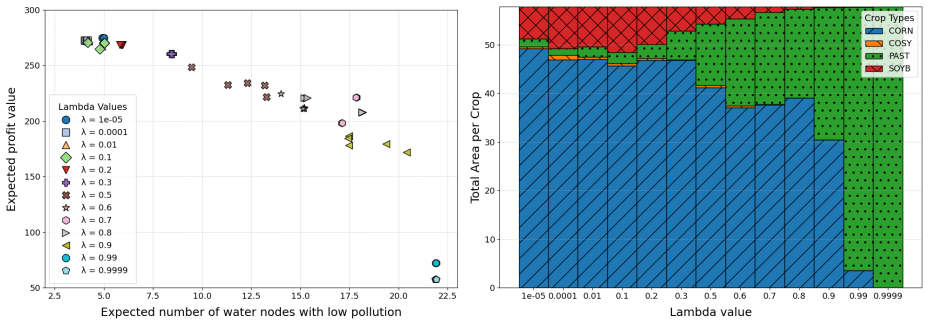
- [§6.2 and Appendix C.3] The code in Appendix C.3 does not implement the λ-weighted objective described in §6.2. The formula `all_const(s) = WIF 0.1 THEN Pollution(s)=LOW ELSE @target_s(s)` is a conditional branch on the constant 0.1, not the stated `λ*Pollution(s) + (1−λ)*@target_s(s)` combination, and it contains no λ parameter at all. The accompanying text says 'the constant 0.1 in the WIF represents the λ parameter', but this is not a weighted sum: for λ=0.1 the expression either returns `Pollution(s)=LOW` or `@target_s(s)`, never a convex combination. Also, under the WIF semantics shown in Figure 1, the then-branch should be a probability value, so `Pollution(s)=LOW` as a Boolean equality is at least ambiguous and likely not well-formed for this semantics. As a result, the λ sweep in Figure 6 and the claimed tradeoff between clean water and profit are not reproducible from the published model definition. This is a load-bearing issue for the multi-objective planning demonstration, which is one of the paper's two main application pillars.
- [§3.4, Proposition 1] Proposition 1 establishes equivalence between GNN cross-entropy minimization and RBN likelihood maximization only under the assumption that the target relation is fully observed in the training graphs, since the proof relies on the chain-rule decomposition of the full log-likelihood into a conditional term for `target` given its parents. In the node classification experiments of Section 5.3 the training data contain only partial labels (train/validation/test splits of 48/32/20), so target values for unobserved nodes are not part of the observed data. The stated equivalence therefore does not cover the setting in which the experiments are actually run. The paper should either state the proposition under a missing-at-random assumption and argue that the partial-label likelihood is still maximized by the same parameters, or explicitly restrict the equivalence claim to fully observed target relations and describe how the experimental setup relates to it.
- [§5.1 and Appendix A] The collective classification objective in equation (7) depends on the true local homophily values LH_{y*}, which are unknown; the paper replaces them with estimates obtained by the propagation algorithm in Appendix A. The paper itself concedes in §5.3 that this 'will not work well on graphs where neighboring nodes have very different local homophily values.' This is a real limitation, but it is explicitly stated and the Ising experiments do include a fragmented case (H=−0.4, F=0.1) where the method still improves over the base GNN. To make the practical reach of the method clearer, the paper should provide a sensitivity analysis or at least a comparison with an oracle variant that uses the true LH values on one of the synthetic settings, quantifying how much of the reported gain depends on the quality of the estimates.
minor comments (5)
- [§5.3] The text refers to 'Table 5.2' when discussing gray cells, but the table in question is Table 1; please correct the cross-reference.
- [§3.4, proof of Proposition 1] There is a typo in the proof: 'log-likelhood' should be 'log-likelihood'.
- [Figure 3] The caption 'Parameter for LH' is uninformative; the figure would benefit from a description of the two logistic curves and how the horizontal axis represents LH_{y*}(v) − LH_{\hat{y}}(v).
- [§6.2] The text says 'let λ used in the definition of η_X(v) vary between 0 and 1', but the definition of η_X in Section 6.1 only introduces the min-max normalization and the conditional probability P(η_X=true|X)=L(X); the role of λ in that definition is not formalized until the weighted combination is discussed later. Please make the definition of the combined objective explicit in one place.
- [Appendix C.3] The formulas for `@profit_land` use crop names CORN, COSY, PAST, SOYB, while Section 6.2 lists the crops as corn, soybean, corn/soy rotation, and pasture; please harmonize the notation.
Circularity Check
No significant circularity: the encoding and MAP reductions are proven constructions, and self-citations are background support.
full rationale
The paper's derivation chain is not circular. The GNN-to-RBN integration (Section 3.4, Eqs. (3)-(4)) is a compilation: the RBN formula is written so that it computes the same function as the GNN, and Proposition 1 gives a chain-rule proof that GNN cross-entropy training and RBN likelihood training coincide; the equivalence is by construction rather than an assumed conclusion. The collective classification model (Section 5.1, Eq. (7)) is a hand-specified product of the independently trained GNN distribution P_N and a homophily-matching factor P(LH|Yhat, LH_y*); the MAP objective is a modeling choice, and the paper explicitly describes the LH_hat approximation and concedes in Section 5.3 that it will not work well on graphs where neighboring nodes have very different local homophily values. The multi-objective reduction (Section 6.1, Definition 1 and Proposition 2) is a proven identity between argmax_c E[X|c] and MAP for an auxiliary Boolean variable eta_X; it does not assume the result it derives. Self-citations to [13] and [27] provide background encoding results that are restated in the paper and are not the source of the new empirical outcomes. One non-circular internal-validity concern: the RBN code printed in Appendix C.3 defines all_const(s) = WIF 0.1 THEN Pollution(s)=LOW ELSE @target_s(s), which the appendix text says represents the lambda-weighted objective of Section 6.2, but the printed formula is not a transparent weighted sum and, under the WIF semantics of Figure 1, is at least syntactically surprising. This is a reproducibility risk, not a circular reduction, so it does not raise the circularity score.
Assumptions & free parameters
free parameters (5)
- LH shape parameters =
4.39 and 2.2 (slope and intercept)
- Homophily propagation iterations and tolerance =
not specified
- Profit coefficients beta_c =
pasture=1, soy=4, cosy=2, corn=5
- Tradeoff coefficient lambda =
stated as varying 0 to 1; appendix code uses 0.1
- MAP search hyperparameters =
batch size b, lookahead depth d, stopping criterion t, restarts (3 for Ising, 5 for watershed)
assumptions (6)
- domain assumption ACR GNNs with sigmoid activations can be exactly represented as RBN probability formulas
- domain assumption In Proposition 1, the training data fully observes the target relation and all parent relations
- domain assumption Homophily propagation produces accurate estimates of true local homophily
- domain assumption The trained GNN generalizes to crop assignments outside the 14 simulated scenarios
- standard math In Proposition 2, X is bounded and the min-max normalization is affine
- standard math Bayes rule and the chain rule factorization of the likelihood graph
invented entities (2)
-
Boolean homophily constraint variable LH(v)
-
Expected-value encoding variable eta_X
Cite this review
Pith. "Pith review of A Neuro-Symbolic Approach for Probabilistic Reasoning on Graph Data." pith.science (2026). https://pith.science/paper/DFNYPMUO
@misc{pith2026250721873,
  author       = {Pith},
  title        = {Pith review of: A Neuro-Symbolic Approach for Probabilistic Reasoning on Graph Data},
  year         = {2026},
  howpublished = {\url{https://pith.science/paper/DFNYPMUO}},
  note         = {Machine review of arXiv:2507.21873}
}
read the original abstract
Graph neural networks (GNNs) excel at predictive tasks on graph-structured data but often lack the ability to incorporate symbolic domain knowledge and perform general reasoning. Relational Bayesian Networks (RBNs), in contrast, enable fully generative probabilistic modeling over graph-like structures and support rich symbolic knowledge and probabilistic inference. This paper presents a neuro-symbolic framework that seamlessly integrates GNNs into RBNs, combining the learning strength of GNNs with the flexible reasoning capabilities of RBNs. We develop two implementations of this integration: one compiles GNNs directly into the native RBN language, while the other maintains the GNN as an external component. Both approaches preserve the semantics and computational properties of GNNs while fully aligning with the RBN modeling paradigm. We also propose a maximum a posteriori (MAP) inference method for these neuro-symbolic models. To demonstrate the framework's versatility, we apply it to two distinct problems. First, we transform a GNN for node classification into a collective classification model that explicitly models homo- and heterophilic label patterns, substantially improving accuracy on both synthetic and real-world datasets. Second, we introduce a multi-objective network optimization problem in environmental planning, where MAP inference and continuous numeric relaxation support a complex decision-making task. Both applications include new publicly available benchmark datasets. This work introduces a powerful and coherent neuro-symbolic approach to graph data, bridging learning and reasoning in ways that enable novel applications and improved performance across diverse tasks.
Figures


Figures from the paper (4 more)



Forward citations
Cited by 1 Pith paper
-
Panning for Gold: Expanding Domain-Specific Knowledge Graphs with General Knowledge
ExeFuse uses learned 'logic' transformations and density checks to fuse general-graph facts into domain knowledge graphs, but the benchmark labels and baseline comparisons are too underspecified to support the claimed gains.
Reference graph
Works this paper leans on
-
[27]
Generalized reasoning with graph neural net- works by relational bayesian network encodings
Raffaele Pojer, Andrea Passerini, and Manfred Jaeger. Generalized reasoning with graph neural net- works by relational bayesian network encodings. In Learning on Graphs Conference , 2024
work page 2024
-
[13]
Learning and Reasoning with Graph Data: Neural and Statistical-Relational Ap- proaches
Manfred Jaeger. Learning and Reasoning with Graph Data: Neural and Statistical-Relational Ap- proaches. In International Research School in Artificial Intelligence in Bergen , Open Access Series in Informatics (OASIcs), 2022
work page 2022
-
[1]
Semantic Probabilistic Layers for Neuro-Symbolic Learning
Kareem Ahmed, Stefano Teso, Kai-Wei Chang, Guy Van den Broeck, and Antonio Vergari. Semantic Probabilistic Layers for Neuro-Symbolic Learning. In NeurIPS, 2022
work page 2022
-
[2]
Samy Badreddine, Artur d 'Avila Garcez, Luciano Serafini, and Michael Spranger. Logic tensor net- works. Artificial Intelligence, 303, 2022
work page 2022
-
[3]
The logical expressiveness of graph neural networks
Pablo Barceló, Egor V Kostylev, Mikael Monet, Jorge Pérez, Juan Reutter, and Juan-Pablo Silva. The logical expressiveness of graph neural networks. In 8th International Conference on Learning Repre- sentations (ICLR 2020), 2020
work page 2020
-
[4]
Controllable neural symbolic regression
Tommaso Bendinelli, Luca Biggio, and Pierre-Alexandre Kamienny. Controllable neural symbolic regression. In Proceedings of ICML, 2023
work page 2023
-
[5]
Neural-symbolic learning and reasoning: A survey and interpretation
Tarek R Besold et al. Neural-symbolic learning and reasoning: A survey and interpretation. InNeuro- Symbolic Artificial Intelligence: The State of the Art . 2021
work page 2021
-
[6]
Neural sheaf diffusion: A topological perspective on heterophily and oversmoothing in gnns
Cristian Bodnar, Francesco Di Giovanni, Benjamin Chamberlain, Pietro Lio, and Michael Bronstein. Neural sheaf diffusion: A topological perspective on heterophily and oversmoothing in gnns. In Proceedings of NeurIPS, 2022
work page 2022
Show all 41 references
-
[7]
Getoor and B
L. Getoor and B. Taskar. Introduction to statistical relational learning . The MIT Press, 2007
2007
-
[8]
Hamilton, Zhitao Ying, and Jure Leskovec
William L. Hamilton, Zhitao Ying, and Jure Leskovec. Inductive representation learning on large graphs. In Proceedings of NeurIPS, 2017
2017
-
[9]
HAWQS System 2.0 and Data to model the lower 48 conterminous U.S using the SWAT model, 2023
HAWQS 2.0. HAWQS System 2.0 and Data to model the lower 48 conterminous U.S using the SWAT model, 2023. 21
2023
-
[10]
Neuro- symbolic approaches in artificial intelligence
Pascal Hitzler, Aaron Eberhart, Monireh Ebrahimi, Md Kamruzzaman Sarker, and Lu Zhou. Neuro- symbolic approaches in artificial intelligence. National Science Review, 9(6), 2022
2022
-
[11]
Relational Bayesian networks
Manfred Jaeger. Relational Bayesian networks. In Proceedings of UAI, 1997
1997
-
[12]
Parameter learning for relational Bayesian networks
Manfred Jaeger. Parameter learning for relational Bayesian networks. In Proceedings ICML, 2007
2007
-
[14]
The third AI summer: AAAI Robert S
Henry Kautz. The third AI summer: AAAI Robert S. Engelmore memorial lecture. AI Magazine, 43, 2022
2022
-
[15]
Variational graph auto-encoders
Thomas N Kipf and Max Welling. Variational graph auto-encoders. arXiv preprint arXiv:1611.07308, 2016
2016 arXiv
-
[16]
Lamb, Artur d’Avila Garcez, Marco Gori, Marcelo O.R
Luís C. Lamb, Artur d’Avila Garcez, Marco Gori, Marcelo O.R. Prates, Pedro H.C. Avelar, and Moshe Y. Vardi. Graph neural networks meet neural-symbolic computing: A survey and perspective. In IJCAI,
-
[17]
Siddharth
Yichao Liang, Josh Tenenbaum, Tuan Anh Le, and N. Siddharth. Drawing out of distribution with neuro-symbolic generative models. In NeurIPS, 2022
2022
-
[18]
Efficient gen- eration of structured objects with constrained adversarial networks
Luca Di Liello, Pierfrancesco Ardino, Jacopo Gobbi, Paolo Morettin, and Stefano Teso. Efficient gen- eration of structured objects with constrained adversarial networks. In NeurIPS, 2020
2020
-
[19]
Graph normalizing flows
Jenny Liu, Aviral Kumar, Jimmy Ba, Jamie Kiros, and Kevin Swersky. Graph normalizing flows. In NeurIPS, 2019
2019
-
[20]
On performance discrepancies across local homophily levels in graph neural networks
Donald Loveland, Jiong Zhu, Mark Heimann, Benjamin Fish, Michael T Schaub, and Danai Koutra. On performance discrepancies across local homophily levels in graph neural networks. In Learning on Graphs Conference, 2024
2024
-
[21]
The heterophilic graph learning handbook: Benchmarks, models, theoretical analysis, applications and challenges
Sitao Luan, Chenqing Hua, Qincheng Lu, Liheng Ma, Lirong Wu, Xinyu Wang, Minkai Xu, Xiao- Wen Chang, Doina Precup, Rex Ying, et al. The heterophilic graph learning handbook: Benchmarks, models, theoretical analysis, applications and challenges. arXiv preprint arXiv:2407.09618, 2024
2024 arXiv
-
[22]
Deepproblog: Neural probabilistic logic programming
Robin Manhaeve, Sebastijan Dumancic, Angelika Kimmig, Thomas Demeester, and Luc De Raedt. Deepproblog: Neural probabilistic logic programming. Advances in Neural Information Processing Systems, 31:3749–3759, 2018
2018
-
[23]
Neural probabilistic logic programming in deepproblog
Robin Manhaeve, Sebastijan Dumančić, Angelika Kimmig, Thomas Demeester, and Luc De Raedt. Neural probabilistic logic programming in deepproblog. Artificial Intelligence, 298, 2021
2021
-
[24]
Neural markov logic networks
Giuseppe Marra and Ondřej Kuželka. Neural markov logic networks. In UAI, 2021
2021
-
[25]
VAEL: Bridging Variational Autoencoders and Probabilistic Logic Programming
Eleonora Misino, Giuseppe Marra, and Emanuele Sansone. VAEL: Bridging Variational Autoencoders and Probabilistic Logic Programming. NeurIPS, 2022
2022
-
[26]
Primula-3 for probabilistic modeling and reasoning on graph data
Raffaele Pojer and Manfred Jaeger. Primula-3 for probabilistic modeling and reasoning on graph data. In ECML PKDD Conference, Demo track , 2025. to appear. 22
2025
-
[28]
Using domain knowledge to guide dialog structure induction via neural probabilistic soft logic
Connor Pryor, Quan Yuan, Jeremiah Liu, Mehran Kazemi, Deepak Ramachandran, Tania Bedrax- Weiss, and Lise Getoor. Using domain knowledge to guide dialog structure induction via neural probabilistic soft logic. In ACL, 2023
2023
-
[29]
Gmnn: Graph Markov neural networks
Meng Qu, Yoshua Bengio, and Jian Tang. Gmnn: Graph Markov neural networks. In ICML, 2019
2019
-
[30]
From statistical relational to neuro-symbolic artificial intelligence
Luc de Raedt, Sebastijan Dumančić, Robin Manhaeve, and Giuseppe Marra. From statistical relational to neuro-symbolic artificial intelligence. In IJCAI, 2020. Survey track
2020
-
[31]
Graphvae: Towards generation of small graphs using variational autoencoders
Martin Simonovsky and Nikos Komodakis. Graphvae: Towards generation of small graphs using variational autoencoders. In ICANN, 2018
2018
-
[32]
Scalable neural- probabilistic answer set programming
Arseny Skryagin, Daniel Ochs, Devendra Singh Dhami, and Kristian Kersting. Scalable neural- probabilistic answer set programming. Journal of Artificial Intelligence Research , 78:579–617, 2023
2023
-
[33]
Lifted relational neural networks: Efficient learning of latent relational structures
Gustav Sourek, Vojtech Aschenbrenner, Filip Zelezny, Steven Schockaert, and Ondrej Kuzelka. Lifted relational neural networks: Efficient learning of latent relational structures. Journal of Artificial In- telligence Research, 62:69–100, 2018
2018
-
[34]
Beyond graph neural networks with lifted rela- tional neural networks
Gustav Šourek, Filip Železn `y, and Ondřej Kuželka. Beyond graph neural networks with lifted rela- tional neural networks. Machine Learning, 110(7):1695–1738, 2021
2021
-
[35]
Soil and water assessment tool (SWAT)
USDA Agricultural Research Service and Texas A&M AgriLife Research. Soil and water assessment tool (SWAT)
-
[36]
A-nesi: A scalable approximate method for probabilistic neurosymbolic inference
Emile van Krieken, Thiviyan Thanapalasingam, Jakub Tomczak, et al. A-nesi: A scalable approximate method for probabilistic neurosymbolic inference. In NeurIPS, 2023
2023
-
[37]
Two sides of the same coin: Heterophily and oversmoothing in graph convolutional neural networks
Yujun Yan, Milad Hashemi, Kevin Swersky, Yaoqing Yang, and Danai Koutra. Two sides of the same coin: Heterophily and oversmoothing in graph convolutional neural networks. In ICDM, 2022
2022
-
[38]
Neurasp: embracing neural networks into answer set programming
Zhun Yang, Adam Ishay, and Joohyung Lee. Neurasp: embracing neural networks into answer set programming. In IJCAI, 2021
2021
-
[39]
A survey on neural-symbolic learning systems
Dongran Yu, Bo Yang, Dayou Liu, Hui Wang, and Shirui Pan. A survey on neural-symbolic learning systems. Neural Networks, 166:105–126, 2023
2023
-
[40]
Efficient probabilistic logic reasoning with graph neural networks
Yuyu Zhang, Xinshi Chen, Yuan Yang, Arun Ramamurthy, Bo Li, Yuan Qi, and Le Song. Efficient probabilistic logic reasoning with graph neural networks. In International Conference on Learning Representations, 2020
2020
-
[41]
Graph neural networks: A review of methods and applications
Jie Zhou, Ganqu Cui, Shengding Hu, Zhengyan Zhang, Cheng Yang, Zhiyuan Liu, Lifeng Wang, Changcheng Li, and Maosong Sun. Graph neural networks: A review of methods and applications. AI Open, 2020. 23 A Propagate Homophily Algorithm Algorithm 2 Propagate Homophily 1: procedure ...
2020
Reviewed August 6, 2026 · model on record in the stance chip above.
Discussion (0). Sign in to comment.