REVIEW 3 major objections 6 minor 51 references
Study of thorium in hypersonic gas jets: Ionization potentials of Th and Th$^+$
T0 review · 3 major / 6 minor · reviewed 2026-08-06 · deepseek-v4-flash
Pith's one-line read Thorium's first two ionization potentials are pinned down to record precision
desk verdict Clean, significantly improved IP1 from a first in-gas-jet Rydberg series; IP2 is plausible but the threshold method's missing systematic error keeps it from being equally secure. read the letter →
The pith
A machine-rendered reading of the paper's core claim, the machinery that carries it, and where it could break.
The reading
What carries the argument
The central objects are the Rydberg series of neutral thorium observed in the hypersonic jet, described by the Rydberg-Ritz formula $E_n = E_{\mathrm{IP}} - R_\mu/(n-\delta)^2$ with a constant quantum defect $\delta = 0.56(1)$, and the empirical S-curve threshold $E_{\mathrm{IP2}} = 2\beta + x_0$ applied to the ion. The hypersonic argon jet, with Mach number above 8, is the enabling mechanism: it reduces the collision rate by about four orders of magnitude relative to the gas cell, suppressing quenching so that the Rydberg series becomes resolvable, and the electric field of the RFQ ion guide subsequently field-ionizes the Rydberg atoms in a localized region, as confirmed by time-of-flight measurements.
What would settle it
A future high-resolution measurement of a different Rydberg series of neutral Th, or of the Th+ Rydberg series in a gas jet, that fits a series limit incompatible with 50 868.41(11) $cm^{-1}$ beyond the combined uncertainties would falsify the IP1 claim; for IP2, a direct Rydberg-series limit for Th+ differing from 99 207(73) $cm^{-1}$ by more than the 21 $cm^{-1}$ calibration offset would falsify the threshold extrapolation.
Extended reading notes
Core claim
We determine the first ionization potential of thorium to be 50 868.41(2)_stat(11)_sys $cm^{-1}$, or 6.306 879(14) eV, from a Rydberg-Ritz fit to 17 unperturbed members of a single Rydberg series observed in a hypersonic gas jet, and the second ionization potential to be 99 207(73) $cm^{-1}$, or 12.300(9) eV, from an S-curve threshold fit to photoionization data in a gas cell. The gas jet suppresses collisional quenching and delivers a spectral resolution of 240(30) MHz, and time-of-flight measurements show that the Rydberg atoms are ionized by field ionization in the RFQ region. Multiconfigurational Dirac-Hartree-Fock calculations reproduce the experimental values within 0.06% (IP1) and 0.19% (IP2). A laser ionization scheme for Th+ based on the autoionizing state at 99 766.87(22) $cm^{-1}$ reaches an efficiency of at least 1.2%, but attempts to observe laser photoionization of 229Th+ from a 233U recoil source were unsuccessful.
Load-bearing premise
The IP1 value assumes the 17 selected peaks form a single Rydberg series with a constant quantum defect $\delta = 0.56(1)$ and that the three excluded members (n = 56, 57, 58) are genuinely perturbed; the IP2 value additionally assumes the empirical S-curve threshold offset, calibrated on neutral thorium with a 21 $cm^{-1}$ deviation, applies to Th+.
Editorial extensions
If this is right
- The first ionization potential of thorium is now known to 0.11 cm^-1, a 9-fold improvement, providing a precise anchor for Rydberg extrapolations and atomic-structure calculations across the actinides.
- The second ionization potential at 99 207(73) cm^-1 constrains the energies of autoionizing states and the electronic-bridge decay estimates relevant to the 229mTh isomer in Th+.
- The demonstrated combination of in-gas-jet Rydberg spectroscopy with subsequent field ionization establishes a route to high-resolution ionization-potential measurements for short-lived actinides at on-line laser-spectroscopy facilities.
- The laser ionization scheme using the 99 766.87 cm^-1 autoionizing state offers a practical basis for efficient gas-cell laser ion sources producing thorium beams.
- The observed 21 cm^-1 offset between the threshold method and the Rydberg-Ritz fit provides a species-specific calibration point for the threshold approach.
Reading between the lines
- If the in-gas-jet Rydberg method can be extended to Th+, the IP2 uncertainty, currently 73 cm^-1, could shrink by roughly two orders of magnitude to match the IP1 precision; the paper's inability to observe a Th+ Rydberg series in the gas jet makes that the direct next test.
- The unsuccessful 229Th+ photoionization suggests that a substantial fraction of recoiling ions occupy long-lived metastable 'dark' states; if so, isomer studies may need either an ionization scheme targeting those states or a neutralization-reionization strategy.
- The constant quantum defect $\delta = 0.56(1)$ over the range n = 44 to 63 is consistent with a single 6d7s np Rydberg series; identifying its spectator configuration could tie the measured limit to a specific LS term and test the present level assignments.
- If the threshold S-curve offset of 21 cm^-1 is found to be similar for other elements, the threshold method could serve as a semi-empirical predictor of ionization potentials for species where Rydberg series are experimentally inaccessible.
Editorial analysis
A structured set of objections, weighed in public.
Referee Report
Summary. The manuscript reports laser ionization spectroscopy of 232Th and 232Th+ in an argon gas cell and in a hypersonic gas jet. The authors identify a 17-member Rydberg series in neutral Th, fit it with the Rydberg-Ritz formula, and obtain IP1(Th) = 50868.41(2)_stat(11)_sys cm^-1, a large improvement over the literature value. For Th+, they extract a photoionization threshold by fitting a sigmoid to selected background regions of a congested spectrum and quote IP2(Th+) = 99207(73) cm^-1 = 12.300(9) eV. The paper also reports autoionizing states with laser ionization efficiencies up to a few percent, MCDHF and HFR+CPOL atomic structure calculations, an in-gas-jet hyperfine spectrum of 229Th, and an unsuccessful search for laser ionization of 229Th+ from 233U recoil sources.
Significance. If the two ionization potentials are correct, the paper delivers the most precise first ionization potential of thorium and a substantially improved second ionization potential, together with the first in-gas-jet Rydberg series detected via field ionization. The strengths of the paper are concrete: the Rydberg-Ritz analysis uses 17 unperturbed members with a constant quantum defect and a clearly stated step-size systematic uncertainty; the field-ionization mechanism is supported by time-of-flight measurements; and the gas-jet performance is demonstrated by a 238(30) MHz hyperfine line. The IP2 result is, however, less secure because it relies on an empirical threshold convention whose only in-paper validation is a single species with a 21 cm^-1 offset. The paper would be an important experimental contribution after that systematic issue is addressed quantitatively.
major comments (3)
- [Sec. III C and Eq. (1), with Sec. V B] The quoted IP2 uncertainty of 73 cm^-1 is presented as a statistical fit error, but no systematic uncertainty is assigned for the threshold method or for the manual selection of background points. The single-species validation in Sec. V B yields a 21 cm^-1 offset between the threshold result and the Rydberg-Ritz IP1; the authors state that this is within the 73 cm^-1 statistical uncertainty, but that does not bound the offset for Th+, where the spectrum is much more congested and no independent Rydberg-series anchor exists. Because the abstract and conclusion claim a 22-fold improvement on IP2, an explicit systematic error budget and a discussion of the transferability of the calibration to Th+ are required before this claim is established.
- [Sec. III C, Fig. 4, Eq. (1)] The threshold fit depends on choices that are not reflected in the stated statistical error: the 0.5 cm^-1 averaging regions, the selection of 'valleys' at high energy, and the empirical definition E_IP2 = 2*beta + x0. I request a sensitivity analysis showing how the extracted IP2 changes when these choices are varied, and ideally a Monte Carlo over the point-selection procedure. Without such an analysis, the reader cannot distinguish the quoted 73 cm^-1 from a fitting artifact.
- [Sec. V B, Table II, Fig. 9] The 17-member Rydberg series is identified by constancy of the quantum defect, with n = 56, 57, 58 excluded as perturbed. Please provide a quantitative membership criterion: residuals of the Rydberg-Ritz fit in units of the line-position uncertainties, and the variation of the fitted IP and delta when individual members are included or excluded. The current result is plausible, but the statistical uncertainty of 0.02 cm^-1 is likely dominated by the choice of series membership, which is not quantified.
minor comments (6)
- [Sec. I] The sentence 'These investigations, led to the extraction' should read 'These investigations led to the extraction'.
- [Sec. III C] The phrase 'The raise in count rate' should be 'The rise in count rate'.
- [Table II] In the row beginning '51 50825.28(1)', the leading '51' appears to be a formatting artifact; the row should be labeled as n = 51.
- [Sec. VII] The phrase 'an 22-fold improvement' should read 'a 22-fold improvement', and 'in forseseen cases' should be 'in foreseen cases'.
- [References] The reference list contains several formatting problems, notably Ref. [29] ('A. Kramida, Yu. Ralchenko, J. Reader, and and NIST ASD Team') and Ref. [39], which has an embedded URL in the title; these should be cleaned.
- [Fig. 4 caption] The phrase 'The found IP2' should be 'The fitted IP2' or 'The determined IP2'.
Circularity Check
No significant circularity: the IP values are data-extracted with an independent theoretical comparison.
full rationale
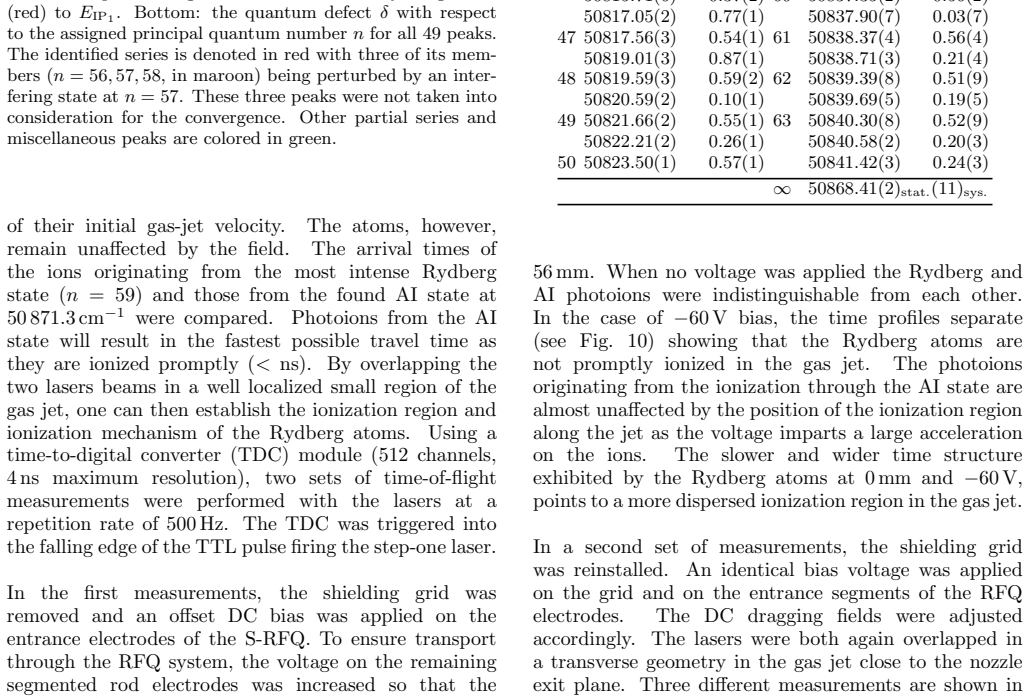
The derivation chain is not circular. The first ionization potential is obtained from a free Rydberg-Ritz fit (Eq. 2) to 17 unperturbed line positions; the literature IP1 is used only as an initial guess to assign principal quantum numbers, and the fitted limit 50868.41(11) cm^-1 is determined by the measured line energies, not by that guess. The second ionization potential is extracted using the explicitly defined sigmoid threshold E_IP2 = 2β + x0 (Eq. 1), an empirical estimator based on prior astatine work and checked here on atomic Th. This is a measurement convention, not a fitted parameter renamed as a prediction. The paper even quantifies the convention's offset for Th (21 cm^-1 lower than the Rydberg-Ritz value) and states that this is within the 73 cm^-1 statistical uncertainty of the Th+ threshold fit, so the limitation is disclosed rather than hidden. The MCDHF ionization potentials are computed from active-space expansions and then compared with the experimental values, so they serve as independent checks rather than inputs. Self-citations in the paper concern instrumentation, nozzle characterization, and prior source development; none carries the logical weight of the ionization-potential determination. The only substantive concern, namely that IP2 lacks an independent Rydberg-series anchor, is a systematic-accuracy risk and not a circularity.
Assumptions & free parameters
free parameters (5)
- IP1 (Rydberg-Ritz convergence limit) =
50868.41(11) cm^-1
- Quantum defect delta of the identified series =
0.56(1)
- IP2 (photoionization threshold intercept) =
99207(73) cm^-1
- Sigmoid threshold parameters x0 and beta =
not stated individually
- HFR+CPOL radial parameter scale factors =
e.g., F2(6d,6d) scaled to 0.59 of ab initio value
assumptions (6)
- standard math The Rydberg-Ritz formula E_n = E_IP - R_mu/(n-delta)^2 with constant delta describes the selected series.
- domain assumption The identified chain of 17 peaks is a single unperturbed series; interlopers at n=56-58 are excluded correctly.
- ad hoc to paper The threshold S-curve intercept method defines the ionization potential as E_IP2 = 2*beta + x0.
- domain assumption The Rydberg excitation region in the gas jet is field-free enough that Stark shifts are negligible at the fitted level accuracy.
- domain assumption Field ionization of Rydberg states in the RFQ region does not alter the measured line positions.
- standard math MCDHF method with the stated active spaces converged for IP1 and IP2.
Cite this review
Pith. "Pith review of Study of thorium in hypersonic gas jets: Ionization potentials of Th and Th$^+$." pith.science (2026). https://pith.science/paper/KHIBTW7V
@misc{pith2026250721946,
  author       = {Pith},
  title        = {Pith review of: Study of thorium in hypersonic gas jets: Ionization potentials of Th and Th$^+$},
  year         = {2026},
  howpublished = {\url{https://pith.science/paper/KHIBTW7V}},
  note         = {Machine review of arXiv:2507.21946}
}
abstract
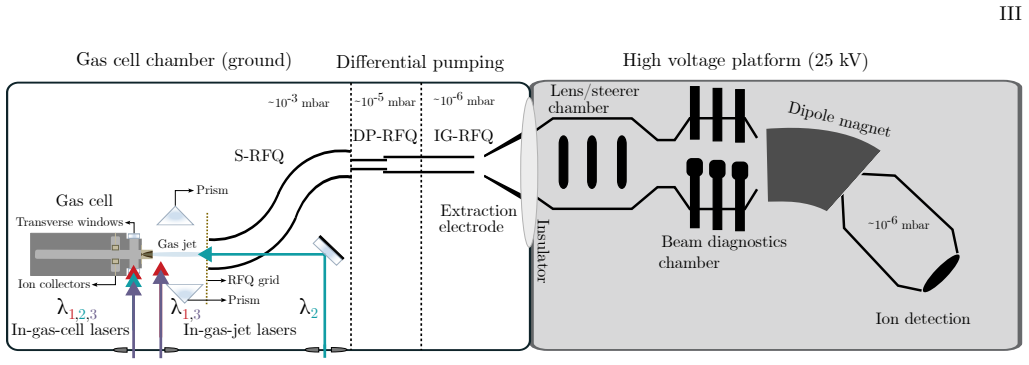
Laser ionization spectroscopy was performed on both neutral and singly ionized $^{232}$Th with the aim of identifying the nuclear-clock isomer in the singly charged ionic state of $^{229}$Th. A search for an efficient laser ionization scheme of $^{232}$Th$^+$ was conducted in an argon-filled gas cell. This revealed a congested spectrum due to collisional quenching effects and the presence of several auto-ionizing states, one of which has a laser ionization efficiency of at least $1.2 \%$. Using a threshold approach, the second ionization potential was determined to be $12.300(9)\,$eV. The subsequent study on atomic $^{232}$Th validated the threshold approach. Conducting spectroscopy in a hypersonic gas jet, suppressed the gas-collision-induced quenching, revealing a Rydberg series that converges to the first ionization potential, determined to be $6.306879(14)\,$eV. The gas jet also cools down the thorium, allowing for high-resolution laser spectroscopy with a resolution of $240(30)\,$MHz. Using the Multiconfigurational Dirac-Hartree-Fock (MCDHF) method, the ionization potentials were computed, showing a relative difference of 0.06\% and 0.19\% between theory and our experimental values for the ionization potentials of Th and Th$^+$ respectively. Further calculations using a pseudo-relativistic Hartree-Fock method reveal strong mixing in the used intermediate state at $26113.27\,$cm$^{-1}$ of Th. A dedicated fast-extraction gas cell with $^{233}$U recoil sources was used to study $^{229}$Th$^+$ but no photo-ionization signal could be observed.
Figures


Figures from the paper (11 more)




Reference graph
Works this paper leans on
-
[1]
E. Peik and C. Tamm, Nuclear laser spectroscopy of the 3.5 eV transition in Th-229, Europhysics Letters 61, 181 (2003)
work page 2003
- [2]
- [3]
-
[4]
C. Zhang, T. Ooi, J. S. Higgins, J. F. Doyle, L. von der Wense, K. Beeks, A. Leitner, G. Kazakov, P. Li, P. G. Thirolf, T. Schumm, and J. Ye, Dawn of a nuclear clock: frequency ratio of the 229mTh isomeric transition and the 87Sr atomic clock, Nature 633, 10.1038/s41586-024- 07839-6 (2024), arXiv:2406.18719
arXiv 2024
-
[5]
Direct detection of the 229Th nuclear clock transition
L. Von Der Wense, B. Seiferle, M. Laatiaoui, J. B. Neu- mayr, H. J. Maier, H. F. Wirth, Ch. Mokry, J. Runke, K. Eberhardt, Ch. E. D¨ ullmann, N. G. Trautmann, and P. G. Thirolf, Direct detection of the 229Th nuclear clock transition, Nature 533, 47 (2016), arXiv:1710.11398
work page Pith review arXiv 2016
-
[6]
Lifetime measurement of the $^{229}$Th nuclear isomer
B. Seiferle, L. von der Wense, and P. G. Thi- rolf, Lifetime measurement of the 229Th nuclear iso- mer, Physical Review Letters 118, 042501 (2017), arXiv:arXiv:1801.05205v1
work page Pith review arXiv 2017
-
[7]
Laser spectroscopic characterization of the nuclear clock isomer $^{229m}$Th
J. Thielking, M. V. Okhapkin, P. G lowacki, D. M. Meier, L. Von Der Wense, B. Seiferle, Ch. E. D¨ ullmann, P. G. Thirolf, and E. Peik, Laser spectroscopic characterization of the nuclear-clock isomer 229mTh , Nature 556, 321 (2018), arXiv:1709.05325
work page Pith review arXiv 2018
-
[8]
A. Yamaguchi, Y. Shigekawa, H. Haba, H. Kikunaga, K. Shirasaki, M. Wada, and H. Katori, Laser spec- troscopy of triply charged 229Th isomer for a nuclear clock, Nature 10.1038/s41586-024-07296-1 (2024)
Show all 51 references
-
[9]
Kraemer, J
S. Kraemer, J. Moens, M. Athanasakis-Kaklamanakis, S. Bara, K. Beeks, P. Chhetri, K. Chrysalidis, A. Claessens, T. E. Cocolios, J. G. Correia, H. D. Witte, R. Ferrer, S. Geldhof, R. Heinke, N. Hosseini, M. Huyse, U. K¨ oster, Y. Kudryavtsev, M. Laatiaoui, R. Lica, G. Magchiels...
2023 arXiv
-
[10]
S. G. Porsev, V. V. Flambaum, E. Peik, and C. Tamm, Excitation of the isomeric 229mTh nuclear state via an electronic bridge process in 229Th+ , Physical Review Let- ters 105, 1 (2010)
2010
-
[11]
S. G. Porsev and V. V. Flambaum, Electronic bridge pro- cess in 229Th+, Physical Review A - Atomic, Molecular, and Optical Physics 81, 1 (2010)
2010
-
[12]
F. F. Karpeshin and M. B. Trzhaskovskaya, Impact of the ionization of the atomic shell on the lifetime of the 229mTh, Nuclear Physics A 969, 173 (2018), arXiv:1701.05340
2018 arXiv
-
[13]
F. F. Karpeshin and M. B. Trzhaskovskaya, A proposed solution for the lifetime puzzle of the229mTh+ isomer, Nu- clear Physics A 1010, 122173 (2021)
2021
-
[14]
O. A. Herrera-Sancho, N. Nemitz, M. V. Okhapkin, and E. Peik, Energy levels of Th + between 7.3 and 8.3 eV, Physical Review A - Atomic, Molecular, and Optical Physics 88, 1 (2013)
2013
-
[15]
D. M. Meier, J. Thielking, P. G lowacki, M. V. Okhap- kin, R. A. M¨ uller, A. Surzhykov, and E. Peik, Electronic level structure of Th + in the range of the 229mTh isomer energy, Physical Review A 99, 1 (2019)
2019
-
[16]
Kudryavtsev, P
Y. Kudryavtsev, P. Creemers, R. Ferrer, C. Granados, L. Gaffney, M. Huyse, E. Mogilevskiy, S. Raeder, S. Sels, P. Van den Bergh, P. Van Duppen, and A. Zadvornaya, A new in-gas-laser ionization and spectroscopy laboratory for off-line studies at KU Leuven, Nuclear Instruments a...
2016
-
[17]
Verlinde, Towards the In-Gas-Jet Laser Ionization Spectroscopy of the 229Th Isomer, Ph.D
M. Verlinde, Towards the In-Gas-Jet Laser Ionization Spectroscopy of the 229Th Isomer, Ph.D. thesis, KU Leu- ven (2021)
2021
-
[18]
Backe, M
H. Backe, M. Hies, H. Kunz, W. Lauth, O. Curtze, P. Schwamb, M. Sewtz, W. Theobald, R. Zahn, K. Eber- hardt, N. Trautmann, D. Habs, R. Repnow, and B. Fricke, Isotope Shift Measurements for Superdeformed Fission Isomeric States, Physical Review Letters 80, 920 (1998)
1998
-
[19]
Kudryavtsev, R
Y. Kudryavtsev, R. Ferrer, M. Huyse, P. Van den Bergh, and P. Van Duppen, The in-gas-jet laser ion source: Res- onance ionization spectroscopy of radioactive atoms in supersonic gas jets, Nuclear Instruments and Methods in Physics Research Section B: Beam Interactions with Mat...
2013 arXiv
-
[20]
Raeder, B
S. Raeder, B. Bastin, M. Block, P. Creemers, P. Dela- haye, R. Ferrer, X. Fl´ echard, S. Franchoo, L. Ghys, L. P. Gaffney, C. Granados, R. Heinke, L. Hijazi, M. Huyse, T. Kron, Y. Kudryavtsev, M. Laatiaoui, N. Lecesne, F. Luton, I. D. Moore, Y. Martinez, E. Mogilevskiy, P. Nau...
2016
-
[21]
Ferrer, A
R. Ferrer, A. Barzakh, B. Bastin, R. Beerwerth, M. Block, P. Creemers, H. Grawe, R. de Groote, P. De- lahaye, X. Fl´ echard, S. Franchoo, S. Fritzsche, L. P. Gaffney, L. Ghys, W. Gins, C. Granados, R. Heinke, L. Hijazi, M. Huyse, T. Kron, Y. Kudryavtsev, M. Laa- tiaoui, N. Lec...
2017
-
[22]
Ferrer, M
R. Ferrer, M. Verlinde, E. Verstraelen, A. Claessens, M. Huyse, S. Kraemer, Y. Kudryavtsev, J. Romans, P. Van den Bergh, P. Van Duppen, A. Zadvornaya, O. Chazot, G. Grossir, V. I. Kalikmanov, M. Nabu- urs, and D. Reynaerts, Hypersonic nozzle for laser- spectroscopy studies at ...
2021
-
[23]
Lantis, A
J. Lantis, A. Claessens, D. M¨ unzberg, J. Auler, M. Block, P. Chhetri, Ch. E. D¨ ullmann, R. Ferrer, F. Giacoppo, M. J. Guti´ errez, F. Ivandikov, O. Kaleja, T. Kieck, E. Kim, M. Laatiaoui, N. Lecesne, V. Manea, S. Noth- helfer, S. Raeder, J. Romans, E. Romero-Romero, A. De R...
2024
-
[24]
Claessens, Laser ionization spectroscopy of 254No and 229Th in hypersonic gas jets , Ph.D
A. Claessens, Laser ionization spectroscopy of 254No and 229Th in hypersonic gas jets , Ph.D. thesis, KU Leuven (2024)
2024
-
[25]
Verlinde, R
M. Verlinde, R. Ferrer, A. Claessens, C. A. Granados, S. Kraemer, Y. Kudryavtsev, D. Li, P. Van den Bergh, P. Van Duppen, and E. Verstraelen, Single-longitudinal- mode pumped pulsed-dye amplifier for high-resolution laser spectroscopy, Review of Scientific Instruments 91, 1030...
2020
-
[26]
O. A. Herrera-Sancho, M. V. Okhapkin, K. Zimmer- mann, C. Tamm, E. Peik, A. V. Taichenachev, V. I. Yudin, and P. G lowacki, Two-photon laser excitation of trapped 232Th+ ions via the 402-nm resonance line, Phys- ical Review A - Atomic, Molecular, and Optical Physics 85, 1 (2012)
2012
-
[27]
Claessens, F
A. Claessens, F. Ivandikov, S. Bara, P. Chhetri, A. Dragoun, Ch. E. D¨ ullmann, Y. Elskens, R. Ferrer, S. Kraemer, Y. Kudryavtsev, D. Renisch, J. Romans, V. Rosecker, A. de Roubin, T. Schumm, P. Van den Bergh, and P. Van Duppen, Laser ionization scheme de- velopment for in-gas...
2023
-
[28]
S. L. Redman and C. J. Nave, .and Sansonetti, The spec- trum of thorium from 250 nm to 5500 nm: Ritz wave- lengths and optimized energy levels, Astrophysical Jour- nal, Supplement Series 211, 10.1088/0067-0049/211/1/4 (2014), arXiv:1308.5229
2014 arXiv
-
[29]
Kramida, Yu
A. Kramida, Yu. Ralchenko, J. Reader, and and NIST ASD Team, NIST Atomic Spectra Database (ver. 5.11), [Online]. Available: https://physics.nist.gov/asd [2024, Jan- uary 20]. National Institute of Standards and Technology, Gaithersburg, MD. (2023). XVI
2023
-
[30]
Rothe, A
S. Rothe, A. N. Andreyev, S. Antalic, A. Borschevsky, L. Capponi, T. E. Cocolios, H. De Witte, E. Eliav, D. V. Fedorov, V. N. Fedosseev, D. A. Fink, S. Fritzsche, L. Ghys, M. Huyse, N. Imai, U. Kaldor, Y. Kudryavt- sev, U. K¨ oster, J. F. Lane, J. Lassen, V. Liberati, K. M. Ly...
2013
-
[31]
Rothe, An all-solid state laser system for the laser ion source RILIS and in-source laser spectroscopy of astatine at ISOLDE/CERN , Ph.D
S. Rothe, An all-solid state laser system for the laser ion source RILIS and in-source laser spectroscopy of astatine at ISOLDE/CERN , Ph.D. thesis, JGU Mainz (2012)
2012
-
[32]
Vascon, S
A. Vascon, S. Santi, A. A. Isse, T. Reich, J. Drebert, H. Christ, Ch. E. D¨ ullmann, and K. Eberhardt, Elu- cidation of constant current density molecular plating, Nuclear Instruments and Methods in Physics Research, Section A: Accelerators, Spectrometers, Detectors and Associ...
2012
-
[33]
R. Haas, M. Hufnagel, R. Abrosimov, Ch. E. D¨ ullmann, D. Krupp, Ch. Mokry, D. Renisch, J. Runke, and U. W. Scherer, Alpha spectrometric characterization of thin 233U sources for 229(m)Th production, Radiochimica Acta 108, 923 (2020)
2020
-
[34]
Uranium-233 recoil ion sources from JGU Mainz for KU Leuven, Progress report (JGU Mainz, 2021)
2021
-
[35]
K¨ ohler, R
S. K¨ ohler, R. Deißenberger, K. Eberhardt, N. Erdmann, G. Herrmann, G. Huber, J. V. Kratz, M. Nunnemann, G. Passler, P. M. Rao, J. Riegel, N. Trautmann, and K. Wendt, Determination of the first ionization poten- tial of actinide elements by resonance ionization mass spectrosc...
1997
-
[36]
Liu and D
Y. Liu and D. Stracener, High efficiency resonance ion- ization of thorium, Nuclear Instruments and Methods in Physics Research Section B: Beam Interactions with Ma- terials and Atoms 462, 95 (2020)
2020
-
[37]
Raeder, V
S. Raeder, V. Sonnenschein, T. Gottwald, I. D. Moore, M. Reponen, S. Rothe, N. Trautmann, and K. Wendt, Resonance ionization spectroscopy of thorium isotopes–towards a laser spectroscopic identification of the low-lying 7.6 eV isomer of 229Th , Journal of Physics B: Atomic, Mo...
2011 arXiv
-
[38]
Tomita, A
H. Tomita, A. Nakamura, D. Matsui, R. Ohtake, V. Son- nenschein, K. Saito, K. Kato, M. Ohashi, V. Degner, K. Wendt, M. Morita, T. Sakamoto, T. Kawai, T. Oku- mura, I. Moore, and T. Iguchi, Development of two-color resonance ionization scheme for Th using an automated wide-rang...
2018
-
[39]
Tiesinga, P
E. Tiesinga, P. Mohr, D. Newell, and B. Taylor, Codata recommended values of the fundamental physical constants: 2018 https://doi.org/10.1103/RevModPhys.93.025010 (2021)
2021 doi
-
[40]
V. S. Lethokhov, Laser Photoionization Spectroscopy (Academic press, 1987)
1987
-
[41]
R. Zalubas, Energy levels, classified lines, and Zeeman effect of neutral thorium, Journal of Research of the Na- tional Bureau of Standards Section A: Physics and Chem- istry 80A, 221 (1976)
1976
-
[42]
Naubereit, T
P. Naubereit, T. Gottwald, D. Studer, and K. Wendt, Ex- cited atomic energy levels in protactinium by resonance ionization spectroscopy, Physical Review A 98, 1 (2018)
2018
-
[43]
Sonnenschein, S
V. Sonnenschein, S. Raeder, A. Hakimi, D. Moore, and K. Wendt, Determination of the ground-state hyperfine structure in neutral 229Th, Journal of Physics B: Atomic, Molecular and Optical Physics 45, 10.1088/0953- 4075/45/16/165005 (2012)
2012 doi
-
[44]
R. D. Cowan, The Theory of Atomic Structure and Spec- tra (University of California Press, Berkeley, 1981)
1981
-
[45]
Quinet, P
P. Quinet, P. Palmeri, E. Bi´ emont, M. M. McCurdy, G. Rieger, E. H. Pinnington, M. E. Wickliffe, and J. E. Lawler, Experimental and Theoretical Radiative Life- times, Branching Fractions and Oscillator Strengths in Lu II , Monthly Notices of the Royal Astronomical Soci- ety 3...
1999
-
[46]
Quinet, P
P. Quinet, P. Palmeri, E. Bi´ emont, Z. S. Li, and S. Svan- berg, Radiative Lifetime Measurements and Transition probability Calculations in Lanthanide Ions, J. Alloys Compounds 344, 255 (2002)
2002
-
[47]
for a Th 4+ ionic core) and a cut-off radius, rc, equal to 1.88 a 0 (which corresponds to the mean value of r for the outermost core orbital (6p), as obtained from our HFR calculations). A least-squares adjustment of the radial parameters was then performed in order to minimiz...
1937
-
[48]
Fraga, J
S. Fraga, J. Karwowski, and K. M. S. Saxena, Handbook of Atomic Data (Elsevier, Amsterdam, 1976)
1976
-
[49]
I. P. Grant, Relativistic quantum theory of atoms and molecules. Theory and computation (Springer, New York, 2007)
2007
-
[50]
Froese Fischer, G
C. Froese Fischer, G. Gaigalas, P. J¨ onsson, and J. Biero´ n, GRASP2018-A Fortran 95 version of the General Rela- tivistic Atomic Structure Package , Computer Physics Communication 237, 184 (2019)
2019
-
[51]
Weigand, X
A. Weigand, X. Cao, T. Hangele, and M. Dolg, Rel- ativistic small-core pseudopotentials for actinium, tho- rium, and protactinium, Journal of Physical Chemistry A 118, 2519 (2014). XVII TABLE IV. Lowest energy levels of Th with their respective LS compositions (only the first ...
2014
Reviewed August 6, 2026 · model on record in the stance chip above.
Discussion (0). Continue with ORCID to comment.