REVIEW 5 major objections 5 minor 22 references
EIFNet: Leveraging Event-Image Fusion for Robust Semantic Segmentation
T0 review · 5 major / 5 minor · reviewed 2026-08-06 · deepseek-v4-flash
Pith's one-line read EIFNet fuses event streams with RGB images and claims new state-of-the-art semantic segmentation accuracy on the DDD17 and DSEC benchmarks.
desk verdict EIFNet is a plausible incremental fusion architecture with a solid ablation, but the SOTA claim rests on sloppy numbers and an opaque baseline protocol. read the letter →
The pith
A machine-rendered reading of the paper's core claim, the machinery that carries it, and where it could break.
The reading
What carries the argument
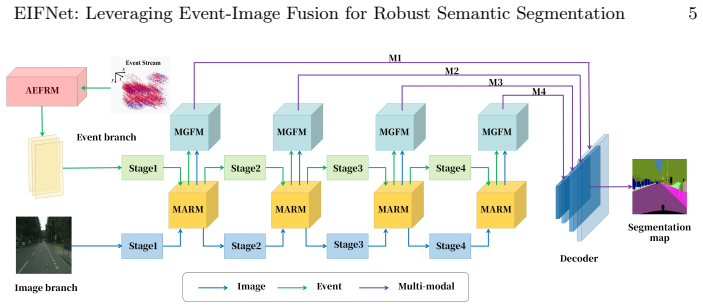
The argument is carried by three modules arranged between two encoders and a Transformer decoder. AEFRM builds an activity accumulation map from the event stream, fuses multi-scale pooled features, and multiplies them by a channel-attention mask to enhance motion structure while suppressing noise. MARM applies channel attention to each modality separately and then a jointly computed spatial attention map, with learnable residual scaling, to reduce noise and align semantic emphasis. MGFM applies differential attention to the event features and efficient cross-attention to the image features, concatenates the attended outputs, derives channel and spatial gates, and fuses them through a per-pixel softmax-weighted sum followed by layer normalization and a feed-forward network. The encoders use Mix Transformer backbones of unequal depth, MiT-B0 for events and MiT-B2 for images, and the final output aggregates the fused multi-scale features before the decoder restores spatial resolution.
What would settle it
Retrain EISNet, CMX, and CMNeXt under EIFNet's exact protocol, with identical backbones, input sizes, epochs, batch size, augmentations, and random seed, and compare the resulting mIoU values. If the reported gaps shrink to near zero or reverse, the state-of-the-art claim fails. A simpler check: the paper gives a DSEC mIoU of 74.64 in Table 1 but 74.05 in the experiment section, so the headline number itself is not settled.
Extended reading notes
Core claim
The paper claims that EIFNet outperforms all compared image-only, event-only, and event-image fusion methods on both DDD17-Semantic and DSEC-Semantic, with the largest gains coming from the combination of all three proposed modules rather than from any single one. The authors attribute the improvement to the Adaptive Event Feature Refinement Module (AEFRM) turning sparse, noisy event streams into clean activity-weighted features; the Modality-Adaptive Recalibration Module (MARM) applying per-modality channel and spatial recalibration; and the Multi-head Attention Gated Fusion Module (MGFM) performing bidirectional attention with per-pixel soft gating. In the ablation study, the full model reaches 76.55 percent mIoU on DDD17 against 73.41 percent for the closest prior fusion baseline, a gain the paper presents as evidence that the architecture as a whole drives the improvement.
Load-bearing premise
The central claim rests on the assumption that the comparison with prior methods is fair, meaning the quoted baseline scores were obtained under conditions comparable to EIFNet's training protocol, since the paper does not state whether baselines were retrained or whether the numbers were copied from their original publications.
Editorial extensions
If this is right
- If the reported results hold, EIFNet would set the best published mIoU on both DDD17-Semantic (76.56 percent) and DSEC-Semantic (74.64 percent) among the methods considered in the paper.
- The ablation study implies that AEFRM, MARM, and MGFM work synergistically, since the full model outperforms every one- and two-module combination.
- The robustness experiment on DDD17 indicates that EIFNet keeps stable mIoU across 10 ms, 50 ms, and 250 ms event integration windows while the compared fusion methods degrade, suggesting the design tolerates varying temporal aggregation.
- With an inference speed above 55 FPS at the tested resolution, the network is presented as satisfying real-time constraints for autonomous driving and robotics.
- The parameter count of 35.48 million is close to that of the strongest prior fusion baseline, so the accuracy gain is claimed without a large complexity penalty.
Reading between the lines
- If the performance gap survives a controlled re-training of all baselines under one protocol, event-image fusion would become the strongest available input pair for low-light and fast-motion segmentation, which could push more deployments toward hybrid event-frame sensors.
- The paper does not define what 'Differential Attention' or 'Efficient Cross-Attention' compute; until those operations are specified, an independent reader cannot attribute the gains to those exact mechanisms rather than to the surrounding scaffolding.
- The asymmetric backbone choice, MiT-B0 for events and MiT-B2 for images, hints that sparse event streams need less capacity; swapping the depths of the two branches would test whether the event branch saturates early.
- The robustness across 10 to 250 ms event windows is an implicit claim about graceful degradation under temporal mismatch, a property that matters for real-time systems in which events and frames are not perfectly synchronized.
Editorial analysis
A structured set of objections, weighed in public.
Referee Report
Summary. The paper proposes EIFNet, a dual-encoder network for event-image semantic segmentation. It introduces three modules: AEFRM for event feature refinement via multi-scale activity modeling and attention, MARM for per-modality channel/spatial recalibration, and MGFM for attention-based gated fusion between event and image features. Experiments on DDD17-Semantic and DSEC-Semantic report state-of-the-art mIoU of 76.56% and 74.64%, respectively, together with ablations and a robustness study across event durations. The manuscript claims that EIFNet significantly outperforms all compared methods while remaining efficient enough for real-time deployment.
Significance. If the reported results are accurate and the comparisons are fair, EIFNet would be a strong empirical contribution: it improves over the closest prior fusion method EISNet by 3.15 mIoU on DDD17 and 1.57 mIoU on DSEC, and the module-level ablations support the utility of each proposed component. The paper does not provide code, formal derivations, or machine-checked proofs; its value rests entirely on the reproducibility and correctness of the empirical claims. The design ideas, especially activity-based event refinement and gated cross-modal attention, are well motivated and could be of interest to the event-vision community. However, several load-bearing details about the reported numbers, baseline protocols, and undefined attention components must be resolved before the claims can be accepted.
major comments (5)
- [§4.3 vs. Table 1] The DSEC results are internally inconsistent: Table 1 reports 74.64 mIoU / 95.61 PA for EIFNet, while Section 4.3 states 74.05 mIoU / 95.27 PA. The claimed margin over EISNet on DSEC is only 1.57 mIoU, so the 0.59-point discrepancy is a large fraction of the claimed improvement. In addition, the full-model mIoU in Table 2 is 76.55, while Table 1 and Section 4.3 report 76.56. The authors must identify the correct numbers and explain the discrepancy.
- [§4.2, Table 1] The fairness of the state-of-the-art comparison is not established. Section 4.2 gives implementation details only for EIFNet; it does not state whether SegFormer-B2, SegNeXt-B, EV-SegNet, ESS, EDCNet-S2D, HALSIE, CMX, CMNeXt, and EISNet were retrained under the same data split, input resolution, optimizer, epochs, augmentations, and backbone initializations, or whether the Table 1 entries were taken from the original papers. A single fixed seed with no error bars or multiple runs also does not support the word 'significantly' in the performance claim. Please provide a common-protocol table or clearly cite the source of each baseline number and justify comparability.
- [§3.4, Eqs. (12)-(13)] The core fusion module MGFM is not reproducible as written. Differential Attention and Efficient Cross-Attention are invoked in Eqs. (12) and (13) but are never defined: the text does not specify the number of heads, the query/key/value projections, the attention scaling, the output shapes, or how the cross-modal inputs are reshaped. Differential Transformer [15] is cited for the former, but no definition or reference is given for Efficient Cross-Attention. Because MGFM is central to the claimed improvements, these components must be defined precisely.
- [§4.4, Table 2] The ablation study does not show the baseline value within the table. The text says EISNet is used as the baseline, and the claimed increments (+1.28 for AEFRM, +0.70 for MARM, +1.15 for MGFM) are computed relative to the EISNet mIoU of 73.41 from Table 1, but Table 2 has no 'Baseline' row. Including the baseline row would make the additive contributions directly verifiable and would also clarify that 'Baseline + MARM + MGFM' reaches 76.36 without AEFRM.
- [§4.5, Table 3] The efficiency claim is not supported by the presented data. Section 4.5 states that Table 3 summarizes parameters, FLOPs, and inference FPS on an RTX 3090, and that the model runs 'above 55 FPS', but Table 3 contains no FPS column and labels the complexity column 'MACs (G)' rather than FLOPs. The implementation details in Section 4.2 mention an RTX 4090, while Section 4.5 says RTX 3090. Please align the hardware description and either add the FPS values or remove the speed claim.
minor comments (5)
- [§1] The text contains a typo: 'a noval dual-stage fusion strategy' should be 'a novel dual-stage fusion strategy'.
- [§3.2, Eqs. (4)-(5)] AEFRM is described as generating a 'spatial attention map' M, but Eq. (4) computes channel-wise weights W and Eq. (5) applies a 1x1 convolution on channel-reweighted features. Please clarify whether M is a spatial attention map or a channel-mixing projection, since the terminology is confusing.
- [§4.1] The sentence 'DSEC-Semantic introduces pixel-level annotations for 11 semantic classes' is clear, but the corresponding class count for DDD17 (6 classes) is given without a reference; please provide a citation or the standard protocol reference for both datasets.
- [§4.3] The text mentions 'Event-Seg [1]' and 'EDCNeXt-S2D', but the reference list and Table 1 use 'EV-SegNet' and 'EDCNet-S2D'. Please unify these names to avoid ambiguity.
- [§4.2] The paper states 'The random seed is fixed to 1 to ensure reproducibility' but does not specify software versions or provide a code release. Please include a reproducibility statement with library versions and, if possible, a public code link.
Circularity Check
No circularity: EIFNet's claims are empirical benchmark results, and the module equations are explicit transformations of the inputs rather than re-statements of the target.
full rationale
I examined the claimed derivation chain in EIFNet. The paper makes no analytical derivation of its performance from first principles; its central claim is an empirical benchmark result. Section 3 defines AEFRM, MARM, and MGFM through explicit equations (Eqs. (1)-(19)), where each output is computed from the input event/image features plus learned weights. No quantity is defined in terms of the target result and then 'predicted'. The ablation study in Section 4.4 compares against EISNet, an externally published baseline, by progressively adding the proposed modules and retraining; this is a standard empirical attribution procedure, not a fitted parameter renamed as a prediction. The inconsistency between Table 1 (74.64 mIoU on DSEC) and Section 4.3 (74.05 mIoU on DSEC), and the absence of a shared training-protocol table for baselines, are reproducibility and fairness concerns, not circularity under the stated criteria. The citations to Differential Transformer and other methods are external prior work, and no load-bearing self-citation appears in the paper. Therefore no circular step is exhibited.
Assumptions & free parameters
free parameters (3)
- Number of temporal bins =
3
- Event integration window =
50 ms
- Input crop size =
346x260 (DDD17), 640x480 (DSEC)
assumptions (4)
- domain assumption The provided train/test splits for DDD17-Semantic and DSEC-Semantic are the standard ones and the labels are correct.
- domain assumption ImageNet-pretrained MiT backbones transfer to event-image inputs.
- domain assumption The 'Differential Attention' and 'Efficient Cross Attention' operations from the cited works behave as expected in this architecture.
- domain assumption The mIoU and PA metrics are computed identically to the baseline papers, making the numbers comparable.
Cite this review
Pith. "Pith review of EIFNet: Leveraging Event-Image Fusion for Robust Semantic Segmentation." pith.science (2026). https://pith.science/paper/D4EKNINT
@misc{pith2026250721971,
  author       = {Pith},
  title        = {Pith review of: EIFNet: Leveraging Event-Image Fusion for Robust Semantic Segmentation},
  year         = {2026},
  howpublished = {\url{https://pith.science/paper/D4EKNINT}},
  note         = {Machine review of arXiv:2507.21971}
}
read the original abstract
Event-based semantic segmentation explores the potential of event cameras, which offer high dynamic range and fine temporal resolution, to achieve robust scene understanding in challenging environments. Despite these advantages, the task remains difficult due to two main challenges: extracting reliable features from sparse and noisy event streams, and effectively fusing them with dense, semantically rich image data that differ in structure and representation. To address these issues, we propose EIFNet, a multi-modal fusion network that combines the strengths of both event and frame-based inputs. The network includes an Adaptive Event Feature Refinement Module (AEFRM), which improves event representations through multi-scale activity modeling and spatial attention. In addition, we introduce a Modality-Adaptive Recalibration Module (MARM) and a Multi-Head Attention Gated Fusion Module (MGFM), which align and integrate features across modalities using attention mechanisms and gated fusion strategies. Experiments on DDD17-Semantic and DSEC-Semantic datasets show that EIFNet achieves state-of-the-art performance, demonstrating its effectiveness in event-based semantic segmentation.
Figures


Figures from the paper (3 more)


Reference graph
Works this paper leans on
-
[15]
arXiv preprint arXiv:2410.05258 (2024)
Ye, T., Dong, L., Xia, Y., Sun, Y., Zhu, Y., Huang, G., Wei, F.: Differential trans- former. arXiv preprint arXiv:2410.05258 (2024)
arXiv 2024
-
[1]
In: Proceedings of the IEEE/CVF Conference on Computer Vision and Pat- tern Recognition Workshops
Alonso, I., Murillo, A.C.: Ev-segnet: Semantic segmentation for event-based cam- eras. In: Proceedings of the IEEE/CVF Conference on Computer Vision and Pat- tern Recognition Workshops. pp. 0–0 (2019)
work page 2019
-
[2]
arXiv preprint arXiv:1711.01458 (2017)
Binas, J., Neil, D., Liu, S.C., Delbruck, T.: Ddd17: End-to-end davis driving dataset. arXiv preprint arXiv:1711.01458 (2017)
arXiv 2017
- [3]
-
[4]
In: European conference on computer vision
Chen, X., Lin, K.Y., Wang, J., Wu, W., Qian, C., Li, H., Zeng, G.: Bi-directional cross-modality feature propagation with separation-and-aggregation gate for rgb-d semantic segmentation. In: European conference on computer vision. pp. 561–577. Springer (2020)
work page 2020
-
[5]
IEEE Transactions on Multimedia 26, 65–76 (2023)
Ding, S., Chen, J., Wang, Y., Kang, Y., Song, W., Cheng, J., Cao, Y.: E-mlb: Multilevel benchmark for event-based camera denoising. IEEE Transactions on Multimedia 26, 65–76 (2023)
work page 2023
-
[6]
IEEE transactions on pattern analysis and machine intelligence 44(1), 154–180 (2020)
Gallego, G., Delbrück, T., Orchard, G., Bartolozzi, C., Taba, B., Censi, A., Leutenegger, S., Davison, A.J., Conradt, J., Daniilidis, K., et al.: Event-based vision: A survey. IEEE transactions on pattern analysis and machine intelligence 44(1), 154–180 (2020)
2020
-
[7]
Advances in neural information processing systems35, 1140–1156 (2022)
Guo, M.H., Lu, C.Z., Hou, Q., Liu, Z., Cheng, M.M., Hu, S.M.: Segnext: Rethink- ing convolutional attention design for semantic segmentation. Advances in neural information processing systems35, 1140–1156 (2022)
work page 2022
Show all 22 references
-
[8]
IEEE Transactions on Image Processing32, 1829–1842 (2023)
Jia, Z., You, K., He, W., Tian, Y., Feng, Y., Wang, Y., Jia, X., Lou, Y., Zhang, J., Li, G., et al.: Event-based semantic segmentation with posterior attention. IEEE Transactions on Image Processing32, 1829–1842 (2023)
2023
-
[9]
IEEE Transactions on Multimedia26, 1920–1931 (2023)
Jiang, Y., Wang, Y., Li, S., Zhang, Y., Zhao, M., Gao, Y.: Event-based low- illumination image enhancement. IEEE Transactions on Multimedia26, 1920–1931 (2023)
2023
-
[10]
IEEE Transactions on Intelligent Transportation Systems24(5), 4716– 4737 (2023)
Li, Y., Moreau, J., Ibanez-Guzman, J.: Emergent visual sensors for autonomous vehicles. IEEE Transactions on Intelligent Transportation Systems24(5), 4716– 4737 (2023)
2023
-
[11]
IEEE transactions on pattern analysis and machine intelligence44(7), 3523–3542 (2021)
Minaee, S., Boykov, Y., Porikli, F., Plaza, A., Kehtarnavaz, N., Terzopoulos, D.: Image segmentation using deep learning: A survey. IEEE transactions on pattern analysis and machine intelligence44(7), 3523–3542 (2021)
2021
-
[12]
In: European Conference on Computer Vision
Sun, Z., Messikommer, N., Gehrig, D., Scaramuzza, D.: Ess: Learning event-based semantic segmentation from still images. In: European Conference on Computer Vision. pp. 341–357. Springer (2022)
2022
-
[13]
IEEE Transactions on Multimedia (2024)
Xie, B., Deng, Y., Shao, Z., Li, Y.: Eisnet: A multi-modal fusion network for semantic segmentation with events and images. IEEE Transactions on Multimedia (2024)
2024
-
[14]
Advances in neural information processing systems34, 12077–12090 (2021)
Xie, E., Wang, W., Yu, Z., Anandkumar, A., Alvarez, J.M., Luo, P.: Segformer: Simple and efficient design for semantic segmentation with transformers. Advances in neural information processing systems34, 12077–12090 (2021)
2021
-
[16]
In: European Conference on Com- puter Vision
Ying, X., Chuah, M.C.: Uctnet: Uncertainty-aware cross-modal transformer net- work for indoor rgb-d semantic segmentation. In: European Conference on Com- puter Vision. pp. 20–37. Springer (2022) EIFNet: Leveraging Event-Image Fusion for Robust Semantic Segmentation 15
2022
-
[17]
IEEE Transactions on intelligent transportation systems24(12), 14679–14694 (2023)
Zhang, J., Liu, H., Yang, K., Hu, X., Liu, R., Stiefelhagen, R.: Cmx: Cross-modal fusion for rgb-x semantic segmentation with transformers. IEEE Transactions on intelligent transportation systems24(12), 14679–14694 (2023)
2023
-
[18]
In: Proceedings of the IEEE/CVF Conference on Computer Vision and Pattern Recognition
Zhang, J., Liu, R., Shi, H., Yang, K., Reiß, S., Peng, K., Fu, H., Wang, K., Stiefelha- gen, R.: Delivering arbitrary-modal semantic segmentation. In: Proceedings of the IEEE/CVF Conference on Computer Vision and Pattern Recognition. pp. 1136– 1147 (2023)
2023
-
[19]
IEEE Transactions on Intelligent Transportation Systems 23(3), 2606–2622 (2021)
Zhang, J., Yang, K., Stiefelhagen, R.: Exploring event-driven dynamic context for accident scene segmentation. IEEE Transactions on Intelligent Transportation Systems 23(3), 2606–2622 (2021)
2021
-
[20]
In: Proceedings of the IEEE/CVF Conference on Computer Vision and Pattern Recognition
Zhang, Q., Zhao, S., Luo, Y., Zhang, D., Huang, N., Han, J.: Abmdrnet: Adaptive- weighted bi-directional modality difference reduction network for rgb-t semantic segmentation. In: Proceedings of the IEEE/CVF Conference on Computer Vision and Pattern Recognition. pp. 2633–2642 (2021)
2021
-
[21]
In: Proceedings of the IEEE/CVF conference on computer vision and pattern recognition
Zheng, S., Lu, J., Zhao, H., Zhu, X., Luo, Z., Wang, Y., Fu, Y., Feng, J., Xiang, T., Torr, P.H., et al.: Rethinking semantic segmentation from a sequence-to-sequence perspective with transformers. In: Proceedings of the IEEE/CVF conference on computer vision and pattern recog...
2021
-
[22]
In: Proceedings of the European Conference on Computer Vision (ECCV) Workshops
Zihao Zhu, A., Yuan, L., Chaney, K., Daniilidis, K.: Unsupervised event-based op- tical flow using motion compensation. In: Proceedings of the European Conference on Computer Vision (ECCV) Workshops. pp. 0–0 (2018)
2018
Reviewed August 6, 2026 · model on record in the stance chip above.
Discussion (0). Sign in to comment.